← Topical Vault

Supply-side policies · IGCSE Economics

Cambridge 0455, Paper 1 & 2. 2,888 questions, 2019 to 2026.

Topic
Year

Paper 1 multiple-choice questions and Paper 2 structured questions, from the original Cambridge material. Paper 2 case studies and mark schemes are reproduced as extracted text, with data tables and charts kept as cropped images rather than retyped. A question tagged under a second chapter shows that as a cross-link; it is only filed once, under its primary chapter.

About Supply-side policies

Supply-side policies such as education and training, labour market reform, deregulation, privatisation and lower direct taxes, and how they affect the macroeconomic aims.

New to Supply-side policies, or finding these questions hard?

Read the notes first: the key ideas, diagrams and formulas, and the mistakes examiners see most, in about 14 minutes.

Read the Supply-side policies notes →

41 past paper questions on this topic since 2019, across 20 exam sessions.

How often it comes up

YearPaper 1Paper 2TotalChart
2026123
2025235
2024224
2023314
2022235
2021145
2020066
2019189

Every 2025–2026 question on Supply-side policies

The whole topic on one page, with answers and mark schemes. Printing this page prints just this list.

Paper 1 · Multiple choice (3)

Question 21June 20260455/131 mark
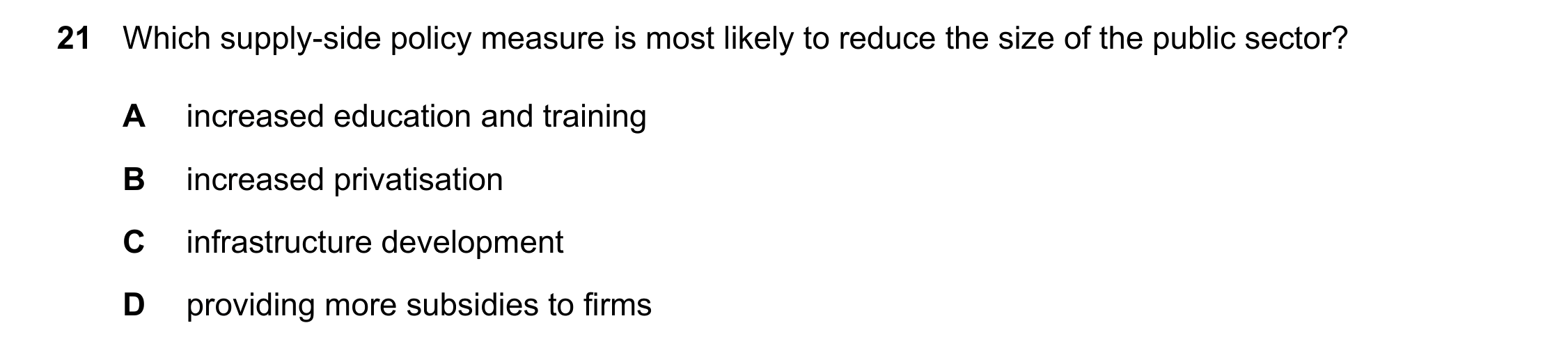
0455/13 June 2026 question 21
Show answer

BCorrect answer

Question 20Oct/Nov 20250455/111 mark

Which government action would not be included as part of a supply-side policy?

  • Aincreasing the privatisation of industries
  • Blowering national minimum wage rates
  • Craising tariffs on international trade
  • Dreducing state benefits
Show answer

CCorrect answer

Question 21Oct/Nov 20250455/131 mark

Which supply-side policy measure would most likely cause the greatest increase in labour productivity in a country?

  • Aa decrease in the rate of corporation tax
  • Ba reduced top rate of income tax
  • Cimproved education and training provision
  • Dprivatisation of a state-owned industry
Show answer

CCorrect answer

Paper 2 · Structured questions (5)

Stimulus: 0455/23

Seoul, the capital city of the Republic of Korea, is home to many large firms which have very high productivity levels. The Republic of Korea has grown rapidly due to advances in technology and successful supply-side policy measures. However, this rapid economic growth has led to some market failures.

---

Question 5(c)May/Jun 20260455/236 marks

Analyse how supply-side policy measures may enable the government to achieve its macroeconomic aims.

Show mark scheme

Analyse how supply-side policy measures may enable Credit the same point, e.g. create economic growth, only the government to achieve its macroeconomic aims. once. Coherent analysis which might include:

  • labour market reforms (1) such as reducing trade union Maximum 2 marks for listing macroeconomic aims or supply power / reducing national minimum wage (1) making it side measures. easier for firms to hire workers / more incentives for people to seek employment (1) decreasing unemployment (1)
  • some of the higher output may be exported (1) reducing the current account deficit / increasing current account surplus (1)
  • education and training (1) will lead to a more qualified / skilled labour force (1) better employment prospects / lower unemployment (1) increasing productivity (1) increasing total supply / national output / economic growth (1)
  • lower income taxes (1) increase disposable incomes (1) may improve incentives to work (1) as disposable income is higher (1)
  • lower corporation tax / business taxes (1) may improve incentives to invest (1) as profits after tax would increase (1) increasing investment (1) leading to economic growth (1)
  • deregulation (1) reduced barriers to entry / more competition (1) lower prices / improved quality of the products (1) increased export demand (1) current account deficit reduces / surplus increases (1)
  • privatisation (1) profit-incentive for firms (1) leading to increased efficiency / better use of available resources (1) increased national output / economic growth (1)
  • subsidies to firms (1) to boost (long-term) economic growth (1) reduce firms’ costs (1) reduce (cost-push) inflation (1) Question Answer Marks Guidance
Stimulus: 0455/22

Monetary policy has changed in Ethiopia in recent years. The country’s central bank now uses changes in the interest rate rather than controls on bank lending. It has also moved from operating a fixed exchange rate to a floating exchange rate. The Ethiopian Government uses a range of supply‑side policy measures. The government has privatised some sugar processing firms, but most large firms are still state‑owned.

Question 3(b)Feb/Mar 20260455/224 marks

Explain two supply‑side policy measures, other than privatisation.

Show mark scheme

Explain two supply-side policy measures, other than privatisation. If more than 2 supply-side policy measures are given, consider the first 3. Logical explanation which might include:

  • improved education (1) e.g. to increase productivity (1). One mark for the policy and one additional mark
  • increased training (1) e.g. to increase employment (1). for its impact/objective.
  • deregulation (1) e.g. to reduce barriers to entry/to increase competition (1). Note: All development content is e.g.
  • cut in direct taxes (1) e.g. to increase incentives (1).
  • cut in unemployment benefit (1) e.g. to reduce frictional unemployment (1).
  • labour market reforms (1) e.g. to increase flexibility (1).
  • nationalisation (1) e.g. to increase investment (1).
  • subsidies (1) e.g. to purchase capital equipment/increase incentive to produce (1). Question Answer Marks Guidance
Stimulus: 0455/22

Some countries engage in dumping by selling their products at less than cost price in Cambodia. The Cambodian Government wants the country to become a high-income economy by 2050. It uses fiscal, monetary and supply-side policies to increase its economic growth rate. Cambodia subsidises some infant industries. The country has one of the world’s largest deficits on the current account of its balance of payments (as a percentage of GDP). Some economists suggest cutting taxes would reduce this deficit.

---

Question 5(b)Oct/Nov 20250455/224 marks

Explain two differences between monetary policy and supply-side policy.

Show mark scheme

Explain two differences between monetary policy and If more than two differences are given, consider the first supply-side policy. three. Logical explanation which might include the following.

  • Monetary policy is usually implemented by the central bank (1) supply-side policy by the government (1).
  • Monetary policy may be used to increase or reduce economic activity (1) supply-side policy is only used to increase economic activity (1).
  • They have different policy measures (1) e.g. monetary policy has the rate of interest whereas supply side policy has privatisation (1).
  • Monetary policy aims to influence total demand (1) supply-side policy aims to increase total supply (1).
  • Supply side policies tend to take longer to implement and have an impact (1) than monetary policy which tends to have a more short -term impact (1).
Case study: The Egyptian economy

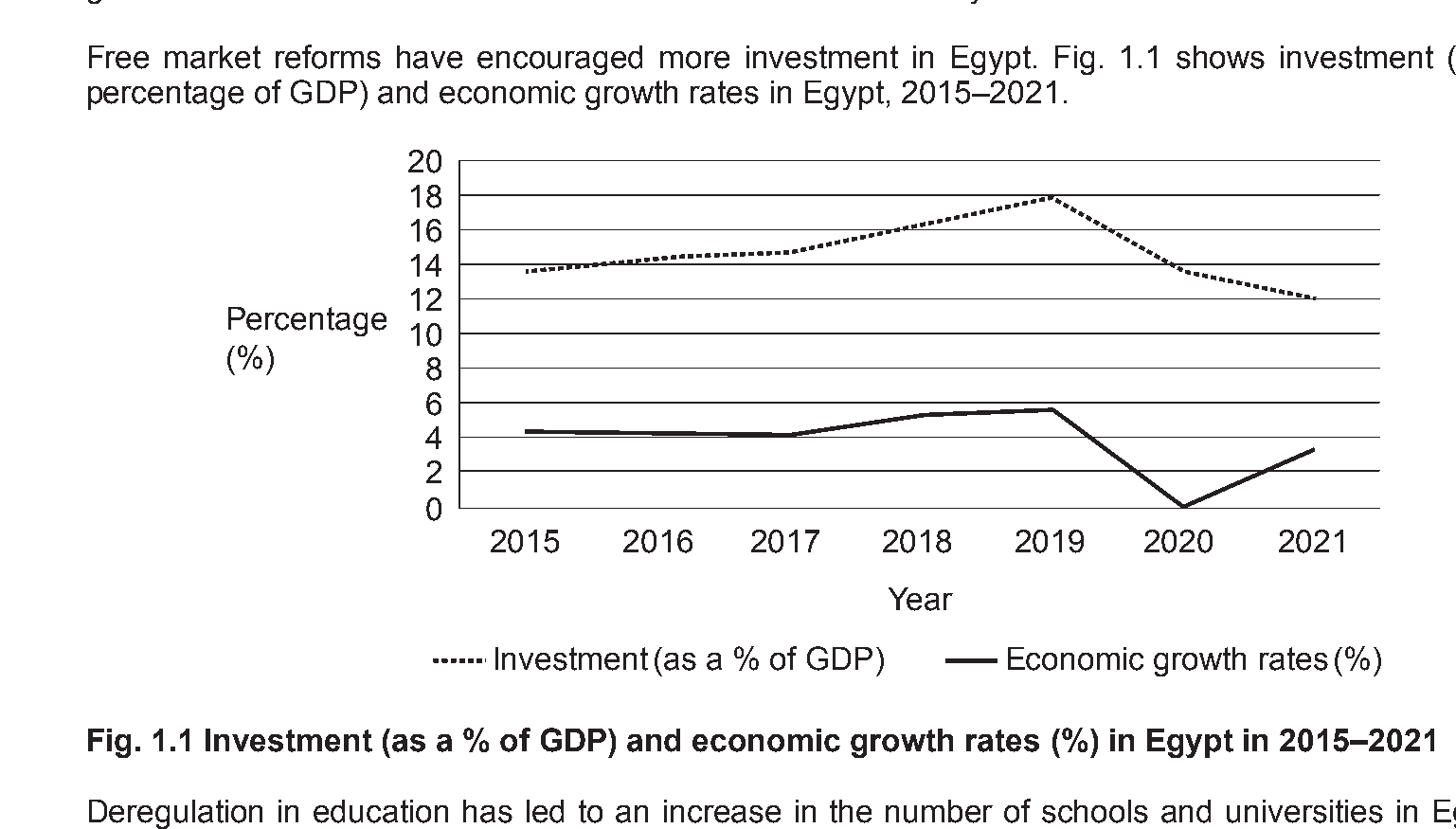
Egypt fact file 2022 GDP $469.1bn Population 110.0m Poverty rate 27.9% Unemployment rate 7.2% Egypt has always attracted tourists due to the pyramids and other ancient wonders. However, the tertiary sector is not the only source of economic growth; the primary and secondary sectors also contribute to economic growth. Egypt’s exports include personal travel, oil, citrus fruits, gold and textiles. There has been a building boom recently in Egypt. A new city is being built which requires finance, raw materials and labour. Firms are taking a big risk with this project as they are building houses before demand for them has been confirmed. If incomes fall, for example, the market for housing might be unprofitable. Tourism is a good source of economic growth for Egypt. The country has attractions that were built thousands of years ago and natural attractions such as beautiful beaches and a warm climate. It has good infrastructure and is considered a safe and secure country which also attract tourists. Free market reforms have encouraged more investment in Egypt. Fig. 1.1 shows investment (as a percentage of GDP) and economic growth rates in Egypt, 2015–2021. Percentage 10 (%) 8 2015 2016 2017 2018 2019 2020 2021 Investment (as a % of GDP) Economic growth rates (%) Fig. 1.1 Investment (as a % of GDP) and economic growth rates (%) in Egypt in 2015–2021 Deregulation in education has led to an increase in the number of schools and universities in Egypt. Increased opportunities for education and training will ensure future improvements in living standards. However, the opening of more private schools and universities might increase inequality as private education may remain unaffordable for some income groups. In 2022, the Egyptian currency halved in value against the US dollar. The fall in the value of the currency affected inflation and the purchasing power of Egyptians. However, certain industries such as tourism have benefited from this as holidays in Egypt have become more affordable for non-Egyptians.
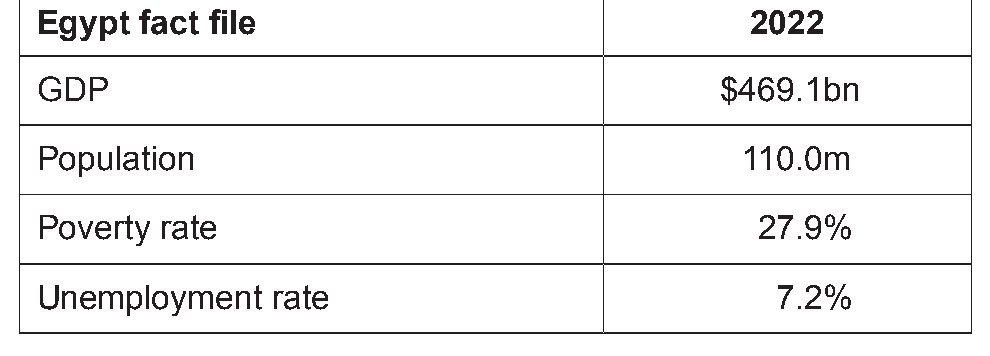
Egypt fact file 2022
Fig. 1.1 Investment (as a % of GDP) and economic growth rates (%) in Egypt in 20
Question 1(g)May/Jun 20250455/236 marks

Discuss whether or not deregulation in education in Egypt will increase living standards.

Show mark scheme

Discuss whether or not deregulation in education in Answers not referring to education, max 3 marks. Egypt will increase living standards. Apply this example to all questions with the command Award up to 4 marks for logical reasons why it might, which word DISCUSS may include: (1(g), 1(h), 2(d), 3(d), 4(d) and 5(d))

  • deregulation has led to an increased number of schools / universities in Egypt (1) may increase competition Each point may be credited only once, on either side of an between private schools / universities (1) may lower argument, but separate development as to how/why the fees (1) raise quality (1) outcome may differ is rewarded.
  • more people have opportunities for education and training (1) making people more educated / skilled / Generic example mark qualified / literate / productive (1) easier to find jobs (1) earn an income (1) increasing affordability of goods and Tax revenue may decrease 1 services (1) more educated people tend to enjoy better health / spend more on healthcare (1) longer life because of reason e.g. incomes may be lower. 1 expectancy (1) increase HDI (1)
  • more school buildings will increase employment (1) of Tax revenue may increase because incomes 0 builders (1) teachers (1) may be higher i.e. reverse of a previous
  • may reduce government spending on education (1) argument. allowing the government to spend more on items that could increase living standards e.g. healthcare (1). Tax revenue may increase because of a different 1 reason i.e. not the reverse of a previous Award up to 4 marks for logical reasons why it might not: argument e.g. government spending on
  • opening more private schools and universities in Egypt subsidies may stimulate the economy more than might increase the level of inequality (1) as private spending on education. education remains unaffordable to lower income groups (1) restricting their employment opportunities (1) as private education is usually more expensive than state- provided education (1)
  • standards of living only improve for those from higher income groups (1) lower income groups remain in relative poverty (1) widen gap between rich and poor / increase relative poverty (1)
  • private schools and universities may prioritise profits (1) over the quality / standards of education provided (1).
Stimulus: 0455/22

Finland is a high-income country that usually has a higher value of exports than imports. It has a strong commercial banking sector which has increased its lending in recent years. The country has an ageing population, with more than a quarter of its population aged over 65. In 2022, Finland’s Government had a budget deficit with government spending exceeding tax revenue.

---

Question 5(d)Feb/Mar 20250455/228 marks

Discuss whether supply-side policy measures will reduce a government’s budget deficit.

Show mark scheme

Discuss whether supply-side policy measures will reduce a Only accept a lower interest rate if linked to government’s budget deficit. encouraging a rise in investment. In assessing each answer, use the table opposite. Answers that show an awareness of supply- side policy measures but which confuse a Why they might: budget deficit with a bop deficit will not be

  • education and training may raise productivity analysing the question, so will be in Level 1.
  • increase economic growth and employment
  • raise direct and indirect tax revenue Level Description Marks
  • privatisation may reduce government spending to support state- owned firms 3 A reasoned discussion 6–8
  • revenue will be raised from the sale of privatised firms which accurately
  • privatised firms may earn high profits which may raise tax revenue examines both sides of the
  • subsidies may encourage firms to expand and earn higher profits economic argument,
  • unemployment benefit may be cut to increase incentive to work. making use of economic
  • budget deficit may be increased in short term but reduced in the long information and clear and term. logical analysis to evaluate economic issues and Why they might not: situations. One side of the
  • education and training will increase government spending and may argument may have more not be successful depth than the other, but
  • lower tax rates may reduce tax revenue overall both sided of the
  • regulation will involve costs to enforce argument are considered
  • spending on infrastructure projects may involve high government and developed. There is spending. thoughtful evaluation of
  • sale of profitable government-owned firms to the private sector may economic concepts, reduce government revenue from profits terminology, information and/or data appropriate to the question. The discussion may also point out the possible uncertainties of alternative decisions and outcomes. Question Answer Marks Guidance 5(d) Level Description Marks 2 A reasoned discussion 3–5 which makes use of economic information and clear analysis to evaluate economic issues and situations. The answer may lack some depth and development may be one- sided. There is relevant use of economic concepts, terminology, information and data appropriate to the question. 1 There is a simple attempt 1–2 at using economic definitions and terminology. Some reference may be made to economic theory, with occasional understanding. 0 A mark of zero should be 0 awarded for no creditable content.

33 more questions from 2019–2024

🔒 Unlock every Supply-side policies question from 2019–2024

All 33 come with their mark schemes, answers and case studies, and appear in the practice tool above once you’re signed in. It’s free.

Create a free accountSign in

A few of them

  • 0455/21 · Oct/Nov 2024 · Question 3(d)Discuss whether or not improving education can… 🔒
  • 0455/22 · Oct/Nov 2024 · Question 5(b)Explain two reasons why countries with a… 🔒
  • 0455/11 · May/June 2024 · Question 20What is the definition of a supply-side… 🔒
  • 0455/11 · Oct/Nov 2023 · Question 20What is a likely objective of supply-side… 🔒
  • 0455/12 · Oct/Nov 2023 · Question 20What is not a supply-side… 🔒
  • + 28 more, by year in the table above

Questions and mark schemes are from past Cambridge papers and are reproduced for revision. Topical Vault is an independent revision resource, not affiliated with or endorsed by Cambridge Assessment International Education.

IGCSE Economics questions by topic

Each topic opens this practice tool with only that topic’s questions, plus how often it comes up and every question on it in one list. Revision notes for IGCSE Economics →

  1. Ch 1The nature of the economic problem
  2. Ch 2Factors of production
  3. Ch 3Opportunity cost
  4. Ch 4Production possibility curves
  5. Ch 5Microeconomics and macroeconomics (removed from the syllabus from 2027)
  6. Ch 6The role of markets in allocating resources
  7. Ch 7Demand
  8. Ch 8Supply
  9. Ch 9Price determination
  10. Ch 10Price changes
  11. Ch 11Price elasticity of demand
  12. Ch 12Price elasticity of supply
  13. Ch 13Market economic system
  14. Ch 14Market failure
  15. Ch 15Mixed economic system
  16. Ch 16Money and banking
  17. Ch 17Households
  18. Ch 18Workers
  19. Ch 19Trade unions
  20. Ch 20Firms
  21. Ch 21Firms and production
  22. Ch 22Firms, costs, revenue and objectives
  23. Ch 23Market structure
  24. Ch 24The role of government (removed from the syllabus from 2027)
  25. Ch 25The macroeconomic aims of government
  26. Ch 26Fiscal policy
  27. Ch 27Monetary policy
  28. Ch 28Supply-side policies
  29. Ch 29Economic growth
  30. Ch 30Employment and unemployment
  31. Ch 31Inflation and deflation
  32. Ch 32Living standards
  33. Ch 33Poverty
  34. Ch 34Population
  35. Ch 35Differences in economic development between countries
  36. Ch 36International specialisation
  37. Ch 37Free trade and protection
  38. Ch 38Foreign exchange rates
  39. Ch 39Current account of balance of payments