Question 9June 20260455/111 mark
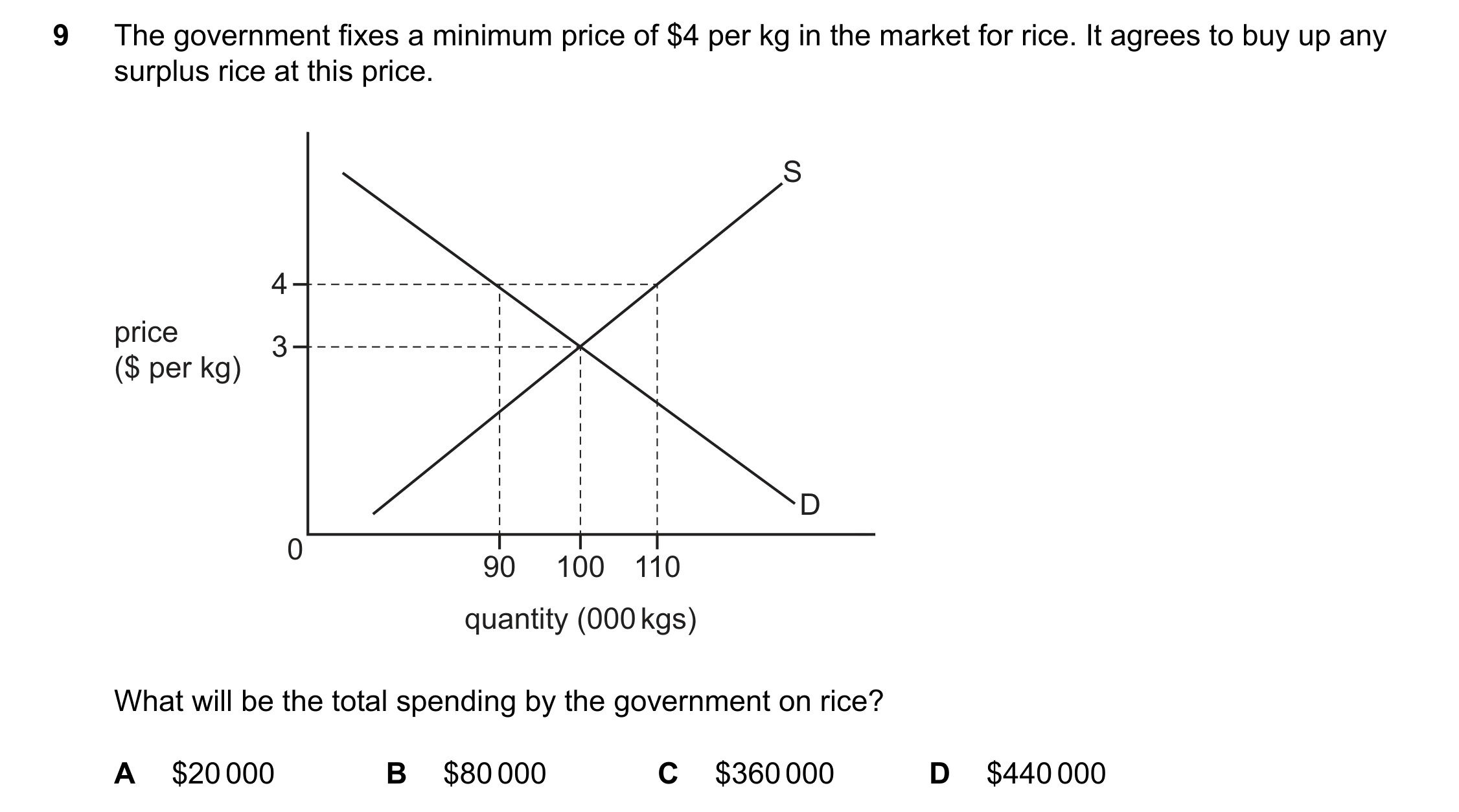
Show answer
BCorrect answer
Cambridge 0455, Paper 1 & 2. 2,888 questions, 2019 to 2026.
Paper 1 multiple-choice questions and Paper 2 structured questions, from the original Cambridge material. Paper 2 case studies and mark schemes are reproduced as extracted text, with data tables and charts kept as cropped images rather than retyped. A question tagged under a second chapter shows that as a cross-link; it is only filed once, under its primary chapter.
The mixed economy, and how governments intervene to correct market failure, including maximum and minimum prices, indirect taxes, subsidies, regulation, privatisation and nationalisation.
New to Mixed economic system, or finding these questions hard?
Read the notes first: the key ideas, diagrams and formulas, and the mistakes examiners see most, in about 22 minutes.
56 past paper questions on this topic since 2019, across 25 exam sessions.
| Year | Paper 1 | Paper 2 | Total | Chart |
|---|---|---|---|---|
| 2026 | 1 | 4 | 5 | |
| 2025 | 0 | 4 | 4 | |
| 2024 | 2 | 9 | 11 | |
| 2023 | 1 | 11 | 12 | |
| 2022 | 0 | 6 | 6 | |
| 2021 | 0 | 6 | 6 | |
| 2020 | 0 | 6 | 6 | |
| 2019 | 0 | 6 | 6 |
The whole topic on one page, with answers and mark schemes. Printing this page prints just this list.
BCorrect answer
Many governments tax petrol. As drivers switch to electric vehicles, this revenue will be lost. However, tax revenue may come from other sources if a country’s production possibility curve (PPC) shifts to the right. Tax revenue may be used for a variety of purposes including subsidising public transport, for example bus transport.
Discuss whether or not a government should subsidise bus transport.
Discuss whether or not a government should subsidise Level Description Marks bus transport. 3 A reasoned discussion which 6–8 In assessing each answer, use the table opposite. accurately examines both sides of the economic argument, making use of Coherent discussion which might include: economic information and clear and logical analysis to evaluate economic Why it should: issues and situations. One side of the
It takes many years for an olive tree to produce olives, making their supply inelastic. However, many economies have developed due to increases in the sales of this primary-sector product. Greek olive farmers have the potential to contribute to economic development. These farmers are hoping that the government will provide more subsidies to their industry.
Discuss whether or not subsidies to farmers are beneficial for an economy.
Discuss whether or not subsidies to farmers are Level Description Marks beneficial for an economy. 3 A reasoned discussion which 6–8 In assessing each answer, use the table opposite. accurately examines both sides of the economic argument, making use Why it might be beneficial: of economic information and clear
Monetary policy has changed in Ethiopia in recent years. The country’s central bank now uses changes in the interest rate rather than controls on bank lending. It has also moved from operating a fixed exchange rate to a floating exchange rate. The Ethiopian Government uses a range of supply‑side policy measures. The government has privatised some sugar processing firms, but most large firms are still state‑owned.
Analyse how state‑owned firms may benefit a country’s population.
Analyse how state-owned firms may benefit a country’s Note: Listing any benefits Max 3 marks. population. Coherent analysis which might include:
Everyone, including young and older workers, who lived on an island off Panama were relocated to the mainland in 2024. This occurred due to rising sea levels and repeated flooding, which the public good of sea defences could not prevent. People from some small island nations may need to move unless governments can reduce pollution which can cause rising sea levels. The effect on the living standards of those who move from countries with small populations to countries with large populations is uncertain.
---
Analyse how a government could reduce pollution.
Analyse how a government could reduce pollution. Note: Listing any methods Max 3 marks. Accept, but do not expect: Coherent analysis which might include:
Switzerland fact file 2022 Population 8.7m Inflation rate 3.5% GDP $808bn Financial sector contribution (as % of GDP) 9% Current account surplus on the balance of payments $78bn Although inflation in Switzerland in 2022 was above its target of 2%, it was below the inflation rate of other high‑income economies, such as the US (9.1%), the UK (11.1%) and Germany (7.9%). Price levels are more stable because of a combination of microeconomic and macroeconomic policy measures. These include maximum prices, subsidies and a contractionary monetary policy. To encourage the production of solar energy, the Swiss Government has provided more than $500 million in subsidies to producers. This is part of the government’s plan to move away from non‑renewable sources of energy which are mainly imported. Overdependence on foreign markets could lead to the economy becoming more exposed to external shocks. Switzerland’s current account of the balance of payments has been in surplus from 2015 to 2022. Low inflation, along with the production of very high‑quality products, may have contributed to this surplus. A strong currency has also kept the cost of imported raw materials low in Switzerland. The Swiss franc is one of the more stable currencies in the world. During times of economic uncertainty, the Swiss franc usually strengthens. Fig. 1.1 shows global growth rate (% change in GDP) and the percentage change in the value of the Swiss franc, against the USD($), from 2018–2022. Percentage 2 –2 –4 2018 2019 2020 2021 2022 Years Global growth rate Change in value of Swiss franc Fig. 1.1 Global growth rate (% change in GDP) and the percentage change in the value of the Swiss franc against the USD($) from 2018–2022 Although inflation was not high compared to other countries, the Swiss central bank increased interest rates in 2022. This was done to reduce inflationary pressures. However, there was a risk that higher interest rates might increase unemployment. The rise in interest rates affected some firms negatively. The Swiss Government had to organise a merger between the two largest banks in Switzerland. This was to avoid one of them collapsing which would have reduced confidence in the whole banking system. A merger might also have helped the merged bank to gain greater economies of scale. However, the merger resulted in some workers losing their jobs and gave the merged bank greater monopoly power.


Identify two microeconomic policy measures.
Identify two microeconomic policy measures. Accept organising mergers. maximum prices (1) If more than two suggested measures are given, consider subsidies (1) the first three.
Street vendors mostly operate outside of the formal economy to avoid government regulation. However, many are now entering the formal economy. This has led to more government revenue, increased productivity and higher economic growth. Some governments plan to take measures to increase the number of firms in the economy.
---
Analyse how government regulation can reduce market failure.
Analyse how government regulation can reduce market Only reward answers that refer to laws and regulations, failure. not taxes and subsidies. Coherent analysis which might include: market failure occurs when there is an inefficient allocation of resources in a free market (1). laws / rules can be used (1):
The shape of Colombia’s population pyramid is changing. The income distribution of this South American country, however, is not changing significantly. The country has one of the most unequal income distributions in the world. Some Colombians work in its footwear industry which produces shoes, sandals and boots. Although footwear is produced in the private sector, Colombia has a mixed economic system.
Discuss whether or not a mixed economic system will benefit the people who live in that economy.
Level Description Marks 1 There is a simple attempt at using 1–2 economic definitions and terminology. Some reference may be made to economic theory, with occasional understanding. 0 A mark of zero should be awarded for 0 no creditable content. Question Answer Marks Guidance
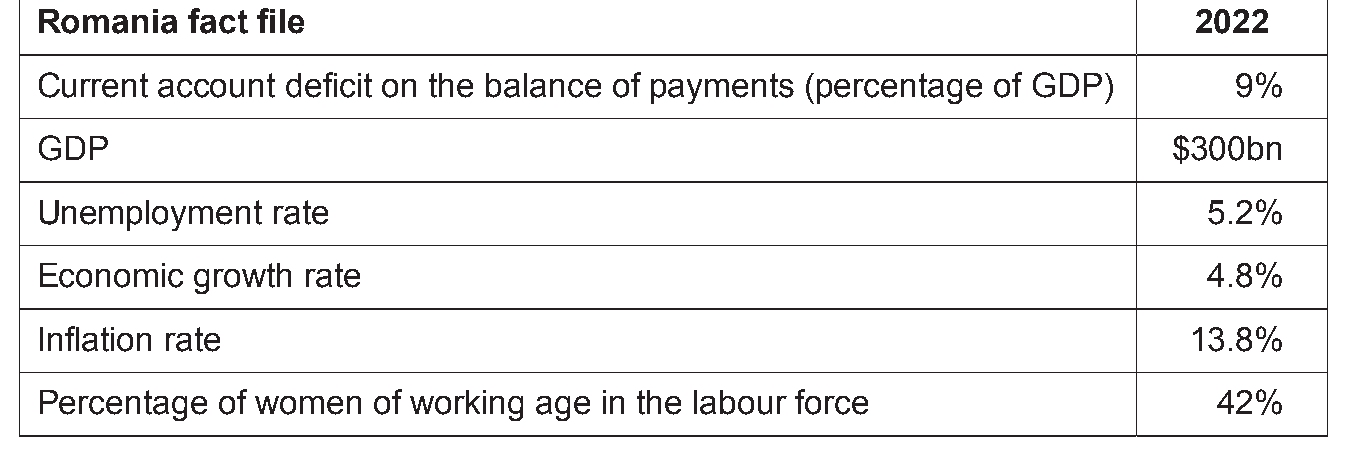
Romania fact file 2022 Current account deficit on the balance of payments (percentage of GDP) 9% GDP $300bn Unemployment rate 5.2% Economic growth rate 4.8% Inflation rate 13.8% Percentage of women of working age in the labour force 42% Between 1990 and 2022, Romania’s population fell from 23 million to 19 million. The country’s birth rate and death rate both fell over this period. Some workers from other countries, including Sri Lanka and Vietnam, came to live in Romania. However, more Romanian workers left the country to work and live mostly in other European countries. If the Romanian economy continues to grow at its relatively high rate, fewer of its people may emigrate and more immigrants may be attracted. Recent economic growth has been driven largely by increases in household spending. Romanians have become wealthier, more confident about their future and have experienced low interest rates. In April 2022, the Romanian Government placed a maximum price on electricity. Romanians spend a relatively high proportion of their income on electricity and on food. Table 1.1 shows selected countries’ GDP per head and average spending on food as a percentage of total household spending. Table 1.1 GDP per head and average spending on food as a percentage of total household spending in 2022 Average spending on food as a % of Country GDP per head ($) total household spending Belgium 52 100 13 Cambodia 1 800 42 Egypt 3 850 33 Ethiopia 960 56 Norway 89 200 11 Romania 15 000 26 USA 70 500 6 The poor are particularly affected by changes in electricity prices and food prices. Romania has a relatively high level of poverty. To reduce poverty, some economists have suggested that the government should attract more foreign multinational companies (MNCs) to Romania. More MNCs may affect poverty because of the possible effects on unemployment and prices. Another way to reduce poverty would be to encourage more women to work. The proportion of women in Romania who work or seek work has fallen in recent years. There is a range of influences on whether women enter the labour force. These include social attitudes, female education and whether childcare facilities and part-time work are available.

Draw a demand and supply diagram to show the effect of setting a maximum price on electricity.
Draw a demand and supply diagram to show the effect of setting a maximum price on electricity. Coherent analysis which might include: D&S diagram: Axes correctly labelled – price and quantity or p and q (1). Demand and supply curves correctly labelled (1). Maximum price set below the equilibrium price – labelled as max price, P1, PX or any other P. (1). Quantity demanded and quantity supplied at the maximum price identified (1). Question Answer Marks Guidance
🔒 Unlock every Mixed economic system question from 2019–2024
All 47 come with their mark schemes, answers and case studies, and appear in the practice tool above once you’re signed in. It’s free.
Questions and mark schemes are from past Cambridge papers and are reproduced for revision. Topical Vault is an independent revision resource, not affiliated with or endorsed by Cambridge Assessment International Education.
Each topic opens this practice tool with only that topic’s questions, plus how often it comes up and every question on it in one list. Revision notes for IGCSE Economics →