Question 6June 20260455/111 mark
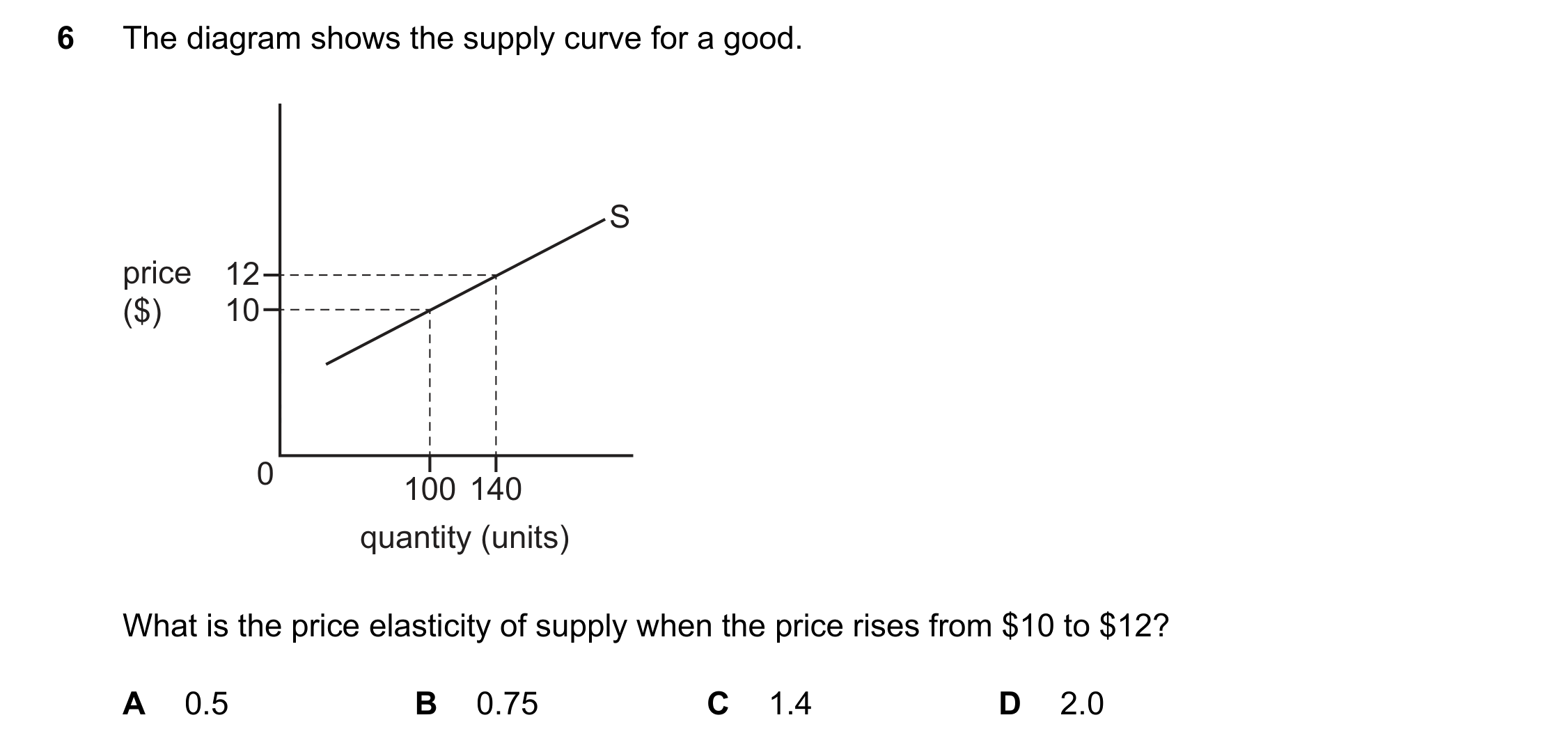
Show answer
DCorrect answer
Cambridge 0455, Paper 1 & 2. 2,888 questions, 2019 to 2026.
Paper 1 multiple-choice questions and Paper 2 structured questions, from the original Cambridge material. Paper 2 case studies and mark schemes are reproduced as extracted text, with data tables and charts kept as cropped images rather than retyped. A question tagged under a second chapter shows that as a cross-link; it is only filed once, under its primary chapter.
Price elasticity of supply: calculating PES, what makes supply elastic or inelastic, and why it matters to producers and consumers.
New to Price elasticity of supply, or finding these questions hard?
Read the notes first: the key ideas, diagrams and formulas, and the mistakes examiners see most, in about 14 minutes.
46 past paper questions on this topic since 2019, across 24 exam sessions.
| Year | Paper 1 | Paper 2 | Total | Chart |
|---|---|---|---|---|
| 2026 | 2 | 2 | 4 | |
| 2025 | 5 | 1 | 6 | |
| 2024 | 4 | 1 | 5 | |
| 2023 | 5 | 3 | 8 | |
| 2022 | 4 | 2 | 6 | |
| 2021 | 5 | 1 | 6 | |
| 2020 | 4 | 1 | 5 | |
| 2019 | 3 | 3 | 6 |
The whole topic on one page, with answers and mark schemes. Printing this page prints just this list.
DCorrect answer
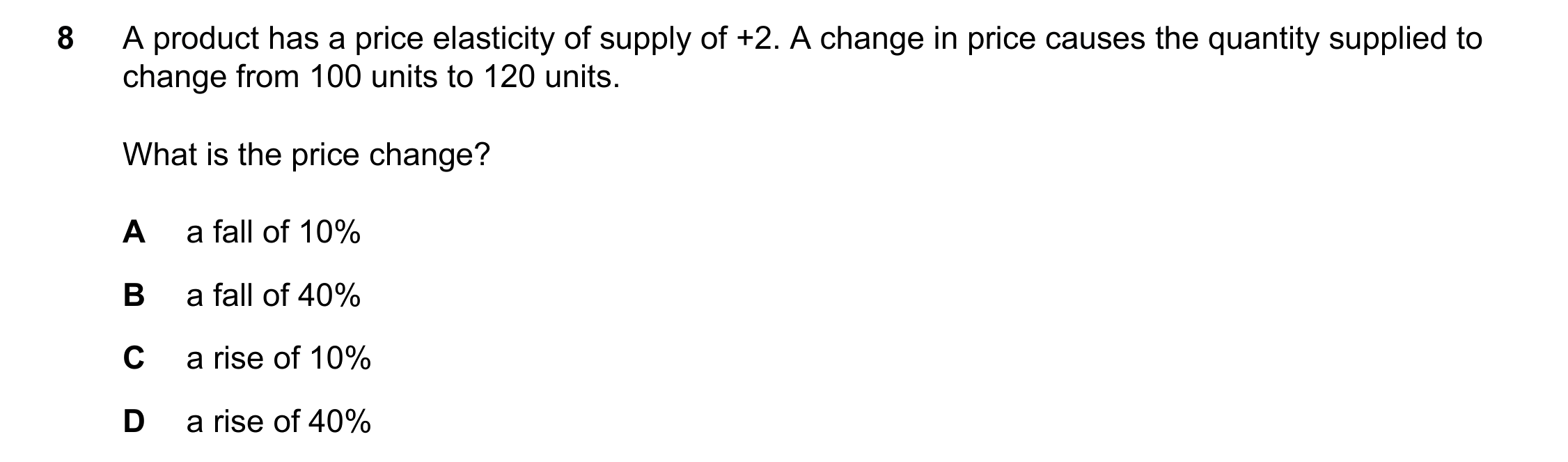
CCorrect answer
When the price of butter increased by 10%, the quantity supplied of butter increased by 20%. What is the price elasticity of supply (PES) of butter?
DCorrect answer
The price of fish has increased from $3.00 to $4.80. The quantity supplied of fish has increased from 100 units to 130 units. What is the price elasticity of supply (PES) of fish?
ACorrect answer
The price elasticity of supply (PES) of coffee is calculated as +0.2 for the current year and +2.0 in the long run. Why is the PES of coffee higher in the long run?
ACorrect answer
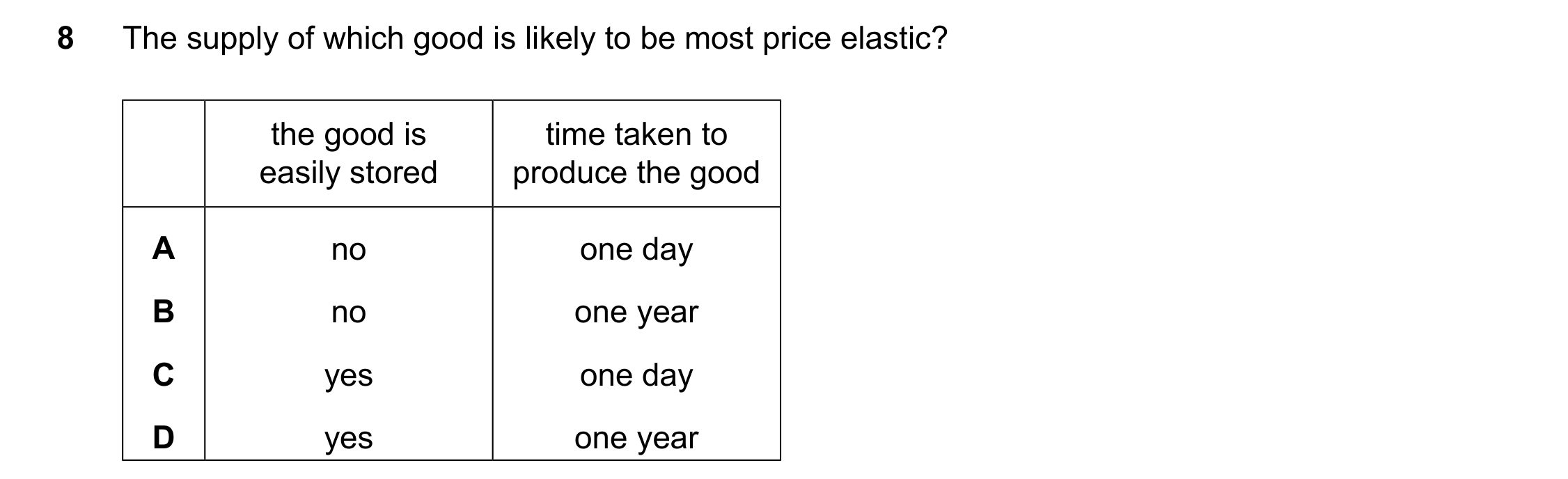
CCorrect answer

BCorrect answer
It takes many years for an olive tree to produce olives, making their supply inelastic. However, many economies have developed due to increases in the sales of this primary-sector product. Greek olive farmers have the potential to contribute to economic development. These farmers are hoping that the government will provide more subsidies to their industry.
Define ‘inelastic supply’.
Define ‘inelastic supply’. Accept an answer referring to unresponsive supply, i.e. When percentage change in quantity supplied / the perfectly inelastic (1) responsiveness of quantity supplied (1) is less than the (percentage) change in price (1). When PES < 1 (1)
Some countries stop firms contacting their workers outside of their normal working hours. In 2024, Australia joined 16 other countries when it passed a law to protect workers’ free time. Such legislation can increase the health and motivation of workers and is supported by trade unions. However, it can reduce the price elasticity of supply of firms in both competitive and monopoly markets.
Give the formula for price elasticity of supply.
Give the formula for price elasticity of supply. The formula can be written out in words. Percentage change in quantity supplied (2) Accept: Percentage change in price for ‘change’ Change in quantity supplied (1) Change in price change in supply change in price (1) Percentage change in price (1) Percentage change in quantity supplied Percentage change in quantity supplied x 100 (1) Percentage change in price
South Korea makes use of both economic goods and free goods. Its output includes products with both elastic and inelastic supply. The country is building the world’s first floating city, estimated to cost $180m. This is to cope with rising sea levels caused by climate change. Governments take a number of measures to reduce greenhouse gases which contribute to climate change, including banning the burning of wood to heat homes.
Analyse the influences on whether supply of a product is elastic or inelastic.
Analyse the influences on whether supply of a product is elastic or inelastic. Coherent analysis which might include: Elasticity of supply is a measure of the responsiveness of supply to a change in price / formula / elastic supply is when pes is > 1/ inelastic supply is when pes <1 (1). Elastic supply occurs when supply changes by a greater percentage than the change in price / inelastic supply is when supply changes by a smaller percentage than the change in price (1). Whether the product can be stored / non-perishable (1) if it can be, it will be elastic (1) able to adjust supply quickly to changes in price (1) as if price rises, goods can be taken out of storage (1). Whether the production time is short (1) if so, output can be increased quickly to take advantage of higher prices (1). Cost of altering supply (1) if it is costly to alter the supply, supply is likely to be inelastic (1). Whether there are unemployed resources / level of capacity (1) if there are, supply can be adjusted by taking on more resources (1). Whether resources / factors of production are mobile (1) if they can change use / location (1). Time (1) supply usually becomes more elastic, the longer the time period (1). Level of competition (1) supply is likely to be more elastic in a competitive than in a monopoly market (1). Question Answer Marks Guidance
🔒 Unlock every Price elasticity of supply question from 2019–2024
All 36 come with their mark schemes, answers and case studies, and appear in the practice tool above once you’re signed in. It’s free.
Questions and mark schemes are from past Cambridge papers and are reproduced for revision. Topical Vault is an independent revision resource, not affiliated with or endorsed by Cambridge Assessment International Education.
Each topic opens this practice tool with only that topic’s questions, plus how often it comes up and every question on it in one list. Revision notes for IGCSE Economics →