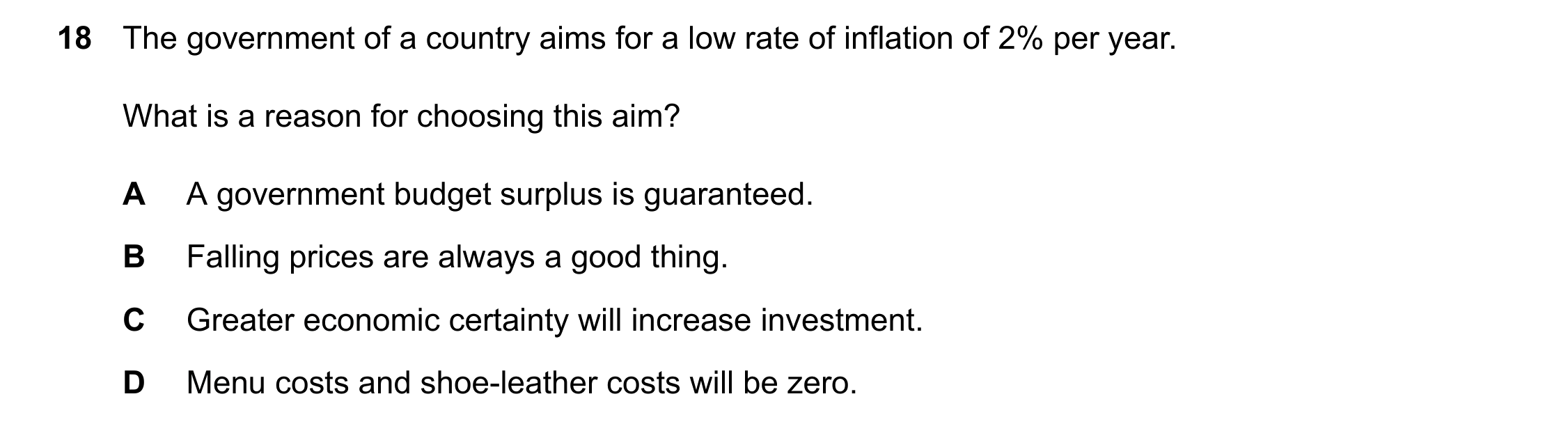
Question 18June 20260455/111 mark
Show answer
CCorrect answer
Cambridge 0455, Paper 1 & 2. 2,888 questions, 2019 to 2026.
Paper 1 multiple-choice questions and Paper 2 structured questions, from the original Cambridge material. Paper 2 case studies and mark schemes are reproduced as extracted text, with data tables and charts kept as cropped images rather than retyped. A question tagged under a second chapter shows that as a cross-link; it is only filed once, under its primary chapter.
Inflation and deflation: measuring them with a consumer price index, their causes and consequences, and policies to control them.
New to Inflation and deflation, or finding these questions hard?
Read the notes first: the key ideas, diagrams and formulas, and the mistakes examiners see most, in about 18 minutes.
94 past paper questions on this topic since 2019, across 30 exam sessions.
| Year | Paper 1 | Paper 2 | Total | Chart |
|---|---|---|---|---|
| 2026 | 5 | 2 | 7 | |
| 2025 | 5 | 4 | 9 | |
| 2024 | 5 | 5 | 10 | |
| 2023 | 4 | 7 | 11 | |
| 2022 | 7 | 3 | 10 | |
| 2021 | 12 | 6 | 18 | |
| 2020 | 5 | 4 | 9 | |
| 2019 | 8 | 12 | 20 |
The whole topic on one page, with answers and mark schemes. Printing this page prints just this list.
CCorrect answer
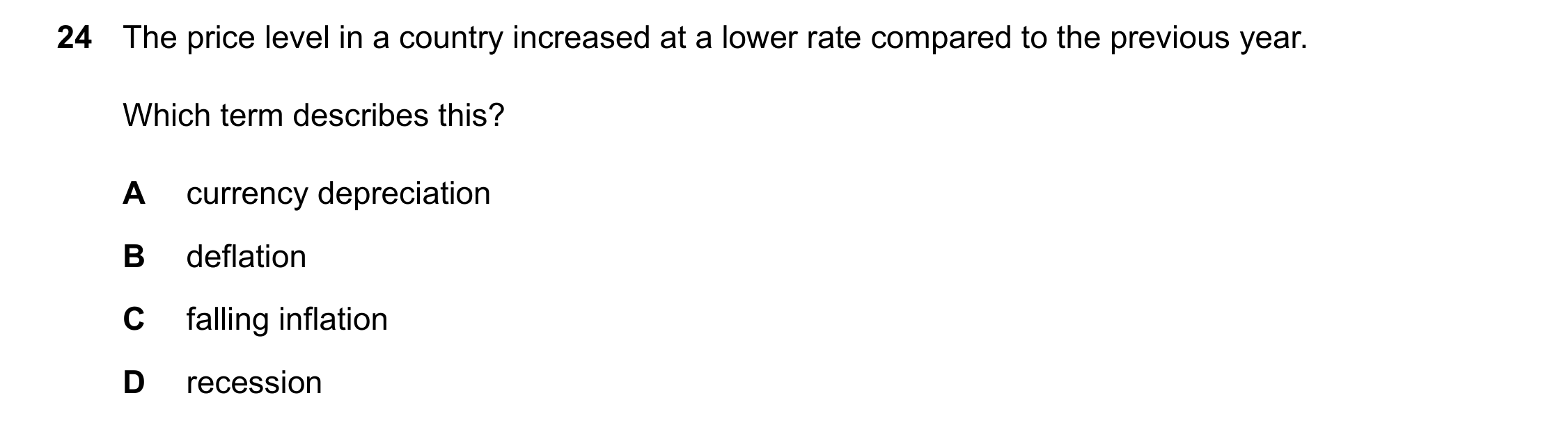
CCorrect answer
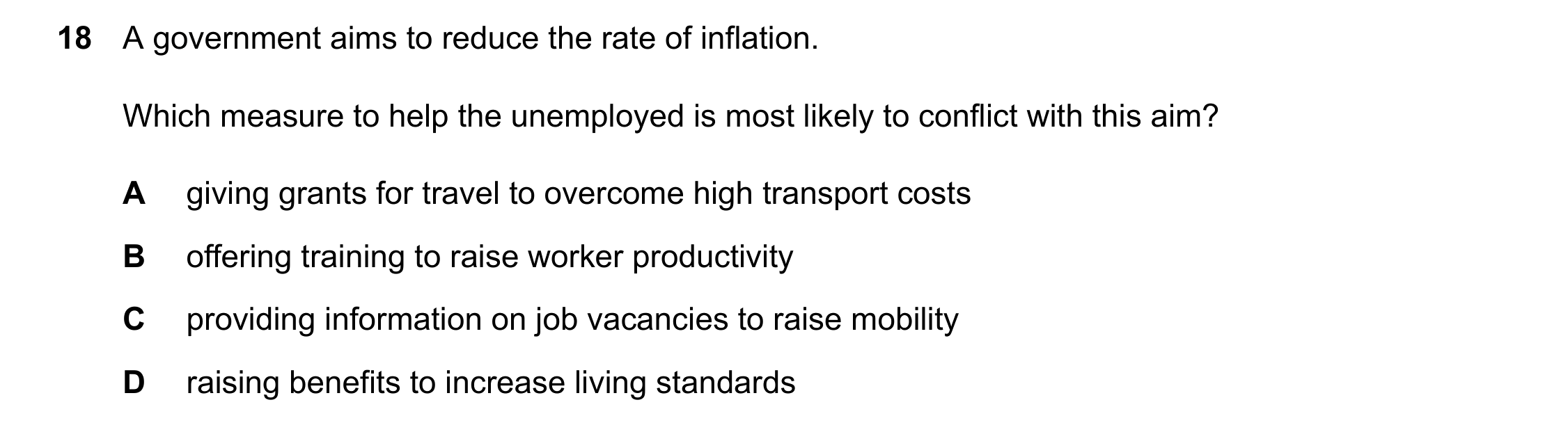
DCorrect answer
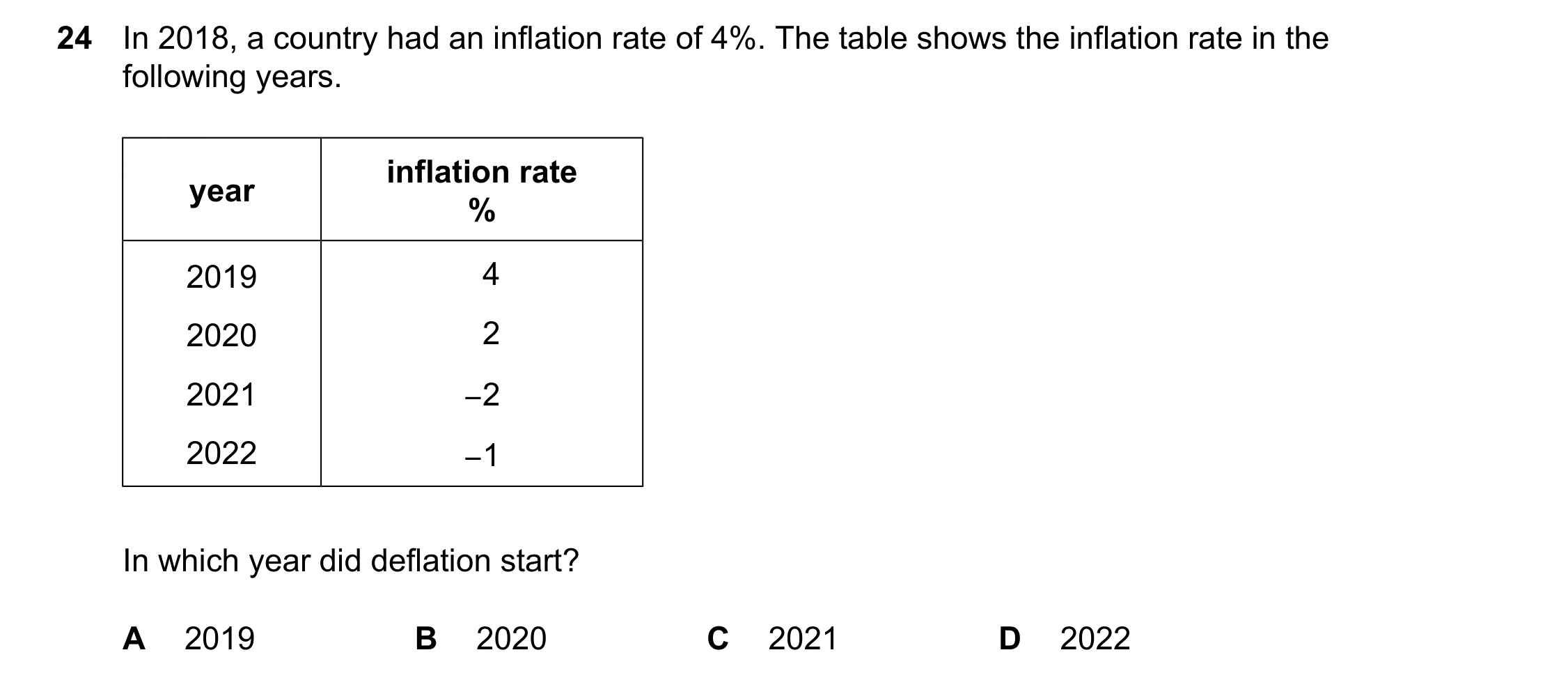
CCorrect answer
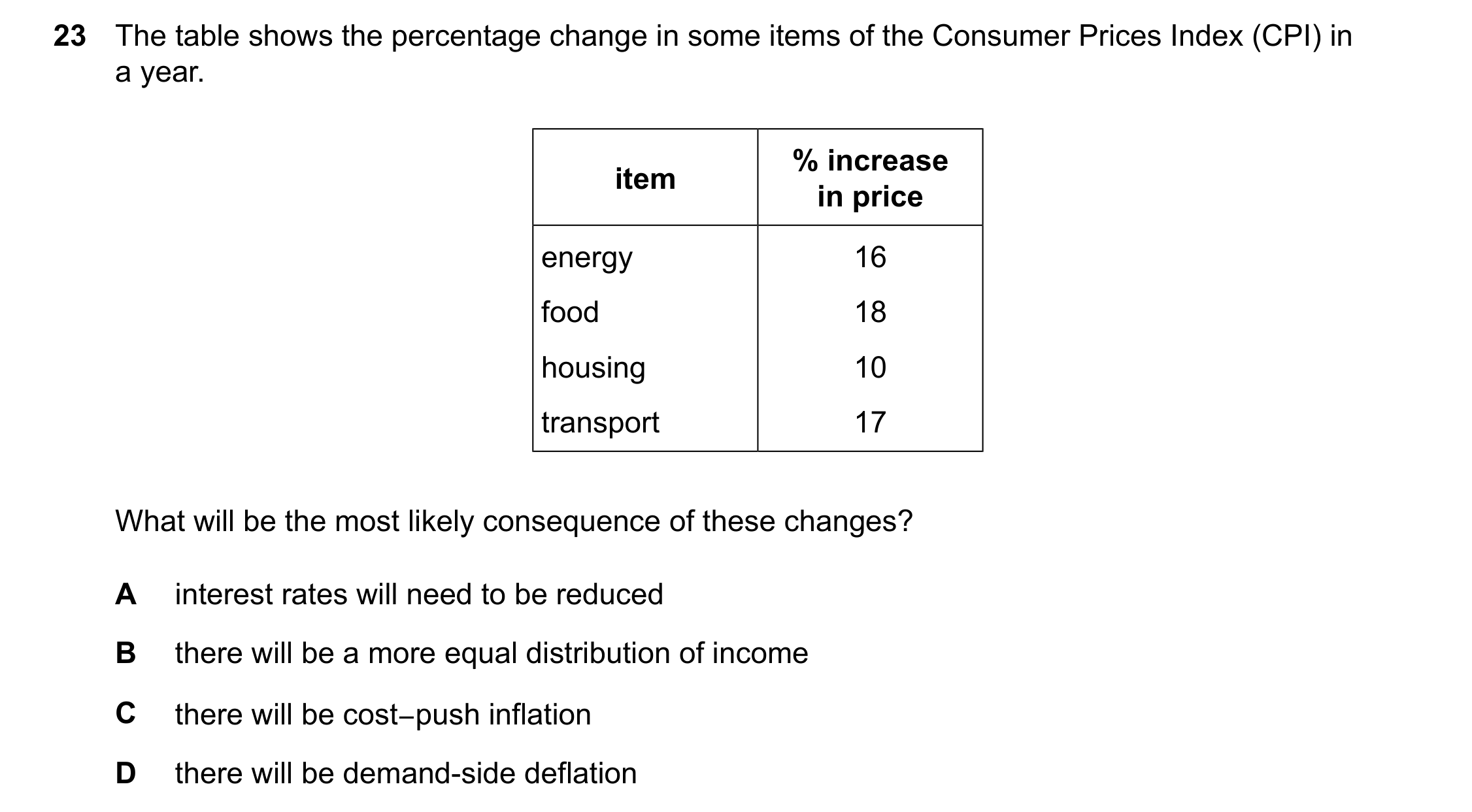
CCorrect answer
What are two macroeconomic aims of government?
BCorrect answer
What is deflation?
BCorrect answer
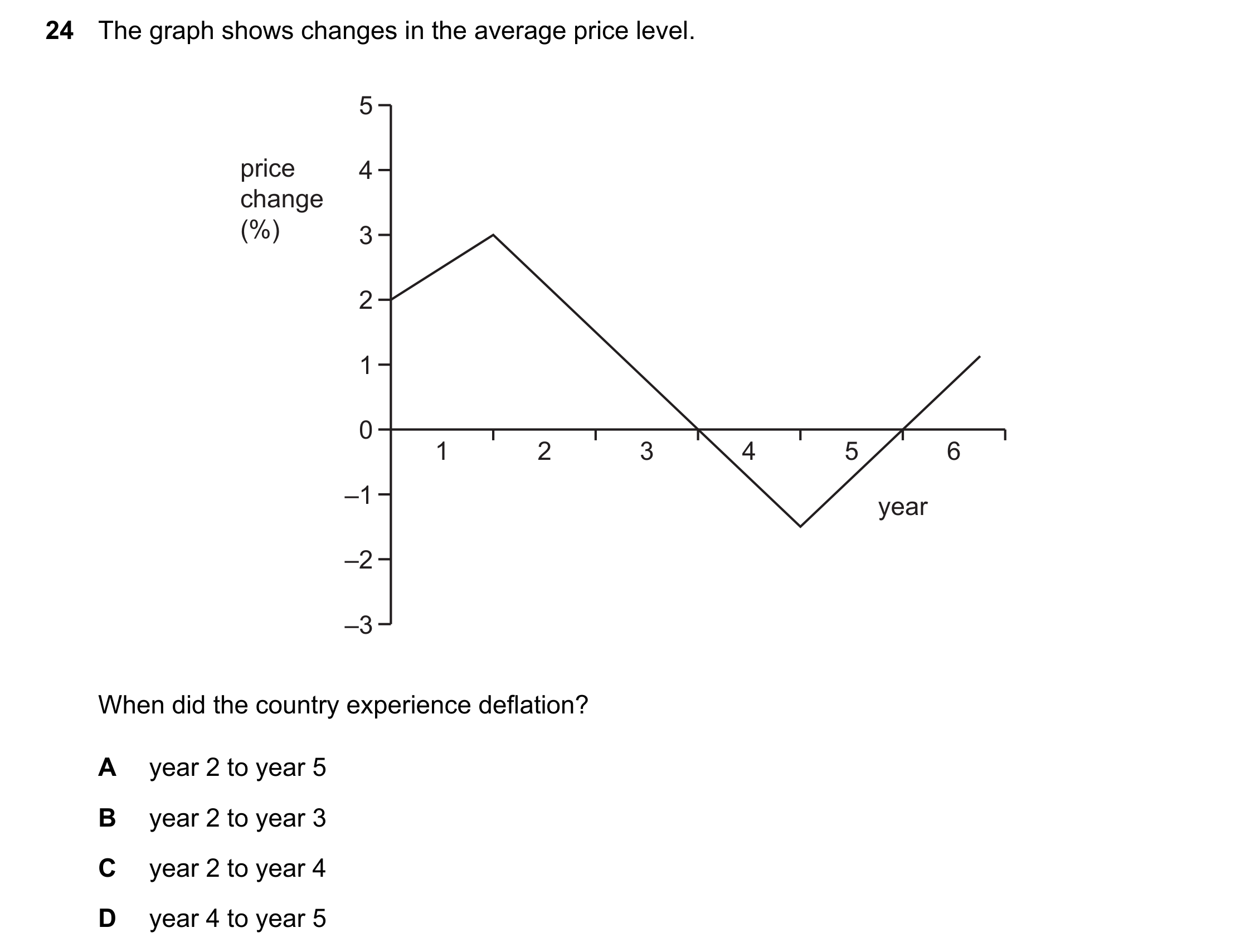
DCorrect answer

ACorrect answer

BCorrect answer
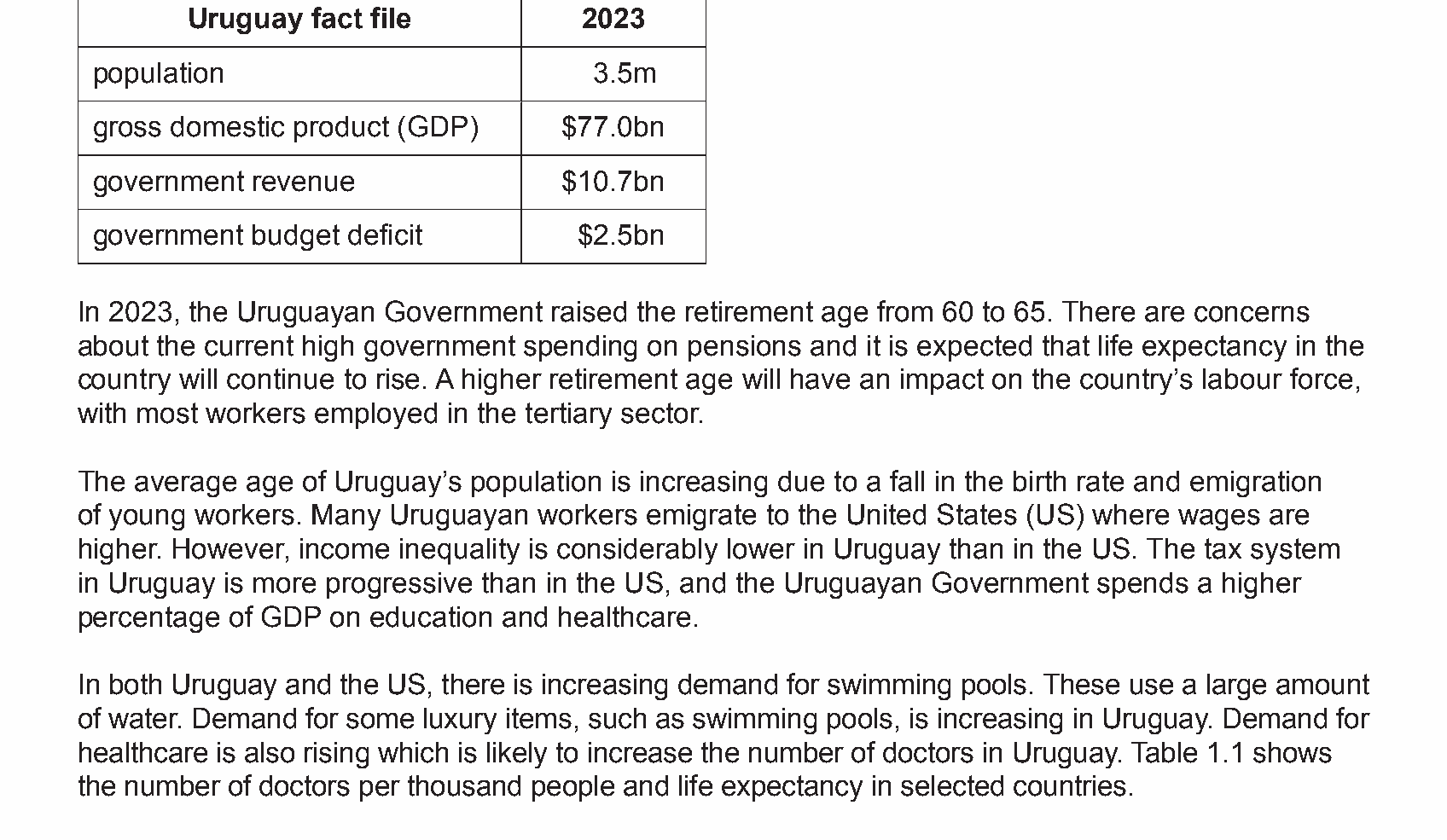
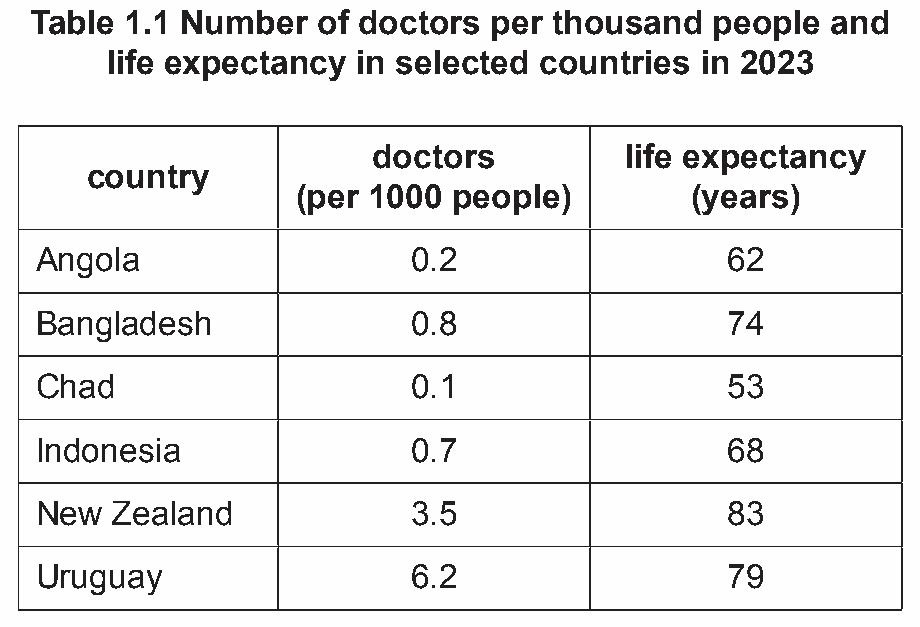
Uruguay fact file 2023 population 3.5m gross domestic product (GDP) $77.0bn government revenue $10.7bn government budget deficit $2.5bn In 2023, the Uruguayan Government raised the retirement age from 60 to 65. There are concerns about the current high government spending on pensions and it is expected that life expectancy in the country will continue to rise. A higher retirement age will have an impact on the country’s labour force, with most workers employed in the tertiary sector. The average age of Uruguay’s population is increasing due to a fall in the birth rate and emigration of young workers. Many Uruguayan workers emigrate to the United States (US) where wages are higher. However, income inequality is considerably lower in Uruguay than in the US. The tax system in Uruguay is more progressive than in the US, and the Uruguayan Government spends a higher percentage of GDP on education and healthcare. In both Uruguay and the US, there is increasing demand for swimming pools. These use a large amount of water. Demand for some luxury items, such as swimming pools, is increasing in Uruguay. Demand for healthcare is also rising which is likely to increase the number of doctors in Uruguay. Table 1.1 shows the number of doctors per thousand people and life expectancy in selected countries. Table 1.1 Number of doctors per thousand people and life expectancy in selected countries in 2023 doctors life expectancy country (per 1000 people) (years) Angola 0.2 62 Bangladesh 0.8 74 Chad 0.1 53 Indonesia 0.7 68 New Zealand 3.5 83 Uruguay 6.2 79 In 2023, Uruguay experienced its lowest inflation rate for eighteen years. This low level of inflation encouraged investment in the country. It changed the international competitiveness of the country’s products against its main trading partners, which had higher inflation rates. It also had an impact on the cost of debt in the country and firms’ willingness to increase their output. Prices change at different rates in different markets. In several markets in Uruguay, there is only one firm. All of Uruguay’s monopolies can set the price of the products they sell. Having monopoly power can also affect the firm’s average total cost and the quality of what they produce.
Discuss whether or not Uruguay’s low inflation rate would have benefited the Uruguayan economy.
Discuss whether or not Uruguay’s low inflation rate Apply this example to all questions with the command would have benefited the Uruguayan economy. word DISCUSS (1g, 1h, 2d, 3d, 4d and 5d) Award up to 4 marks for logical reasons why it might, which may include: Each point may be credited only once, on either side of an argument, but separate development as to how/why the outcome may differ is rewarded.
In 2022, the President of Zimbabwe ordered the country’s commercial banks to stop lending. He was concerned that people were borrowing money to buy foreign currency. At this time, Zimbabwe faced several economic problems. The inflation rate was very high at 105%. In 2023, it rose to 850% despite the government’s aim of a fall in the inflation rate.
State what is meant by a fall in the inflation rate.
State what is meant by a fall in the inflation rate. The rate of increase in the (general) price level/prices (1) has fallen (1)
Japan has faced significant periods of deflation in recent decades. Despite efforts to stimulate the economy through fiscal policy measures and monetary policy measures, economic growth remains low. Some economists have also argued that the monetary policy used by the central bank is one of the causes of low productivity in Japan.
Discuss whether or not deflation is a problem for an economy.
Why it might not be a problem: Level Description Marks
St. Kitts and Nevis fact file 2022 Population 54 800 GDP per head $27 000 Government spending $310m Tax revenue $292m Unemployment rate 5.1% Inflation rate 2.4% Current account balance of the balance of payments –$56m St. Kitts and Nevis is a small, two-island country in the Caribbean. The country’s three main industries are tourism, financial services and agriculture. Tourists are attracted by the country’s beaches, coral reefs, forts, rainforests and shipwrecks. However, if rainforests continue to be cut down and soil erosion continues to pollute the coral reefs, killing off marine life, tourism may be discouraged. The St. Kitts and Nevis Government is also concerned that the social costs of tourism exceed the private costs. St. Kitts and Nevis’s financial services include a growing banking sector. Among the country’s commercial banks are a few foreign multinational companies (MNCs). These MNCs are attracted by the country’s relatively high incomes, the absence of personal income tax and a relatively high literacy rate. Some of the country’s main agricultural products are carrots, onions, peanuts and sweet potatoes. In 2017, the St. Kitts and Nevis Government introduced a training scheme to raise the productivity of onion farmers. Other important industries in St Kitts and Nevis include healthcare and fishing. Table 1.1 shows healthcare spending as a percentage of GDP and life expectancy in six selected countries in 2022. Table 1.1 Healthcare spending as a percentage of GDP and life expectancy in selected countries in 2022 Country Healthcare spending as Life expectancy (years) a % of GDP Canada 12.9 84 Egypt 4.5 75 Haiti 3.3 65 Monaco 1.9 90 St. Kitts and Nevis 5.4 77 Sweden 11.5 83 The small size of St. Kitts and Nevis’s fishing industry means that it imports large quantities of fish. The country’s fishing boats are small and some lack up-to-date equipment. A larger fishing industry, with bigger boats, may bring a number of benefits to the country. Changes in the structure and performance of industries in St. Kitts and Nevis may alter the country’s price level. Between 2018 and 2020, the country experienced deflation. This affected people’s purchasing power, saving and debts. It also affected the country’s exports and firms’ investment decisions.

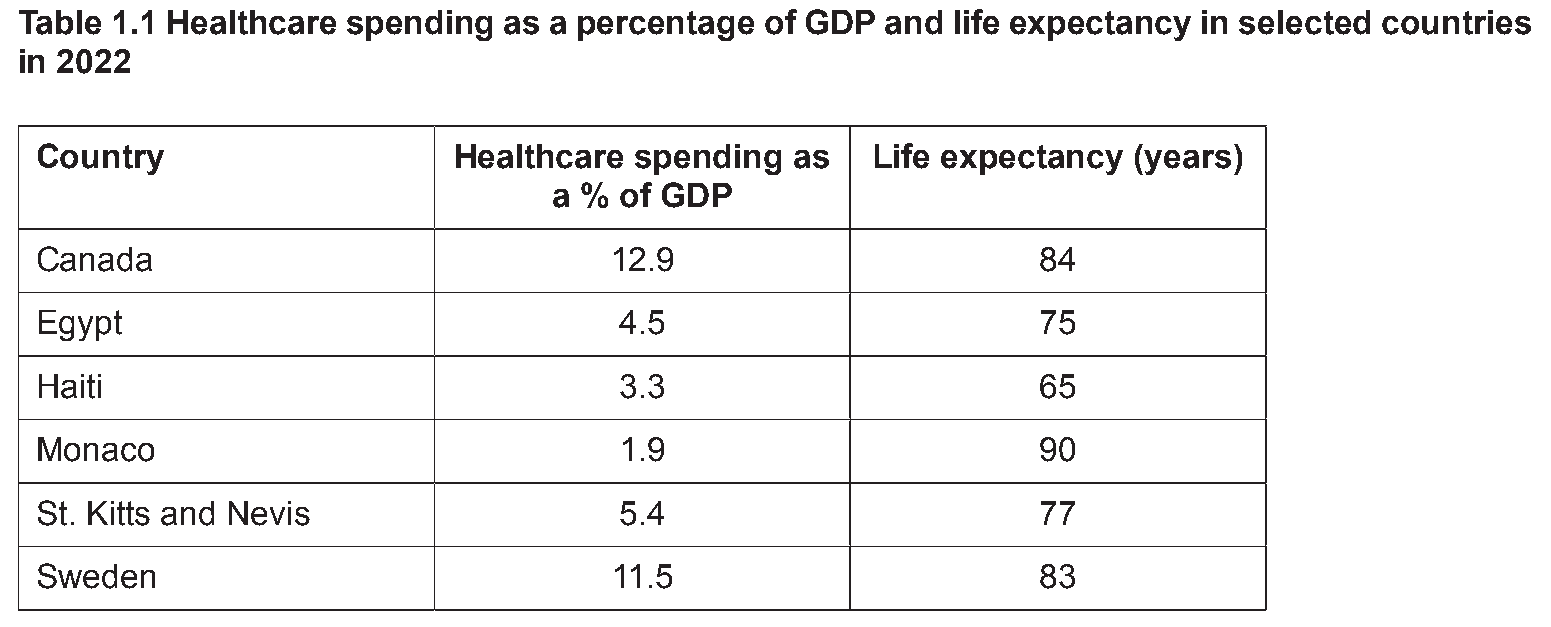
Discuss whether or not deflation is likely to have harmed St. Kitts and Nevis.
Discuss whether or not deflation is likely to have Award one mark for malign (bad) deflation is harmful harmed St. Kitts and Nevis. whereas benign (good) deflation is beneficial. Award up to 4 marks for logical reasons why it might, which Mark for higher employment and mark for higher GDP can may include: only be awarded if come from higher total supply.
In 2023, the Chinese Government said that it would aim for an economic growth rate of 5% and a steady increase in both exports and imports. It was expected that higher output would be caused mainly by an increase in household spending, although this could also result in inflation. Another aim of the Chinese Government was to keep the unemployment rate at around 5.5%. China has an ageing population and an ageing labour force.
---
Analyse how an increase in household spending could cause inflation.
_Not available — this sub-part's mark scheme entry is missing or was not printed in the official published PDF for this session._
Nigeria has a mixed economic system. In January 2023, Nigeria had a high unemployment rate of 33% which created a number of costs. Its high inflation rate of 22% had several effects on the country’s firms. In 2022 and the start of 2023, Nigerians increased their demand for foreign currency.
Discuss whether or not inflation will harm a country’s firms.
Discuss whether or not inflation will harm a country’s firms. Level Description Marks In assessing each answer, use the table opposite. 3 A reasoned discussion 6–8 which accurately Why it might: examines both sides of the
🔒 Unlock every Inflation and deflation question from 2019–2024
All 78 come with their mark schemes, answers and case studies, and appear in the practice tool above once you’re signed in. It’s free.
Questions and mark schemes are from past Cambridge papers and are reproduced for revision. Topical Vault is an independent revision resource, not affiliated with or endorsed by Cambridge Assessment International Education.
Each topic opens this practice tool with only that topic’s questions, plus how often it comes up and every question on it in one list. Revision notes for IGCSE Economics →