← Topical Vault

Firms, costs, revenue and objectives · IGCSE Economics

Cambridge 0455, Paper 1 & 2. 2,888 questions, 2019 to 2026.

Topic
Year

Paper 1 multiple-choice questions and Paper 2 structured questions, from the original Cambridge material. Paper 2 case studies and mark schemes are reproduced as extracted text, with data tables and charts kept as cropped images rather than retyped. A question tagged under a second chapter shows that as a cross-link; it is only filed once, under its primary chapter.

About Firms, costs, revenue and objectives

Firms' costs, revenue and objectives: fixed, variable, total and average costs, total and average revenue, and objectives such as survival, profit maximisation and growth.

New to Firms, costs, revenue and objectives, or finding these questions hard?

Read the notes first: the key ideas, diagrams and formulas, and the mistakes examiners see most, in about 18 minutes.

Read the Firms, costs, revenue and objectives notes →

141 past paper questions on this topic since 2019, across 30 exam sessions.

How often it comes up

YearPaper 1Paper 2TotalChart
2026606
202516319
202418321
202313720
202211415
202116420
202015419
201915621

Every 2025–2026 question on Firms, costs, revenue and objectives

The whole topic on one page, with answers and mark schemes. Printing this page prints just this list.

Paper 1 · Multiple choice (22)

Question 15June 20260455/111 mark
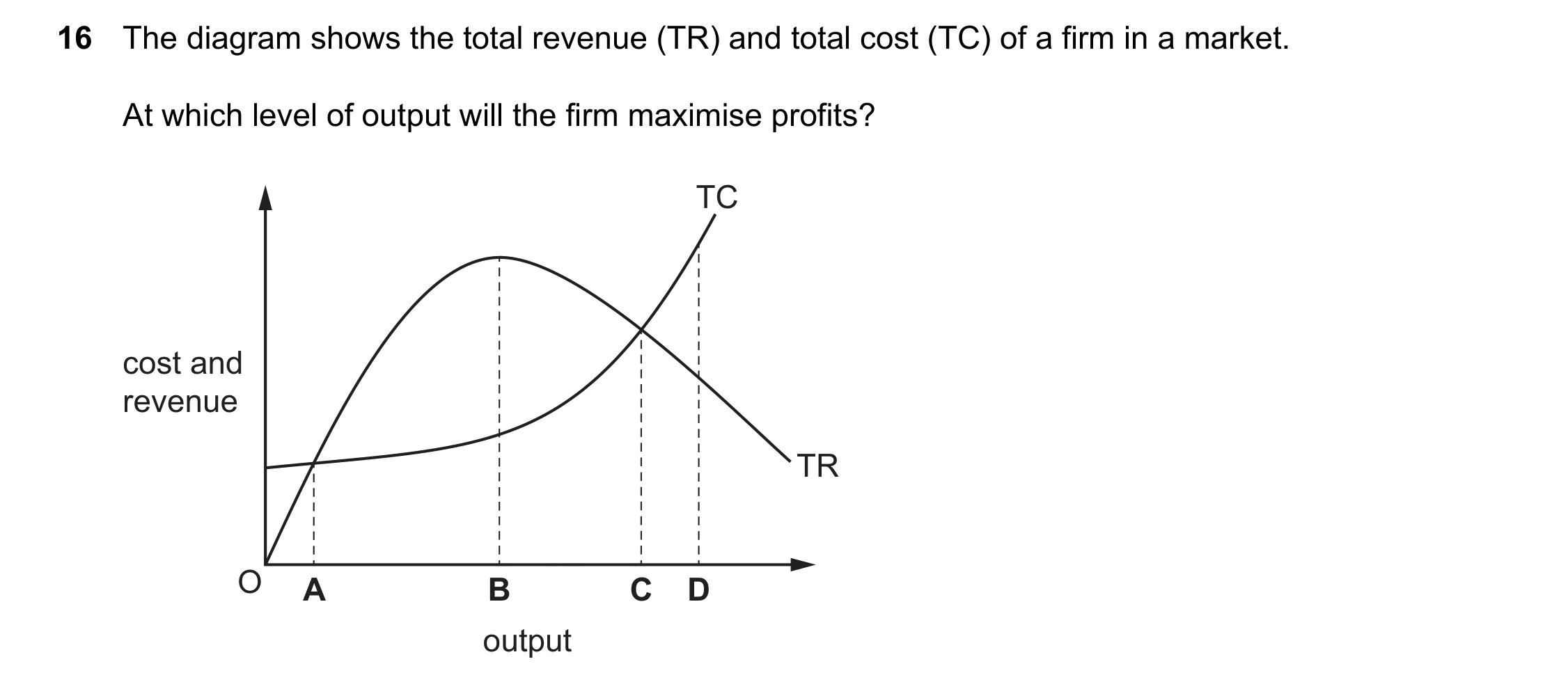
0455/11 June 2026 question 15
Show answer

CCorrect answer

Question 15June 20260455/121 mark
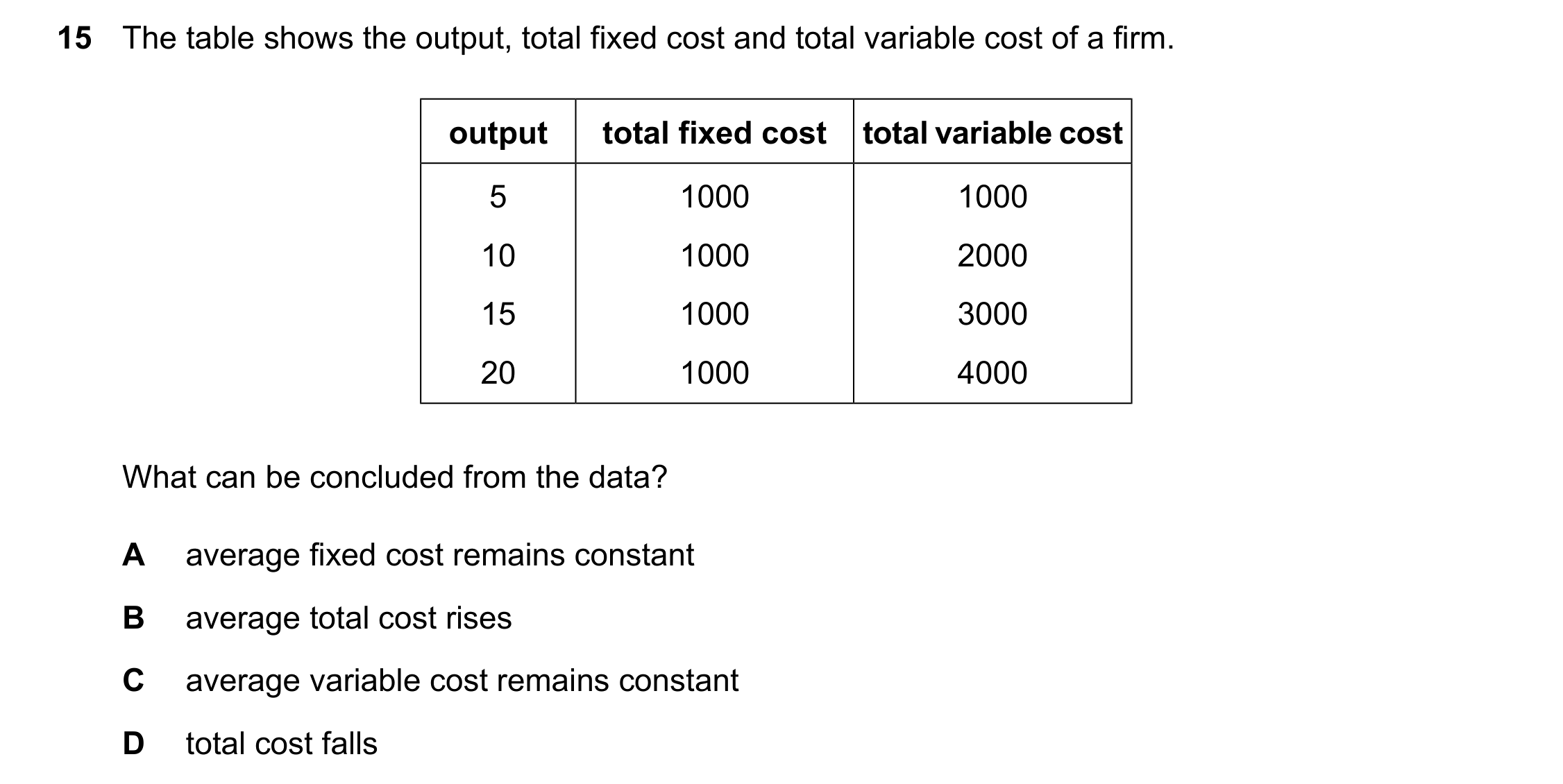
0455/12 June 2026 question 15
Show answer

CCorrect answer

Question 13June 20260455/131 mark
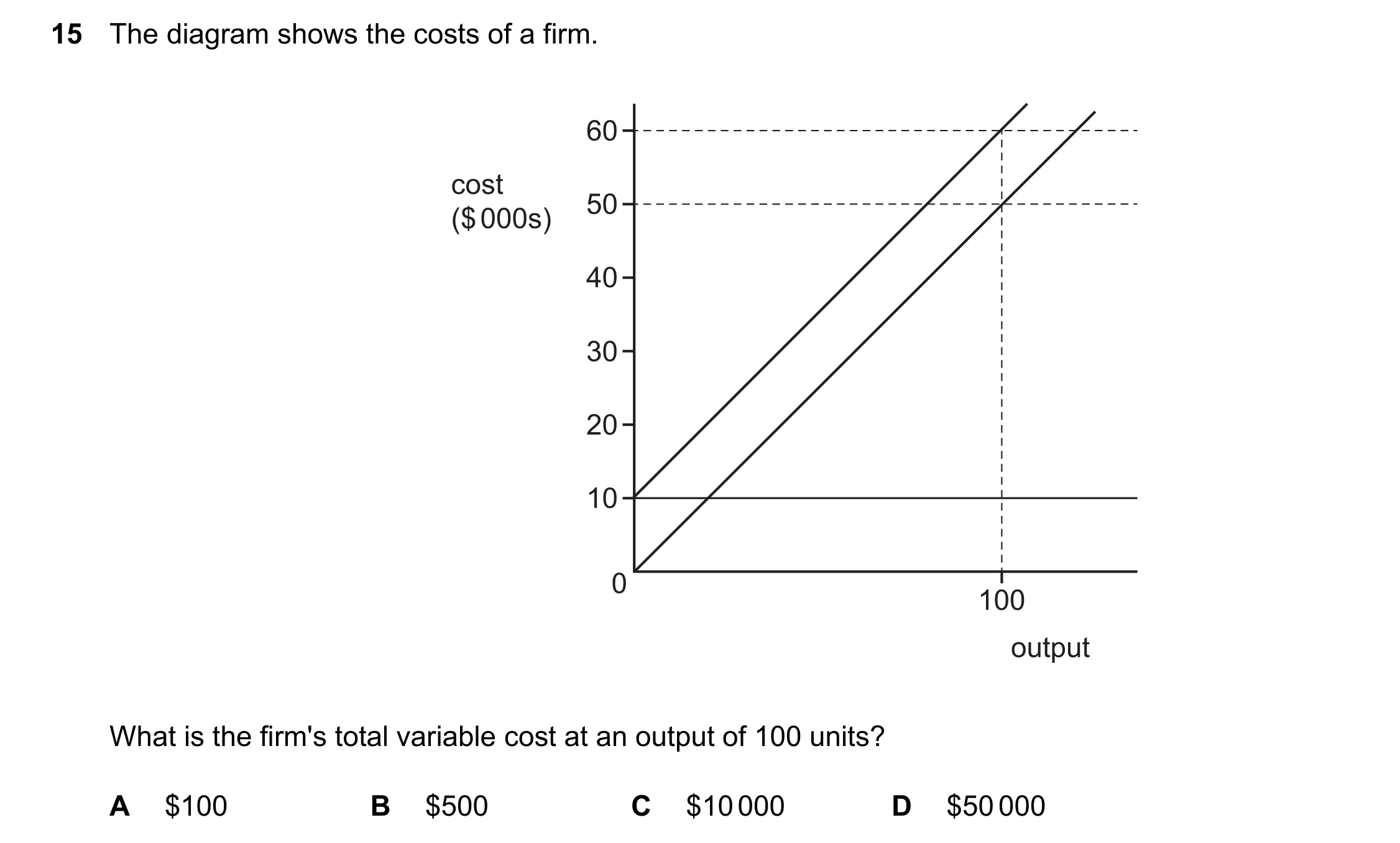
0455/13 June 2026 question 13
Show answer

CCorrect answer

Question 15June 20260455/131 mark
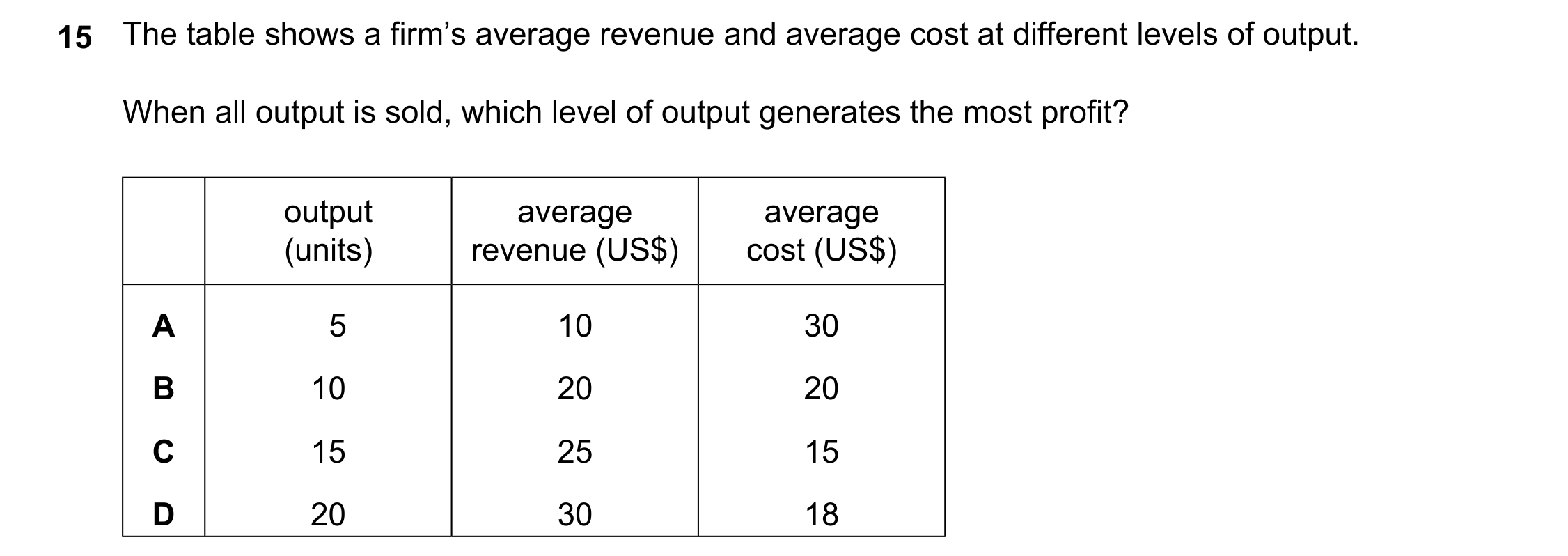
0455/13 June 2026 question 15
Show answer

BCorrect answer

Question 16June 20260455/131 mark
0455/13 June 2026 question 16
Show answer

BCorrect answer

Question 15March 20260455/121 mark
0455/12 March 2026 question 15
Show answer

CCorrect answer

Question 14Oct/Nov 20250455/111 mark

What must occur if a firm experiences economies of scale?

  • Aaverage costs decrease
  • Bprofits decrease
  • Cthe number of workers increases
  • Dtotal advertising costs decrease
Show answer

ACorrect answer

Question 15Oct/Nov 20250455/111 mark
0455/11 Oct/Nov 2025 question 15
Show answer

DCorrect answer

Question 16Oct/Nov 20250455/111 mark

If the average revenue of a firm increases from $4 to $5 and quantity demanded decreases from 20 units to 10 units, what will be the effect on the firm’s total revenue?

  • Adecreases by $20
  • Bdecreases by $30
  • Cincreases by $20
  • Dincreases by $30
Show answer

BCorrect answer

Question 15Oct/Nov 20250455/121 mark

When it produces 100 units, a firm’s total variable cost is $300 and its total fixed cost is $2700. What is the average total cost?

  • A$3
  • B$24
  • C$27
  • D$30
Show answer

DCorrect answer

Question 15Oct/Nov 20250455/131 mark
0455/13 Oct/Nov 2025 question 15
Show answer

DCorrect answer

Question 9May/June 20250455/111 mark

What would a person believe who wished to encourage the use of the market system?

  • Apeople should have equal living standards
  • Bpeople should have freedom of action
  • Cprofit maximisation is wrong
  • Dthe government should correct people’s bad behaviour
Show answer

BCorrect answer

Question 16May/June 20250455/111 mark
0455/11 May/June 2025 question 16
Show answer

ACorrect answer

Question 11May/June 20250455/121 mark
0455/12 May/June 2025 question 11
Show answer

CCorrect answer

Question 13May/June 20250455/121 mark

What are fixed costs?

  • Acosts that are divided by the amount produced
  • Bcosts that are present when output is zero
  • Ccosts that change according to the level of output
  • Dcosts that decrease when output increases
Show answer

BCorrect answer

Question 14May/June 20250455/121 mark
0455/12 May/June 2025 question 14
Show answer

ACorrect answer

Question 15May/June 20250455/121 mark

The only information known about a firm is the price it charges for its product and the quantity it sells. What else can be concluded from this?

  • Aits average cost and profit
  • Bits average cost and total revenue
  • Cits average revenue and profit
  • Dits average revenue and total revenue
Show answer

DCorrect answer

Question 13May/June 20250455/131 mark
0455/13 May/June 2025 question 13
Show answer

DCorrect answer

Question 15May/June 20250455/131 mark
0455/13 May/June 2025 question 15
Show answer

CCorrect answer

Question 15Feb/Mar 20250455/121 mark
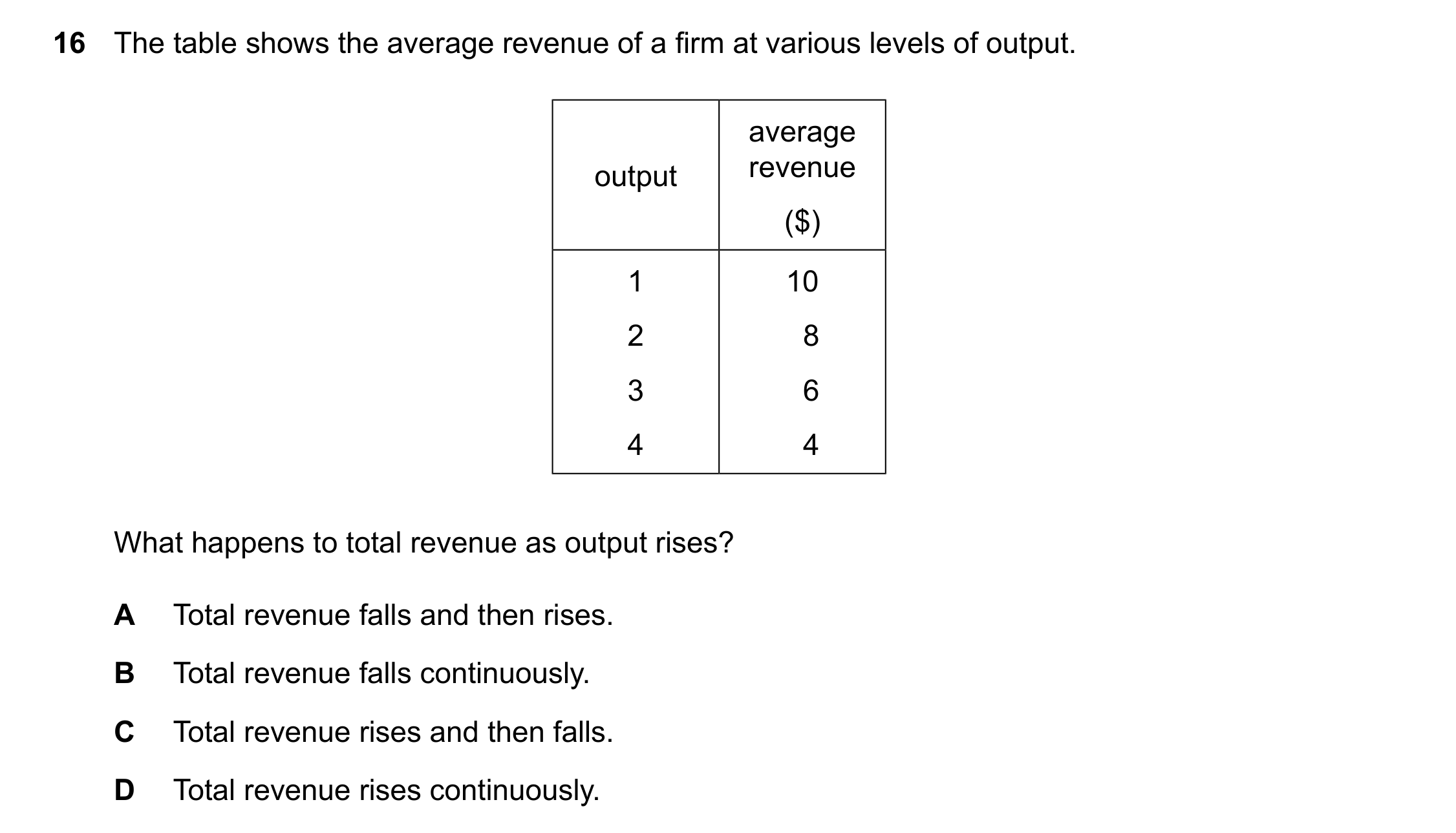
0455/12 Feb/Mar 2025 question 15
Show answer

CCorrect answer

Question 16Feb/Mar 20250455/121 mark
0455/12 Feb/Mar 2025 question 16
Show answer

CCorrect answer

Question 23Feb/Mar 20250455/121 mark
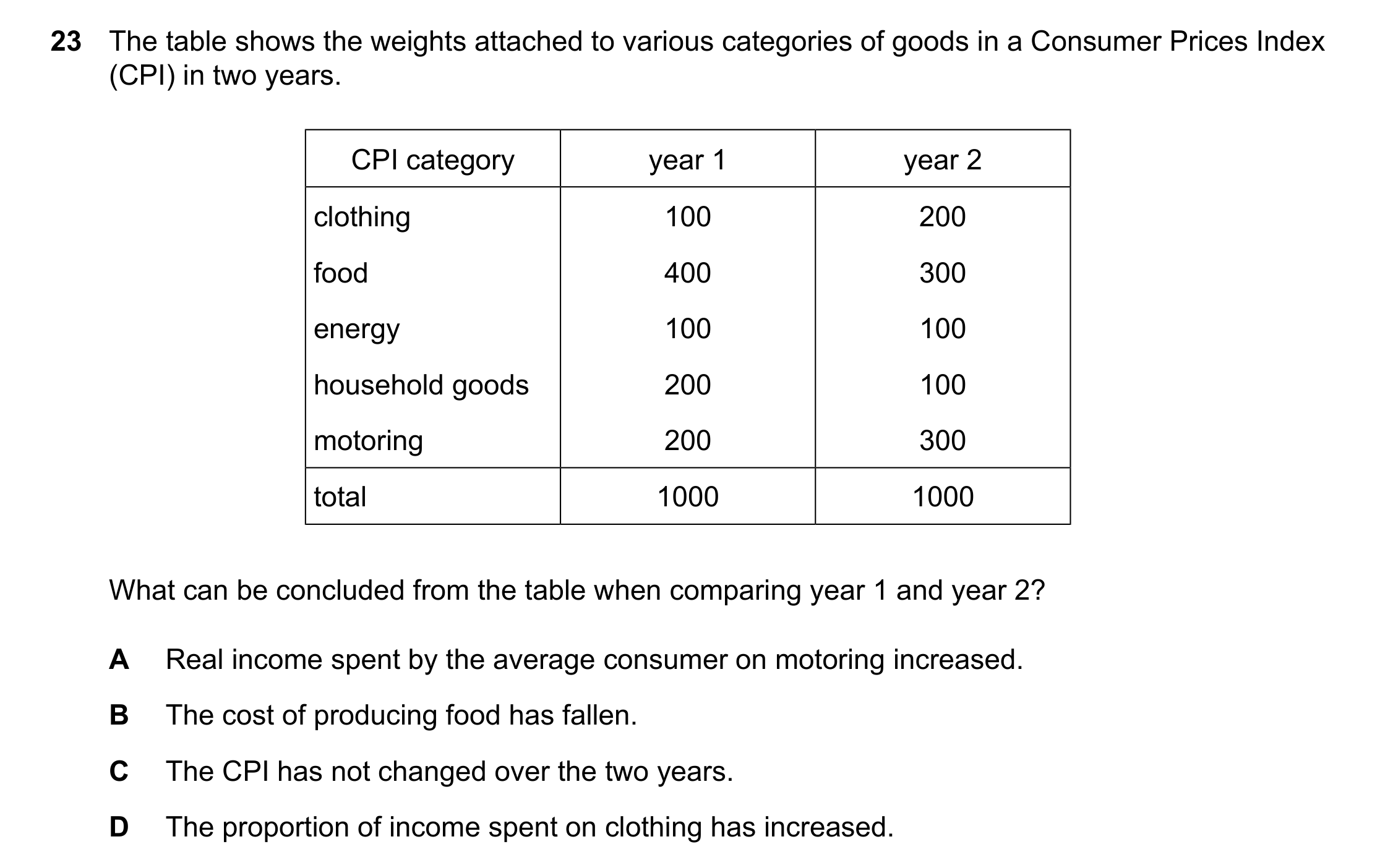
0455/12 Feb/Mar 2025 question 23
Show answer

DCorrect answer

Paper 2 · Structured questions (3)

Stimulus: 0455/22

In April 2023, a French cosmetics firm merged with an Australian cosmetics firm. It is expected the merger will lower average total cost as the new firm is likely to benefit from greater internal economies of scale. A manager stated that a key aim is to make the firm’s production more sustainable by using raw materials taken from renewable sources. In most countries, the cosmetics firm’s products, including perfume, are taxed at a higher rate than food.

Question 3(a)Oct/Nov 20250455/222 marks

Define average total cost.

Show mark scheme

Define average total cost. Total cost divided by output (2). Cost per unit (1).

Question 3(b)Oct/Nov 20250455/224 marks

Explain how using renewable raw materials may affect a firm’s profits.

Show mark scheme

Explain how using renewable raw materials may affect a A simple statement that profits rise or fall with no relevant firm’s profits. explanation is 0 marks. Logical explanation which might include the following. Profits rising and profits falling can both be credited if each is explained.

  • Using renewable resources may be more expensive (1) increase costs of production (1) reduce profits (1).
  • Can advertise that renewable resources which create less pollution / improve environmental sustainability are being used (1) increase image of the firm (1) raise demand (1) increase profits (1).
  • Using renewable resources may be subsidised (1). May become cheaper to use renewable resources in the long run (1).
  • Resources will not be depleted / firms have a constant supply of raw materials (1) raise profits (1). Question Answer Marks Guidance
Stimulus: 0455/23

As cities experience economic growth, the buildings in the city become taller. This is driven by an increase in the willingness and ability of consumers to live in tall buildings. Changes in the conditions of supply have also increased the number of tall buildings being constructed. However, there is a limit to the height of buildings – above a certain height, the total cost of constructing the building will exceed the total revenue generated.

Question 4(a)May/Jun 20250455/232 marks

Define total cost.

Show mark scheme

Define total cost. Total cost is addition of all costs / overall costs (1) fixed cost (1) plus variable cost (1).

116 more questions from 2019–2024

🔒 Unlock every Firms, costs, revenue and objectives question from 2019–2024

All 116 come with their mark schemes, answers and case studies, and appear in the practice tool above once you’re signed in. It’s free.

Create a free accountSign in

A few of them

  • 0455/11 · Oct/Nov 2024 · Question 14A food-processing firm decides to change from… 🔒
  • 0455/11 · Oct/Nov 2024 · Question 15What is an example of a fixed… 🔒
  • 0455/11 · Oct/Nov 2024 · Question 16What is the definition of… 🔒
  • 0455/13 · Oct/Nov 2024 · Question 15How is total… 🔒
  • 0455/13 · Oct/Nov 2024 · Question 17What is a macroeconomic aim… 🔒
  • + 111 more, by year in the table above

Questions and mark schemes are from past Cambridge papers and are reproduced for revision. Topical Vault is an independent revision resource, not affiliated with or endorsed by Cambridge Assessment International Education.

IGCSE Economics questions by topic

Each topic opens this practice tool with only that topic’s questions, plus how often it comes up and every question on it in one list. Revision notes for IGCSE Economics →

  1. Ch 1The nature of the economic problem
  2. Ch 2Factors of production
  3. Ch 3Opportunity cost
  4. Ch 4Production possibility curves
  5. Ch 5Microeconomics and macroeconomics (removed from the syllabus from 2027)
  6. Ch 6The role of markets in allocating resources
  7. Ch 7Demand
  8. Ch 8Supply
  9. Ch 9Price determination
  10. Ch 10Price changes
  11. Ch 11Price elasticity of demand
  12. Ch 12Price elasticity of supply
  13. Ch 13Market economic system
  14. Ch 14Market failure
  15. Ch 15Mixed economic system
  16. Ch 16Money and banking
  17. Ch 17Households
  18. Ch 18Workers
  19. Ch 19Trade unions
  20. Ch 20Firms
  21. Ch 21Firms and production
  22. Ch 22Firms, costs, revenue and objectives
  23. Ch 23Market structure
  24. Ch 24The role of government (removed from the syllabus from 2027)
  25. Ch 25The macroeconomic aims of government
  26. Ch 26Fiscal policy
  27. Ch 27Monetary policy
  28. Ch 28Supply-side policies
  29. Ch 29Economic growth
  30. Ch 30Employment and unemployment
  31. Ch 31Inflation and deflation
  32. Ch 32Living standards
  33. Ch 33Poverty
  34. Ch 34Population
  35. Ch 35Differences in economic development between countries
  36. Ch 36International specialisation
  37. Ch 37Free trade and protection
  38. Ch 38Foreign exchange rates
  39. Ch 39Current account of balance of payments