Question 21June 20260455/111 mark

Show answer
DCorrect answer
Cambridge 0455, Paper 1 & 2. 2,888 questions, 2019 to 2026.
Paper 1 multiple-choice questions and Paper 2 structured questions, from the original Cambridge material. Paper 2 case studies and mark schemes are reproduced as extracted text, with data tables and charts kept as cropped images rather than retyped. A question tagged under a second chapter shows that as a cross-link; it is only filed once, under its primary chapter.
Foreign exchange rates: how exchange rates are determined in the foreign exchange market, the causes and consequences of changes, and floating versus fixed exchange rates.
New to Foreign exchange rates, or finding these questions hard?
Read the notes first: the key ideas, diagrams and formulas, and the mistakes examiners see most, in about 18 minutes.
81 past paper questions on this topic since 2019, across 29 exam sessions.
| Year | Paper 1 | Paper 2 | Total | Chart |
|---|---|---|---|---|
| 2026 | 7 | 3 | 10 | |
| 2025 | 6 | 5 | 11 | |
| 2024 | 5 | 4 | 9 | |
| 2023 | 7 | 3 | 10 | |
| 2022 | 6 | 6 | 12 | |
| 2021 | 9 | 4 | 13 | |
| 2020 | 4 | 3 | 7 | |
| 2019 | 3 | 6 | 9 |
The whole topic on one page, with answers and mark schemes. Printing this page prints just this list.
DCorrect answer
What is least likely to be a benefit of a floating exchange rate system?
CCorrect answer

DCorrect answer

ACorrect answer

CCorrect answer

BCorrect answer
What is necessary to be able to operate a fixed exchange rate system?
DCorrect answer

BCorrect answer
Which policy measures would be classified as fiscal policy?
CCorrect answer

BCorrect answer
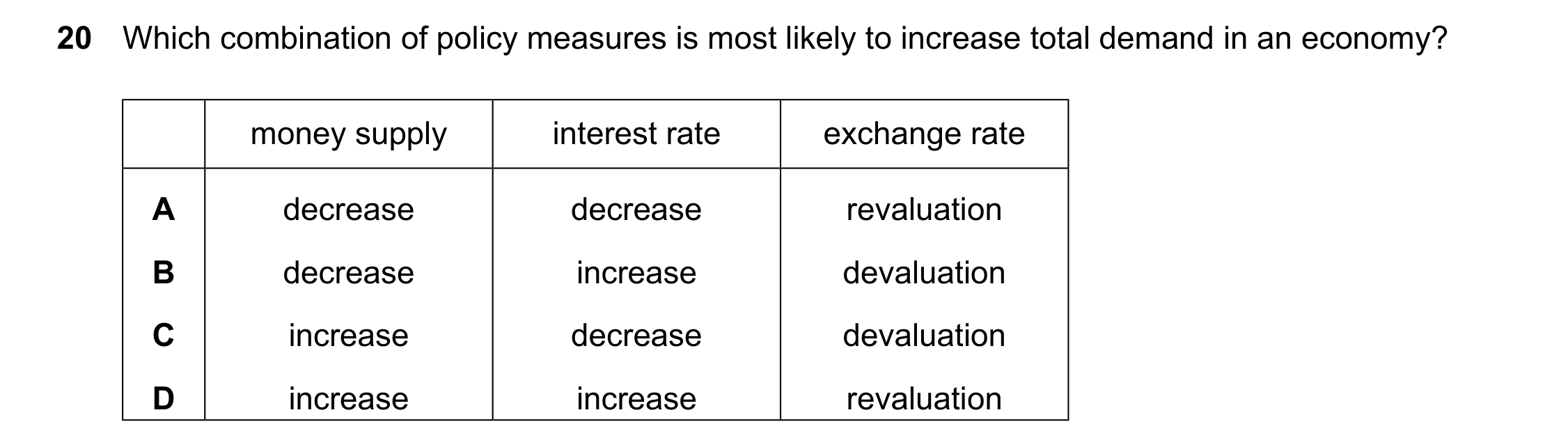
CCorrect answer
An Argentine product initially sells in the US for $50 when the exchange rate between the two countries is 5 pesos to 1 dollar ($). The exchange rate changes to 10 pesos to 1 dollar and the price of the product remains unchanged in Argentina. What will be the new price of the product in the US?
BCorrect answer
What might a central bank do to stop a fall in the value of its country’s currency?
ACorrect answer
In 2022, the President of Zimbabwe ordered the country’s commercial banks to stop lending. He was concerned that people were borrowing money to buy foreign currency. At this time, Zimbabwe faced several economic problems. The inflation rate was very high at 105%. In 2023, it rose to 850% despite the government’s aim of a fall in the inflation rate.
Analyse how a fall in a country’s foreign exchange rate can cause inflation.
Analyse how a fall in a country's foreign exchange rate Note: Listing any reasons Max 3 marks. can cause inflation. Coherent analysis which might include:
In 2023, the interest rate set by the central bank in Argentina reached 97%. This was to stop the foreign exchange rate of the Argentinian currency from falling further. Commercial banks in Argentina became concerned over their levels of loans and household savings.
Discuss whether or not a fall in the foreign exchange rate of a currency is an advantage for an economy.
Discuss whether or not a fall in the foreign exchange Level Description Marks rate of a currency is an advantage for an economy. 3 A reasoned discussion which 6–8 In assessing each answer, use the table opposite. accurately examines both sides of the economic argument, making use Why it might be an advantage: of economic information and clear
Monetary policy has changed in Ethiopia in recent years. The country’s central bank now uses changes in the interest rate rather than controls on bank lending. It has also moved from operating a fixed exchange rate to a floating exchange rate. The Ethiopian Government uses a range of supply‑side policy measures. The government has privatised some sugar processing firms, but most large firms are still state‑owned.
Discuss whether or not having a fixed exchange rate will benefit an economy.
Discuss whether or not having a fixed exchange rate will benefit an economy. Level Description Marks 3 A reasoned discussion 6–8 In assessing each answer, use the table opposite. which accurately examines both sides of the Why it might: economic argument,
Switzerland fact file 2022 Population 8.7m Inflation rate 3.5% GDP $808bn Financial sector contribution (as % of GDP) 9% Current account surplus on the balance of payments $78bn Although inflation in Switzerland in 2022 was above its target of 2%, it was below the inflation rate of other high‑income economies, such as the US (9.1%), the UK (11.1%) and Germany (7.9%). Price levels are more stable because of a combination of microeconomic and macroeconomic policy measures. These include maximum prices, subsidies and a contractionary monetary policy. To encourage the production of solar energy, the Swiss Government has provided more than $500 million in subsidies to producers. This is part of the government’s plan to move away from non‑renewable sources of energy which are mainly imported. Overdependence on foreign markets could lead to the economy becoming more exposed to external shocks. Switzerland’s current account of the balance of payments has been in surplus from 2015 to 2022. Low inflation, along with the production of very high‑quality products, may have contributed to this surplus. A strong currency has also kept the cost of imported raw materials low in Switzerland. The Swiss franc is one of the more stable currencies in the world. During times of economic uncertainty, the Swiss franc usually strengthens. Fig. 1.1 shows global growth rate (% change in GDP) and the percentage change in the value of the Swiss franc, against the USD($), from 2018–2022. Percentage 2 –2 –4 2018 2019 2020 2021 2022 Years Global growth rate Change in value of Swiss franc Fig. 1.1 Global growth rate (% change in GDP) and the percentage change in the value of the Swiss franc against the USD($) from 2018–2022 Although inflation was not high compared to other countries, the Swiss central bank increased interest rates in 2022. This was done to reduce inflationary pressures. However, there was a risk that higher interest rates might increase unemployment. The rise in interest rates affected some firms negatively. The Swiss Government had to organise a merger between the two largest banks in Switzerland. This was to avoid one of them collapsing which would have reduced confidence in the whole banking system. A merger might also have helped the merged bank to gain greater economies of scale. However, the merger resulted in some workers losing their jobs and gave the merged bank greater monopoly power.


Analyse the relationship between the global GDP growth rate and the change in the value of the Swiss franc.
Analyse the relationship between the global GDP Responses do not have to be in the format suggested but growth rate and the change in the value of the Swiss they should address the expected / normal relationship, offer Franc. supporting evidence of that, highlight any exceptions to that, and analyse the overall data. Coherent analysis which might include the following. Expected relationship: generally negative / inverse relationship (1) as the global growth rate falls, the value of the Swiss Franc rises / as the global growth rate rises, the value of the Swiss Franc falls (1). Supporting evidence: fall in global growth rate led to rise in the value of Swiss Franc from 2018–2019 or 2019–2020 (1), rise in global growth rate led to fall in the value of Swiss Franc from 2020–2021 (1). Analysis: Swiss Franc’s status as a “safe haven” currency (1) when investors are unsure about the economy, they usually keep their money in Swiss francs (1). Exception: 2021–2022 (1) where global growth was falling but Swiss Franc was stable / rising only slightly (1). Analysis for exception: Other reasons could affect the value of Swiss Franc (1), for example Switzerland was also affected by the Covid–19 pandemic (1). Question Answer Marks Guidance
Malawi fact file 2022 Population 22m Percentage of population with access to electricity 15% Deficit on the current account of the balance of payments 12.9% of GDP Malawi is a low-income East African country. It is often affected by natural disasters including droughts, floods and storms. In January 2022, Malawi was hit by Storm Ana. This damaged agricultural crops, factories, forests and power stations. More than three-quarters of Malawi’s labour force are employed in agriculture. Two of the country’s main crops are tea and sugar. The quantity of tea offered for sale is affected by weather conditions, government subsidies and the price of fertilisers. The global market for sugar has been affected by health reports which identified the possible harmful effects of consuming too much sugar. Three of the priorities of the Malawian Government are to develop new industries, raise education standards and develop more sustainable sources of energy. The proportion of Malawian children who finish their primary education (5–11 years of age) is relatively low. Table 1.1 shows GDP per head and the percentage of children who complete primary education in selected countries in 2022. Table 1.1 GDP per head and the percentage of children who complete primary education in selected countries in 2022 Country GDP per head ($) Children who complete primary education (%) Malawi 650 35 Mauritania 2200 70 Namibia 4900 78 Senegal 1640 60 South Africa 7060 99 Uganda 890 22 Only a small proportion of Malawi’s population has access to electricity. Most households rely on wood and charcoal for cooking and heating. Using wood as a fuel contributes to the destruction of the country’s forests and reduces air quality. The country does, however, get 3000 hours of sunshine a year. This means it could develop solar energy. There would be an initial cost to install solar panels and to reduce the risk of storm damage. Solar energy plants (also known as solar farms) can take up a large area and create visual pollution. However, a successful solar energy industry could decrease Malawi’s imports of fuel and might affect its exchange rate. Malawi’s foreign exchange rate fell in 2022. The country’s currency, the kwacha, bought fewer US dollars. This depreciation affected Malawi’s current account of the balance of payment, its inflation rate and its economic growth rate. Some economists suggested that the Malawian Government should stop the kwacha falling further in value.

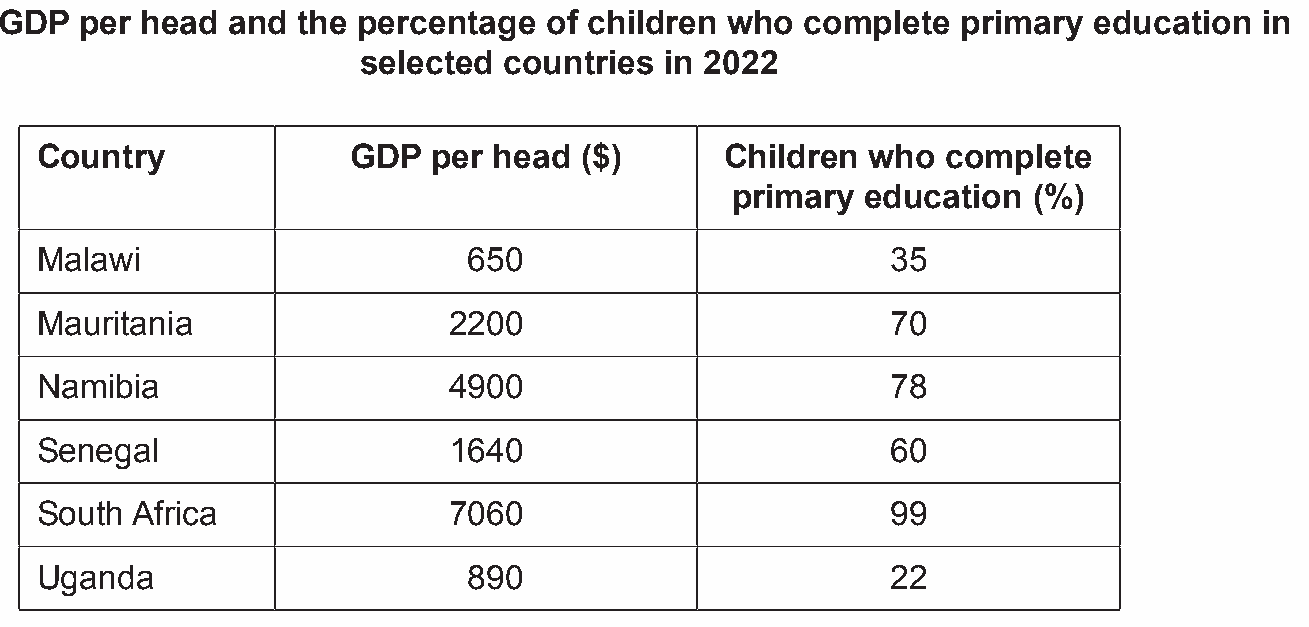
Discuss whether or not a government should try to stop its country’s foreign exchange rate falling in value.
Discuss whether or not a government should try to stop Note: many candidates provide incorrect analysis e.g. its country’s foreign exchange rate falling in value. wrong way around. Award up to 4 marks for logical reasons why it should try to Maximum of 3 marks if there is no development / evaluation stop it falling in value e.g. the disadvantages of the fall, of reasons given. including:
Australia has a number of firms that operate in other countries. These multinational companies (MNCs) provide several benefits for their home country of Australia. The Australian Government imposes relatively low import tariffs and the country has a floating exchange rate. In recent years, Australia has experienced an increase in investment and a higher Human Development Index (HDI) value.
---
Discuss whether or not having a floating exchange rate benefits an economy.
Level Description Marks 1 There is a simple attempt at using 1–2 economic definitions and terminology. Some reference may be made to economic theory, with occasional understanding. 0 A mark of zero should be awarded for 0 no creditable content. Note: reward candidates if they refer to the impact of appreciation and depreciation of the currency in their answers.
Egypt fact file 2022 GDP $469.1bn Population 110.0m Poverty rate 27.9% Unemployment rate 7.2% Egypt has always attracted tourists due to the pyramids and other ancient wonders. However, the tertiary sector is not the only source of economic growth; the primary and secondary sectors also contribute to economic growth. Egypt’s exports include personal travel, oil, citrus fruits, gold and textiles. There has been a building boom recently in Egypt. A new city is being built which requires finance, raw materials and labour. Firms are taking a big risk with this project as they are building houses before demand for them has been confirmed. If incomes fall, for example, the market for housing might be unprofitable. Tourism is a good source of economic growth for Egypt. The country has attractions that were built thousands of years ago and natural attractions such as beautiful beaches and a warm climate. It has good infrastructure and is considered a safe and secure country which also attract tourists. Free market reforms have encouraged more investment in Egypt. Fig. 1.1 shows investment (as a percentage of GDP) and economic growth rates in Egypt, 2015–2021. Percentage 10 (%) 8 2015 2016 2017 2018 2019 2020 2021 Investment (as a % of GDP) Economic growth rates (%) Fig. 1.1 Investment (as a % of GDP) and economic growth rates (%) in Egypt in 2015–2021 Deregulation in education has led to an increase in the number of schools and universities in Egypt. Increased opportunities for education and training will ensure future improvements in living standards. However, the opening of more private schools and universities might increase inequality as private education may remain unaffordable for some income groups. In 2022, the Egyptian currency halved in value against the US dollar. The fall in the value of the currency affected inflation and the purchasing power of Egyptians. However, certain industries such as tourism have benefited from this as holidays in Egypt have become more affordable for non-Egyptians.
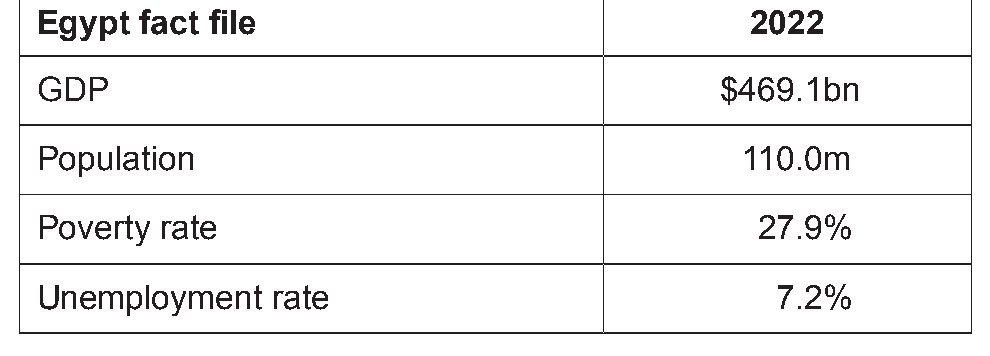
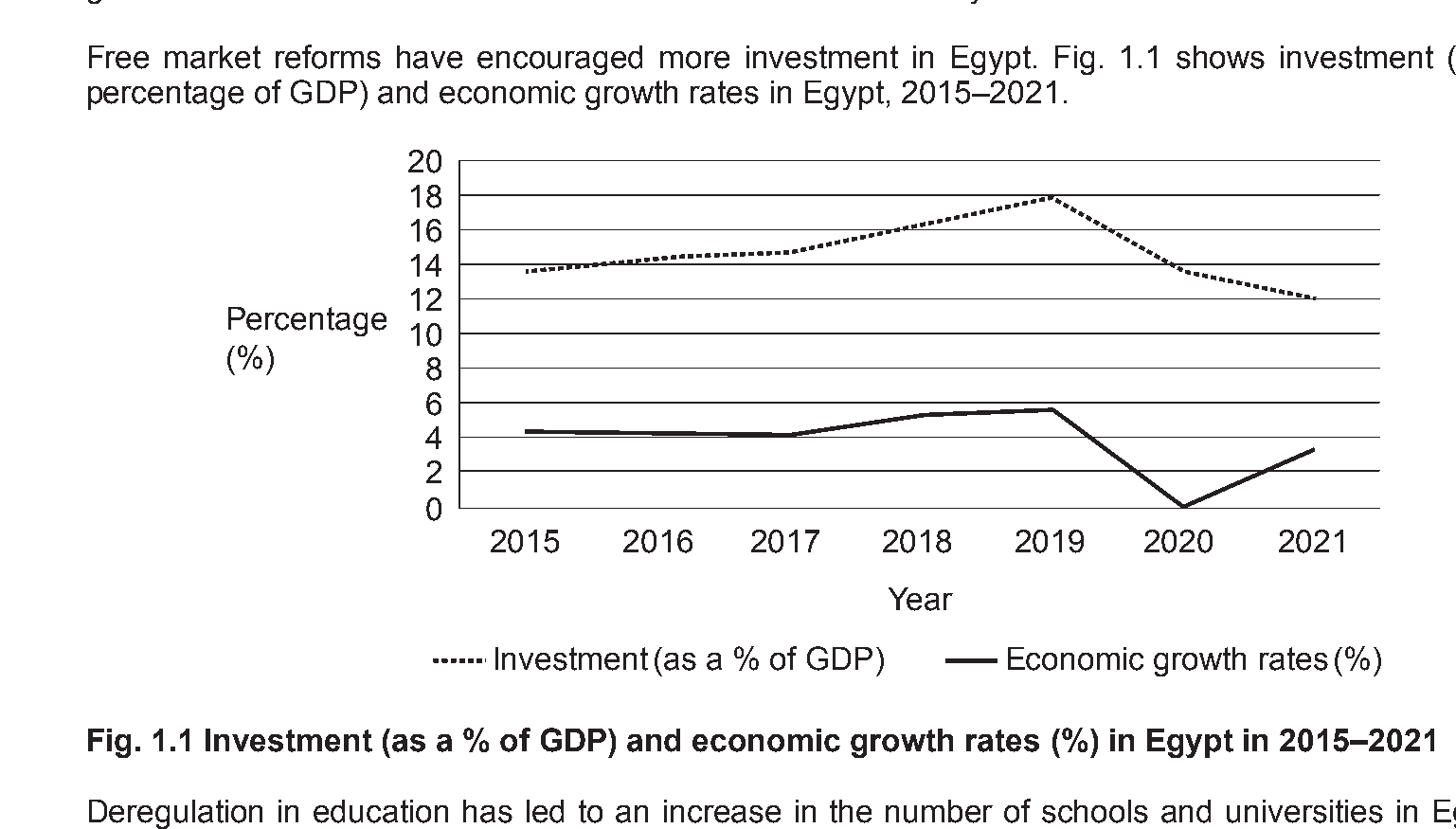
Discuss whether or not a fall in the value of the Egyptian currency would harm the Egyptian economy.
Discuss whether or not a fall in the value of the One mark for identifying increase or decrease in investment. Egyptian currency would harm the Egyptian economy. Award up to 4 marks for logical reasons why it might, which may include:
Nigeria has a mixed economic system. In January 2023, Nigeria had a high unemployment rate of 33% which created a number of costs. Its high inflation rate of 22% had several effects on the country’s firms. In 2022 and the start of 2023, Nigerians increased their demand for foreign currency.
Analyse the causes of an increase in the demand for foreign currency.
Analyse the causes of an increase in the demand for foreign currency. Coherent analysis which might include: To buy more goods and services from that country / higher demand by other countries for that country’s products (1) increased foreign tourism (1) may be the result of higher inflation in the buying country (1) may be due to removal of trade restrictions (1) rise in quality of the other country’s products (1) higher incomes in the buying country (1). To speculate / increased confidence in the currency (1) that it will rise in price / value (1) make a profit (1). To invest more in that country (1) e.g. set up a branch of a MNC / FDI (1) MNC sending profit home (1). To send more money home to relatives (1) workers’ remittances (1). The government / central bank may buy it (1) to influence the exchange rate (1) add to the reserves (1). To take advantage of a rise in interest rates in that country (1) increase hot money flows (1) increase return on saving / financial investment (1). More people may migrate to that country (1) to e.g. buy a home in another country (1). Question Answer Marks Guidance
🔒 Unlock every Foreign exchange rates question from 2019–2024
All 60 come with their mark schemes, answers and case studies, and appear in the practice tool above once you’re signed in. It’s free.
Questions and mark schemes are from past Cambridge papers and are reproduced for revision. Topical Vault is an independent revision resource, not affiliated with or endorsed by Cambridge Assessment International Education.
Each topic opens this practice tool with only that topic’s questions, plus how often it comes up and every question on it in one list. Revision notes for IGCSE Economics →