← Topical Vault

Price elasticity of demand · IGCSE Economics

Cambridge 0455, Paper 1 & 2. 2,888 questions, 2019 to 2026.

Topic
Year

Paper 1 multiple-choice questions and Paper 2 structured questions, from the original Cambridge material. Paper 2 case studies and mark schemes are reproduced as extracted text, with data tables and charts kept as cropped images rather than retyped. A question tagged under a second chapter shows that as a cross-link; it is only filed once, under its primary chapter.

About Price elasticity of demand

Price elasticity of demand: calculating PED, interpreting elastic and inelastic values, what determines PED, and how it links to total spending and revenue.

New to Price elasticity of demand, or finding these questions hard?

Read the notes first: the key ideas, diagrams and formulas, and the mistakes examiners see most, in about 18 minutes.

Read the Price elasticity of demand notes →

65 past paper questions on this topic since 2019, across 29 exam sessions.

How often it comes up

YearPaper 1Paper 2TotalChart
2026437
2025448
2024538
20238412
2022437
2021336
2020516
20195611

Every 2025–2026 question on Price elasticity of demand

The whole topic on one page, with answers and mark schemes. Printing this page prints just this list.

Paper 1 · Multiple choice (8)

Question 7June 20260455/121 mark

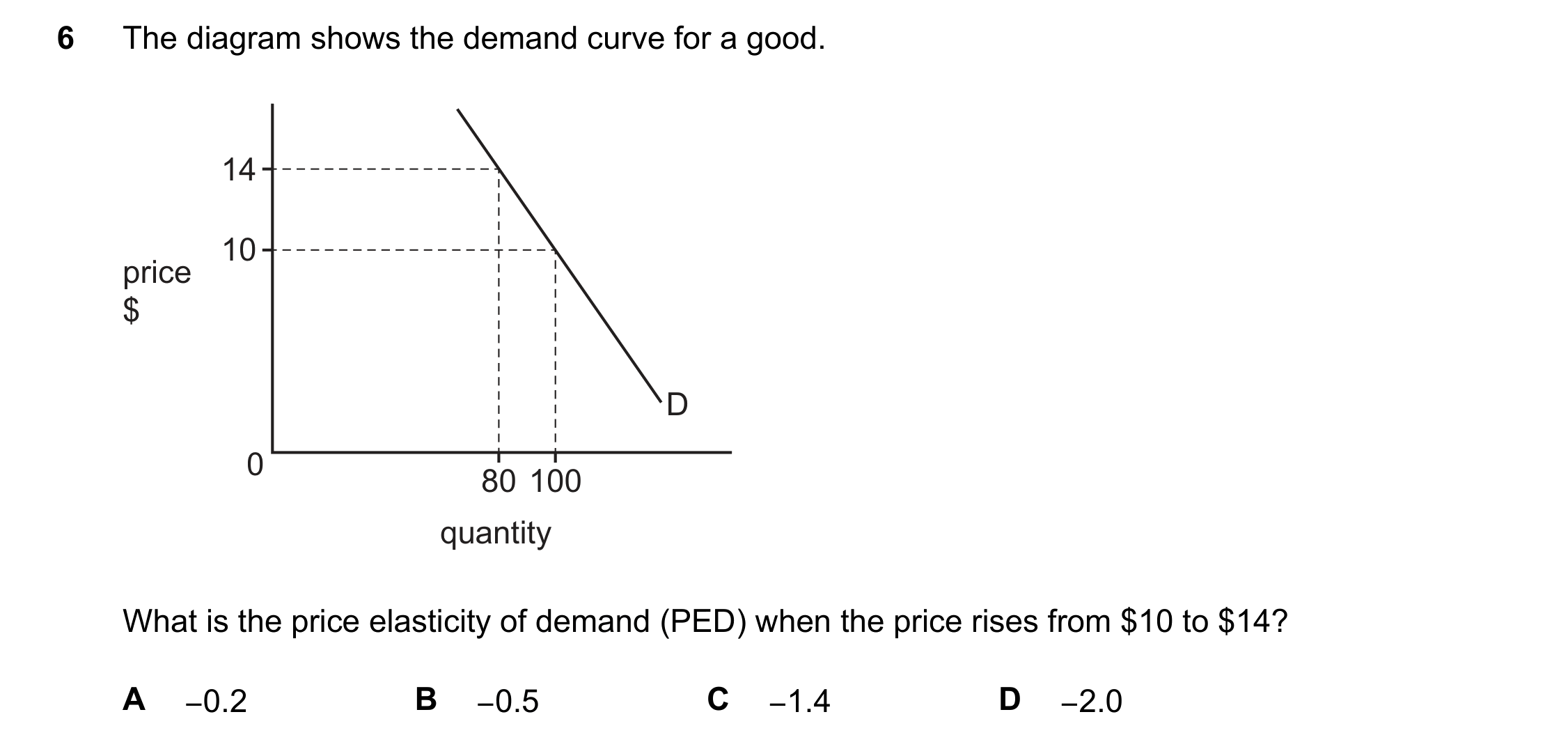
0455/12 June 2026 question 7
Show answer

DCorrect answer

Question 6June 20260455/131 mark
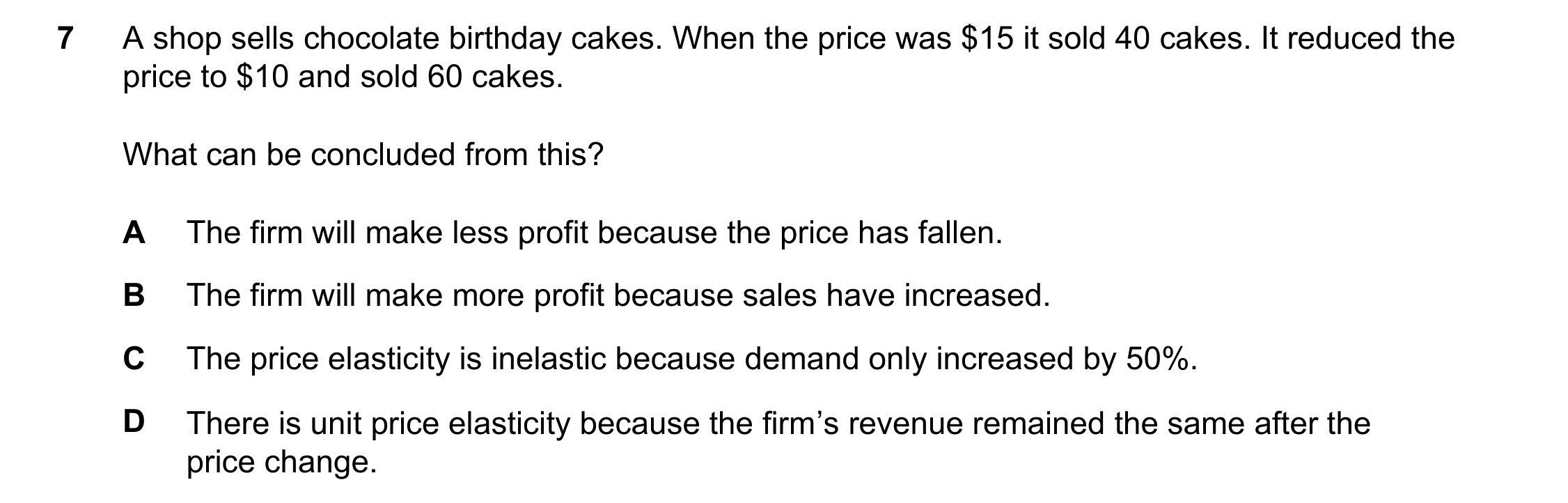
0455/13 June 2026 question 6
Show answer

BCorrect answer

Question 7June 20260455/131 mark
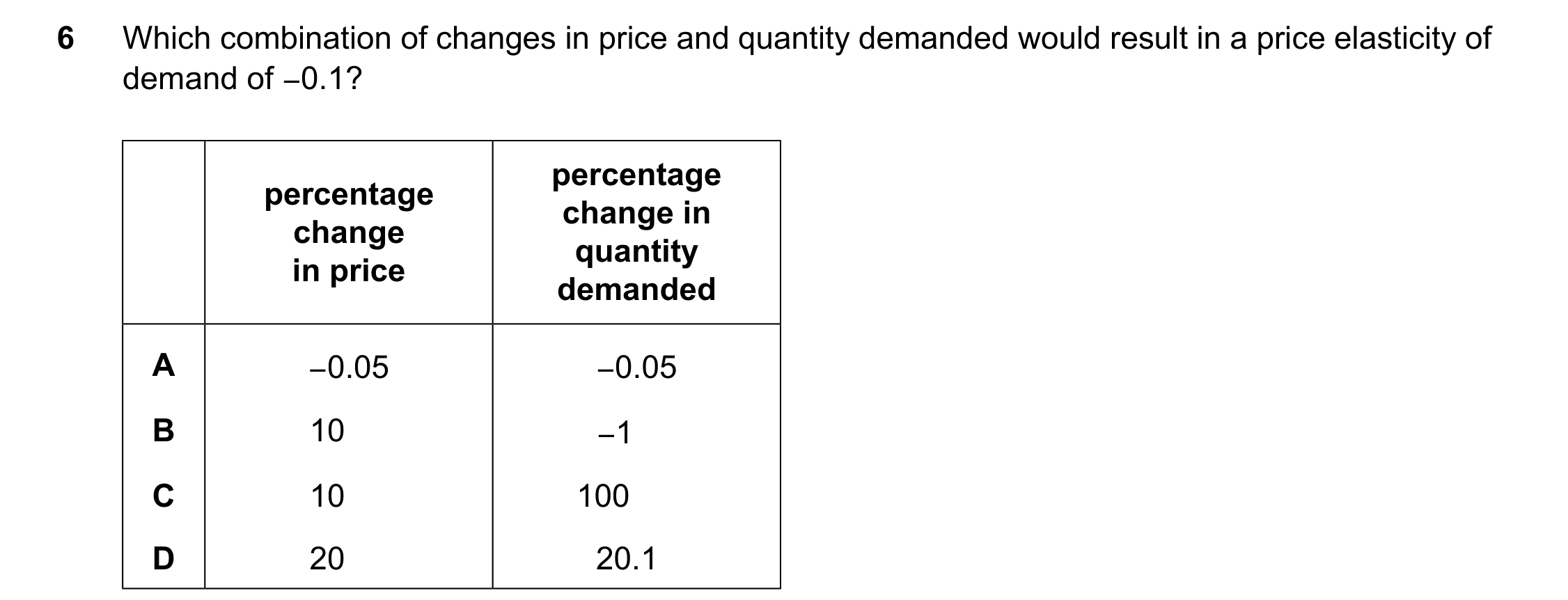
0455/13 June 2026 question 7
Show answer

DCorrect answer

Question 6March 20260455/121 mark
0455/12 March 2026 question 6
Show answer

BCorrect answer

Question 7Oct/Nov 20250455/111 mark

The price elasticity of demand (PED) of a good is –1. What will happen to both demand and total revenue as price increases?

  • Ademand will fall and total revenue will not change
  • Bdemand will fall and total revenue will rise
  • Cdemand will rise and total revenue will not change
  • Ddemand will rise and total revenue will rise
Show answer

ACorrect answer

Question 7May/June 20250455/131 mark

A German car producer estimates the price elasticity of demand (PED) for its cars is −2.0. What can be concluded from this information?

  • Aits cars are price elastic
  • Bits cars are price inelastic
  • Cits cars are unitary elastic
  • Dits cars take time to produce
Show answer

ACorrect answer

Question 7Feb/Mar 20250455/121 mark

The price elasticity of demand for smartphones is believed to be −2.0. A manufacturer decides to cut prices by 10%. What will be the effect of this change in price?

  • Ademand will fall by 20%
  • Bdemand will rise by 5%
  • Cquantity supplied will remain unchanged
  • Drevenue will increase
Show answer

DCorrect answer

Question 28Feb/Mar 20250455/121 mark

The US puts a 25% tariff on Chinese steel to protect jobs in the US steel industry. Under which condition would this policy be most effective?

  • AThe price elasticity of demand for Chinese steel is –2.5.
  • BThe price elasticity of demand for Chinese steel is –0.5.
  • CThe price elasticity of supply for Chinese steel is 2.5.
  • DThe price elasticity of supply for Chinese steel is zero.
Show answer

ACorrect answer

Paper 2 · Structured questions (7)

Stimulus: 0455/21

In 2023, Argentina had a high inflation rate and a deficit on the current account of its balance of payments. Very high inflation can affect how efficiently the price mechanism works. As Argentina’s products have different price elasticities of demand, the impact of price changes affected the demand for products to different extents. The high inflation also encouraged workers to try to increase their wages and some industries to ask for protection from foreign competition.

Question 2(b)May/Jun 20260455/214 marks

Explain how price elasticity of demand influences the total spending on a product when its price changes.

Show mark scheme

Explain how price elasticity of demand influences the May answer in terms of a fall in price. total spending on a product when its price changes. Logical explanation which might include:

  • If demand is price-elastic, a rise in price will cause a fall in total spending / revenue (1) as demand will fall by greater (%) than the fall in price (1).
  • If demand is price-inelastic, a rise in price will cause a rise in total spending / revenue (1) as demand will fall by smaller (%) than the fall in price (1). Question Answer Marks Guidance
Stimulus: 0455/22

The birth rate has fallen in many countries. However, the birth rate has risen in Denmark where fathers take on more childcare responsibilities than in many countries. Some Danish firms provide free childcare. These firms can have elastic or inelastic demand for their products. A relatively high proportion of Danish adults work in the public sector and most of them belong to a trade union. Some governments prevent workers from joining trade unions.

---

Question 5(c)May/Jun 20260455/226 marks

Analyse how a firm could make demand for its products more price-inelastic.

Show mark scheme

Analyse how a firm could make demand for its product Note: Listing any determinant of PED up to 3 marks more price-inelastic. Maximum 3 marks if there is no valid development of the Coherent analysis which might include: determinant(s) given.

  • Advertising/marketing (1) information provision (1) Analysis/development must relate to ‘… demand for its packaging/ branding (1) to make the product seem product…’ special/superior (1) making demand seem addictive (1) necessary (1) Nothing for a simple ‘change in price’ effect.
  • Eliminate substitutes/competition (1) by merging (1) less However, allow the following as a secondary, indirect effect: willing to switch/product becomes unique (1)
  • Reduce the price of a complement (1) consumers use If the price of the product is reduced (1) the purchase the two goods together (1) becomes a smaller proportion of income (1).
  • Make the product better quality (1) customers are less likely to switch (1) In this case the price reduction can be credited if it is
  • Create limited time to respond (1) consumers cannot developed with the ‘smaller proportion of income’ point. delay their purchase/look for alternatives (1). Allow just one mark in total for any correct statement of price inelastic demand. This must contain responsiveness/sensitivity/proportionality. Question Answer Marks Guidance
Case study: Will Senegal escape poverty?

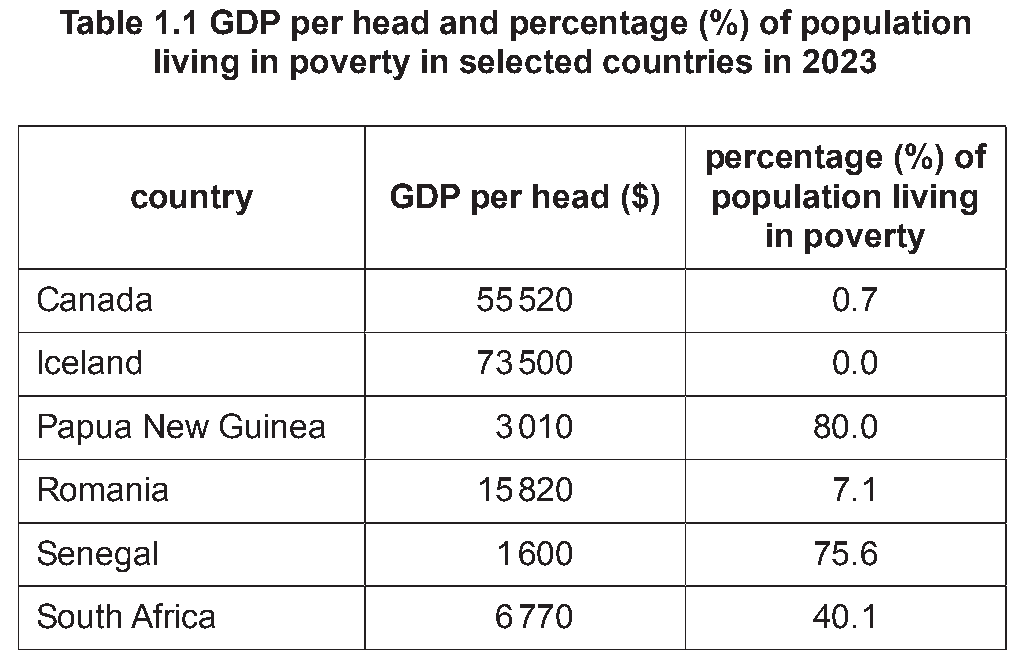
Senegal fact file 2023 population 19m gross domestic product (GDP) $31bn workers’ remittances as a percentage of GDP 9% Human Development Index (HDI) value 0.517 Senegal, a north‑east African country, has some of its workers employed in other countries. These workers send a percentage of their wages home to relatives. This money is known as workers’ remittances. Due to their relatively low incomes, most Senegalese households spend all of these remittances. However, some households do not spend all of the money they receive when interest rates are high or when confidence is low. A relatively high proportion of workers in Senegal are employed in agriculture. The crops grown in Senegal are affected by extreme heat and droughts. These weather conditions are one reason why the country grows the crop, sorghum, which does not need much water during its growth. Sorghum is low in calories and so can help people who consume it to lose weight. Senegal is a net exporter of sorghum. It is also the largest African exporter of rice after Nigeria. Greater use of capital equipment in the production of both sorghum and rice could affect productivity. This may reduce the deficit on the current account of Senegal’s balance of payments. The Senegalese Government wants to develop the country’s secondary and tertiary sectors to improve the country’s economic performance. It also expects that this will reduce poverty as measured by those living on $6.85 or less a day. Table 1.1 shows GDP per head and the percentage (%) of population living in poverty in selected countries. Table 1.1 GDP per head and percentage (%) of population living in poverty in selected countries in 2023 percentage (%) of country GDP per head ($) population living in poverty Canada 55 520 0.7 Iceland 73 500 0.0 Papua New Guinea 3 010 80.0 Romania 15 820 7.1 Senegal 1 600 75.6 South Africa 6 770 40.1 A related aim of the Senegalese Government is to increase the country’s HDI value. Governments can use fiscal policy measures to improve the three components of their HDI value, including life expectancy. Changes in fiscal policy can also affect the markets for Senegalese products including gold. Among the influences on the price elasticity of demand for gold are changes in income, the availability of substitutes and the extent to which gold is seen as a luxury.

Senegal fact file 2023
Table 1.1 GDP per head and percentage (%) of population
Question 1(h)Feb/Mar 20260455/226 marks

Discuss whether or not the demand for gold will be more price‑elastic in the future.

Show mark scheme

Discuss whether or not the demand for gold will be more Nothing for a simple ‘change in price’ argument. price-elastic in the future. Note: any determinant of PED can be used on Award up to 4 marks for logical reasons why it might, which may either side but only one way each. include:

  • more availability of substitutes (1) e.g. silver/rose gold (1) if price Note: of a substitute falls (1) or quality of a substitute rises (1) increased The content ‘consumers become more responsive switching from gold (1). to price changes’ (1)
  • income may fall (1) a larger proportion of income spent on gold (1) and consumers become more responsive to price changes (1). ‘consumers become less responsive to price
  • gold may be seen as more of a luxury (1) consumers can more changes’ (1) easily reduce their purchases when the price rises (1). can only be credited once each.
  • the price of a complementary good increase (1) e.g. jewels (1) consumers become more responsive to price changes (1). Maximum of 3 marks if there is no valid
  • longer time period considered (1) consumers have more time to development of the determinant given. adjust their behaviour/find substitutes (1). Maximum of 4 marks for a static answer with no Award up to 4 marks for logical reasons why it might not, which may dynamic notion of more/increase. include:
  • income may rise (1) so the purchase of gold will take up a smaller percentage of income (1) consumers become less responsive to price changes (1).
  • the ownership of gold/items made from gold may become more addictive/habitual (1) consumers become less responsive to price changes (1).
  • if gold is increasingly used in the production of other goods (1) gold will have more derived demand (1) (firms) need to continue buying gold even when the price rises (1).
  • an increased preference for gold over time (investment) (1) may make it (for some) more of a necessity (1) consumers become less responsive to price changes (1). Question Answer Marks Guidance
Stimulus: 0455/22

Some markets in Belgium are in equilibrium. The country produces a wide range of goods and services with different degrees of price elasticity of demand. The Belgian Government wants the economy to move to a production possibility point beyond its current production possibility curve (PPC). Belgium’s scientific industry is one industry which is doing well. Workers in this industry are highly specialised.

Question 2(c)Oct/Nov 20250455/226 marks

Analyse how price elasticity of demand can influence a firm’s pricing decisions.

Show mark scheme

Analyse how price elasticity of demand can influence a Reward, but do not expect: firm’s pricing decisions. Facilitate price discrimination (1) charging higher prices in Coherent analysis which might include the following. markets with inelastic demand (1) valid example, e.g. higher rail fares at peak times (1). Price elasticity of demand is a measure of the responsiveness of demand to a change in price (1). If demand is elastic, a rise in price will cause a greater percentage change in demand (1) may indicate the firm’s product has close substitutes / is not a necessity / takes a significant proportion of consumers’ incomes (1) may encourage firms to lower price (1) raise revenue (1). If demand is inelastic, a rise in price will cause a smaller percentage change in demand (1) may indicate the firm’s product has few substitutes / is a necessity / takes a small proportion of consumers’ incomes (1) may encourage firms to raise prices (1) revenue would increase (1). Question Answer Marks Guidance

Stimulus: 0455/23

A Swiss multinational food manufacturer increased prices for its products by an average of 8% in 2022. It increased its prices in the USA by 11.6%. This multinational company (MNC) is one of the world’s oldest MNCs. It started as a small firm but has grown over the last 160 years. Over this period, its decisions have always been influenced by opportunity cost.

Question 2(b)Oct/Nov 20250455/234 marks

Explain two reasons why a firm may charge a different price for the same product in two different countries.

Show mark scheme

Explain two reasons why a firm may charge a different One mark each for two reasons identified and one mark price for the same product in two different countries. each for two explanations. Logical explanation which might include: If more than two reasons are given, consider the first three.

  • demand may be higher / lower in one country (1) Note: There will be other relevant reasons. To get the resulting in higher / lower prices (1) development mark there must be a justification of why that
  • supply maybe higher / lower in one country (1) resulting factor will affect prices. in lower prices (1)
  • higher income / GNP per head in one country (1) means Do not accept answers based on foreign exchange rate. more able to afford to pay higher price (1)
  • price elasticity of demand may vary (1) more power to raise price where demand is inelastic (1)
  • greater competition in one country / more substitutes (1) leads to lower prices to be competitive (1)
  • indirect tax rates may vary e.g. higher GST / VAT / import tariffs (1) will lead to higher price (1)
  • government subsidies may be given in some countries (1) lowering price (1)
  • local material costs / wages may be lower in one country (1) lowering costs of production mean lower prices (1)
  • different transport costs (1) may be cheaper to transport to countries close by (1)
  • quality of good may be higher (1) enable firm to charge a higher price (1). Question Answer Marks Guidance
Stimulus: 0455/21

The shape of Colombia’s population pyramid is changing. The income distribution of this South American country, however, is not changing significantly. The country has one of the most unequal income distributions in the world. Some Colombians work in its footwear industry which produces shoes, sandals and boots. Although footwear is produced in the private sector, Colombia has a mixed economic system.

Question 2(c)May/Jun 20250455/216 marks

Analyse the influences on whether demand for shoes is elastic or inelastic.

Show mark scheme

Analyse the influences on whether demand for shoes is elastic or inelastic. Coherent analysis which might include:

  • Shoes have substitutes in the form of sandals and boots (1) may make demand (price) elastic (1) as a change in price will cause consumers to switch between different forms of footwear (1) especially if the types are close substitutes / close in price (1).
  • PED of particular brands of shoes will be more elastic than demand for shoes as a whole (1)
  • Proportion of income spent on the shoes (1) the lower the proportion, the more inelastic the demand (1) as a change in price will not have such a significant impact on demand (1).
  • Whether shoes are considered to be a necessity or a luxury (1) shoes are likely to be considered a necessity (1) and therefore inelastic (1).
  • It may not be possible to delay the purchase of shoes (1) making demand inelastic (1).
  • Durability of shoes (1) the more durable the more inelastic (1).
  • Demand for some shoe may be addictive (1) making demand inelastic (1). Question Answer Marks Guidance
Stimulus: 0455/22

The world’s four largest accountancy firms experienced a decline in demand for their services at the start of 2023. One cause of this lower demand was a decline in mergers in other industries, including the chocolate industry. Three of the accountancy firms reduced the number of new workers they hired and the other accountancy firm announced job losses. The ability of workers to gain new jobs is influenced by their mobility.

Question 2(d)May/Jun 20250455/228 marks

Discuss whether or not the demand for chocolate is likely to be price elastic.

Show mark scheme

Discuss whether or not the demand for chocolate is Level Description Marks likely to be price elastic. 3 A reasoned discussion which accurately 6–8 In assessing each answer, use the table opposite. examines both sides of the economic argument, making use of economic Why it might: information and clear and logical

  • may have substitutes analysis to evaluate economic issues
  • may be seen as a luxury and situations. One side of the argument
  • PED of particular brands will be more elastic than may have more depth than the other, but demand for chocolate as a whole overall both sides of the argument are
  • the longer the time period, the easier it will be for considered and developed. There is consumers to change their spending patterns. thoughtful evaluation of economic concepts, terminology, information Why it might not: and/or data appropriate to the question.
  • may be addictive The discussion may also point out the
  • may be seen as a necessity possible uncertainties of alternative
  • may take up a small % of income. decisions and outcomes. 2 A reasoned discussion which makes use 3–5 of economic information and clear analysis to evaluate economic issues and situations. The answer may lack some depth and development may be one-sided. There is relevant use of economic concepts, terminology, information and data appropriate to the question. 2(d) Level Description Marks 1 There is a simple attempt at using 1–2 economic definitions and terminology. Some reference may be made to economic theory, with occasional understanding. 0 A mark of zero should be awarded for no 0 creditable content.

50 more questions from 2019–2024

🔒 Unlock every Price elasticity of demand question from 2019–2024

All 50 come with their mark schemes, answers and case studies, and appear in the practice tool above once you’re signed in. It’s free.

Create a free accountSign in

A few of them

  • 0455/12 · Oct/Nov 2024 · Question 8When the price of shirts rises from… 🔒
  • 0455/13 · Oct/Nov 2024 · Question 7When the price of meat increased from… 🔒
  • 0455/21 · Oct/Nov 2024 · Question 1(d)Explain one advantage and one disadvantage of… 🔒
  • 0455/13 · May/June 2024 · Question 6An explosion in an important oil pipeline… 🔒
  • 0455/21 · May/Jun 2024 · Question 1(a)Calculate the price elasticity of demand for… 🔒
  • + 45 more, by year in the table above

Questions and mark schemes are from past Cambridge papers and are reproduced for revision. Topical Vault is an independent revision resource, not affiliated with or endorsed by Cambridge Assessment International Education.

IGCSE Economics questions by topic

Each topic opens this practice tool with only that topic’s questions, plus how often it comes up and every question on it in one list. Revision notes for IGCSE Economics →

  1. Ch 1The nature of the economic problem
  2. Ch 2Factors of production
  3. Ch 3Opportunity cost
  4. Ch 4Production possibility curves
  5. Ch 5Microeconomics and macroeconomics (removed from the syllabus from 2027)
  6. Ch 6The role of markets in allocating resources
  7. Ch 7Demand
  8. Ch 8Supply
  9. Ch 9Price determination
  10. Ch 10Price changes
  11. Ch 11Price elasticity of demand
  12. Ch 12Price elasticity of supply
  13. Ch 13Market economic system
  14. Ch 14Market failure
  15. Ch 15Mixed economic system
  16. Ch 16Money and banking
  17. Ch 17Households
  18. Ch 18Workers
  19. Ch 19Trade unions
  20. Ch 20Firms
  21. Ch 21Firms and production
  22. Ch 22Firms, costs, revenue and objectives
  23. Ch 23Market structure
  24. Ch 24The role of government (removed from the syllabus from 2027)
  25. Ch 25The macroeconomic aims of government
  26. Ch 26Fiscal policy
  27. Ch 27Monetary policy
  28. Ch 28Supply-side policies
  29. Ch 29Economic growth
  30. Ch 30Employment and unemployment
  31. Ch 31Inflation and deflation
  32. Ch 32Living standards
  33. Ch 33Poverty
  34. Ch 34Population
  35. Ch 35Differences in economic development between countries
  36. Ch 36International specialisation
  37. Ch 37Free trade and protection
  38. Ch 38Foreign exchange rates
  39. Ch 39Current account of balance of payments