Cambridge 9708, Paper 3 & 4. 1,666 questions, 2020 to 2026.
Topic
Year
Paper 3 multiple-choice questions and Paper 4 data-response/essay questions and case
studies, retyped from the original Cambridge material; artwork and data tables are reproduced as images.
Mark schemes show the official answer key and level-marked indicative content.
About Unit 9: The macroeconomy
Unit 9 covers the A Level macroeconomy: the circular flow and the multiplier, economic growth and sustainability, employment and unemployment, and money, banking and interest rates.
Revision notes for this unit
Short, plain-English notes with the diagrams, formulas and exam tips, one topic at a time:
388 past paper questions on this topic since 2020, across 20 exam sessions.
How often it comes up
Year
Paper 3
Paper 4
Total
Chart
2026
35
9
44
2025
46
13
59
2024
32
7
39
2023
28
8
36
2022
45
23
68
2021
51
20
71
2020
46
25
71
Every 2025–2026 question on Unit 9: The macroeconomy
The whole topic on one page, with answers and mark schemes. Printing this page prints just this list.
Paper 3 · Multiple choice (81)
Question 13May/June 20269708/311 mark
In 2008, the inflation rate reached more than 1 million % in Zimbabwe. This hyperinflation led to some Zimbabweans refusing Zimbabwean dollars as payment for goods and services. Which characteristic of money does this mean the Zimbabwean dollar was losing?
Adivisibility
Bgeneral acceptability
Cintrinsic value
Dlegal tender
Show answer
BCorrect answer
Question 14May/June 20269708/311 mark
What is likely to result from a decrease in interest rates?
Aa decrease in the price of government bonds
Ba decrease in the velocity of circulation of money
Ca decrease in the price of equities
Da decrease in the desire to hold money
Show answer
BCorrect answer
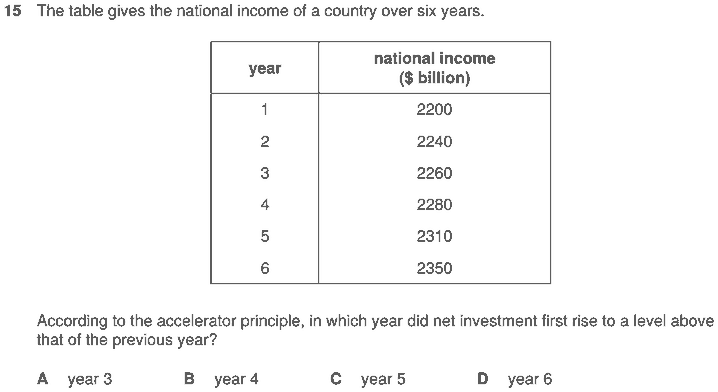
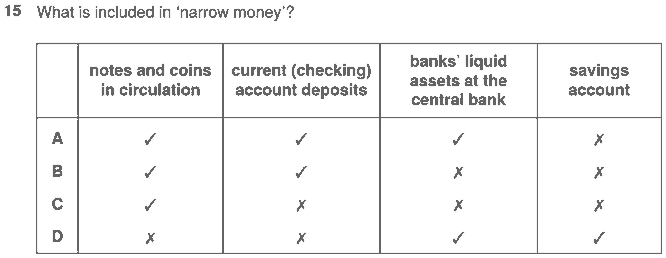
Question 15May/June 20269708/311 mark
Show answer
CCorrect answer
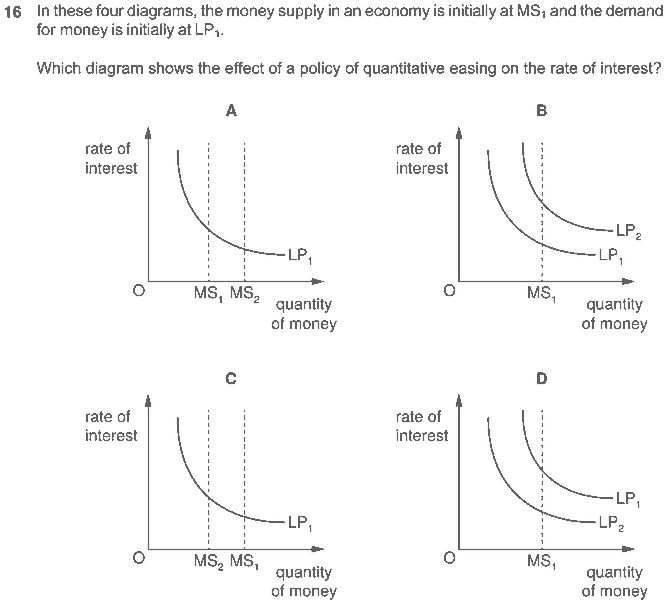
Question 16May/June 20269708/311 mark
What would increase the value of the multiplier?
Aa decrease in the marginal propensity to consume
Ba decrease in the marginal rate of tax
Can increase in the marginal propensity to import
Dan increase in the marginal propensity to save
Show answer
BCorrect answer
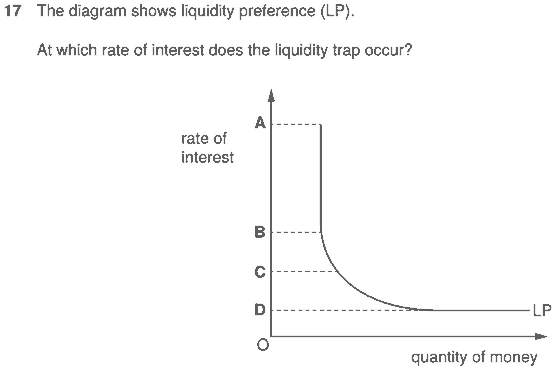
Question 17May/June 20269708/311 mark
Which increase would lead to an immediate increase in national expenditure?
Ainterest rates
Bprivate sector investment
Cthe budget surplus
Dthe savings ratio
Show answer
BCorrect answer
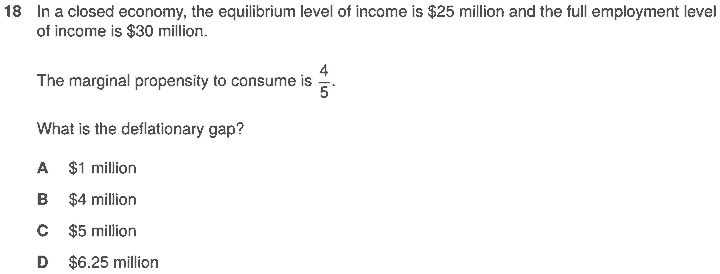
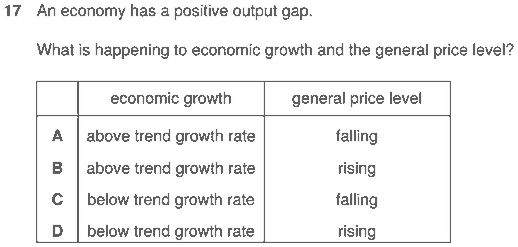
Question 18May/June 20269708/311 mark
Show answer
ACorrect answer
Question 19May/June 20269708/311 mark
What is likely to result in an increase in nominal interest rates?
Aa decrease in the rate of inflation
Ba decrease in the government’s budget deficit
Can increase in the rate of economic growth
Dan increase in the propensity to save
Show answer
CCorrect answer
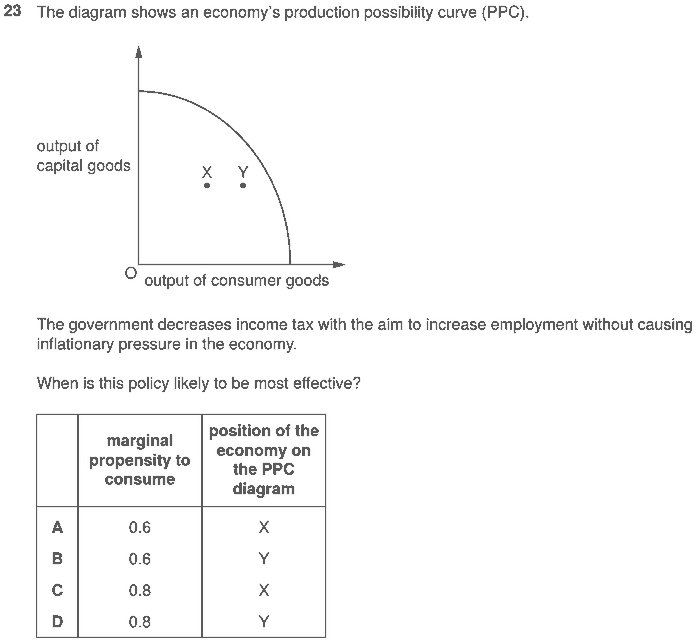
Question 23May/June 20269708/311 mark
Show answer
CCorrect answer
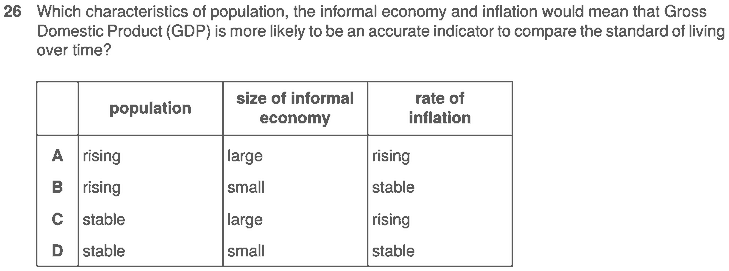
Question 26May/June 20269708/311 mark
Show answer
DCorrect answer
Question 28May/June 20269708/311 mark
Country X’s living standards were compared with country Y’s living standards using real GNP per head converted into US dollars. Country X was ranked above country Y. Which factor might have caused this ranking to be incorrect?
AMarket exchange rates were used rather than purchasing power parity exchange rates.
BGovernment spending on transfer payments was higher in country Y than in country X.
CInflation was higher in country X than in country Y.
DThe distribution of income was more equal in country X than in country Y.
Show answer
ACorrect answer
Question 30May/June 20269708/311 mark
Show answer
ACorrect answer
Question 13May/June 20269708/321 mark
Which statement relating to the distinction between broad and narrow money is correct?
ABoth broad and narrow money can be used as a store of value.
BBroad money includes all financial assets that individuals can trade.
CGovernments exercise direct control over narrow money, but have no influence over
DNarrow money consists of coins and notes only.
Show answer
ACorrect answer
Question 14May/June 20269708/321 mark
The quantity theory of money states that MV = PT. What does T represent?
Atotal amount of tax revenue
Btotal amount of trade
Ctotal value of transfer earnings
Dtotal volume of transactions
Show answer
DCorrect answer
Question 15May/June 20269708/321 mark
An economy had a large negative output gap and C + I + G + X – M was less than full employment potential. What was the likely type of unemployment?
Acyclical
Bfrictional
Cseasonal
Dvoluntary
Show answer
ACorrect answer
Question 16May/June 20269708/321 mark
(Question image not available.)
Show answer
BCorrect answer
Question 17May/June 20269708/321 mark
What is not likely to increase the natural rate of unemployment?
Atechnological developments leading to a mismatch between the skills of workers and the
Bthe introduction of minimum wage legislation
Cworkers delaying searching for jobs because they have enough savings
Dworkers losing their jobs because of a general decline in economic activity
Show answer
DCorrect answer
Question 18May/June 20269708/321 mark
An economy experiences an increase in employment, unemployment and real GDP. What is most likely to explain this outcome?
AThe deflationary gap has narrowed.
BThe economy is experiencing actual as well as potential growth.
CThe economy is operating further away from its potential output.
DThere has been a net outward migration of the adult population.
Show answer
BCorrect answer
Question 19May/June 20269708/321 mark
Pessimistic consumers and entrepreneurs hoard cash rather than spend or invest even when the rate of interest has become very low. What does this describe?
Areserve ratio
Bthe liquidity trap
Cthe marginal propensity to save
Dthe quantity theory of money
Show answer
BCorrect answer
Question 14May/June 20269708/341 mark
What is not a necessary characteristic of money?
Aeasy to carry
Bgenerally acceptable
Crelatively limited in supply
Duseful in its own right
Show answer
DCorrect answer
Question 15May/June 20269708/341 mark
Show answer
ACorrect answer
Question 16May/June 20269708/341 mark
What would result in an increase in the volume of bank deposits?
Aan increase in the public’s desire to hold cash
Ban increase in government expenditure financed by borrowing from the central bank
Can increase in the proportion of their deposits that banks hold in cash
Dan open market sale of securities by the central bank
Show answer
BCorrect answer
Question 17May/June 20269708/341 mark
What is most likely to result in sustainable economic growth?
Aplanting trees to replace those that are being cut down for wood and timber production
Bremoval of rainforests to create grazing land for animals to help meat production
Cthe use of fertilisers for better crop yields that harden the soil and reduce fertility
Dthe use of finite resources instead of renewable resources
Show answer
ACorrect answer
Question 18May/June 20269708/341 mark
What will reduce the value of the investment multiplier?
Alower marginal propensity to import
Bautomatic stabilisers
Ca reduction in marginal tax rates
Da reduction in the level of unemployment benefits
Show answer
BCorrect answer
Question 19May/June 20269708/341 mark
Show answer
DCorrect answer
Question 20May/June 20269708/341 mark
Over a given period, money income in an economy increased by 6%. Over the same period, prices rose on average by 3%. What can be deduced from this?
AThe velocity of circulation of money is equal to two.
BThe velocity of circulation of money remained unchanged.
CThe money supply increased by 9%.
DThe volume of output increased by 3%.
Show answer
DCorrect answer
Question 21May/June 20269708/341 mark
An economy is in macroeconomic equilibrium. Private sector investment is equal to private sector saving but the current account of the balance of payments is in deficit. What can be deduced from this?
AConsumption is being financed partly by residents’ net borrowing from banks.
BThe central bank is accumulating additional reserves of foreign currency.
CThe government has a fiscal deficit financed by borrowing from foreign countries.
DThere was a net outflow of capital to foreign countries.
Show answer
CCorrect answer
Question 26May/June 20269708/341 mark
In 2023, New Zealand had a real Gross Domestic Product per capita of $47 046. Why might this figure not be a good indicator of living standards?
AForeign trade is not included in the figure.
BIt does not take into account changes in population.
CIt does not take into account inflation.
DIt does not take into account the wide differences in the distribution of income.
Show answer
DCorrect answer
Question 14Feb/March 20269708/321 mark
Investment in education and training is most likely to reduce which type of unemployment?
Acyclical
Bfrictional
Cstructural
Dvoluntary
Show answer
CCorrect answer
Question 15Feb/March 20269708/321 mark
An estimate of the consumption function of an economy is given by an equation C = 10 000 + 0.8Y where C = consumption and Y = income. Which conclusion can be drawn from this information?
AThe average propensity to consume is constant.
BThe average propensity to consume increases as income increases.
CThe average propensity to consume is always equal to the marginal propensity to consume.
DThe average propensity to consume is always greater than the marginal propensity to consume.
Show answer
DCorrect answer
Question 16Feb/March 20269708/321 mark
Show answer
CCorrect answer
Question 17Feb/March 20269708/321 mark
(Question image not available.)
Show answer
ACorrect answer
Question 18Feb/March 20269708/321 mark
There are different measures of the money supply from narrow money to broad money. Why are different measures necessary?
Abecause different countries have their own national measures of money supply
Bbecause of disagreement among economists over the importance of money supply
Cbecause of the need to produce different measures of inflation
Dbecause of the need to reflect the different functions that money performs
Show answer
DCorrect answer
Question 19Feb/March 20269708/321 mark
Show answer
BCorrect answer
Question 28Feb/March 20269708/321 mark
During a year, a country’s national income in money terms increased by 3%, prices increased by 4%, and the total population increased by 1%. What was the approximate change in real income per head?
Aa decrease of 1%
Ba decrease of 2%
Can increase of 2%
Dan increase of 3%
Show answer
BCorrect answer
Question 29Feb/March 20269708/321 mark
Show answer
CCorrect answer
Question 14Oct/Nov 20259708/311 mark
Which statement about the quantity theory of money is correct?
AIt suggests changes in liquidity preference lead to proportional changes in the price level.
BIt suggests changes in the money supply lead to proportional changes in the price level.
CIt suggests changes in the price level lead to proportional changes in liquidity preference.
DIt suggests changes in the price level lead to proportional changes in the money supply.
Show answer
BCorrect answer
Question 15Oct/Nov 20259708/311 mark
What is a part of Keynesian economic analysis?
Aa liquidity trap below which interest rates are ineffective
Ban equilibrium price that always clears the market
Ca small value for the government expenditure multiplier
Da vertical short-run aggregate supply curve
Show answer
ACorrect answer
Question 16Oct/Nov 20259708/311 mark
What describes a Keynesian measure to reduce cyclical unemployment?
Aadopting a supply-side policy to retrain unskilled workers
Ballowing the private sector to take over the supply of merit goods
Cincreasing the ratio of capital equipment to manual labour in production
Dusing fiscal policy to increase effective demand
Show answer
DCorrect answer
Question 17Oct/Nov 20259708/311 mark
Show answer
DCorrect answer
Question 20Oct/Nov 20259708/311 mark
What may prevent a government achieving a faster rate of growth of real GDP?
AThe multiplier has a small value.
BThe consumer price index is below its target set by the central bank.
CThe economy is operating on the vertical section of the long-run aggregate supply curve.
DThere is a large negative output gap in the economy.
Show answer
CCorrect answer
Question 13Oct/Nov 20259708/321 mark
What is likely to reduce the domestic money supply?
ABanks being allowed to hold a lower liquidity ratio.
BIndividuals choosing to hold more money in the form of idle balances.
CThe government financing its budget deficit by borrowing from the banking sector.
DThe government increasing its borrowing from other countries.
Show answer
BCorrect answer
Question 14Oct/Nov 20259708/321 mark
The unemployment rate in an economy may continue to rise even after the economy has recovered from a recession. Which explanation for this trend is not correct?
AMany foreign businesses have moved out of the country.
BThe government has abolished the national minimum wage.
CAn increase in net migration of low-skilled workers.
DWorkers lose skills, making them less employable.
Show answer
BCorrect answer
Question 16Oct/Nov 20259708/321 mark
Show answer
ACorrect answer
Question 17Oct/Nov 20259708/321 mark
What is most likely to increase if an economy enters a negative output gap?
Abusiness confidence
Beconomic growth rate
Cinflation rate
Dunemployment rate
Show answer
DCorrect answer
Question 19Oct/Nov 20259708/321 mark
What would cause an individual’s demand curve for an active money balance to move to the left?
Aan increase in the frequency of income payments
Ban increase in the general price level
Can increase in the individual’s income
Dan increase in the rate of interest
Show answer
ACorrect answer
Question 13Oct/Nov 20259708/331 mark
Which stage of the business (trade) cycle is most likely to be characterised by an increasing negative output gap?
Aboom
Brecession
Crecovery
Dtrough
Show answer
BCorrect answer
Question 14Oct/Nov 20259708/331 mark
Show answer
ACorrect answer
Question 15Oct/Nov 20259708/331 mark
Which policy is most likely to lead to a reduction in the natural rate of unemployment?
Aan increase in government expenditure on goods and services
Ban increase in government expenditure on training schemes to address skill shortages
Can increase in the period when the unemployed are eligible for welfare benefits
Dan increase in the minimum wage
Show answer
BCorrect answer
Question 16Oct/Nov 20259708/331 mark
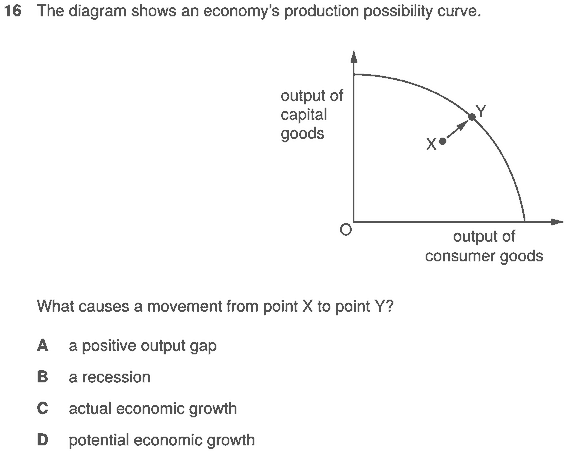
On a diagram showing a production possibility curve, what definitely represents long-run economic growth?
Aa change in the slope of the curve
Ba movement from a point below the curve to a point on the curve
Ca movement from one point to another along a given curve
Dan outward shift of the curve
Show answer
DCorrect answer
Question 17Oct/Nov 20259708/331 mark
Show answer
ACorrect answer
Question 18Oct/Nov 20259708/331 mark
Show answer
BCorrect answer
Question 26Oct/Nov 20259708/331 mark
Show answer
ACorrect answer
Question 15Oct/Nov 20259708/341 mark
What leads to an inflationary gap?
AAggregate demand is greater than the maximum potential output of the economy.
BInvestment increases at a greater rate than profits received by a firm.
CThe economy is operating below its full capacity.
DInnovation results in increased productivity in the economy.
Show answer
ACorrect answer
Question 16Oct/Nov 20259708/341 mark
An open economy has a positive output gap. What is likely to be decreasing?
Aexpenditure on imports
Bleisure time of workers
Cnominal wage rates
Dthe general price level
Show answer
BCorrect answer
Question 17Oct/Nov 20259708/341 mark
In a two-sector economy, autonomous consumer expenditure increases by $100 billion, autonomous investment expenditure increases by $200 billion, and the marginal propensity to consume is 0.5. What will the increase in National Income be?
A$150 billion
B$300 billion
C$450 billion
D$600 billion
Show answer
DCorrect answer
Question 19Oct/Nov 20259708/341 mark
What is an example of a demand-side macroeconomic policy that would reduce cyclical unemployment?
Aan increase in government spending on new infrastructure such as roads
Ban increase in government spending on retraining workers
Ca reduction in the rate of tax on imports
Dan increase in the rate of tax on goods and services
Show answer
ACorrect answer
Question 20Oct/Nov 20259708/341 mark
Show answer
BCorrect answer
Question 15May/June 20259708/311 mark
In an economy with no government sector or foreign trade, the marginal propensity to consume is 0.6. If the equilibrium level of national income is $10 000 million and the full employment level of national income is $15 000 million, by how much would investment have to increase to achieve full employment?
A$1666 million
B$2000 million
C$3012 million
D$5000 million
Show answer
BCorrect answer
Question 16May/June 20259708/311 mark
What is a definition of hysteresis unemployment?
Apeople who become temporarily unemployed because it takes a short period of time to find a job after they leave school
Bpeople who become unemployed when there is a recession but who will find employment as the economy comes out of recession
Cpeople who become unemployed for a long period of time due to a loss of job skills and work experience while unemployed
Dpeople who become unemployed when established firms close and new firms are created as technology advances
Show answer
CCorrect answer
Question 17May/June 20259708/311 mark
Show answer
BCorrect answer
Question 20May/June 20259708/311 mark
Show answer
CCorrect answer
Question 23May/June 20259708/311 mark
An economy is at its natural rate of unemployment. Under which circumstances will an increase in government spending aimed at reducing unemployment be most likely to conflict with a government’s objective of low inflation?
Aif inflationary expectations are unchanged
Bif inflationary expectations fall
Cif labour productivity increases
Dif labour supply increases
Show answer
ACorrect answer
Question 15May/June 20259708/321 mark
An initial injection into the circular flow of income causes a much larger increase in GDP. What does this define?
Aautonomous investment
Bdemand-pull inflation
Cthe accelerator principle
Dthe national income multiplier
Show answer
DCorrect answer
Question 16May/June 20259708/321 mark
An increase in a country’s inflation rate causes real incomes to decline, but consumers decide to maintain their living standards. What has increased?
Aautonomous consumer spending
Bautonomous saving
Cinduced consumer spending
Dinduced savings
Show answer
ACorrect answer
Question 18May/June 20259708/321 mark
Show answer
BCorrect answer
Question 19May/June 20259708/321 mark
Show answer
ACorrect answer
Question 20May/June 20259708/321 mark
A government decreases interest rates to reduce unemployment but finds this has little effect due to hysteresis. What causes this hysteresis?
Acapital investment increases
Bfewer people are encouraged to save
Cskills of unemployed workers become outdated
Dthe money supply increases
Show answer
CCorrect answer
Question 28May/June 20259708/321 mark
Show answer
ACorrect answer
Question 13May/June 20259708/341 mark
In a closed economy with no government, the level of consumption spending is determined by the equation C = a + bY. What does b represent in this equation?
Aautonomous consumption
Bautonomous investment
Cthe average propensity to consume
Dthe marginal propensity to consume
Show answer
DCorrect answer
Question 14May/June 20259708/341 mark
Show answer
ACorrect answer
Question 15May/June 20259708/341 mark
According to the accelerator theory, what would cause investment in an economy to be lower than in the previous year?
Aa lower marginal propensity to consume than in the previous year
Ba lower marginal propensity to save than in the previous year
Ca smaller fall in national income than occurred in the previous year
Da smaller rise in national income than occurred in the previous year
Show answer
DCorrect answer
Question 16May/June 20259708/341 mark
What is the best description of sustainable economic development?
Aa long-term increase in the actual output of an economy
Ba long-term increase in living standards without damage to the environment
Ca long-term increase in the productive potential of an economy
Da long-term increase in the living standards of every member of society
Show answer
BCorrect answer
Question 17May/June 20259708/341 mark
What is least likely to increase the natural rate of unemployment?
Aa decrease in information about vacancies
Ba decrease in trade union power
Can increase in unemployment benefits
Dan increase in immigration
Show answer
BCorrect answer
Question 18May/June 20259708/341 mark
In Keynesian economic theory, what is the purpose of interest?
Ato bring national income and expenditure into line
Bto control the level of economic growth
Cto create a balance between savings and investment
Dto provide a reward for surrendering liquidity
Show answer
DCorrect answer
Question 19May/June 20259708/341 mark
The quantity theory of money is sometimes represented by the equation MV = PT. Which statement is not correct?
AM is a measure of the total value of notes and coins in circulation in the country.
BP measures the average level of prices in the country.
CT stands for the quantity of real transactions during the year.
DV represents the number of times a unit of money is spent during a given time period.
Show answer
ACorrect answer
Question 15Feb/March 20259708/321 mark
What does the accelerator principle explain?
Ahow changes in consumption lead to changes in income
Bhow changes in income lead to changes in consumption
Chow changes in income lead to changes in investment
Dhow changes in investment lead to changes in income
Show answer
CCorrect answer
Question 16Feb/March 20259708/321 mark
Show answer
CCorrect answer
Question 17Feb/March 20259708/321 mark
In the quantity theory of money equation, MV = PT, V is defined as the income velocity of circulation. Which change would tend to reduce the value of V?
Aa move to monthly rather than weekly salary payments by firms
Ban increase in interest rates
Can increase in the use of cash machines to reduce money balances held
Da decrease in the use of credit cards by individuals
Show answer
ACorrect answer
Question 19Feb/March 20259708/321 mark
Show answer
ACorrect answer
Question 20Feb/March 20259708/321 mark
Show answer
ACorrect answer
Question 24Feb/March 20259708/321 mark
In an economy with unemployed resources the marginal propensity to consume is 0.2. The government increases its budget deficit and finances it by selling bonds to the non-bank private sector. What is the likely consequence of this?
AThe currency will depreciate, increasing exports and reducing the trade deficit.
BThe increase in real output will be limited as the value of the multiplier is low.
CThe money supply will fall, leading to a reduction in aggregate demand.
DThere will be a decrease in the rate of interest, causing demand-pull inflation.
Show answer
BCorrect answer
Paper 4 · Data response and essays (22)
Case study: Interest Rates and Exchange Rates
Many commercial banks in Japan raised their interest rates on customer accounts in early 2024 for the first time in 17 years. Some banks also increased the interest rates on their housing loans (mortgages), which placed a heavier burden on borrowers.
The rise in interest rates followed the ending of a policy of negative interest rates used by the Bank of Japan (BOJ), the country’s central bank. Previously, the BOJ had set interest rates at –0.1% on some of the deposits made by commercial banks at the central bank.
The increase in interest rates coincided with a falling unemployment rate and expectations that Japan’s economy would grow further in the second half of 2024. This economic growth would be caused by higher wages, increased consumer spending and a depreciation of Japan’s currency, the yen.
The BOJ has a target inflation rate of 2%, but core inflation, which excludes fresh food prices, was last reported at 2.6% in March 2024. Core inflation was forecast to be above target for at least a year. This gave the central bank an opportunity to increase interest rates further. Higher interest rates, however, can reduce demand for loans and restrain economic growth.
Higher interest rates in Japan would usually lead to higher capital inflows from foreign savers causing an appreciation of the yen. Compared to other major economies, however, the interest rates in Japan were still very low. When the interest rate set by the BOJ was 0.1%, the equivalent rate was 5.25% in both the United States (US) and the United Kingdom (UK) and 4.5% in the Eurozone.
The value of the yen fell to a 34-year low in April 2024 as the chances of an expected cut in US interest rates diminished. Intervention by the BOJ to support the yen was seen as a possibility by the foreign exchange markets to restore confidence in the currency and reduce imported inflation.
On the other hand, the weak yen helped Japan’s balance of trade in goods and services. It encouraged export sales despite relatively low global economic growth. Export growth occurred across several products, particularly in transportation equipment. The number of foreign visitors to Japan also increased due to the weak yen.
Sources: Adapted from: japantimes.co.jp, 6 May 2024 morningstar.co.uk, 21 March 2024 kyodonews.net, 1 March 2024 deloitte.com, 18 October 2024
Question 1(a)May/June 20269708/414 marks
(a) Explain two pieces of evidence from the extract that show Japan was in an expansion phase of the business (trade) cycle in 2024. [4]
Show mark scheme
Explain two pieces of evidence from the extract that show Japan was in an expansion phase of the business (trade) cycle in 2024.
Unemployment is falling (1) Wages are growing and consumer spending is rising (1) rising aggregate demand (1) rising output/GDP (1)
Rising interest rates (1) Inflation is high/ above target (1)
Note: each identified piece of evidence requires a brief explanation (1+1)
Question 1(b)May/June 20269708/414 marks
(b) Explain how Japan’s commercial banks could have helped the BOJ achieve its target inflation rate of 2%. [4]
Show mark scheme
Explain how Japan’s commercial banks could have helped the BOJ achieve its target inflation rate of 2%.
Function of commercial banks in general: providing deposit accounts (demand deposit account, savings account), lending money (overdrafts, loans), and/or holding or providing cash, securities, loans, deposits, equity (1)
commercial banks as sources of credit (1) could help decrease the money supply in the economy (1) less lending leading to less investments and consumption (1)
higher interest rates could lead to more savings (1) discourage borrowing
(1) decreasing consumption (1) decreasing aggregate demand (1) encourage more hot money inflows (1) increasing the value of the domestic currency (1) decreasing imported inflation (1)
In summary, commercial banks could help achieve the 2% target by making borrowing more expensive, encouraging saving, and restricting the growth of credit all of which reduce spending and inflationary pressures.
Note: each identified point requires a brief explanation (1+1)
Question 4May/June 20269708/4120 marks
4 Due to the multiplier process, governments conducting an expansionary fiscal policy do not need to increase spending by the full amount of the negative output gap to bring the output of the economy to its full employment level.
Evaluate this statement. [20]
Show mark scheme
Due to the multiplier process, governments conducting an expansionary fiscal policy do not need to increase spending by the full amount of the negative output gap to bring the output of the economy to its full employment level. Evaluate this statement.
Use Table A: AO1 Knowledge and understanding and AO2 Analysis and Table B: AO3 Evaluation to mark candidate responses to this question.
AO1 and AO2 out of 8 marks. AO3 out of 4 marks.
Indicative content Responses may include:
AO1 Knowledge and understanding and AO2 Analysis
Negative output gap as the condition where actual output is less than potential output.
The concept of full employment where all available resources in the economy are fully and efficiently used, where there is no cyclical unemployment.
Aggregate demand is a determinant of the output of an economy.
Expansionary fiscal policy is when the government decreases taxes and increases government spending, incurring a budget deficit.
Government spending is an injection into the circular flow of income and is a component of aggregate demand.
Multiplier = 1 / (1-MPC) = 1/ MPW = 1/ (MPS + MTR + MPM) = Change in National Income/ Change in Injection
Multiplier process leads to multiple rounds of spending due to an injection
The increase in income leads to induced consumption and investment spending by households and businesses.
As households have more disposable income, they increase their consumption of goods and services.
Similarly, businesses may invest in new capital equipment or expand production capacity to meet the growing demand.
The initial injection of spending sets off a chain reaction of additional rounds of spending, as the increase in income from one round leads to further increases in consumption and investment, creating a multiplier effect on aggregate demand.
An injection of government spending leading to a more than proportionate increase in national income.
Examples of what the government can spend on and the additional rounds of spending that it creates.
AD/AS diagram showing more than one shift in AD (or 1 shift with written explanation that the amount of increase is more than the amount the government spent)
AO3 Evaluation
The uncertainty of the existence of the multiplier may lead to government spending being insufficient.
Uncertainty could also lead to overshooting, leading to higher inflation.
Government spending is a small part of the aggregate demand of the economy and therefore may have an insignificant impact on the national output levels, even with the multiplier.
Expansionary fiscal policy could lead to the crowding out effect.
National debt issues could emerge such as high debt servicing ratio, lower investor confidence, debt crises.
MPM in the economy might be very large /MPC in the economy might be very small, leading to small multiplier.
Accept all valid responses.
AO1 Knowledge and understanding and AO2 Analysis
AO3 Evaluation
Question 4May/June 20269708/4220 marks
4 Evaluate whether the quantity theory of money is a satisfactory explanation of the cause of inflation. [20]
Show mark scheme
Evaluate whether the quantity theory of money is a satisfactory explanation of the cause of inflation. Use TableA: AO1 Knowledge and understanding and AO2 Analysis and Table B: AO3 Evaluation to mark candidate responses to thisquestion.
AO1 and AO2 out of 14marks. AO3 out of 6 marks.
Indicative content Responses may include:
AO1 Knowledge and understanding and AO2 Analysis
A monetarist view of inflation caused by an increase in the money supply.
The quantity theory of money states MV = PQ
Definitions of M, V, P, and Q.
Explanation and analysis of how changes in M will affect P given the assumptions regarding V and Q to show that P is proportionate to M.
AO3 Evaluation
This assumes that Q the quantity of output is constant (perfectly inelastic). In the short run with unemployment Q can grow as unemployment falls. It also ignores that in the long run there be technological development that raise productivity or the discovery of resources that allow Q to increase.
V the velocity of circulation is assumed to be constant, but this may not be the case. If there are changes in people’s transaction/precautionary demand for money the velocity may increase or decrease.
It ignores the exchange rate effects of an increase in the money supply. Changes in the money supply affect the rate of interest which in turn affects the relative demand for a country’s currency. If M increases, then interest rates falls and the currency is sold reducing the foreign exchange rate. This affects the relative price of imports/exports and therefore the balance of trade (X-M) and thus Q as more imports and fewer exports take place.
Other explanations of inflation may provide a better analysis.
The quantity theory is an identity not an equation.
Accept all valid responses.
AO1 Knowledge and understanding and AO2Analysis
AO3 Evaluation4
Question 5May/June 20269708/4220 marks
5 Consider whether the use of gross national income (GNI) alone is sufficient to measure the standard of living in a high-income country (HIC). [20]
Show mark scheme
Consider whether the use of gross national income (GNI) alone is sufficient to measure the standard of living in a high-income country. Use TableA: AO1 Knowledge and understanding and AO2 Analysis and Table B: AO3 Evaluation to mark candidate responses to thisquestion.
AO1 and AO2 out of 14marks. AO3 out of 6 marks.
AO1 Knowledge and understanding and AO2 Analysis
Definitions of GNI, standard of living material and non-material, and HIC
Conversion of GNI to real GNI per capita as a measure of material standard of living
Identification of link between material and non-material standard of living
Given the level of real GNI pc in HIC are the differences significant in a real sense?
AO3 Evaluation
Problems of measuring real GNI pc Data collection, informal economy non-marketed activities
Changing range of goods and services
The impact of negative and positive externalities on the accuracy of the measure of the non-material standard of living
Impact on workers of striving for a high real GNI pc – long hours, commuting
Effects on sustainability of high GNI
Justified consideration of alternative measure of standard of living HDI/MPI etc.
Consideration of the Gini coefficient
Accept all valid responses.
AO1 Knowledge and understanding and AO2 Analysis
AO3 Evaluation
Case study: Environmental policies in Czechia
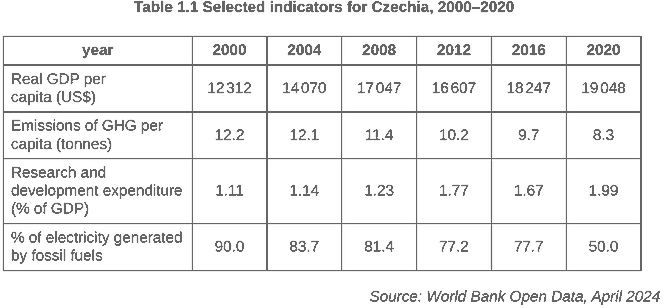
Czechia, a country in the European Union, is experiencing strong growth of its gross domestic product (GDP). Climate change, however, is affecting its agriculture and forestry sectors and people’s health. According to Table 1.1, Czechia currently generates 50% of its electricity using fossil fuels (coal, oil, and gas), which emit greenhouse gases (GHG) and other air pollutants. Nuclear power plants generate 32% and renewable sources generate 18%. Czechia also has coal‑fuelled heating systems, and industry that emits a lot of GHG, particularly in car production. Despite an increase in the use of renewables and energy efficiency measures, Czechia remains highly dependent on fossil fuels. If Czechia is to reach net zero carbon emissions by 2050, further measures are needed.
Czechia’s relatively low research and development (R&D) spending in the private sector is shown in Table 1.1. Combined with inadequate digital and transport infrastructure, this restricts innovation. However, energy efficiency regulations, such as setting energy efficiency standards for buildings, will incentivise private investment. Increased government spending on renewable energy projects and energy efficiency measures, such as modernising electricity grids, would act as a fiscal injection. There is not enough skilled labour at present to install new technologies in the renewable energy sector, but education and training can be improved.
The government needs to ensure that energy prices do not rise too much, which would add to firms’ costs. If Czechia fulfils its commitment to phase out the use of coal to generate electricity by 2033, the high levels of unemployment and poverty in Czechia’s coal‑producing region could increase.
Since 2000, transport’s use of energy has increased by 64%. As incomes have grown, the use of public transport, such as rail and buses, has decreased from 37% to 18% of all passenger kilometres travelled, while the use of private cars has increased from 63% to 82%. Therefore, policies to improve the quality and availability of public transport are needed. Increasing investment in public transport would also promote worker mobility and productivity growth.
Higher taxes on cars and electricity would raise revenues that could partly finance environmental projects. The structure of vehicle taxes in Czechia encourages the use of hybrid and electric cars, for example electric‑car owners are exempt from road tax and can park for free in cities. But further measures to facilitate the use of electric vehicles, such as providing charging infrastructure, are necessary.
Sources: International Monetary Fund : Enhancing the green transition in Czechia Odysee Mure: European Union: Czechia : Energy profile, March 2024
Question 1(a)May/June 20269708/442 marks
(a) Using information from Table 1.1, identify the relationship between the standard of living and greenhouse gas (GHG) emissions in Czechia. [2]
Show mark scheme
Using information from Table 1.1, identify the relationship between the standard of living and greenhouse gas emissions in Czechia.
GDP/capita (indicating standard of living) is rising (over time) (1)
Greenhouse gas emissions (per capita) are falling (over time) (1)
Negative/inverse relationship/correlation (1)
Question 1(d)May/June 20269708/448 marks
(d) Using the information and your economics knowledge, assess whether there is a conflict between economic growth and sustainability in Czechia. [8]
Show mark scheme
Using the information and your economics knowledge, assess whether there is a conflict between economic growth and sustainability in Czechia. Reasons why there is not a conflict between economic growth and sustainability (Maximum of 4)
Government policies (aiming for net zero by 2050) and environmental projects using fiscal policy/budget (1), which will also cause growth by increasing AD and AS (1) will cause spending on measures to limit/adapt to climate change (sustainability (1))
Emissions of GHG per capita/(relative) and use of fossil fuels are falling as the economy grows (1) due to more education/technology (1) therefore sustainable (1)
Training of labour/increasing R&D will encourage both growth (1) (by shifting AS and LRAS to the right with increased productivity) (1) and more clean technology (1)
Setting energy efficiency regulations/standards will lead to more investment, which will add to growth (through increases in AD and AS) (1)
Increasing investment in public transport will add to AD and LRAS (1) and improve sustainability
Measures to encourage use of electric vehicles will add to AD (1)
Sustainability HAS to be mentioned for the 4th mark. Reasons why there is a conflict between economic growth and sustainability (Maximum of 4)
Share of energy generated from renewables is too low (18%) therefore significant negative externalities will remain (1)
Structure of industry/heating systems/energy inefficient systems add to negative externalities (1)
Changing to renewables etc. causes the price of energy to rise, which will raise firms’ costs and may impede growth by shifting AS leftwards/upwards (1)
As incomes rise with growth, use of cars (in preference to public transport) rises (1)
Reducing the use of coal/oil/gas causes unemployment in certain areas, lowering growth (1)
Higher taxes on emitters (such as cars and electricity) may hamper growth (1)
Lack of sustainability HAS to be mentioned for 3rd/4th mark
Max 3 marks for a well-developed point
Maximum of 7 Conclusion (which should not just be a summary of earlier points made) (1)
Question 4May/June 20269708/4420 marks
4 Knowledge of both the multiplier and the accelerator enable a government to implement effective fiscal policies to close a deflationary gap.
Evaluate this statement. [20]
Show mark scheme
Knowledge of both the multiplier and the accelerator enable a government to implement effective fiscal policies to close a deflationary gap. Evaluate this statement.
Use Table A: AO1 Knowledge and understanding and AO2 Analysis and Table B: AO3 Evaluation to mark candidate responses to this question.
AO1 and AO2 out of 14 marks. AO3 out of 6 marks.
Indicative content
AO1 Knowledge and understanding and AO2 Analysis Responses may include:
Explanation of a deflationary gap in terms of the full employment level of income and the equilibrium level of income.
Explanation of multiplier, accelerator and fiscal policies
Formula for the multiplier and accelerator.
Explanation of the multiplier mechanism after an increase in government spending and/or a decrease in taxation.
Explanation of the accelerator mechanism after an increase in real gross domestic product leading to an increase in induced investment.
Analysis of the effects of expansionary fiscal policy on equilibrium level of national income and the level of real output, the price level and employment. Use of AD/AS diagram, showing a deflationary gap, with shifts in AD/AS (and LRAS).
AO3 Evaluation
Effectiveness depends on accurate calculations of marginal propensity to consume, the potential level (full employment level) of national income, and the present level of national income.
Government failure can occur if variables change/forecasts are wrong.
Time lags in implementation.
Other influences on consumption and investment, such as confidence and interest rates.
Supply shocks will change planned outcomes
Effectiveness of an expansionary fiscal policy may be reduced if government needs to borrow funds to finance a budget deficit.
Marginal propensity to consume may change in the long run.
Accept all valid responses.
AO1 Knowledge and understanding and AO2 Analysis
AO3 Evaluation
Case study: Widening levels of inequality resulting from the COVID-19 pandemic
The COVID-19 pandemic led to a global economic crisis, causing an increase in inequality within and between countries. Whilst economic policy responses helped reduce infection rates in the short run, increases in public and private debt resulted in significantly greater levels of inequality.
During 2020, it became apparent that many households and firms could not cope with the income shock caused by the pandemic. Globally, earned income fell by US$3.5 trillion in the first nine months of 2020, a fall of 10.7% compared with the same period the year before. Studies have shown that before the pandemic more than half of all households in emerging and advanced economies had savings equivalent to 90 days of income. Firms, on average, had 55 days of cash reserves. Many of those households and firms were already struggling with their debt repayments and, once public lockdowns were established, their incomes and revenues fell.
For the first time in a generation global poverty increased. In 2020 unemployment grew in most low-income countries (LICs). Income losses were greatest amongst young people, the self-employed and casual workers. Women were particularly affected because they tended to work in sectors which were more sensitive to lockdowns and social distancing, for example, the hospitality, retail and personal services sectors.
Small, and medium-sized firms were vulnerable because they were also likely to operate within those sensitive sectors. Because smaller firms had limited access to credit, they suffered from revenue losses more than larger firms.
A sector that does appear to have done well out of lockdowns is the digital sector. One US company, which provides logistics, communications, social media and financial technology services saw its revenue increase from US$233 bn in 2018 to US$514 bn in 2022. Similarly, a Chinese company involved in video games, social media and investment, saw its revenues rise from US$47 bn to US$84 bn over the same time period.
To try and ease pressures on their economies, governments adopted various fiscal and monetary policy tools including direct income support, writing off debt, and asset purchase programmes by their central banks. Direct income support took the form of transfer payments to workers and firms unable to earn due to lockdowns.
High-income countries (HICs) could offer more of these resources than LICs which had limited access to credit markets and high levels of international debt. In middle-income countries (MICs) assistance varied according to the ability and the willingness of governments to spend on such packages.
Figure 1 Additional government spending in response to the COVID-19 pandemic as a percentage of gross domestic product (GDP), selected countries
Question 1(c)Feb/March 20269708/425 marks
(c) Consider why lockdowns affected those working in the ‘digital sector’ differently from those working in ‘the hospitality, retail, and personal services sectors’. [5]
Show mark scheme
Consider why lockdowns affected those working in the ‘digital sector’ differently from those working in the ‘hospitality, retail, and personal service sectors’. Those working in hospitality, retail and personal services sectors:
work on-site and therefore cannot work from home (1)
low level of skills required and tend to have low incomes (1)
During lockdown public unable to leave their homes and enjoy the night- time economy/retail shopping → lack of demand for workers. (1)
Firms unable to pay rent → declining revenue for commercial property owners. (1)
Reduced wages leading to less discretionary income, increased unemployment, leading to a fall in standard of living. (1) (Max 2 marks) Accept any valid point for 1 mark. Those working in digital sector:
Digital sector shows significant growth during the period. (1)
Those working in digital sector tend to be better educated/higher earners/male. (1)
Opportunity to work from home, therefore limited disruption to wages. (1)
Access to internet leading to an increase in demand for digital services.
(1)
increase in revenue (Max 2 marks) Accept any valid point for 1 mark. Relevant conclusion 1 mark.
Case study: Working overseas
Many low-income countries have large proportions of the population below the World Bank’s absolute poverty level of $2.15 per day (United States dollars, 2022). One way in which these countries try to reduce their poverty is by the migration of workers to richer countries. The migrants send a portion of their incomes, known as remittances, back home to support their families.
These overseas workers are a link between migration and development. The flow of remittance money is greater than the foreign direct investment and official development aid received by middle-income and low-income countries. Total remittances received by those countries in 2022 was $650 billion, of which 45% ($293 billion) was received by only five countries.
About 50% of migrants from low-income countries went to high-income countries.
Migrants can find their incomes increase significantly. A nurse may make seven times more in Australia than in the Philippines, adjusted for purchasing power parity (PPP).
Unlike official aid, remittances flow directly to their receivers and are a stable source of income. They can buy extra food and they may provide savings for the receiver. They may reduce child labour in disadvantaged families and allow for higher spending on education through higher enrolments and more years of completed schooling.
Migration can reduce unemployment and raise wages in home countries. Migration may lead to larger benefits for the home country by increasing the rates of return on human capital caused by the creation of better, more productive, and higher paying jobs.
When the flow of migrants goes to a host country whose population is ageing, it may reduce the average age of the population. This can lead to an increase in the size of the labour force, reduce the age dependency ratio and make a positive tax contribution. The migrants increase the demand for host country output and may utilise housing in less popular areas. Those with a high level of education make an even more significant contribution to economic output.
Sources: The Guardian, 23 August 2023 asia.nikkei.com, 3 March 2023 imf.org, March 2020
Question 1(d)Oct/Nov 20259708/417 marks
(d) Consider if the article contains sufficient information to support the view that migrants have only a beneficial economic impact on the host country. [7]
Show mark scheme
Considerif the article contains sufficient informationto support the view that migrants have only a beneficial economic impact on the host country. Beneficial to host country: Higher labour force(1), pay taxes (1) allows pay- as you-go pension system (1), increases demand (1), Increased productivity and economic growth (1)Entrepreneurship e.g.new business startups Max 3. Disadvantages: The effects of higher demand for housing (1),health services
(1), education services (1). cultural differences (1) are not mentioned, Other considerations-wage suppression in some sectors, short term unemployment effects, integration/training costs, regional disparities Max 3. Justified Conclusion (1)
Question 5Oct/Nov 20259708/4120 marks
5 Economic growth can only occur when an economy is below full employment.
Evaluate this statement. [20]
Show mark scheme
Economic growth can only occur when an economy is below full employment. Evaluate this statement. Use TableA:AO1 Knowledge and understanding andAO2 Analysis and Table B: AO3 Evaluation to mark candidate responses to this question.
AO1 and AO2 out of 14 marks. AO3 out of 6 marks.
Indicative content Responses may include:
AO1 Knowledge and understanding and AO2Analysis
Definition of economic growth: increase in real GDP/output over time.
Definition of full employment: whenall resources, especially labour, are used efficiently (natural rate of unemployment remains).
Below full employment (Keynesian range): Growth possible via increase in AD (e.g., higher consumption, investment). Movement from inside PPF towards PPF. Little inflationary pressure due to spare capacity.
At full employment (Classical range): Growth possible only through potential growth – rightward shift of LRAS or outward shift of PPF. Driven by productivity, technology, education, capital formation.
Diagrams: AD–AS showing movement along the AS curve below full employment. LRAS shift showing potential growth.
AO3 Evaluation
The statement is too narrow – growth can occur both below and at full employment.
Context matters: In a recession, growth typically comes from AD increases (below full employment). In the long run, growth depends on supply-side improvements (even at full employment).
Inflationary pressures: At/near full employment, AD-led growth may cause inflation rather than real growth.
Judgement: Economic growth can occur when below full employment (actual growth) and at full employment (potential growth) – so the statement is partially correct.
Is unemployment the principal economic problem and the opportunity costs of pursuing low unemployment rather than balance of payments equilibrium etc.
The effect of the multiplier when considering the extent of the increase in GNI.
A discussion of whether C, I or (X–M) can increase without unemployment.
AO1 Knowledge and understanding and AO2Analysis
AO3 Evaluation
Case study: Resources in Brazil
Between 2000 and 2020, Brazilian GDP, measured in US dollars ($), rose from $1.19 trillion to $1.89 trillion at constant prices (2015). In the same period GDP per head rose from $6745 to $8204 at constant prices (2015).
The strength of the Brazilian economy lies in the variety and quantity of its natural resources. For example, Brazil is one of the world’s largest exporters of agricultural commodities, mainly soya and beef. There are also significant exports of minerals. Brazil is the second largest iron ore producer in the world and extracts 3.4% of the world’s crude oil.
World agricultural markets are dominated by four large commodity traders that buy and sell products such as grain and soya. They have grown through both horizontal integration and vertical integration. These traders own many large farms, they process farm produce and transport it to trade on international markets. In addition to buying and selling, the traders provide seed and fertiliser to farmers and supply storage for their products. They use agricultural by-products to produce items like biofuel. These traders also provide financial services to these markets.
Commodity traders are very important to the development of complex global food markets. Food prices, access to scarce resources such as land and water, climate change and food security are all affected by the activities of traders. In Brazil, the output of 15 000 farmers is purchased by a single trader.
In Brazil the development of agriculture, mining and oil extraction all contribute to environmental degradation. Both agriculture and mining have been accompanied by deforestation of the Amazon rainforest. Access roads to mining areas also lead to deforestation. Waste water from mining activity is frequently stored in reservoirs behind dams. On two occasions in the last 10 years these dams failed to hold back the water. This led to widespread flooding, the discharge of pollutants such as mercury into rivers, and deaths.
Sources: The Guardian, 23 August 2022
Cereal Secrets, Oxfam Research Report, August 2012 oec.world/en/profile, August 2023
Question 1(a)Oct/Nov 20259708/423 marks
(a) Explain the significance of measuring GDP at constant prices. [3]
Show mark scheme
Explain the significance of measuring GDP at constant prices. The total output from within a country (1) Constant prices mean changes in prices are taken into account (1) which allows for the measurement of the real change in output (1) Easier comparisons of GDP (1)
Question 4Oct/Nov 20259708/4420 marks
4 A country imposes a tariff of 20% on imported goods and restricts the number of immigrants entering the country.
Evaluate, with the aid of a diagram(s), the impact of these two policies on the rate of inflation in that country. [20]
Show mark scheme
A countryimposes a tariff of 20% on imported goods and restricts the number of immigrants entering the country. Evaluate, with the aid of a diagram(s), the impact of these two policies on the rate of inflation in that country. Use TableA:AO1 Knowledge and understanding andAO2 Analysis and Table B: AO3 Evaluation to mark candidate responses to this question.
AO1 and AO2 out of 14 marks. AO3 out of 6 marks.
Indicative content Responses may include:
AO1 Knowledge and understanding and AO2 Analysis
Definition of a tariff and analysis of the effect of a tariff on the price of goods and a development of this in terms of the direct effect on the price of goods bought by consumers.
The analysis may also be in terms of the cost of imported raw materials and cost push inflation.
Analysis of impact on macroeconomy in terms of leftwards shift of aggregate supply (AS) promoting cost push inflation.
A similar analysis of the effect of restricting the supply of labour and reducing any potential decrease in the general wage rate.
A relevant diagram to show either the effect of a tariff on cost/prices, the restriction of immigrants and the effect on wages and the impact on AS
AO3 Evaluation
The elasticity of supply of domestically produced goods subject to the tariff.
The availability of domestic labour force prepared to do jobs.
The rate of inflation will also depend on the level of aggregate demand (AD). The restriction on immigrants will reduce the level of demand and hence demand pull inflation.
Limited migration may allow domestic workers to claim higher wages and contribute to cost push inflation.
Accept all valid responses.
AO1 Knowledge and understanding and AO2 Analysis
AO3 Evaluation
Question 5Oct/Nov 20259708/4420 marks
5 Evaluate whether an increase in a government’s budget deficit will always lead to economic growth. [20]
Show mark scheme
Evaluate whether an increase in a government’s budget deficit will always lead to economic growth. Use TableA:AO1 Knowledge and understanding andAO2 Analysis and Table B: AO3 Evaluation to mark candidate responses to this question.
AO1 and AO2 out of 14 marks. AO3 out of 6 marks.
AO1 Knowledge and understanding and AO2 Analysis
Definitions of budget deficit, economic growth.
Use of AD/AS models or 45o model to analyse government budget deficit.
Use of the circular flow of income to explain the effect of an increase in government spendingincreases the level of aggregate demand within the economy.
Reference to the short run and long run economic growth.
Reference can be made to employment, inflation, the balance of payments
Impact of supply side expenditure of budget deficit on education/investment
AO3 Evaluation
Evaluation may be by individual measure or by comparing the measures.
Closeness of economy to full employment.
Use of Phillips’ Curve to reflect inflationary impact.
Commentary on the size of marginal propensity to consume and its effects on the size of the multiplier.
The role of expectations in determining the reactions to expansionary fiscal policy
Reference to the multiplier being an analysis of the trade cycle which exists for only a short run and that the accelerator effect is needed to increase investment and an outwards shift in the production possibility curve for the long run effects.
Accept all valid responses
AO1 Knowledge and understanding and AO2 Analysis
AO3 Evaluation
Case study: The influence of governments
People often talk as if governments can easily control economic outcomes.
Content removed due to copyright restrictions.
High-income countries decided to focus on economic growth realising that it was essential to generate revenues and taxes needed to pay for costly investments, for example, the storage of renewable energy, required to reduce the use of fossil fuels.
Sources: Irwin Stelzer, The Sunday Times, 29 January 2023 Ray Bourne, The Times, 9 February 2023
Question 1(a)May/June 20259708/413 marks
(a) The article refers to structural unemployment. Explain what this means and whether it is the same as the natural rate of unemployment. [3]
Show mark scheme
The article refers to structural unemployment. Explain what this means and whether it is the same as the natural rate of unemployment. Structural unemployment occurs when the skills of the labour force are not equal to the jobs available. There are individuals seeking a job, but are not able to find one because they don't have the skills required or the number of jobs opened in an economy is lower than the number of people looking for a job. (2) Natural rate of unemployment includes structural and frictional so they are not the same. (1)
Question 1(b)May/June 20259708/416 marks
(b) To keep unemployment low, one government used fiscal policy. Analyse how this policy can affect unemployment rates. [6]
Show mark scheme
To keep unemployment low, one government used fiscal policy. Analyse how this policy can affect unemployment rates. Explanation of meaning of fiscal policy (Government spending and Taxation).
(2).
Up to 4 marks for a correct diagram explained. Comment on how it could affect output and unemployment – up to 2 for comment on each example. Fully developed point up to 4 marks.
Case study: Global carbon emissions
A key message of the 2021 World Climate Summit was that the use of coal must be phased out for the good of the planet.
Content removed due to copyright restrictions.
Content removed due to copyright restrictions.
Instead, a mixture of renewable energies will be required to achieve zero-carbon
Sources: The Sunday Times, 17 October 2021 The Times, 26 October and 24 November 2021 nsenergybusiness.com, 4 November 2021
Question 1(a)May/June 20259708/422 marks
(a) Define economic sustainability and give one example from the information of a change that can be used to illustrate it. [2]
Show mark scheme
Define economic sustainability and give one example from the information of a change that can be used to illustrate it. Definition 1 Economic sustainability is current economic activity which does not compromise the ability of future generations to meet their needs. Illustration 1 Use of alternative sources of fuel to coal to save damage to the environment.
Question 1(c)May/June 20259708/424 marks
(c) Discuss why the article says that ‘China is a country of contradictions’. [4]
Show mark scheme
Discuss why the article says that ‘China is a country of contradictions’. China undermines aim of World Climate Summit because of its policy of using mainly coal (70%) and other fossil fuels to produce electricity.1 This accounts for large scale emissions of pollutants (31 % of world total). 1. Use of coal projected to increase to record level in 2022 (1) 2 max China has stated that it will not sacrifice economic growth, which has been relatively high at 8.3 %, in order to reduce reliance on coal. (1) By contrast, China is investing in ‘green’ technologies – solar, wind, hydro- electric, 1 and is a leading user of electric cars and a leading manufacturer of wind turbines (exports). 1 2 max Refuses to sign agreement 1
Question 4May/June 20259708/4220 marks
4 With the help of an injections and withdrawals graph, assess the impact of a decrease in interest rates on the level of employment in an economy. [20]
Show mark scheme
With the help of an injections and withdrawals graph, assess the impact of a decrease in interest rates on the level of employment in an economy.
Use Table A: AO1 Knowledge and understanding and AO2 Analysis and Table B: AO3 Evaluation to mark candidate responses to this question.
AO1 and AO2 out of 14marks. AO3 out of 6 marks.
Indicative content Responses may include:
AO1 Knowledge and understanding and AO2Analysis
An explanation of what is meant by injections, withdrawals and level of employment/unemployment.
A description of the circular flow of income between sectors of the economy.
An analysis of how the circular flow operates supported by an accurately labelled injections/withdrawals graph.
An explanation of how changes in interest rates will have an impact on employment
Analysis, based on a J/W graph can then be used to show how a decrease in interest rates will affect employment. For example, through different components of aggregate demand.
A J/W graph might be used to explain the concept of a full employment equilibrium by identifying the links between changes in expenditure, income, output and employment. Credit multiplier/accelerator analysis if offered. No J/W graph Max L2, 8 marks. General monetary policy response Max L2, 8 marks No credit for alternative policies eg supply side/fiscal policy
AO3 Evaluation
A decrease in interest rates might lead to an increase aggregate monetary demand but this might cause inflation if the economy is already operating at high levels of employment
A decrease in interest rates might also lead to a depreciation in the value of the currency, increasing the cost of imports and potentially lead to cost push inflationary pressures.
Lower interest rates plus an increase in borrowing might lead to house price inflation with subsequent long term negative effects on the economy.
The impact of lower interest rates on employment will be determined to some extent by the cause of unemployment. For example, this policy is likely to be less effective when addressing the problem of structural unemployment
A reduction in interest rates would be expected to decrease savings and increase consumption expenditure but the final impact on employment will be determined by both the marginal propensity to save and the marginal propensity to consumer and ultimately the multiplier effects of the initial change in injection.
Time lags for policy to have an impact.
Size of multiplier and/or accelerator effects
Accept all valid responses.
AO1 Knowledge and understanding and AO2Analysis
AO3 Evaluation
Question 5May/June 20259708/4420 marks
5 Evaluate how a country might increase its potential economic growth. [20]
Show mark scheme
Evaluate how a country might increase its potential economic growth.
Use Table A: AO1 Knowledge and understanding and AO2 Analysis and Table B: AO3 Evaluation to mark candidate responses to thisquestion.
AO1 and AO2 out of 14marks.
AO3 out of 6 marks.
Indicative content Responses may include:
AO1 Knowledge and understanding and AO2 Analysis
Definition and explanation of what is meant by potential economic growth (PEG): LRAS/AD analysis or production possibility curves may be used to illustrate the PEG.
Identification of government LRAS macroeconomic policies.
Supply-side policies: privatisation, education and training, labour market infrastructure Investment in R&D, increased net migration, FDI/MNC and competition policies.
Candidates need to identify and analyse at least 2 of these policies to show how they will increase the long-run economic performance of the economy.
AO3 Evaluation
Government spending might be constrained by how much the government might borrow without high interest rates/domestic/international lenders becoming reluctant to lend.
Monetary policy the government aim to promote long run growth may be compromised by a growth in borrowing and a rise in interest rates to.
Supply-side policies may be compromised by political constraints as the government may rely for example, on TU or industrial support.
Shortages of Factors of production: labour, raw material or resources.
Time lags
Shortage of government finance
Environmental impact.
Privatisation and exploitation of labour/monopoly inefficiencies.
Accept all valid responses
AO1 Knowledge and understanding and AO2Analysis
AO3 Evaluation
Case study: China’s population trend
China’s economic miracle has been built on a seemingly endless supply of affordable labour from a population of 1.4 billion.
Content removed due to copyright restrictions.
Fig. 1.1 Annual population change in China, 1970 to 2050
Sources: Didi Tang, The Times, 29 April 2021 and 12 January 2023 US Census International Database, 15 February 2023
Question 1(c)Feb/March 20259708/426 marks
(c) Identify two observations economists have made about changes in China’s population and analyse how these changes would affect GDP. [6]
Show mark scheme
Identify two observations economists have made about changes in China’s population andanalyse how these changes would affect GDP.
smaller numbers of youngerpeople (1) means a smaller pool of potential innovators and would-be entrepreneurs (1) decrease in output and productivity/negative effect on GDP (1)
increase in relative numbers of older people (1) increase in spending on providing social services (1) more expenditure on transfer payments leading to increase in budget deficit and negative impact on GDP (1)
Question 1(d)Feb/March 20259708/427 marks
(d) China’s government has a different view from what it says are the alarming statements made by economists. Consider the effects on the economy of the population policies suggested by China’s government. [7]
Show mark scheme
China’s government has a different view from what it says are the alarming statements made by economists. Consider the effects on the economyof the population policies suggested by China’s government. The one-child policy was based on the assumption that China’s population had increased beyond its optimum point and needed to transition to an economy based on skills, froman economy based on the size of its workforce.
(1) The one child policy did produce asignificant fall in the rate of increase of the population. However, this created challenges: an increasingly dependent population (1); a potential decline in savings and investment (1); leading to a fall in long term AS and AD (1) The two-child policy was introduced in 2016 to achieve economic growth and move back towards an optimum population (1) This policy was based on the assumption that China needed a young, skilled workforce, assisted by technology (1) This would make China internationally more competitive (1) leading to a rise in AD and AS in the long run. (1) A conclusion, for example, estimates based on fig 1.1 suggest that the intended effects of the two-child policy are unlikely to be achieved. (1)
Up to 3 marks maximum for discussing the effects of each policy. 1 mark for a conclusion
reverse declining birth rate : encourage couples to have 2 or more children rather than 1 child to increase fertility rate; changes AD and in long run AS
increase size of the working population to achieve an immediate impact by raising the retirement age for both men and women; may change both AD and AS
recognise that China cannot rely on cheap labour alone to remain internationally competitive. Labour is now more organised and demands higher pay and benefits (pensions) increasing variable costs. Needs skilled workers.
improve the quality of a smaller workforce though applied technology; increase productivity; needs to invest in new technology, implies educational and training reforms are essential. changes AS
increase domestic consumption to support growth that comes from exports. Gives more stability and balance to the economy. Multiplier effects on income and growth.
285 more questions from 2020–2024
🔒 Unlock every Unit 9: The macroeconomy question from 2020–2024
All 285 come with their mark schemes, answers and case studies, and appear in the practice tool above once you’re signed in. It’s free.
9708/31 · Oct/Nov 2024 · Question 17In country X, unemployment is rising at… 🔒
9708/31 · Oct/Nov 2024 · Question 18An increase in which variable affecting labour… 🔒
9708/31 · Oct/Nov 2024 · Question 19A consumer has an income of $1000… 🔒
9708/31 · Oct/Nov 2024 · Question 24What is most likely to influence subsequent… 🔒
+ 280 more, by year in the table above
Questions and mark schemes are from past Cambridge papers and are reproduced for revision. Topical Vault is an independent revision resource, not affiliated with or endorsed by Cambridge Assessment International Education.
A Level Economics questions by topic
Each topic opens this practice tool with only that topic’s questions, plus how often it comes up and every question on it in one list. Revision notes for A Level Economics →
Pick a paper, sub-topics and years to draw from (leave any blank for "all"), choose
how many questions you want, and we'll open a new worksheet page with a random set for you to review
and download.