About Government policies to achieve efficient resource allocation and correct market failure
Questions on government policies to correct market failure: taxes, subsidies, regulation, pollution permits, nudge theory, competition policy, privatisation and government failure.
125 past paper questions on this topic since 2020, across 20 exam sessions.
How often it comes up
| Year | Paper 3 | Paper 4 | Total | Chart |
|---|
| 2026 | 7 | 0 | 7 | |
|---|
| 2025 | 23 | 5 | 28 | |
|---|
| 2024 | 12 | 6 | 18 | |
|---|
| 2023 | 11 | 7 | 18 | |
|---|
| 2022 | 15 | 3 | 18 | |
|---|
| 2021 | 13 | 5 | 18 | |
|---|
| 2020 | 9 | 9 | 18 | |
|---|
Every 2025–2026 question on Government policies to achieve efficient resource allocation and correct market failure
The whole topic on one page, with answers and mark schemes. Printing this page prints just this list.
Paper 3 · Multiple choice (30)
Question 11May/June 20269708/311 mark
Households underestimate the benefits to their own health of a vaccination programme. What is a behavioural economics policy measure designed to overcome market failure caused by this problem?
- Aa law requiring all individuals to be vaccinated
- Ba reduction in income tax for all vaccinated workers
- Ca subsidy to reduce the price of vaccinations
- Dadvertisements showing celebrities being vaccinated
Show answer
Question 10May/June 20269708/321 mark
What is an advantage of a ‘creation of property rights’ solution to externalities resulting from river pollution?
- AIt allows the possibility of a claim for compensation to those harmed.
- BIt always makes the polluter pay for pollution caused.
- CIt results in better monitoring by the government of the damage from pollution.
- DIt will eliminate pollution completely.
Show answer
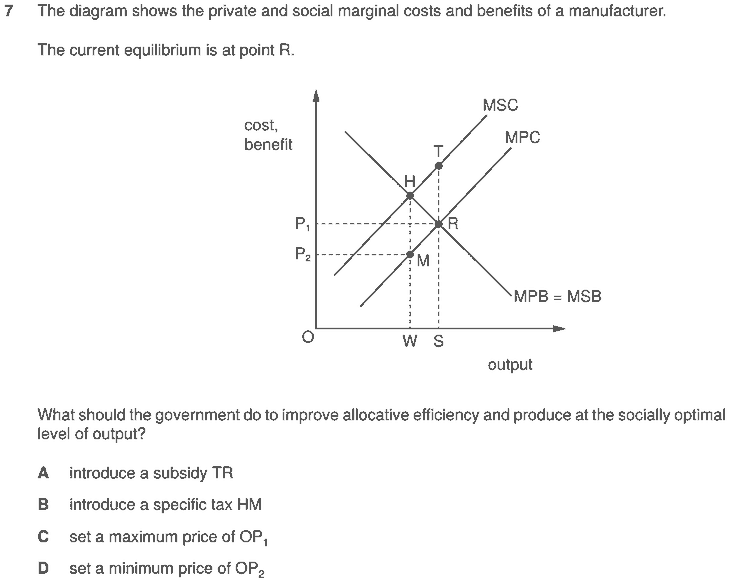
Question 11May/June 20269708/321 mark
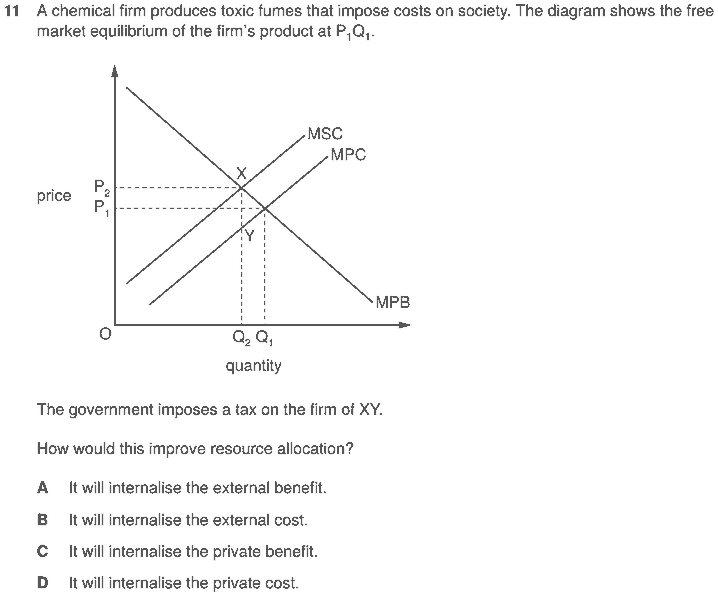
Show answer
Question 8May/June 20269708/341 mark
What would not cause government failure?
- Aa lack of information
- Bthe economy is in recession
- Cpolitical pressures
- Dunintended consequences
Show answer
Question 9May/June 20269708/341 mark
A producer of a good causes pollution. When will a specific tax on the production of the good be most effective in reducing output?
- Awhen there is price elastic demand and price elastic supply
- Bwhen there is price elastic demand and price inelastic supply
- Cwhen there is price inelastic demand and price elastic supply
- Dwhen there is price inelastic demand and price inelastic supply
Show answer
Question 9Feb/March 20269708/321 mark
The government of a country allows each factory in the fertiliser industry to discharge 10 000 litres of liquid waste into the rivers each year. If a factory discharges less than 10 000 litres, it can sell its remaining allowance to another factory that wants to discharge more than 10 000 litres. What does this illustrate?
- Aa pollution embargo
- Ba pollution permit
- Ca pollution tariff
- Da pollution subsidy
Show answer
Question 10Feb/March 20269708/321 mark
What is not an example of government failure in the free provision of health care?
- Aequal access to health care
- Binsufficient spending on vaccinations
- Clong waiting time to see doctors
- Dstoring excess supplies of unused medicine
Show answer
Question 9Oct/Nov 20259708/311 mark
Which government policy is intended to correct a negative externality?
- Aguaranteed minimum prices for farmers producing certain agricultural products
- Bimposition of taxes on factories releasing pollutants into rivers
- Crent controls on housing occupied by low-income individuals
- Dthe provision of free books for children of poorer households
Show answer
Question 11Oct/Nov 20259708/311 mark
Extra fishing boats start to operate from a local harbour which depends on fishing for its main income. Which action by the local authority is an example of nudge theory?
- Ainsisting that all fish caught are sold to local people
- Bincreasing the licence fees for new boats
- Cdistributing leaflets about the need to safeguard fish stocks
- Drestricting the areas in which boats can fish
Show answer
Question 13Oct/Nov 20259708/311 mark
What is an advantage of pollution permits, when compared with an alternative policy of taxes levied on the quantity of pollutants emitted by firms?
- Afirms cannot sell any surplus permits
- Bno monitoring of firms’ emissions is required
- Cpollution levels can be reduced to zero
- Dthe reduction in the level of pollution is more predictable
Show answer
Question 9Oct/Nov 20259708/321 mark
What is the essential feature of nudge theory?
- Athe aim of satisficing
- Bthe establishing of a legal requirement
- Cthe existence of a contestable market
- Dthe idea of persuasion
Show answer
Question 11Oct/Nov 20259708/321 mark
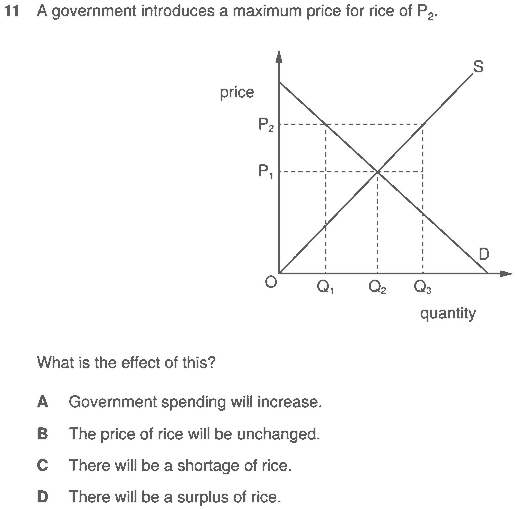
Show answer
Question 8Oct/Nov 20259708/331 mark
Assuming there are no externalities, where would a nationalised firm set output to maximise social welfare?
- Awhere average revenue equals average cost
- Bwhere average revenue equals marginal cost
- Cwhere marginal revenue equals marginal cost
- Dwhere marginal revenue is zero
Show answer
Question 10Oct/Nov 20259708/331 mark
Which method of government intervention may correct market failure caused by the under-consumption of a merit good?
- Aminimum price
- Bprivatisation
- Cindirect taxation
- Dsubsidy
Show answer
Question 11Oct/Nov 20259708/331 mark
Some governments introduce rent controls (maximum prices) on houses rented from private landlords. They impose such rent controls to improve living standards for individuals with low incomes. What might be the effects of rent controls in the long run?
- AThe long-run supply of rental houses will contract.
- BThe number of unoccupied privately rented houses will increase over time.
- CThe price of owner-occupied houses will increase.
- DThere will be no effect on the supply of rental housing.
Show answer
Question 12Oct/Nov 20259708/331 mark
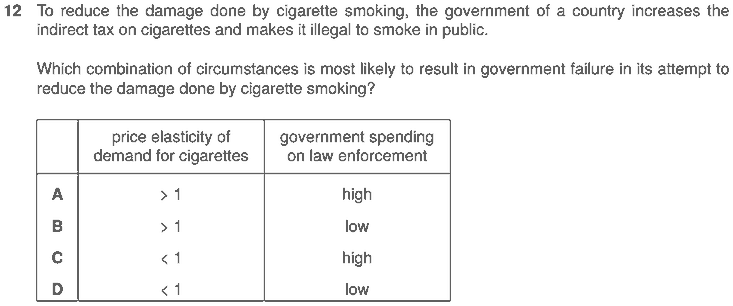
Show answer
Question 8Oct/Nov 20259708/341 mark
What is a potential benefit of the privatisation of a country’s railway services?
- Ahigher levels of competition
- Bhigher costs passed on in the form of higher prices
- Copportunity for government regulation
- Dpotential for a private monopoly
Show answer
Question 22Oct/Nov 20259708/341 mark
A government is aiming to increase the role of market forces. Which policy might achieve this?
- Aderegulation
- Bnationalisation
- Cprice controls
- Dproduction quotas
Show answer
Question 8May/June 20259708/311 mark
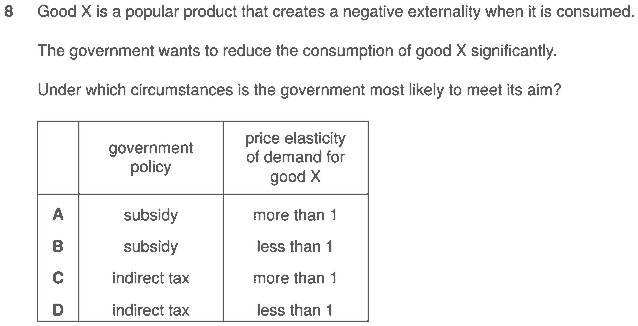
Show answer
Question 9May/June 20259708/311 mark
A government introduces tradeable pollution permits to reduce pollution. What is an advantage of this scheme?
- AIt allows consumers to determine the optimum pollution level.
- BIt can provide rewards for firms that reduce pollution.
- CIt enables the government to raise revenue from the resale of permits.
- DIt uses the market system with no administrative costs.
Show answer
Question 10May/June 20259708/311 mark
To reduce traffic congestion, a government built a new highway. A majority of the citizens were opposed to this. Some citizens responded by switching from public transport to private cars. This caused car journeys to take even longer. What can be concluded about government failure in this case?
- AIt occurred because the government‘s opportunity costs were not considered.
- BIt occurred because the wishes of the majority of citizens were ignored.
- CIt occurred because the result was unintended.
- DIt occurred from over-reliance on the market system.
Show answer
Question 13May/June 20259708/311 mark
What is an example of ‘nudge’ theory as applied to the prevention of tax evasion?
- Aemploying an extensive administration to ensure detection of evasion
- Bimposing heavy penalties on those who do evade tax
- Cproviding information to taxpayers about the undesirable effects of tax evasion
- Drequiring employers to inform the tax authorities of workers’ pay
Show answer
Question 8May/June 20259708/321 mark
The marginal social benefit of consuming a drink is less than the marginal private benefit. What would be the best policy to improve resource allocation in this market?
- Agive a subsidy to the producers of the drink
- Bincrease competition in the drink industry
- Cimpose a maximum price for the drink above the market equilibrium price
- Dimpose a per unit tax on the drink
Show answer
Question 9May/June 20259708/321 mark
A country’s government banned cigarette smoking in enclosed public spaces, such as offices, shops, bars and restaurants. What is a government failure arising from this ban?
- Adecreased consumption of cigarettes by smokers
- Bdecreased levels of passive cigarette smoking by non-smokers
- Cincreased litter from used cigarettes outside offices and shops
- Dincreased sales of cigarette substitutes like nicotine patches and gum
Show answer
Question 11May/June 20259708/321 mark
What is not an outcome of the existence of private property rights?
- AThey encourage private owners to conserve property when its value is expected to rise.
- BThey give private owners the incentive to manage their property carefully.
- CThey make private owners accountable for damage to others from property misuse.
- DThey prevent private owners gaining from using resources to benefit others.
Show answer
Question 7May/June 20259708/341 mark
Show answer
Question 8May/June 20259708/341 mark
A government wishes to discourage tax avoidance. Which policy to achieve this would be an example of the behavioural approach of nudge theory?
- Acompelling direct tax deduction by employers
- Bmaking random inspections of individual tax records
- Cproviding information on how the tax is spent by the government
- Dusing penalties such as fines and imprisonment for tax avoidance
Show answer
Question 8Feb/March 20259708/321 mark
What is not an example of government failure?
- Adecreased maximum price causing producers to leave the market
- Bhigher guaranteed price encouraging suppliers to overproduce
- Cincreased minimum wage leading to employers dismissing workers
- Dincreased subsidies encouraging the consumption of a socially desirable product
Show answer
Question 10Feb/March 20259708/321 mark
What is not a reason for imposing a tax on producers based on the amount of pollution caused in the production process?
- AFirms have a financial incentive to reduce pollution.
- BIt is relatively hard to administer and monitor this tax scheme.
- CSome firms cause less pollution than others.
- DTaxes on pollution reduce negative production externalities.
Show answer
Question 11Feb/March 20259708/321 mark
A government introduced a tax on soft drinks containing sugar. It was forecast that the tax would raise £520m per year for the government. However, the tax received was £240m. What is the most likely reason why the tax collected was lower than forecast?
- Aa specific tax instead of an ad valorem tax was introduced
- Bfewer drinks than originally forecast contained sugar
- Cmost retailers did not increase the price of soft drinks
- Dthe demand for soft drinks was price inelastic
Show answer
Paper 4 · Data response and essays (5)
Question 2Oct/Nov 20259708/4120 marks
2 Market failure is to blame for climate change and the inefficient allocation of resources. The only solution is for governments to intervene to improve resource allocation.
Assess the extent to which you agree with this statement. [20]
Show mark scheme
Market failure is to blame for climate change and the inefficient allocation of resources. The only solution is for governments to intervene to improve resource allocation. Assess the extent to which you agree with this statement
AO1 Knowledge and understanding and AO2 Analysis
- Climate change can be regarded as a form of market failure can be explained by linking this to the requirement to allocate resources to maximise consumer satisfaction. This can be supported by a diagram illustrating a level of output where AR = MC or MSB = MSC which is consistent with an outcome that achieves allocative efficiency.
- Negative externalities occur when the consumption/use of a good produces a cost to society which is greater than that received by an individual producer MPB ⩾ MSB or MSC ⩾MPC. This is sometimes described as a negative ‘spill-over’ effect. The negative externality leads to an over production of the good carbon dioxide or other greenhouse gas.
- Government intervention takes place to address the failure of market forces to allocate resources efficiently. In this case positive externalities would lead to under–consumption of a good or service.
- Different types of government intervention can be used to correct the under-production of output to enable consumer satisfaction to be maximised.
- Forms of government intervention might include: the use of subsidies for consumers to move to less polluting forms of consumption and also producers to change productionmethods, use of positive advertising; the direct provision of goods and services such as alternative transport methods. Alternatively indirect taxation might be applied to the CO 2 producing source. Nudge theory effects.
- A clearly labelled, accurate diagram can be used to show the impact of a positive/negative externality on the level of outputand the welfare change will be identified.
- The diagram could show the market equilibriumpoint which does not take into account the existence of anegative consumption externality and may compare this with the allocatively efficient level of output when the negative externality is taken into account. The diagram may be amended or re-drawn to show the impact of achosen policy(ies) and the impact on consumption or production shown.
- Reference to the diagram and the outcomes it illustrates is made in the text.
AO3 Evaluation
- A government might introduce a subsidy to encourage producers to increase output to enable allocative efficiency, however it is difficult to measure the precise valueof the subsidy. Subsidies are costly in that the funds might have been used by governments for other purposes. This means governments will have to make a value judgement when deciding whether to provide a subsidy. Thereare opportunity costs of the subsidy.
- Also, the impact on price and output in some circumstances takes a long time to become effective.
- Advertising is often costly and it is not always certain that it will have a sufficiently persuasive effect to ensure the correct level of output/ consumption is reached.
- Direct provision is also costly and sometimes less efficient than that provided through market forces.
- It is possible to show that government intervention can reduce the level of inefficiency caused by the existence of positive externalities but it is not clear whether the net effect of government intervention will always be positive. Some types of intervention will be more effective than others depending on the nature of the good/service under consideration.
- Government failure. Concluding point which considers ‘only’ aspect.
Accept all valid responses.
AO1 Knowledge and understanding and AO2Analysis
AO3 Evaluation
Question 2Oct/Nov 20259708/4220 marks
2 Traffic congestion is a cause of allocative inefficiency.
Evaluate, with the help of diagram(s) two policies that a government may introduce to reduce the problem of allocative inefficiency caused by traffic congestion. [20]
Show mark scheme
Traffic congestion is a cause of allocative inefficiency. Evaluate, with the help of diagram(s) two policies that a government may introduce to reduce the problem of allocative inefficiency caused by traffic congestion.
AO1 Knowledge and understanding and AO2 Analysis
- Market failure regarding this question would relate to allocative inefficiency. Market failure can be explained by defining allocative efficiency and linking this to the requirement to allocate resources to maximise consumer satisfaction. This can be supported by a diagram illustrating a level of output where AR = MC or MSB = MSC which is consistent with an outcome that achieves allocative efficiency.
- Negative externalities occur when the consumption/use of agood produces a cost to society which is greater than that received by an individual consumer MPB > MSB. This is sometimesdescribed as a negative ‘spill-over’ effect. The negative externality leads to an over production of the good.
- Government intervention takes place to address the failure of market forces to allocate resources efficiently.
- Different types of governmentinterventioncan be used to correct the over consumption to enable consumer satisfaction to be maximised.
- Forms of government intervention might include: the use of subsidies for consumers to increase consumption of alternative forms of transport, use of positive advertising of alternatives; the direct provision of goods and services such as alternative transport methods. Indirect taxation. Nudge theory effects.
- Aclearly labelled, accurate diagram can be used to show the impact of a negative externality on the level of output and the welfare change will be identified.
- The diagram could show the market equilibriumpoint which does not take into account the existence of anegative consumption externality and may compare this with the allocatively efficient level of output when the negative externality is taken into account. The diagram may be amended or re-drawn to show the impact of achosen policy(ies) and the impact on consumption or production shown.
- Reference to the diagram and the outcomes it illustrates is made in the text.
AO3 Evaluation
- A government might introduceasubsidy for alternative forms of transport e.g. mass rapid transport to encourage production to enable allocative efficiency, however it is difficult to measure the precise value of the subsidy. Subsidies have opportunity costs and are costly in that the funds might have been used by governments for other purposes. This means governments will have to make a value judgement when deciding whether to provide a subsidy.
- Consumer demand for alternatives may be low due to the reluctance to price in-elasticity of demand for public transport/alternatives.
- The impact on price and output in some circumstances takes along time to become effective.
- Advertising of alternative methods of transportis often costly and it is not always certain that it will have a sufficiently persuasive effect to ensure the correct level of consumption is reached.
- Public sector provision is costly and sometimes less efficient than that provided through market forces.
Accept all valid responses.
Case study: The influence of governments
People often talk as if governments can easily control economic outcomes.
Content removed due to copyright restrictions.
High-income countries decided to focus on economic growth realising that it was essential to generate revenues and taxes needed to pay for costly investments, for example, the storage of renewable energy, required to reduce the use of fossil fuels.
Sources: Irwin Stelzer, The Sunday Times, 29 January 2023 Ray Bourne, The Times, 9 February 2023
Question 1(c)May/June 20259708/413 marks
(c) Explain how the policies of high-income economies towards ‘green energy’ changed between 2015 and 2022. [3]
Show mark scheme
Explain how the policies of high-income economies towards ‘green energy’ changed between 2015 and 2022. Initially at the Paris Agreement willing to increase green energy outputs (1) or reduce the uses of fossil fuels in energy production.(1) By 2022 want more emphasis on economic growth (1) or helped by a continuation of energy production using fossils fuels. (1) Promise of funds from ‘rich’ to ‘poor’ countries did not materialise (1) or poor countries less effective in reducing CO2 emissions.(1)
Case study: Global carbon emissions
A key message of the 2021 World Climate Summit was that the use of coal must be phased out for the good of the planet.
Content removed due to copyright restrictions.
Content removed due to copyright restrictions.
Instead, a mixture of renewable energies will be required to achieve zero-carbon
Sources: The Sunday Times, 17 October 2021 The Times, 26 October and 24 November 2021 nsenergybusiness.com, 4 November 2021
Question 1(b)May/June 20259708/424 marks
(b) Use the information to comment on the possible effects on the economies of the countries that refused to sign the carbon policy agreement. [4]
Show mark scheme
Use the information to comment on the possible effects on the economies of the countries that refused to sign the carbon policy agreement. Those countries are some of the top producers of coal. (1) Advantages: Cheapness as a power source 1 enabling them to increase/maintaining GDP/Economic Growth 1. Reliable source of power1 enabling continuity of production 1. Coal supplies can be stored and managed 1 to meet demand for electricity 1. Disadvantages: Coal is a finite resource 1 and therefore there are future costs of switching 1. Continuation of the output of negative externalities 1 e.g. carbon dioxide/greenhouse/toxic gases/lower air quality 1. 4 max
Question 2May/June 20259708/4220 marks
2 Monopolies restrict output to raise prices to exploit consumers.
With the help of a diagram, assess the extent to which a government should intervene in monopoly markets. [20]
Show mark scheme
Monopolies restrict output to raise prices and exploit consumers. With the help of a diagram, assess the extent to which a government should intervene in monopoly markets.
Use Table A: AO1 Knowledge and understanding and AO2 Analysis and Table B: AO3 Evaluation to mark candidate responses to this question.
AO1 and AO2 out of 14marks. AO3 out of 6 marks.
Indicative content Responses may include:
AO1 Knowledge and understanding and AO2Analysis
- The key characteristics of a monopoly market structure should be identified.
- The aim of profit maximization should be explained and an accurately labelled supporting diagram should be provided to illustrate this situation.
- Analysis should be provided, based on a diagram, which shows the links between low output, high prices and allocative inefficiency.
- Alternative government policies to reduce the power of monopolies should be explained.
- Diagram(s) may be provided to illustrate monopoly equilibrium and/or the policy suggested.
- Analysis of how alternative types of government intervention can be used to address some of the negative outcomes associated with monopoly firms. No monopoly diagram Max L2 8 marks.
AO3 Evaluation
Accept all valid responses.
- A government can use taxation to reduce monopoly profits and control market power. However, this might reduce the incentive to invest by monopoly firms and lead to X inefficiency
- Maximum pricing might be introduced to control high prices but this might lead to shortages and/or the operation of underground markets.
- Some types of product/service can be described as natural monopolies, therefore any attempt to introduce more competition is simply likely to lead to more inefficient outcomes.
- Direct government intervention by regulation/legislation might reduce a monopoly market share but this would also make it more difficult for a monopoly to benefit from economies of scale. Hence, costs and prices might subsequently rise.
- A conclusion should attempt to examine alternative types of government intervention to try and establish the extent to which governments should intervene in monopoly markets.
Accept all valid responses.
AO1 Knowledge and understanding and AO2Analysis
AO3 Evaluation
90 more questions from 2020–2024
🔒 Unlock every Government policies to achieve efficient resource allocation and correct market failure question from 2020–2024
All 90 come with their mark schemes, answers and case studies, and appear in the practice tool above once you’re signed in. It’s free.
Create a free accountSign in
A few of them
- 9708/31 · Oct/Nov 2024 · Question 11Which government policy would not be classified… 🔒
- 9708/31 · Oct/Nov 2024 · Question 12A government removes a subsidy on a… 🔒
- 9708/32 · Oct/Nov 2024 · Question 11What is not a valid comment economists… 🔒
- 9708/41 · Oct/Nov 2024 · Question 22 Governments in many countries are promoting… 🔒
- 9708/42 · Oct/Nov 2024 · Question 33 Privatisation is often required by the… 🔒
- + 85 more, by year in the table above
Questions and mark schemes are from past Cambridge papers and are reproduced for revision. Topical Vault is an independent revision resource, not affiliated with or endorsed by Cambridge Assessment International Education.