Question 1May/June 20269708/311 mark
What causes a market to fail and produce more than the optimum output of an economic good?
Show answer
BCorrect answer
Cambridge 9708, Paper 3 & 4. 1,666 questions, 2020 to 2026.
Paper 3 multiple-choice questions and Paper 4 data-response/essay questions and case studies, retyped from the original Cambridge material; artwork and data tables are reproduced as images. Mark schemes show the official answer key and level-marked indicative content.
Questions on private and social costs and benefits: positive and negative externalities in production and consumption, deadweight loss, and cost-benefit analysis of projects.
New to Private costs and benefits, externalities and social costs and benefits, or finding these questions hard?
Read the notes first: the key ideas, diagrams and formulas, and the mistakes examiners see most, in about 14 minutes.
Read the Private costs and benefits, externalities and social costs and benefits notes →
97 past paper questions on this topic since 2020, across 20 exam sessions.
| Year | Paper 3 | Paper 4 | Total | Chart |
|---|---|---|---|---|
| 2026 | 8 | 2 | 10 | |
| 2025 | 9 | 3 | 12 | |
| 2024 | 8 | 2 | 10 | |
| 2023 | 12 | 5 | 17 | |
| 2022 | 11 | 7 | 18 | |
| 2021 | 10 | 3 | 13 | |
| 2020 | 12 | 5 | 17 |
The whole topic on one page, with answers and mark schemes. Printing this page prints just this list.
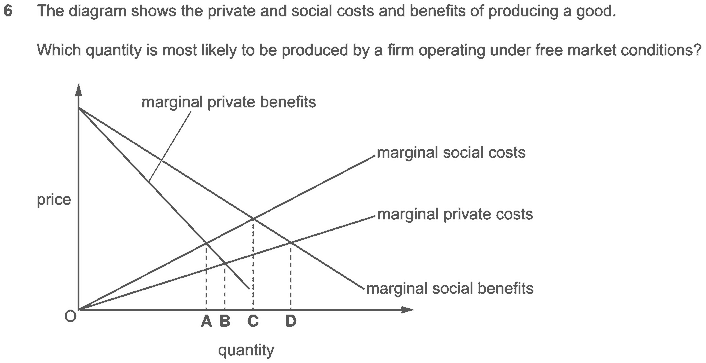
What causes a market to fail and produce more than the optimum output of an economic good?
BCorrect answer
In a market system, a good creates a negative production externality and a positive consumption externality. When will the market equilibrium achieve an allocatively efficient output of the good?
ACorrect answer
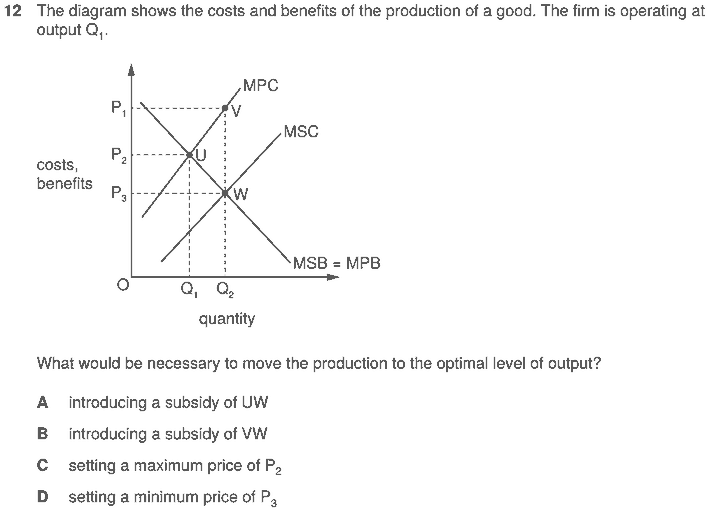
BCorrect answer
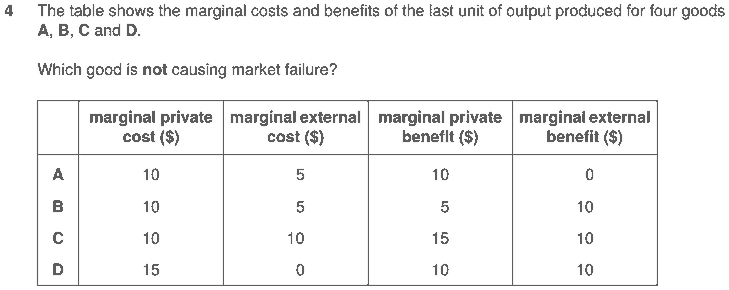
BCorrect answer
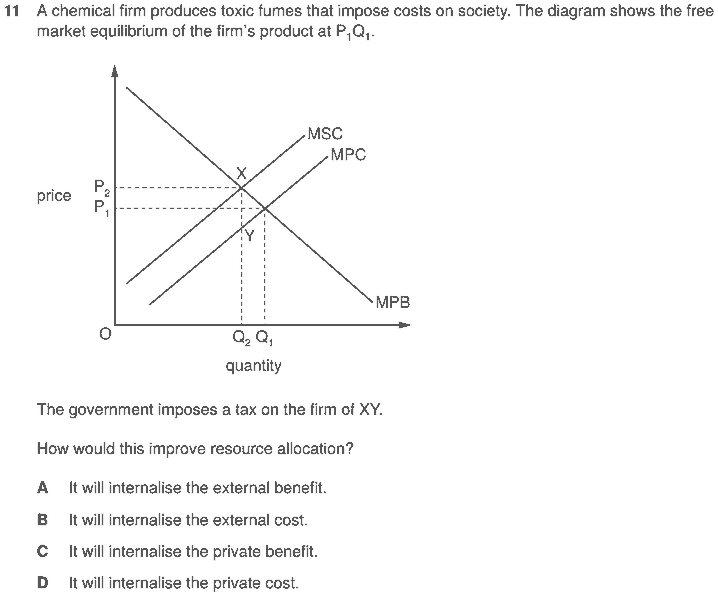
BCorrect answer
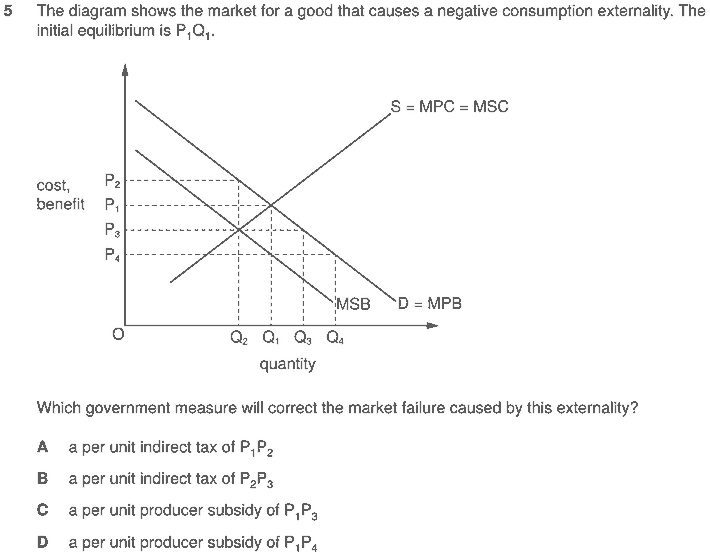
BCorrect answer
A producer of a good causes pollution. When will a specific tax on the production of the good be most effective in reducing output?
ACorrect answer
BCorrect answer
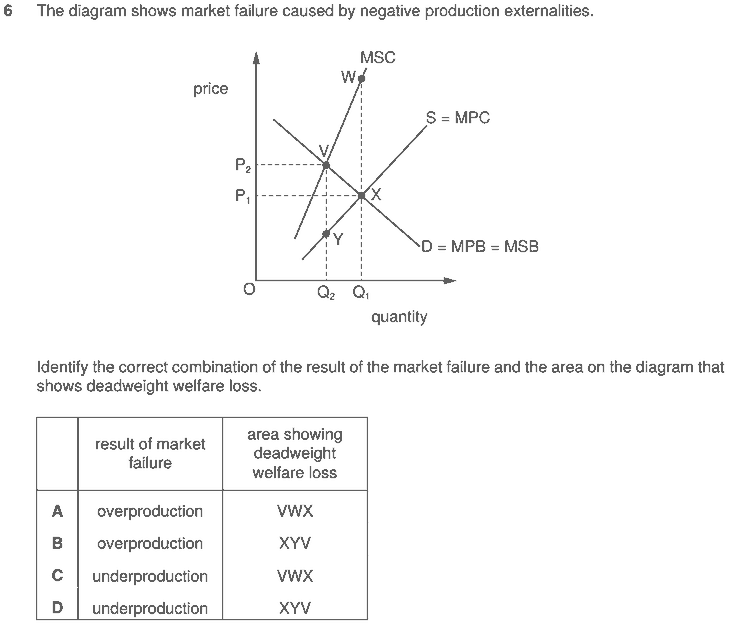
ACorrect answer
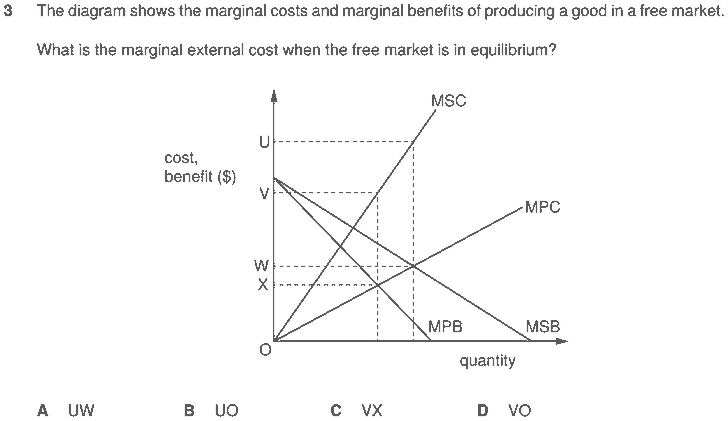
CCorrect answer
An economist undertakes a cost–benefit analysis of the pollution resulting from a manufacturing process. Which outcome is most likely to guide any recommendation about the optimal level of manufacturing output?
ACorrect answer
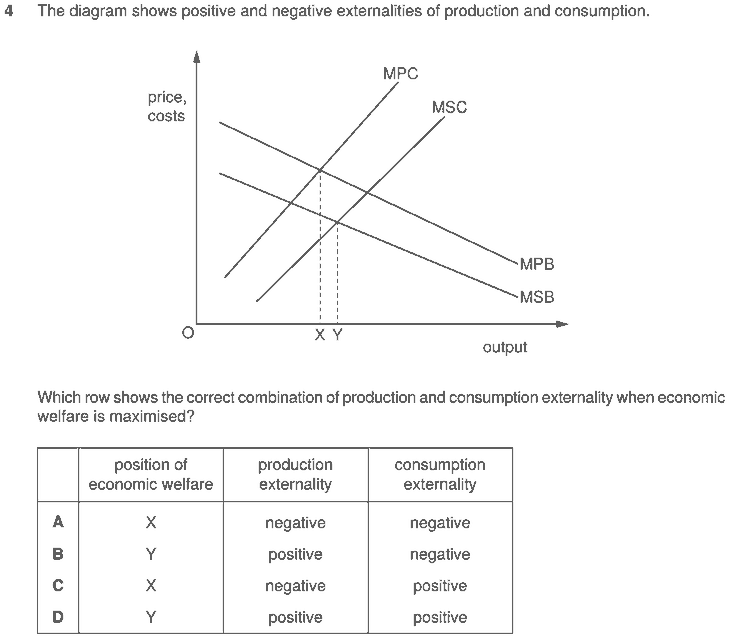
BCorrect answer
The marginal social benefit of consuming a drink is less than the marginal private benefit. What would be the best policy to improve resource allocation in this market?
DCorrect answer
A cost–benefit analysis is carried out on the construction of a hydroelectric power station. Under which circumstances would the scheme be most likely to be approved?
BCorrect answer
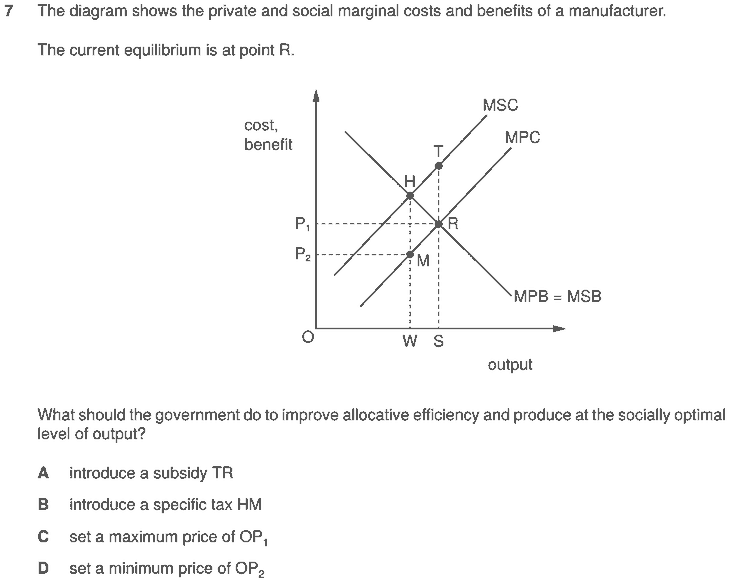
BCorrect answer
Which policy by a government would increase the negative externalities that result from cigarette smoking?
CCorrect answer
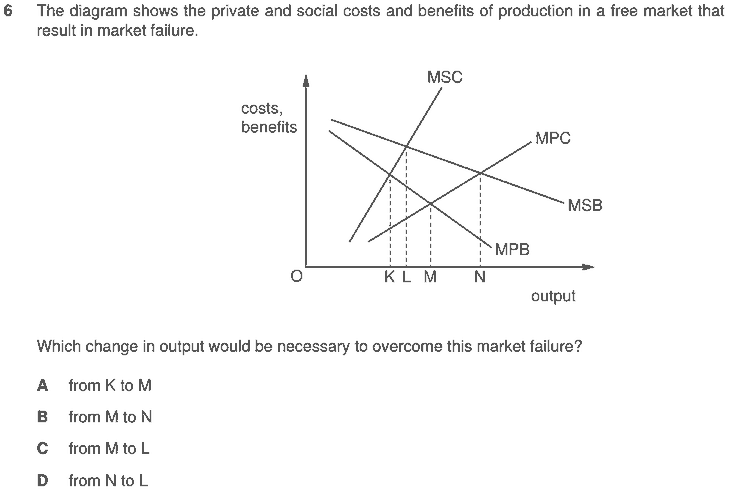
CCorrect answer
Czechia, a country in the European Union, is experiencing strong growth of its gross domestic product (GDP). Climate change, however, is affecting its agriculture and forestry sectors and people’s health. According to Table 1.1, Czechia currently generates 50% of its electricity using fossil fuels (coal, oil, and gas), which emit greenhouse gases (GHG) and other air pollutants. Nuclear power plants generate 32% and renewable sources generate 18%. Czechia also has coal‑fuelled heating systems, and industry that emits a lot of GHG, particularly in car production. Despite an increase in the use of renewables and energy efficiency measures, Czechia remains highly dependent on fossil fuels. If Czechia is to reach net zero carbon emissions by 2050, further measures are needed.
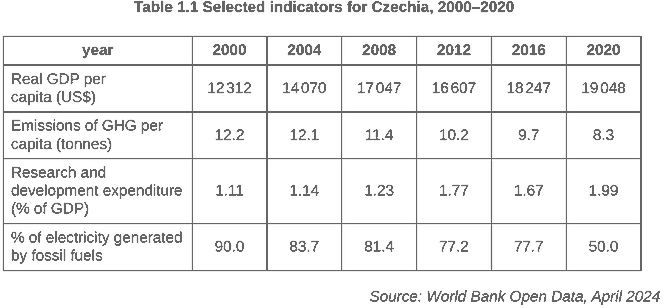
Czechia’s relatively low research and development (R&D) spending in the private sector is shown in Table 1.1. Combined with inadequate digital and transport infrastructure, this restricts innovation. However, energy efficiency regulations, such as setting energy efficiency standards for buildings, will incentivise private investment. Increased government spending on renewable energy projects and energy efficiency measures, such as modernising electricity grids, would act as a fiscal injection. There is not enough skilled labour at present to install new technologies in the renewable energy sector, but education and training can be improved.
The government needs to ensure that energy prices do not rise too much, which would add to firms’ costs. If Czechia fulfils its commitment to phase out the use of coal to generate electricity by 2033, the high levels of unemployment and poverty in Czechia’s coal‑producing region could increase.
Since 2000, transport’s use of energy has increased by 64%. As incomes have grown, the use of public transport, such as rail and buses, has decreased from 37% to 18% of all passenger kilometres travelled, while the use of private cars has increased from 63% to 82%. Therefore, policies to improve the quality and availability of public transport are needed. Increasing investment in public transport would also promote worker mobility and productivity growth.
Higher taxes on cars and electricity would raise revenues that could partly finance environmental projects. The structure of vehicle taxes in Czechia encourages the use of hybrid and electric cars, for example electric‑car owners are exempt from road tax and can park for free in cities. But further measures to facilitate the use of electric vehicles, such as providing charging infrastructure, are necessary.
Sources: International Monetary Fund : Enhancing the green transition in Czechia Odysee Mure: European Union: Czechia : Energy profile, March 2024
(c) Consider, with the help of a diagram, whether electricity generation in Czechia creates a deadweight welfare loss. [6]
Consider, with the help of a diagram, whether electricity generation in Czechia creates a deadweight welfare loss.
(1)
Diagram is worth (3) marks in total
(1)
3 The fashion industry employs around 75 million workers, many of whom earn very low wages and work up to 16 hours a day. The industry contributes to 20% of global wastewater and 8% of all carbon emissions. 60% of clothes are made from plastics, 83 million tonnes of the 100 billion garments produced are sent to landfill, and only 20% are collected for recycling.
Consider to what extent an equitable solution can be found for market failures in the fashion industry. [20]
The fashion industry employs around 75 million workers, many of whom earn very low wages and work up to 16 hours a day. The industry contributes to 20% of global wastewater and 8% of all carbon emissions. 60% of clothes are made from plastics, 83 million tonnes of the 100 billion garments produced are sent to landfill, and only 20% are collected for recycling. Consider to what extent an equitable solution can be found for market failures in the fashion industry.
Use Table A: AO1 Knowledge and Understanding, AO2 Analysis, and Table B: AO3 Evaluation, to mark candidate responses to this question
AO1 and AO2 are out of 14 marks. AO3 is out of 6 marks.
Indicative Content Responses may include:
AO1 Knowledge and Understanding and AO2 Analysis
AO3 Evaluation
Accept all valid responses
AO1 Knowledge and understanding and AO2 Analysis
AO3 Evaluation
From Adam Smith onwards, most economists have regarded competitive markets as the main mechanism of economic activity. They argue that the interaction between producers and consumers can lead to both allocative efficiency and productive efficiency.
It can, however, be questioned whether the market automatically produces the best solution. Sometimes there are significant reasons for governments to intervene in a market in order to produce a better outcome than market forces alone. These situations are market failures.
When producing goods and services firms consider the private costs they pay and private benefits they receive. For example, a steel producer accounts for the cost of iron ore, fuel, labour and administration. It offsets these costs against the revenue from selling the steel. However, those people who live near the steelworks suffer the consequences of the noise, dirt and polluted air generated as part of the production process. Similarly, in many areas the extraction of iron ore can lead to environmental destruction such as the degradation of ground water for domestic consumption and a reduction in the variety of wildlife and flowers.
Competitive markets as envisaged by economists, however, may not exist. Firms may integrate to gain the benefits of economies of scale, to realise their ambition to rule the market or to increase their market share. Such integration might lead to the development of a monopoly market structure. Many believe that a monopoly always operates against the interests of the consumer because of its lack of efficiency. As a result, governments often restrict the operation of monopolies.
(b) (i) Explain what is meant by a negative production externality. [2]
(ii) Identify from the extract a negative production externality resulting from steel production. [1]
(iii) Explain, with the aid of a diagram, the consequences for output and price if the steel market is required to take into consideration negative production externalities. [5]
Explain what is meant by a negative production externality. A cost 1 that is born by someone other than the producer of the good/a third party 1 Identify from the extract, a negative production externality resulting from steel production. Noise, dirt or polluted air 1
Max 1 mark Explain, with the aid of a diagram, the consequences for output and price if the steel market is required to take into consideration negative production externalities. 1(b)(ii) cost/benefit MPB MSC MPC Negative P Externally P Q Q Quantity 1 Labels 1 Axes 1 and explicit indication of negative externality 1 Comment: Quantity falls from Q to Q 1 and Price increases from P to P 1 1 1 Welfare loss explained 1
A key message of the 2021 World Climate Summit was that the use of coal must be phased out for the good of the planet.
Content removed due to copyright restrictions.
Content removed due to copyright restrictions.
Instead, a mixture of renewable energies will be required to achieve zero-carbon
Sources: The Sunday Times, 17 October 2021 The Times, 26 October and 24 November 2021 nsenergybusiness.com, 4 November 2021
(b) Use the information to comment on the possible effects on the economies of the countries that refused to sign the carbon policy agreement. [4]
Use the information to comment on the possible effects on the economies of the countries that refused to sign the carbon policy agreement. Those countries are some of the top producers of coal. (1) Advantages: Cheapness as a power source 1 enabling them to increase/maintaining GDP/Economic Growth 1. Reliable source of power1 enabling continuity of production 1. Coal supplies can be stored and managed 1 to meet demand for electricity 1. Disadvantages: Coal is a finite resource 1 and therefore there are future costs of switching 1. Continuation of the output of negative externalities 1 e.g. carbon dioxide/greenhouse/toxic gases/lower air quality 1. 4 max
(d) With the help of a marginal social cost and benefit diagram discuss whether the continued use of coal to produce electricity makes the achievement of allocative efficiency less likely. [10]
With the help of a marginal social cost and benefit diagram discuss whether the continued use of coal to produce electricity makes the achievement of allocative efficiency less likely. Definitions of: private cost 1, external cost/social cost, 1 allocative efficiency 1. External costs of coal/‘dirty fuel’/greenhouse gases/pollution 1 3 countries produce 52% of global CO emissions from coal use 1 2 Correct axes with Discussion: correct drawing and $/P/C/B MSC MPC labels of MPB/MSB and MPB/MSB MSC, MPC 1 Indication of Externality/Welfare loss 1 Correct identification Q* of Q* and Q 1 Q Output/Quantity Coal production/burning has negative externalities which mean MSC is greater than MPC. 1 Conclusion: This means the allocative efficient output is Q* not Q/allocative efficiency is not achieved 1.
🔒 Unlock every Private costs and benefits, externalities and social costs and benefits question from 2020–2024
All 75 come with their mark schemes, answers and case studies, and appear in the practice tool above once you’re signed in. It’s free.
Questions and mark schemes are from past Cambridge papers and are reproduced for revision. Topical Vault is an independent revision resource, not affiliated with or endorsed by Cambridge Assessment International Education.
Each topic opens this practice tool with only that topic’s questions, plus how often it comes up and every question on it in one list. Revision notes for A Level Economics → Full A Level Economics past papers →