← Topical Vault

Money and banking · A Level Economics

Cambridge 9708, Paper 3 & 4. 1,666 questions, 2020 to 2026.

Topic
Year

Paper 3 multiple-choice questions and Paper 4 data-response/essay questions and case studies, retyped from the original Cambridge material; artwork and data tables are reproduced as images. Mark schemes show the official answer key and level-marked indicative content.

About Money and banking

Questions on money and banking: the functions of money, the money supply and credit creation, commercial and central banks, liquidity preference and the demand for money.

New to Money and banking, or finding these questions hard?

Read the notes first: the key ideas, diagrams and formulas, and the mistakes examiners see most, in about 17 minutes.

Read the Money and banking notes →

76 past paper questions on this topic since 2020, across 17 exam sessions.

How often it comes up

YearPaper 3Paper 4TotalChart
202611213
202515015
2024718
2023101
20225611
20218715
20208513

Every 2025–2026 question on Money and banking

The whole topic on one page, with answers and mark schemes. Printing this page prints just this list.

Paper 3 · Multiple choice (26)

Question 13May/June 20269708/311 mark

In 2008, the inflation rate reached more than 1 million % in Zimbabwe. This hyperinflation led to some Zimbabweans refusing Zimbabwean dollars as payment for goods and services. Which characteristic of money does this mean the Zimbabwean dollar was losing?

  • Adivisibility
  • Bgeneral acceptability
  • Cintrinsic value
  • Dlegal tender
Show answer

BCorrect answer

Question 14May/June 20269708/311 mark

What is likely to result from a decrease in interest rates?

  • Aa decrease in the price of government bonds
  • Ba decrease in the velocity of circulation of money
  • Ca decrease in the price of equities
  • Da decrease in the desire to hold money
Show answer

BCorrect answer

Question 19May/June 20269708/311 mark

What is likely to result in an increase in nominal interest rates?

  • Aa decrease in the rate of inflation
  • Ba decrease in the government’s budget deficit
  • Can increase in the rate of economic growth
  • Dan increase in the propensity to save
Show answer

CCorrect answer

Question 13May/June 20269708/321 mark

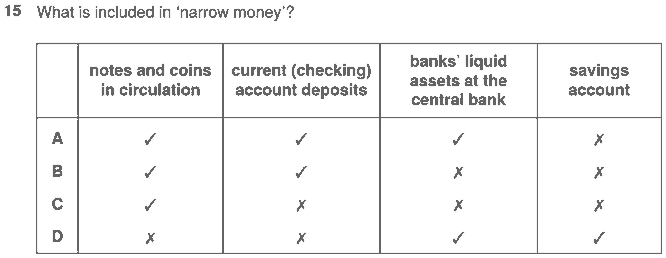
Which statement relating to the distinction between broad and narrow money is correct?

  • ABoth broad and narrow money can be used as a store of value.
  • BBroad money includes all financial assets that individuals can trade.
  • CGovernments exercise direct control over narrow money, but have no influence over
  • DNarrow money consists of coins and notes only.
Show answer

ACorrect answer

Question 14May/June 20269708/321 mark

The quantity theory of money states that MV = PT. What does T represent?

  • Atotal amount of tax revenue
  • Btotal amount of trade
  • Ctotal value of transfer earnings
  • Dtotal volume of transactions
Show answer

DCorrect answer

Question 19May/June 20269708/321 mark

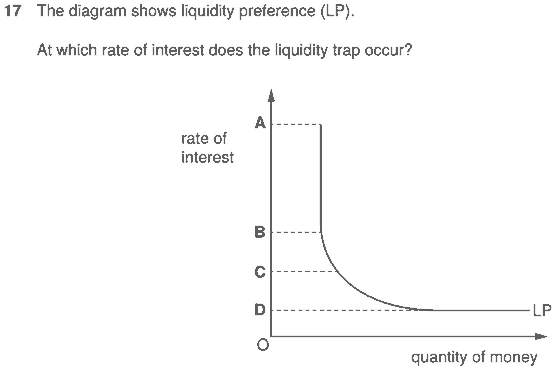
Pessimistic consumers and entrepreneurs hoard cash rather than spend or invest even when the rate of interest has become very low. What does this describe?

  • Areserve ratio
  • Bthe liquidity trap
  • Cthe marginal propensity to save
  • Dthe quantity theory of money
Show answer

BCorrect answer

Question 14May/June 20269708/341 mark

What is not a necessary characteristic of money?

  • Aeasy to carry
  • Bgenerally acceptable
  • Crelatively limited in supply
  • Duseful in its own right
Show answer

DCorrect answer

Question 15May/June 20269708/341 mark
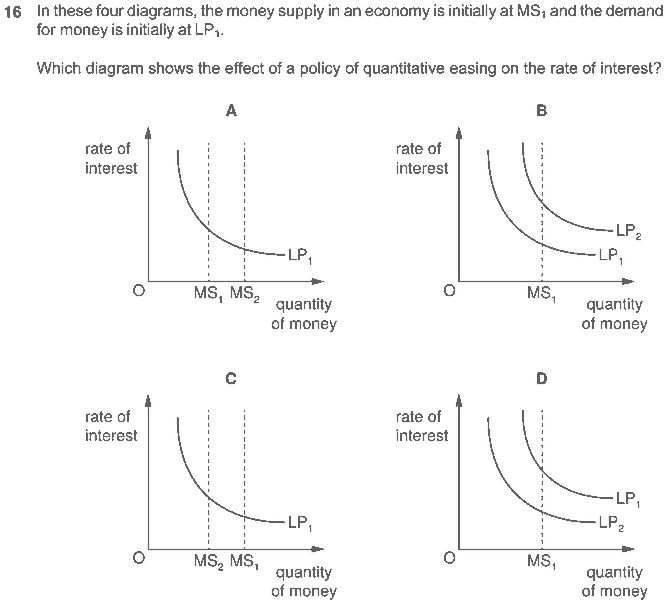
9708/34 May/June 2026 question 15
Show answer

ACorrect answer

Question 16May/June 20269708/341 mark

What would result in an increase in the volume of bank deposits?

  • Aan increase in the public’s desire to hold cash
  • Ban increase in government expenditure financed by borrowing from the central bank
  • Can increase in the proportion of their deposits that banks hold in cash
  • Dan open market sale of securities by the central bank
Show answer

BCorrect answer

Question 17Feb/March 20269708/321 mark

(Question image not available.)

Show answer

ACorrect answer

Question 18Feb/March 20269708/321 mark

There are different measures of the money supply from narrow money to broad money. Why are different measures necessary?

  • Abecause different countries have their own national measures of money supply
  • Bbecause of disagreement among economists over the importance of money supply
  • Cbecause of the need to produce different measures of inflation
  • Dbecause of the need to reflect the different functions that money performs
Show answer

DCorrect answer

Question 14Oct/Nov 20259708/311 mark

Which statement about the quantity theory of money is correct?

  • AIt suggests changes in liquidity preference lead to proportional changes in the price level.
  • BIt suggests changes in the money supply lead to proportional changes in the price level.
  • CIt suggests changes in the price level lead to proportional changes in liquidity preference.
  • DIt suggests changes in the price level lead to proportional changes in the money supply.
Show answer

BCorrect answer

Question 15Oct/Nov 20259708/311 mark

What is a part of Keynesian economic analysis?

  • Aa liquidity trap below which interest rates are ineffective
  • Ban equilibrium price that always clears the market
  • Ca small value for the government expenditure multiplier
  • Da vertical short-run aggregate supply curve
Show answer

ACorrect answer

Question 17Oct/Nov 20259708/311 mark
9708/31 Oct/Nov 2025 question 17
Show answer

DCorrect answer

Question 13Oct/Nov 20259708/321 mark

What is likely to reduce the domestic money supply?

  • ABanks being allowed to hold a lower liquidity ratio.
  • BIndividuals choosing to hold more money in the form of idle balances.
  • CThe government financing its budget deficit by borrowing from the banking sector.
  • DThe government increasing its borrowing from other countries.
Show answer

BCorrect answer

Question 16Oct/Nov 20259708/321 mark
9708/32 Oct/Nov 2025 question 16
Show answer

ACorrect answer

Question 19Oct/Nov 20259708/321 mark

What would cause an individual’s demand curve for an active money balance to move to the left?

  • Aan increase in the frequency of income payments
  • Ban increase in the general price level
  • Can increase in the individual’s income
  • Dan increase in the rate of interest
Show answer

ACorrect answer

Question 14Oct/Nov 20259708/331 mark
9708/33 Oct/Nov 2025 question 14
Show answer

ACorrect answer

Question 17Oct/Nov 20259708/331 mark
9708/33 Oct/Nov 2025 question 17
Show answer

ACorrect answer

Question 20Oct/Nov 20259708/341 mark
9708/34 Oct/Nov 2025 question 20
Show answer

BCorrect answer

Question 20May/June 20259708/311 mark
9708/31 May/June 2025 question 20
Show answer

CCorrect answer

Question 19May/June 20259708/321 mark
9708/32 May/June 2025 question 19
Show answer

ACorrect answer

Question 18May/June 20259708/341 mark

In Keynesian economic theory, what is the purpose of interest?

  • Ato bring national income and expenditure into line
  • Bto control the level of economic growth
  • Cto create a balance between savings and investment
  • Dto provide a reward for surrendering liquidity
Show answer

DCorrect answer

Question 19May/June 20259708/341 mark

The quantity theory of money is sometimes represented by the equation MV = PT. Which statement is not correct?

  • AM is a measure of the total value of notes and coins in circulation in the country.
  • BP measures the average level of prices in the country.
  • CT stands for the quantity of real transactions during the year.
  • DV represents the number of times a unit of money is spent during a given time period.
Show answer

ACorrect answer

Question 17Feb/March 20259708/321 mark

In the quantity theory of money equation, MV = PT, V is defined as the income velocity of circulation. Which change would tend to reduce the value of V?

  • Aa move to monthly rather than weekly salary payments by firms
  • Ban increase in interest rates
  • Can increase in the use of cash machines to reduce money balances held
  • Da decrease in the use of credit cards by individuals
Show answer

ACorrect answer

Question 20Feb/March 20259708/321 mark
9708/32 Feb/March 2025 question 20
Show answer

ACorrect answer

Paper 4 · Data response and essays (2)

Case study: Interest Rates and Exchange Rates

Many commercial banks in Japan raised their interest rates on customer accounts in early 2024 for the first time in 17 years. Some banks also increased the interest rates on their housing loans (mortgages), which placed a heavier burden on borrowers.

The rise in interest rates followed the ending of a policy of negative interest rates used by the Bank of Japan (BOJ), the country’s central bank. Previously, the BOJ had set interest rates at –0.1% on some of the deposits made by commercial banks at the central bank.

The increase in interest rates coincided with a falling unemployment rate and expectations that Japan’s economy would grow further in the second half of 2024. This economic growth would be caused by higher wages, increased consumer spending and a depreciation of Japan’s currency, the yen.

The BOJ has a target inflation rate of 2%, but core inflation, which excludes fresh food prices, was last reported at 2.6% in March 2024. Core inflation was forecast to be above target for at least a year. This gave the central bank an opportunity to increase interest rates further. Higher interest rates, however, can reduce demand for loans and restrain economic growth.

Higher interest rates in Japan would usually lead to higher capital inflows from foreign savers causing an appreciation of the yen. Compared to other major economies, however, the interest rates in Japan were still very low. When the interest rate set by the BOJ was 0.1%, the equivalent rate was 5.25% in both the United States (US) and the United Kingdom (UK) and 4.5% in the Eurozone.

The value of the yen fell to a 34-year low in April 2024 as the chances of an expected cut in US interest rates diminished. Intervention by the BOJ to support the yen was seen as a possibility by the foreign exchange markets to restore confidence in the currency and reduce imported inflation.

On the other hand, the weak yen helped Japan’s balance of trade in goods and services. It encouraged export sales despite relatively low global economic growth. Export growth occurred across several products, particularly in transportation equipment. The number of foreign visitors to Japan also increased due to the weak yen.

Sources: Adapted from: japantimes.co.jp, 6 May 2024 morningstar.co.uk, 21 March 2024 kyodonews.net, 1 March 2024 deloitte.com, 18 October 2024
Question 1(b)May/June 20269708/414 marks

(b) Explain how Japan’s commercial banks could have helped the BOJ achieve its target inflation rate of 2%. [4]

Show mark scheme

Explain how Japan’s commercial banks could have helped the BOJ achieve its target inflation rate of 2%.

  • Function of commercial banks in general: providing deposit accounts (demand deposit account, savings account), lending money (overdrafts, loans), and/or holding or providing cash, securities, loans, deposits, equity (1)
  • commercial banks as sources of credit (1) could help decrease the money supply in the economy (1) less lending leading to less investments and consumption (1)
  • higher interest rates could lead to more savings (1) discourage borrowing

(1) decreasing consumption (1) decreasing aggregate demand (1) encourage more hot money inflows (1) increasing the value of the domestic currency (1) decreasing imported inflation (1)

In summary, commercial banks could help achieve the 2% target by making borrowing more expensive, encouraging saving, and restricting the growth of credit all of which reduce spending and inflationary pressures.

Note: each identified point requires a brief explanation (1+1)

Question 4May/June 20269708/4220 marks

4 Evaluate whether the quantity theory of money is a satisfactory explanation of the cause of inflation. [20]

Show mark scheme

Evaluate whether the quantity theory of money is a satisfactory explanation of the cause of inflation. Use TableA: AO1 Knowledge and understanding and AO2 Analysis and Table B: AO3 Evaluation to mark candidate responses to thisquestion.

AO1 and AO2 out of 14marks. AO3 out of 6 marks.

Indicative content Responses may include:

AO1 Knowledge and understanding and AO2 Analysis

  • A monetarist view of inflation caused by an increase in the money supply.
  • The quantity theory of money states MV = PQ
  • Definitions of M, V, P, and Q.
  • Explanation and analysis of how changes in M will affect P given the assumptions regarding V and Q to show that P is proportionate to M.

AO3 Evaluation

  • This assumes that Q the quantity of output is constant (perfectly inelastic). In the short run with unemployment Q can grow as unemployment falls. It also ignores that in the long run there be technological development that raise productivity or the discovery of resources that allow Q to increase.
  • V the velocity of circulation is assumed to be constant, but this may not be the case. If there are changes in people’s transaction/precautionary demand for money the velocity may increase or decrease.
  • It ignores the exchange rate effects of an increase in the money supply. Changes in the money supply affect the rate of interest which in turn affects the relative demand for a country’s currency. If M increases, then interest rates falls and the currency is sold reducing the foreign exchange rate. This affects the relative price of imports/exports and therefore the balance of trade (X-M) and thus Q as more imports and fewer exports take place.
  • Other explanations of inflation may provide a better analysis.
  • The quantity theory is an identity not an equation.

Accept all valid responses.

AO1 Knowledge and understanding and AO2Analysis

AO3 Evaluation4

48 more questions from 2020–2024

🔒 Unlock every Money and banking question from 2020–2024

All 48 come with their mark schemes, answers and case studies, and appear in the practice tool above once you’re signed in. It’s free.

Create a free accountSign in

A few of them

  • 9708/31 · Oct/Nov 2024 · Question 16Which statement about money… 🔒
  • 9708/32 · Oct/Nov 2024 · Question 16When buying a car, Salma agrees to… 🔒
  • 9708/33 · Oct/Nov 2024 · Question 16A website compares the prices… 🔒
  • 9708/43 · Oct/Nov 2024 · Question 44 Central banks can control the money… 🔒
  • 9708/31 · May/June 2024 · Question 16A world financial crisis was partly linked… 🔒
  • + 43 more, by year in the table above

Questions and mark schemes are from past Cambridge papers and are reproduced for revision. Topical Vault is an independent revision resource, not affiliated with or endorsed by Cambridge Assessment International Education.

A Level Economics questions by topic

Each topic opens this practice tool with only that topic’s questions, plus how often it comes up and every question on it in one list. Revision notes for A Level Economics →

  1. Unit 7The price system and the microeconomy
  2. Ch 30Utility
  3. Ch 31Indifference curves and budget lines
  4. Ch 32Efficiency and market failure
  5. Ch 33Private costs and benefits, externalities and social costs and benefits
  6. Ch 34Types of cost, revenue and profit, short-run and long-run production
  7. Ch 35Different market structures
  8. Ch 36Growth and survival of firms
  9. Ch 37Differing objectives and policies of firms
  10. Unit 8Government microeconomic intervention
  11. Ch 38Government policies to achieve efficient resource allocation and correct market failure
  12. Ch 39Equity and redistribution of income and wealth
  13. Ch 40Labour market forces and government intervention
  14. Unit 9The macroeconomy
  15. Ch 41The circular flow of income
  16. Ch 42Economic growth and sustainability
  17. Ch 43Employment and unemployment
  18. Ch 44Money and banking
  19. Unit 10Government macroeconomic intervention
  20. Ch 45Government macroeconomic policy objectives
  21. Ch 46Links between macroeconomic problems and their interrelatedness
  22. Ch 47Effectiveness of policy options to meet all macroeconomic objectives
  23. Unit 11International economic issues
  24. Ch 48Policies to correct disequilibrium in the balance of payments
  25. Ch 49Exchange rates
  26. Ch 50Economic development
  27. Ch 51Characteristics of countries at different levels of development
  28. Ch 52Relationship between countries at different levels of development
  29. Ch 53Globalisation