Question 20May/June 20269708/311 mark
In the short run, which policy measure would tend to reduce a country’s current account of the balance of payments deficit but increase its inflation rate?
Show answer
CCorrect answer
Cambridge 9708, Paper 3 & 4. 1,666 questions, 2020 to 2026.
Paper 3 multiple-choice questions and Paper 4 data-response/essay questions and case studies, retyped from the original Cambridge material; artwork and data tables are reproduced as images. Mark schemes show the official answer key and level-marked indicative content.
Unit 11 covers international economic issues at A Level: correcting balance of payments disequilibrium, exchange rates, economic development, countries at different levels of development, aid, FDI and multinationals, and globalisation.
Revision notes for this unit
Short, plain-English notes with the diagrams, formulas and exam tips, one topic at a time:
245 past paper questions on this topic since 2020, across 20 exam sessions.
| Year | Paper 3 | Paper 4 | Total | Chart |
|---|---|---|---|---|
| 2026 | 22 | 9 | 31 | |
| 2025 | 49 | 17 | 66 | |
| 2024 | 29 | 8 | 37 | |
| 2023 | 23 | 12 | 35 | |
| 2022 | 14 | 14 | 28 | |
| 2021 | 12 | 9 | 21 | |
| 2020 | 19 | 8 | 27 |
The whole topic on one page, with answers and mark schemes. Printing this page prints just this list.
In the short run, which policy measure would tend to reduce a country’s current account of the balance of payments deficit but increase its inflation rate?
CCorrect answer
A central bank seeks to prevent a country’s currency from appreciating in value against the US dollar by intervening in the foreign exchange market. What is likely to be a consequence of this action?
BCorrect answer
Iceland had a Human Development Index value of 0.95 in 2023. What could explain this?
ACorrect answer
Country J is a low-income country that specialises in growing and exporting coffee beans. It receives a money loan from a high-income country. It has to decide how to spend this money. Which choice of spending will be most likely to reduce the external debt of country J in the short run?
ACorrect answer
Country X’s living standards were compared with country Y’s living standards using real GNP per head converted into US dollars. Country X was ranked above country Y. Which factor might have caused this ranking to be incorrect?
ACorrect answer
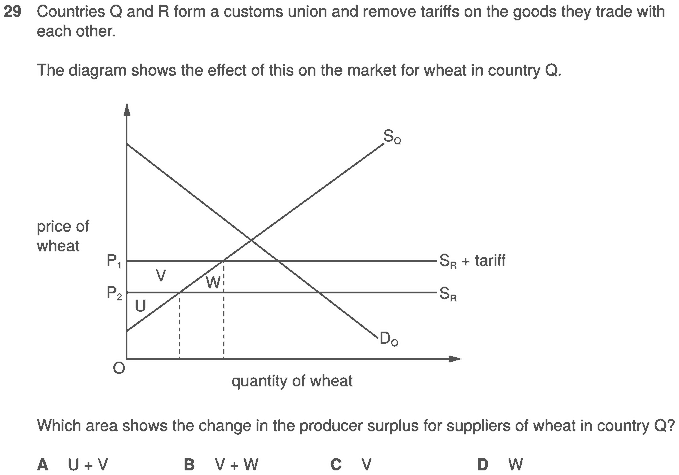
CCorrect answer
Which action is open to a government to control the rate of decline in the value of the currency and improve the current account of the balance of payments?
BCorrect answer
‘A depreciation of a country’s currency leads initially to a worsening of its trade balance.’ What helps to explain this?
DCorrect answer

ACorrect answer
One year, the World Bank gave a loan of $650 million to Angola to help stabilise the economy. The Bank said Angola needed to have a fiscal policy that would encourage the diversification of its economy. Which policy would be consistent with this requirement?
DCorrect answer
What is most likely to happen as a country develops?
ACorrect answer

CCorrect answer

DCorrect answer
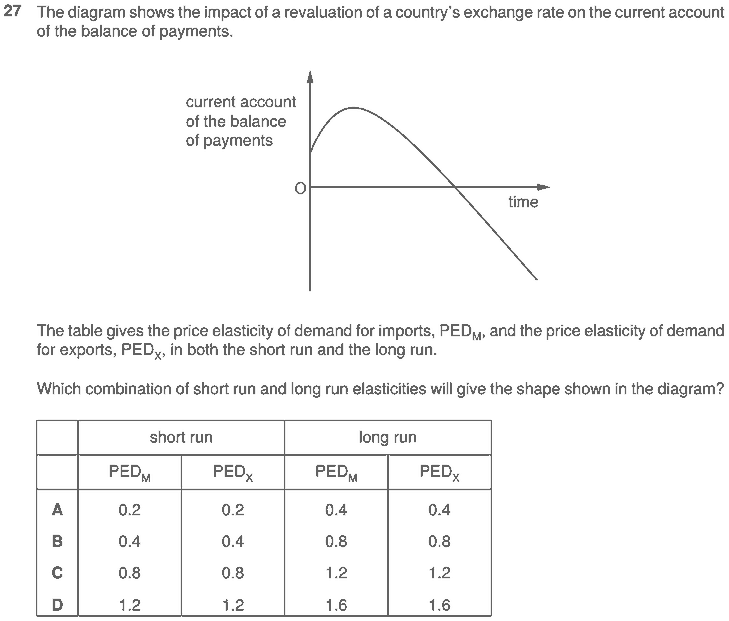
A country devalues its currency on the foreign exchange market. Its current account balance on the balance of payments worsens in the short run, but improves in the long run. What does this illustrate?
ACorrect answer
It has been estimated by the United Nations that the total external debt of developing countries has been increasing by about $425 billion each year. What is likely to have contributed to this?
DCorrect answer
What is not a role of the International Monetary Fund (IMF)?
CCorrect answer
The African Union (AU) consists of 55 countries of Africa, but only 18% of total trade of the AU is between countries in Africa. If the AU decides to co-operate on trade policy, what would make the greatest change to this situation?
DCorrect answer

BCorrect answer
What is likely to be found in a free trade area?
ACorrect answer
What is not included in the Human Development Index?
ACorrect answer
A multilateral organisation that provides loans and grants to governments of low and middle-income countries for the purpose of pursuing capital projects. Which organisation does this statement describe?
CCorrect answer
What is not a possible effect of using expenditure-switching policies to reduce a deficit on the current account of the balance of payments?
ACorrect answer

DCorrect answer
Which statement about the components of the balance of payments is correct?
ACorrect answer
Which statement describes a multinational company (MNC)?
BCorrect answer
What occurs in a monetary union?
ACorrect answer
What is the main role of the World Bank?
DCorrect answer
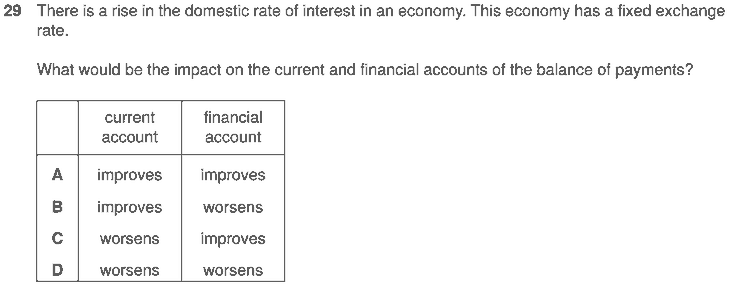
ACorrect answer
As a member of the European Union, Greece must trade at the same exchange rate, tied to the euro, as stronger economies such as Germany. Greece has a persistent balance of payments deficit. How would changing to a floating exchange rate help Greece?
CCorrect answer

CCorrect answer
Which statement is correct?
CCorrect answer
What is a trade-weighted exchange rate?
ACorrect answer
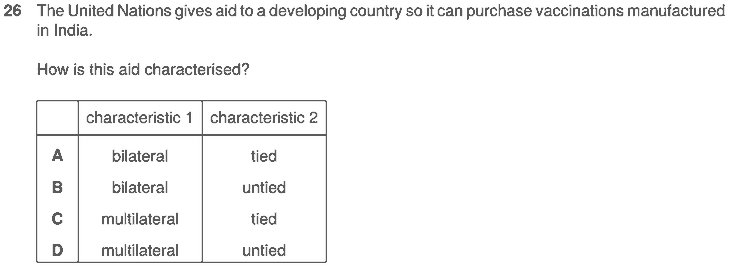
CCorrect answer
What is a protectionist policy a government may use to reduce the deficit on the balance of payments of the current account?
DCorrect answer
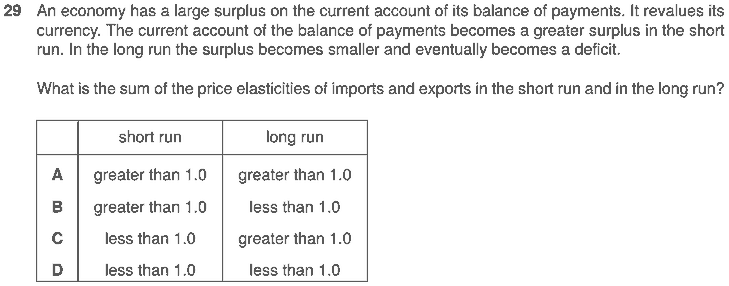
CCorrect answer
What is not a characteristic of an emerging economy?
ACorrect answer
What is not a likely feature of a customs union?
DCorrect answer
A central bank officially lowers the price of its currency relative to an agreed rate in terms of other currencies. What type of central bank policy is this?
CCorrect answer

ACorrect answer
Which variable is included in the calculation of both the Human Development Index (HDI) and the Multidimensional Poverty Index (MPI)?
DCorrect answer
A multinational company is planning to invest in a new factory in a low-income country. What is not a possible benefit to the low-income country?
DCorrect answer
A country with fixed exchange rates faces a surplus on its current account. Which policy is most desirable to maintain the fixed exchange rate?
DCorrect answer
Which criticism of foreign direct investment (FDI) is least valid?
ACorrect answer

DCorrect answer
A country’s government imposes a tariff on steel imports. What is the likely impact of this tariff on this country’s economy?
BCorrect answer
Which measurement is not included in the calculation of the Human Development Index?
CCorrect answer
BCorrect answer
What is not a function of the International Monetary Fund (IMF)?
CCorrect answer
DCorrect answer
What is most likely to prevent a developing country from achieving economic development?
BCorrect answer

ACorrect answer
The value of the currency of an open economy with a fixed exchange rate is significantly below its purchasing power parity value. If the economy decides to adopt a floating exchange rate, which of its macroeconomic policy aims is most likely to benefit?
ACorrect answer
Which policy will help to correct a deficit on the current account of the balance of payments?
BCorrect answer

ACorrect answer
The following are four conditions sometimes attached to IMF loans to low-income countries. Which condition would conflict with the ‘infant industry’ argument?
ACorrect answer
DCorrect answer
What is the best description of sustainable economic development?
BCorrect answer

ACorrect answer

DCorrect answer
What would be the most effective long-term solution to a persistent deficit on the current account of the balance of payments?
BCorrect answer

BCorrect answer

ACorrect answer
Which combination of characteristics is usually associated with a low-income country?
ACorrect answer
What is least likely to improve as a result of the decision by high-income countries to increase their aid to low-income countries?
BCorrect answer
The current account on the balance of payments moves into deficit. What is a possible reason for this?
DCorrect answer
Which policy would not lead to an increase in the value of a country’s currency?
ACorrect answer

DCorrect answer
What is least likely to lead to an increase in optimum population?
CCorrect answer
What is not included as a weighted indicator of poverty in the Multidimensional Poverty Index (MPI)?
CCorrect answer
Which role is performed by the World Bank but not by the International Monetary Fund (IMF)?
DCorrect answer
Some economists argue there is little evidence of the value of aid in improving economic development in less-developed countries. Which situation supports this claim?
CCorrect answer
Many commercial banks in Japan raised their interest rates on customer accounts in early 2024 for the first time in 17 years. Some banks also increased the interest rates on their housing loans (mortgages), which placed a heavier burden on borrowers.
The rise in interest rates followed the ending of a policy of negative interest rates used by the Bank of Japan (BOJ), the country’s central bank. Previously, the BOJ had set interest rates at –0.1% on some of the deposits made by commercial banks at the central bank.
The increase in interest rates coincided with a falling unemployment rate and expectations that Japan’s economy would grow further in the second half of 2024. This economic growth would be caused by higher wages, increased consumer spending and a depreciation of Japan’s currency, the yen.
The BOJ has a target inflation rate of 2%, but core inflation, which excludes fresh food prices, was last reported at 2.6% in March 2024. Core inflation was forecast to be above target for at least a year. This gave the central bank an opportunity to increase interest rates further. Higher interest rates, however, can reduce demand for loans and restrain economic growth.
Higher interest rates in Japan would usually lead to higher capital inflows from foreign savers causing an appreciation of the yen. Compared to other major economies, however, the interest rates in Japan were still very low. When the interest rate set by the BOJ was 0.1%, the equivalent rate was 5.25% in both the United States (US) and the United Kingdom (UK) and 4.5% in the Eurozone.
The value of the yen fell to a 34-year low in April 2024 as the chances of an expected cut in US interest rates diminished. Intervention by the BOJ to support the yen was seen as a possibility by the foreign exchange markets to restore confidence in the currency and reduce imported inflation.
On the other hand, the weak yen helped Japan’s balance of trade in goods and services. It encouraged export sales despite relatively low global economic growth. Export growth occurred across several products, particularly in transportation equipment. The number of foreign visitors to Japan also increased due to the weak yen.
Sources: Adapted from: japantimes.co.jp, 6 May 2024 morningstar.co.uk, 21 March 2024 kyodonews.net, 1 March 2024 deloitte.com, 18 October 2024
(c) Consider the extent to which a depreciation of the yen has been beneficial for Japan’s balance of trade in goods and services. [6]
Consider the extent to which a depreciation of the yen has been beneficial for Japan’s balance of trade in goods and services. Evidence from the article about its benefits:
(1) due to lower prices of exports (1)
(1)
(d) Assess how diminished chances of a US interest rate cut pushed the yen to a 34-year low in April 2024. [6]
Assess how diminished chances of a US interest rate cut pushed the yen to a 34-year low in April 2024. Economic theory states that:
(1).
(1).
Max 4 for general description of how interest rates affect exchange rates, without clear application to the US and Japan.
5 Assess the view that high levels of external debt are an unsustainable burden to low-income countries. [20]
Assess the view that high levels of external debt are an unsustainable burden to low-income countries.
Use Table A: AO1 Knowledge and understanding andAO2 Analysis and Table B: AO3 Evaluation to mark candidate responses to this question.
AO1 and AO2 out of 8 marks. AO3 out of 4 marks.
Indicative content Responses may include:
AO1 Knowledge and understanding and AO2 Analysis
AO3 Evaluation
Accept all valid responses.
AO1 Knowledge and understanding and AO2 Analysis
AO3 Evaluation
The United States (US) balance of trade deficit increased to US$69.4 billion in March 2024. The deficit is considered to be undesirable and has caused discussion within the US on how to decrease it. Current and previous US governments have decided that import tariffs are their preferred solution.
Following the COVID-19 pandemic, there was a period in 2022 when the annual rate of inflation was over 10%. Intervention by the Federal Reserve (the US central bank) helped to reduce the annual rate of inflation to 2.9% by December 2023. This was still above its target rate of 2%. There was uncertainty about whether government policy objectives concerning inflation, economic growth and employment were all moving in the right direction. This uncertainty and above-target inflation meant the Federal Reserve decided to leave interest rates unchanged at 5.5%. It also decided to continue its policy of reversing quantitative easing by selling securities to remove money from money markets.
A secondary effect of this high-interest rate policy was that the US foreign exchange rate had appreciated by 6.25% during the previous 5 years. This meant that low-income countries (LICs) had to pay more for their imports priced in US$, such as raw materials, foodstuffs and oil.
These LICs often have an underdeveloped market economy with limited ability to raise tax revenue. They also have large external debts in US$, the repayment of which restricts their ability to increase economic development.
Sources: Adapted from; March 2024 Trade Gap is $69.4 Billion, bea.gov, 2 May 2024 Transcript of Chair Powell’s press conference, federalreserve.gov, 1 May 2024 Consumer prices up 2.9 percent, bls.gov, 21 August 2024
(a) Explain why a balance of trade deficit might be regarded as undesirable by the US government. [2]
Explain why a balance of trade deficit might be regarded as undesirable by the US government. Implies that (X-M) worsens and therefore Job losses 1 Reduction in gross domestic product (GDP) 1 Imported inflation 1 Fall in foreign exchange reserves. 1
Max 2
(b) Explain, with the aid of a diagram, how import tariffs lead to expenditure switching in the US economy. [4]
Explain, with the aid of a diagram, how import tariffs lead to expenditure switching in the US economy. Price US Demand US supply P1 B P2 F G World Supply+Tariff P3 world supply Q1 Q2 Qe Q3 Q4 Quantity
Diagram Axes and Labels 1 + 1 (Axes MUST show world supply)
Max 2 for diagram Comments based on diagram Max 2 Imports reduce (Q1 to Q4) to (Q2 to Q3) 1 Domestic output increases Q1 to Q2 1 World supply falls from Q4 to Q3 1 Explanation 1 developed point 1 + 1 2 points 1 and 1
(d) Assess whether the information is sufficient to conclude that the Federal Reserve’s interest rate policy has benefitted LICs. [7]
Assess whether the information is sufficient to conclude that the Federal Reserve’s interest rate policy has benefitted LICs.
Max 6 Conclusion. The evidence is insufficient to show any benefit to LIC 1
5 Consider whether the use of gross national income (GNI) alone is sufficient to measure the standard of living in a high-income country (HIC). [20]
Consider whether the use of gross national income (GNI) alone is sufficient to measure the standard of living in a high-income country. Use TableA: AO1 Knowledge and understanding and AO2 Analysis and Table B: AO3 Evaluation to mark candidate responses to thisquestion.
AO1 and AO2 out of 14marks. AO3 out of 6 marks.
AO1 Knowledge and understanding and AO2 Analysis
AO3 Evaluation
Accept all valid responses.
AO1 Knowledge and understanding and AO2 Analysis
AO3 Evaluation
5 Discuss whether expenditure‑reducing policies are preferable to expenditure‑switching policies in order to correct a persistent deficit on the current account of the balance of payments. [20]
Discuss whether expenditure-reducing policies are preferable to expenditure-switching policies in order to correct a persistent deficit on the current account of the balance of payments.
Use Table A: AO1 Knowledge and understanding andAO2 Analysis and Table B: AO3 Evaluation to mark candidate responses to this question.
AO1 and AO2 out of 14 marks. AO3 out of 6 marks.
Indicative content Responses may include:
AO1 Knowledge and understanding and AO2 Analysis
AO3 Evaluation
Accept all valid responses.
AO1 Knowledge and understanding and AO2 Analysis
AO3 Evaluation
5 Consider the extent to which aid and trade can contribute to a country’s economic development. [20]
Consider the extent to which aid and trade can contribute to a country’s economic development.
Use Table A: AO1 Knowledge and Understanding, AO2 Analysis, and Table B: AO3 Evaluation, to mark candidate responses to this question
AO1 and A)2 is out of 14 marks and AO3 is out of 6 marks
Indicative Content Responses may include:
AO1 Knowledge and Understanding and AO2 Analysis
AO3 Evaluation
Accept all valid responses
AO1 Knowledge and understanding and AO2 Analysis
AO3 Evaluation
Many low-income countries have large proportions of the population below the World Bank’s absolute poverty level of $2.15 per day (United States dollars, 2022). One way in which these countries try to reduce their poverty is by the migration of workers to richer countries. The migrants send a portion of their incomes, known as remittances, back home to support their families.
These overseas workers are a link between migration and development. The flow of remittance money is greater than the foreign direct investment and official development aid received by middle-income and low-income countries. Total remittances received by those countries in 2022 was $650 billion, of which 45% ($293 billion) was received by only five countries.
About 50% of migrants from low-income countries went to high-income countries.
Migrants can find their incomes increase significantly. A nurse may make seven times more in Australia than in the Philippines, adjusted for purchasing power parity (PPP).
Unlike official aid, remittances flow directly to their receivers and are a stable source of income. They can buy extra food and they may provide savings for the receiver. They may reduce child labour in disadvantaged families and allow for higher spending on education through higher enrolments and more years of completed schooling.
Migration can reduce unemployment and raise wages in home countries. Migration may lead to larger benefits for the home country by increasing the rates of return on human capital caused by the creation of better, more productive, and higher paying jobs.
When the flow of migrants goes to a host country whose population is ageing, it may reduce the average age of the population. This can lead to an increase in the size of the labour force, reduce the age dependency ratio and make a positive tax contribution. The migrants increase the demand for host country output and may utilise housing in less popular areas. Those with a high level of education make an even more significant contribution to economic output.
Sources: The Guardian, 23 August 2023 asia.nikkei.com, 3 March 2023 imf.org, March 2020
(b) Explain, with the aid of a diagram, how the migration of workers from a low-income country is likely to affect wages in the low-income country. [5]
Explain, with theaid of a diagram, how the migration of workers from a low-income country is likelyto affect wages in the low-income country. Labels and axes Wages/labour (1) Initial S and D for labour (1) and equilibrium point (1) Reduction in the supply of labour (supply curve shift) (1) New equilibrium wage and quantity (1)
Maximum 3 marks if no diagram
(c) The article states: ‘Total remittances received by those countries in 2022 was $650 billion.’
Analyse how this is likely to benefit the migrants’ home economies. [6]
The article states: ‘The remittances received by those countries in 2022 was $650 billion.’ Analyse how this is likely to benefit the migrants’ home economies. Remittances a form of invisible earning for the migrant’s home country (1) thus the US$650 are secondary income for the home country (1) There BoP effect is to increase exports (X) (1) and to increase the (X–M) element in the aggregate demand equation (1). The increase in AD will shift the AD curve to the right (1) and GDP will increase (1)
Candidates can show this effect through an AD/AS diagram (2) NOTE: Candidates may take a wider view than the macro mark scheme and consider groups within the economies as the references in data.
(d) Consider if the article contains sufficient information to support the view that migrants have only a beneficial economic impact on the host country. [7]
Considerif the article contains sufficient informationto support the view that migrants have only a beneficial economic impact on the host country. Beneficial to host country: Higher labour force(1), pay taxes (1) allows pay- as you-go pension system (1), increases demand (1), Increased productivity and economic growth (1)Entrepreneurship e.g.new business startups Max 3. Disadvantages: The effects of higher demand for housing (1),health services
(1), education services (1). cultural differences (1) are not mentioned, Other considerations-wage suppression in some sectors, short term unemployment effects, integration/training costs, regional disparities Max 3. Justified Conclusion (1)
4 Evaluate the effect of a rise in the exchange rate on the achievement of the macroeconomic aims of a country. [20]
Evaluate the effect ofa rise in the exchange rate on the achievement of the macroeconomic aims of a country.
AO1 Knowledge and understanding and AO2 Analysis
AO3 Evaluation
AO1 Knowledge and understanding and AO2 Analysis
AO3 Evaluation
Between 2000 and 2020, Brazilian GDP, measured in US dollars ($), rose from $1.19 trillion to $1.89 trillion at constant prices (2015). In the same period GDP per head rose from $6745 to $8204 at constant prices (2015).
The strength of the Brazilian economy lies in the variety and quantity of its natural resources. For example, Brazil is one of the world’s largest exporters of agricultural commodities, mainly soya and beef. There are also significant exports of minerals. Brazil is the second largest iron ore producer in the world and extracts 3.4% of the world’s crude oil.
World agricultural markets are dominated by four large commodity traders that buy and sell products such as grain and soya. They have grown through both horizontal integration and vertical integration. These traders own many large farms, they process farm produce and transport it to trade on international markets. In addition to buying and selling, the traders provide seed and fertiliser to farmers and supply storage for their products. They use agricultural by-products to produce items like biofuel. These traders also provide financial services to these markets.
Commodity traders are very important to the development of complex global food markets. Food prices, access to scarce resources such as land and water, climate change and food security are all affected by the activities of traders. In Brazil, the output of 15 000 farmers is purchased by a single trader.
In Brazil the development of agriculture, mining and oil extraction all contribute to environmental degradation. Both agriculture and mining have been accompanied by deforestation of the Amazon rainforest. Access roads to mining areas also lead to deforestation. Waste water from mining activity is frequently stored in reservoirs behind dams. On two occasions in the last 10 years these dams failed to hold back the water. This led to widespread flooding, the discharge of pollutants such as mercury into rivers, and deaths.
Sources: The Guardian, 23 August 2022
Cereal Secrets, Oxfam Research Report, August 2012 oec.world/en/profile, August 2023
(d) Use the article to evaluate the impact of the development of the agricultural and mining industries on the standard of living in Brazil. [7]
Use the article to evaluate the impact of the development of the agricultural and mining industries on the standard of living in Brazil. Definition of standard of living: Monetary (1) and non-Monetary (1). (2) Max Data interpretation (4) max Data for improvement SoL Increase in GDP 0.7 trn (1), and US$ 1459 pc (1), Can quote the changes, Large exporter (1), (2) Max Data for reduction in SoL Agricultural/mining/oil degradation of rain forest (1) Environmental pollution from mining/Flooding from burst dams (1) (2) Max But no mention of non-financial aspect of SoL:1 e.g. education, health or housing (1) (2) Max Conclusion: The data is mixed with some positive and negative points but there is need for a wider range of data to make a full judgement (1)
4 Evaluate the effect of a fall in the exchange rate on the achievement of the macroeconomic aims of a country. [20]
Evaluate the effect ofa fall in the exchange rate on the achievement of the macroeconomic aims of a country.
AO1 Knowledge and understanding and AO2 Analysis
AO3 Evaluation
Accept all valid responses.
5 Evaluate whether the presence of multinational companies (MNCs) in low-income countries is always beneficial. [20]
Evaluate whether the presence of multinational companies (MNCs) in low-income countries is always beneficial. Use TableA:AO1 Knowledge and understanding andAO2 Analysis and Table B: AO3 Evaluation to mark candidate responses to this question.
AO1 and AO2 out of 14 marks. AO3 out of 6 marks.
Indicative content Responses may include:
AO1 Knowledge and understanding and AO2Analysis
AO3 Evaluation
Accept all valid responses.
A government commission published a report saying that global poverty and inequality were worsening and there was a risk that the gap between the rich and the poor would increase.
But, according to a newspaper, a lot of what is said about inequality is wrong. It overlooks the fact that the past 50 years saw a period of dramatic reduction in global inequality. The normal measurement of relative inequality is the Gini coefficient. The figure for global inequality in 1975 was 0.75, in 2020 it was 0.72 and in 2022 it was 0.67.
It is important to understand this trend rather than make the mistake of the commission.
The fall in global inequality should not come as a surprise. For about two hundred years the benefits of industrialisation went mainly to countries in Europe and North America. Income inequality between these countries and poorer countries worsened. The spread of globalisation in recent decades has meant this difference has lessened. Countries such as China and India have benefited from large increases in per capita (average) income, as shown in Table 1.1.

If the attention is on the relief of poverty rather than the wealth of the richest, improvements can be seen. Life expectancy has increased, most noticeably by ten years in the past two decades in the poorest region of sub-Saharan Africa. Literacy rates have also increased. Those in absolute poverty across the world have fallen from more than a third to under a tenth of the world’s population. And all this while the world’s population has increased.
Critics of globalisation and foreign direct investment (FDI) by multinational companies point to the possible negative environmental effects, the weakening of individual cultures and the reliance on international financial institutions that can fail. They also claim there can be exploitation of workers leading to greater wage inequality and possible increases in domestic unemployment as cheaper goods are imported.
Source: The Times, 23 August 2021
(c) With reference to the article, explain the idea of globalisation and assess whether there is enough evidence to conclude that globalisation has a net benefit for everyone. [8]
With reference to the article, explainthe idea of globalisationand assess whetherthere is enoughevidence to conclude that globalisation has a net benefit for everyone. Globalisation means the growing interdependence of the world's economies, cultures, and populations, brought about by cross-border trade in goods and services, technology, and flows of investment, people, and information. (2) Benefits mentioned include increases in incomes, life expectancy (10 years in sub-Saharan Africa) and literacy rates. A fall in absolute poverty. A fall in inequality (2) Drawbacks mentioned environmental issues, exploitation of workers, domestic unemployment, increasing dependence on other countries. (2) The benefits have occurred while the population has increased so are probably substantial. However, there is no statistical information to compare the benefits with the drawbacks. Also it depends on what ‘net benefit’ means– does it mean an increase in quantity of goods, higher profits, or does it mean wider choice, better quality. It is difficult to make an overall assessment. (2)
5 ‘The use of tariffs is the most effective way to correct a balance of payments deficit.’
With the help of a diagram, evaluate this statement. [20]
The use of tariffs is the most effective way to correct a balance of payments deficit. With the help of a diagram, evaluate this statement
Use Table A: AO1 Knowledge and understanding and AO2 Analysis and Table B: AO3 Evaluation to mark candidate responses to this question.
AO1 and AO2 out of 14 marks. AO3 out of 6 marks.
Indicative content Responses may include:
AO1 Knowledge and understanding and AO2 Analysis
AO3 Evaluation
Accept all valid responses.
AO1 Knowledge and understanding and AO2 Analysis
AO3 Evaluation
5 A free trade area gains all the benefits associated with being a member of a customs union while avoiding all the costs associated with being a member of a customs union.
Evaluate this statement. [20]
A free trade area gains all the benefits associated with joining a customs union while avoiding all the costs associated with being a member of a customs union. Evaluate this statement.
Use Table A: AO1 Knowledge and understanding and AO2 Analysis and Table B: AO3 Evaluation to mark candidate responses to this question.
AO1 and AO2 out of 14 marks. AO3 out of 6 marks.
Indicative content Responses may include:
AO1 Knowledge and understanding and AO2 Analysis
AO3 Evaluation
Accept all valid responses.
AO1 Knowledge and understanding and AO2 Analysis
AO3 Evaluation
5 Globalisation will have an equally beneficial effect on the standard of living in both high-income and low-income countries.
Evaluate this statement. [20]
Globalisation will have an equally beneficial effect on the standard of living in both high-income and low-income countries Evaluate this statement
Use Table A: AO1 Knowledge and understanding and AO2 Analysis and Table B: AO3 Evaluation to mark candidate responses to this question.
AO1 and AO2 out of 14marks. AO3 out of 6 marks.
Indicative content Responses may include:
AO1 Knowledge and understanding and AO2Analysis
AO3 Evaluation
Accept all valid responses.
Since 1971 Bangladesh has experienced significant economic development, moving from the low-income to the lower-middle-income country classification. Gross National Income (GNI) per capita at constant 2017 prices in United States dollars ($) rose from $2342 to $5823 between 2000 and 2020. Over the same period, the country’s Human Development Index (HDI) rose from 0.49 to 0.66.
During this period, Bangladesh underwent changes in employment as it moved from the agricultural sector to the manufacturing and services sectors.
First, in agriculture, output increased by more than 100% whilst employment fell from 65% to 38% of the working population. This change was helped by innovation in crop irrigation, land preparation and harvesting, aided by the development of local industries to provide the capital equipment needed.
A second source of economic development was the growth in the clothing industry producing ready-made garments (RMG) that contributed about 11% of Bangladesh’s Gross Domestic Product (GDP) and employed 4.4 million workers of which 2.5 million were women (2020). The industry uses significant division of labour with production split into 10 or more processes, for example, cutting, sewing zips, assembly and packaging.
The value of raw materials imported for the RMG industry was about half of the value of the industry’s exports. Net exports from this sector stood at $23 billion. This enabled Bangladesh to both import a wider range of goods and services and reduce the deficit on its balance of trade in goods.
In 2020, there were more than 4000 RMG manufacturers in Bangladesh, differentiated by the quality of their products and the speed of their delivery. The RMG industry supplied more than 100 major US and European retailers.
However, the RMG industry has critics who point to air and water pollution from the chemicals used in cotton growing and manufacturing clothes. The industry is also accused of employing child labour and of having poorly constructed factories.
Sources: Bangladesh overview: World Bank, 11 April 2024 and Quarterly Review on Readymade Garments, Bangladesh Bank Research Department, 14 February 2023
(a) Identify what is included in the HDI. [3]
Identify what is included in the HDI. Health/Life Expectancy 1 Education/Years of Schooling 1 Income/Gross National Income pc/GNI 1
(d) With reference to the article, assess whether there is enough evidence to conclude that living standards in Bangladesh have improved since 1971. [8]
With reference to the article, assess whether there is enough evidence to conclude that living standards in Bangladesh have improved since 1971. Distinction between standard of living: monetary e.g. income and non- monetary e.g. health, education, water quality 1. Improvements Rise in GNI from 2342 US$ to 5823 US$ = 2481 1 US$/ 143% increase 1 HDI rose 0.49 to 0.66 1 Agricultural production/productivity. increased 1, Balance of Trade improved 1 Net exports increased 1, wider range of goods and services imported 1
Maximum 3 marks Disadvantages Development of negative externalities 1 air/water pollution 1 use of child labour 1 bad working conditions 1 Loss of agricultural jobs 1 Poorly constructed factories 1
Maximum 3 marks Conclusion Not enough evidence in the article 1 No information on housing/education or health 1
China’s economic miracle has been built on a seemingly endless supply of affordable labour from a population of 1.4 billion.
Content removed due to copyright restrictions.
Fig. 1.1 Annual population change in China, 1970 to 2050
Sources: Didi Tang, The Times, 29 April 2021 and 12 January 2023 US Census International Database, 15 February 2023
(a) Explain what is meant by an optimum population. [2]
Explain what is meant by an optimum population. The optimum size of population is an economy which, with existing natural resources/factors of production/ given state of technology, (1) yields the highest income per capita in a country/where the standard of life is at a maximum (1)
(b) Explain how China’s population structure changed between 1970 and 2020 and consider whether the statement ‘its population is decreasing’ is supported by Fig. 1.1. [5]
Explain how China’s population structure changed between 1970 and 2020 and considerwhetherthe statement ‘its population is decreasing’ is supported by Fig. 1.1. References should be made to: the declining birth rate, (1) an ageing population (1) an increasing dependency ratio (1) Fig.1. shows population still growing/ not declining/ growing at a slower rate up to 2020 (1). Fig 1.1 does not support the statement that ‘its population is decreasing (1)
(d) China’s government has a different view from what it says are the alarming statements made by economists. Consider the effects on the economy of the population policies suggested by China’s government. [7]
China’s government has a different view from what it says are the alarming statements made by economists. Consider the effects on the economyof the population policies suggested by China’s government. The one-child policy was based on the assumption that China’s population had increased beyond its optimum point and needed to transition to an economy based on skills, froman economy based on the size of its workforce.
(1) The one child policy did produce asignificant fall in the rate of increase of the population. However, this created challenges: an increasingly dependent population (1); a potential decline in savings and investment (1); leading to a fall in long term AS and AD (1) The two-child policy was introduced in 2016 to achieve economic growth and move back towards an optimum population (1) This policy was based on the assumption that China needed a young, skilled workforce, assisted by technology (1) This would make China internationally more competitive (1) leading to a rise in AD and AS in the long run. (1) A conclusion, for example, estimates based on fig 1.1 suggest that the intended effects of the two-child policy are unlikely to be achieved. (1)
Up to 3 marks maximum for discussing the effects of each policy. 1 mark for a conclusion
5 With the help of a diagram, evaluate the effectiveness of the use of expenditure-switching policies to reduce a current account deficit on the balance of payments. [20]
With the help of a diagram, evaluate the effectiveness of the use of expenditure-switchingpolicies to reduce a currentaccount deficiton the balance of payments. Use TableA:AO1 Knowledge and understanding andAO2 Analysis and Table B: AO3 Evaluation to mark candidate responses to this question.
AO1 and AO2 out of 14 marks. AO3 out of 6 marks.
Indicative content Responses may include:
AO1 Knowledge and understanding and AO2Analysis
L2 max if no relevant diagram provided.
AO3 Evaluation
Accept all valid responses.
AO1 Knowledge and understanding and AO2Analysis
AO3 Evaluation
🔒 Unlock every Unit 11: International economic issues question from 2020–2024
All 148 come with their mark schemes, answers and case studies, and appear in the practice tool above once you’re signed in. It’s free.
Questions and mark schemes are from past Cambridge papers and are reproduced for revision. Topical Vault is an independent revision resource, not affiliated with or endorsed by Cambridge Assessment International Education.
Each topic opens this practice tool with only that topic’s questions, plus how often it comes up and every question on it in one list. Revision notes for A Level Economics → Full A Level Economics past papers →