← Topical Vault

Differing objectives and policies of firms · A Level Economics

Cambridge 9708, Paper 3 & 4. 1,666 questions, 2020 to 2026.

Topic
Year

Paper 3 multiple-choice questions and Paper 4 data-response/essay questions and case studies, retyped from the original Cambridge material; artwork and data tables are reproduced as images. Mark schemes show the official answer key and level-marked indicative content.

About Differing objectives and policies of firms

Questions on the objectives of firms: profit, revenue and sales maximisation, satisficing, the principal-agent problem, and pricing policies such as limit and predatory pricing.

New to Differing objectives and policies of firms, or finding these questions hard?

Read the notes first: the key ideas, diagrams and formulas, and the mistakes examiners see most, in about 13 minutes.

Read the Differing objectives and policies of firms notes →

48 past paper questions on this topic since 2020, across 16 exam sessions.

How often it comes up

YearPaper 3Paper 4TotalChart
2026101
2025707
2024628
2023404
2022538
202110010
20208210

Every 2025–2026 question on Differing objectives and policies of firms

The whole topic on one page, with answers. Printing this page prints just this list.

Paper 3 · Multiple choice (8)

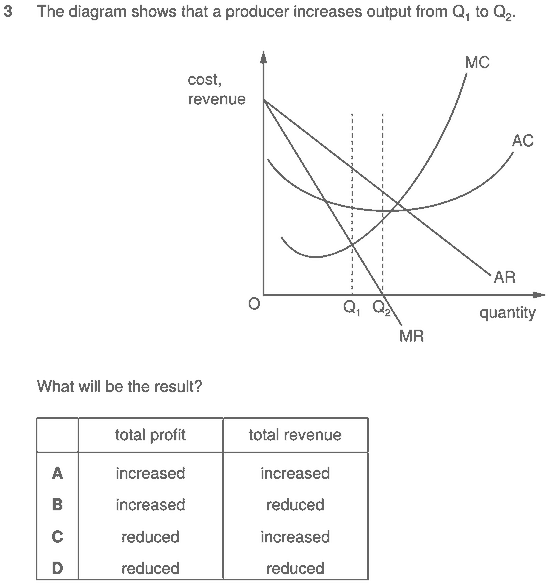
Question 3Feb/March 20269708/321 mark
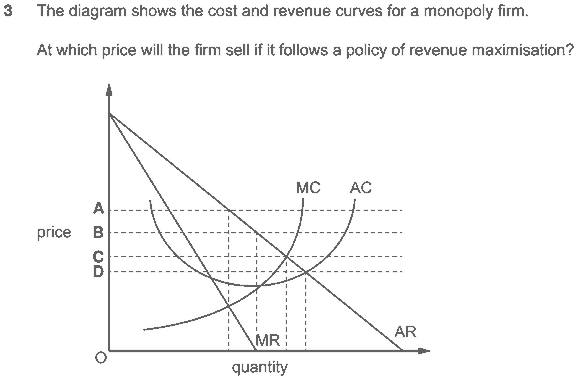
9708/32 Feb/March 2026 question 3
Show answer

BCorrect answer

Question 1Oct/Nov 20259708/311 mark

What is likely to lead to the principal-agent problem?

  • Aa manager of a business makes decisions on behalf of the owner
  • Bmusic festival tickets are purchased by a person who intends to sell them at a large profit
  • Cthe government is the only buyer of a pharmaceutical product
  • Dthere is only one firm that manufactures the product
Show answer

ACorrect answer

Question 3Oct/Nov 20259708/311 mark
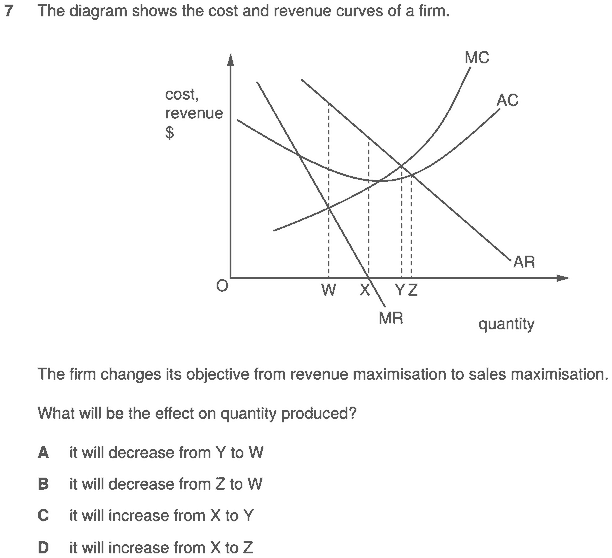
9708/31 Oct/Nov 2025 question 3
Show answer

CCorrect answer

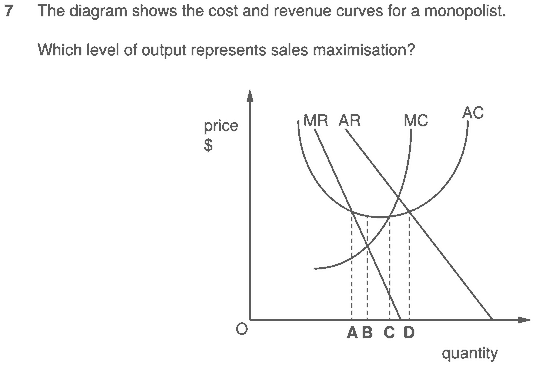
Question 7Oct/Nov 20259708/311 mark
9708/31 Oct/Nov 2025 question 7
Show answer

DCorrect answer

Question 7Oct/Nov 20259708/321 mark
9708/32 Oct/Nov 2025 question 7
Show answer

DCorrect answer

Question 2Oct/Nov 20259708/331 mark

A firm has set a low price in the short run to act as a barrier to entry for new firms entering the market. This is an example of which pricing strategy?

  • Alimit pricing
  • Bpredatory pricing
  • Cprice discrimination
  • Dprice leadership
Show answer

ACorrect answer

Question 7Oct/Nov 20259708/341 mark

A firm is operating at a level of output which corresponds to the point where MR = 0. What objective is the firm achieving?

  • Amaximising consumer surplus
  • Bmaximising profit
  • Cmaximising sales
  • Dmaximising revenue
Show answer

DCorrect answer

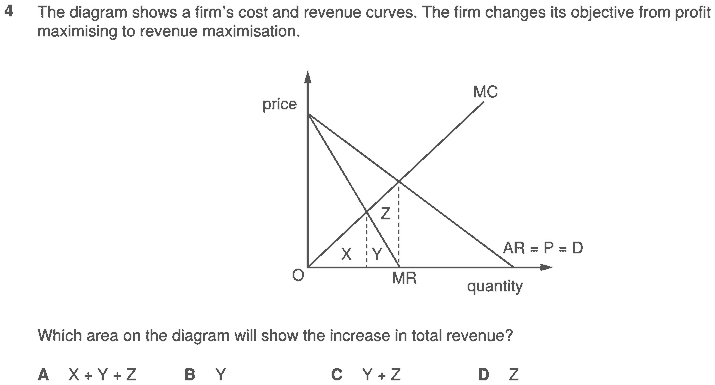
Question 4Feb/March 20259708/321 mark
9708/32 Feb/March 2025 question 4
Show answer

BCorrect answer

40 more questions from 2020–2024

🔒 Unlock every Differing objectives and policies of firms question from 2020–2024

All 40 come with their mark schemes, answers and case studies, and appear in the practice tool above once you’re signed in. It’s free.

Create a free accountSign in

A few of them

  • 9708/31 · Oct/Nov 2024 · Question 9What is likely to have its cause… 🔒
  • 9708/41 · Oct/Nov 2024 · Question 33 Evaluate the consequences for the price… 🔒
  • 9708/43 · Oct/Nov 2024 · Question 1(a)(i) Distinguish between limit pricing and predatory… 🔒
  • 9708/31 · May/June 2024 · Question 8A firm that raises capital through a… 🔒
  • 9708/32 · Feb/March 2024 · Question 8Which type of employment contract is most… 🔒
  • + 35 more, by year in the table above

Questions and mark schemes are from past Cambridge papers and are reproduced for revision. Topical Vault is an independent revision resource, not affiliated with or endorsed by Cambridge Assessment International Education.

A Level Economics questions by topic

Each topic opens this practice tool with only that topic’s questions, plus how often it comes up and every question on it in one list. Revision notes for A Level Economics →

  1. Unit 7The price system and the microeconomy
  2. Ch 30Utility
  3. Ch 31Indifference curves and budget lines
  4. Ch 32Efficiency and market failure
  5. Ch 33Private costs and benefits, externalities and social costs and benefits
  6. Ch 34Types of cost, revenue and profit, short-run and long-run production
  7. Ch 35Different market structures
  8. Ch 36Growth and survival of firms
  9. Ch 37Differing objectives and policies of firms
  10. Unit 8Government microeconomic intervention
  11. Ch 38Government policies to achieve efficient resource allocation and correct market failure
  12. Ch 39Equity and redistribution of income and wealth
  13. Ch 40Labour market forces and government intervention
  14. Unit 9The macroeconomy
  15. Ch 41The circular flow of income
  16. Ch 42Economic growth and sustainability
  17. Ch 43Employment and unemployment
  18. Ch 44Money and banking
  19. Unit 10Government macroeconomic intervention
  20. Ch 45Government macroeconomic policy objectives
  21. Ch 46Links between macroeconomic problems and their interrelatedness
  22. Ch 47Effectiveness of policy options to meet all macroeconomic objectives
  23. Unit 11International economic issues
  24. Ch 48Policies to correct disequilibrium in the balance of payments
  25. Ch 49Exchange rates
  26. Ch 50Economic development
  27. Ch 51Characteristics of countries at different levels of development
  28. Ch 52Relationship between countries at different levels of development
  29. Ch 53Globalisation