← Topical Vault

Indifference curves and budget lines · A Level Economics

Cambridge 9708, Paper 3 & 4. 1,666 questions, 2020 to 2026.

Topic
Year

Paper 3 multiple-choice questions and Paper 4 data-response/essay questions and case studies, retyped from the original Cambridge material; artwork and data tables are reproduced as images. Mark schemes show the official answer key and level-marked indicative content.

About Indifference curves and budget lines

Questions on indifference curves and budget lines: their shapes, consumer equilibrium, and splitting a price change into income and substitution effects for normal, inferior and Giffen goods.

New to Indifference curves and budget lines, or finding these questions hard?

Read the notes first: the key ideas, diagrams and formulas, and the mistakes examiners see most, in about 13 minutes.

Read the Indifference curves and budget lines notes →

67 past paper questions on this topic since 2020, across 19 exam sessions.

How often it comes up

YearPaper 3Paper 4TotalChart
2026404
2025617
2024617
2023516
202212315
20217613
20207815

Every 2025–2026 question on Indifference curves and budget lines

The whole topic on one page, with answers and mark schemes. Printing this page prints just this list.

Paper 3 · Multiple choice (10)

Question 4May/June 20269708/311 mark
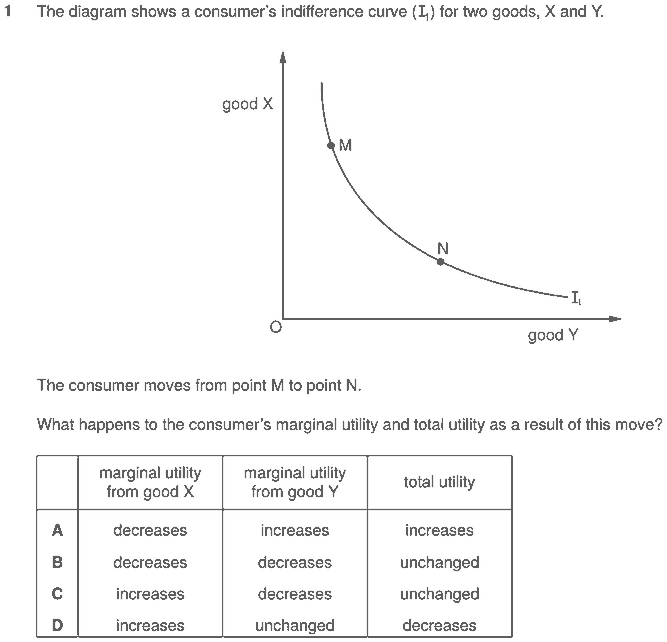
9708/31 May/June 2026 question 4
Show answer

ACorrect answer

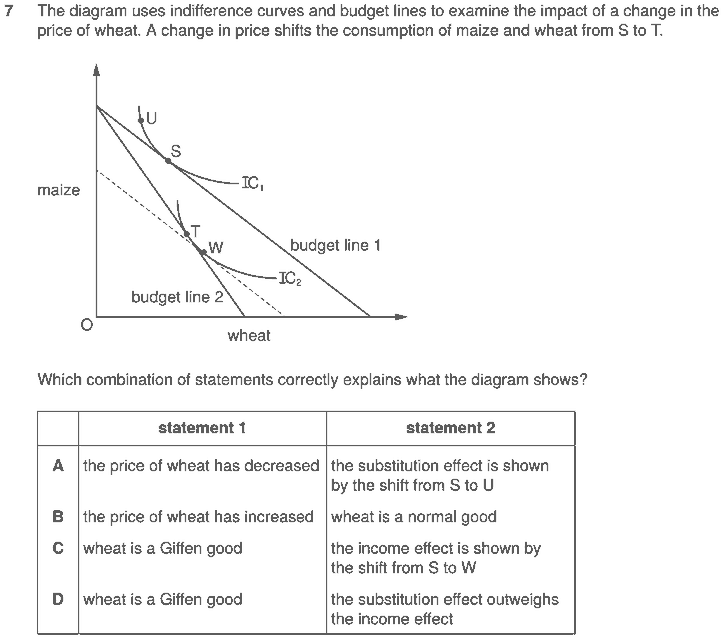
Question 7May/June 20269708/321 mark
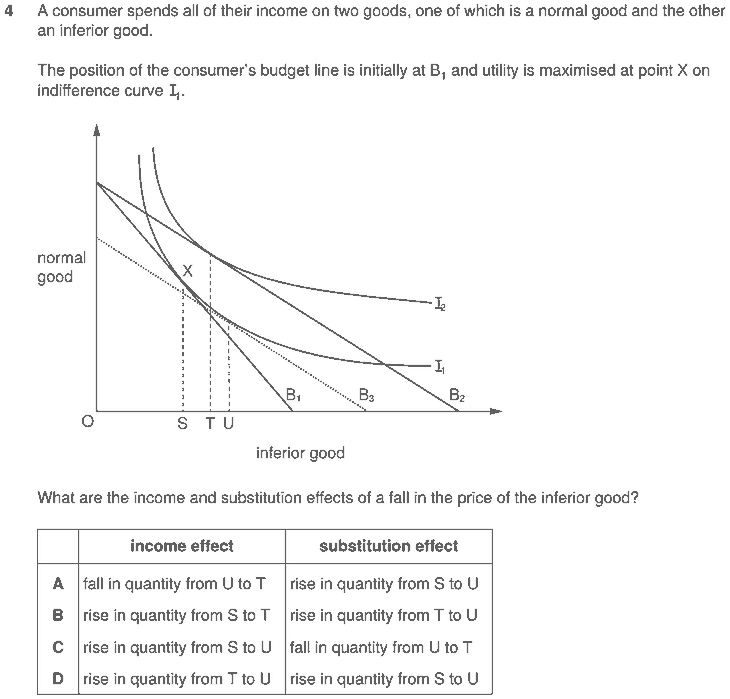
9708/32 May/June 2026 question 7
Show answer

CCorrect answer

Question 2May/June 20269708/341 mark
9708/34 May/June 2026 question 2
Show answer

DCorrect answer

Question 2Feb/March 20269708/321 mark

Which statement about an indifference curve is correct?

  • Ait always has a positive gradient
  • Bit can intersect with other indifference curves
  • Cits gradient is determined by the marginal rate of substitution
  • Dthe higher the indifference curve the lower the utility gained
Show answer

CCorrect answer

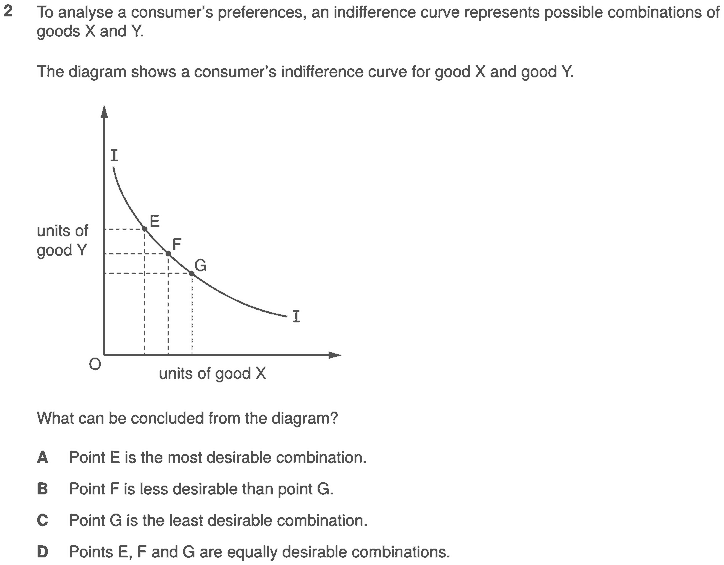
Question 2Oct/Nov 20259708/321 mark
9708/32 Oct/Nov 2025 question 2
Show answer

DCorrect answer

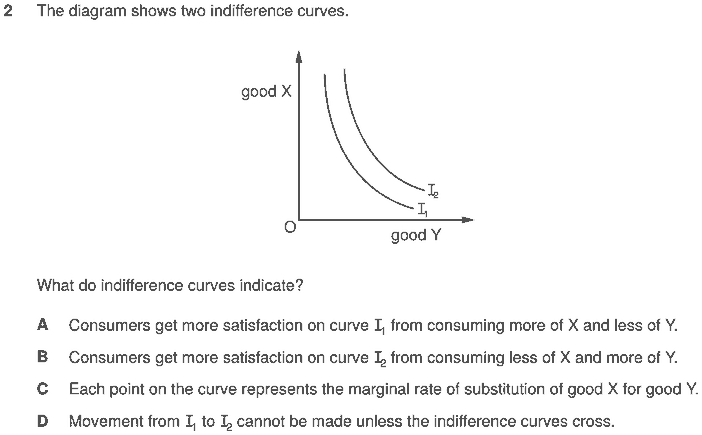
Question 2Oct/Nov 20259708/341 mark
9708/34 Oct/Nov 2025 question 2
Show answer

CCorrect answer

Question 3May/June 20259708/311 mark

What would not affect the budget line of an individual consumer?

  • Athe individual’s preference for various goods
  • Bthe level of income tax
  • Cthe money prices of goods
  • Dthe incomes earned by the individual
Show answer

ACorrect answer

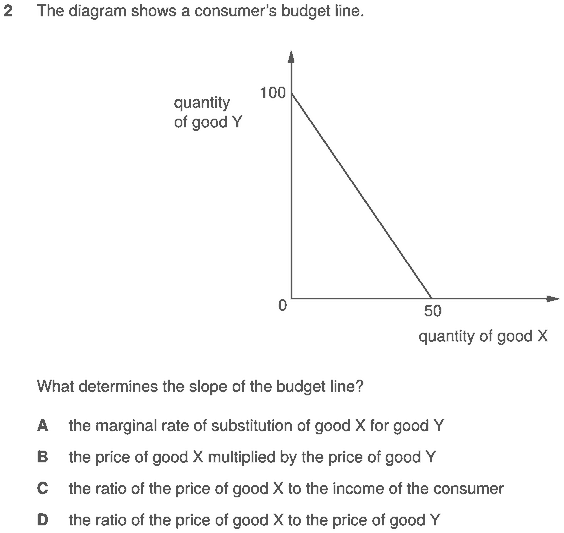
Question 1May/June 20259708/321 mark
9708/32 May/June 2025 question 1
Show answer

CCorrect answer

Question 1May/June 20259708/341 mark
9708/34 May/June 2025 question 1
Show answer

CCorrect answer

Question 5Feb/March 20259708/321 mark

Which statement about the downward sloping demand curve of an inferior good is correct?

  • ANegative income effect and substitution effect move in opposite directions, leading to a
  • BNegative income effect and substitution effect move in the same direction, leading to a flatter
  • CPositive income effect and substitution effect move in opposite directions, leading to a
  • DPositive income effect and substitution effect move in the same direction, leading to a flatter
Show answer

ACorrect answer

Paper 4 · Data response and essays (1)

Question 2May/June 20259708/4120 marks

2 With the help of a diagram, evaluate the use of indifference curve analysis to explain the relationship between a change in the price of a product and the change in an individual consumer’s demand for this product. [20]

Show mark scheme

With the help of a diagram, evaluate the use of indifference curve analysis to explain the relationship between a change in the price of a product and the change in an individual consumer’s demand for this product.

Use Table A: AO1 Knowledge and understanding and AO2 Analysis and Table B: AO3 Evaluation to mark candidate responses to this question.

AO1 and AO2 out of 14 marks. AO3 out of 6 marks.

Indicative content Responses may include:

AO1 Knowledge and understanding and AO2 Analysis

  • An explanation of what is meant by an indifference curve and an indifference curve map.
  • Explanation of a budget line and understanding of how a change in price or how a change in real income will affect a budget line
  • Demonstration of an understanding of consumer equilibrium.
  • Use of a diagram to analyse the links between indifference curves, budget lines and consumer equilibrium.
  • Analysis of how a change in price might affect consumer equilibrium. This can be supported by a clear, accurately labelled diagram.
  • Analysis of each element of the price effect on individual consumer demand. Both substitution effects and real income effects should be considered to attain Level 3 No diagram-highest mark is L2 – 8

AO3 Evaluation

  • Recognise that the key assumptions regarding human behaviour will determine the shape of the indifference curve. For example, it is assumed that all consumers attempt to maximise satisfaction.
  • Although the analysis only considers ‘bundles’ of two good consumed, it still assumes the consumer can correctly distinguish between different levels of satisfaction between different ‘bundles’.
  • The analysis only considers a choice between two goods. Consumers have the opportunity to consider alternative prices of a wide range of goods before choosing what to purchase.
  • Other factors such as advertising might change consumer taste, which in turn, will change the shape of the indifference curve and, ultimately the final impact of a price change on consumer demand.
  • A conclusion should be attempted which examines the effectiveness of the use of indifference curve analysis to predict the impact of a price change on individual consumer demand.

Accept all valid responses

56 more questions from 2020–2024

🔒 Unlock every Indifference curves and budget lines question from 2020–2024

All 56 come with their mark schemes, answers and case studies, and appear in the practice tool above once you’re signed in. It’s free.

Create a free accountSign in

A few of them

  • 9708/31 · Oct/Nov 2024 · Question 2What is a characteristic of an indifference… 🔒
  • 9708/32 · Oct/Nov 2024 · Question 2Which feature of indifference curve theory is… 🔒
  • 9708/33 · Oct/Nov 2024 · Question 2Which statement about indifference curves is not… 🔒
  • 9708/41 · May/June 2024 · Question 33 With the help of an indifference… 🔒
  • 9708/32 · Feb/March 2024 · Question 2What does an indifference… 🔒
  • + 51 more, by year in the table above

Questions and mark schemes are from past Cambridge papers and are reproduced for revision. Topical Vault is an independent revision resource, not affiliated with or endorsed by Cambridge Assessment International Education.

A Level Economics questions by topic

Each topic opens this practice tool with only that topic’s questions, plus how often it comes up and every question on it in one list. Revision notes for A Level Economics →

  1. Unit 7The price system and the microeconomy
  2. Ch 30Utility
  3. Ch 31Indifference curves and budget lines
  4. Ch 32Efficiency and market failure
  5. Ch 33Private costs and benefits, externalities and social costs and benefits
  6. Ch 34Types of cost, revenue and profit, short-run and long-run production
  7. Ch 35Different market structures
  8. Ch 36Growth and survival of firms
  9. Ch 37Differing objectives and policies of firms
  10. Unit 8Government microeconomic intervention
  11. Ch 38Government policies to achieve efficient resource allocation and correct market failure
  12. Ch 39Equity and redistribution of income and wealth
  13. Ch 40Labour market forces and government intervention
  14. Unit 9The macroeconomy
  15. Ch 41The circular flow of income
  16. Ch 42Economic growth and sustainability
  17. Ch 43Employment and unemployment
  18. Ch 44Money and banking
  19. Unit 10Government macroeconomic intervention
  20. Ch 45Government macroeconomic policy objectives
  21. Ch 46Links between macroeconomic problems and their interrelatedness
  22. Ch 47Effectiveness of policy options to meet all macroeconomic objectives
  23. Unit 11International economic issues
  24. Ch 48Policies to correct disequilibrium in the balance of payments
  25. Ch 49Exchange rates
  26. Ch 50Economic development
  27. Ch 51Characteristics of countries at different levels of development
  28. Ch 52Relationship between countries at different levels of development
  29. Ch 53Globalisation