← Topical Vault

Resource allocation in different economic systems · AS Level Economics

Cambridge 9708, Paper 1 & 2. 2,092 questions, 2020 to 2026.

Topic
Year

Paper 1 multiple-choice questions and Paper 2 data-response/essay questions, from the original Cambridge material. Paper 2 mark schemes and case studies are reproduced as images of the official pages rather than retyped, so nothing is lost or paraphrased; a question tagged under more than one topic appears under each. Tick “Add to my paper” on any question to build a custom practice PDF from the tray in the corner.

About Resource allocation in different economic systems

Questions comparing market, planned and mixed economies: who decides what, how and for whom to produce, and the strengths and weaknesses of each system.

New to Resource allocation in different economic systems, or finding these questions hard?

Read the notes first: the key ideas, diagrams and formulas, and the mistakes examiners see most, in about 10 minutes.

Read the Resource allocation in different economic systems notes →

68 past paper questions on this topic since 2020, across 19 exam sessions.

How often it comes up

YearPaper 1Paper 2TotalChart
2026145
20259312
2024235
2023426
20228614
20219312
202011314

Every 2025–2026 question on Resource allocation in different economic systems

The whole topic on one page, with answers and mark schemes. Printing this page prints just this list.

Paper 1 · Multiple choice (10)

Question 5June 20269708/131 mark

What would most likely be considered an advantage by producers and a disadvantage by consumers of the operation of a planned economy?

  • Aa bureaucratic system of decision-making
  • Ba government emphasis on the production of capital goods
  • Ca long response time to changing economic events
  • Dan absence of financial incentives to work and to produce
Show answer

BCorrect answer

Question 2November 20259708/111 mark
9708/11 November 2025 question 2
Show answer

BCorrect answer

Question 3November 20259708/121 mark

What is not a characteristic of a planned economy?

  • AConsumers have limited influence on what is produced.
  • BProfit is the motive for increasing output.
  • CResources are owned by the government.
  • DThere is limited competition in the market.
Show answer

BCorrect answer

Question 4November 20259708/131 mark
9708/13 November 2025 question 4
Show answer

ACorrect answer

Question 3November 20259708/141 mark

A government wants to move its economy away from central planning towards a market economy.

Which policy would be consistent with this aim?

  • Aintroduce tariffs on imported goods
  • Bprivatise the ownership of electricity generation
  • Cprovide free education for primary school pupils
  • Dreduce prices of foods such as wheat and rice
Show answer

BCorrect answer

Question 3June 20259708/111 mark

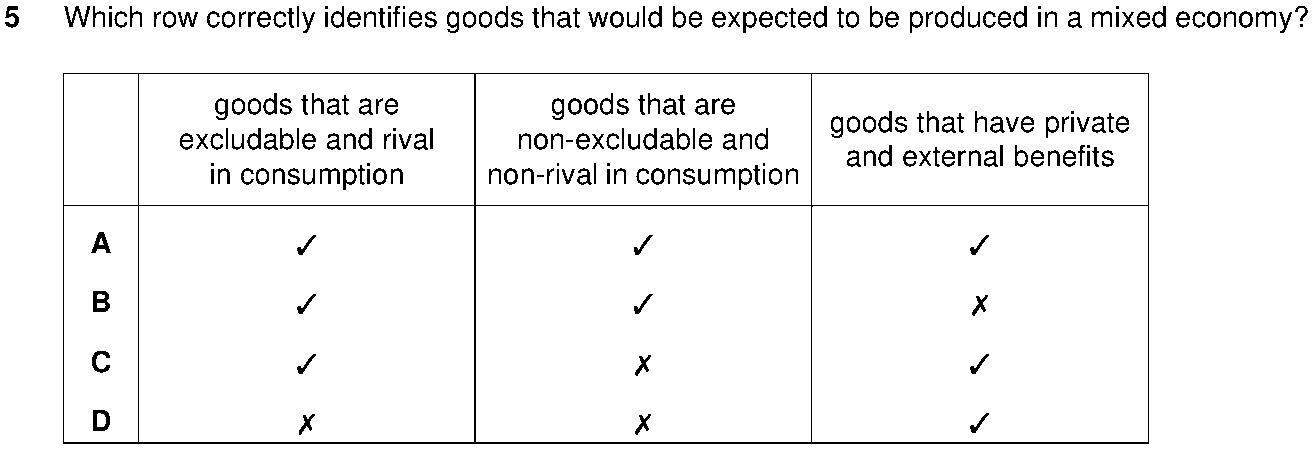
Which goods are least likely to be allocated by market forces in a mixed economy?

  • Ahospitals
  • Brailways
  • Cstreet lighting
  • Dtelevision programmes
Show answer

CCorrect answer

Question 5June 20259708/131 mark
9708/13 June 2025 question 5
Show answer

ACorrect answer

Question 2June 20259708/141 mark

This question was later withdrawn by Cambridge.

What is an essential requirement for a market economy to be able to allocate its resources?

  • Afreedom of entry and exit
  • Bprivate ownership of property
  • Cmany buyers and sellers
  • Dperfect product knowledge
Show answer

No answer was published (the question was withdrawn).

Question 3June 20259708/141 mark

Under which conditions are free market forces most likely to allocate resources efficiently in an economy?

the number of certain types of good needed by consumers in the economy

demerit goods merit goods public goods

  • Aa few a few a few
  • Bmany many a few
  • Cnone many none
  • Dnone none none
Show answer

DCorrect answer

Question 1March 20259708/121 mark

Which statement about a market economy is not correct?

  • ACompetition is promoted among firms which can increase productive efficiency.
  • BImmobility of the factors of production can lead to allocative inefficiency.
  • CPrice always reflects all the costs and all the benefits associated with production.
  • DThe entrepreneur is encouraged to innovate and take risks, motivated by profit.
Show answer

CCorrect answer

Paper 2 · Data response and essays (7)

Question 2(b)June 20269708/2212 marks

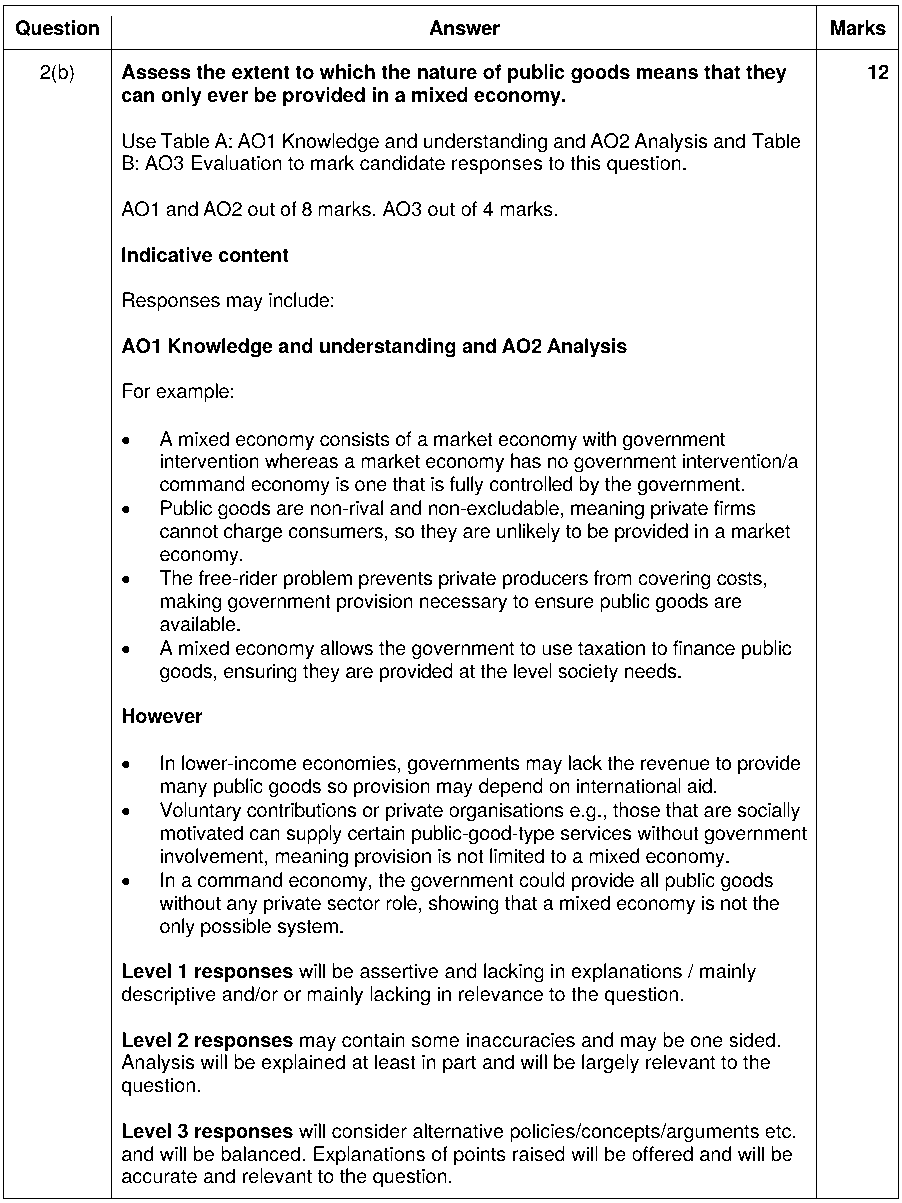
Assess the extent to which the nature of public goods means that they can only ever be provided in a mixed economy. [12]
Show mark scheme
Mark scheme, 9708/22 June 2026 question 2(b) (page 1 of 2)
Mark scheme, 9708/22 June 2026 question 2(b) (page 2 of 2)
Question 3(a)June 20269708/248 marks

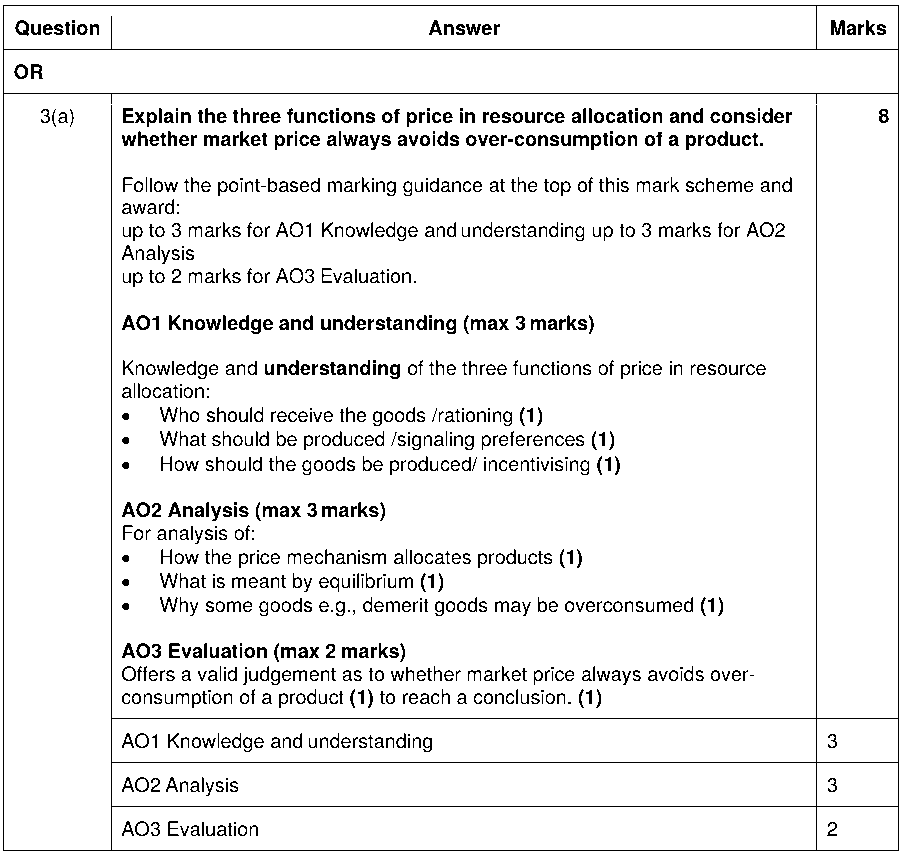
Explain the three functions of price in resource allocation and consider whether market price always avoids over-consumption of a product. [8]
Show mark scheme
Mark scheme, 9708/24 June 2026 question 3(a)
Question 3(b)June 20269708/2412 marks

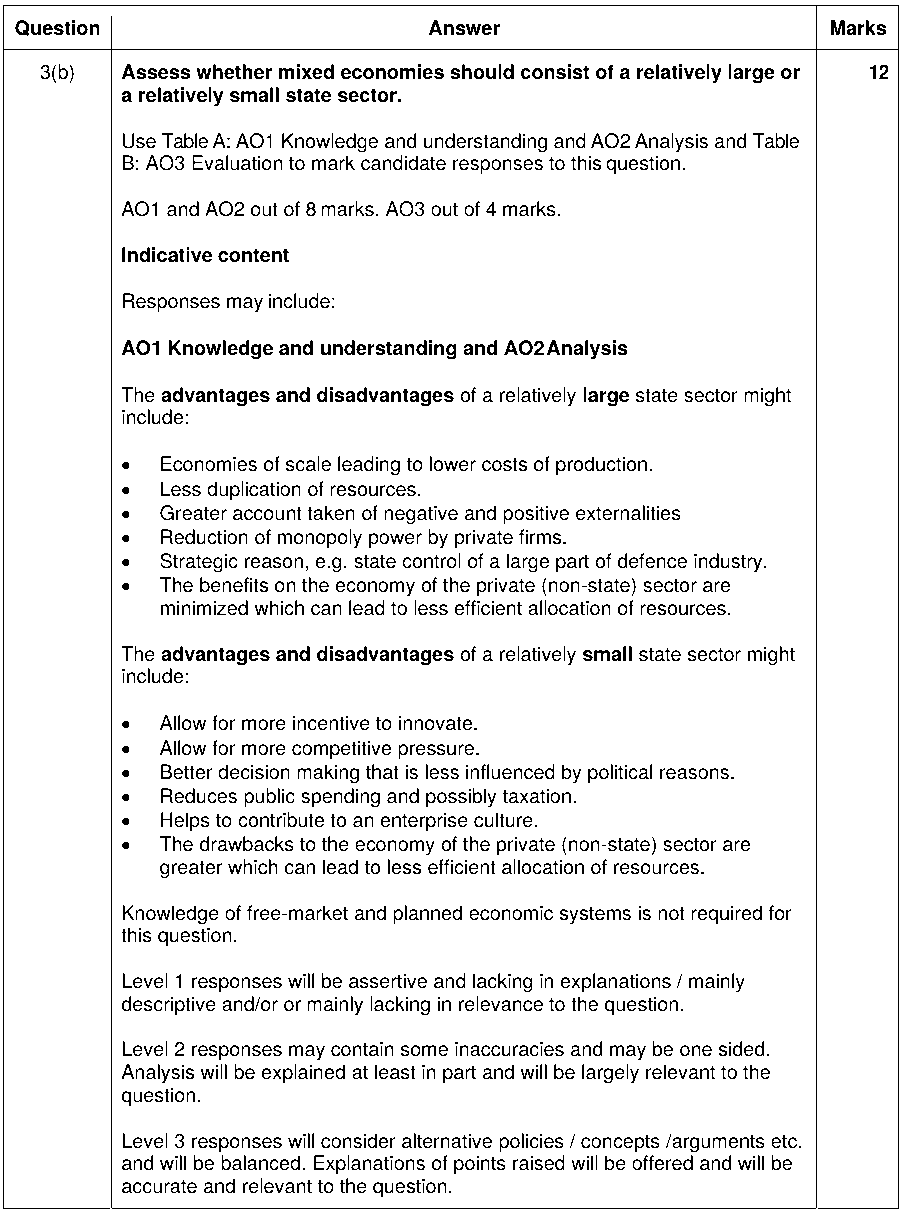
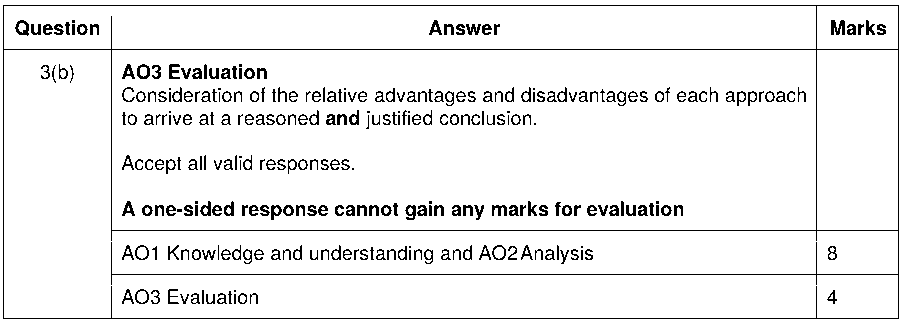
Assess whether mixed economies should consist of a relatively large or a relatively small state sector. [12]
Show mark scheme
Mark scheme, 9708/24 June 2026 question 3(b) (page 1 of 2)
Mark scheme, 9708/24 June 2026 question 3(b) (page 2 of 2)
Question 3(b)March 20269708/2212 marks

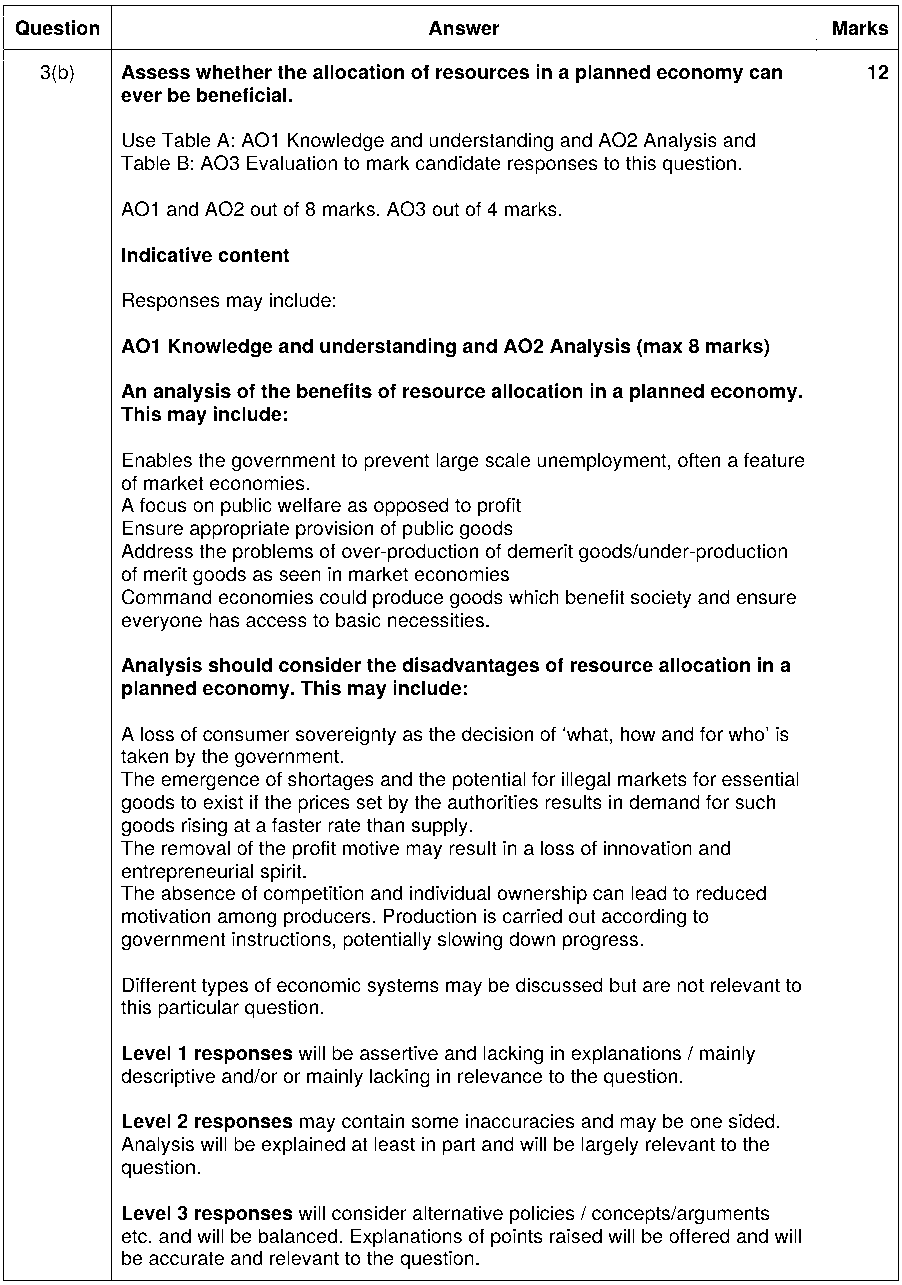
Assess whether the allocation of resources in a planned economy can ever be beneficial. [12]
Show mark scheme
Mark scheme, 9708/22 March 2026 question 3(b) (page 1 of 2)
Mark scheme, 9708/22 March 2026 question 3(b) (page 2 of 2)
Case study: Mexico’s backward-looking energy policy is bad for the country and the planet
Case study: Mexico’s backward-looking energy policy is bad for the country and the planet (page 1 of 2)
Case study: Mexico’s backward-looking energy policy is bad for the country and the planet (page 2 of 2)
Question 1(a)November 20259708/212 marks

Using the information provided, explain whether Mexico is a mixed economy. [2]

Show mark scheme
Mark scheme, 9708/21 November 2025 question 1(a)
Question 2(a)June 20259708/228 marks

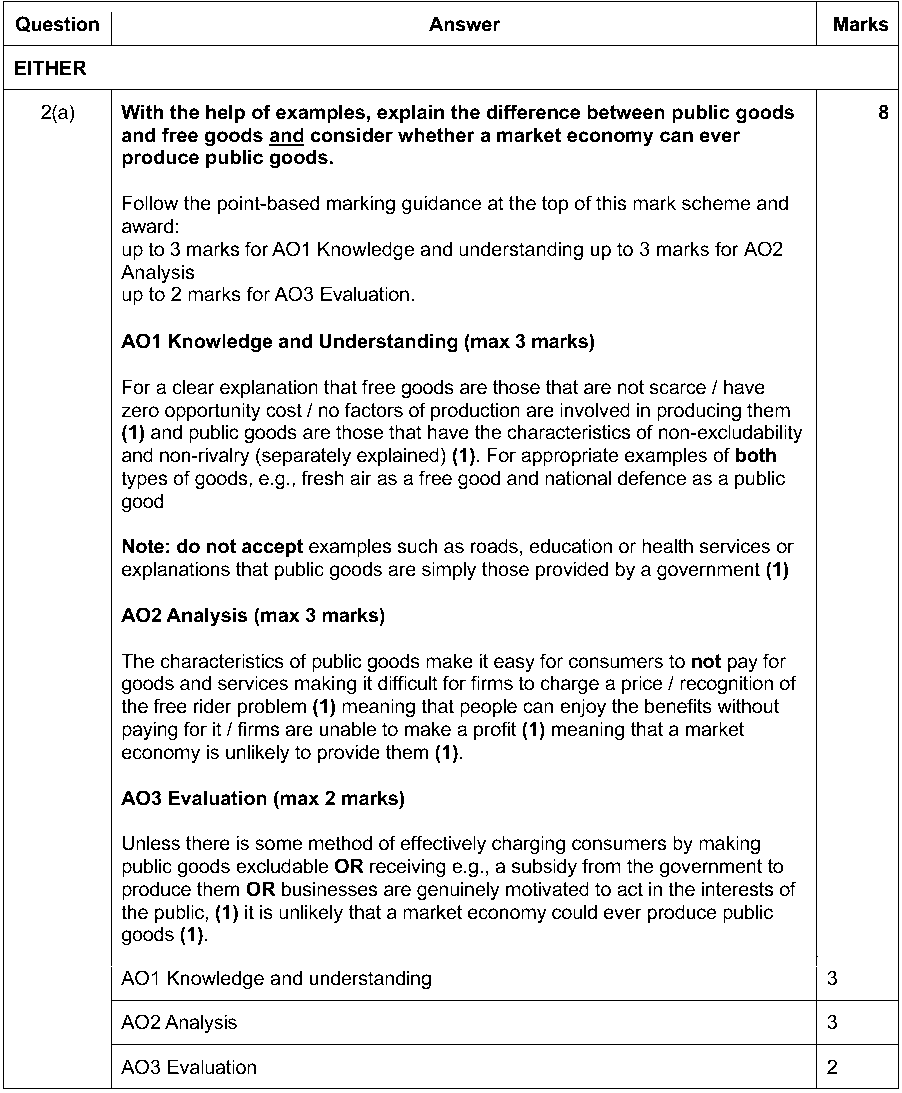
With the help of examples, explain the difference between public goods and free goods and consider whether a market economy can ever produce public goods. [8]
Show mark scheme
Mark scheme, 9708/22 June 2025 question 2(a)
Question 2(b)March 20259708/2212 marks

Assess whether the allocation of resources in a market economy is always beneficial. [12]

Show mark scheme
Mark scheme, 9708/22 March 2025 question 2(b)

51 more questions from 2020–2024

🔒 Unlock every Resource allocation in different economic systems question from 2020–2024

All 51 come with their mark schemes, answers and case studies, and appear in the practice tool above once you’re signed in. It’s free.

Create a free accountSign in

A few of them

  • 9708/21 · November 2024 · Question 3(b)Assess whether consumers always benefit when the… 🔒
  • 9708/22 · November 2024 · Question 3(b)Assess whether a market economy is always… 🔒
  • 9708/12 · June 2024 · Question 2What is produced in a mixed economy… 🔒
  • 9708/21 · June 2024 · Question 2(b)Assess whether a planned economic system should… 🔒
  • 9708/12 · March 2024 · Question 4What is the main reason an economy… 🔒
  • + 46 more, by year in the table above

Questions and mark schemes are from past Cambridge papers and are reproduced for revision. Topical Vault is an independent revision resource, not affiliated with or endorsed by Cambridge Assessment International Education.

AS Level Economics questions by topic

Each topic opens this practice tool with only that topic’s questions, plus how often it comes up and every question on it in one list. Revision notes for AS Level Economics →

  1. Unit 1Basic economic ideas and resource allocation
  2. Ch 1Scarcity, choice and opportunity cost
  3. Ch 2Economic methodology
  4. Ch 3Factors of production
  5. Ch 4Resource allocation in different economic systems
  6. Ch 5Production possibility curves
  7. Ch 6Classification of goods and services
  8. Unit 2The price system and the microeconomy
  9. Ch 7Demand and supply curves
  10. Ch 8Price elasticity, income elasticity and cross elasticity of demand
  11. Ch 9Price elasticity of supply
  12. Ch 10The interaction of demand and supply
  13. Ch 11Consumer and producer surplus
  14. Unit 3Government microeconomic intervention
  15. Ch 12Reasons for government intervention in markets
  16. Ch 13Methods and effects of government intervention in markets
  17. Ch 14Addressing income and wealth inequality
  18. Unit 4The macroeconomy
  19. Ch 15National income statistics
  20. Ch 16Introduction to the circular flow of income
  21. Ch 17Aggregate demand and aggregate supply analysis
  22. Ch 18Economic growth
  23. Ch 19Unemployment
  24. Ch 20Price stability
  25. Unit 5Government macroeconomic intervention
  26. Ch 21Government macroeconomic policy objectives
  27. Ch 22Fiscal policy
  28. Ch 23Monetary policy
  29. Ch 24Supply-side policy
  30. Unit 6International economic issues
  31. Ch 25The reasons for international trade
  32. Ch 26Protectionism
  33. Ch 27Current account of the balance of payments
  34. Ch 28Exchange rates
  35. Ch 29Policies to correct imbalances in the current account of the balance of payments