← Topical Vault

Demand and supply curves · AS Level Economics

Cambridge 9708, Paper 1 & 2. 2,092 questions, 2020 to 2026.

Topic
Year

Paper 1 multiple-choice questions and Paper 2 data-response/essay questions, from the original Cambridge material. Paper 2 mark schemes and case studies are reproduced as images of the official pages rather than retyped, so nothing is lost or paraphrased; a question tagged under more than one topic appears under each. Tick “Add to my paper” on any question to build a custom practice PDF from the tray in the corner.

About Demand and supply curves

Questions on demand and supply curves: what causes movements along them, what shifts them, joint and derived demand, and the factors behind individual and market curves.

New to Demand and supply curves, or finding these questions hard?

Read the notes first: the key ideas, diagrams and formulas, and the mistakes examiners see most, in about 10 minutes.

Read the Demand and supply curves notes →

99 past paper questions on this topic since 2020, across 20 exam sessions.

How often it comes up

YearPaper 1Paper 2TotalChart
20266410
202512214
202416319
20239413
202217118
202112214
202011011

Every 2025–2026 question on Demand and supply curves

The whole topic on one page, with answers and mark schemes. Printing this page prints just this list.

Paper 1 · Multiple choice (18)

Question 6June 20269708/111 mark

What describes a market supply curve?

  • AIt is downward sloping.
  • BIt is the same as the aggregate supply curve.
  • CIt is the sum of all firms’ supply curves for a product.
  • DIt is the supply of all products within an economy.
Show answer

CCorrect answer

Question 7June 20269708/111 mark
9708/11 June 2026 question 7
Show answer

BCorrect answer

Question 7June 20269708/121 mark
9708/12 June 2026 question 7
Show answer

DCorrect answer

Question 6June 20269708/131 mark

What would not affect the position of the demand curve for wigs?

  • Aan increase in incomes
  • Ba reduction in the price of hairdressing
  • Can increase in wigs worn by television celebrities
  • Da reduction in the price of wigs
Show answer

DCorrect answer

Question 9June 20269708/141 mark

A firm supplies a highly competitive market with mobile phones and the apps used with them.

The market price of mobile phones rises but the price charged for apps remains the same.

What are the most likely consequences for expenditure on this firm’s mobile phones and apps?

expenditure expenditure on phones on apps

  • Afalls falls
  • Brises falls
  • Cfalls unchanged
  • Drises unchanged
Show answer

ACorrect answer

Question 7March 20269708/121 mark

An increased demand for cars leads to an increased demand for steel.

What best describes this relationship between cars and steel?

  • Asubstitutes
  • Bcomplements
  • Cderived demand
  • Djoint supply
Show answer

CCorrect answer

Question 7November 20259708/111 mark
9708/11 November 2025 question 7
Show answer

BCorrect answer

Question 7November 20259708/121 mark
9708/12 November 2025 question 7
Show answer

BCorrect answer

Question 11November 20259708/121 mark

The demand for electric vehicle batteries is derived from the demand for electric vehicles. To tackle climate change, a government subsidises producers of electric vehicles.

What are the likely effects of this subsidy on the price and sales of electric vehicle batteries?

price sales

  • Adecrease decrease
  • Bdecrease increase
  • Cincrease decrease
  • Dincrease increase
Show answer

DCorrect answer

Question 7November 20259708/131 mark
9708/13 November 2025 question 7
Show answer

CCorrect answer

Question 9June 20259708/111 mark
9708/11 June 2025 question 9
Show answer

BCorrect answer

Question 6June 20259708/121 mark
9708/12 June 2025 question 6
Show answer

CCorrect answer

Question 10June 20259708/121 mark

Farmers want to extract wild honey from beehives. They find the beehives by following birds known as honeyguide birds who want the beeswax that is also found in the beehives.

What does this suggest?

  • AFarmers and honeyguide birds are rival consumers.
  • BWild honey and beeswax are free goods.
  • CWild honey and beeswax are in joint supply.
  • DWild honey is the opportunity cost of beeswax.
Show answer

CCorrect answer

Question 6June 20259708/141 mark

Along which axis can the market demand curve be aggregated from individual demand curves?

  • Aboth the horizontal and the vertical axis
  • Bthe horizontal axis only
  • Cthe horizontal or the vertical axis but not both
  • Dthe vertical axis only
Show answer

BCorrect answer

Question 7June 20259708/141 mark
9708/14 June 2025 question 7
Show answer

CCorrect answer

Question 10June 20259708/141 mark

The price of laptop computers falls.

The price of which product is likely to rise as a result?

  • Adesktop computers
  • Bcarrying cases for laptop computers
  • Cmonitors for desktop computers
  • Dworkstation tables for desktop computers
Show answer

BCorrect answer

Question 4March 20259708/121 mark

The price of a good rises by 5% and the quantity of it demanded rises by 3%. At the same time, the incomes of consumers of the good rise by 4%.

The law of demand appears not to be working in this case.

What is the most likely explanation?

  • AOther things did not remain equal.
  • BThe demand for the good was price inelastic.
  • CThe real price of the good fell.
  • DThe time period was the very short run.
Show answer

ACorrect answer

Question 9March 20259708/121 mark

What is likely to have a greater effect on an individual demand curve than on a market demand curve?

  • Achanging weather patterns
  • Bgovernment policy to promote consumption
  • Cgrowth in population
  • Dmore expensive substitutes
Show answer

DCorrect answer

Paper 2 · Data response and essays (6)

Question 3(a)June 20269708/228 marks

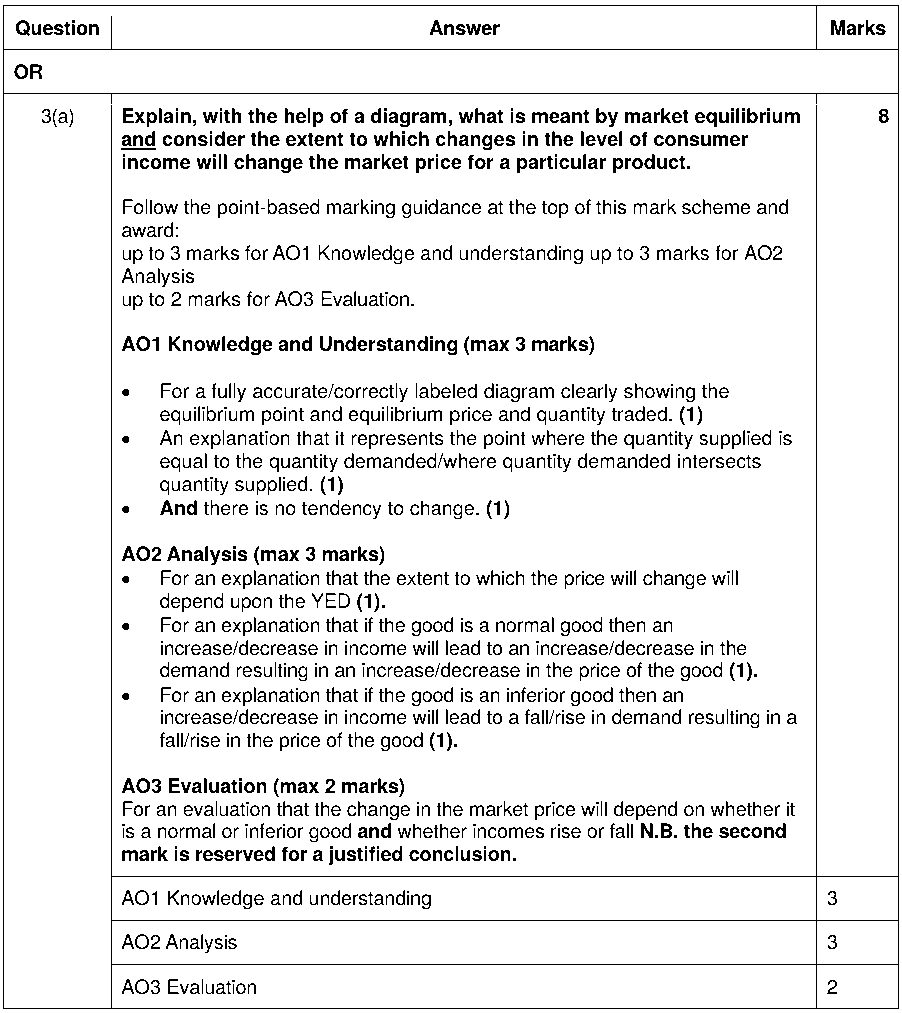
Explain, with the help of a diagram, what is meant by market equilibrium and consider the extent to which changes in the level of consumer income will change the market price for a product. [8]
Show mark scheme
Mark scheme, 9708/22 June 2026 question 3(a)
Case study: Exports of Chinese electric vehicles (EVs) continue to increase
Question 1(a)June 20269708/232 marks

Use Table 1.1 to identify two changes in the global sales of EVs from 2020 to 2024. [2]

Show mark scheme
Mark scheme, 9708/23 June 2026 question 1(a)
Question 1(b)June 20269708/232 marks

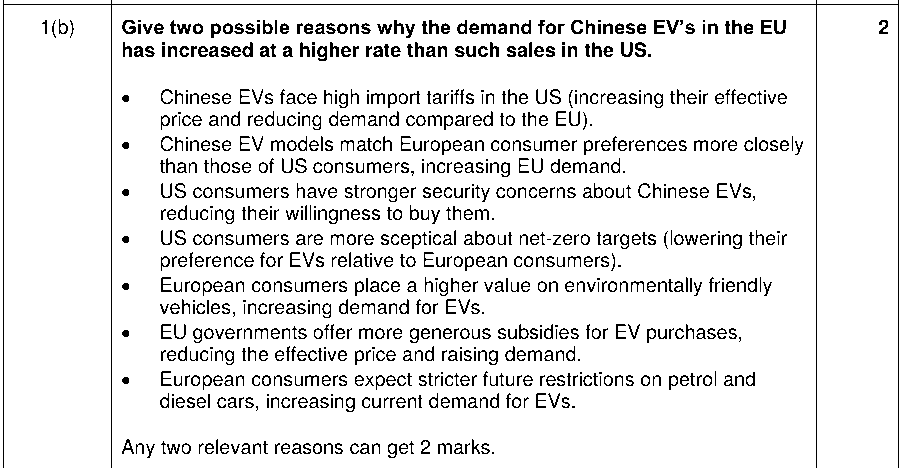
Give two possible reasons why the demand for Chinese EVs in the EU has increased at a higher rate than such sales in the US. [2]
Show mark scheme
Mark scheme, 9708/23 June 2026 question 1(b)
Question 2(a)June 20269708/238 marks

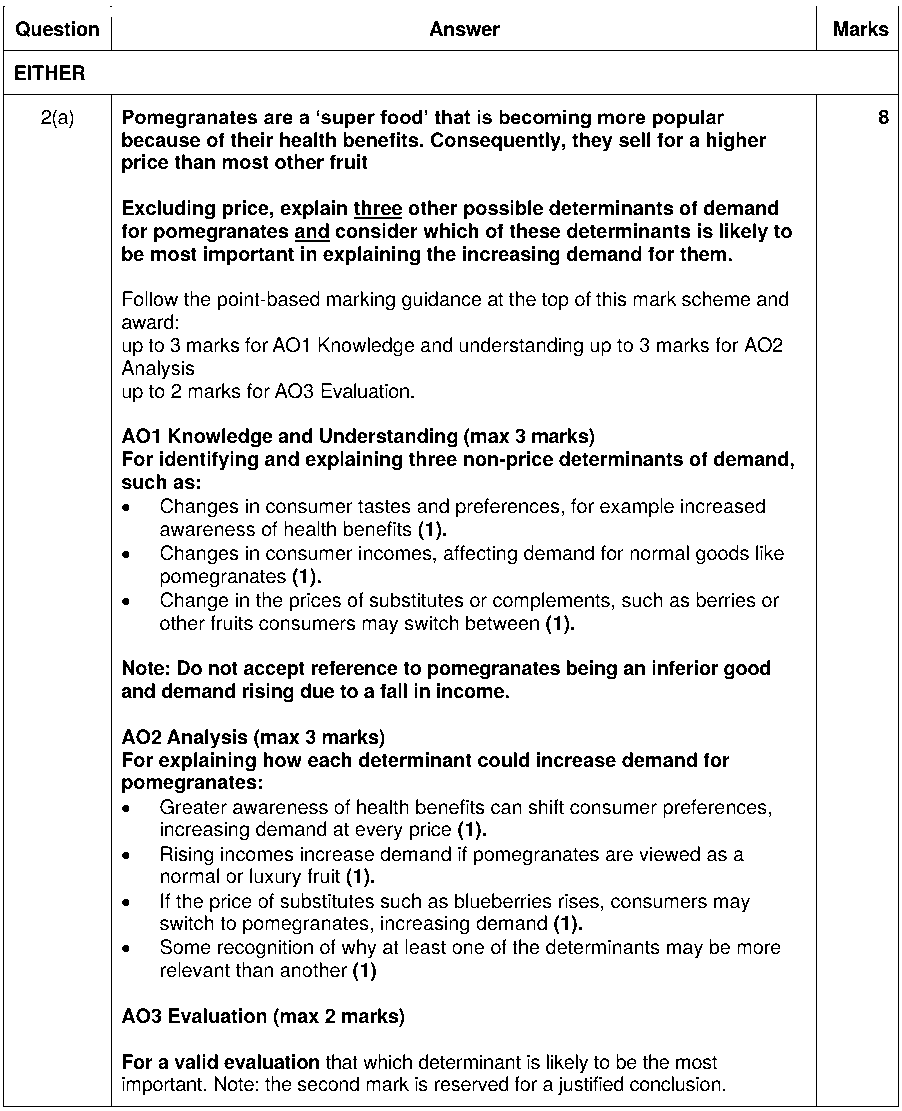
Pomegranates are a ‘superfood’ that are becoming more popular because of their health benefits. Consequently, they sell for a higher price than most other fruit.

Excluding price, explain three other possible determinants of demand for pomegranates and consider which of these determinants is likely to be most important in explaining an increasing demand for them. [8]
Show mark scheme
Mark scheme, 9708/23 June 2026 question 2(a) (page 1 of 2)
Mark scheme, 9708/23 June 2026 question 2(a) (page 2 of 2)
Case study: Will stronger economic growth in the United States (US) lead to high inflation?
Case study: Will stronger economic growth in the United States (US) lead to high inflation? (page 1 of 2)
Case study: Will stronger economic growth in the United States (US) lead to high inflation? (page 2 of 2)
Question 1(c)November 20259708/244 marks

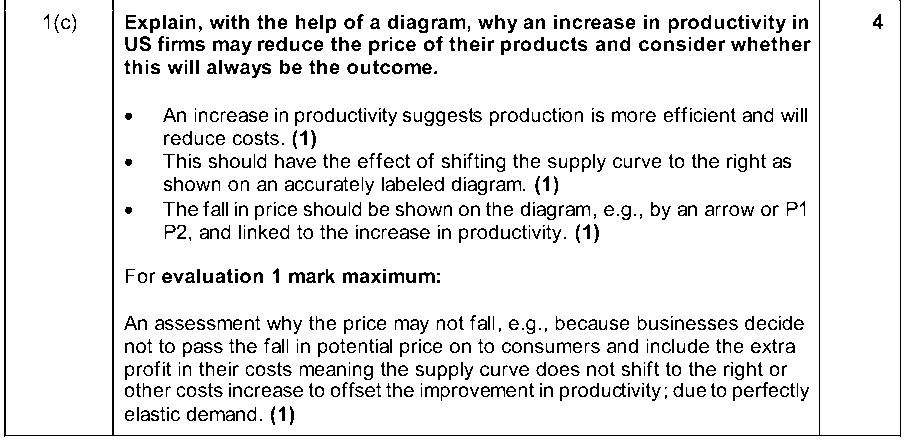
Explain, with the help of a diagram, why an increase in productivity in US firms may reduce the price of their products and consider whether this will always be the outcome. [4]
Show mark scheme
Mark scheme, 9708/24 November 2025 question 1(c)
Question 3(a)June 20259708/228 marks

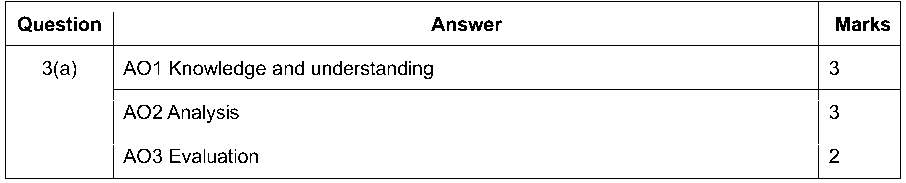
Explain three reasons, associated with costs of production, why the supply curve for a particular market may shift to the right and consider the extent to which government microeconomic policy may also shift the supply curve for a particular market to the right. [8]

Show mark scheme
Mark scheme, 9708/22 June 2025 question 3(a) (page 1 of 2)
Mark scheme, 9708/22 June 2025 question 3(a) (page 2 of 2)

75 more questions from 2020–2024

🔒 Unlock every Demand and supply curves question from 2020–2024

All 75 come with their mark schemes, answers and case studies, and appear in the practice tool above once you’re signed in. It’s free.

Create a free accountSign in

A few of them

  • 9708/11 · November 2024 · Question 6In a particular year, 12 000 units… 🔒
  • 9708/11 · November 2024 · Question 9What is not held constant when aggregating… 🔒
  • 9708/12 · November 2024 · Question 8What is most likely to cause the… 🔒
  • 9708/12 · November 2024 · Question 11Good X has a substitute, good Y… 🔒
  • 9708/13 · November 2024 · Question 7The Chinese government relaxed controls on private… 🔒
  • + 70 more, by year in the table above

Questions and mark schemes are from past Cambridge papers and are reproduced for revision. Topical Vault is an independent revision resource, not affiliated with or endorsed by Cambridge Assessment International Education.

AS Level Economics questions by topic

Each topic opens this practice tool with only that topic’s questions, plus how often it comes up and every question on it in one list. Revision notes for AS Level Economics →

  1. Unit 1Basic economic ideas and resource allocation
  2. Ch 1Scarcity, choice and opportunity cost
  3. Ch 2Economic methodology
  4. Ch 3Factors of production
  5. Ch 4Resource allocation in different economic systems
  6. Ch 5Production possibility curves
  7. Ch 6Classification of goods and services
  8. Unit 2The price system and the microeconomy
  9. Ch 7Demand and supply curves
  10. Ch 8Price elasticity, income elasticity and cross elasticity of demand
  11. Ch 9Price elasticity of supply
  12. Ch 10The interaction of demand and supply
  13. Ch 11Consumer and producer surplus
  14. Unit 3Government microeconomic intervention
  15. Ch 12Reasons for government intervention in markets
  16. Ch 13Methods and effects of government intervention in markets
  17. Ch 14Addressing income and wealth inequality
  18. Unit 4The macroeconomy
  19. Ch 15National income statistics
  20. Ch 16Introduction to the circular flow of income
  21. Ch 17Aggregate demand and aggregate supply analysis
  22. Ch 18Economic growth
  23. Ch 19Unemployment
  24. Ch 20Price stability
  25. Unit 5Government macroeconomic intervention
  26. Ch 21Government macroeconomic policy objectives
  27. Ch 22Fiscal policy
  28. Ch 23Monetary policy
  29. Ch 24Supply-side policy
  30. Unit 6International economic issues
  31. Ch 25The reasons for international trade
  32. Ch 26Protectionism
  33. Ch 27Current account of the balance of payments
  34. Ch 28Exchange rates
  35. Ch 29Policies to correct imbalances in the current account of the balance of payments