About Price stability
Questions on inflation and deflation: how price indices are built, demand-pull and cost-push inflation, and the effects of rising or falling prices.
New to Price stability, or finding these questions hard?
Read the notes first: the key ideas, diagrams and formulas, and the mistakes examiners see most, in about 13 minutes.
Read the Price stability notes →
160 past paper questions on this topic since 2020, across 20 exam sessions.
How often it comes up
| Year | Paper 1 | Paper 2 | Total | Chart |
|---|
| 2026 | 6 | 3 | 9 | |
|---|
| 2025 | 11 | 12 | 23 | |
|---|
| 2024 | 11 | 12 | 23 | |
|---|
| 2023 | 14 | 12 | 26 | |
|---|
| 2022 | 15 | 12 | 27 | |
|---|
| 2021 | 22 | 15 | 37 | |
|---|
| 2020 | 9 | 6 | 15 | |
|---|
Every 2025–2026 question on Price stability
The whole topic on one page, with answers and mark schemes. Printing this page prints just this list.
Paper 1 · Multiple choice (17)
Question 20June 20269708/111 mark
The UK inflation rate as measured by the Consumer Price Index (CPI) was 5.2% in September 2011. In June 2014, the UK inflation rate as measured by the CPI was 1.6%.
What can be concluded about the period September 2011 to June 2014?
- AFixed income earners had increased purchasing power.
- BPrices were falling.
- CThe rate of price increases was slowing.
- DThe real rate of interest became positive.
Show answer
Question 23June 20269708/111 mark
What is a reason for a government policy that aims at achieving a low and stable rate of inflation?
- AConsumers are encouraged to increase spending on imports.
- BFirms are encouraged to increase the level of production.
- CThe central bank is encouraged to increase the interest rate.
- DThe government is encouraged to increase the rate of income tax.
Show answer
Question 19June 20269708/131 mark
Which combination is likely to result in cost−push inflation?
output per exchange rate worker per hour
- Afalling falling
- Bfalling rising
- Crising falling
- Drising rising
Show answer
Question 17June 20269708/141 mark
Which change in aggregate demand will increase demand−pull inflationary pressure in an economy?
- Ahigher government spending
- Bhigher import spending
- Clower consumer spending
- Dlower investment spending
Show answer
Question 19June 20269708/141 mark
What is the most likely reason why the usefulness of a consumer price index (CPI) is limited when recording changes in the price level?
- AIt does not take account of changes in the quality of goods and services.
- BIt is not possible to include enough prices of different goods and services.
- CIt only records consumption patterns for an average household.
- DIt does not consider all available goods and services.
Show answer
Question 20March 20269708/121 mark
Show answer
Question 23November 20259708/121 mark
A country has a target rate of inflation of 2.5% and has recently experienced the actual rate rising to 6%, with unemployment falling to very low levels.
Which policy option is most likely to be implemented?
- Aan increase in government expenditure on training
- Ban increase in indirect taxes on demerit goods
- Can increase in import tariffs
- Dan increase in interest rates
Show answer
Question 20November 20259708/131 mark
What might be a consequence of a fall in the domestic price level?
- Aimports become more competitive
- Binterest rates increase
- Cthe purchasing power of savings falls
- Dthe real value of incomes increases
Show answer
Question 22November 20259708/131 mark
Show answer
Question 17November 20259708/141 mark
What is required to prevent a rising price level due to an increase in aggregate demand?
- AAdditional productive capacity must be created.
- BGovernment investment must remain at a constant level to stabilise supply.
- CGreater reliance must be placed on imported goods to overcome any domestic shortfalls.
- DWage rates must change more frequently to maintain levels of employment and output.
Show answer
Question 19November 20259708/141 mark
Which increase makes cost-push inflation less likely to happen?
- Aindirect tax rates
- Braw material shortages
- Cthe foreign exchange rate
- Dtrade union power
Show answer
Question 20June 20259708/111 mark
The price of a pack of six eggs rises from $1.00 to $1.32 over a year. Consumer prices, as measured by the consumer price index, rise by 10% over the same period.
What is the real price of a pack of six eggs at the end of the year?
Show answer
Question 16June 20259708/121 mark
Price stability can be said to occur if the measured value of the consumer prices index (CPI) is unchanged during the year.
Which statement is correct?
- AFor price stability to occur, there must be no changes in prices of any products.
- BFor price stability to occur, the number of products whose prices rise must exactly match the number whose prices fall.
- CIf some prices rise and others fall, there cannot be price stability.
- DDifferent weightings of items used in the calculation of CPI mean that price stability can occur in many ways.
Show answer
Question 19June 20259708/131 mark
An economy is experiencing a period of deflation.
What must be happening?
- AThe average price level is falling.
- BThe output of the economy is falling.
- CThe rate of inflation is falling.
- DThe real value of money is falling.
Show answer
Question 25June 20259708/131 mark
A government has a target to reduce the rate of inflation.
Why might it not want to raise interest rates to achieve this target?
- Aaggregate demand may fall
- Baggregate supply may fall
- Csaving may fall
- Dthe exchange rate may fall
Show answer
Question 20June 20259708/141 mark
If a country is suffering from deflation, what would be the best policy to reflate the economy?
- Aincrease corporation tax
- Bincrease income tax
- Creduce interest rates
- Dreduce spending on education
Show answer
Question 16March 20259708/121 mark
Governments may have price stability as a macroeconomic objective.
What is meant by price stability?
- AAll equilibrium prices are maintained in the long run.
- BDemand-pull inflation cancels out any cost-push inflation.
- COnly disinflation is present in the economy in the long run.
- DProlonged periods of inflation and deflation are avoided.
Show answer
Paper 2 · Data response and essays (15)
Case study: Inflation and economic growth in Japan
Question 1(a)June 20269708/212 marks
‘One important development in 2023 was that for the first time in two years real wages increased in Japan.’
Using Table 1.1, explain by how much money wages would have to change in Japan in 2023 for real wages to increase. [2]
Show mark scheme
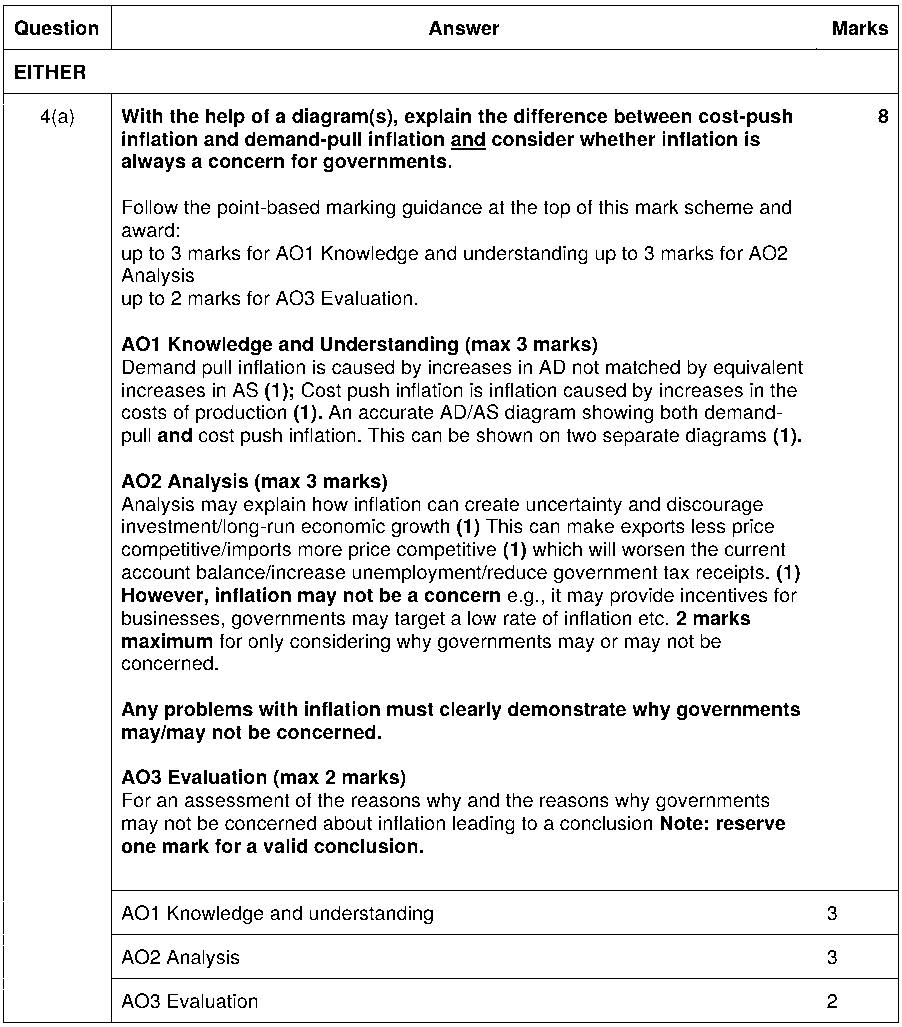
Question 4(a)March 20269708/228 marks
With the help of a diagram(s), explain the difference between cost-push inflation and demand-pull inflation and consider whether inflation is always a concern for governments. [8]
Show mark scheme
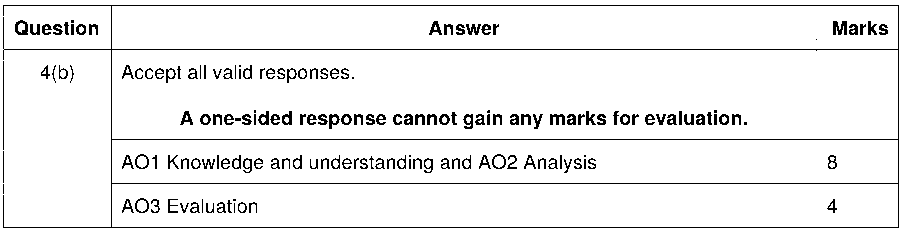
Question 4(b)March 20269708/2212 marks
Assess whether expansionary monetary policy is the best method to correct deflation and restore price stability. [12]
Show mark scheme
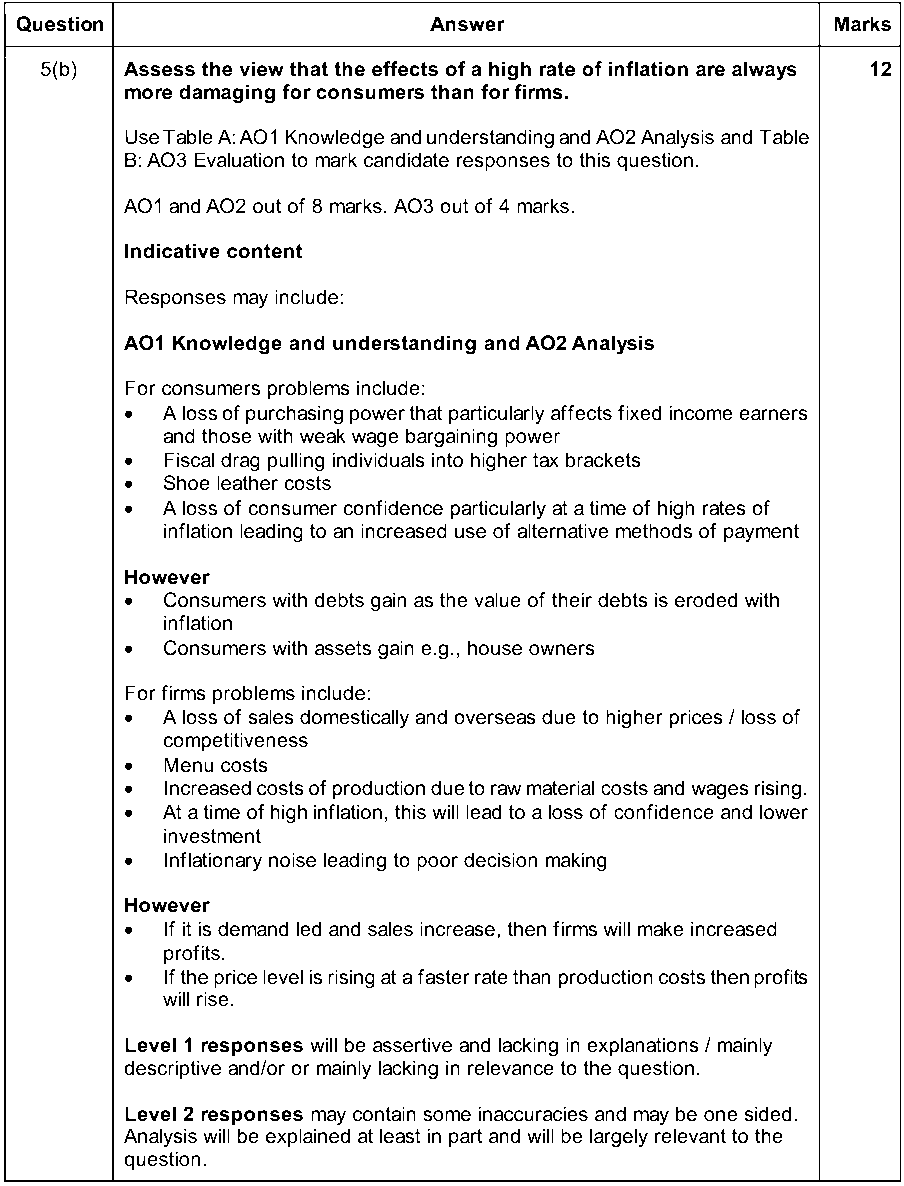
Question 5(b)November 20259708/2212 marks
Assess the view that the effects of a high rate of inflation are always more damaging for consumers than for firms. [12]
Show mark scheme
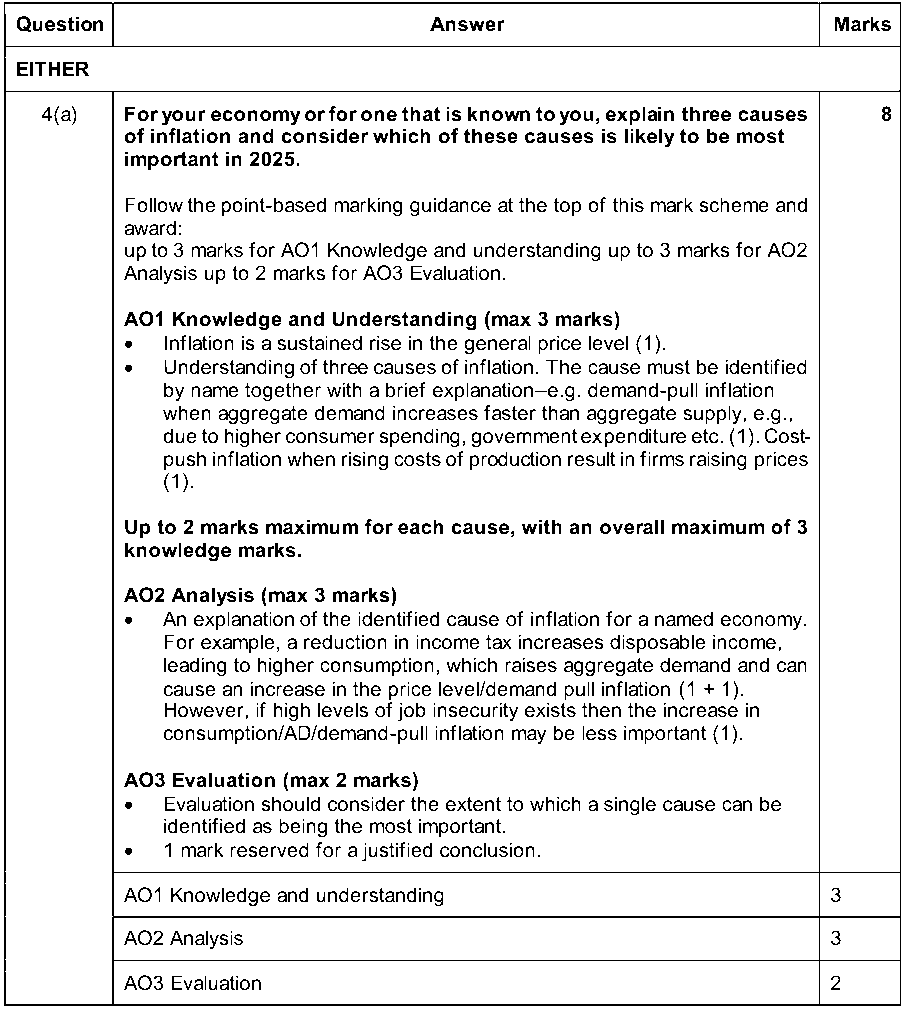
Question 4(a)November 20259708/238 marks
For your economy or for one that is known to you, explain three causes of inflation and consider which of these causes is likely to be most important in 2025. [8]
Show mark scheme
Case study: Will stronger economic growth in the United States (US) lead to high inflation?
Question 1(d)November 20259708/246 marks
Assess whether the costs of inflation are always likely to be greater than the benefits of inflation for the US. [6]
Show mark scheme
Question 1(e)November 20259708/246 marks
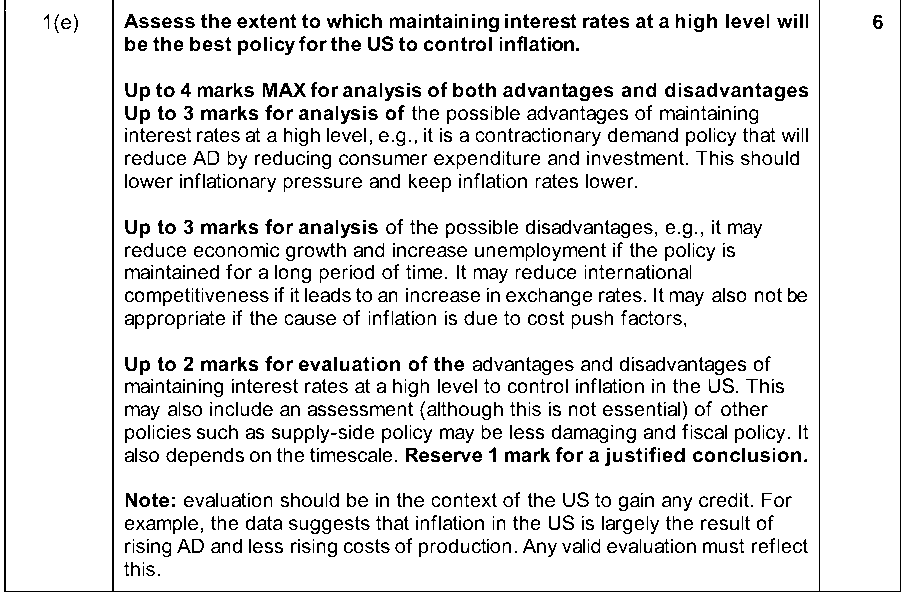
Assess the extent to which maintaining interest rates at a high level will be the best policy for the US to control inflation. [6]
Show mark scheme
Case study: Inflation rate falls in the United States (US), but fears continue over the economic outlook
Question 1(a)June 20259708/212 marks
Using the data in Table 1.1, compare changes in the inflation rate and changes in the interest rate in the US. [2]
Show mark scheme
Question 1(b)June 20259708/212 marks
Explain one reason why using the Consumer Price Index (CPI) to measure the inflation rate in the US may not produce an accurate result. [2]
Show mark scheme
Question 1(c)June 20259708/214 marks
‘In an attempt to bring about disinflation, the Federal Reserve used a contractionary monetary policy.’ Consider whether disinflation is more harmful than deflation. [4]
Show mark scheme
Question 4(a)June 20259708/228 marks
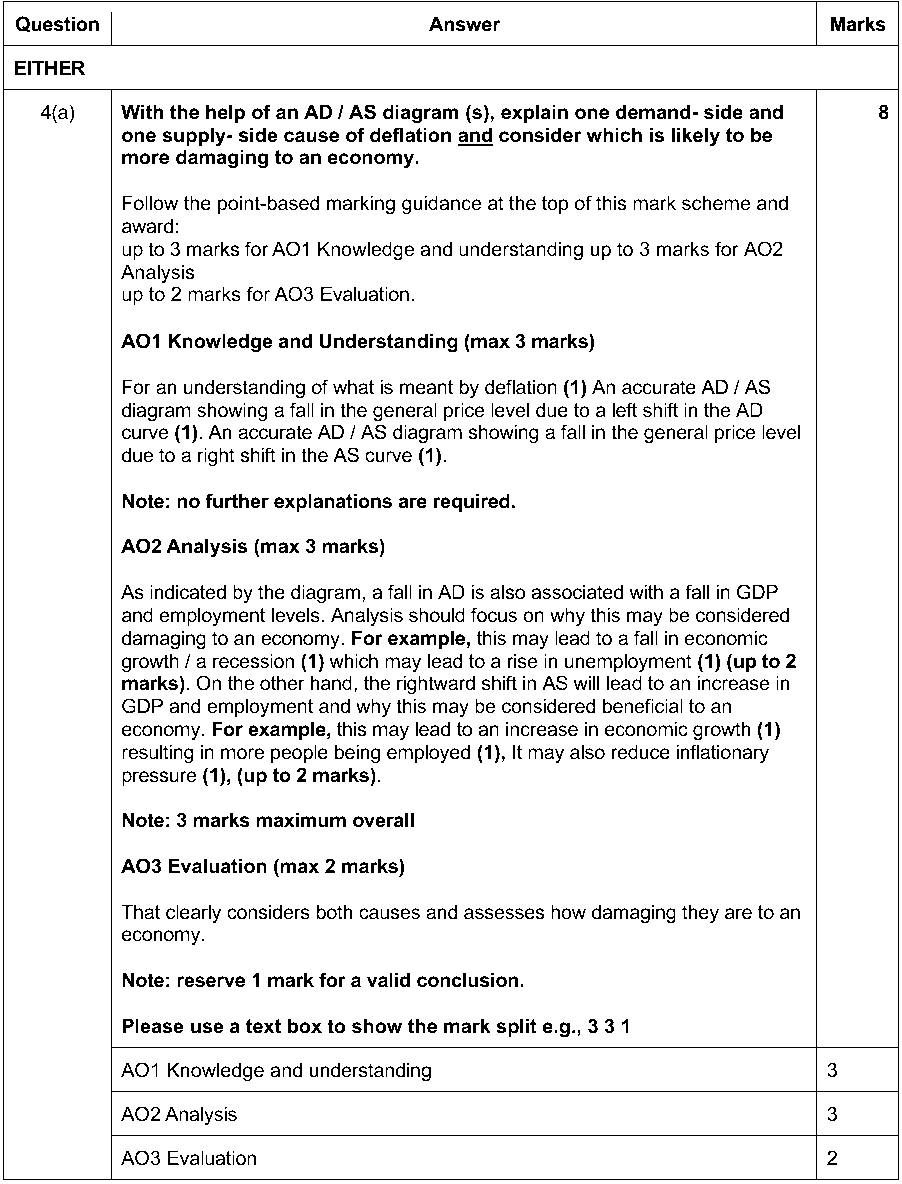
With the help of an AD/AS diagram(s), explain one demand-side and one supply-side cause of deflation and consider which is likely to be more damaging to an economy. [8]
Show mark scheme
Question 4(b)June 20259708/2212 marks
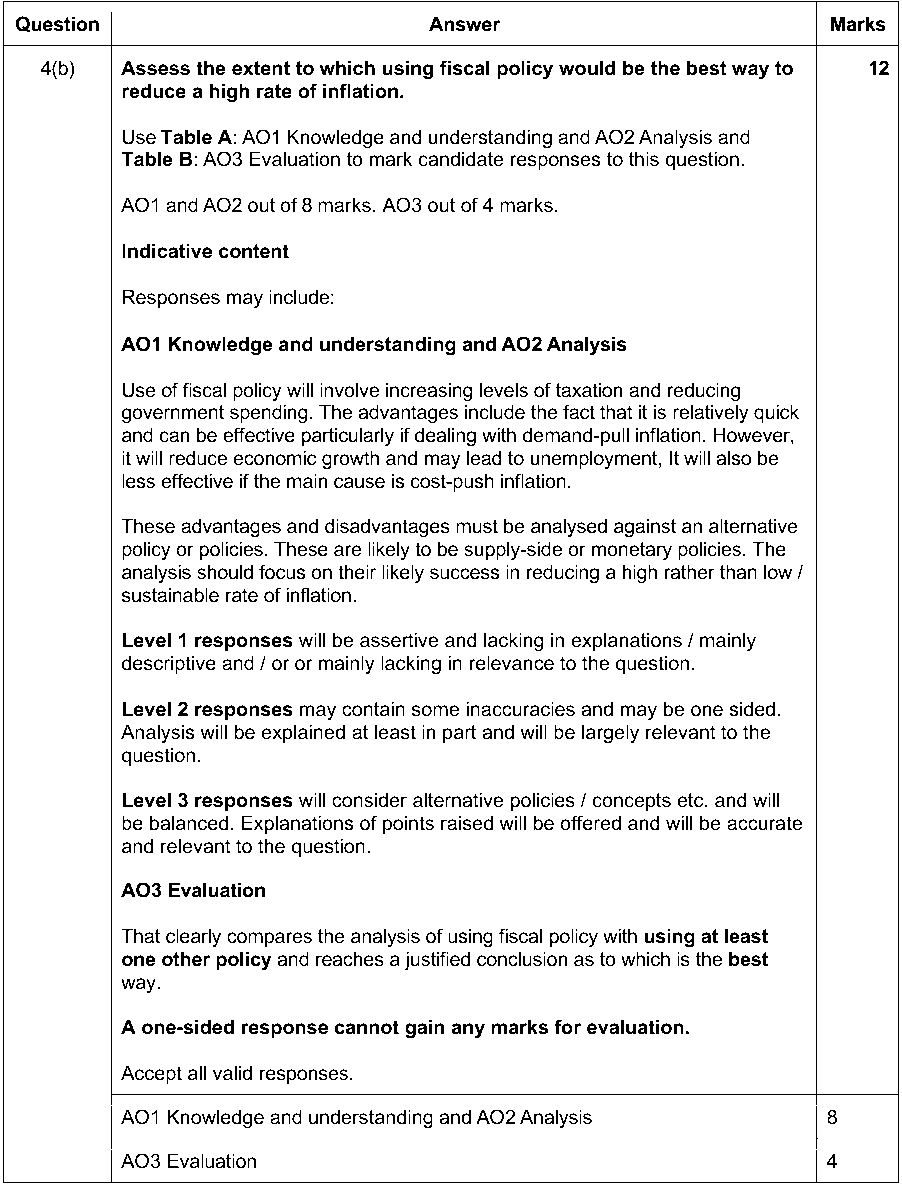
Assess the extent to which using fiscal policy would be the best way to reduce a high rate of inflation. [12]
Show mark scheme
Question 4(a)June 20259708/248 marks
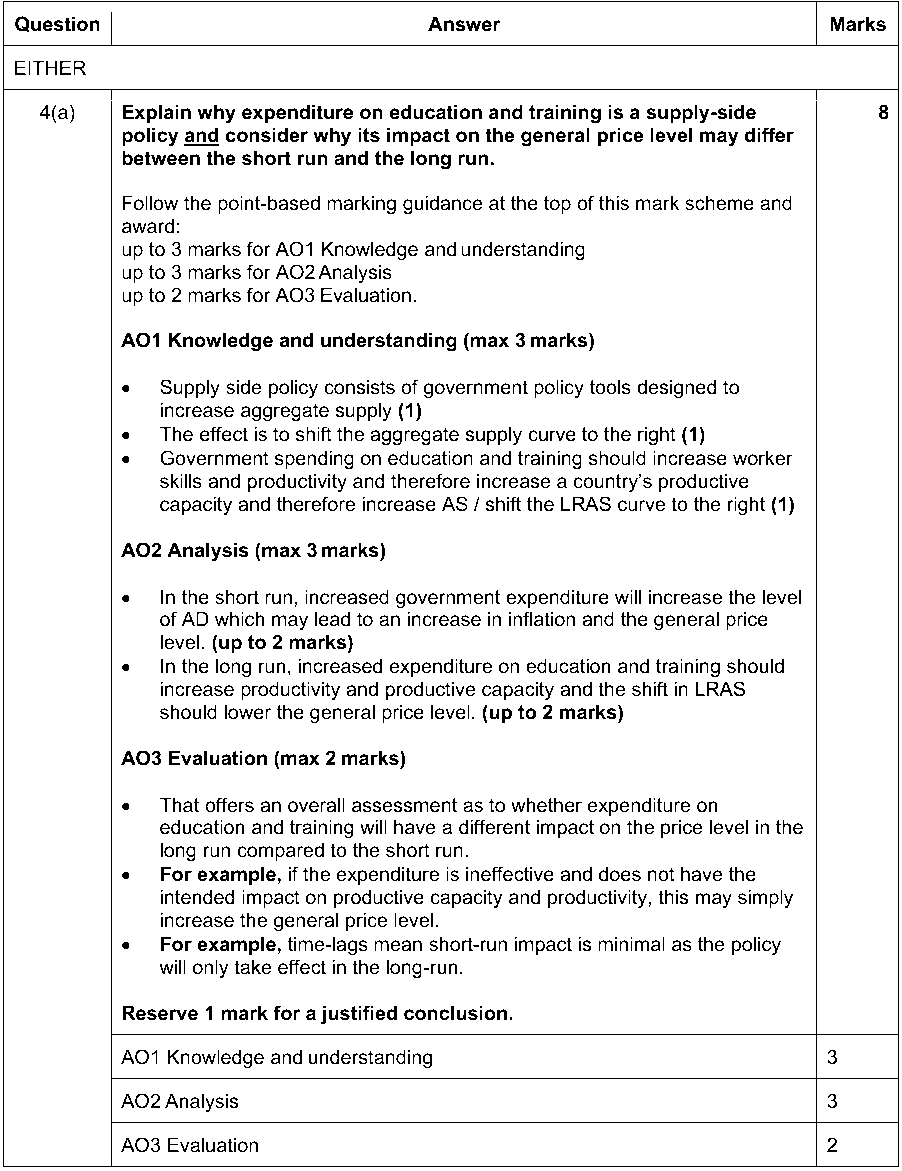
Explain why expenditure on education and training is a supply-side policy and consider why its impact on the general price level may differ between the short run and the long run. [8]
Show mark scheme
Question 4(b)June 20259708/2412 marks
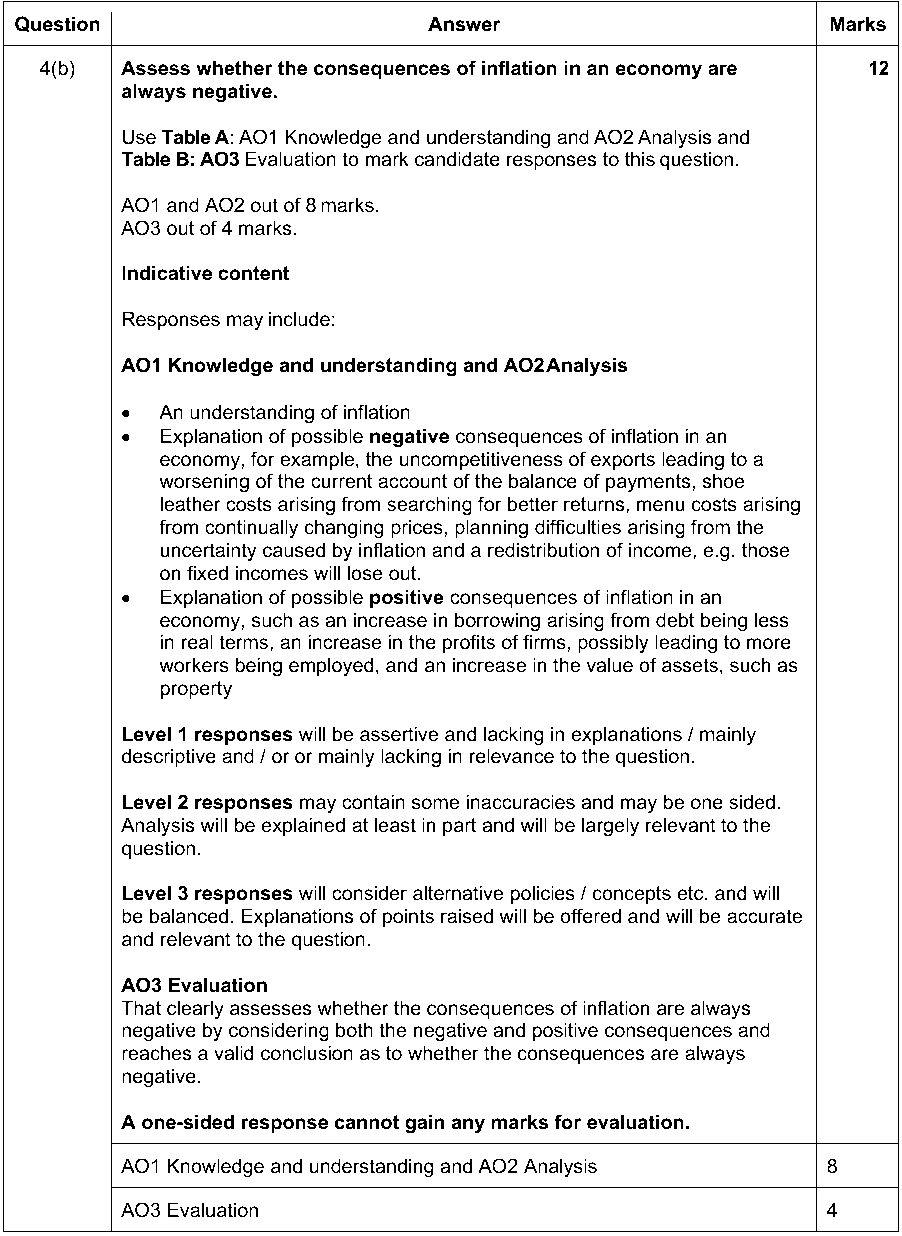
Assess whether the consequences of inflation in an economy are always negative. [12]
Show mark scheme
Question 5(b)March 20259708/2212 marks
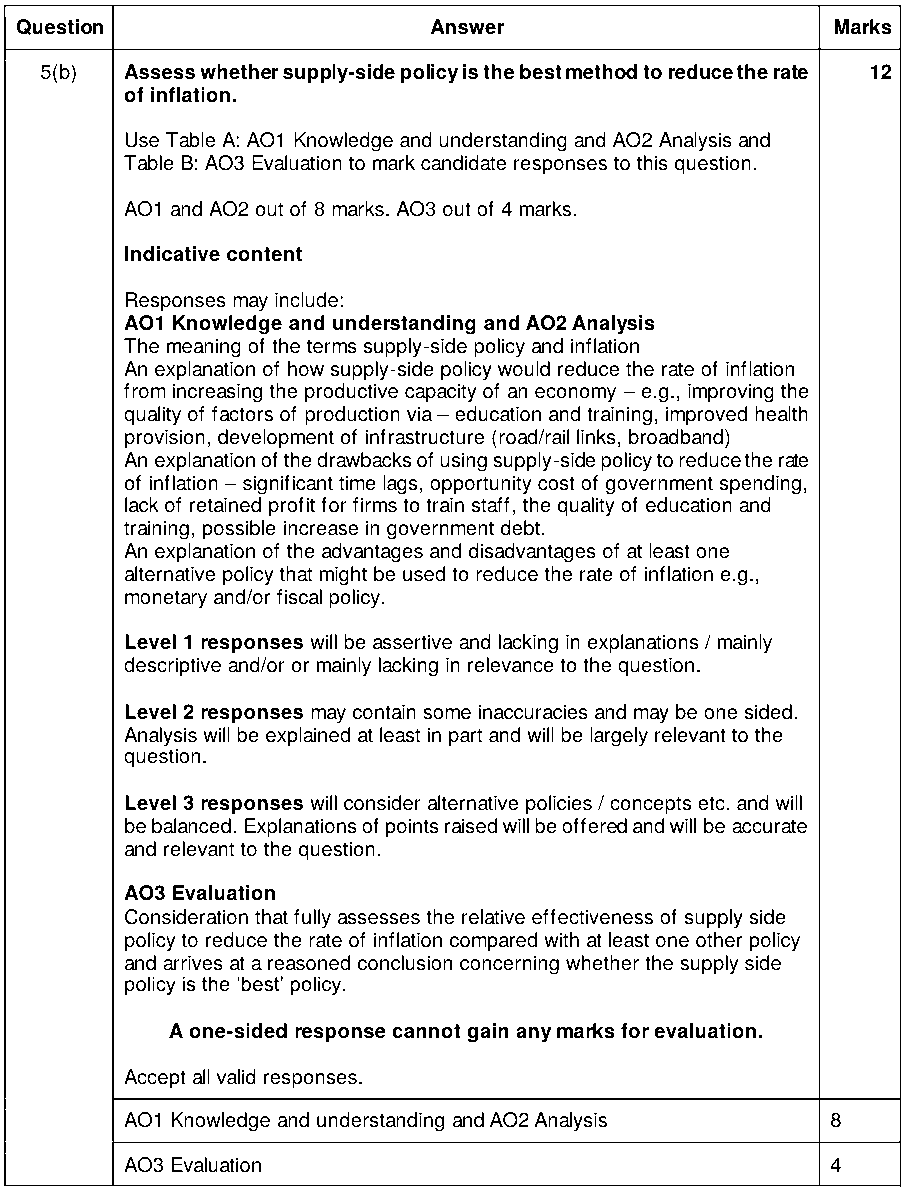
Assess the extent to which supply-side policy is the best method to reduce the rate of inflation. [12]
Show mark scheme
128 more questions from 2020–2024
🔒 Unlock every Price stability question from 2020–2024
All 128 come with their mark schemes, answers and case studies, and appear in the practice tool above once you’re signed in. It’s free.
Create a free accountSign in
A few of them
- 9708/11 · November 2024 · Question 15The table shows the Consumer Prices Index… 🔒
- 9708/11 · November 2024 · Question 16What is most likely to cause the… 🔒
- 9708/12 · November 2024 · Question 19In an economy with an interest rate… 🔒
- 9708/13 · November 2024 · Question 15A country experienced an annual deflation rate… 🔒
- 9708/21 · November 2024 · Question 1(a)Using the data in Fig. 1.1, describe… 🔒
- + 123 more, by year in the table above
Questions and mark schemes are from past Cambridge papers and are reproduced for revision. Topical Vault is an independent revision resource, not affiliated with or endorsed by Cambridge Assessment International Education.