← Topical Vault

Economic growth · AS Level Economics

Cambridge 9708, Paper 1 & 2. 2,092 questions, 2020 to 2026.

Topic
Year

Paper 1 multiple-choice questions and Paper 2 data-response/essay questions, from the original Cambridge material. Paper 2 mark schemes and case studies are reproduced as images of the official pages rather than retyped, so nothing is lost or paraphrased; a question tagged under more than one topic appears under each. Tick “Add to my paper” on any question to build a custom practice PDF from the tray in the corner.

About Economic growth

Questions on economic growth: actual and potential growth, its causes, how it is measured, and the costs and benefits of a growing economy.

New to Economic growth, or finding these questions hard?

Read the notes first: the key ideas, diagrams and formulas, and the mistakes examiners see most, in about 10 minutes.

Read the Economic growth notes →

52 past paper questions on this topic since 2020, across 14 exam sessions.

How often it comes up

YearPaper 1Paper 2TotalChart
2026134
20257815
202431114
20234812
2022011
2021033
2020123

Every 2025–2026 question on Economic growth

The whole topic on one page, with answers and mark schemes. Printing this page prints just this list.

Paper 1 · Multiple choice (8)

Question 19June 20269708/121 mark

What will decrease if the level of employment falls?

  • Alabour force
  • Bactual output
  • Cproductive capacity
  • Dpotential output
Show answer

BCorrect answer

Question 20November 20259708/121 mark

What is not a likely reason for a government having the objective of economic growth?

  • Ato improve living standards
  • Bto improve business confidence
  • Cto increase inflationary pressures
  • Dto increase consumer choice
Show answer

CCorrect answer

Question 25November 20259708/121 mark

What is the least likely consequence of rapid economic growth?

  • Ahigh levels of pollution
  • Blarge deficit on the current account of the balance of payments
  • Clarge deficit in the government’s budget balance
  • Dmore congestion on the roads
Show answer

CCorrect answer

Question 3November 20259708/131 mark

What would be an opportunity cost of growth in an economy?

  • Athe faster growth of services than of manufacturing
  • Bthe need for an increased level of imported raw materials
  • Cthe need for greater government intervention
  • Dthe reduction of consumption if growth requires investment
Show answer

DCorrect answer

Question 4November 20259708/141 mark
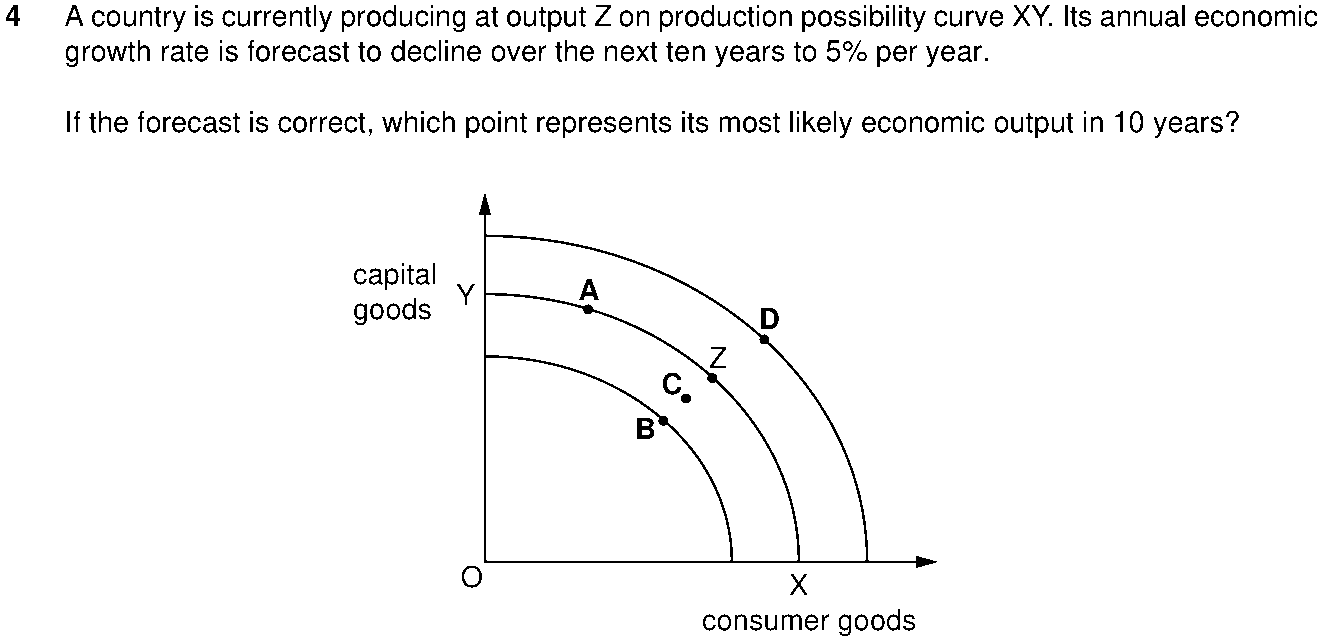
9708/14 November 2025 question 4
Show answer

DCorrect answer

Question 20June 20259708/131 mark

What is the most likely consequence of economic growth?

  • Aa fall in the price of raw materials
  • Ba rise in youth unemployment
  • Ca worsening current account balance
  • Dreduced demand-pull inflationary pressures
Show answer

CCorrect answer

Question 21June 20259708/141 mark

What would be a positive effect on the growth of an economy in the short run, if the government reduced a direct tax on individual earnings?

  • AFood prices would increase because of shortages.
  • BImports of luxury cars would increase to satisfy a change in demand.
  • CSavings would increase because of additional disposable income.
  • DThe consumption of domestically produced goods would increase.
Show answer

DCorrect answer

Question 20March 20259708/121 mark

High economic growth is often accompanied by a worsening of the current account of the balance of payments.

Which reason for this trend is not valid?

  • AEconomic growth raises domestic consumption, leaving very little to sell to overseas consumers.
  • BEconomic growth raises domestic output, leading to lower prices and more price-competitive goods both at home and abroad.
  • CEconomic growth raises incomes and leads to rising demand for foreign goods.
  • DEconomic growth results in rising requirements of inputs from other countries.
Show answer

BCorrect answer

Paper 2 · Data response and essays (11)

Case study: Inflation and economic growth in Japan
Question 1(e)June 20269708/216 marks

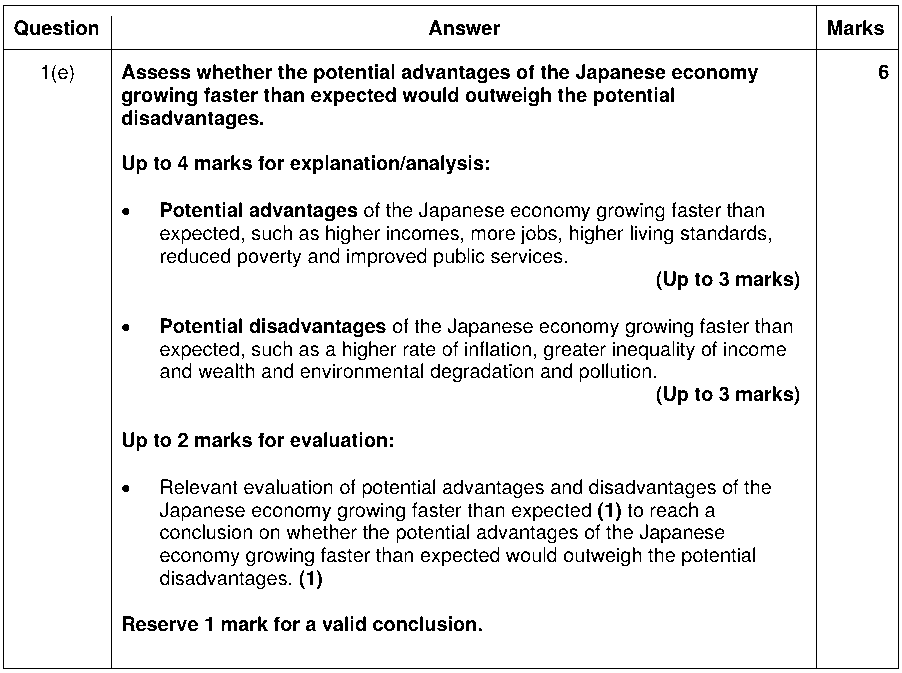
Assess whether the potential advantages of the Japanese economy growing faster than expected would outweigh the potential disadvantages. [6]
Show mark scheme
Mark scheme, 9708/21 June 2026 question 1(e)
Question 4(a)June 20269708/228 marks

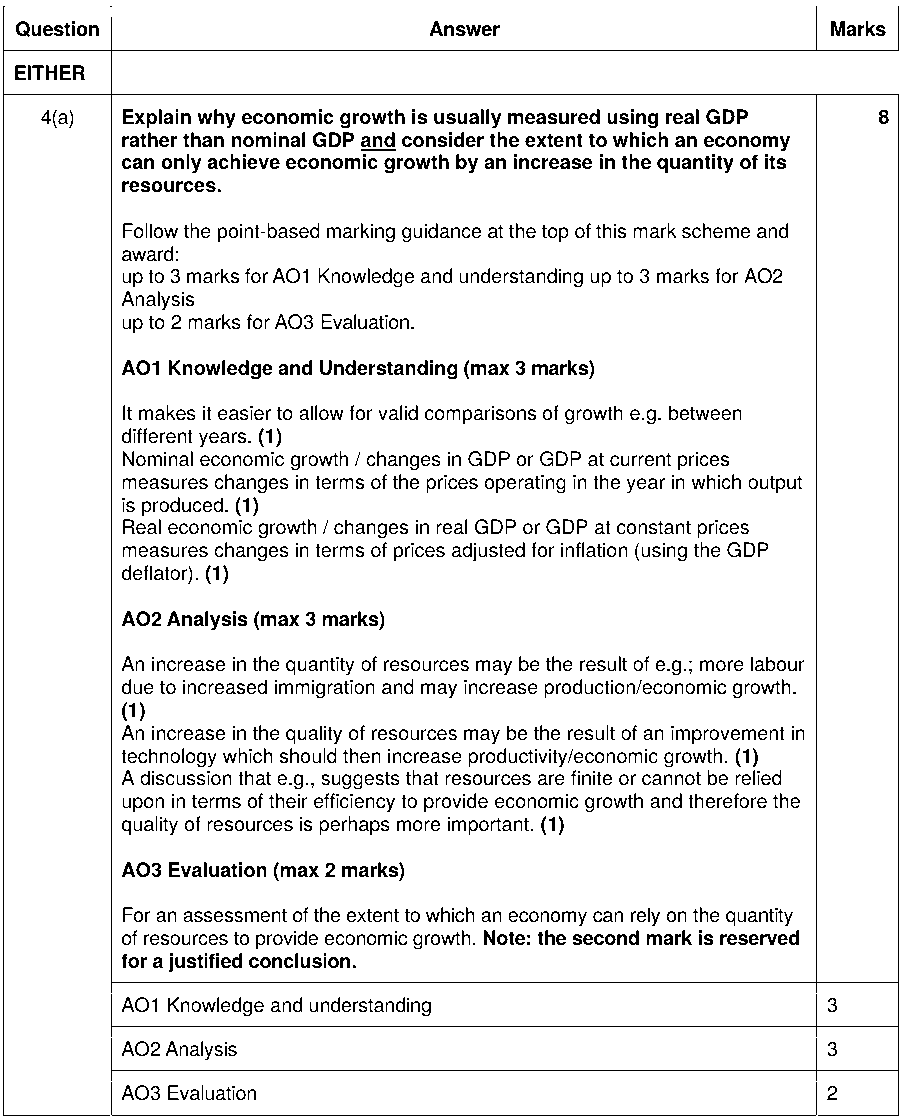
Explain why economic growth is usually measured using real GDP rather than nominal GDP and consider the extent to which an economy can only achieve economic growth by an increase in the quantity of its resources. [8]
Show mark scheme
Mark scheme, 9708/22 June 2026 question 4(a)
Question 4(b)June 20269708/2212 marks

Assess the extent to which the benefits of economic growth will always outweigh the costs for all economies. [12]

Show mark scheme
Mark scheme, 9708/22 June 2026 question 4(b) (page 1 of 2)
Mark scheme, 9708/22 June 2026 question 4(b) (page 2 of 2)
Case study: Will stronger economic growth in the United States (US) lead to high inflation?
Case study: Will stronger economic growth in the United States (US) lead to high inflation? (page 1 of 2)
Case study: Will stronger economic growth in the United States (US) lead to high inflation? (page 2 of 2)
Question 1(a)November 20259708/242 marks

Compare the forecast rates of economic growth for the US and Eurozone between 2023 and 2024. [2]

Show mark scheme
Mark scheme, 9708/24 November 2025 question 1(a)
Question 1(b)November 20259708/242 marks

Explain one reason why the IMF uses percentage change in real GDP and not percentage change in nominal GDP when measuring economic growth. [2]

Show mark scheme
Mark scheme, 9708/24 November 2025 question 1(b)
Case study: Inflation rate falls in the United States (US), but fears continue over the economic outlook
Case study: Inflation rate falls in the United States (US), but fears continue over the economic outlook (page 1 of 2)
Case study: Inflation rate falls in the United States (US), but fears continue over the economic outlook (page 2 of 2)
Question 1(d)June 20259708/216 marks

Assess whether increases in the interest rate make a recession in the US inevitable. [6]

Show mark scheme
Mark scheme, 9708/21 June 2025 question 1(d)
Case study: Can South Africa escape from its economic difficulties?
Case study: Can South Africa escape from its economic difficulties? (page 1 of 2)
Case study: Can South Africa escape from its economic difficulties? (page 2 of 2)
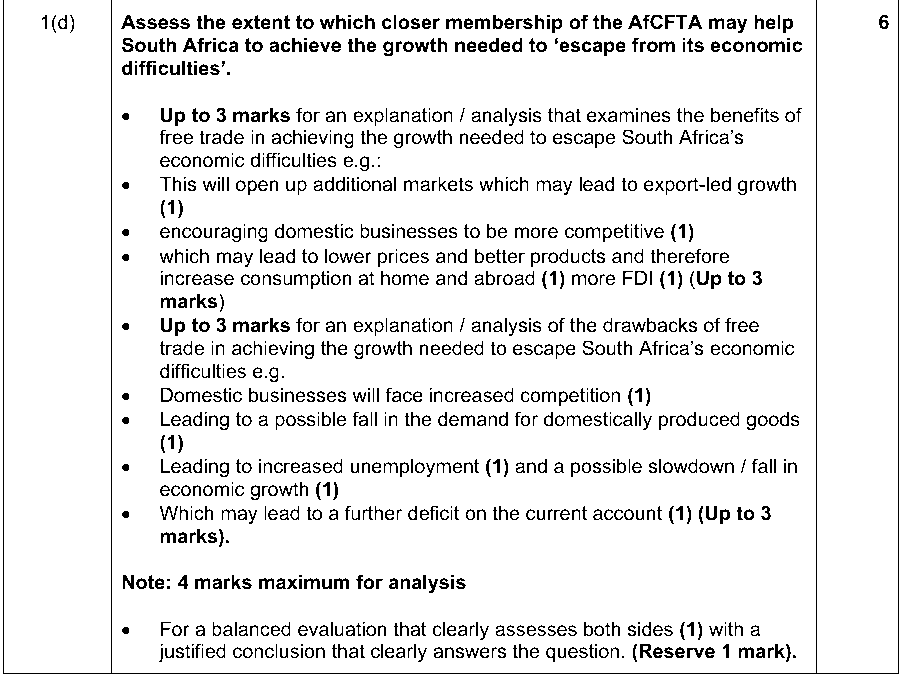
Question 1(d)June 20259708/226 marks

Assess the extent to which closer membership of the AfCFTA may help South Africa to achieve the growth needed to ‘escape from its economic difficulties’. [6]
Show mark scheme
Mark scheme, 9708/22 June 2025 question 1(d)
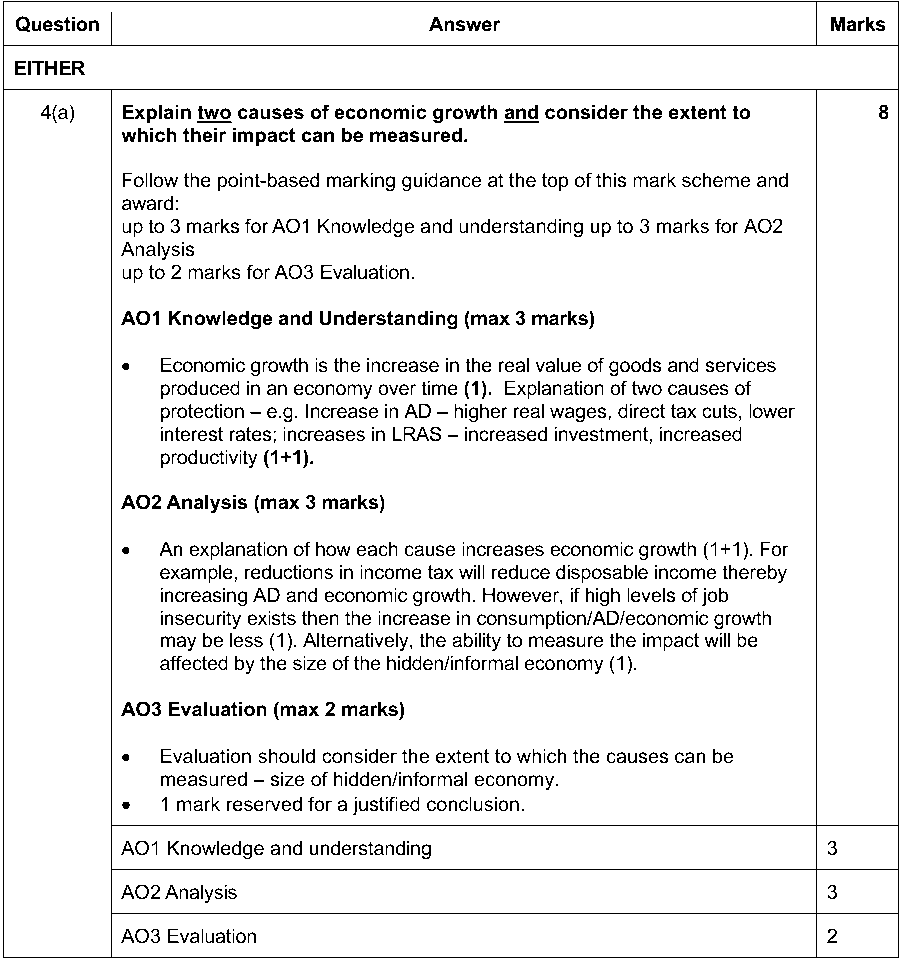
Question 4(a)June 20259708/238 marks

Explain two causes of economic growth and consider the extent to which their impact can be measured. [8]
Show mark scheme
Mark scheme, 9708/23 June 2025 question 4(a)
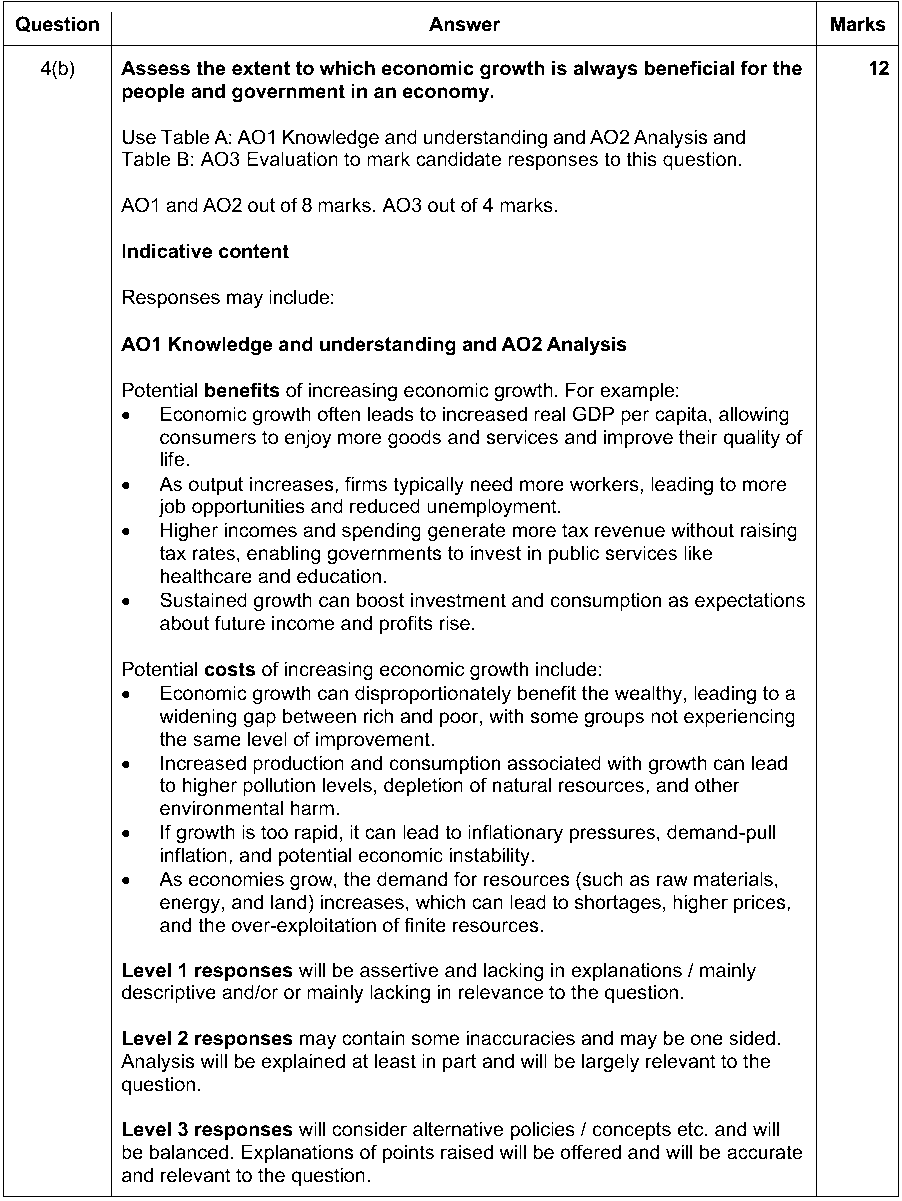
Question 4(b)June 20259708/2312 marks

Assess the extent to which economic growth is always beneficial for the people and government in an economy. [12]
Show mark scheme
Mark scheme, 9708/23 June 2025 question 4(b) (page 1 of 2)
Mark scheme, 9708/23 June 2025 question 4(b) (page 2 of 2)
Case study: Economic challenges in Malaysia
Question 1(a)June 20259708/242 marks

Using the data in Fig. 1.1, describe the trend shown in the annual rate of economic growth in Malaysia over the period January 2019 to January 2022. [2]

Show mark scheme
Mark scheme, 9708/24 June 2025 question 1(a)
Question 1(d)June 20259708/246 marks

Assess how far external factors were responsible for economic growth in Malaysia over the period January 2019 to January 2022. [6]

Show mark scheme
Mark scheme, 9708/24 June 2025 question 1(d)

33 more questions from 2020–2024

🔒 Unlock every Economic growth question from 2020–2024

All 33 come with their mark schemes, answers and case studies, and appear in the practice tool above once you’re signed in. It’s free.

Create a free accountSign in

A few of them

  • 9708/21 · November 2024 · Question 4(a)Explain two possible causes of economic growth… 🔒
  • 9708/22 · November 2024 · Question 1(e)Assess the likely impact of the rise… 🔒
  • 9708/23 · November 2024 · Question 1(e)Assess the likely impact of the fluctuations… 🔒
  • 9708/12 · June 2024 · Question 18Which change affecting an economy’s labour force… 🔒
  • 9708/13 · June 2024 · Question 18What is a cost of negative economic… 🔒
  • + 28 more, by year in the table above

Questions and mark schemes are from past Cambridge papers and are reproduced for revision. Topical Vault is an independent revision resource, not affiliated with or endorsed by Cambridge Assessment International Education.

AS Level Economics questions by topic

Each topic opens this practice tool with only that topic’s questions, plus how often it comes up and every question on it in one list. Revision notes for AS Level Economics →

  1. Unit 1Basic economic ideas and resource allocation
  2. Ch 1Scarcity, choice and opportunity cost
  3. Ch 2Economic methodology
  4. Ch 3Factors of production
  5. Ch 4Resource allocation in different economic systems
  6. Ch 5Production possibility curves
  7. Ch 6Classification of goods and services
  8. Unit 2The price system and the microeconomy
  9. Ch 7Demand and supply curves
  10. Ch 8Price elasticity, income elasticity and cross elasticity of demand
  11. Ch 9Price elasticity of supply
  12. Ch 10The interaction of demand and supply
  13. Ch 11Consumer and producer surplus
  14. Unit 3Government microeconomic intervention
  15. Ch 12Reasons for government intervention in markets
  16. Ch 13Methods and effects of government intervention in markets
  17. Ch 14Addressing income and wealth inequality
  18. Unit 4The macroeconomy
  19. Ch 15National income statistics
  20. Ch 16Introduction to the circular flow of income
  21. Ch 17Aggregate demand and aggregate supply analysis
  22. Ch 18Economic growth
  23. Ch 19Unemployment
  24. Ch 20Price stability
  25. Unit 5Government macroeconomic intervention
  26. Ch 21Government macroeconomic policy objectives
  27. Ch 22Fiscal policy
  28. Ch 23Monetary policy
  29. Ch 24Supply-side policy
  30. Unit 6International economic issues
  31. Ch 25The reasons for international trade
  32. Ch 26Protectionism
  33. Ch 27Current account of the balance of payments
  34. Ch 28Exchange rates
  35. Ch 29Policies to correct imbalances in the current account of the balance of payments