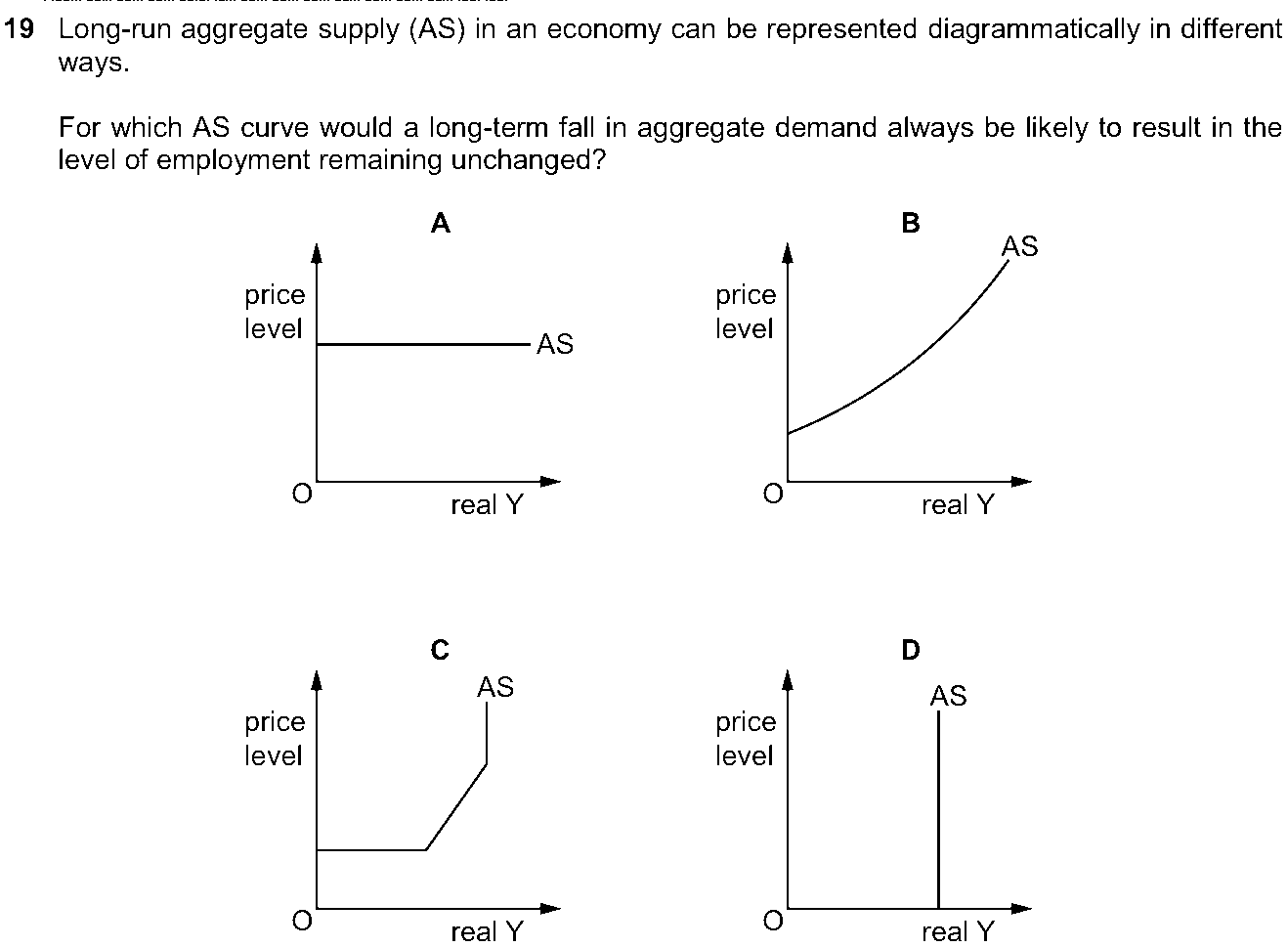
← Topical Vault

Aggregate demand and aggregate supply analysis · AS Level Economics

Cambridge 9708, Paper 1 & 2. 2,092 questions, 2020 to 2026.

Topic
Year

Paper 1 multiple-choice questions and Paper 2 data-response/essay questions, from the original Cambridge material. Paper 2 mark schemes and case studies are reproduced as images of the official pages rather than retyped, so nothing is lost or paraphrased; a question tagged under more than one topic appears under each. Tick “Add to my paper” on any question to build a custom practice PDF from the tray in the corner.

About Aggregate demand and aggregate supply analysis

Questions on aggregate demand and aggregate supply: the components of AD, what shifts AD and AS, short-run and long-run AS, and the effects on output and the price level.

New to Aggregate demand and aggregate supply analysis, or finding these questions hard?

Read the notes first: the key ideas, diagrams and formulas, and the mistakes examiners see most, in about 14 minutes.

Read the Aggregate demand and aggregate supply analysis notes →

135 past paper questions on this topic since 2020, across 19 exam sessions.

How often it comes up

YearPaper 1Paper 2TotalChart
202612719
202516521
202413720
202319322
202216521
20217714
202014418

Every 2025–2026 question on Aggregate demand and aggregate supply analysis

The whole topic on one page, with answers and mark schemes. Printing this page prints just this list.

Paper 1 · Multiple choice (28)

Question 19June 20269708/111 mark

In which situation would an increase in consumption not cause an increase in real GDP?

  • Athe current rate of GDP growth is less than the country’s target rate
  • Bthe economy is experiencing low rates of inflation
  • Cthe economy is in recession
  • Dthe economy is operating at full capacity
Show answer

DCorrect answer

Question 22June 20269708/111 mark

Some countries experienced a recent decline in investment spending.

What might be done to stop such a decline?

  • Aincrease quotas on imports
  • Blower interest rates
  • Craise income tax
  • Dset up training courses
Show answer

BCorrect answer

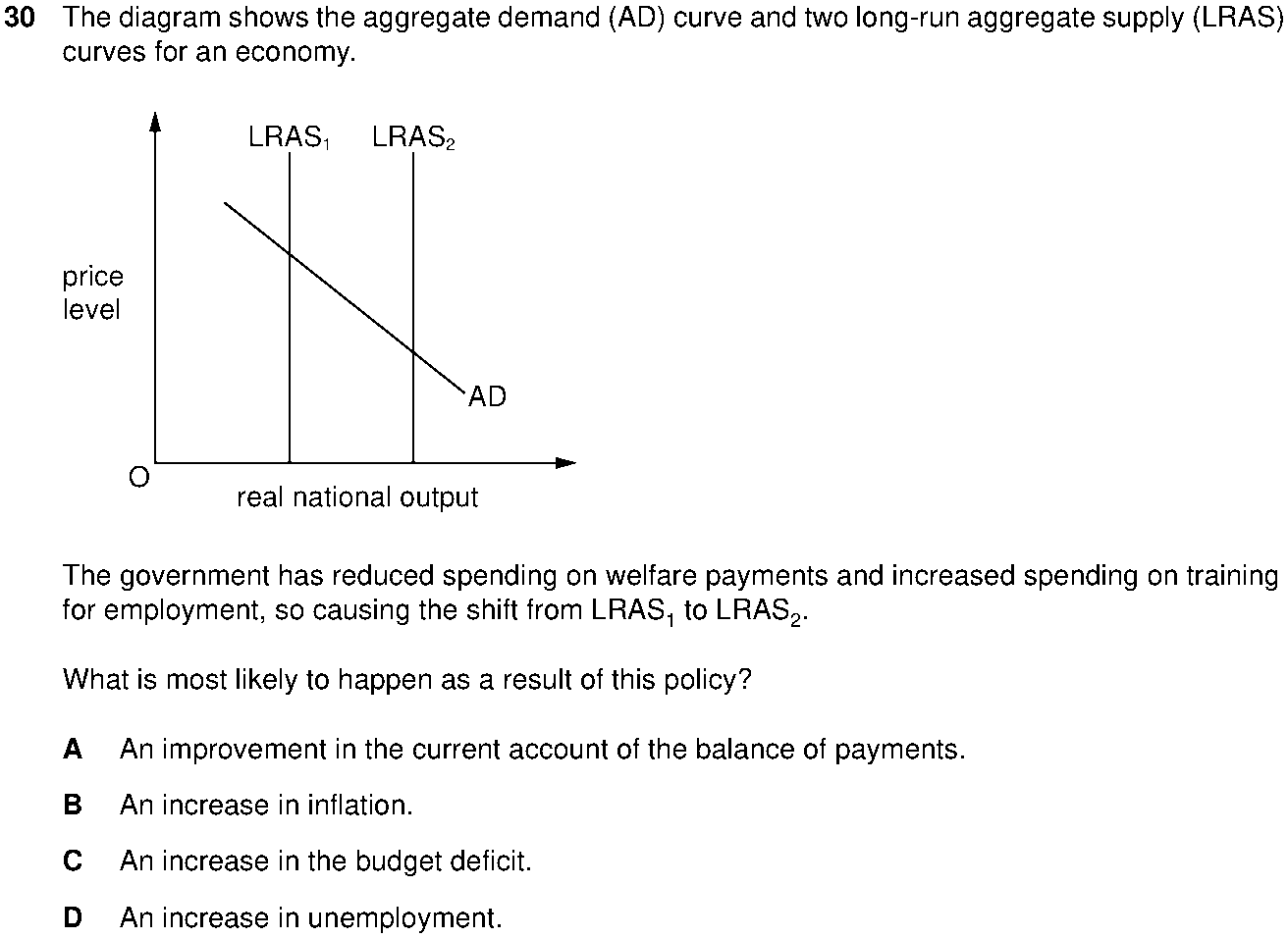
Question 30June 20269708/111 mark
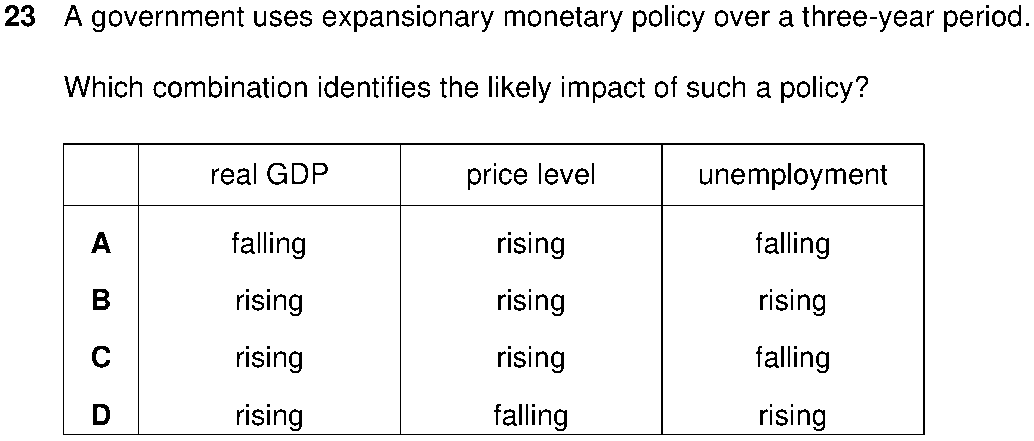
9708/11 June 2026 question 30
Show answer

ACorrect answer

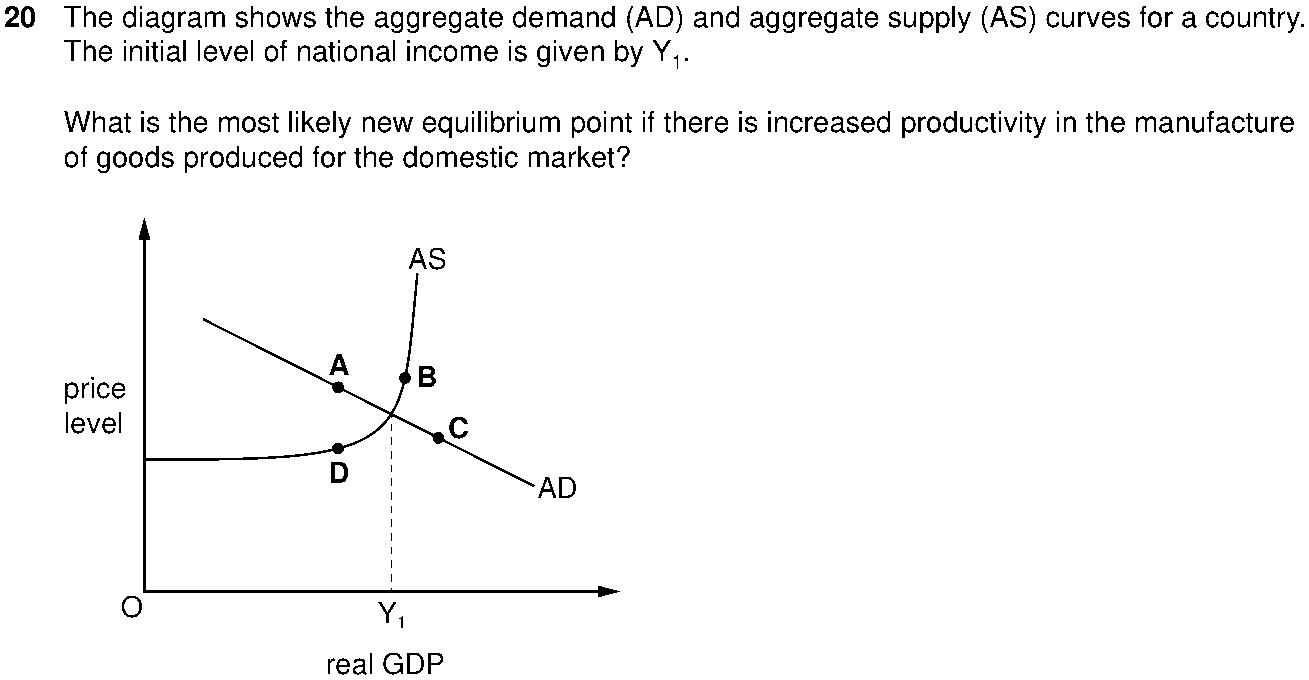
Question 20June 20269708/121 mark
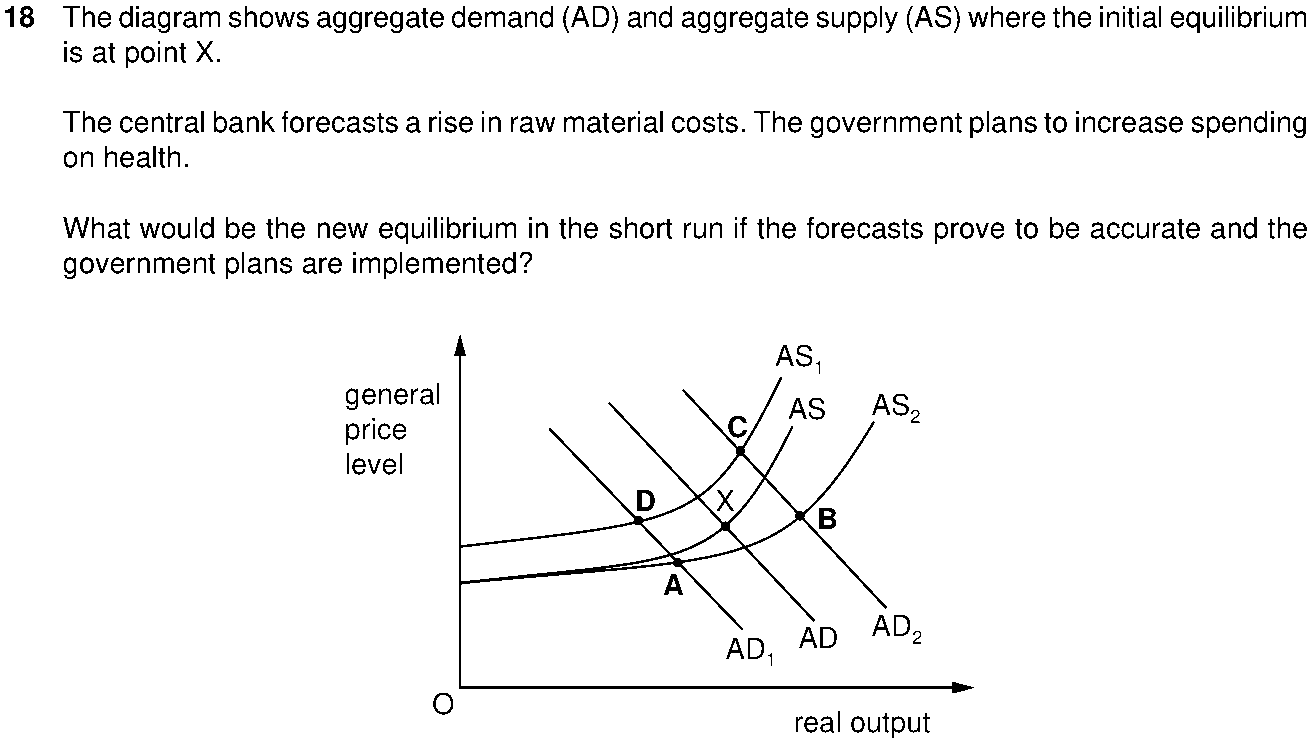
9708/12 June 2026 question 20
Show answer

CCorrect answer

Question 22June 20269708/121 mark

A government reduced direct taxes on consumers and businesses.

What are likely to be the effects of these changes on consumption, investment and national output?

consumption investment national output

  • Adecrease decrease decrease
  • Bdecrease increase increase
  • Cincrease decrease decrease
  • Dincrease increase increase
Show answer

DCorrect answer

Question 25June 20269708/121 mark

What is not included in government spending (G) while calculating aggregate demand (AD)?

  • Aeducation
  • Bhealthcare
  • Croads
  • Dtransfer payments
Show answer

DCorrect answer

Question 24June 20269708/131 mark

In which situation is expansionary fiscal policy through increased government expenditure likely to be most effective in increasing employment in an economy?

  • AWhen the AD curve cuts the horizontal part of the AS curve.
  • BWhen the AD curve cuts the vertical part of the AS curve.
  • CWhen the government also raises tax to fund its increased expenditure.
  • DWhen the government injects a large amount of spending into the economy.
Show answer

ACorrect answer

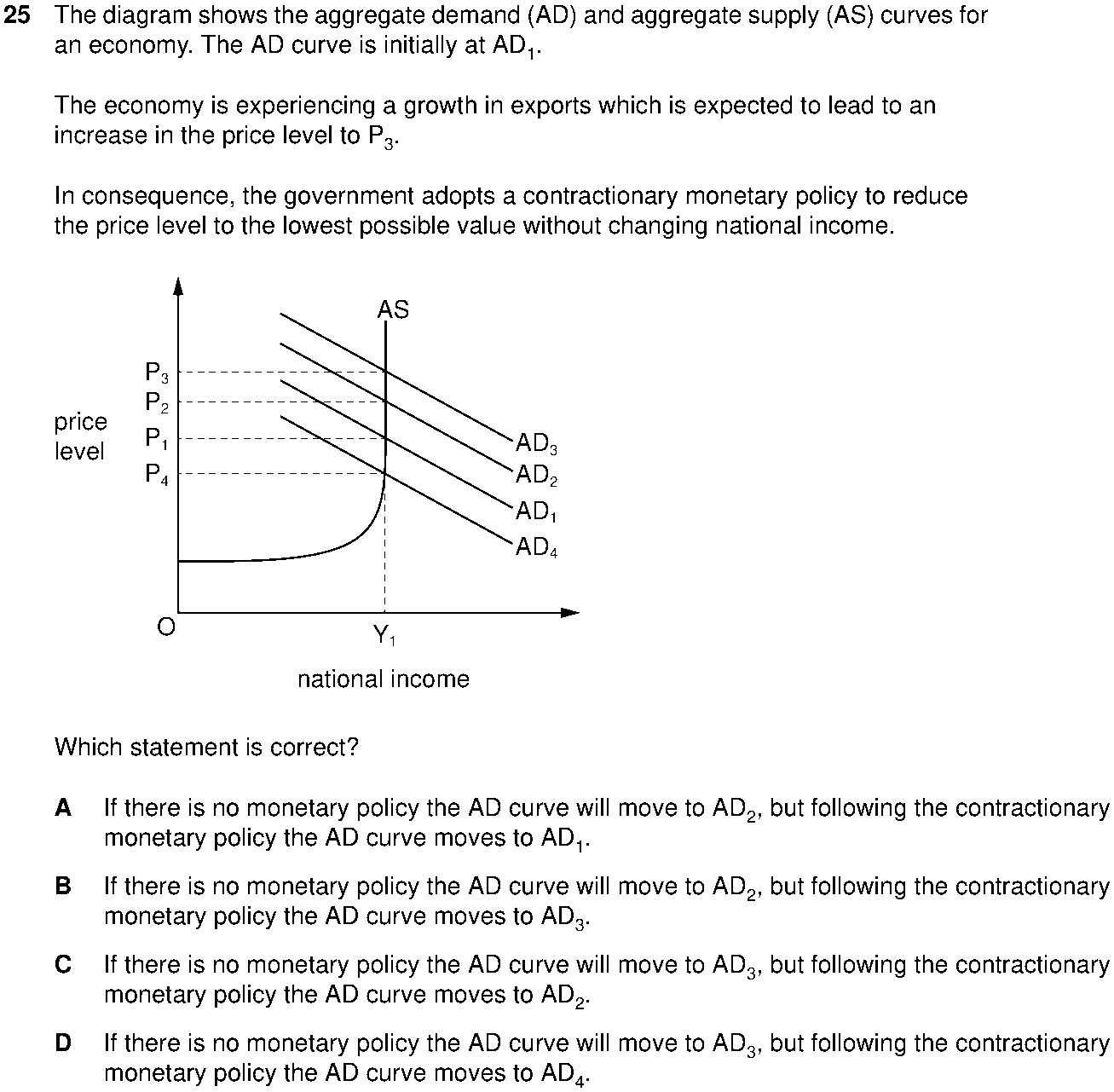
Question 25June 20269708/131 mark
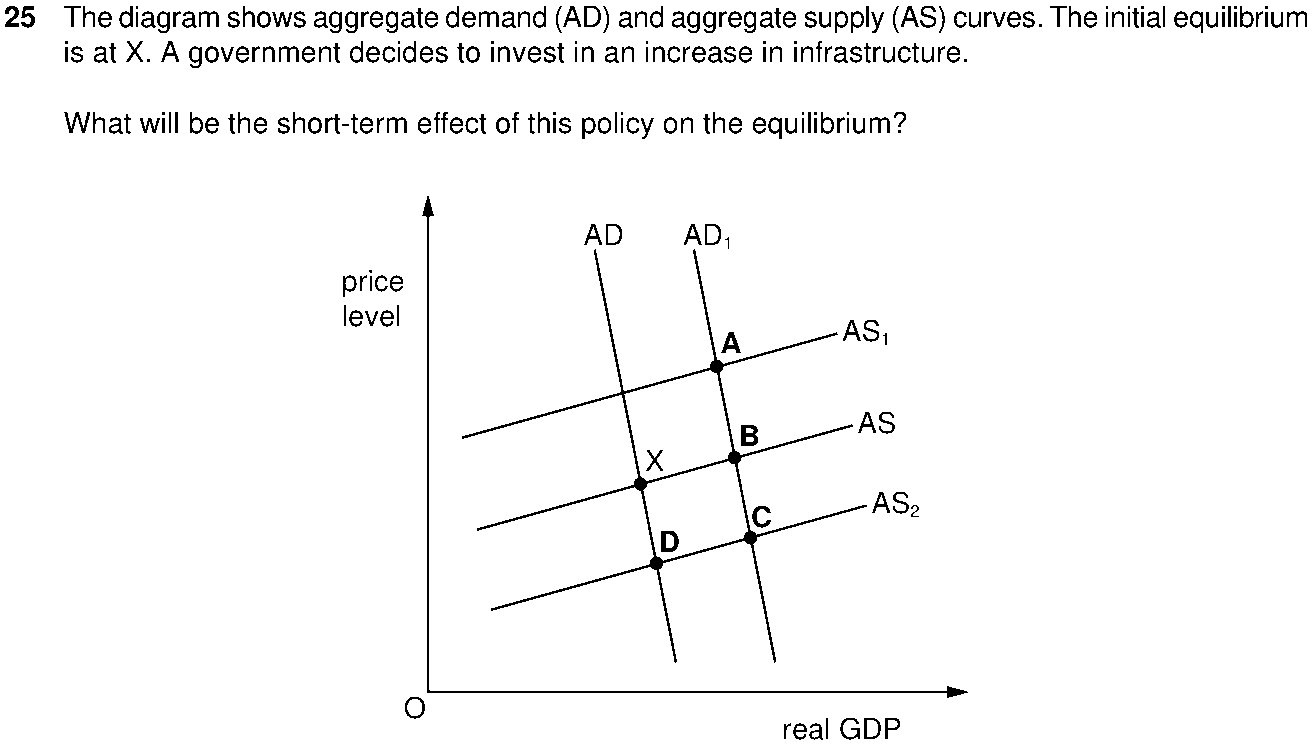
9708/13 June 2026 question 25
Show answer

DCorrect answer

Question 17June 20269708/141 mark

Which change in aggregate demand will increase demand−pull inflationary pressure in an economy?

  • Ahigher government spending
  • Bhigher import spending
  • Clower consumer spending
  • Dlower investment spending
Show answer

ACorrect answer

Question 20June 20269708/141 mark
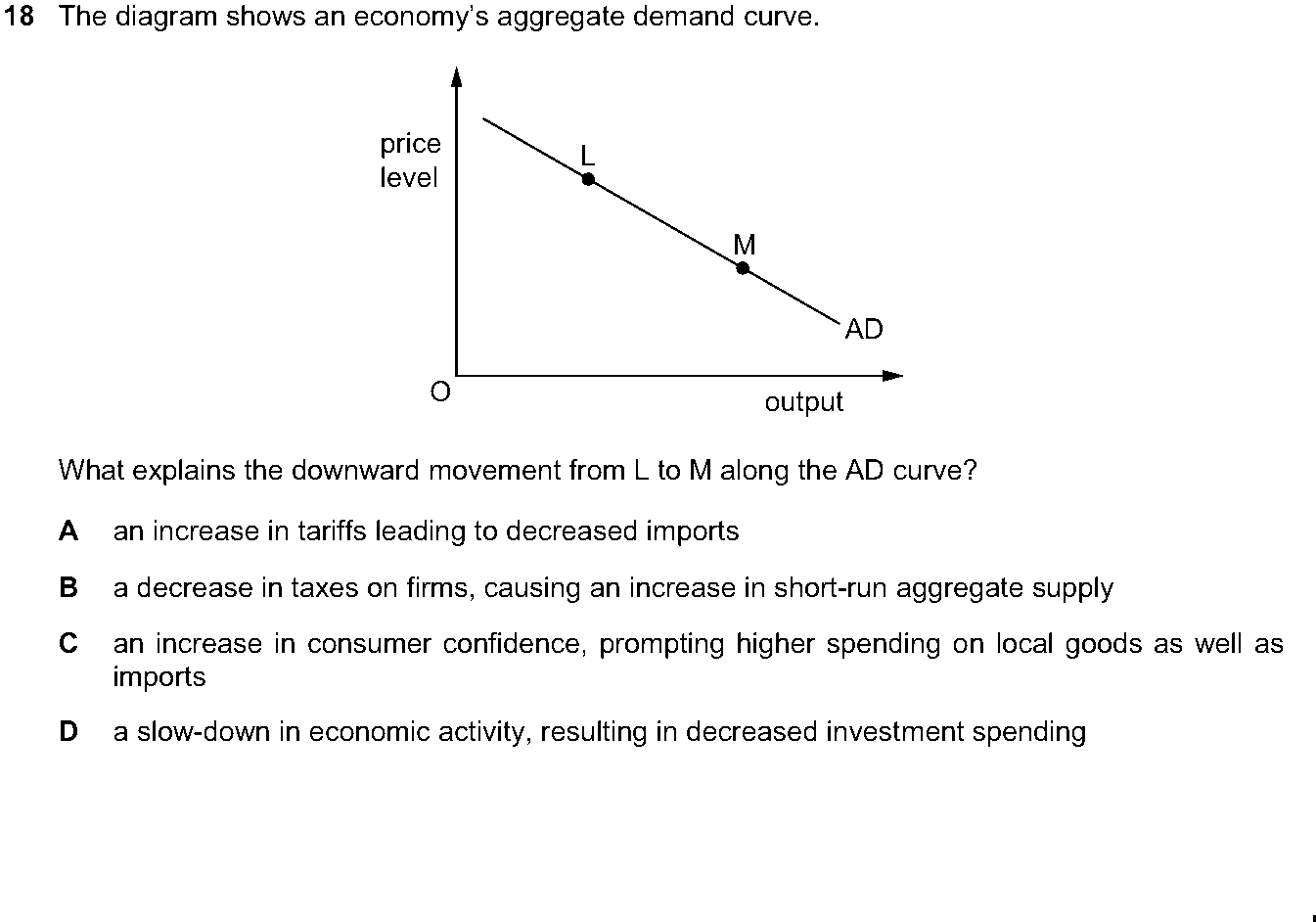
9708/14 June 2026 question 20
Show answer

BCorrect answer

Question 24June 20269708/141 mark
9708/14 June 2026 question 24
Show answer

BCorrect answer

Question 19March 20269708/121 mark

What will not shift the vertical part of the long run Aggregate Supply curve?

  • Aa fall in factor prices
  • Bimmigration of skilled labour
  • Cimproved education and training
  • Dtechnological advancement
Show answer

ACorrect answer

Question 20November 20259708/111 mark

The aggregate demand (AD) curve in an economy shifts to the left.

What is most likely to cause this shift?

  • Aa decrease in the exchange rate
  • Ba decrease in the interest rate
  • Can increase in the budget deficit
  • Dan increase in the current account deficit
Show answer

DCorrect answer

Question 21November 20259708/111 mark
9708/11 November 2025 question 21
Show answer

BCorrect answer

Question 16November 20259708/121 mark
9708/12 November 2025 question 16
Show answer

CCorrect answer

Question 17November 20259708/121 mark
9708/12 November 2025 question 17
Show answer

ACorrect answer

Question 28November 20259708/121 mark
9708/12 November 2025 question 28
Show answer

ACorrect answer

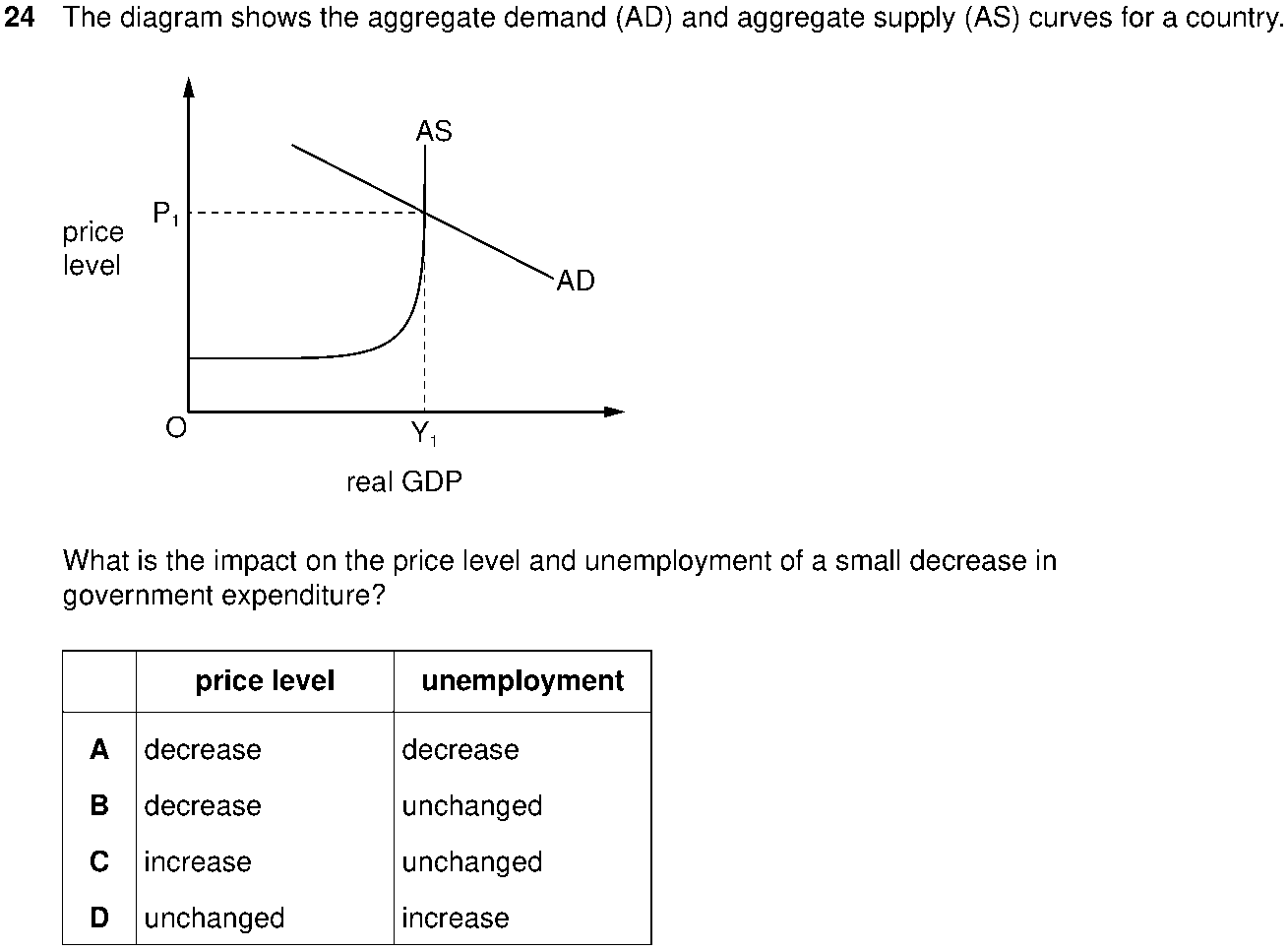
Question 24November 20259708/131 mark
9708/13 November 2025 question 24
Show answer

ACorrect answer

Question 17November 20259708/141 mark

What is required to prevent a rising price level due to an increase in aggregate demand?

  • AAdditional productive capacity must be created.
  • BGovernment investment must remain at a constant level to stabilise supply.
  • CGreater reliance must be placed on imported goods to overcome any domestic shortfalls.
  • DWage rates must change more frequently to maintain levels of employment and output.
Show answer

ACorrect answer

Question 19June 20259708/111 mark

Which statement is not correct?

  • AThe long-run aggregate supply curve can be downward sloping.
  • BThe long-run aggregate supply curve can be horizontal.
  • CThe long-run aggregate supply curve can be upward sloping.
  • DThe long-run aggregate supply curve can be vertical.
Show answer

ACorrect answer

Question 23June 20259708/111 mark
9708/11 June 2025 question 23
Show answer

CCorrect answer

Question 18June 20259708/121 mark

The aggregate demand curve is typically downward sloping.

What is one possible explanation for this?

  • AA fall in the price level will lead to a rise in demand for imports.
  • BAs the price level falls, improved productivity will reduce unit costs.
  • CIf the price level is high, any interest rate changes will encourage consumption.
  • DThe real value of assets increases as the price level falls.
Show answer

DCorrect answer

Question 25June 20259708/121 mark
9708/12 June 2025 question 25
Show answer

BCorrect answer

Question 18June 20259708/131 mark
9708/13 June 2025 question 18
Show answer

CCorrect answer

Question 18June 20259708/141 mark
9708/14 June 2025 question 18
Show answer

BCorrect answer

Question 19June 20259708/141 mark
9708/14 June 2025 question 19
Show answer

DCorrect answer

Question 18March 20259708/121 mark
9708/12 March 2025 question 18
Show answer

BCorrect answer

Question 24March 20259708/121 mark

A government decides to use supply-side policy to increase long-run aggregate supply (LRAS).

What is the most likely reason why this policy tool will not lead to a fall in the price level?

  • AAggregate demand will also increase.
  • BLabour productivity levels will increase.
  • CWorkers will save any extra wages they earn.
  • DWorkers will spend any extra wages on imports.
Show answer

ACorrect answer

Paper 2 · Data response and essays (12)

Case study: Inflation and economic growth in Japan
Question 1(d)June 20269708/216 marks

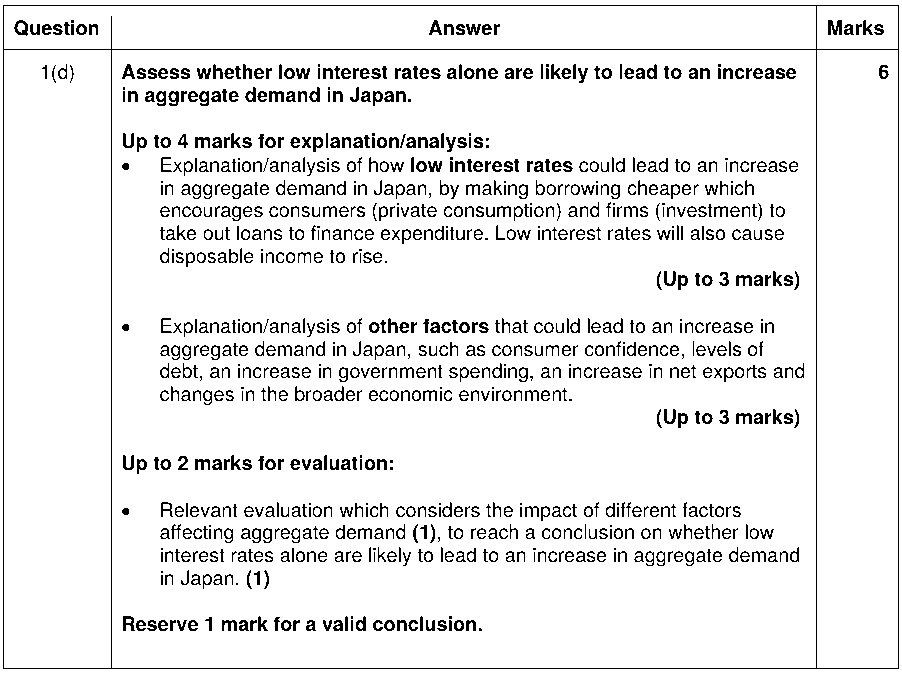
Assess whether low interest rates alone are likely to lead to an increase in aggregate demand in Japan. [6]
Show mark scheme
Mark scheme, 9708/21 June 2026 question 1(d)
Case study: Should Australia support the production of nickel?
Case study: Should Australia support the production of nickel? (page 1 of 2)
Case study: Should Australia support the production of nickel? (page 2 of 2)
Question 1(d)June 20269708/226 marks

‘The Australian government plans a large increase in its spending.’

Assess the possible effects of a large increase in government spending by the government on the Australian economy. [6]

Show mark scheme
Mark scheme, 9708/22 June 2026 question 1(d)
Case study: Exports of Chinese electric vehicles (EVs) continue to increase
Question 1(e)June 20269708/236 marks

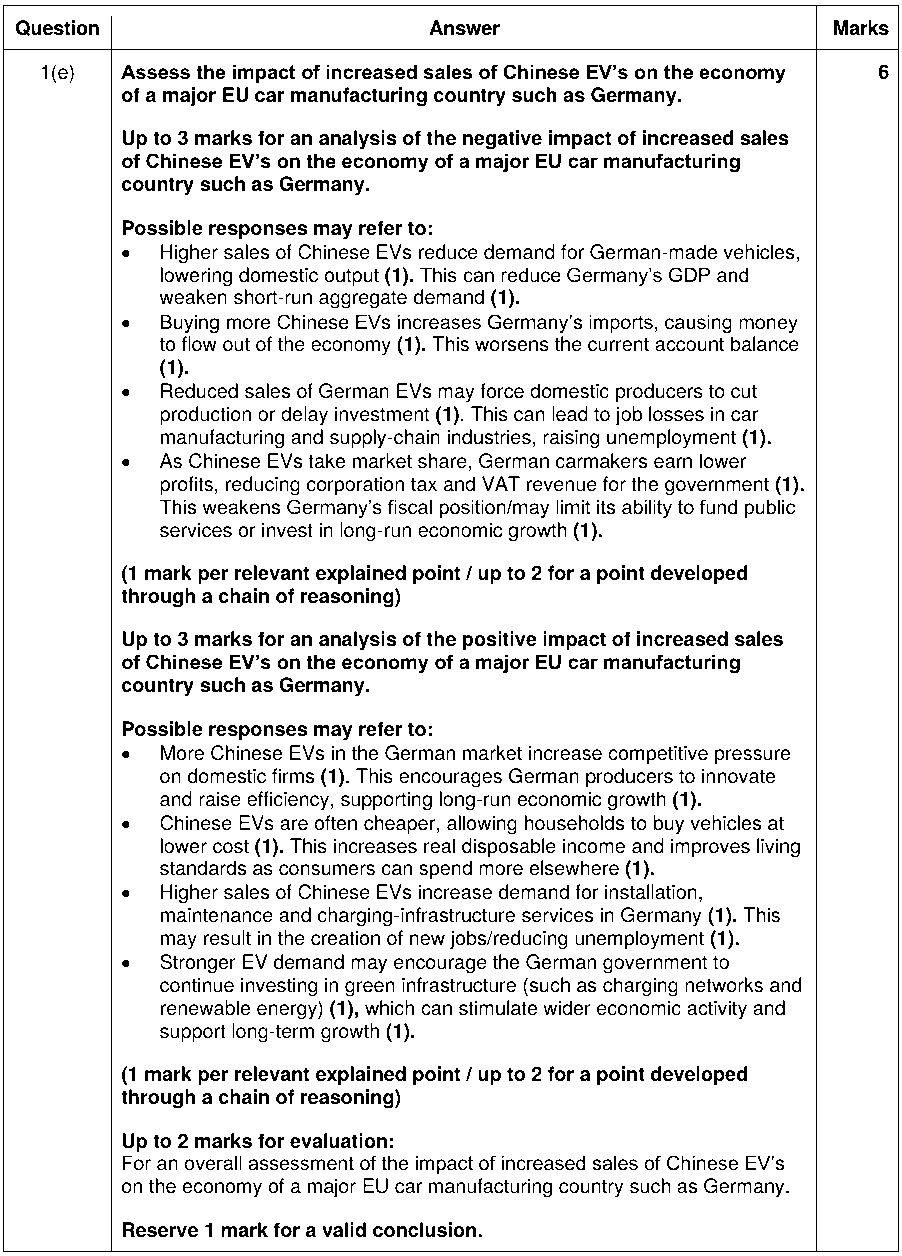
Assess the impact of increased sales of Chinese EVs on the economy of a major EU car manufacturing country such as Germany. [6]
Show mark scheme
Mark scheme, 9708/23 June 2026 question 1(e)
Question 4(a)June 20269708/238 marks

With the help of a diagram(s), explain how increases in aggregate demand affect the level of real output and the price level in an economy and consider when such increases may become a problem. [8]

Show mark scheme
Mark scheme, 9708/23 June 2026 question 4(a)
Question 4(b)June 20269708/2312 marks

Assess whether increases in long-run aggregate supply (LRAS) are the best way of reducing unemployment. [12]

Show mark scheme
Mark scheme, 9708/23 June 2026 question 4(b) (page 1 of 2)
Mark scheme, 9708/23 June 2026 question 4(b) (page 2 of 2)
Question 4(b)June 20269708/2412 marks

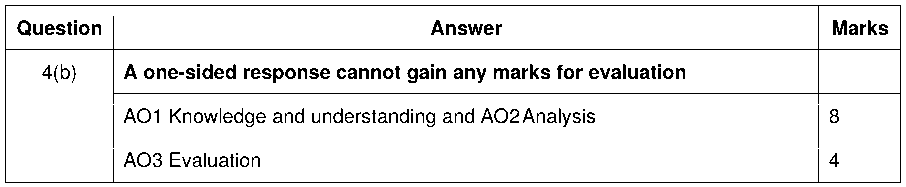
Assess the extent to which the shape of the long-run aggregate supply (LRAS) curve affects the ability of a government to use fiscal policy to achieve price stability. [12]

Show mark scheme
Mark scheme, 9708/24 June 2026 question 4(b) (page 1 of 2)
Mark scheme, 9708/24 June 2026 question 4(b) (page 2 of 2)
Question 4(a)March 20269708/228 marks

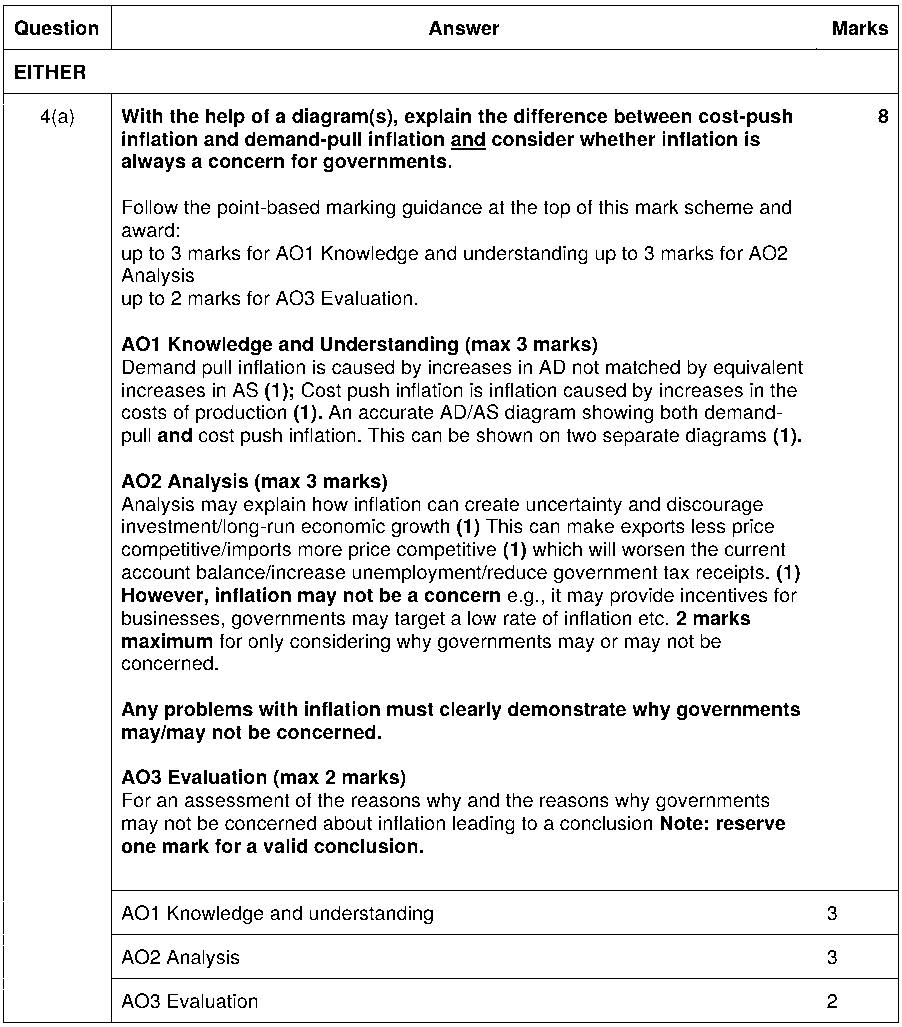
With the help of a diagram(s), explain the difference between cost-push inflation and demand-pull inflation and consider whether inflation is always a concern for governments. [8]
Show mark scheme
Mark scheme, 9708/22 March 2026 question 4(a)
Question 5(a)November 20259708/228 marks

With the help of an aggregate demand and aggregate supply (AD/AS) diagram, explain why two components of AD may increase and consider the extent to which an increase in AD will always lead to inflation. [8]

Show mark scheme
Mark scheme, 9708/22 November 2025 question 5(a)
Case study: Malaysia’s uncertain economic prospects
Case study: Malaysia’s uncertain economic prospects (page 1 of 2)
Case study: Malaysia’s uncertain economic prospects (page 2 of 2)
Question 1(e)November 20259708/236 marks

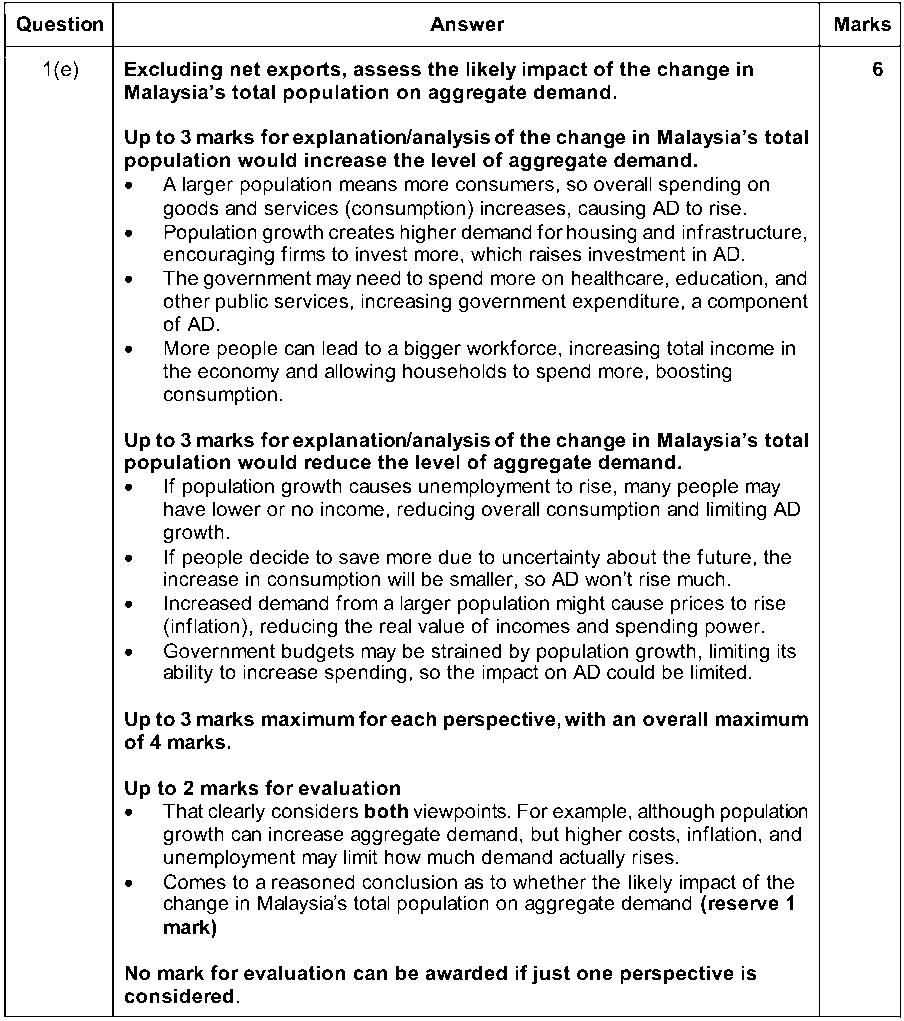
Excluding net exports, assess the likely impact of the change in Malaysia’s total population on aggregate demand. [6]
Show mark scheme
Mark scheme, 9708/23 November 2025 question 1(e)
Case study: Will stronger economic growth in the United States (US) lead to high inflation?
Case study: Will stronger economic growth in the United States (US) lead to high inflation? (page 1 of 2)
Case study: Will stronger economic growth in the United States (US) lead to high inflation? (page 2 of 2)
Question 1(c)November 20259708/244 marks

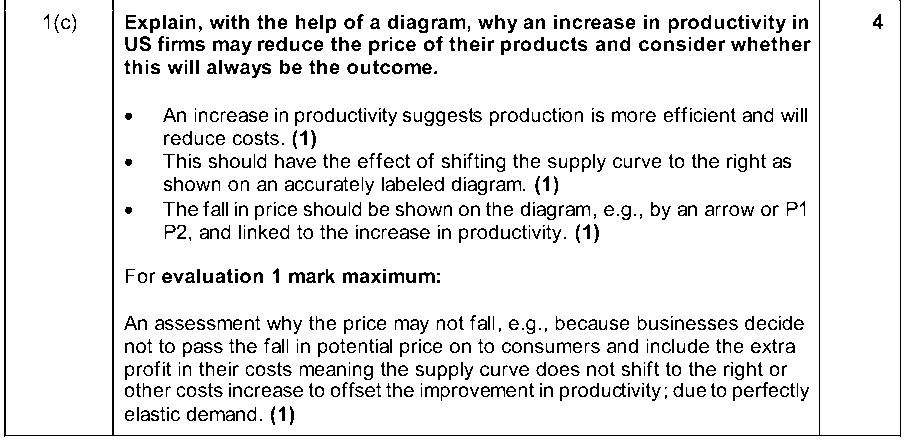
Explain, with the help of a diagram, why an increase in productivity in US firms may reduce the price of their products and consider whether this will always be the outcome. [4]
Show mark scheme
Mark scheme, 9708/24 November 2025 question 1(c)
Question 4(a)June 20259708/228 marks

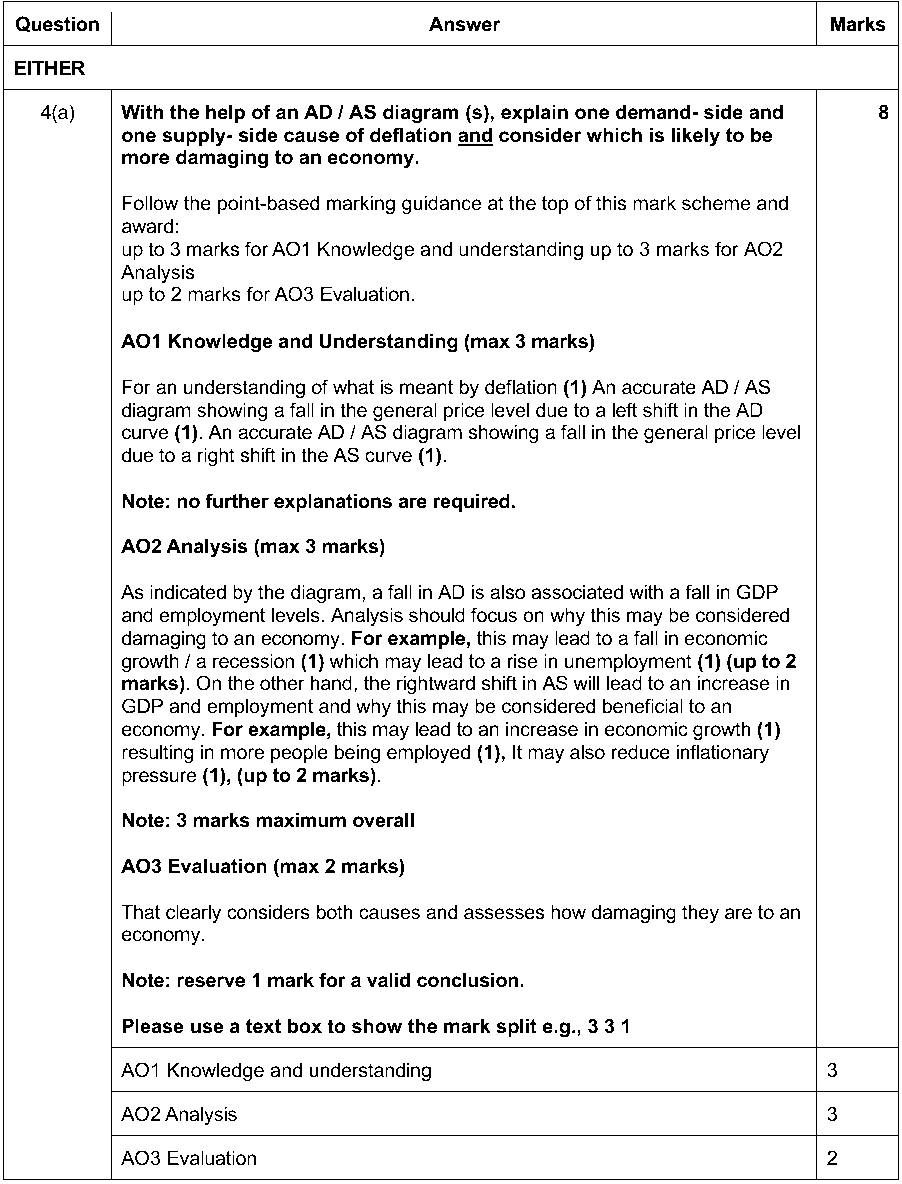
With the help of an AD/AS diagram(s), explain one demand-side and one supply-side cause of deflation and consider which is likely to be more damaging to an economy. [8]
Show mark scheme
Mark scheme, 9708/22 June 2025 question 4(a)
Question 5(a)March 20259708/228 marks

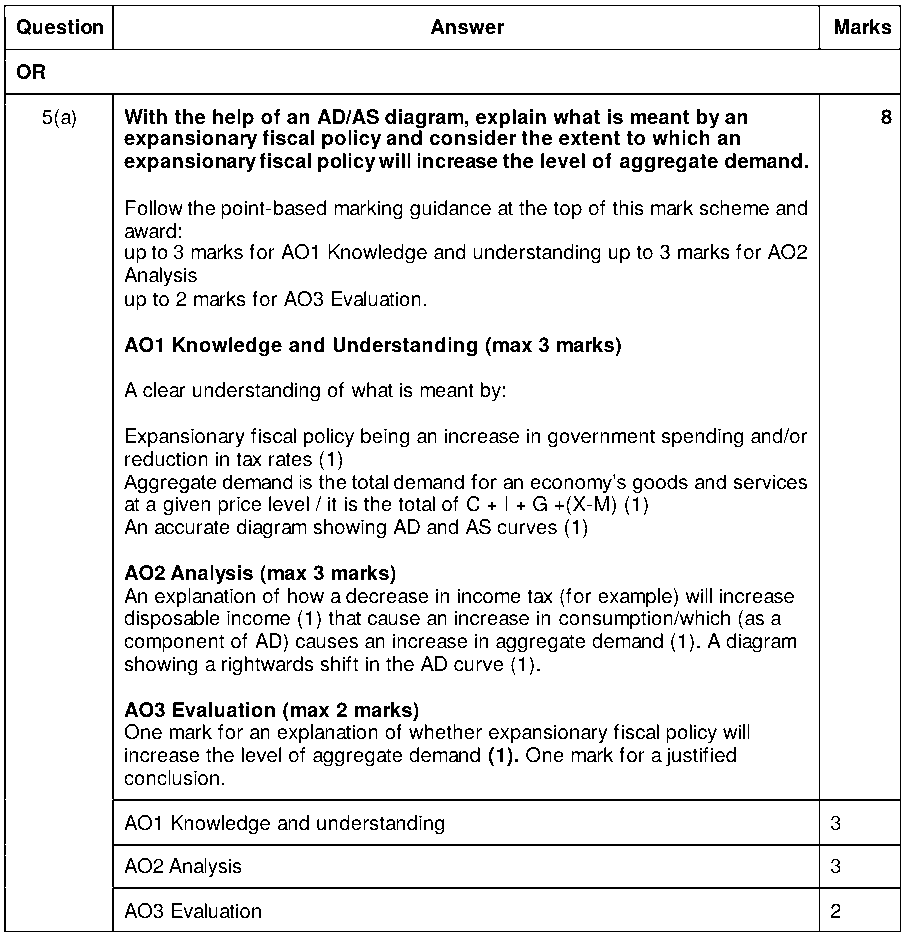
With the help of an AD/AS diagram, explain what is meant by an expansionary fiscal policy and consider the extent to which an expansionary fiscal policy will always increase the level of aggregate demand. [8]
Show mark scheme
Mark scheme, 9708/22 March 2025 question 5(a)

95 more questions from 2020–2024

🔒 Unlock every Aggregate demand and aggregate supply analysis question from 2020–2024

All 95 come with their mark schemes, answers and case studies, and appear in the practice tool above once you’re signed in. It’s free.

Create a free accountSign in

A few of them

  • 9708/11 · November 2024 · Question 19Which combination correctly identifies the necessary information… 🔒
  • 9708/11 · November 2024 · Question 20A government makes two changes to income… 🔒
  • 9708/12 · November 2024 · Question 17What is likely to move an economy’s… 🔒
  • 9708/13 · November 2024 · Question 19A government is considering building a large… 🔒
  • 9708/23 · November 2024 · Question 4(a)In 2021, year-on-year inflation in many economies… 🔒
  • + 90 more, by year in the table above

Questions and mark schemes are from past Cambridge papers and are reproduced for revision. Topical Vault is an independent revision resource, not affiliated with or endorsed by Cambridge Assessment International Education.

AS Level Economics questions by topic

Each topic opens this practice tool with only that topic’s questions, plus how often it comes up and every question on it in one list. Revision notes for AS Level Economics →

  1. Unit 1Basic economic ideas and resource allocation
  2. Ch 1Scarcity, choice and opportunity cost
  3. Ch 2Economic methodology
  4. Ch 3Factors of production
  5. Ch 4Resource allocation in different economic systems
  6. Ch 5Production possibility curves
  7. Ch 6Classification of goods and services
  8. Unit 2The price system and the microeconomy
  9. Ch 7Demand and supply curves
  10. Ch 8Price elasticity, income elasticity and cross elasticity of demand
  11. Ch 9Price elasticity of supply
  12. Ch 10The interaction of demand and supply
  13. Ch 11Consumer and producer surplus
  14. Unit 3Government microeconomic intervention
  15. Ch 12Reasons for government intervention in markets
  16. Ch 13Methods and effects of government intervention in markets
  17. Ch 14Addressing income and wealth inequality
  18. Unit 4The macroeconomy
  19. Ch 15National income statistics
  20. Ch 16Introduction to the circular flow of income
  21. Ch 17Aggregate demand and aggregate supply analysis
  22. Ch 18Economic growth
  23. Ch 19Unemployment
  24. Ch 20Price stability
  25. Unit 5Government macroeconomic intervention
  26. Ch 21Government macroeconomic policy objectives
  27. Ch 22Fiscal policy
  28. Ch 23Monetary policy
  29. Ch 24Supply-side policy
  30. Unit 6International economic issues
  31. Ch 25The reasons for international trade
  32. Ch 26Protectionism
  33. Ch 27Current account of the balance of payments
  34. Ch 28Exchange rates
  35. Ch 29Policies to correct imbalances in the current account of the balance of payments