Question 26June 20269708/111 mark
Which measure would not be part of a government subsidy to protect domestic producers from competition?
Show answer
ACorrect answer
Cambridge 9708, Paper 1 & 2. 2,092 questions, 2020 to 2026.
Paper 1 multiple-choice questions and Paper 2 data-response/essay questions, from the original Cambridge material. Paper 2 mark schemes and case studies are reproduced as images of the official pages rather than retyped, so nothing is lost or paraphrased; a question tagged under more than one topic appears under each. Tick “Add to my paper” on any question to build a custom practice PDF from the tray in the corner.
Unit 6 covers the international economy: why countries trade, protectionism, the current account of the balance of payments, exchange rates, and policies to correct current account imbalances.
Revision notes for this unit
Short, plain-English notes with the diagrams, formulas and exam tips, one topic at a time:
456 past paper questions on this topic since 2020, across 20 exam sessions.
| Year | Paper 1 | Paper 2 | Total | Chart |
|---|---|---|---|---|
| 2026 | 25 | 14 | 39 | |
| 2025 | 48 | 22 | 70 | |
| 2024 | 51 | 20 | 71 | |
| 2023 | 37 | 17 | 54 | |
| 2022 | 56 | 21 | 77 | |
| 2021 | 51 | 19 | 70 | |
| 2020 | 48 | 27 | 75 |
The whole topic on one page, with answers and mark schemes. Printing this page prints just this list.
Which measure would not be part of a government subsidy to protect domestic producers from competition?
ACorrect answer
The table shows different possible outputs of apples and bananas for country X and country Y assuming only two goods are produced and all resources are used to their maximum.
apples bananas
country X 100 or 80
country Y 50 or 25
Country Y decides to specialise in the production of the good in which it has a comparative advantage.
Country X decides to use 75% of its resources to produce the good in which it has a comparative advantage and 25% of its resources to produce the other good.
What will be the total output?
apples bananas
CCorrect answer
Why may a government introduce a floating exchange rate?
ACorrect answer

CCorrect answer
The US dollar ($) has appreciated by 12% against an average of other major trading currencies.
What is likely to have caused this?
BCorrect answer
What is the least likely outcome for participating countries of a move towards free trade?
BCorrect answer
Which government measure would reduce protectionism?
CCorrect answer
Which policy will lead to a fall in the volume of goods imported?
CCorrect answer

ACorrect answer
A government increases the import tariff on food products.
What will be the impact on consumer surplus and price?
consumer price surplus
BCorrect answer
What is not an example of protectionism?
CCorrect answer
A family from the United States buys a holiday in Spain.
What is the effect of this on the current account of the balance of payments in Spain?
BCorrect answer
ACorrect answer
What is not an argument for protectionist policies?
CCorrect answer
What is the consequence of an appreciation of the exchange rate on the current account of the balance of payments and the price level?
current account of the balance price level of payments
CCorrect answer
Which action increases and which action decreases the level of protectionism?
increases protectionism decreases protectionism
ACorrect answer
Which policy is not likely to help reduce a current account deficit on the balance of payments?
BCorrect answer
The principle of comparative advantage states that a country can make gains in international trade.
What are these gains determined by?
BCorrect answer
There is a floating exchange rate between country M and country N.
Which changes will definitely cause an appreciation of country M’s currency?
value of exports value of imports from M to N from N to M
CCorrect answer
The slowdown of global economic activity has not only decreased the demand for various goods and services, but also decreased oil prices.
What is the most likely effect on a country that relies heavily on imports of oil and foreign remittances from workers?
current account inflation of the balance of payments
BCorrect answer
What would cause an immediate increase in the deficit in a country’s current account balance on the balance of payments?
BCorrect answer
What must be true for a country whose Terms of Trade (TOT) deteriorate?
CCorrect answer
Countries X and Y both produce and trade in good Z.
What may cause a reduction in quantity supplied by domestic producers of good Z in country X?
BCorrect answer
To what is a depreciation of a currency’s exchange rate most likely to lead?
DCorrect answer

BCorrect answer
A country’s currency depreciates in terms of other currencies.
What would be a consequence of this depreciation?
CCorrect answer
The terms of trade of a developing country fell from 90 in 2010 to 80 in 2015.
Assuming the index of its import prices remained constant at 110 between these two years, what happened to its index of export prices?
BCorrect answer
What is not a limitation of the theory of comparative advantage?
CCorrect answer
What would not be included in the current account of the balance of payments?
BCorrect answer
A country has a current account deficit on its balance of payments. The government also has a budget deficit.
Which measure to reduce the current account deficit will increase the budget deficit?
DCorrect answer
A country with a floating exchange rate has a large deficit on the current account of the balance of payments.
What is most likely to decrease as a consequence of this deficit?
CCorrect answer
What will definitely lead to an improvement in the terms of trade?
DCorrect answer

ACorrect answer
What is the effect of a cut in a country‘s income tax rates on its exports and imports?
exports imports
DCorrect answer

CCorrect answer
What is an example of primary income in the current account of the balance of payments of Pakistan?
CCorrect answer
What is meant by comparative advantage?
ACorrect answer
An economy specialises in the production of one product. It exports this product to obtain another product.
Which type of diagram can show the combinations of these products?
DCorrect answer
The main export of country X is oil. The world demand for oil is price inelastic. The world supply of oil is reduced by the major oil producing countries, including country X. Imports into country X are unchanged.
What are the effects of this action by the major oil producing countries on the terms of trade and the current account of the balance of payments in country X?
terms of trade current account
ACorrect answer

CCorrect answer
The table shows the terms of trade for an economy expressed as an index number for the period 2019 to 2021.
terms of year trade index (2018 = 100)
2019 101
2020 104
2021 109
What can be concluded from the table?
BCorrect answer
Which explanation for a country choosing to engage in international trade is not valid?
DCorrect answer
In which economic context is the term ‘protectionism’ usually applied?
CCorrect answer

ACorrect answer
In 2020, there was a worldwide pandemic. High-income countries quickly developed a vaccine. Low-income countries built high-tech factories to manufacture large quantities of the vaccine for export.
What explains this international division of labour?
high-income countries low-income countries
ACorrect answer
Why does the value of a country’s terms of trade have no monetary units?
CCorrect answer
Which statement correctly describes a tariff?
DCorrect answer
A country has a persistent deficit on the current account of its balance of payments.
What is most likely to improve the situation in the long run?
DCorrect answer
Primary income and secondary income are components of the current account of the balance of payments.
Which option correctly identifies an example of primary income and secondary income?
primary income secondary income
CCorrect answer
The table shows the change in the value of UK sterling over a three-month period.
June Sept
£1 = $1.38 £1 = $1.32
What is likely to be the short-term impact of the change in the value of UK sterling on the UK economy?
BCorrect answer
Which statement is not a valid reason why a country may impose protectionist measures?
CCorrect answer
What is most likely to lead to a persistent surplus in a country’s current account of its balance of payments?
BCorrect answer
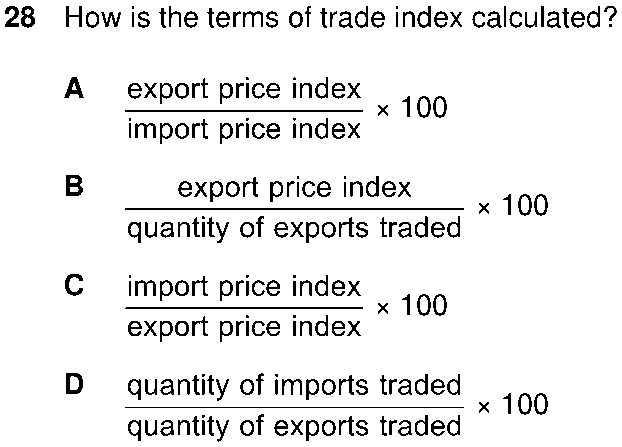
Which formula is used to calculate the terms of trade?
ACorrect answer
A country is experiencing a deficit on the current account of its balance of payments.
Which policy decision could reduce the deficit?
DCorrect answer
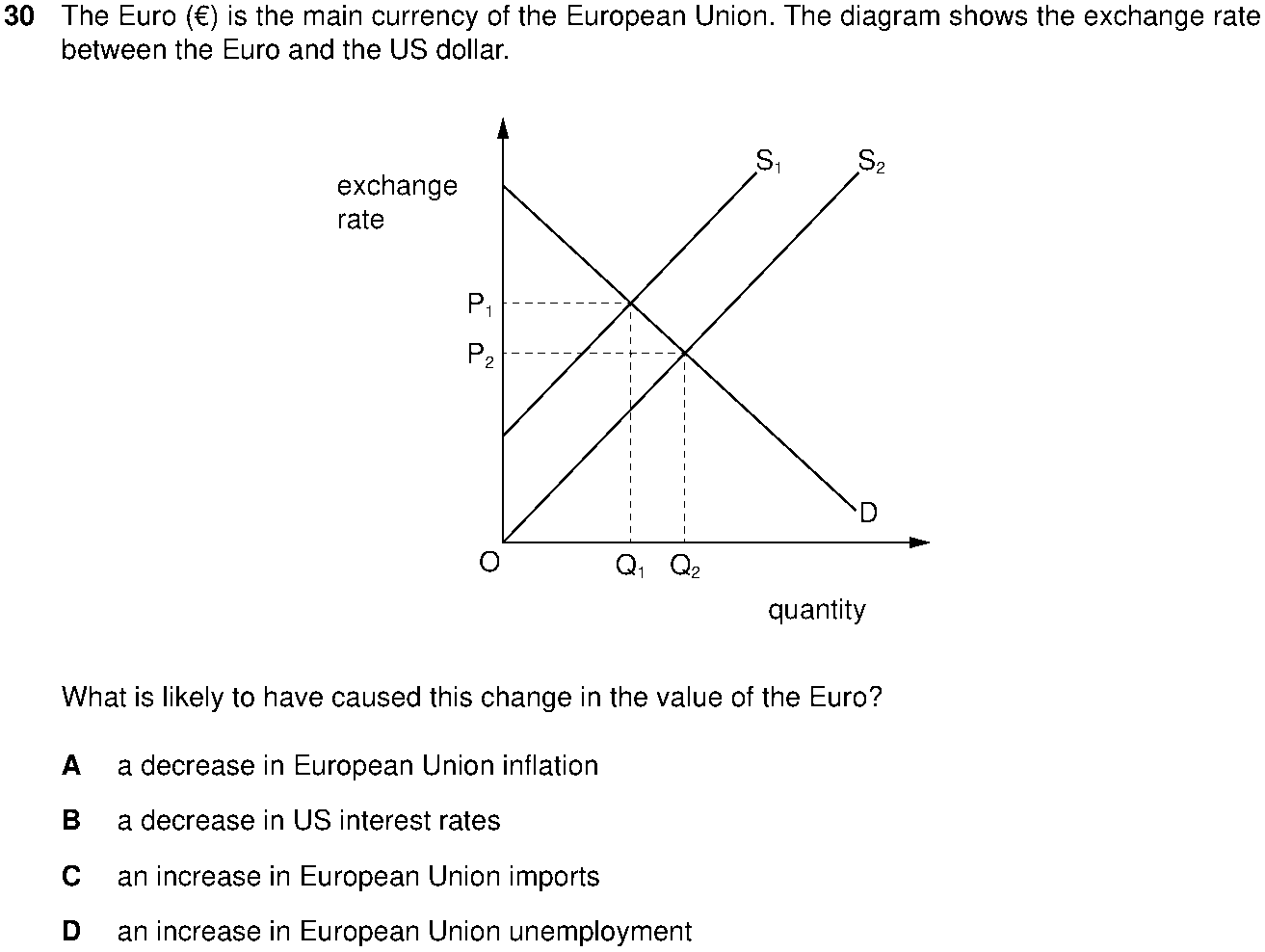
CCorrect answer
Which argument in favour of protectionism is not generally regarded as economically valid?
DCorrect answer
A country has a deficit on the current account of the balance of payments.
What would be expected to increase the deficit?
ACorrect answer
A government increases the import quota of cars.
What is the likely effect of this?
BCorrect answer
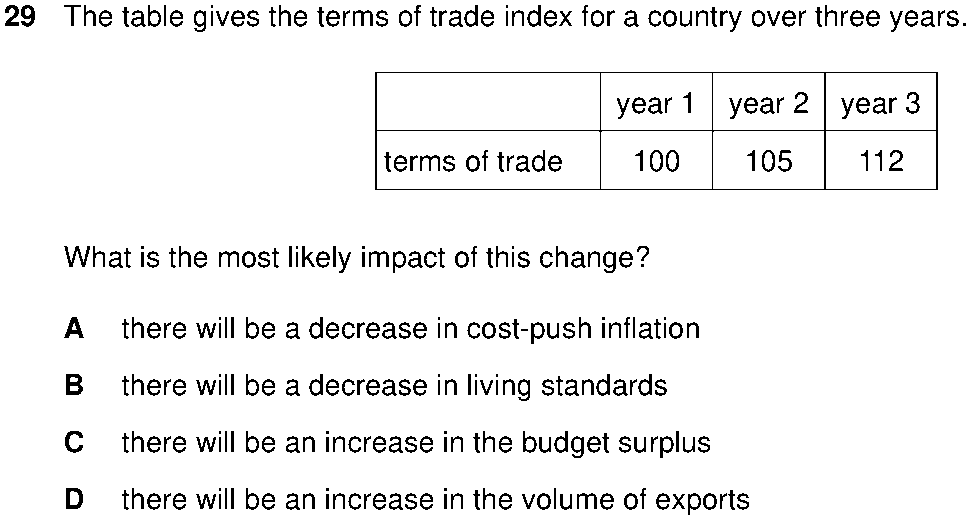
ACorrect answer
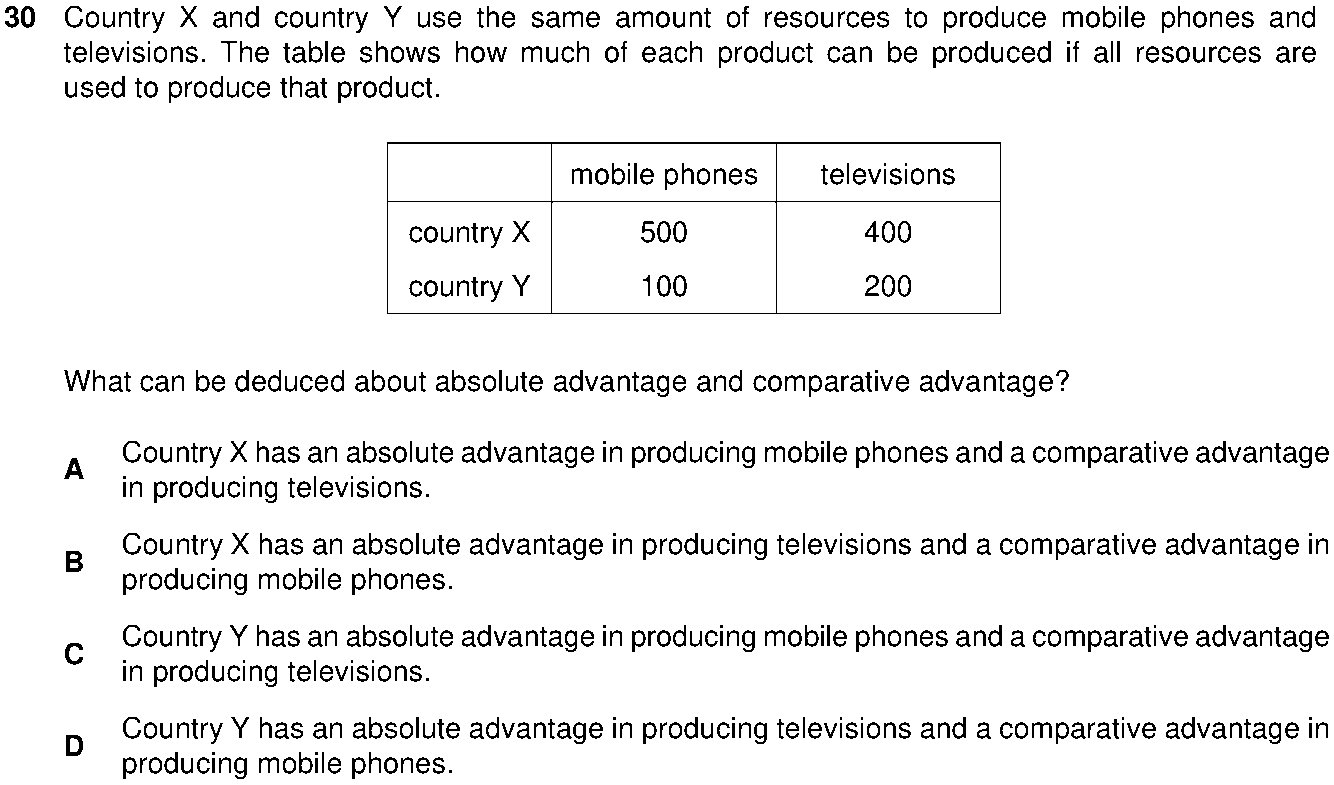
BCorrect answer
The table shows the ability of two countries, P and Q, to produce two goods, Y and Z.
production of good Y production of good Z per person per person
country P 1000 1600
country Q 1500 2000
Which statement is correct?
DCorrect answer
A trading country can produce two goods, X and Y. It specialises completely in the production of good Y.
What will be the opportunity cost to the country of consuming additional imports of good X?
CCorrect answer
, , 26 What are the terms of trade?
DCorrect answer
An Australian family purchases a holiday to New Zealand and an Australian mining company sells coal to China.
Four students, A, B, C and D, are asked where these transactions appear in the current account of Australia’s balance of payments.
Which student is correct?
holiday to coal to China New Zealand
CCorrect answer
A government believes its current account deficit will be beneficial in the long run.
What is the most likely reason for this?
BCorrect answer

BCorrect answer
, , 30 A country has a current account deficit.
What would be classified as a protectionist measure to restore the current account to equilibrium?
CCorrect answer
High economic growth is often accompanied by a worsening of the current account of the balance of payments.
Which reason for this trend is not valid?
BCorrect answer
Country X trades with country Y.
What are the terms of trade for country X?
BCorrect answer
When is a country’s exchange rate most likely to fall?
BCorrect answer
A country experiences a rising trade deficit and a current account surplus at the same time.
Which combination of events might explain this?
Event 1 Event 2
DCorrect answer

BCorrect answer

BCorrect answer

With the help of a diagram, explain how a decrease in the interest rate in Japan could lead to the depreciation in the value of the yen and consider whether only Japan’s interest rate determines the value of the yen. [4]

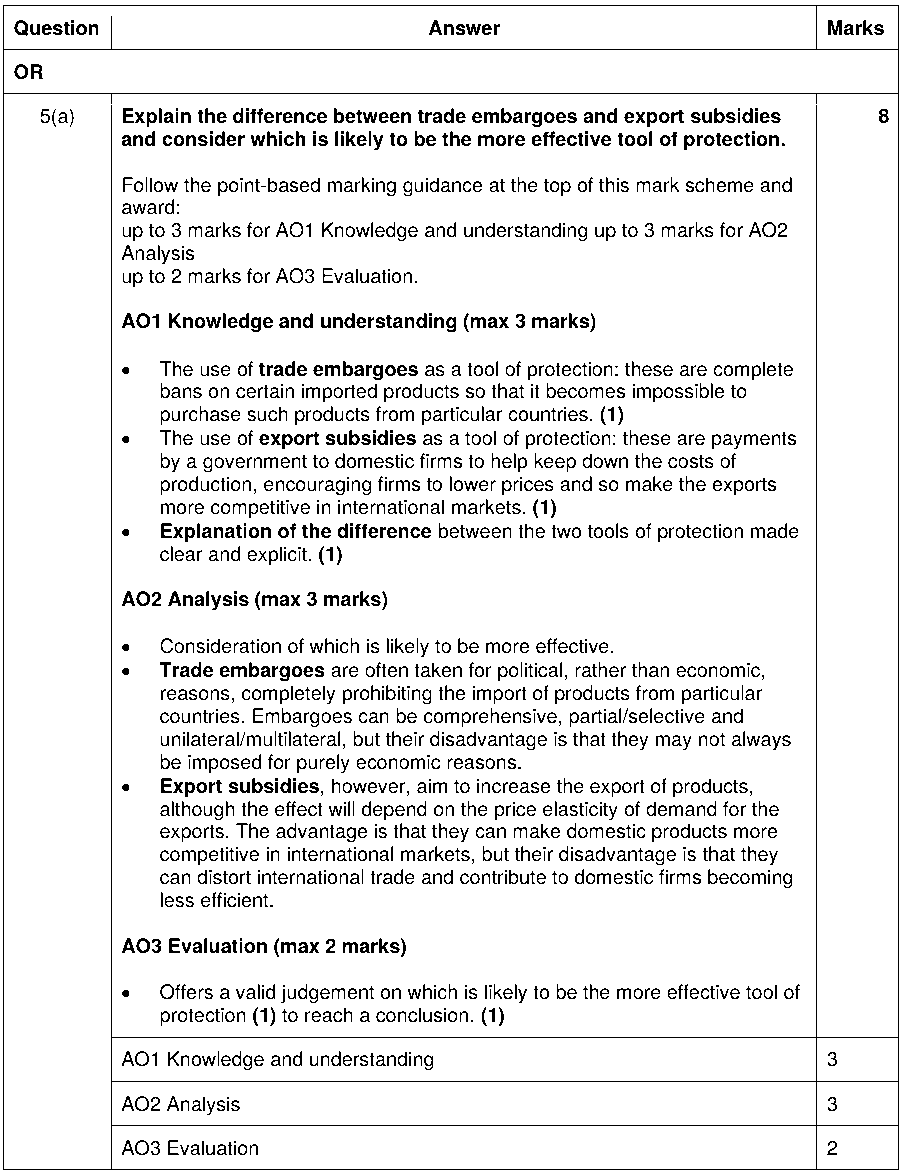
Explain the difference between trade embargoes and export subsidies and consider which is likely to be the more effective tool of protection. [8]
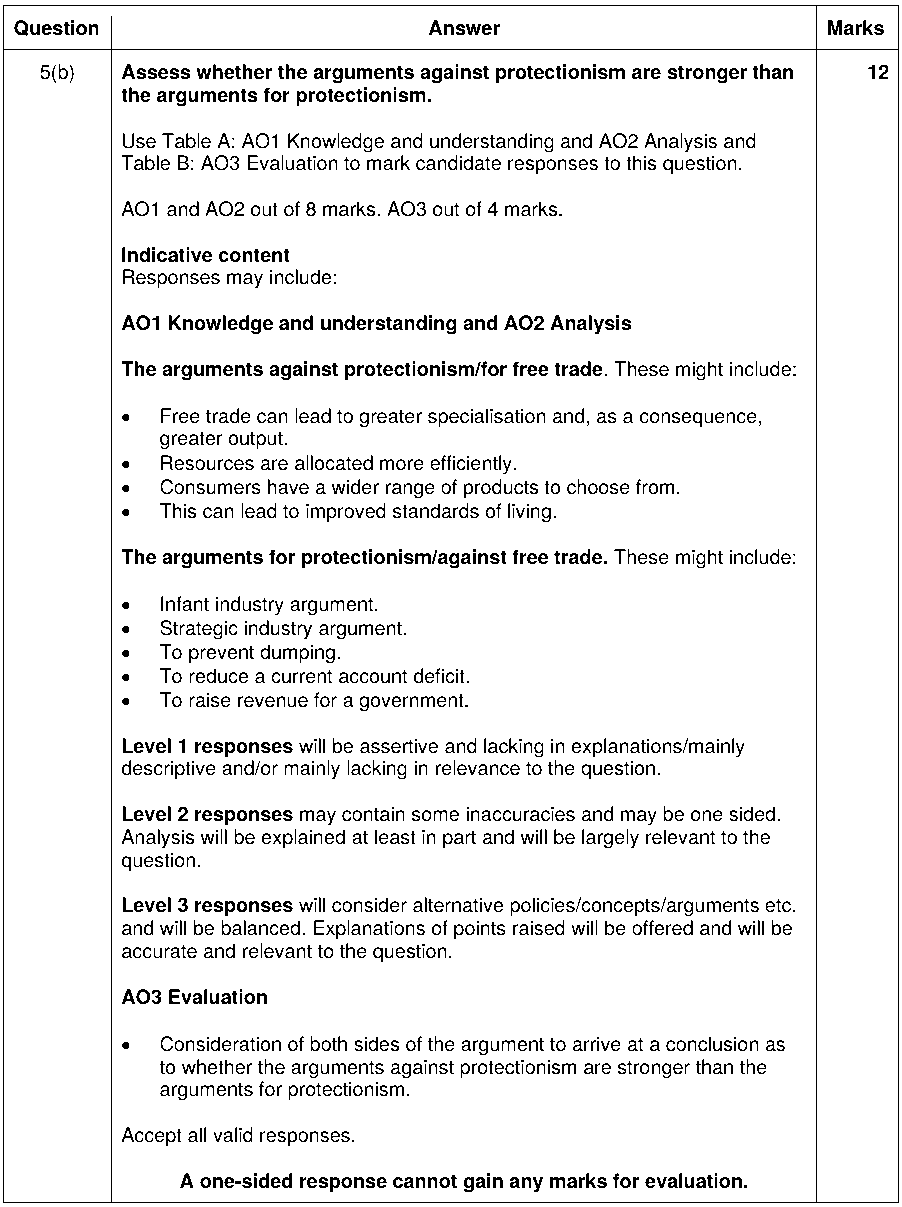
Assess whether the arguments against protectionism are stronger than the arguments for protectionism. [12]



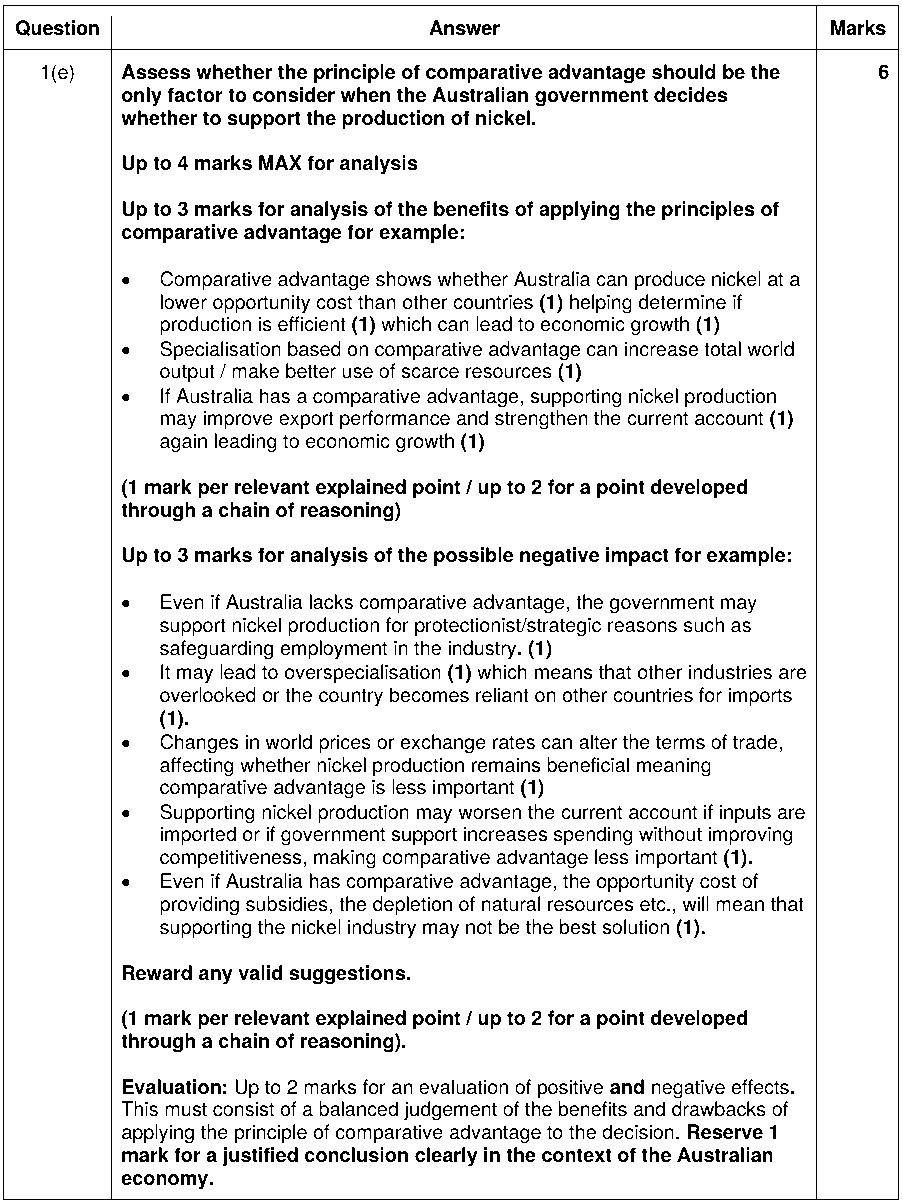
Assess whether the principle of comparative advantage should be the only factor to consider when the Australian government decides whether to support the production of nickel. [6]

With the help of a diagram, explain the effects of an export subsidy on the price and sales of imported Chinese EVs in the EU and consider an economic factor that could affect the size of any change. [4]

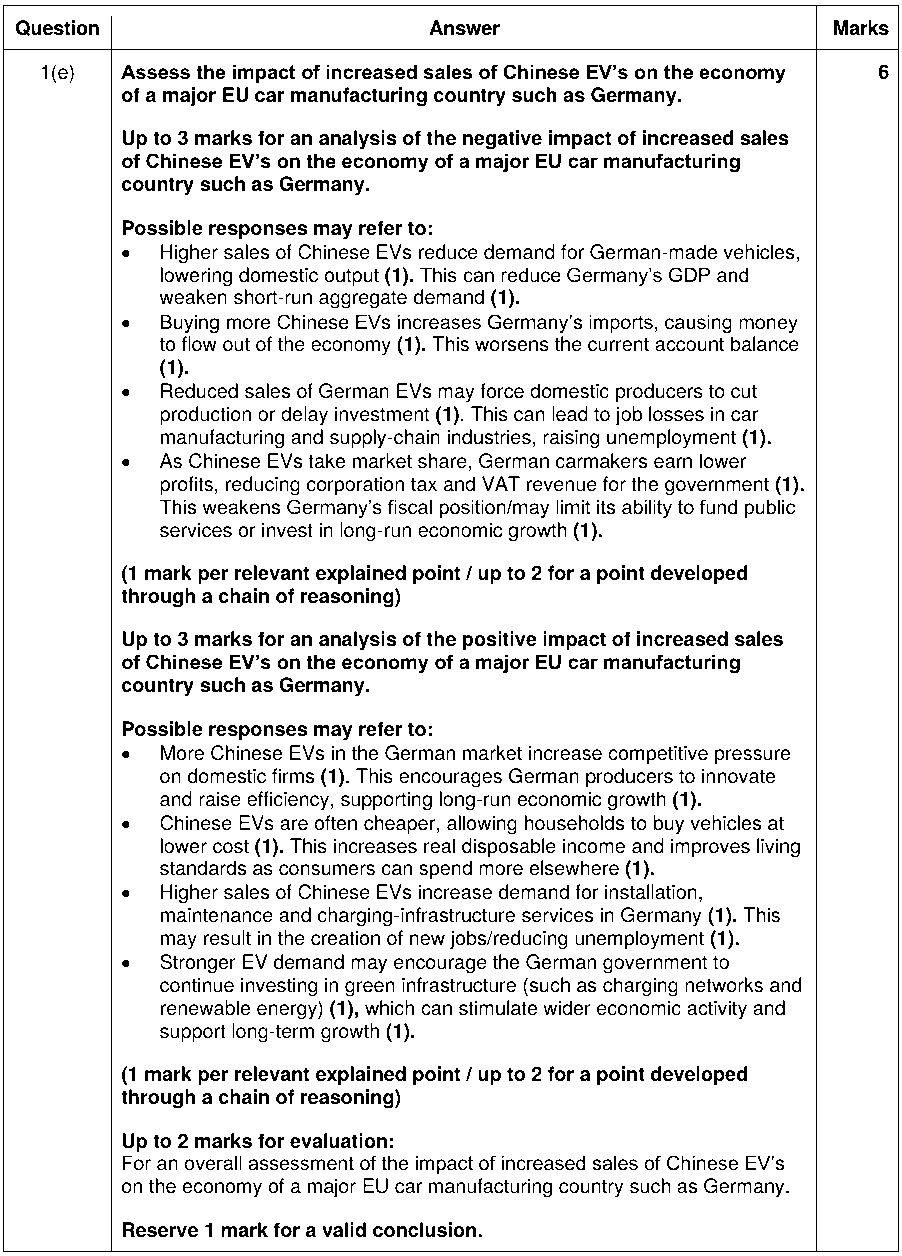
Assess the impact of increased sales of Chinese EVs on the economy of a major EU car manufacturing country such as Germany. [6]
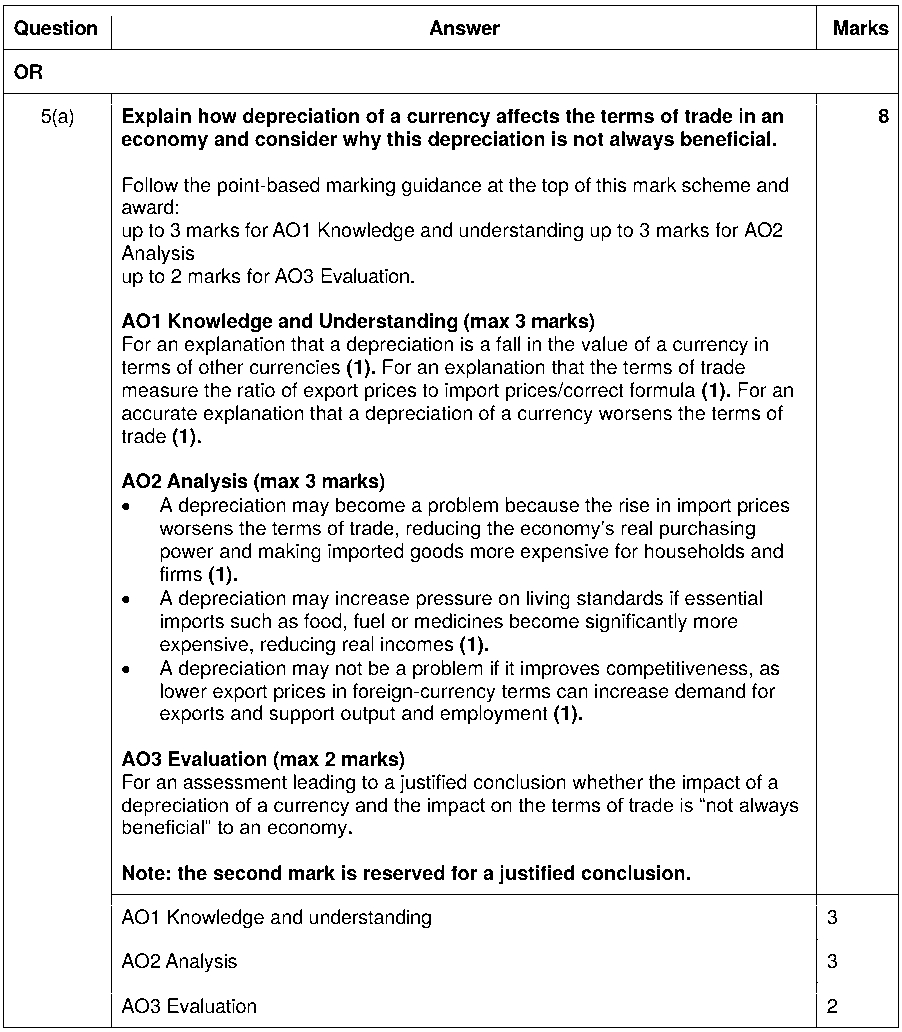
Explain how depreciation of a currency affects the terms of trade in an economy and consider why this depreciation is not always beneficial. [8]
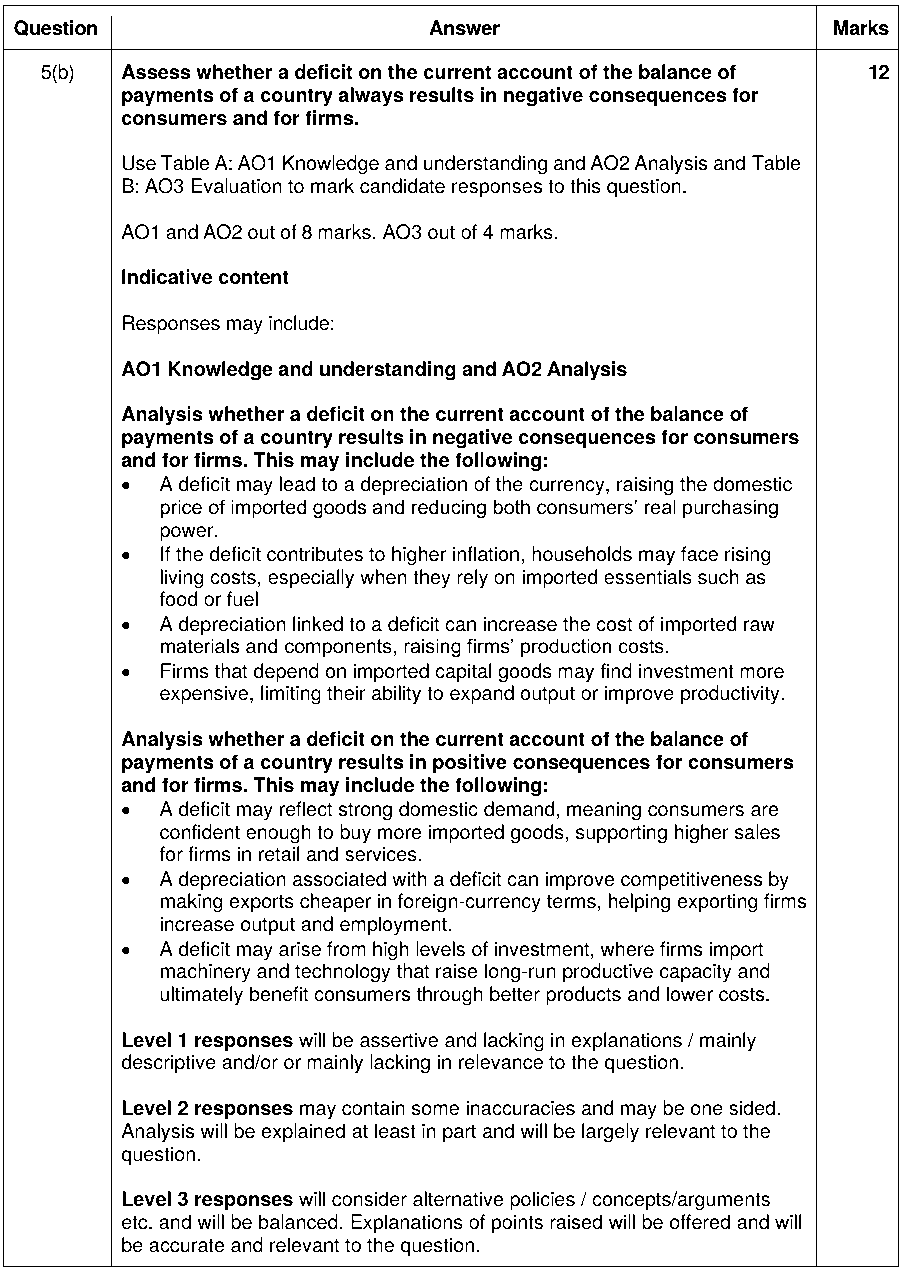
Assess whether a deficit on the current account of the balance of payments of a country always results in negative consequences for consumers and for firms. [12]

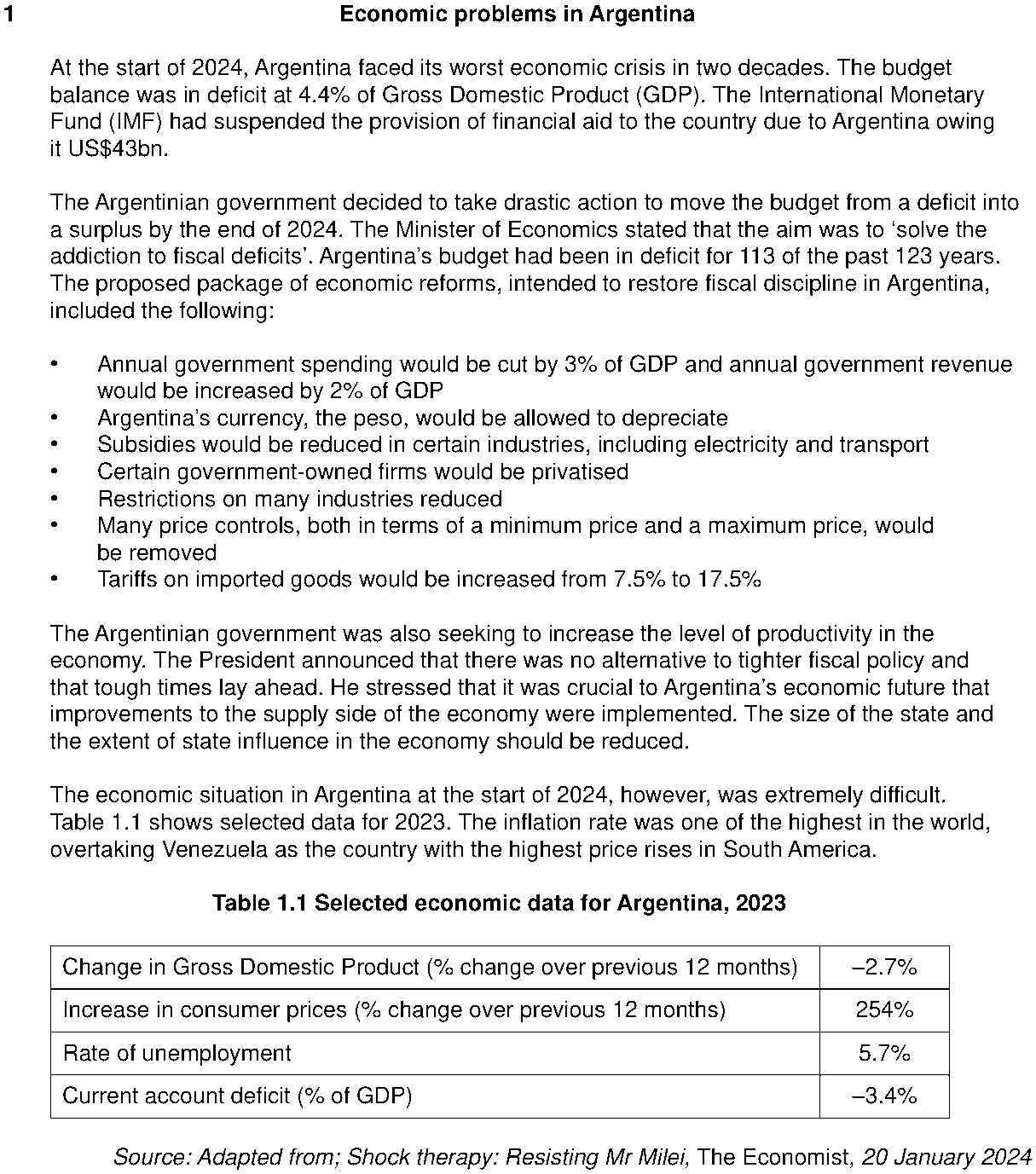
‘Argentina’s currency, the peso, would be allowed to depreciate’.
Describe the meaning of depreciation of a currency and state one consequence for Argentina’s exporters of a depreciation of the peso. [2]

Explain one likely effect of the increase in tariffs on the value of imports into Argentina. [2]

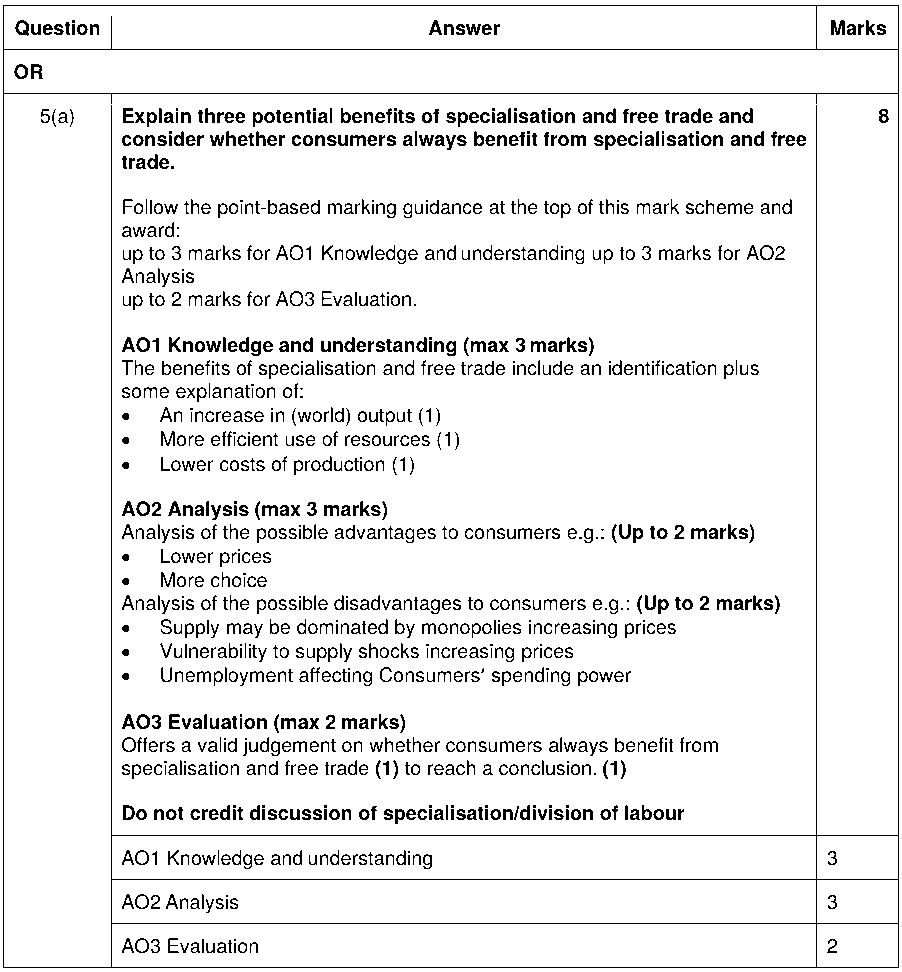
Explain three potential benefits of specialisation and free trade and consider whether consumers always benefit from specialisation and free trade. [8]
Assess whether a surplus in the current account of the balance of payments of an economy is always an advantage for this economy. [12]
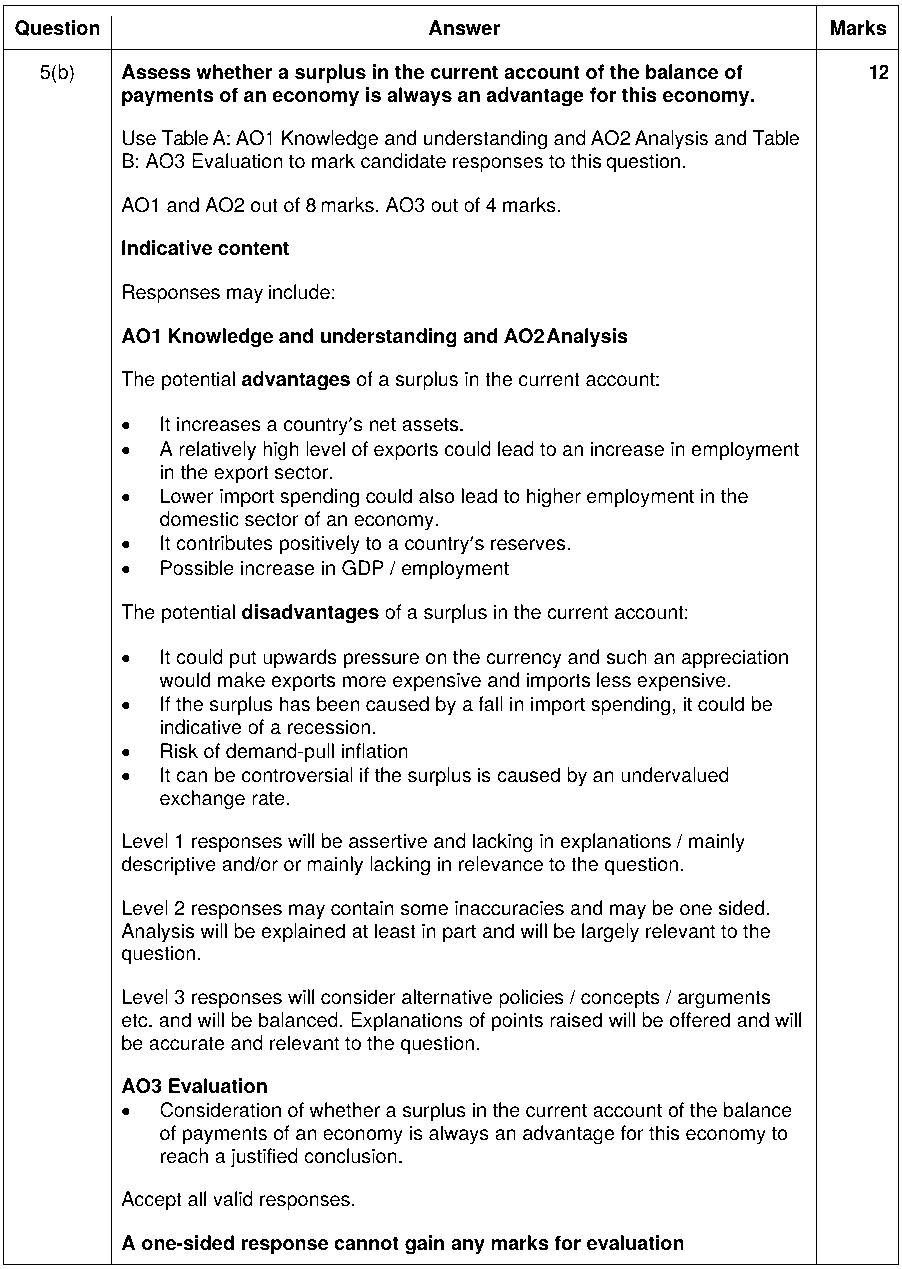

With the help of a diagram(s), explain two causes of an appreciation of an exchange rate and consider whether an appreciation of a country’s exchange rate is likely to reduce its real output. [8]
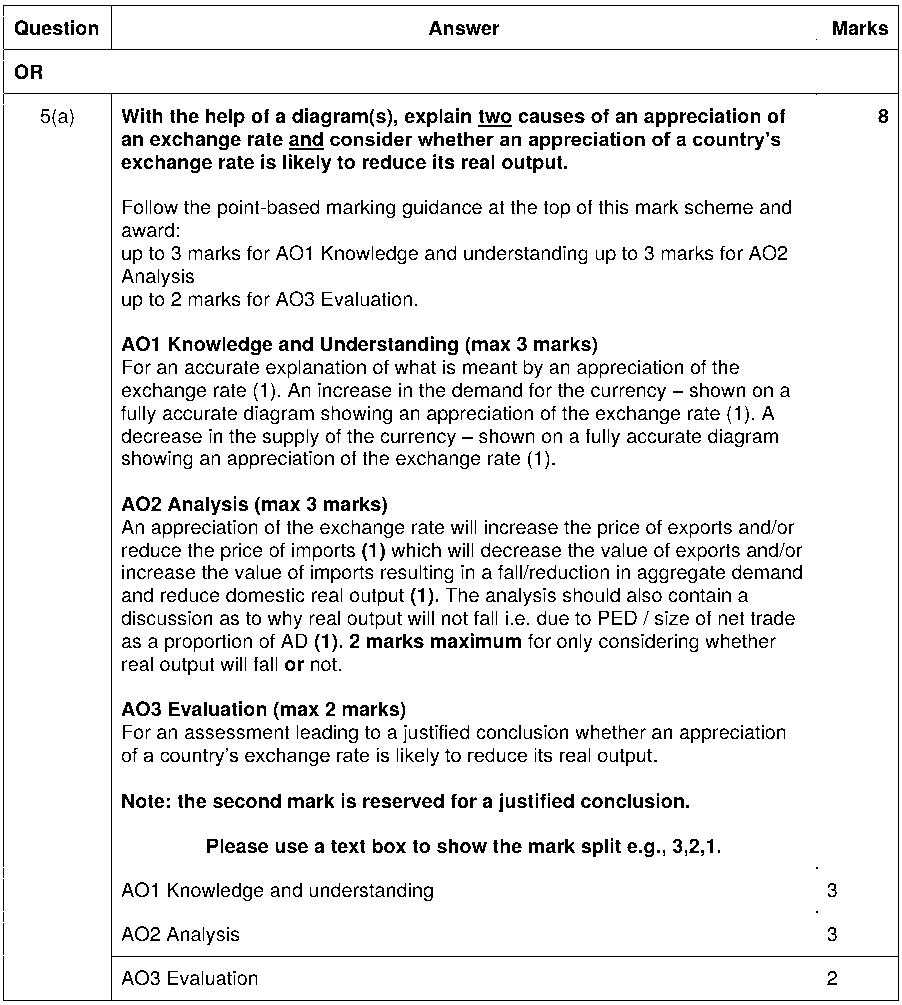
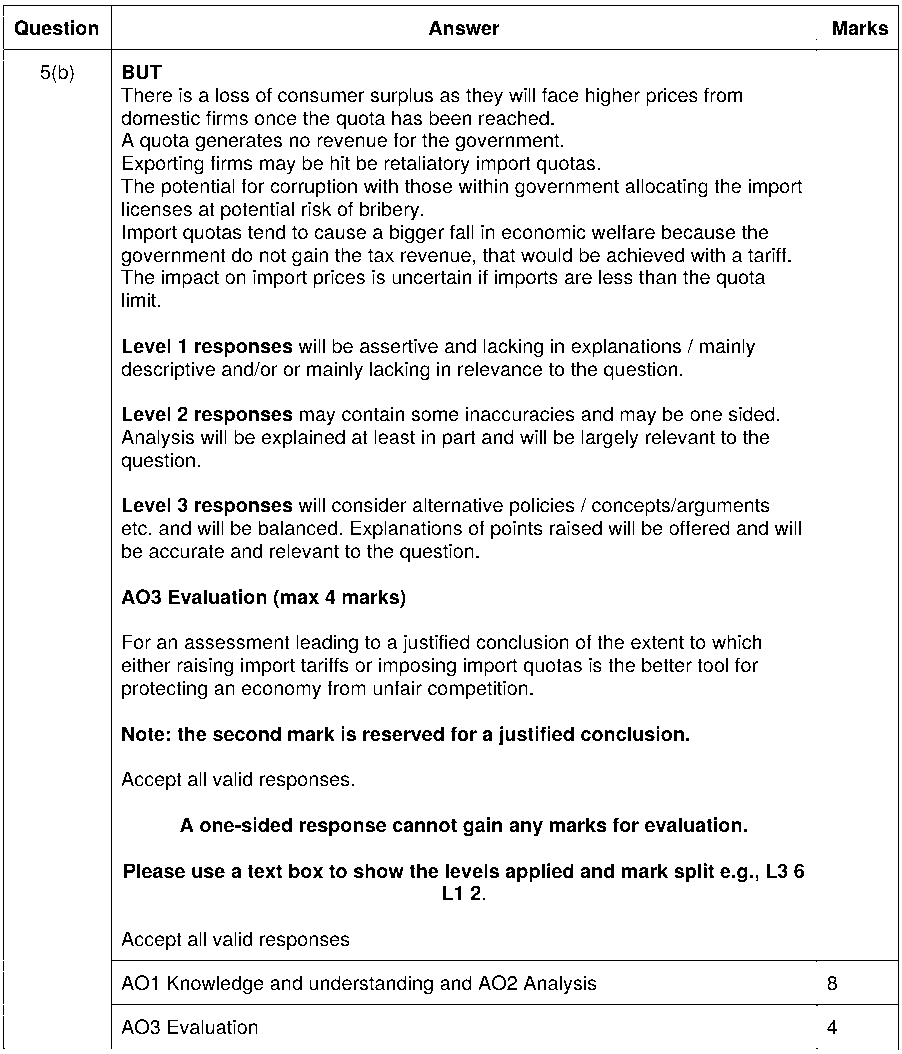
Assess the extent to which either raising import tariffs or imposing import quotas is a better tool for protecting an economy from unfair competition. [12]



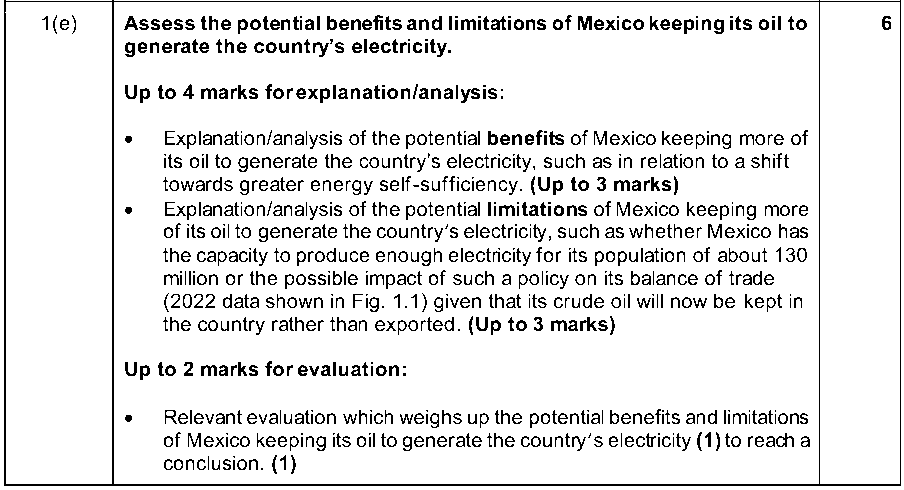
Assess the potential benefits and limitations of Mexico keeping its oil to generate the country’s electricity. [6]
Explain two tools of protection used by a country when trading internationally and consider whether one is likely to have more of an impact on the country’s economy than the other. [8]

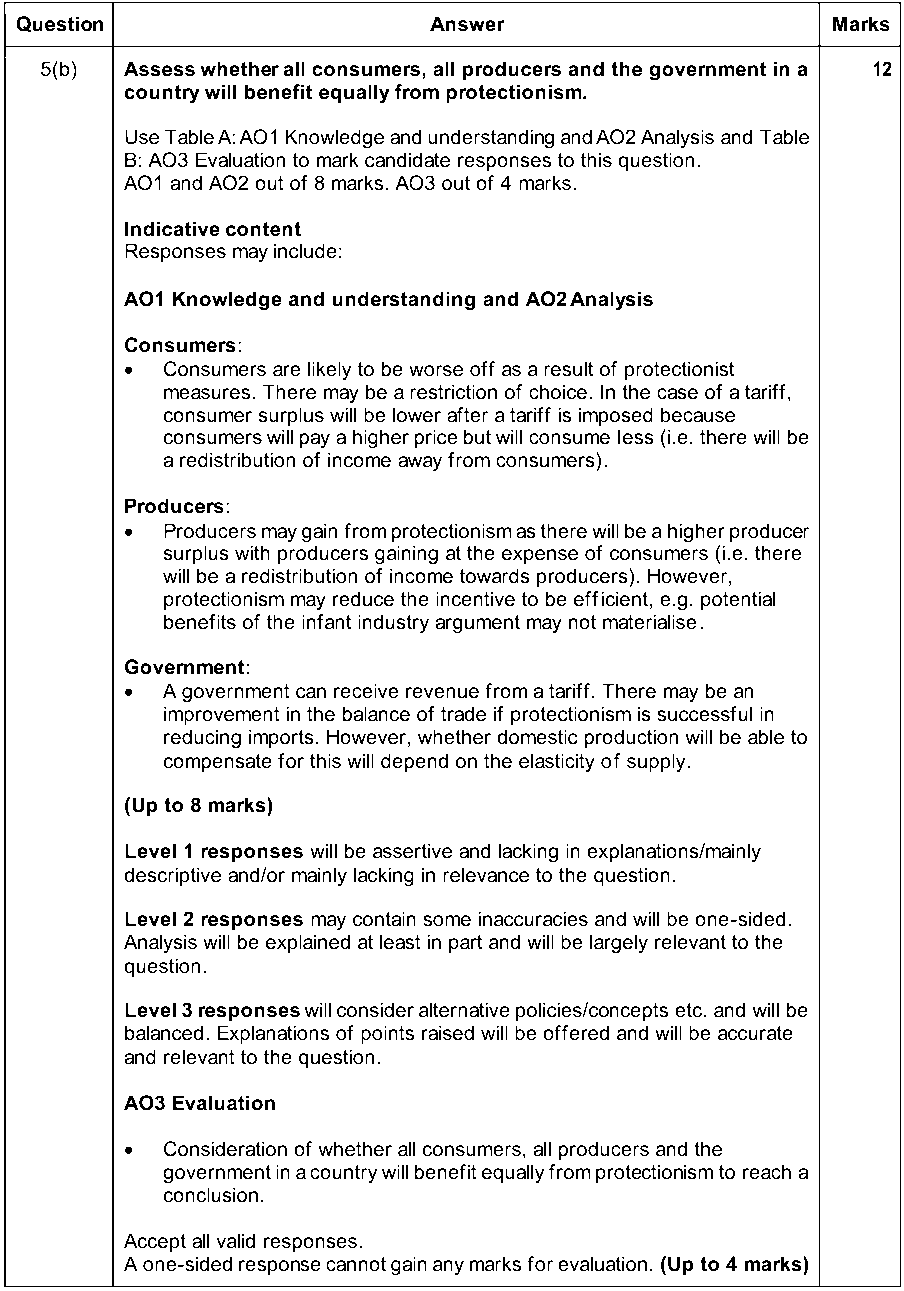
Assess whether all consumers, all producers and the government in a country will benefit equally from protectionism. [12]


Assess the advantages and disadvantages of Ivory Coast continuing to specialise in the production and export of cocoa beans. [6]

Explain three components of the current account of the balance of payments and consider the extent to which a depreciation in the exchange rate will always lead to a surplus on the current account. [8]

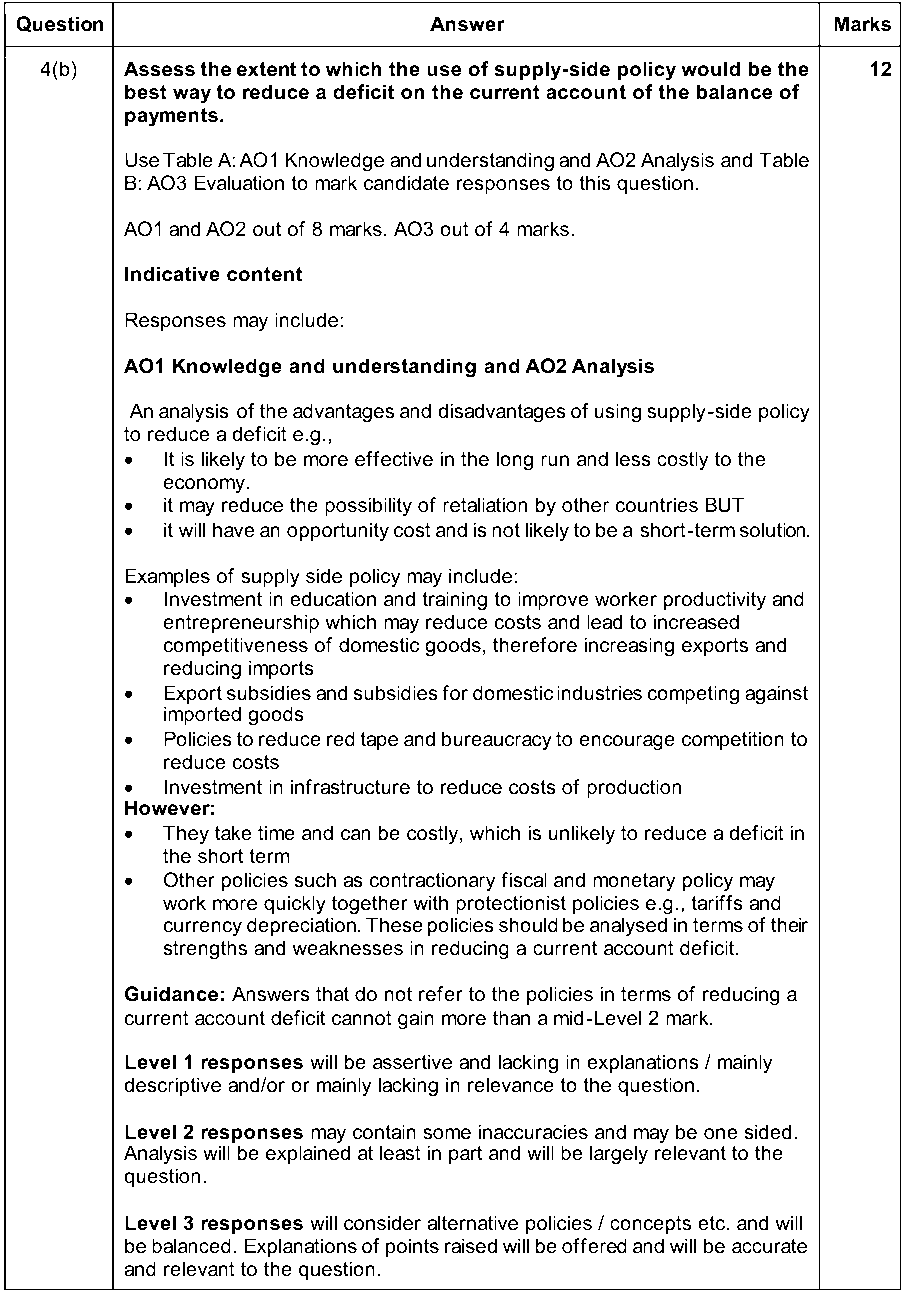
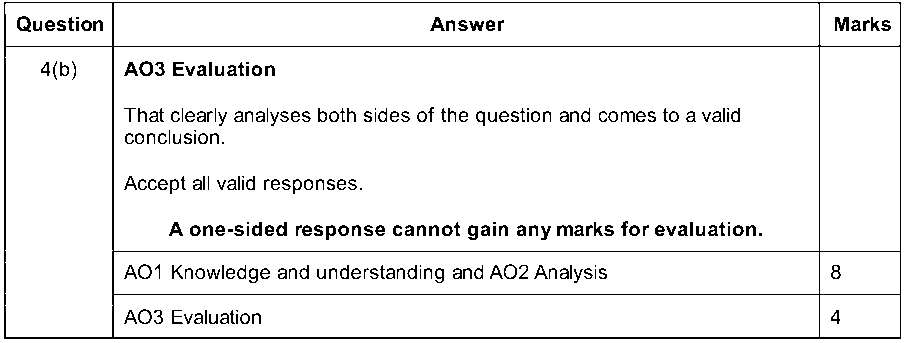
Assess the extent to which the use of supply-side policy would be the best way to reduce a deficit on the current account of the balance of payments. [12]
Explain two reasons why an economy may have a deficit on the current account of its balance of payments and consider whether its government is likely to be concerned about this deficit. [8]

Assess whether it is better to use protectionist policies or contractionary policies to reduce a deficit on the current account of the balance of payments. [12]


Using two tools of protection, explain what is meant by protectionism and consider the extent to which these two tools may benefit an economy. [8]

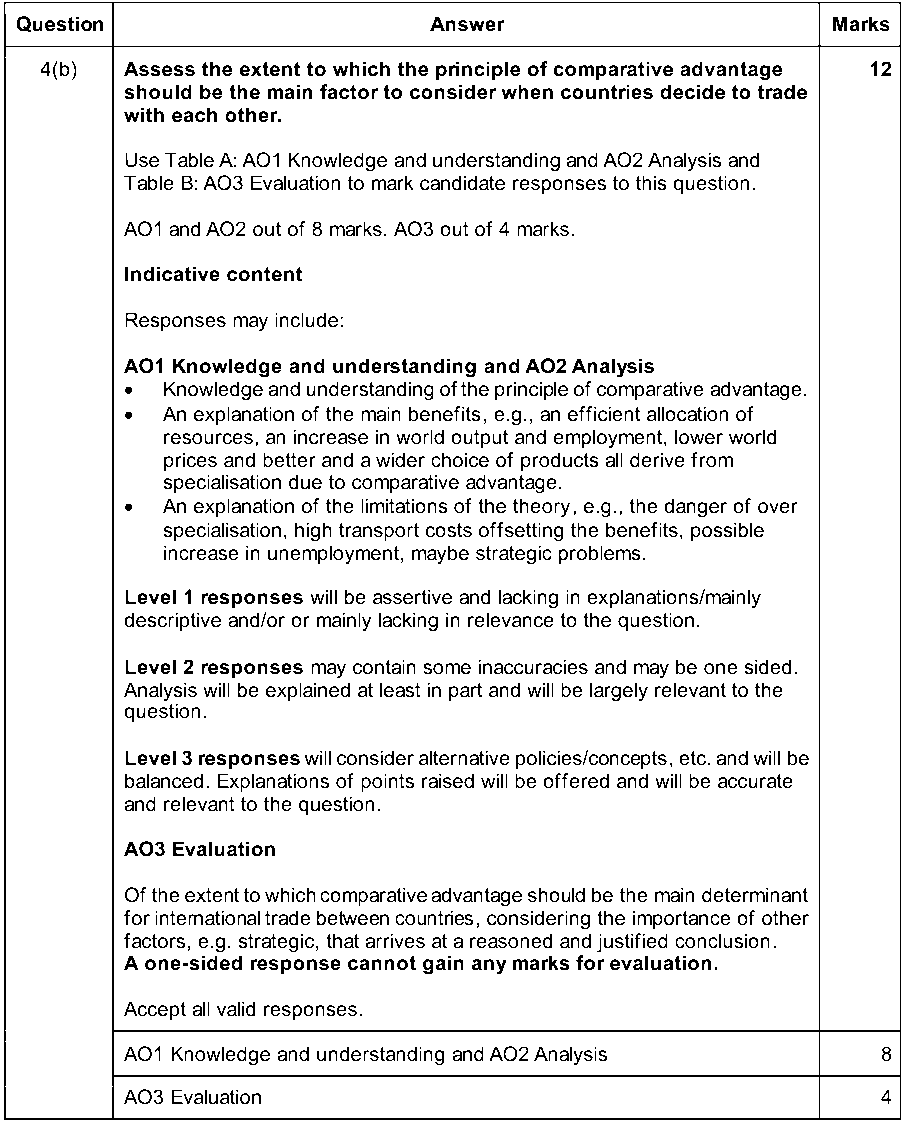
Assess the extent to which the principle of comparative advantage should be the main factor to consider when countries decide whether to trade with each other. [12]
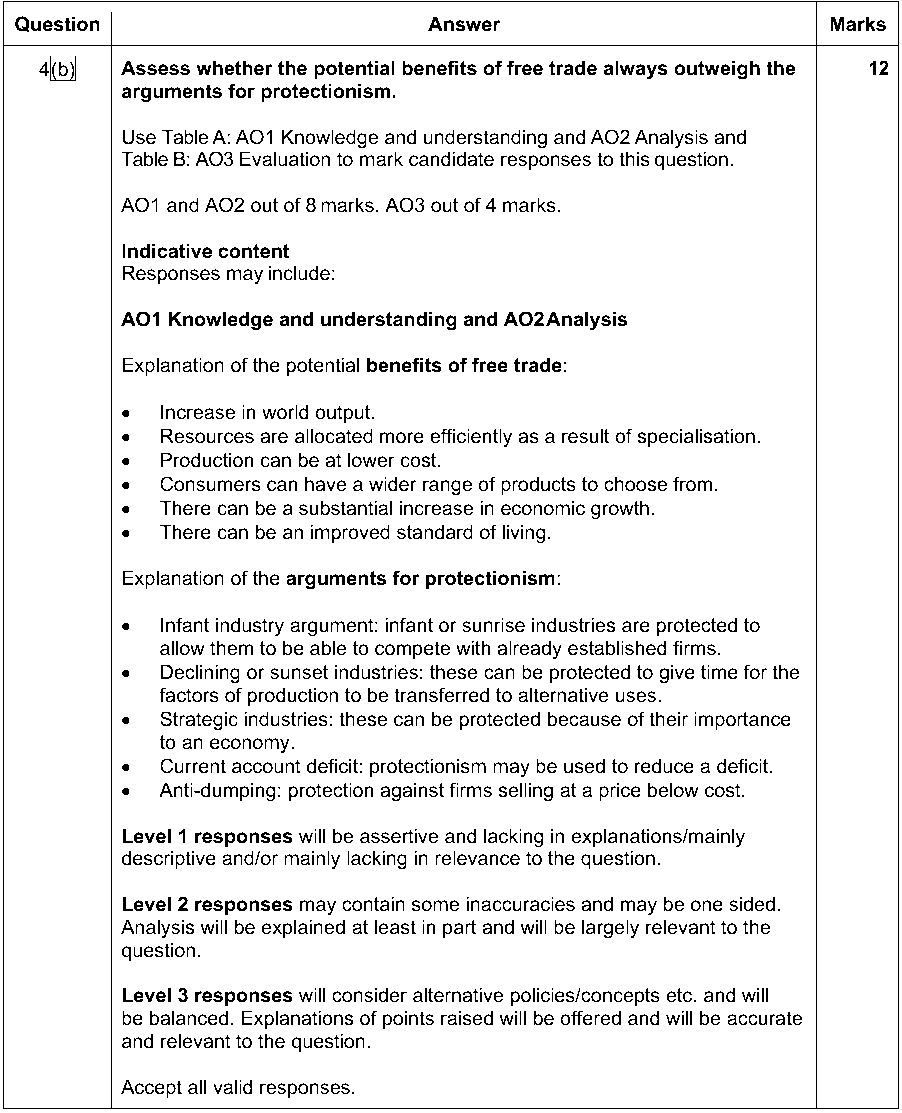
Assess whether the potential benefits of free trade always outweigh the arguments for protectionism. [12]


Consider whether continued falls in the value of the South African rand may lead to a reduction in the current account deficit of the balance of payments. [4]

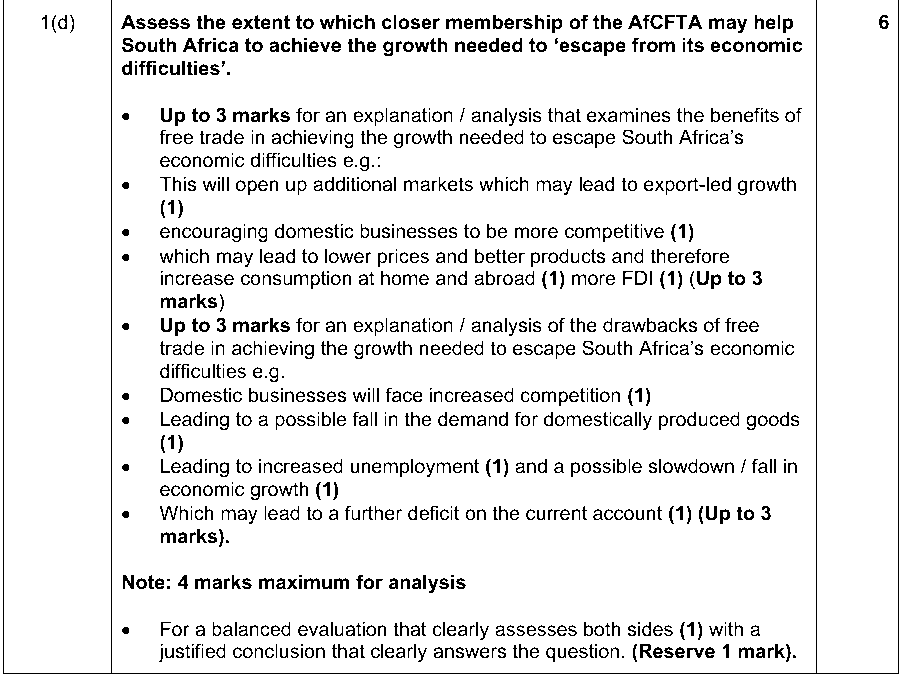
Assess the extent to which closer membership of the AfCFTA may help South Africa to achieve the growth needed to ‘escape from its economic difficulties’. [6]
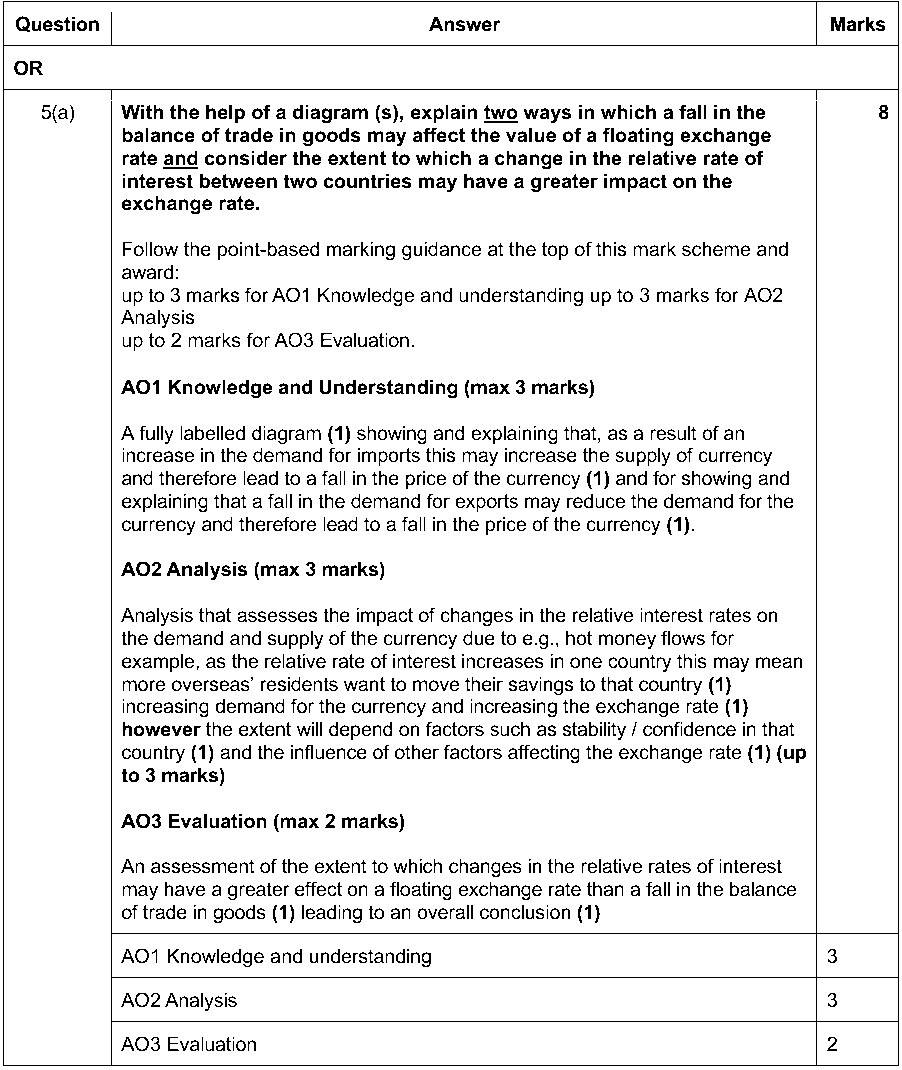
With the help of a diagram, explain two ways in which a fall in the balance of trade in goods may affect the value of a floating exchange rate and consider the extent to which a change in the relative rate of interest between two countries may have a greater impact on the exchange rate. [8]
Assess whether an improvement in the terms of trade or a surplus on the current account of the balance of payments is of more benefit to an economy. [12]

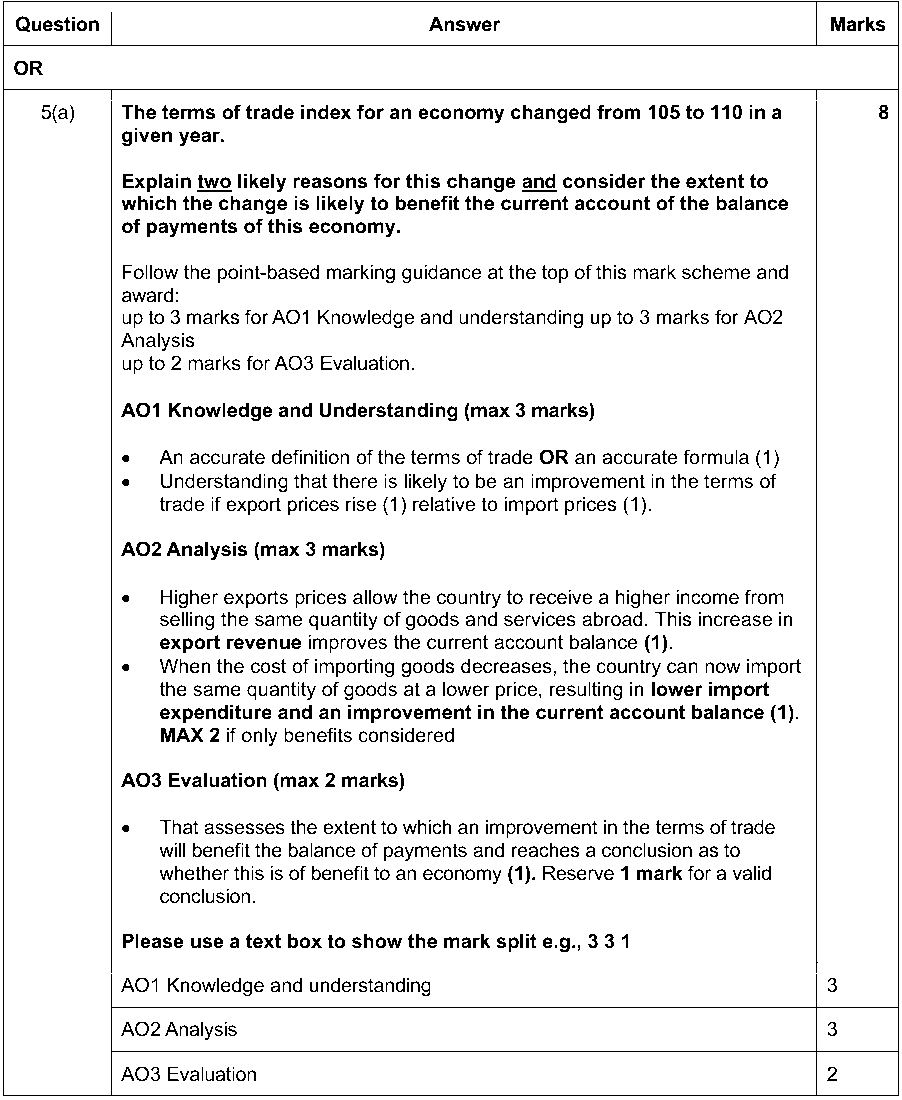
The terms of trade index for an economy changed from 105 to 110 in a given year.
Explain two likely reasons for this change and consider the extent to which the change is likely to benefit the current account of the balance of payments of this economy. [8]
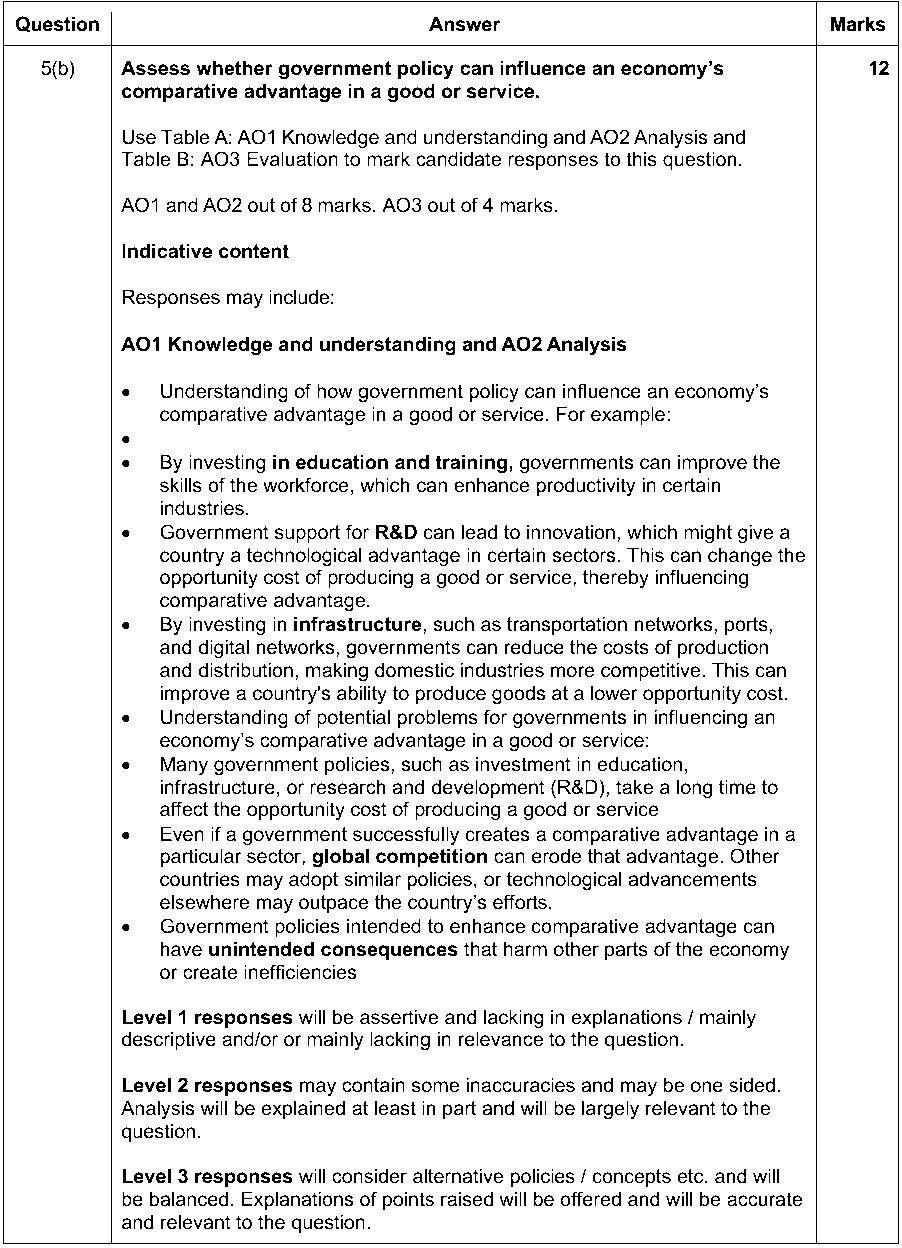
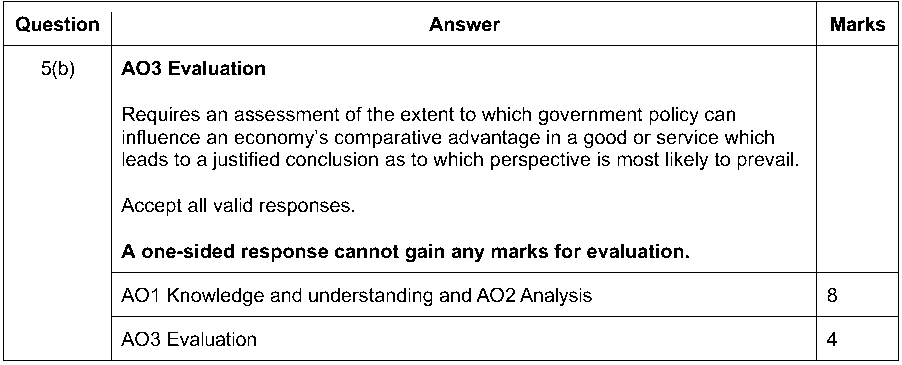
Assess whether government policy can influence an economy’s comparative advantage in a good or service. [12]
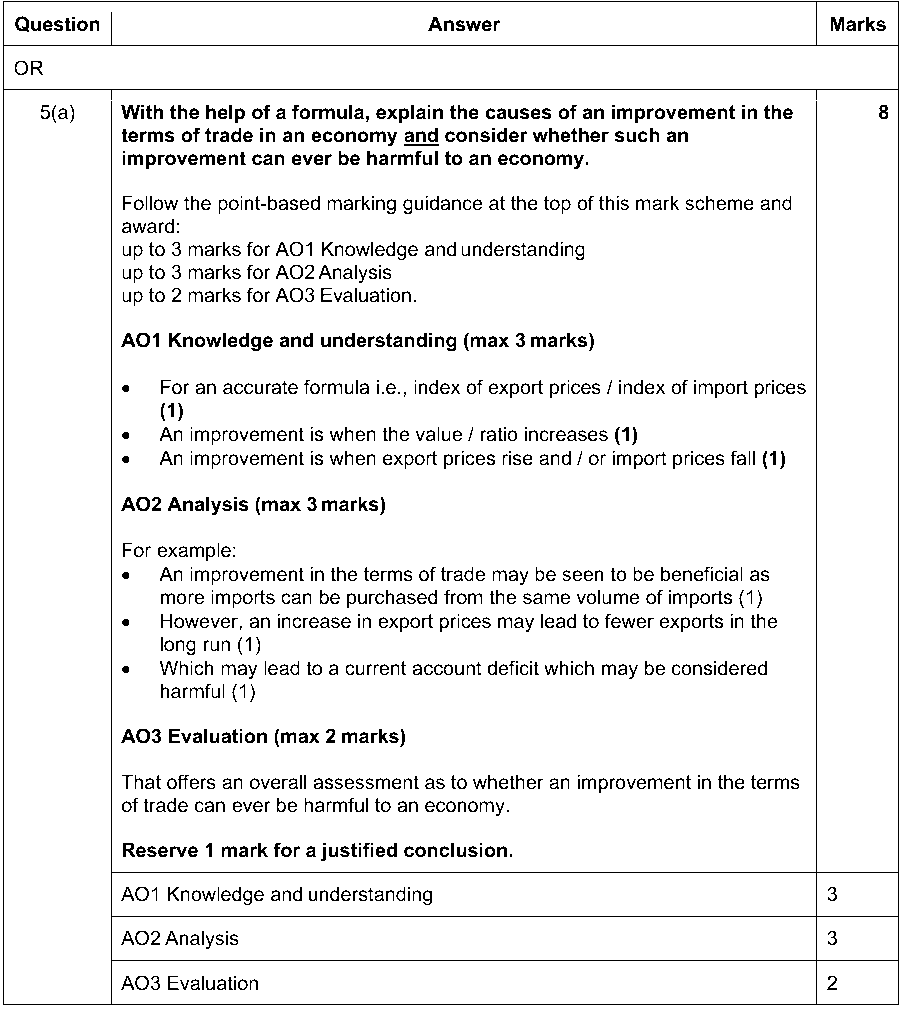
With the help of a formula, explain the causes of an improvement in the terms of trade in an economy and consider whether such an improvement can ever be harmful to an economy. [8]
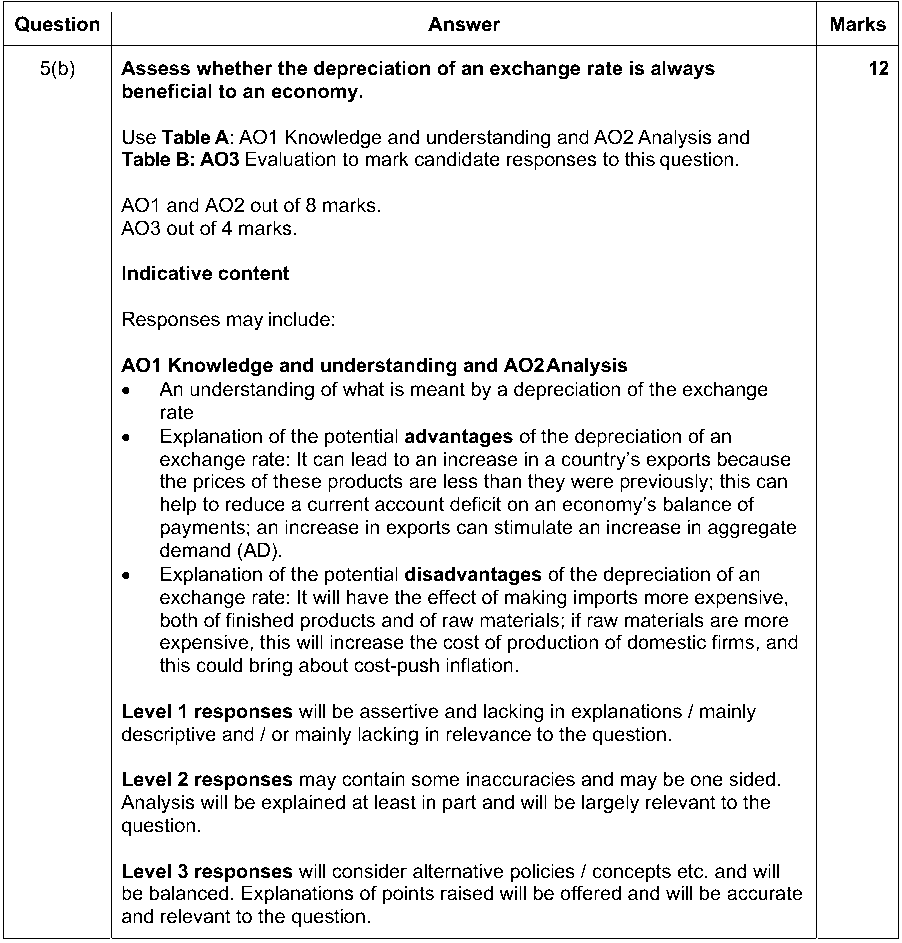
Assess whether the depreciation of an exchange rate is always beneficial to an economy. [12]


Assess the extent to which a fall in the value of the US dollar against the euro is likely to affect US imports of olive oil from the EU. [6]

With the help of a formula, explain two reasons for an improvement in the terms of trade and consider the extent to which an improvement in the terms of trade will benefit an economy. [8]
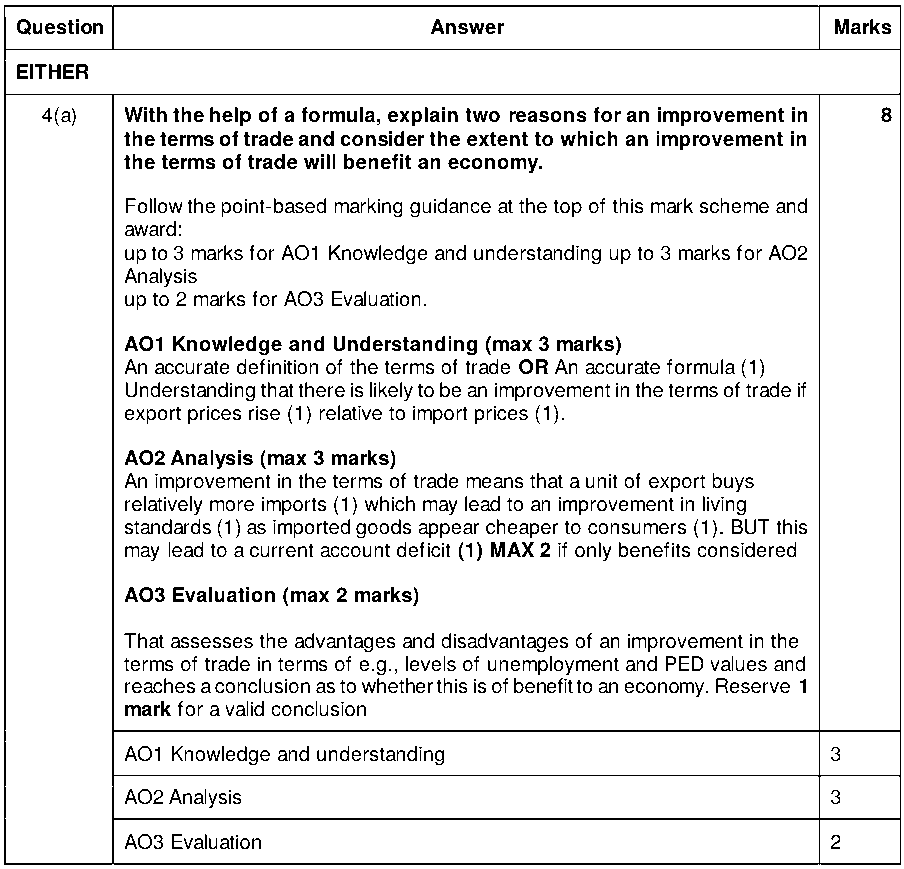
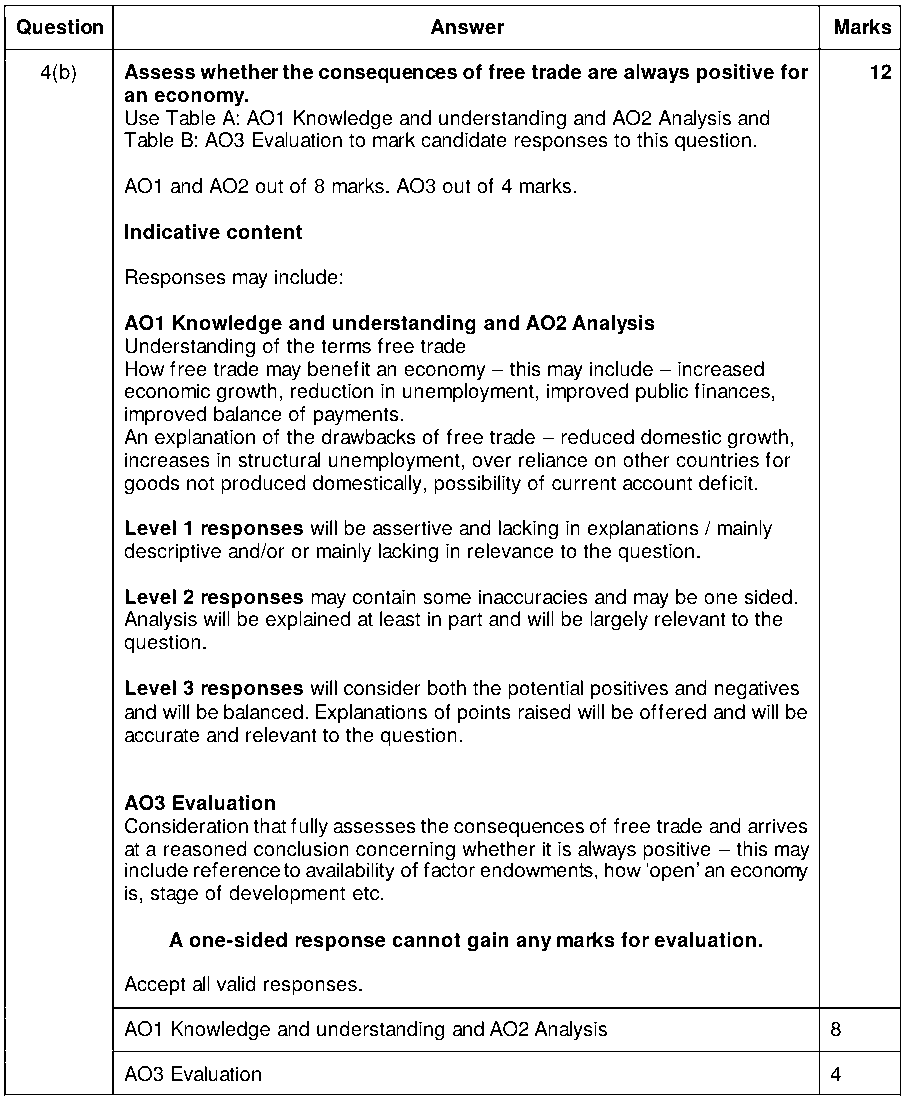
Assess the extent to which the consequences of free trade are always positive for an economy. [12]

🔒 Unlock every Unit 6: International economic issues question from 2020–2024
All 347 come with their mark schemes, answers and case studies, and appear in the practice tool above once you’re signed in. It’s free.
Questions and mark schemes are from past Cambridge papers and are reproduced for revision. Topical Vault is an independent revision resource, not affiliated with or endorsed by Cambridge Assessment International Education.
Each topic opens this practice tool with only that topic’s questions, plus how often it comes up and every question on it in one list. Revision notes for AS Level Economics →