Cambridge 0450 / 0264, Paper 1 & 2. 1,484 questions, 2019 to 2026.
Topic
Year
Every question begins with its business context — a short case for Paper 1, a full
case study (shared across all four questions on that paper) for Paper 2. Mark schemes show the typed
marking points alongside a cropped image of the official mark scheme page for exact wording.
About Types of business organisation
Sole traders, partnerships, private and public limited companies, franchises and joint ventures: ownership, control, liability and which form suits which business.
New to Types of business organisation, or finding these questions hard?
Read the notes first: the key ideas, diagrams and formulas, and the mistakes examiners see most, in about 18 minutes.
80 past paper questions on this topic since 2019, across 23 exam sessions.
How often it comes up
Year
Paper 1
Paper 2
Total
Chart
2026
4
0
4
2025
4
5
9
2024
4
1
5
2023
7
4
11
2022
9
2
11
2021
13
3
16
2020
10
3
13
2019
9
2
11
Every 2025–2026 question on Types of business organisation
The whole topic on one page, with answers and mark schemes. Printing this page prints just this list.
Paper 1 · Short answer and structured (8)
Scenario
Peter wants to start up a small business as a photographer who takes photographs at weddings. He has been told that there is government support available for new businesses. Peter will operate his business as a sole trader. He is considering using crowdfunding as a source of finance. Peter knows that many businesses fail.
Question 1(e)May/Jun 20260450/116 marks
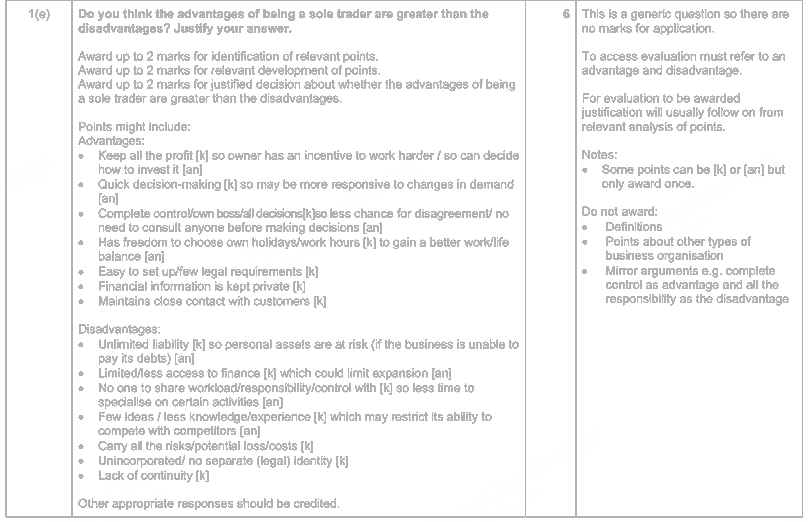
Do you think the advantages of being a sole trader are greater than the disadvantages? Justify your answer.
Show mark scheme
Do you think the advantages of being a sole trader are greater than the disadvantages? Justify your answer. Award up to 2 marks for identification of relevant points. Award up to 2 marks for relevant development of points. Award up to 2 marks for justified decision about whether the advantages of being a sole trader are greater than the disadvantages. Points might include: Advantages:
Keep all the profit [k] so owner has an incentive to work harder / so can decide how to invest it [an]
Quick decision-making [k] so may be more responsive to changes in demand [an]
Complete control/own boss/all decisions[k]so less chance for disagreement/ no need to consult anyone before making decisions [an]
Has freedom to choose own holidays/work hours [k] to gain a better work/life balance [an]
Easy to set up/few legal requirements [k]
Financial information is kept private [k]
Maintains close contact with customers [k] Disadvantages:
Unlimited liability [k] so personal assets are at risk (if the business is unable to pay its debts) [an]
Limited/less access to finance [k] which could limit expansion [an]
No one to share workload/responsibility/control with [k] so less time to specialise on certain activities [an]
Few ideas / less knowledge/experience [k] which may restrict its ability to compete with competitors [an]
Carry all the risks/potential loss/costs [k]
Unincorporated/ no separate (legal) identity [k]
Lack of continuity [k] Other appropriate responses should be credited. Justification might include: One advantage is the owner can keep all the profit [k] so has an incentive to work harder [an]. However, having less access to finance [k] could limit expansion [an]. The disadvantages are greater, because if the business misses out on the opportunity to expand, this could result in less potential sales/revenue [eval] and if costs remain the same, there could be less potential profit. [eval] Answer
Scenario
APL is a public limited company. It manufactures mobile phones. APL has 20000 employees working in its 5 factories in country X. The business uses many methods to motivate its employees including paying bonuses. Managers are encouraged to use different leadership styles. APL uses external recruitment when recruiting new employees.
Question 1(e)May/Jun 20260450/126 marks
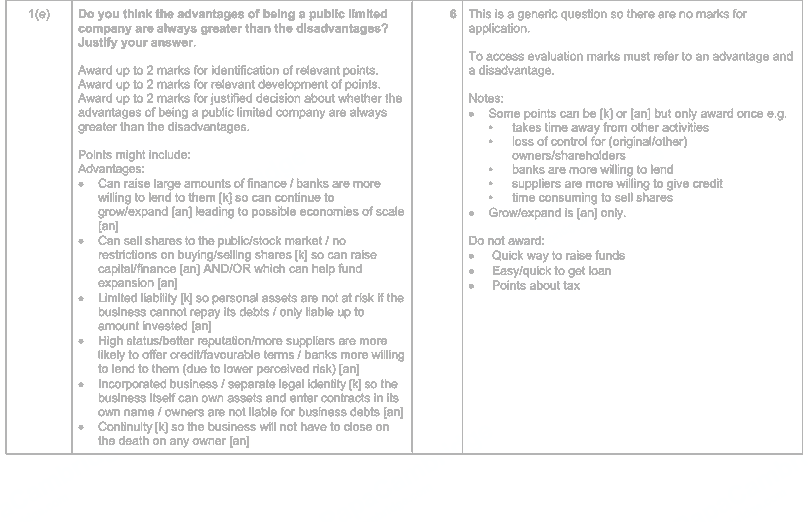
Do you think the advantages of being a public limited company are always greater than the disadvantages? Justify your answer.
Show mark scheme
Do you think the advantages of being a public limited company are always greater than the disadvantages? Justify your answer. Award up to 2 marks for identification of relevant points. Award up to 2 marks for relevant development of points. Award up to 2 marks for justified decision about whether the advantages of being a public limited company are always greater than the disadvantages. Points might include: Advantages:
Can raise large amounts of finance / banks are more willing to lend to them [k] so can continue to grow/expand [an] leading to possible economies of scale [an]
Can sell shares to the public/stock market / no restrictions on buying/selling shares [k] so can raise capital/finance [an] AND/OR which can help fund expansion [an]
Limited liability [k] so personal assets are not at risk if the business cannot repay its debts / only liable up to amount invested [an]
High status/better reputation/more suppliers are more likely to offer credit/favourable terms / banks more willing to lend to them (due to lower perceived risk) [an]
Incorporated business / separate legal identity [k] so the business itself can own assets and enter contracts in its own name / owners are not liable for business debts [an]
Continuity [k] so the business will not have to close on the death on any owner [an] Disadvantages:
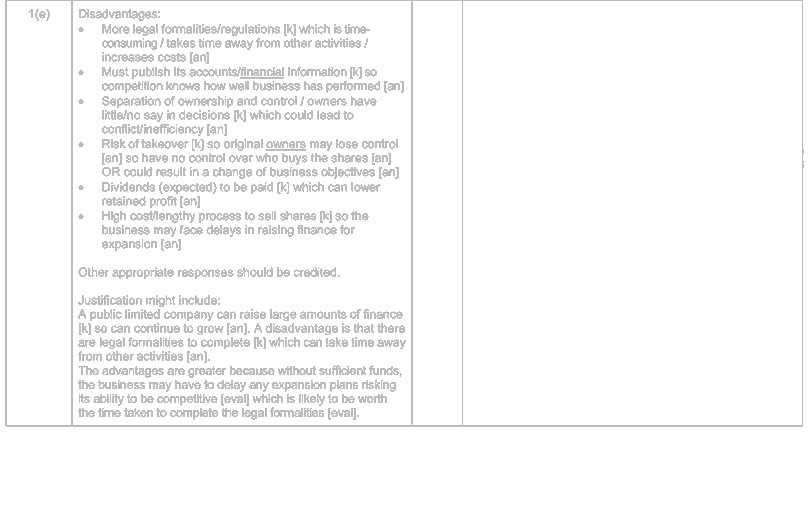
More legal formalities/regulations [k] which is time- consuming / takes time away from other activities / increases costs [an]
Must publish its accounts/financial information [k] so competition knows how well business has performed [an]
Separation of ownership and control / owners have little/no say in decisions [k] which could lead to conflict/inefficiency [an]
Risk of takeover [k] so original owners may lose control [an] so have no control over who buys the shares [an] OR could result in a change of business objectives [an]
Dividends (expected) to be paid [k] which can lower retained profit [an]
High cost/lengthy process to sell shares [k] so the business may face delays in raising finance for expansion [an] Other appropriate responses should be credited. Justification might include: A public limited company can raise large amounts of finance [k] so can continue to grow [an]. A disadvantage is that there are legal formalities to complete [k] which can take time away from other activities [an]. The advantages are greater because without sufficient funds, the business may have to delay any expansion plans risking its ability to be competitive [eval] which is likely to be worth the time taken to complete the legal formalities [eval].
Scenario
CNR is a bank in country X. It is a private limited company. One of CNR’s business objectives is growth and the directors are planning to merge the bank with one of its competitors. This decision will affect many stakeholder groups. After the merger, CNR will have 8000 branches and 36000 employees. The managing director knows she will have to find a suitable method of communication to inform CNR’s employees about the merger.
Question 3(c)May/Jun 20260450/134 marks
Outline one advantage and one disadvantage to CNR of being a private limited company. advantage disadvantage
Show mark scheme
Outline one advantage and one disadvantage to CNR of being a private limited company. Award 1 mark for each relevant advantage/disadvantage (max 2). Award 1 mark for each relevant reference to this business (max 2). Points might include: Advantages:
Limited liability [k] for shareholders/owners of the bank [app]
Can raise large amount of finance [k] so can have more than 36 000 employees [app]
Can decide who to sell/issue shares to [k] to fund its growth [app]
Separate legal identity [k]
Continuity [k] Disadvantages:
Need to publish (some) financial accounts [k] for its 8000 branches [app]
Shareholders may expect dividends [k] especially after the merger [app]
Can only sell shares to friends and family/cannot sell shares to public [k]
Legal formalities to set up/run [k]
Separation of ownership and control / owners have a say in decisions [k] Other appropriate responses should be credited.
Scenario
MCL is a private limited company which makes toys. The business wants to contribute to sustainable development so uses recycled plastic to make the toys. MCL uses primary market research to decide which toys to produce. The business uses retailers as its channel of distribution. MCL’s finance director knows that the business has a cash flow problem.
Question 1(a)Feb/Mar 20260450/122 marks
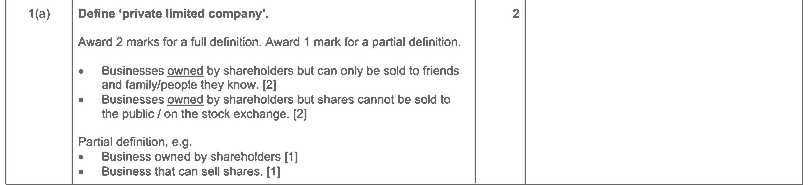
Define ‘private limited company’.
Show mark scheme
Define ‘private limited company’. Award 2 marks for a full definition. Award 1 mark for a partial definition.
Businesses owned by shareholders but can only be sold to friends and family/people they know. [2]
Businesses owned by shareholders but shares cannot be sold to the public / on the stock exchange. [2] Partial definition, e.g.
Business owned by shareholders [1]
Business that can sell shares. [1]
Scenario
Miguel plans to start up a gym (sports club). It will offer a range of fitness classes including yoga. The business will be a partnership with his sister. Miguel thinks the size of the business will remain small. Secondary market research will be used to help make decisions including which pricing method to use. Miguel knows it is important for a new business to select a suitable location.
Question 3(a)Oct/Nov 20250450/122 marks
Define ‘partnership’.
Show mark scheme
Define ‘partnership’. Award 2 marks for a full definition. Award 1 mark for a partial definition.
Two (or more) people agree to jointly own a business (together) [2]
A business formed by two or more people [2] Partial definition e.g.
A business run/operated/managed/controlled/lead by two (or more) people [1]
Scenario
Brendan wants to be a successful entrepreneur. He plans to start up a flower shop using government support. Brendan’s brother has offered to form a business partnership with him. Brendan knows it is important for a new business to use a suitable pricing method. He has already identified ways the business can increase added value. Brendan wants to know how an economic boom might affect his business.
Question 1(a)May/Jun 20250450/112 marks
Define ‘business partnership’.
Show mark scheme
Define ‘business partnership’. Award 2 marks for a full definition. Award 1 mark for a partial definition.
Two (or more) people agree to (jointly) own the business [2]
A business formed by two (or more) people who will usually share responsibility for the day to day running of the business [2]
An unincorporated business that has more than one owner [2] Partial definition e.g.
business run by two or more people [1]
Scenario
Jonathon is a sole trader. He owns a shop selling office equipment including printers. To encourage sales Jonathon allows customers 4 weeks to pay for the office equipment. Jonathon thinks his business is likely to remain small. He knows managing cash flow is important for his business and he has prepared a cash flow forecast. An extract is shown in Table 2.1. Table 2.1 Extract from Jonathon’s cash flow forecast July - September 2025 ($000) July August September Cash inflow 60 80 Y Cash outflow 90 95 70 Net cash flow (30) X 20 Opening balance 20 (10) (25) Closing balance (10) (25) (5)
Question 2(e)May/Jun 20250450/136 marks
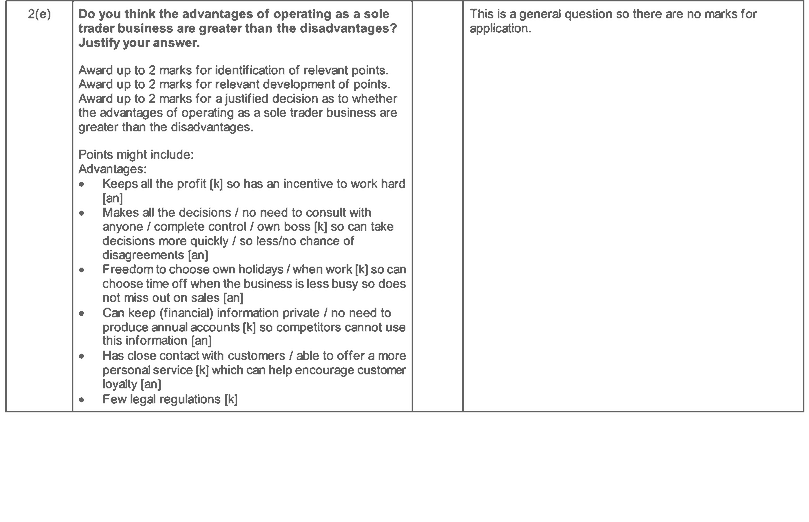
Do you think the advantages of operating as a sole trader business are greater than the disadvantages? Justify your answer.
Show mark scheme
Do you think the advantages of operating as a sole trader business are greater than the disadvantages? Justify your answer. Award up to 2 marks for identification of relevant points. Award up to 2 marks for relevant development of points. Award up to 2 marks for a justified decision as to whether the advantages of operating as a sole trader business are greater than the disadvantages. Points might include: Advantages:
Keeps all the profit [k] so has an incentive to work hard [an]
Makes all the decisions / no need to consult with anyone / complete control / own boss [k] so can take decisions more quickly / so less/no chance of disagreements [an]
Freedom to choose own holidays / when work [k] so can choose time off when the business is less busy so does not miss out on sales [an]
Can keep (financial) information private / no need to produce annual accounts [k] so competitors cannot use this information [an]
Has close contact with customers / able to offer a more personal service [k] which can help encourage customer loyalty [an]
Few legal regulations [k] Disadvantages:
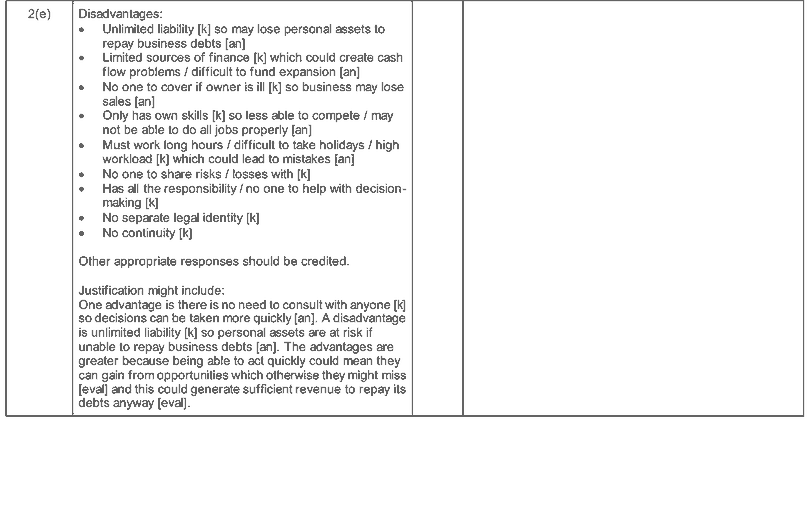
Unlimited liability [k] so may lose personal assets to repay business debts [an]
Limited sources of finance [k] which could create cash flow problems / difficult to fund expansion [an]
No one to cover if owner is ill [k] so business may lose sales [an]
Only has own skills [k] so less able to compete / may not be able to do all jobs properly [an]
Must work long hours / difficult to take holidays / high workload [k] which could lead to mistakes [an]
No one to share risks / losses with [k]
Has all the responsibility / no one to help with decision- making [k]
No separate legal identity [k]
No continuity [k] Other appropriate responses should be credited. Justification might include: One advantage is there is no need to consult with anyone [k] so decisions can be taken more quickly [an]. A disadvantage is unlimited liability [k] so personal assets are at risk if unable to repay business debts [an]. The advantages are greater because being able to act quickly could mean they can gain from opportunities which otherwise they might miss [eval] and this could generate sufficient revenue to repay its debts anyway [eval].
Scenario
Rachel’s business produces and sells chocolate bars. Quality is important. Rachel is a sole trader who received government support when she started up her business. The business operates in a competitive market. Rachel is considering ways to increase sales of her best-selling product. She is also planning to introduce a new chocolate bar. Rachel knows deciding which pricing method to use for a new product is important.
Question 2(a)Feb/Mar 20250450/122 marks
Define ‘sole trader’.
Show mark scheme
Define ‘sole trader’. Award 2 marks for a full definition. Award 1 mark for a partial definition.
A business is owned (and controlled) by one person [2].
An (unincorporated) business owned by one person [2]. Partial definition, e.g.
One person starts/runs/controls/operates a business [1]
Paper 2 · Case study (5)
Case study: Luxury Bathrooms (LB)
LB is a large private limited company. The business was started 20 years ago in country X. LB manufactures luxury bathroom products including baths, showers and basins, which it sells to specialist retail shops. The Managing Director knows that working capital is important. LB has recently introduced new machinery into its factory. The business has continued to grow each year and has benefited from economies of scale including financial, purchasing and managerial. The market for luxury bathrooms is very competitive in country X. LB plans to produce a new range of bathroom products. It is using primary market research to decide which products to manufacture. LB also needs to choose which channel of distribution to use. It could sell the new range of bathroom products to the same specialist retail shops as its existing products, or sell directly to customers through its website. LB currently uses its website to provide information and does not sell its products through it. LB wants to enter the luxury bathroom market in country Y. It plans to build a factory in country Y in 2026. LB will probably use a bank loan to finance the building of the factory. LB needs to communicate the expansion plans to all of its employees. Choosing the most suitable method of communication will be important.
Appendix 3 — referenced by Q4(b)
Newspaper article from City News in country Y, September 2025 The economy in country Y is growing and consumer incomes are rising. This is causing an increase in demand for luxury items for the home which is forecast to continue. There are many local businesses manufacturing bathroom products. The government is aware that multinational companies are considering locating factories in country Y. There are both benefits and drawbacks to country Y of allowing businesses from other countries to build their factories here.
---
Question 1(a)Oct/Nov 20250450/218 marks
Explain two advantages and two disadvantages of a business being a private limited company. Advantage 1: Advantage 2: Disadvantage 1: Disadvantage 2:
Show mark scheme
Explain two advantages and two disadvantages of a business being a 8 private limited company. Award 1 mark for each advantage/disadvantage (max 2 advantages/max 2 disadvantages). Award 1 additional mark for each explanation of the advantage/disadvantage. There are no application marks for this question. Relevant advantages might include:
Has a separate legal identity – company can be sued but not usually the owners
Can sell shares to family and friends to raise capital – larger amounts of capital may be raised than if a sole trader / partnership
Limited liability – owners will not lose personal possessions if business is unable to pay its debts
Cannot be taken over without the consent of the shareholders
Provides continuity on the death of the owner Relevant disadvantages might include:
Accounts are not private – competitors may access the accounts
Cannot sell shares to the public / shares cannot be sold on the stock exchange - not easy to transfer shares so family and friends may be less willing to buy shares
Legal formalities required to operate the company – need to have accounts audited and registered with government which takes time and increases costs
Legal formalities setting up the company – has to complete paperwork to register the company which takes time and money / may take more time for owner than setting up as a sole trader/partnership For example: Cannot sell shares to the public on the stock exchange (1) as it is not easy to transfer / sell shares family and friends may be less willing to buy shares in the first place (1).
Case study: Exceptional Sailing (ES)
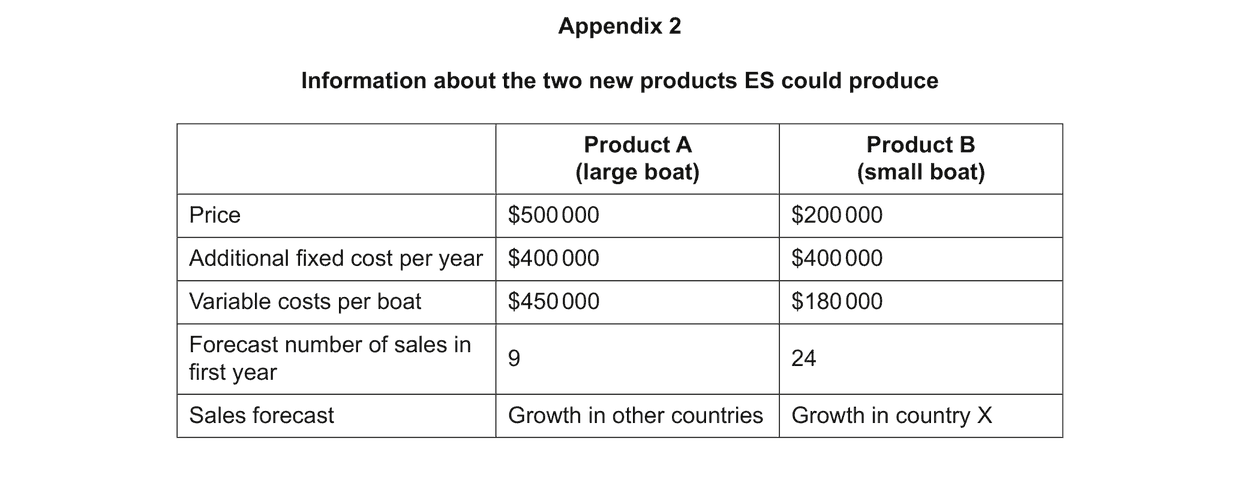
Tim worked at a large boat manufacturer in country X for 20 years. He is highly skilled in building boats. Tim decided to start his own business, called ES, 4 years ago. He currently operates as a sole trader. ES only makes and sells boats in country X. It has become established as a well-known brand with a reputation for high quality. ES has 12 skilled employees including an assistant who helps Tim to run the business. ES has a flat organisational structure with a short chain of command. ES has grown quickly and Tim plans to expand the business further by selling his boats to customers in other countries. He is aware that there are opportunities and threats of globalisation, especially as tariffs and quotas on boats and their component parts have been removed both in country X and in other countries. Tim plans to take out a bank loan to help fund the expansion. His two brothers will also invest in the business. One of his brothers has experience of financial management and the other is skilled in IT. Tim will need to decide whether ES should become a partnership or a private limited company. Tim wants to manufacture a new boat and he will need to choose between Product A and Product B. Information about the two new boats is shown in Appendix 2. ES currently promotes its boats in sailing magazines. Tim is considering using social media to promote his new boat to a wider market. Tim will need to recruit 4 new employees. These new employees will require training and Tim has to decide whether to train them at ES or send them to college two days a week.
Appendix 3 — referenced by Q4(a)
Email from Tim to his two brothers To: My two brothers From: Tim Date: 1 October 2025 I am pleased that you have both decided to invest in the business. I know that it will be good to work together and make decisions about the growth of ES. I have included some financial information for 2024.
Revenue increased by 50%
Gross profit margin was 65%
Profit was $100 000
Current ratio was 2
Acid test ratio was 0.5
---
Question 1(b)Oct/Nov 20250450/2312 marks
Consider the advantages and disadvantages of the following two types of business organisation that Tim could use when his brothers join the business. Which would be the best type for Tim to choose? Justify your answer.
Partnership
Private limited company Partnership: Private limited company: Recommendation:
Show mark scheme
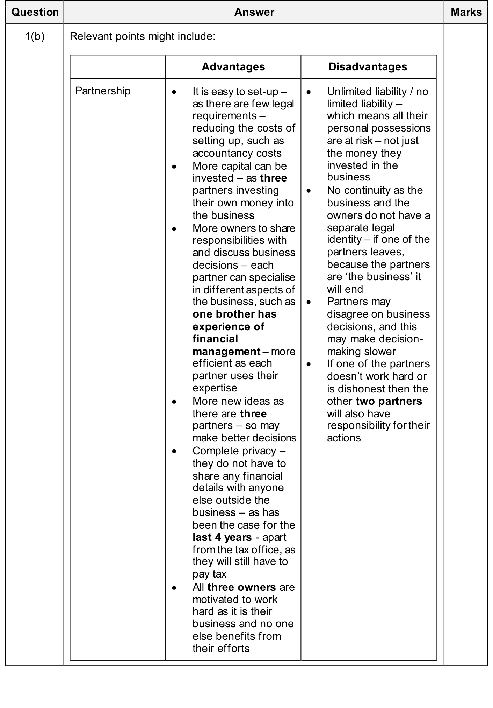
Consider the advantages and disadvantages of the following two types 12 of business organisation that Tim could use when his brothers join the business. Which would be the best type for Tim to choose? Justify your answer.
Partnership
Private limited company Level Description Marks 3 Sound application of knowledge and understanding of 9–12 relevant business concepts using appropriate terminology. Detailed discussion of both types of business organisation. Well-justified recommendation. Candidates discussing both types of business organisation, in context and with a well-justified recommendation, including why the alternative type of business organisation was rejected, should be rewarded with the top marks in the band. 2 Sound application of knowledge and understanding of 5–8 relevant business concepts using appropriate terminology. Detailed discussion of one type of business organisation. Judgement with some justification / some evaluation of choice made. Candidates discussing in detail one or more types of business organisation and applying it to the case should be rewarded with the top marks in the band. 1 Limited application of knowledge and understanding of 1–4 relevant business concepts. Limited ability to discuss the types of business organisation with little/no explanation. Simple judgement with limited justification / limited evaluation of choice made. Candidates outlining the two types of business organisation in context should be rewarded with the top marks in the band. 0 No creditable response. 0 Relevant points might include: Advantages Disadvantages Partnership • It is easy to set-up – • Unlimited liability / no as there are few legal limited liability – requirements – which means all their reducing the costs of personal possessions setting up, such as are at risk – not just accountancy costs the money they
More capital can be invested in the invested – as three business partners investing • No continuity as the their own money into business and the the business owners do not have a
More owners to share separate legal responsibilities with identity – if one of the and discuss business partners leaves, decisions – each because the partners partner can specialise are ‘the business’ it in different aspects of will end the business, such as • Partners may one brother has disagree on business experience of decisions, and this financial may make decision- management – more making slower efficient as each • If one of the partners partner uses their doesn’t work hard or expertise is dishonest then the
More new ideas as other two partners there are three will also have partners – so may responsibility for their make better decisions actions
Complete privacy – they do not have to share any financial details with anyone else outside the business – as has been the case for the last 4 years - apart from the tax office, as they will still have to pay tax
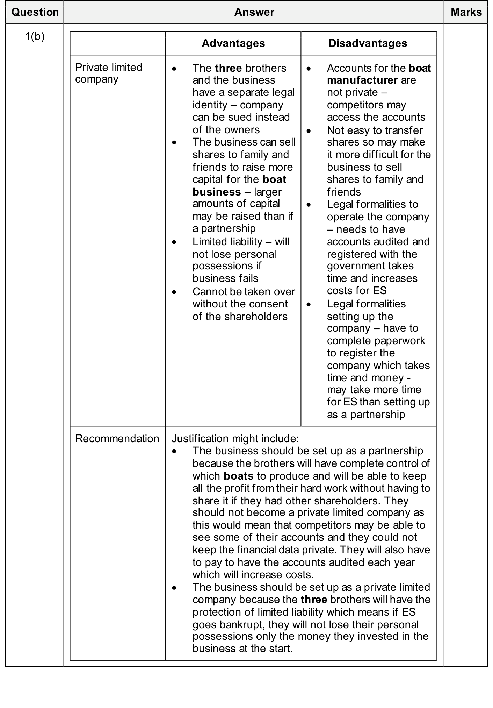
All three owners are motivated to work hard as it is their business and no one else benefits from their efforts Advantages Disadvantages Private limited • The three brothers • Accounts for the boat company and the business manufacturer are have a separate legal not private – identity – company competitors may can be sued instead access the accounts of the owners • Not easy to transfer
The business can sell shares so may make shares to family and it more difficult for the friends to raise more business to sell capital for the boat shares to family and business – larger friends amounts of capital • Legal formalities to may be raised than if operate the company a partnership – needs to have
Limited liability – will accounts audited and not lose personal registered with the possessions if government takes business fails time and increases
Cannot be taken over costs for ES without the consent • Legal formalities of the shareholders setting up the company – have to complete paperwork to register the company which takes time and money - may take more time for ES than setting up as a partnership Recommendation Justification might include:
The business should be set up as a partnership because the brothers will have complete control of which boats to produce and will be able to keep all the profit from their hard work without having to share it if they had other shareholders. They should not become a private limited company as this would mean that competitors may be able to see some of their accounts and they could not keep the financial data private. They will also have to pay to have the accounts audited each year which will increase costs.
The business should be set up as a private limited company because the three brothers will have the protection of limited liability which means if ES goes bankrupt, they will not lose their personal possessions only the money they invested in the business at the start.
Case study: Philip Flop (PF)
Philip started PF 10 years ago as a sole trader in country X. PF makes shoes out of natural rubber. Philip used $100 000 of his own money to start up PF. The business has been very successful. Last year Philip changed PF from a sole trader business to a private limited company because he wanted to grow the business. PF employs 20 workers to make the shoes. They are paid a weekly wage based on the number of hours worked. Philip often has to recruit new production workers as the jobs are boring. Other local businesses pay a higher wage for similar work. Philip needs to improve the motivation of PF’s employees and has to decide the best way to do this. Philip wants to build a new factory. This factory will produce a new range of shoes. PF’s products will still be made from natural rubber which is grown in the local area. The bank has agreed to provide a loan to finance the building of the new factory. Philip needs to choose a suitable location for the new factory and is considering the following factors:
availability of raw materials
transport links
government influence. PF operates in a very competitive market. Philip will need to make a decision about how to promote the new range of shoes in a mass market. Philip’s sister is a successful entrepreneur and is considering investing in PF. She is using the extracts from PF’s statements of financial position, shown in Appendix 3, to help her decide.
Appendix 2 — referenced by Q4(a)
Newspaper article from Main News in country X, 2 April 2025 The government is increasing tax rates on people’s incomes and on business profits. The tax on people’s incomes will increase by 2% and the tax on profits made by businesses will increase by 4%. These increases will be introduced next month. No further tax increases are planned.
Question 1(a)May/Jun 20250450/218 marks
Explain two advantages and two disadvantages to Philip of changing PF from a sole trader business to a private limited company. Advantage 1: Advantage 2: Disadvantage 1: Disadvantage 2:
Show mark scheme
Explain two advantages and two disadvantages to Philip of changing PF 8 from a sole trader business to a private limited company. Award 1 mark for each advantage/disadvantage (max 2 advantages/2 disadvantages). Award a maximum of 1 additional mark for each explanation of the advantage/disadvantage applied to this context. Relevant advantages might include:
Limited liability – as the original investment of $100 000 as well as his personal possessions are safe
More capital / easier to raise finance – as he can sell shares to fund the building of the new factory
Continuity – if Philip decides to leave the shoe making business, then PF will still exist
May be able to keep control – because he can decide whether to sell shares to expand the business Relevant disadvantages might include:
He would not be able to keep all the profits/pay dividends – from the manufacture of rubber shoes
No privacy / will have to share some financial details – from his forecast statement of financial position
Legal restrictions in setting up the business – which he would not have when he set up the business 10 years ago
Owner may not now have complete control / making all the decisions / being his own boss – such as where to locate the new factory For example: Will not be able to keep all the profit made (1) from selling the shoes he produces (app). Application could include: rubber shoes; natural rubber raw material; build a new factory; sells in a mass market; increase in taxes; bank loan for the new factory; sister wants to invest in the business; $100 000; wants to grow the business; produce a new range of shoes; operates in a very competitive market; started 10 years ago; information from Appendix 3.
Case study: Vegan Veg (VV)
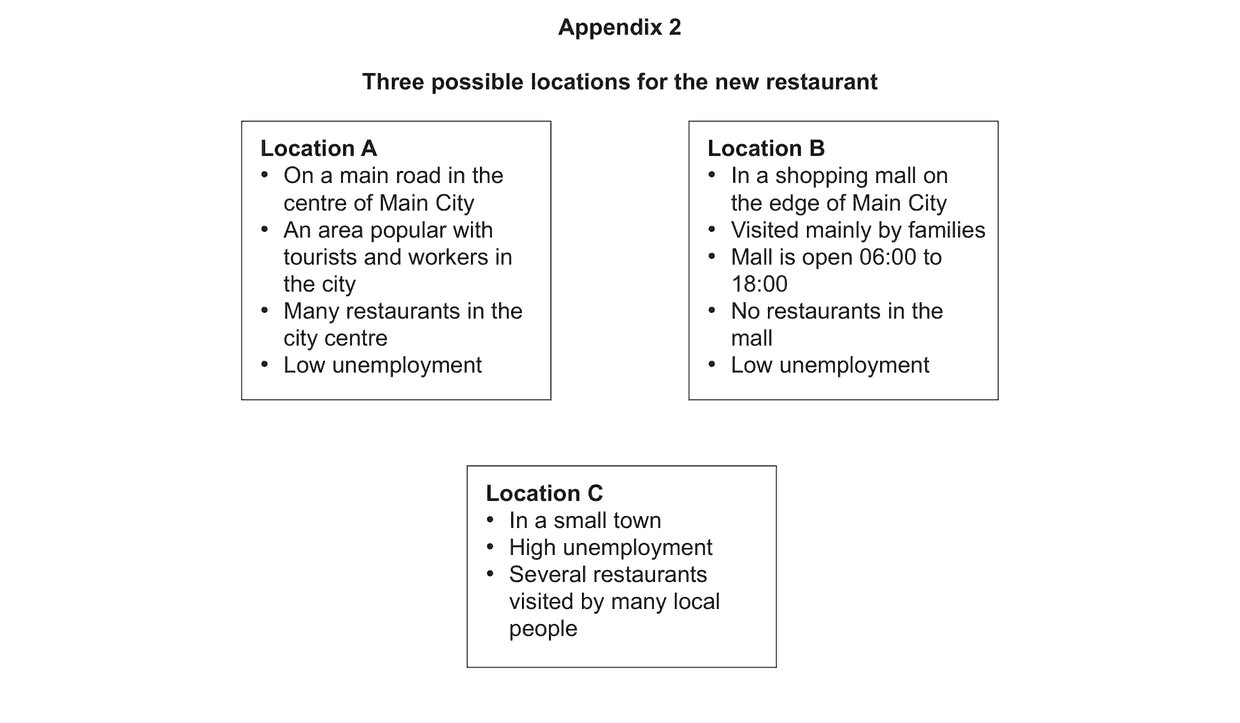
Jemi has always wanted to own a business. She is planning to buy a franchise called VV, a restaurant brand that only serves vegan meals. The meals do not contain any ingredients made from animal products. Market segmentation is important to VV. There has been an increasing trend for people to eat vegan meals. Jemi will need to decide the best location for her restaurant. There are three possible locations outlined in Appendix 2. The restaurant will serve a wide range of vegan meals and Jemi will purchase ingredients, including fruit and vegetables, directly from local suppliers. Jemi will employ a chef to cook the meals. The chef will be expected to work 40 hours a week. Jemi has identified the two best applicants. Their details are shown in Appendix 1. As well as a chef, Jemi plans to employ another 3 people to help in the kitchen and 8 people to serve customers in the restaurant. Jemi knows that keeping these employees motivated will be important. She is considering using job enrichment or giving a discount on meals in the restaurant to keep her employees motivated. Jemi is going to use her own capital of $50 000 to buy the franchise, but she will also need a source of external finance to help set up the business. Jemi knows that the profitability and liquidity ratios for her restaurant will be important for the success of her business.
Appendix 3 — referenced by Q4(a)
Newspaper article from Main News, 3 May 2025 A recent government report said that everyone should be eating more fruit and vegetables. It found that this is particularly important to help keep children healthy and to live a long life. Eating less meat is also good for the environment. Five years ago, only 10% of the population ate vegan meals but this percentage has increased to 25%. It is forecast that this trend will continue. Many well-known restaurants are adding vegan meals to their menus. There are also new vegan restaurants being opened. However, it is getting more difficult to find reliable suppliers of fruit and vegetables. Restaurants are now having to buy from suppliers that are further away.
---
Question 1(a)May/Jun 20250450/238 marks
Explain two advantages and two disadvantages to Jemi of buying a franchise. Advantage 1: Advantage 2: Disadvantage 1: Disadvantage 2:
Show mark scheme
Explain two advantages and two disadvantages to Jemi of buying a 8 franchise. Award 1 mark for each advantage/disadvantage (max 2 advantages/max 2 disadvantages). Award a maximum of 1 additional mark for each explanation of the advantage/disadvantage of buying a franchise which must be applied to this context. Relevant advantages might include:
Risk of business failure to the franchisee is much reduced – because the brand is well-known with people who like eating vegan meals
The franchisor pays for national advertising – reducing the costs of promotion for the restaurant
Supplies are obtained from central sources / quality will be assured as already checked by the franchisor – less need to research suppliers of plant-based ingredients
Fewer decisions to be made
Training for employees and management is provided/arranged by the franchisor
Banks may be more willing to lend as risk of failure is lower Relevant disadvantages might include:
Less independence than when operating a non-franchise business / franchisor will impose strict controls over what is allowed – which meals to sell
May be unable to make decisions to suit the local areas – and some local vegetables may be more popular than others nationally
Licence fee must be paid to the franchisor – costs $50 000
Local advertising will still have to be paid for by the franchisee
Royalty payment made to franchisor each year For example: The risk of business failure is much reduced (1) because the brand is well-known with people who like eating vegan meals (app). Application could include: restaurant; vegan target market; plant-based ingredients; meals; fruit and vegetables; $50 000; chefs; working 40 hours a week; 12 employees; increasing trend for people eating vegan meals; eating less meat is good for the environment; menus; recipes.
Case study: Comfy Rugs (CR)
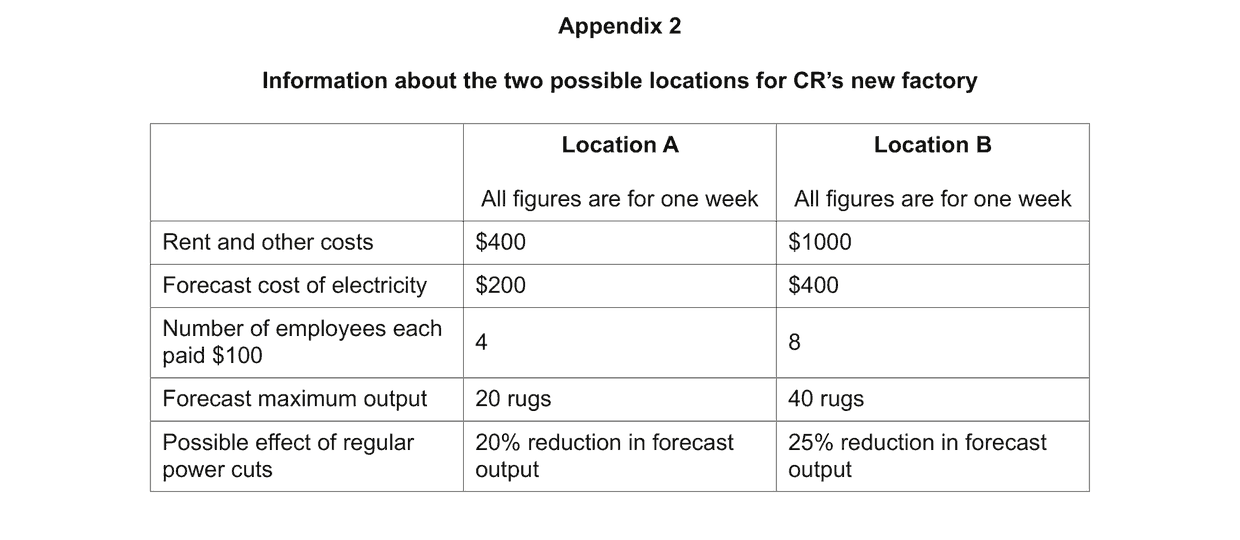
Charly has worked for a large rug manufacturer in country P for 10 years. She is planning to leave and set up her own business later this year. It will be called CR and will make luxury rugs. She knows that new businesses are at a greater risk of failing than existing businesses. Charly has $10 000 of her own money to invest in a factory to make the rugs. She will also need to apply for a $20 000 bank loan. Charly has to decide which type of business organisation to choose for her new business. She could be a sole trader or set up CR as a private limited company. Charly will need to understand the functions of management required to operate CR whichever type of business organisation she chooses. Charly needs to choose a location for her new factory. Appendix 2 has information about two possible locations. She will have to decide the best location to produce her rugs. Charly forecasts that demand for her rugs will be 20 rugs per week in the first year. Charly must decide the best way to sell her luxury rugs when she starts producing them. The three options for CR are as follows:
selling through CR’s own shop
selling online by setting up a website
selling to a wholesaler which sells rugs to many retailers in country P.
Appendix 1 — not directly referenced by any question in this paper
Email from Charly to her accountant To: Accountant From: Charly Date: 1 February 2025 I have been told that I need to produce a cash flow forecast. This will be important because the rugs are expensive to produce. I will need to hold inventory of raw materials as well as finished rugs before they are sold. Please tell me what to include in the cash inflows and cash outflows in the cash flow forecast. I do not want to run out of cash and have to apply for an overdraft. I already plan to take out a bank loan to set up the factory.
Appendix 3 — referenced by Q4(b)
Newspaper article in Main News, 3 January 2025 The government in country P reduced taxes last year to help the economy to grow. For example, the taxes on people’s incomes decreased by 5% and the taxes on business profits decreased by 2%. The government is concerned that the economy is starting to grow too fast. Banks are increasing their interest rates from 4% to 7%. This will have different effects on different businesses in country P.
---
Question 1(b)Feb/Mar 20250450/2212 marks
Consider the following two types of business organisation that Charly could choose for her new business. Which type of business organisation should Charly choose? Justify your answer.
Sole trader
Private limited company Sole trader: Private limited company: Recommendation:
Show mark scheme
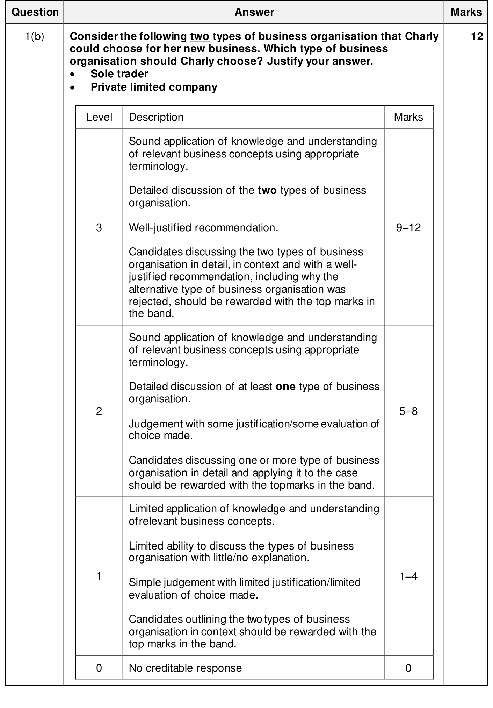
Consider the following two types of business organisation that Charly 12 could choose for her new business. Which type of business organisation should Charly choose? Justify your answer.
Sole trader
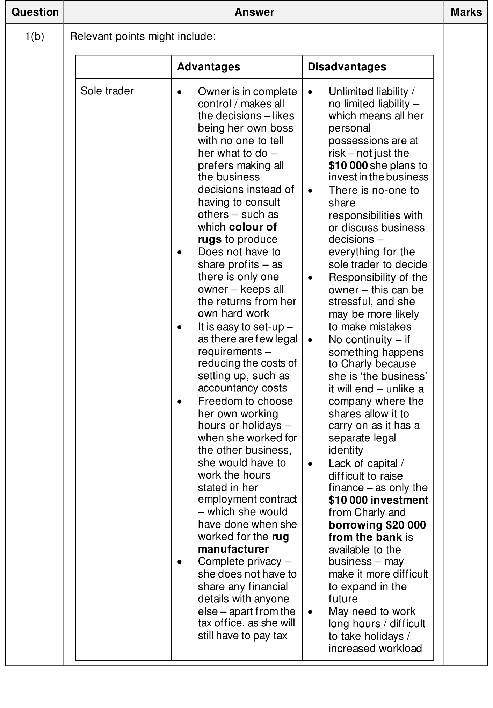
Private limited company Level Description Marks Sound application of knowledge and understanding of relevant business concepts using appropriate terminology. Detailed discussion of the two types of business organisation. 3 Well-justified recommendation. 9–12 Candidates discussing the two types of business organisation in detail, in context and with a well- justified recommendation, including why the alternative type of business organisation was rejected, should be rewarded with the top marks in the band. Sound application of knowledge and understanding of relevant business concepts using appropriate terminology. Detailed discussion of at least one type of business organisation. 2 5–8 Judgement with some justification/some evaluation of choice made. Candidates discussing one or more type of business organisation in detail and applying it to the case should be rewarded with the top marks in the band. Limited application of knowledge and understanding of relevant business concepts. Limited ability to discuss the types of business organisation with little/no explanation. 1 1–4 Simple judgement with limited justification/limited evaluation of choice made. Candidates outlining the two types of business organisation in context should be rewarded with the top marks in the band. 0 No creditable response 0 Relevant points might include: Advantages Disadvantages Sole trader • Owner is in complete • Unlimited liability / control / makes all no limited liability – the decisions – likes which means all her being her own boss personal with no one to tell possessions are at her what to do – risk – not just the prefers making all $10 000 she plans to the business invest in the business decisions instead of • There is no-one to having to consult share others – such as responsibilities with which colour of or discuss business rugs to produce decisions –
Does not have to everything for the share profits – as sole trader to decide there is only one • Responsibility of the owner – keeps all owner – this can be the returns from her stressful, and she own hard work may be more likely
It is easy to set-up – to make mistakes as there are few legal • No continuity – if requirements – something happens reducing the costs of to Charly because setting up, such as she is ‘the business’ accountancy costs it will end – unlike a
Freedom to choose company where the her own working shares allow it to hours or holidays – carry on as it has a when she worked for separate legal the other business, identity she would have to • Lack of capital / work the hours difficult to raise stated in her finance – as only the employment contract $10 000 investment – which she would from Charly and have done when she borrowing $20 000 worked for the rug from the bank is manufacturer available to the
Complete privacy – business – may she does not have to make it more difficult share any financial to expand in the details with anyone future else – apart from the • May need to work tax office, as she will long hours / difficult still have to pay tax to take holidays / increased workload Advantages Disadvantages Private limited • Charly and the • Accounts are not company business are a private – competitors separate legal producing rugs may identity – provides access the accounts continuity if • Cannot sell shares something happens to the public / cannot to Charly – company be sold on the stock can be sued instead exchange – not easy of Charly to transfer shares so
Charly can sell may make it more shares to family and difficult for Charly to friends to raise sell shares to family capital for the new and friends business – larger • Legal formalities amounts of capital setting up the rug may be raised than if company – has to a sole trader complete paperwork
Limited liability – will to register the not lose personal company which possessions if takes time and business fails – and money – may take she is aware that more time for Charly as a new business than setting up as a is at a greater risk sole trader of failing • Legal formalities to
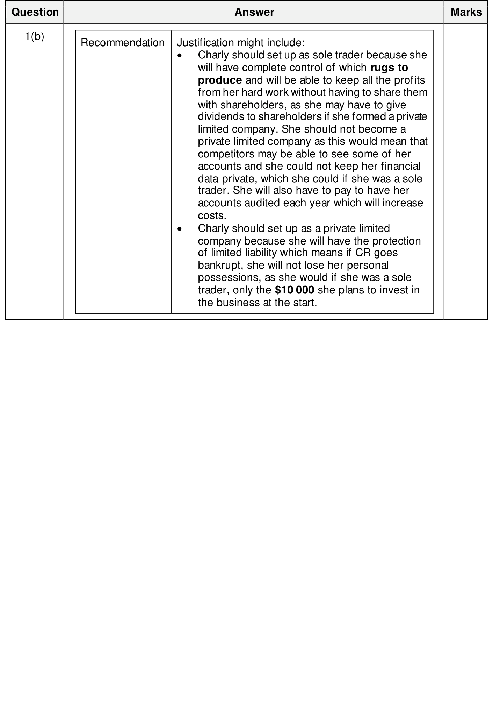
Cannot be taken operate the over without the company – needs to consent of the have accounts shareholders if there audited and are more registered with the shareholders in the government takes business time and increases costs for CR Recommendation Justification might include:
Charly should set up as sole trader because she will have complete control of which rugs to produce and will be able to keep all the profits from her hard work without having to share them with shareholders, as she may have to give dividends to shareholders if she formed a private limited company. She should not become a private limited company as this would mean that competitors may be able to see some of her accounts and she could not keep her financial data private, which she could if she was a sole trader. She will also have to pay to have her accounts audited each year which will increase costs.
Charly should set up as a private limited company because she will have the protection of limited liability which means if CR goes bankrupt, she will not lose her personal possessions, as she would if she was a sole trader, only the $10 000 she plans to invest in the business at the start.
67 more questions from 2019–2024
🔒 Unlock every Types of business organisation question from 2019–2024
All 67 come with their mark schemes, answers and case studies, and appear in the practice tool above once you’re signed in. It’s free.
0450/12 · Feb/Mar 2024 · Question 4(e)Do you think operating as a sole… 🔒
+ 62 more, by year in the table above
Questions and mark schemes are from past Cambridge papers and are reproduced for revision. Topical Vault is an independent revision resource, not affiliated with or endorsed by Cambridge Assessment International Education.
IGCSE Business questions by topic
Each topic opens this practice tool with only that topic’s questions, plus how often it comes up and every question on it in one list. Revision notes for IGCSE Business →
Pick a paper, sub-topics and years to draw from (leave any blank for "all"), choose
how many questions you want, and we'll open a new worksheet page with a random set for you to review
and download.