Cambridge 0450 / 0264, Paper 1 & 2. 1,484 questions, 2019 to 2026.
Topic
Year
Every question begins with its business context — a short case for Paper 1, a full
case study (shared across all four questions on that paper) for Paper 2. Mark schemes show the typed
marking points alongside a cropped image of the official mark scheme page for exact wording.
About Production of goods and services
Production methods (job, batch and flow), productivity and how to raise it, inventory management, lean production and the effect of technology on production.
New to Production of goods and services, or finding these questions hard?
Read the notes first: the key ideas, diagrams and formulas, and the mistakes examiners see most, in about 22 minutes.
91 past paper questions on this topic since 2019, across 23 exam sessions.
How often it comes up
Year
Paper 1
Paper 2
Total
Chart
2026
4
2
6
2025
8
3
11
2024
7
4
11
2023
8
4
12
2022
8
3
11
2021
11
4
15
2020
12
3
15
2019
7
3
10
Every 2025–2026 question on Production of goods and services
The whole topic on one page, with answers and mark schemes. Printing this page prints just this list.
Paper 1 · Short answer and structured (12)
Scenario
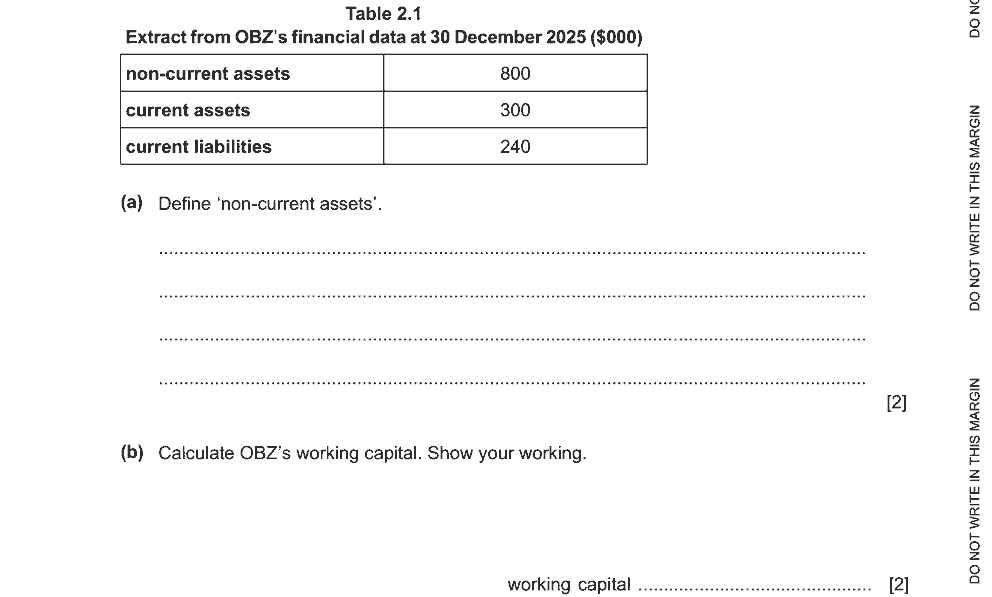
OBZ uses job production to manufacture carpets. The business has 80 employees. OBZ’s operations manager is considering different ways to maintain quality production in the factory. The finance manager knows OBZ needs to manage its cash. She is reviewing OBZ’s financial data. An extract is shown in Table 2.1. Table 2.1 Extract from OBZ’s financial data at 30 December 2025 ($000) non-current assets 800 current assets 300 current liabilities 240
Question 2(e)May/Jun 20260450/116 marks
Do you think the advantages to a business of using job production are greater than the disadvantages? Justify your answer.
Show mark scheme
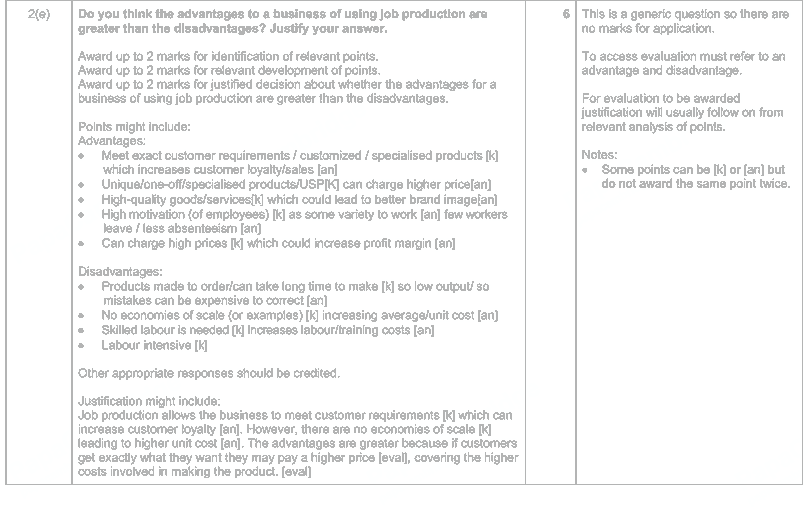
Do you think the advantages to a business of using job production are greater than the disadvantages? Justify your answer. Award up to 2 marks for identification of relevant points. Award up to 2 marks for relevant development of points. Award up to 2 marks for justified decision about whether the advantages for a business of using job production are greater than the disadvantages. Points might include: Advantages:
Unique/one-off/specialised products/USP[K] can charge higher price[an]
High-quality goods/services[k] which could lead to better brand image[an]
High motivation (of employees) [k] as some variety to work [an] few workers leave / less absenteeism [an]
Can charge high prices [k] which could increase profit margin [an] Disadvantages:
Products made to order/can take long time to make [k] so low output/ so mistakes can be expensive to correct [an]
No economies of scale (or examples) [k] increasing average/unit cost [an]
Skilled labour is needed [k] increases labour/training costs [an]
Labour intensive [k] Other appropriate responses should be credited. Justification might include: Job production allows the business to meet customer requirements [k] which can increase customer loyalty [an]. However, there are no economies of scale [k] leading to higher unit cost [an]. The advantages are greater because if customers get exactly what they want they may pay a higher price [eval], covering the higher costs involved in making the product. [eval]
Scenario
BTV’s 16 factories use flow production to manufacture cars. Maintaining quality is important. The managing director is reviewing BTV’s financial data including profit. An extract is shown in Table 3.1. She knows there are many external users of accounts who are interested in this data. Table 3.1 Extract from BTV’s financial data - December 2025 ($ million) non-current assets 700 current assets 90 current liabilities 120 non-current liabilities 300 profit 900
Question 3(d)May/Jun 20260450/126 marks
Explain two disadvantages to BTV of using flow production. disadvantage 1 explanation disadvantage 2 explanation
Show mark scheme
Explain two disadvantages to BTV of using flow production. Award 1 mark for identification of each relevant disadvantage (max 2). Award 1 mark for each relevant reference to this business (max 2). Award 1 mark for each relevant explanation (max 2). Points might include:
Inflexible / lack of customization /variety [k] so less able to respond to changes in the market /could lower demand [an] for cars [app]
Lower motivation [k] so employees are less efficient / lower output / high labour turnover / fewer quality products [an] at its factories [app]
High levels of inventory / large (storage) space needed [k] increasing (storage/warehouse/rent) costs [an] at the 16 locations [app]
If one machine breaks down whole production line/process stops/delays production [k] which reduces output / lower efficiency / may not be able to meet orders [an]
High set up/machinery costs / high/large capital expenditure [k] leading to large cash outflows / lower profit margin/ has an opportunity cost [an] Other appropriate responses should be credited.
Scenario
CCH builds large boats in its factory. The business has 1800 employees who are all members of a trade union. All CCH’s employees are offered regular on-the-job training. The human resources director uses different financial methods of motivation for CCH’s production employees. She knows there are many legal controls over employment that might affect a business. The directors want to know the advantages to CCH of changes in technology.
Question 2(d)May/Jun 20260450/136 marks
Explain two advantages to CCH of changes in technology. advantage 1 explanation advantage 2 explanation
Show mark scheme
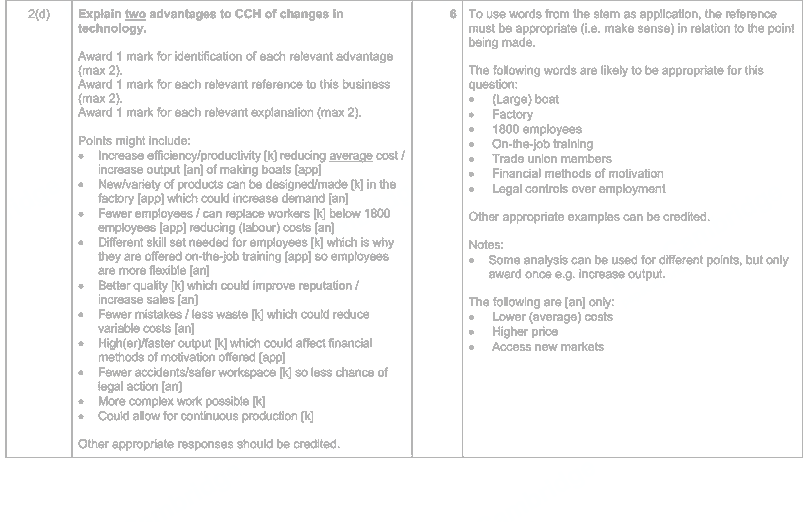
Explain two advantages to CCH of changes in technology. Award 1 mark for identification of each relevant advantage (max 2). Award 1 mark for each relevant reference to this business (max 2). Award 1 mark for each relevant explanation (max 2). Points might include:
Increase efficiency/productivity [k] reducing average cost / increase output [an] of making boats [app]
New/variety of products can be designed/made [k] in the factory [app] which could increase demand [an]
Different skill set needed for employees [k] which is why they are offered on-the-job training [app] so employees are more flexible [an]
Better quality [k] which could improve reputation / increase sales [an]
Fewer mistakes / less waste [k] which could reduce variable costs [an]
High(er)/faster output [k] which could affect financial methods of motivation offered [app]
Fewer accidents/safer workspace [k] so less chance of legal action [an]
More complex work possible [k]
Could allow for continuous production [k] Other appropriate responses should be credited.
Scenario
KYX is a public limited company. It manufactures beds in country Y. The business holds a high level of inventory. Country Y has experienced economic growth and demand for KYX’s beds increased by 30% last year. The operations manager is reviewing KYX’s output data as he wants to calculate the margin of safety. An extract from KYX’s output data is shown in Table 3.1. KYX’s managing director plans to open another factory in country Y and knows there are many location factors to consider. She will also need to decide on an external source of finance to fund the new factory. Table 3.1 Extract from KYX’s output data (units) current output 13000 break-even level of output 10000
Question 3(c)Feb/Mar 20260450/124 marks
Outline two reasons why KYX holds a high level of inventory. reason 1 reason 2
Show mark scheme
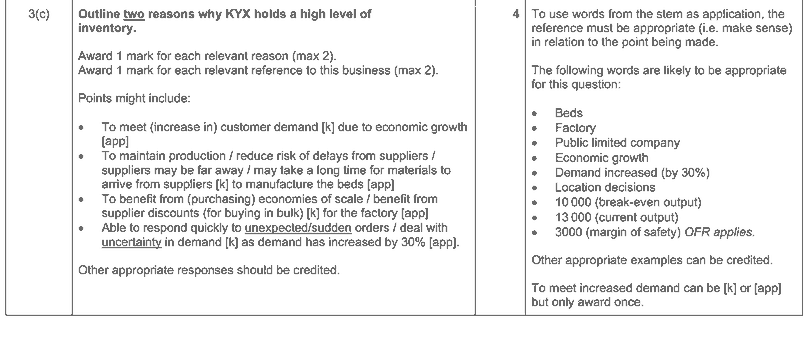
Outline two reasons why KYX holds a high level of inventory. Award 1 mark for each relevant reason (max 2). Award 1 mark for each relevant reference to this business (max 2). Points might include:
To meet (increase in) customer demand [k] due to economic growth [app]
To maintain production / reduce risk of delays from suppliers / suppliers may be far away / may take a long time for materials to arrive from suppliers [k] to manufacture the beds [app]
To benefit from (purchasing) economies of scale / benefit from supplier discounts (for buying in bulk) [k] for the factory [app]
Able to respond quickly to unexpected/sudden orders / deal with uncertainty in demand [k] as demand has increased by 30% [app]. Other appropriate responses should be credited.
Scenario
WMH is a business which operates in the secondary sector. It makes furniture including tables and chairs. WMH’s employees are all members of a trade union. The Managing Director knows the business is likely to remain small. She is considering introducing new technology into WMH’s factory. She also knows it is important for a manufacturing business to choose a suitable location for a factory.
Question 1(d)Oct/Nov 20250450/116 marks
Explain two possible effects of WMH introducing new technology. Effect 1: Explanation: Effect 2: Explanation:
Show mark scheme
Explain two possible effects of WMH introducing new technology. Award 1 mark for identification of each relevant effect (max 2). Award 1 mark for each relevant reference to this business (max 2). Award 1 mark for each relevant explanation (max 2). Points might include: Positive effects:
Improve quality / less waste / fewer mistakes [k] leading to a better reputation [an] for its furniture [app]
Increases productivity / efficiency / quicker production [k] leading to lower (average) costs [an] for this small business [app]
Improved communication [k] leading to fewer mistakes / better efficiency [an] in the factory [app]
Can design new products [k] which may increase sales / access new markets [an]
Greater job satisfaction/motivation [k] reducing absenteeism/lowering labour turnover [an]
Employees may gain new skills [k] leading to higher pay/chances of promotion [an]
Reduces time/costs to design new products [k]
Increase output [k]
Safer workplace [k] Negative effects:
Purchasing new equipment / expensive to buy/set up [k] increasing cash outflows/debt [an]
Need to train workers [k] which can increase costs [an]
If technology is rapidly changing it will need to change often to remain competitive [k] which will increase costs [an]
Some employees may lose their jobs/made redundant [k]
May demotivate employees [k] Other appropriate responses should be credited.
Scenario
KPX manufactures computers. The business imports 60% of its raw materials. The Operations Director is considering ways to use lean production methods in KPX’s factory. The Finance Director is reviewing KPX’s financial data to calculate the value of its expenses. An extract is shown in Table 1.1. Table 1.1 Extract from KPX’s financial data for 2024 ($ million) Revenue 750 Cost of sales 360 Gross profit 390 Profit 90
Question 1(d)Oct/Nov 20250450/136 marks
Explain two methods of lean production KPX could use. Method 1: Explanation: Method 2: Explanation:
Show mark scheme
Explain two methods of lean production KPX could use. Award 1 mark for identification of each relevant method (max 2). Award 1 mark for each relevant reference to this business (max 2). Award 1 mark for each relevant explanation (max 2). Points might include:
Just-in-time (inventory control) / JIT [k] when importing raw materials [app] reducing amount of space / inventory held / lower storage costs [an]
Kaizen [k] to help eliminate mistakes/errors [an] when making computers [app] Other appropriate responses should be credited.
Scenario
STB is a public limited company. It uses job production to build houses. In 2024 the business built 13500 houses. STB has many stakeholder groups including its 5000 employees. The Managing Director knows business activity can affect the environment and that there are many reasons why a business should respond to environmental pressures. She also wants to know how economic growth might affect STB.
Question 3(d)Oct/Nov 20250450/136 marks
Explain two benefits to STB of using job production. Benefit 1: Explanation: Benefit 2: Explanation:
Show mark scheme
Explain two benefits to STB of using job production. Award 1 mark for identification of each relevant benefit (max 2). Award 1 mark for each relevant reference to this business (max 2). Award 1 mark for each relevant explanation (max 2). Points might include:
Motivate employees [k] helping lower absenteeism / increase retention [an] among its 5000 employees [app]
Could set high(er) price [k] for each house [app] which may help increase added value/increase profit margin [an]
Meet exact customer requirements/needs [k] can help brand loyalty / increase competitive advantage [an] for this public limited company [app]
High-quality goods/service [k] Other appropriate responses should be credited.
Scenario
NSL is a business based in country X. It manufactures food products including bread and breakfast cereals. NSL uses lean production in its factory. Maintaining quality is important. NSL imports 15% of its raw materials. Changes in country X’s exchange rate can affect businesses which import raw materials. NSL’s Marketing Manager knows the business should respond to changes in consumer spending patterns. She is aware that market research can be used to help make business decisions.
Question 2(d)May/Jun 20250450/116 marks
Explain two benefits to NSL of using lean production. Benefit 1: Explanation: Benefit 2: Explanation:
Show mark scheme
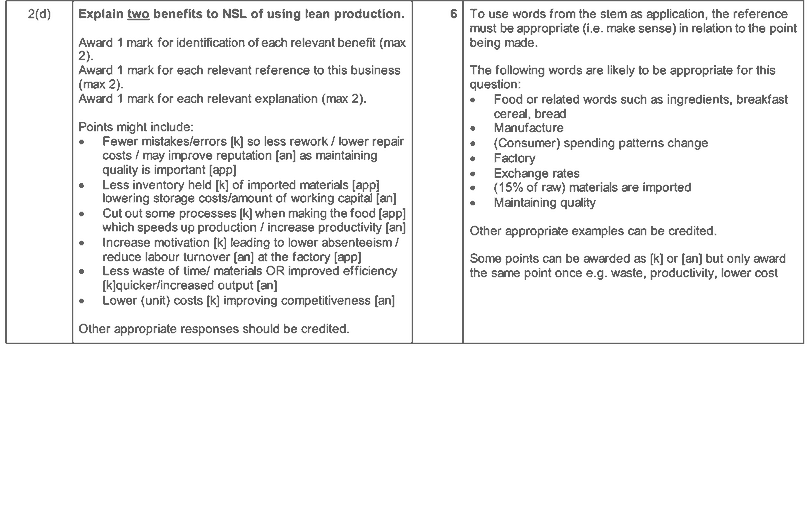
Explain two benefits to NSL of using lean production. Award 1 mark for identification of each relevant benefit (max 2). Award 1 mark for each relevant reference to this business (max 2). Award 1 mark for each relevant explanation (max 2). Points might include:
Fewer mistakes/errors [k] so less rework / lower repair costs / may improve reputation [an] as maintaining quality is important [app]
Less inventory held [k] of imported materials [app] lowering storage costs/amount of working capital [an]
Cut out some processes [k] when making the food [app] which speeds up production / increase productivity [an]
Increase motivation [k] leading to lower absenteeism / reduce labour turnover [an] at the factory [app]
Less waste of time/ materials OR improved efficiency [k]quicker/increased output [an]
Lower (unit) costs [k] improving competitiveness [an] Other appropriate responses should be credited.
Scenario
NFC manufactures shoes using batch production. Quality assurance is used to maintain quality. NFC uses market segmentation. The Marketing Director is reviewing NFC’s product range. He knows there are both benefits and limitations to developing new products. He also knows the promotion of products is important.
Question 1(a)May/Jun 20250450/122 marks
Define ‘batch production’.
Show mark scheme
Define ‘batch production’. Award 2 marks for a full definition. Award 1 mark for a partial definition.
Where a quantity/group of one product is made, then a quantity of another product will be produced [2]
A whole batch/group moves through the different stages of production together [2] Partial definition e.g.
Similar items made together/items made in a group/set [1]
Moving together through different stages of production [1]
Scenario
GAE is a multinational company. It manufactures steel. GAE has 2400 employees and has factories in 4 countries. The business regularly introduces new technology. Holding inventory is important. GAE’s directors are planning to build a new factory and want to know how legal controls over location might affect this decision. The Managing Director said, ‘The new factory will create many external benefits.’
Question 3(c)May/Jun 20250450/134 marks
Outline two advantages to GAE of introducing new technology. Advantage 1: Advantage 2:
Show mark scheme
Outline two advantages to GAE of introducing new technology. Award 1 mark for each relevant advantage (max 2). Award 1 mark for each relevant reference to this business (max 2). Points might include:
Motivate employees [k] as have 2400 workers [app]
Fewer employees needed [k] in the 4 countries [app]
Increases productivity / efficiency / quicker (rate of) production [k] in its factories [app]
Improved quality / consistent quality / less waste / fewer mistakes [k] when making steel [app]
Increase output [k] for this multinational company [app]
Can work 24/7 / no need to have breaks in production [k]
Help design / make new products [k]
Improved communication [k] Other appropriate responses should be credited.
Question 3(d)May/Jun 20250450/136 marks
Explain two reasons why holding inventory might be important for GAE. Reason 1: Explanation: Reason 2: Explanation:
Show mark scheme
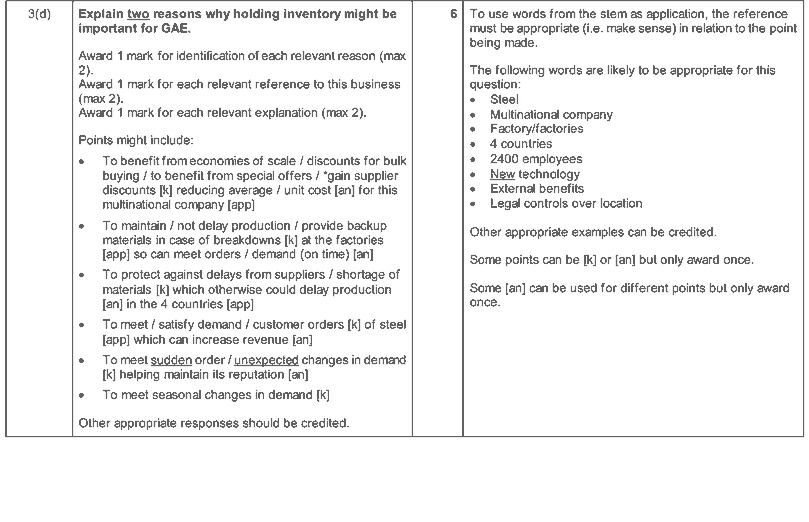
Explain two reasons why holding inventory might be important for GAE. Award 1 mark for identification of each relevant reason (max 2). Award 1 mark for each relevant reference to this business (max 2). Award 1 mark for each relevant explanation (max 2). Points might include:
To benefit from economies of scale / discounts for bulk buying / to benefit from special offers / *gain supplier discounts [k] reducing average / unit cost [an] for this multinational company [app]
To maintain / not delay production / provide backup materials in case of breakdowns [k] at the factories [app] so can meet orders / demand (on time) [an]
To protect against delays from suppliers / shortage of materials [k] which otherwise could delay production [an] in the 4 countries [app]
To meet / satisfy demand / customer orders [k] of steel [app] which can increase revenue [an]
To meet sudden order / unexpected changes in demand [k] helping maintain its reputation [an]
To meet seasonal changes in demand [k] Other appropriate responses should be credited.
Scenario
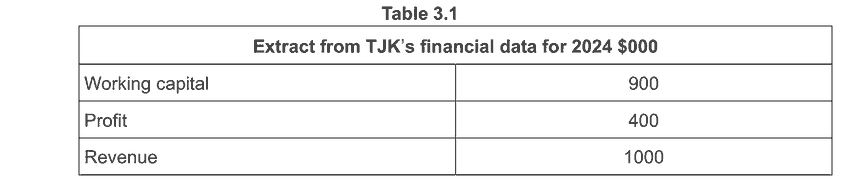
TJK manufactures candles. Contributing to sustainable development is important to TJK. The business uses batch production in its factory in country X. The target market for TJK’s products is females between 20 and 50 years of age. The Managing Director is reviewing TJK’s financial data. An extract is shown in Table 3.1. He is also considering the benefits to a business of becoming a multinational company. Table 3.1 Extract from TJK’s financial data for 2024 $000 Working capital 900 Profit 400 Revenue 1000
Question 3(e)Feb/Mar 20250450/126 marks
Do you think batch production is the best method of production for a business to use? Justify your answer.
Show mark scheme
Do you think batch production is the best method of production for a business to use? Justify your answer. Award 1 mark for each relevant point [max 2]. Award 1 mark for each relevant explanation [max 2]. Award up to 2 marks for a justified decision as to whether batch production is the best method of production for a business to use. Points might include: Batch production:
Flexible / can easily change from one product to another [k] so can respond quickly to changing customer tastes [an]
Variety of products can be made [k] which can widen its customer base/help spread risk [an]
(Variety of tasks) can motivate employees [k]
Machines must be re-set between batches [k] which can reduce output [an]
Warehouse space needed [k] which increases storage costs [an] Other methods include: Flow production [k]
Quick/high output [an]
Economies of scale [an]
Low(er) unit cost [an] so able to charge a lower price [an]
Can operate 24 hours a day [an]
Few(er) employees / high levels of automation [an]
If a machine breaks down the whole production line will stop [an]
High initial cost of machinery [an]
Can lower motivation [an] Job production [k]
Can charge a high price [an] increasing profit margin [an]
Can meet the (exact) requirements of customers [an]
(Often) high quality [an]
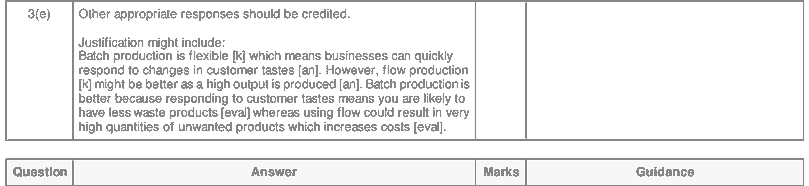
Labour intensive [an] which increases (labour) costs [an] Other appropriate responses should be credited. Justification might include: Batch production is flexible [k] which means businesses can quickly respond to changes in customer tastes [an]. However, flow production [k] might be better as a high output is produced [an]. Batch production is better because responding to customer tastes means you are likely to have less waste products [eval] whereas using flow could result in very high quantities of unwanted products which increases costs [eval]. Answer
Paper 2 · Case study (5)
Case study: KE (Kitchen Equipment)
KE is a public limited company in country X. It has 10 000 employees. KE manufactures cooking equipment such as cooking pots, which it sells at low prices. KE produces 20 million cooking pots per year in its factory, and sells its products in country X. The market for cooking pots is very competitive. KE uses simple packaging to help keep costs low. KE is planning to build a second factory. The existing factory is working at maximum output and is unable to meet growing demand. The second factory will allow KE to increase sales from $90 million to $180 million per year. KE needs to choose between two possible locations for the second factory. Information about the two locations is shown in Appendix 1. KE does not currently use lean production. The operations director plans to introduce lean production in both the existing factory and the second factory. Training for all employees is important for KE. KE is planning to produce a new cooking pot when it opens the second factory. The marketing director will use primary market research to help decide whether to produce product A or product B. Information about the two new cooking pots in shown in Appendix 3. KE wants to choose the cooking pot with the highest potential revenue and profit.
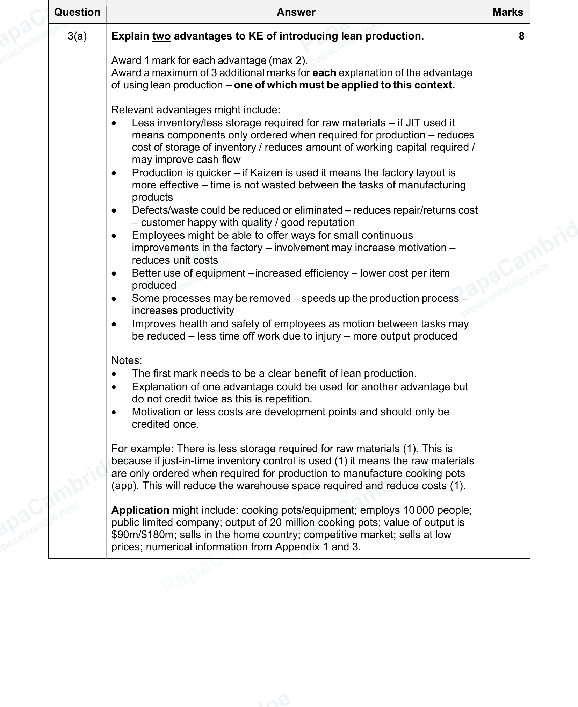
Question 3(a)May/Jun 20260450/228 marks
Explain two advantages for KE of introducing lean production. advantage 1 explanation advantage 2 explanation
Show mark scheme
Explain two advantages to KE of introducing lean production. 8 Award 1 mark for each advantage (max 2). Award a maximum of 3 additional marks for each explanation of the advantage of using lean production – one of which must be applied to this context. Relevant advantages might include:
Less inventory/less storage required for raw materials – if JIT used it means components only ordered when required for production – reduces cost of storage of inventory / reduces amount of working capital required / may improve cash flow
Production is quicker – if Kaizen is used it means the factory layout is more effective – time is not wasted between the tasks of manufacturing products
Defects/waste could be reduced or eliminated – reduces repair/returns cost – customer happy with quality / good reputation
Employees might be able to offer ways for small continuous improvements in the factory – involvement may increase motivation – reduces unit costs
Better use of equipment – increased efficiency – lower cost per item produced
Some processes may be removed – speeds up the production process – increases productivity
Improves health and safety of employees as motion between tasks may be reduced – less time off work due to injury – more output produced Notes:
The first mark needs to be a clear benefit of lean production.
Explanation of one advantage could be used for another advantage but do not credit twice as this is repetition.
Motivation or less costs are development points and should only be credited once. For example: There is less storage required for raw materials (1). This is because if just-in-time inventory control is used (1) it means the raw materials are only ordered when required for production to manufacture cooking pots (app). This will reduce the warehouse space required and reduce costs (1). Application might include: cooking pots/equipment; employs 10 000 people; public limited company; output of 20 million cooking pots; value of output is $90m/$180m; sells in the home country; competitive market; sells at low prices; numerical information from Appendix 1 and 3.
Case study: Kitty’s Homeshoes (KH)
KH is a private limited company. It manufactures shoes for people with large feet. People with large feet often find it difficult to buy shoes to fit them. KH started producing shoes for this niche market 10 years ago. KH has a good brand image and charges a high price for its shoes. The marketing director has produced an advertisement for its current products shown in Appendix 1. She knows it is important that the advertisement meets all the legal controls on marketing. KH’s shoes are made from imported high-quality natural rubber extracted from trees. KH’s suppliers have cleared forests to grow their rubber trees. Pressure groups have been posting their concerns on social media. KH has started to sell its shoes online which has increased its sales. KH’s managing director wants to expand the business and plans to build a second factory. A new operations manager will need to be recruited. Internal or external recruitment could be used for this position. All KH’s managers are encouraged to use delegation. KH’s marketing director is considering whether to produce shoes of all sizes and to start selling to a mass market. If KH starts selling to a mass market many changes will need to be made.
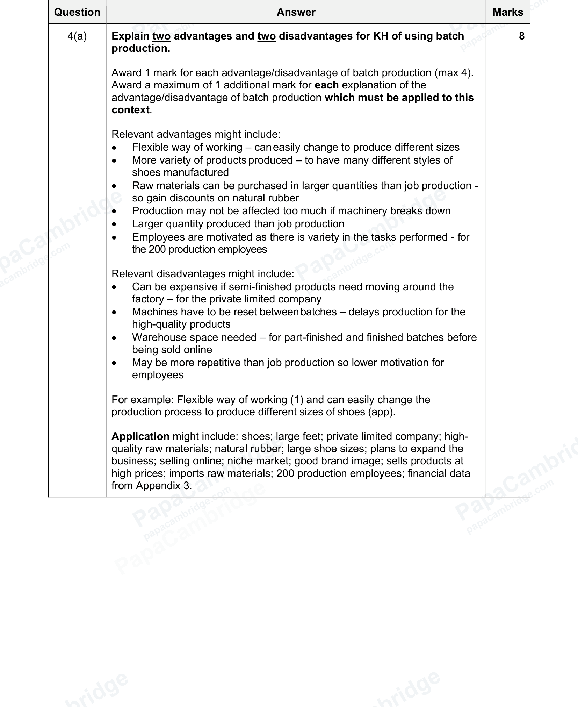
Question 4(a)May/Jun 20260450/238 marks
Explain two advantages and two disadvantages for KH of using batch production. advantage 1 advantage 2 disadvantage 1 disadvantage 2
Show mark scheme
Explain two advantages and two disadvantages for KH of using batch 8 production. Award 1 mark for each advantage/disadvantage of batch production (max 4). Award a maximum of 1 additional mark for each explanation of the advantage/disadvantage of batch production which must be applied to this context. Relevant advantages might include:
Flexible way of working – can easily change to produce different sizes
More variety of products produced – to have many different styles of shoes manufactured
Raw materials can be purchased in larger quantities than job production - so gain discounts on natural rubber
Production may not be affected too much if machinery breaks down
Larger quantity produced than job production
Employees are motivated as there is variety in the tasks performed - for the 200 production employees Relevant disadvantages might include:
Can be expensive if semi-finished products need moving around the factory – for the private limited company
Machines have to be reset between batches – delays production for the high-quality products
Warehouse space needed – for part-finished and finished batches before being sold online
May be more repetitive than job production so lower motivation for employees For example: Flexible way of working (1) and can easily change the production process to produce different sizes of shoes (app). Application might include: shoes; large feet; private limited company; high- quality raw materials; natural rubber; large shoe sizes; plans to expand the business; selling online; niche market; good brand image; sells products at high prices; imports raw materials; 200 production employees; financial data from Appendix 3.
Case study: Fun Florals (FF)
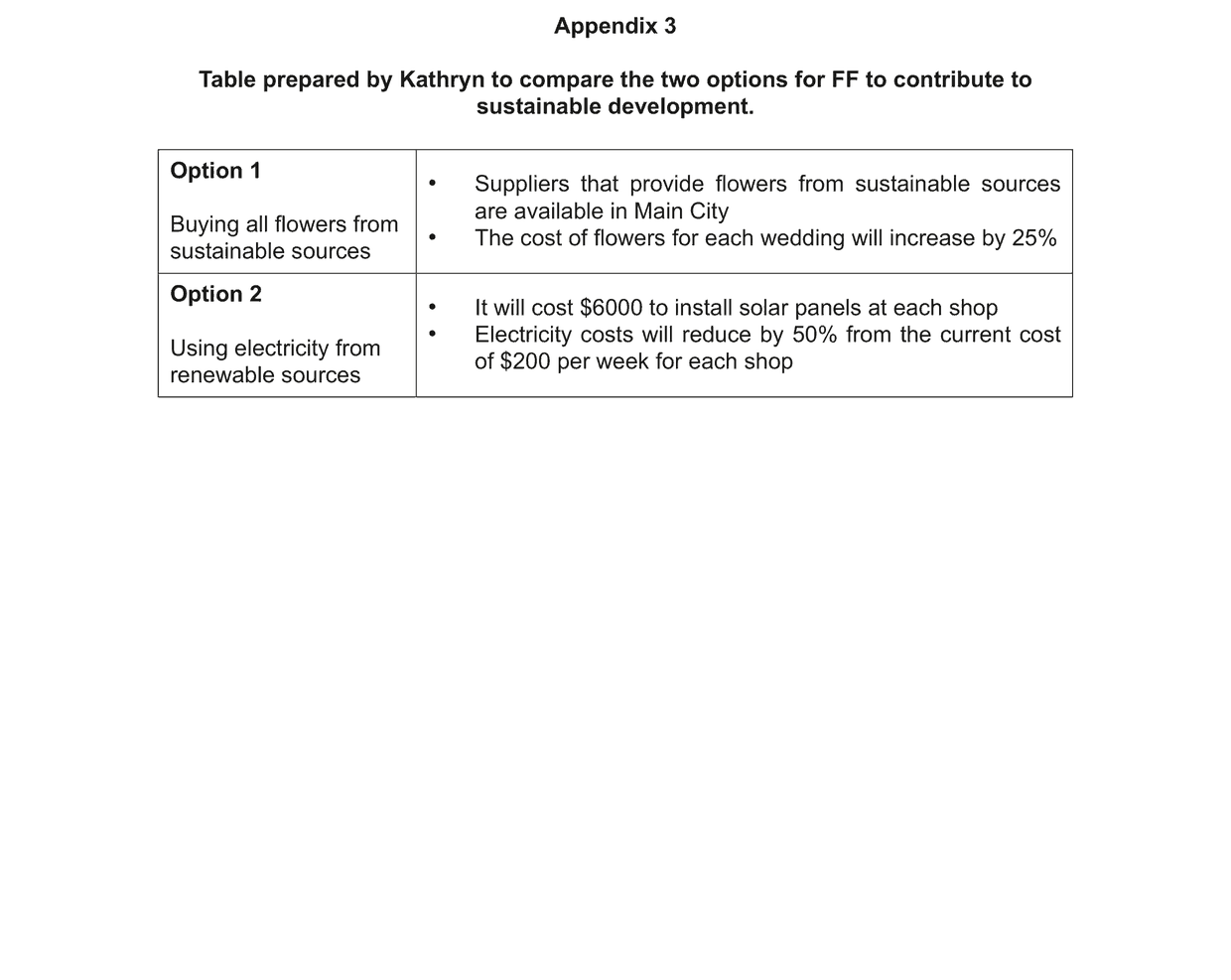
FF is a small business owned by Kathryn. It has 2 small shops in Main City which sell wedding flowers. Each shop has 4 employees. FF has a good reputation for providing high-quality flower arrangements. Most flower shops provide flowers for many occasions, but FF operates in a niche market as it only provides flowers for weddings. The average price customers pay for FF’s wedding flowers is $2000. Kathryn buys flowers from her suppliers every day to ensure that the flowers are fresh and last a long time. She has a good relationship with her suppliers who provide the flowers and other items such as ribbons and packaging materials. Kathryn knows that communication with her suppliers is important. She uses job production for each customer’s order. Kathryn wants to open a larger third shop in the centre of Main City and has written a business plan. She is considering which marketing mix to use for this new shop. FF will need finance for working capital. Kathryn has the choice of using either a bank overdraft or trade credit. Kathryn wants FF to contribute to sustainable development. Many of her customers have told her they are concerned about global warming. Appendix 3 shows information about two ways Kathryn could use to contribute to sustainable development.
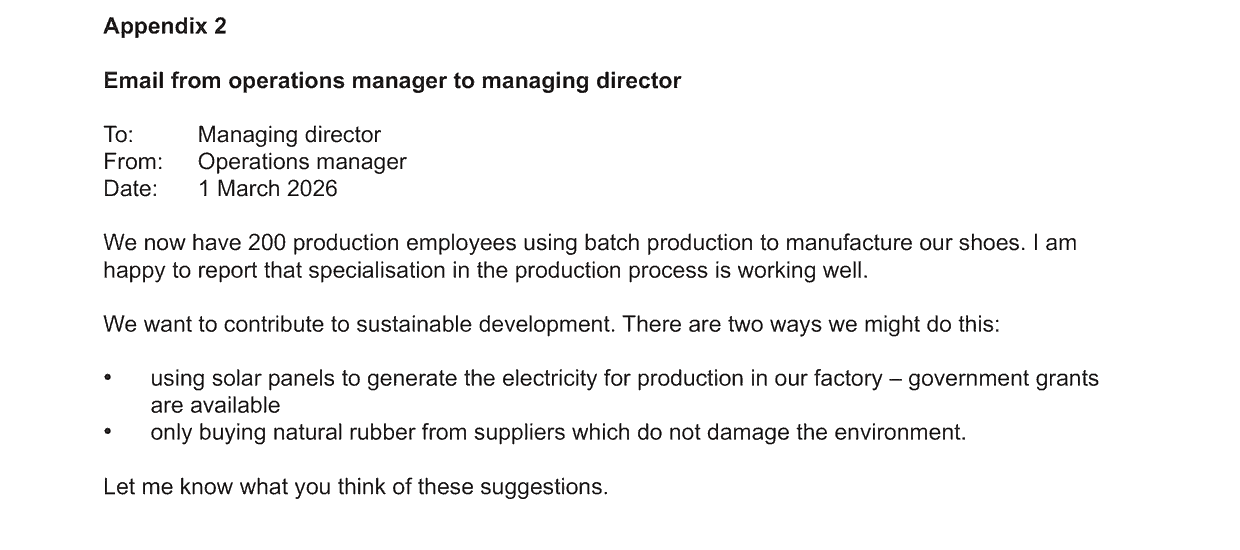
Appendix 2 — referenced by Q2(b)
Email to Kathryn from FF’s Marketing Assistant To: Kathryn From: Marketing Assistant Date: 1 October 2025 Hi Kathryn I have outlined a possible marketing mix for the new larger shop in the centre of Main City. Let me know what you think.
Price – using cost-plus pricing for the wedding flowers as we know not all flowers cost the same.
Place – selling some of our flowers through wedding planners (businesses which plan weddings for customers).
Explain two reasons why FF uses job production. 8 Award 1 mark for reason why FF uses job production (max 2). Award a maximum of 3 additional marks for each explanation of why FF uses job production – one of which must be applied to this context. Reasons might include:
Is suitable for individual/unique products – makes them more competitive – leading to higher revenue/sales
Meets the exact needs of customers – so increases customer satisfaction – increases reputation and word of mouth advertising
The employees have more varied jobs – as may carry out all the tasks to produce the product – increasing employee motivation
A higher price can be charged – as the product is a ‘one-off’ for the customer – willing to pay a higher price for a product that is exactly what they want
Production can be of a higher quality – because each product is individually made For example: The flower shop will produce wedding flower arrangements (app) that are specially designed for customers (1) and more closely meets the exact needs of these customers (1) so is more likely to increase customer recommendations (1). Application could include: new shop/third shop; 2 shops; flowers; source of finance required for working capital; weddings; bride/groom; ribbons; reputation for high quality; contribute to sustainable development; targets a niche market; 4/8 employees at each shop; bride; average price paid is $2000; supplies purchased each day; supplies are fresh; small business; marketing mix for the new shop; social media reviews.
Case study: Tennis and Sports Equipment (TSE)
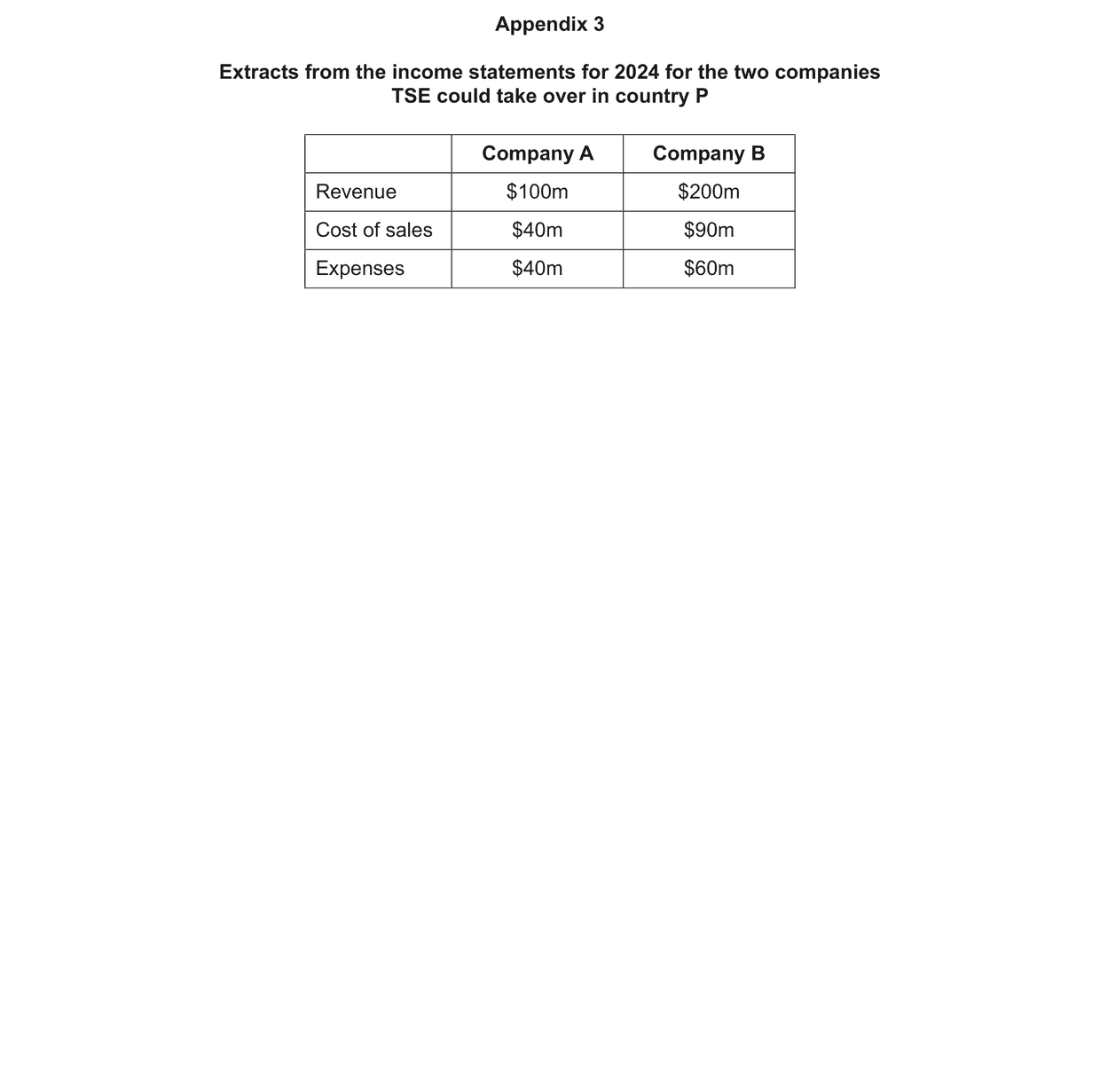
TSE is a successful multinational company. It has its head office in country P. TSE has factories in 10 countries producing its high-quality sports equipment. It sells its products in 30 countries and plans to enter a new market in another country. TSE has many stakeholder groups with different objectives. TSE uses market research in the countries where its products are sold. There are many different sports played in these 30 countries and some sports are popular in only one country. Raw materials, such as plastic and rubber, are used to make the sports equipment. These are often produced near to TSE’s factories. All purchases of raw materials are currently made by the head office in country P. However, TSE’s directors are considering whether to allow the factory managers in each country to purchase raw materials locally. TSE’s Human Resources Director knows that having a well-motivated workforce is important as it reduces absenteeism and lowers labour turnover. Most of TSE’s production employees are skilled and all work full time. Some of TSE’s factories use new technology and have an automated flow production line. However, to remain competitive TSE needs to make sure all of its factories are as efficient as possible. TSE sells 30% of its total output in country P. The directors want to increase market share in country P and plan to take over a competitor. Appendix 3 includes information about two companies TSE could take over.
Appendix 2 — not directly referenced by any question in this paper
Newspaper article from Main News in country P, 1 May 2025 The country has enjoyed several years of increasing economic growth. However, country P is now moving into the recession stage of the business cycle. Businesses will be affected in either positive ways or negative ways. Unemployment is starting to rise and it is expected this will continue for the next year.
Question 2(b)May/Jun 20250450/2212 marks
Consider the following two ways TSE could use to increase efficiency. Which way should TSE use? Justify your answer.
Improving labour skills
Increasing automation and technology Improving labour skills: Increasing automation and technology: Recommendation:
Show mark scheme
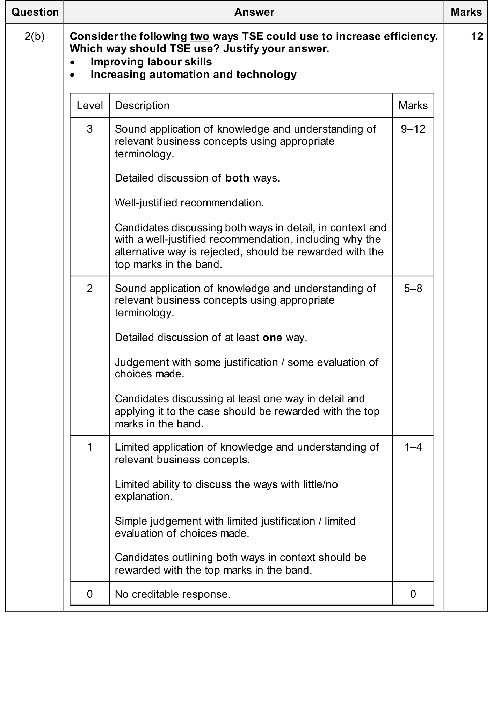
Consider the following two ways TSE could use to increase efficiency. 12 Which way should TSE use? Justify your answer.
Improving labour skills
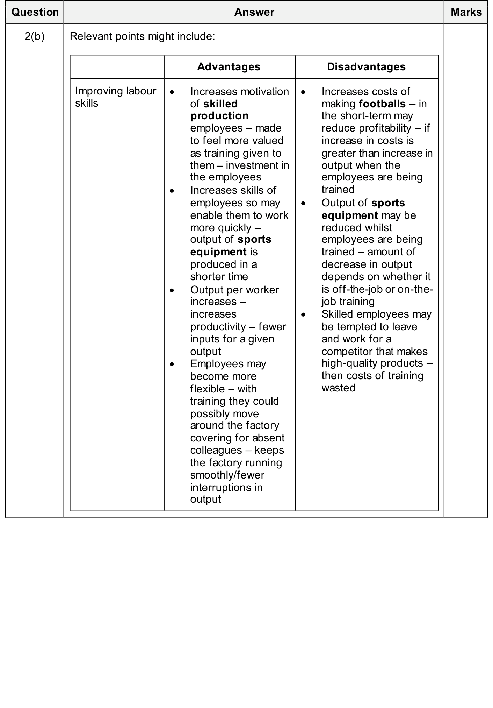
Increasing automation and technology Level Description Marks 3 Sound application of knowledge and understanding of 9–12 relevant business concepts using appropriate terminology. Detailed discussion of both ways. Well-justified recommendation. Candidates discussing both ways in detail, in context and with a well-justified recommendation, including why the alternative way is rejected, should be rewarded with the top marks in the band. 2 Sound application of knowledge and understanding of 5–8 relevant business concepts using appropriate terminology. Detailed discussion of at least one way. Judgement with some justification / some evaluation of choices made. Candidates discussing at least one way in detail and applying it to the case should be rewarded with the top marks in the band. 1 Limited application of knowledge and understanding of 1–4 relevant business concepts. Limited ability to discuss the ways with little/no explanation. Simple judgement with limited justification / limited evaluation of choices made. Candidates outlining both ways in context should be rewarded with the top marks in the band. 0 No creditable response. 0 Relevant points might include: Advantages Disadvantages Improving labour • Increases motivation • Increases costs of skills of skilled making footballs – in production the short-term may employees – made reduce profitability – if to feel more valued increase in costs is as training given to greater than increase in them – investment in output when the the employees employees are being
Increases skills of trained employees so may • Output of sports enable them to work equipment may be more quickly – reduced whilst output of sports employees are being equipment is trained – amount of produced in a decrease in output shorter time depends on whether it
Output per worker is off-the-job or on-the- increases – job training increases • Skilled employees may productivity – fewer be tempted to leave inputs for a given and work for a output competitor that makes
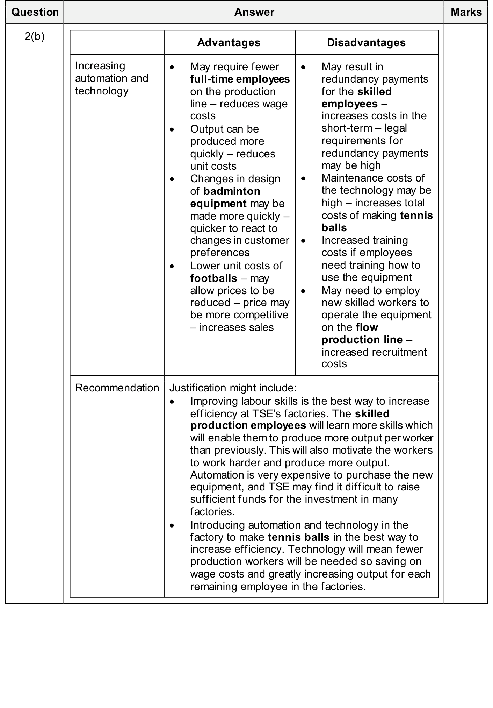
Employees may high-quality products – become more then costs of training flexible – with wasted training they could possibly move around the factory covering for absent colleagues – keeps the factory running smoothly/fewer interruptions in output Advantages Disadvantages Increasing • May require fewer • May result in automation and full-time employees redundancy payments technology on the production for the skilled line – reduces wage employees – costs increases costs in the
Output can be short-term – legal produced more requirements for quickly – reduces redundancy payments unit costs may be high
Changes in design • Maintenance costs of of badminton the technology may be equipment may be high – increases total made more quickly – costs of making tennis quicker to react to balls changes in customer • Increased training preferences costs if employees
Lower unit costs of need training how to footballs – may use the equipment allow prices to be • May need to employ reduced – price may new skilled workers to be more competitive operate the equipment – increases sales on the flow production line – increased recruitment costs Recommendation Justification might include:
Improving labour skills is the best way to increase efficiency at TSE’s factories. The skilled production employees will learn more skills which will enable them to produce more output per worker than previously. This will also motivate the workers to work harder and produce more output. Automation is very expensive to purchase the new equipment, and TSE may find it difficult to raise sufficient funds for the investment in many factories.
Introducing automation and technology in the factory to make tennis balls in the best way to increase efficiency. Technology will mean fewer production workers will be needed so saving on wage costs and greatly increasing output for each remaining employee in the factories.
Case study: Comfy Rugs (CR)
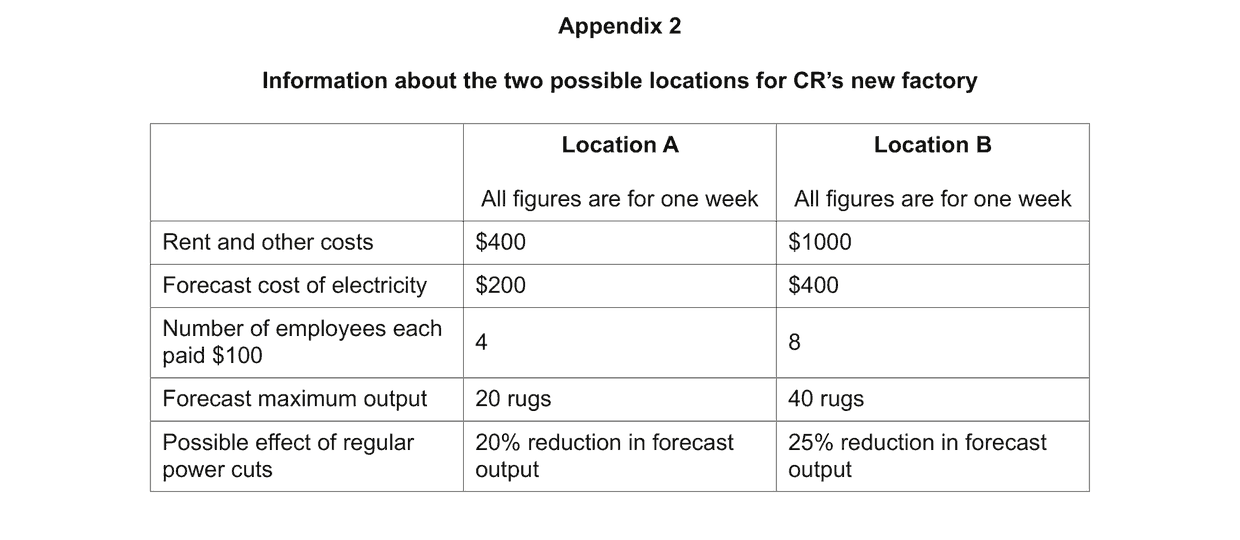
Charly has worked for a large rug manufacturer in country P for 10 years. She is planning to leave and set up her own business later this year. It will be called CR and will make luxury rugs. She knows that new businesses are at a greater risk of failing than existing businesses. Charly has $10 000 of her own money to invest in a factory to make the rugs. She will also need to apply for a $20 000 bank loan. Charly has to decide which type of business organisation to choose for her new business. She could be a sole trader or set up CR as a private limited company. Charly will need to understand the functions of management required to operate CR whichever type of business organisation she chooses. Charly needs to choose a location for her new factory. Appendix 2 has information about two possible locations. She will have to decide the best location to produce her rugs. Charly forecasts that demand for her rugs will be 20 rugs per week in the first year. Charly must decide the best way to sell her luxury rugs when she starts producing them. The three options for CR are as follows:
selling through CR’s own shop
selling online by setting up a website
selling to a wholesaler which sells rugs to many retailers in country P.
Appendix 1 — not directly referenced by any question in this paper
Email from Charly to her accountant To: Accountant From: Charly Date: 1 February 2025 I have been told that I need to produce a cash flow forecast. This will be important because the rugs are expensive to produce. I will need to hold inventory of raw materials as well as finished rugs before they are sold. Please tell me what to include in the cash inflows and cash outflows in the cash flow forecast. I do not want to run out of cash and have to apply for an overdraft. I already plan to take out a bank loan to set up the factory.
Appendix 3 — referenced by Q4(b)
Newspaper article in Main News, 3 January 2025 The government in country P reduced taxes last year to help the economy to grow. For example, the taxes on people’s incomes decreased by 5% and the taxes on business profits decreased by 2%. The government is concerned that the economy is starting to grow too fast. Banks are increasing their interest rates from 4% to 7%. This will have different effects on different businesses in country P.
---
Question 3(a)Feb/Mar 20250450/228 marks
Explain one advantage and one disadvantage of CR holding inventory. Advantage: Explanation: Disadvantage: Explanation:
Show mark scheme
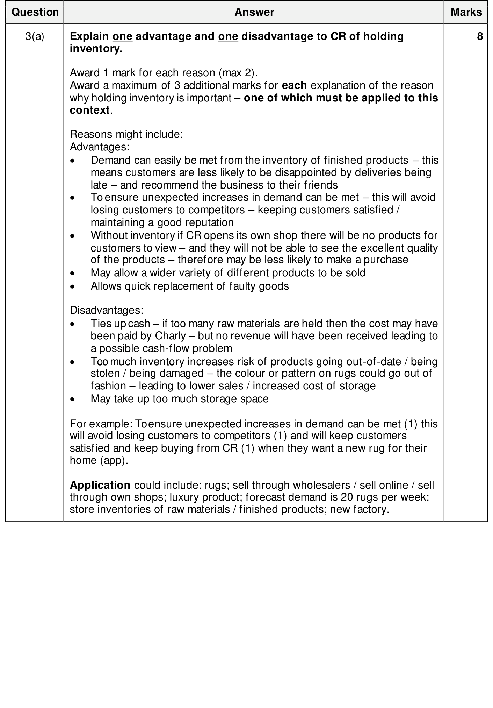
Explain one advantage and one disadvantage to CR of holding 8 inventory. Award 1 mark for each reason (max 2). Award a maximum of 3 additional marks for each explanation of the reason why holding inventory is important – one of which must be applied to this context. Reasons might include: Advantages:
Demand can easily be met from the inventory of finished products – this means customers are less likely to be disappointed by deliveries being late – and recommend the business to their friends
To ensure unexpected increases in demand can be met – this will avoid losing customers to competitors – keeping customers satisfied / maintaining a good reputation
Without inventory if CR opens its own shop there will be no products for customers to view – and they will not be able to see the excellent quality of the products – therefore may be less likely to make a purchase
May allow a wider variety of different products to be sold
Allows quick replacement of faulty goods Disadvantages:
Ties up cash – if too many raw materials are held then the cost may have been paid by Charly – but no revenue will have been received leading to a possible cash-flow problem
Too much inventory increases risk of products going out-of-date / being stolen / being damaged – the colour or pattern on rugs could go out of fashion – leading to lower sales / increased cost of storage
May take up too much storage space For example: To ensure unexpected increases in demand can be met (1) this will avoid losing customers to competitors (1) and will keep customers satisfied and keep buying from CR (1) when they want a new rug for their home (app). Application could include: rugs; sell through wholesalers / sell online / sell through own shops; luxury product; forecast demand is 20 rugs per week; store inventories of raw materials / finished products; new factory.
74 more questions from 2019–2024
🔒 Unlock every Production of goods and services question from 2019–2024
All 74 come with their mark schemes, answers and case studies, and appear in the practice tool above once you’re signed in. It’s free.
0450/11 · Oct/Nov 2024 · Question 1(a)Identify two benefits to a business of… 🔒
0450/12 · Oct/Nov 2024 · Question 2(b)Identify two factors which might affect how… 🔒
0450/12 · Oct/Nov 2024 · Question 2(c)Outline two benefits to SNT of using… 🔒
0450/13 · Oct/Nov 2024 · Question 1(e)Do you think batch production is the… 🔒
0450/21 · Oct/Nov 2024 · Question 3(a)Explain two benefits and two limitations of… 🔒
+ 69 more, by year in the table above
Questions and mark schemes are from past Cambridge papers and are reproduced for revision. Topical Vault is an independent revision resource, not affiliated with or endorsed by Cambridge Assessment International Education.
IGCSE Business questions by topic
Each topic opens this practice tool with only that topic’s questions, plus how often it comes up and every question on it in one list. Revision notes for IGCSE Business →
Pick a paper, sub-topics and years to draw from (leave any blank for "all"), choose
how many questions you want, and we'll open a new worksheet page with a random set for you to review
and download.