← Topical Vault

Analysis of accounts · IGCSE Business

Cambridge 0450 / 0264, Paper 1 & 2. 1,484 questions, 2019 to 2026.

Topic
Year

Every question begins with its business context — a short case for Paper 1, a full case study (shared across all four questions on that paper) for Paper 2. Mark schemes show the typed marking points alongside a cropped image of the official mark scheme page for exact wording.

About Analysis of accounts

Analysing accounts with profitability and liquidity ratios, and who uses accounts and why.

New to Analysis of accounts, or finding these questions hard?

Read the notes first: the key ideas, diagrams and formulas, and the mistakes examiners see most, in about 20 minutes.

Read the Analysis of accounts notes →

54 past paper questions on this topic since 2019, across 18 exam sessions.

How often it comes up

YearPaper 1Paper 2TotalChart
2026213
2025235
2024819
2023426
2022437
2021415
2020549
20197310

Every 2025–2026 question on Analysis of accounts

The whole topic on one page, with answers and mark schemes. Printing this page prints just this list.

Paper 1 · Short answer and structured (4)

Scenario

BTV’s 16 factories use flow production to manufacture cars. Maintaining quality is important. The
managing director is reviewing BTV’s financial data including profit. An extract is shown in Table 3.1.
She knows there are many external users of accounts who are interested in this data.
Table 3.1
Extract from BTV’s financial data - December 2025 ($ million)
non-current assets 700
current assets 90
current liabilities 120
non-current liabilities 300
profit 900

Case material
Question 3(a)May/Jun 20260450/122 marks

Calculate BTV’s current ratio. Show your working. current ratio

Show mark scheme

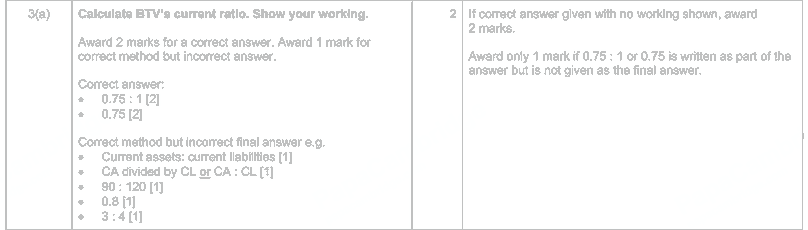
Calculate BTV’s current ratio. Show your working. Award 2 marks for a correct answer. Award 1 mark for correct method but incorrect answer. Correct answer:

  • 0.75 : 1 [2]
  • 0.75 [2] Correct method but incorrect final answer e.g.
  • Current assets: current liabilities [1]
  • CA divided by CL or CA : CL [1]
  • 90 : 120 [1]
  • 0.8 [1]
  • 3 : 4 [1]
Mark scheme, 0450/12 May/Jun 2026 question 3(a)
Question 3(b)May/Jun 20260450/122 marks

Identify two external users of accounts. external user 1 external user 2

Show mark scheme

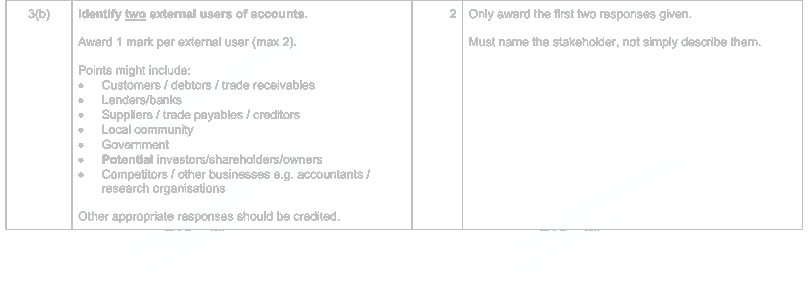
Identify two external users of accounts. Award 1 mark per external user (max 2). Points might include:

  • Customers / debtors / trade receivables
  • Lenders/banks
  • Suppliers / trade payables / creditors
  • Local community
  • Government
  • Potential investors/shareholders/owners
  • Competitors / other businesses e.g. accountants / research organisations Other appropriate responses should be credited.
Mark scheme, 0450/12 May/Jun 2026 question 3(b)
Scenario

KPX manufactures computers. The business imports 60% of its raw materials. The Operations
Director is considering ways to use lean production methods in KPX’s factory. The Finance Director
is reviewing KPX’s financial data to calculate the value of its expenses. An extract is shown in Table
1.1.
Table 1.1
Extract from KPX’s financial data for 2024 ($ million)
Revenue 750
Cost of sales 360
Gross profit 390
Profit 90

Case material
Question 1(c)Oct/Nov 20250450/134 marks

Outline two ways KPX’s Finance Director could use the financial data in Table 1.1. Way 1: Way 2:

Show mark scheme

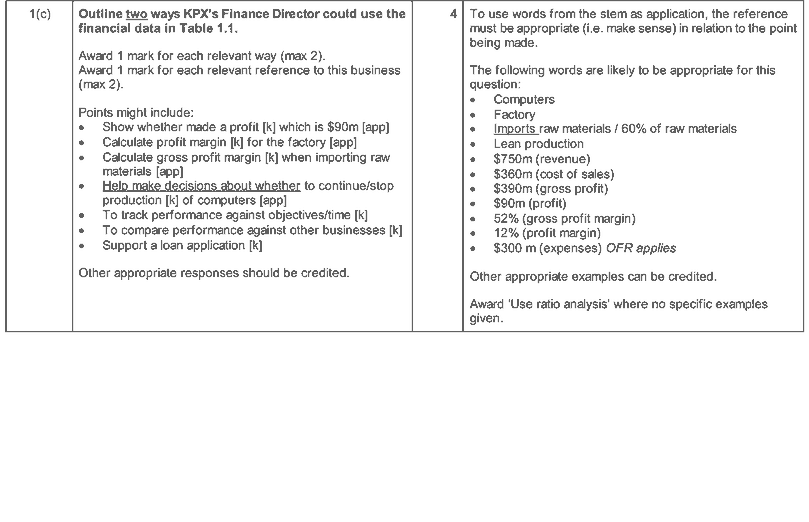
Outline two ways KPX’s Finance Director could use the financial data in Table 1.1. Award 1 mark for each relevant way (max 2). Award 1 mark for each relevant reference to this business (max 2). Points might include:

  • Show whether made a profit [k] which is $90m [app]
  • Calculate profit margin [k] for the factory [app]
  • Calculate gross profit margin [k] when importing raw materials [app]
  • Help make decisions about whether to continue/stop production [k] of computers [app]
  • To track performance against objectives/time [k]
  • To compare performance against other businesses [k]
  • Support a loan application [k] Other appropriate responses should be credited.
Mark scheme, 0450/13 Oct/Nov 2025 question 1(c)
Scenario

TJK manufactures candles. Contributing to sustainable development is important to TJK. The
business uses batch production in its factory in country X. The target market for TJK’s products is
females between 20 and 50 years of age. The Managing Director is reviewing TJK’s financial data.
An extract is shown in Table 3.1. He is also considering the benefits to a business of becoming a
multinational company.
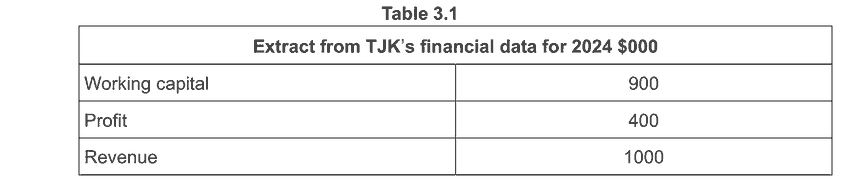
Table 3.1
Extract from TJK’s financial data for 2024 $000
Working capital 900
Profit 400
Revenue 1000

Case material
Question 3(b)Feb/Mar 20250450/122 marks

Calculate TJK’s profit margin. Show your working. Working: Final answer:

Show mark scheme

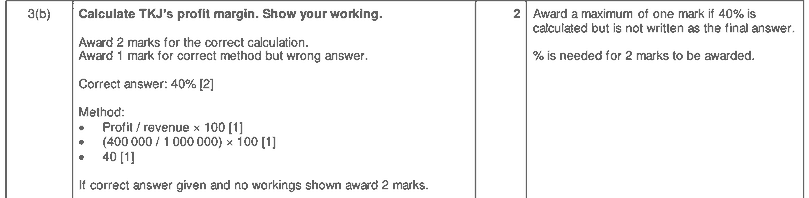
Calculate TKJ’s profit margin. Show your working. Award 2 marks for the correct calculation. Award 1 mark for correct method but wrong answer. Correct answer: 40% [2] Method:

  • Profit / revenue  100 [1]
  • (400 000 / 1 000 000)  100 [1]
  • 40 [1] If correct answer given and no workings shown award 2 marks.
Mark scheme, 0450/12 Feb/Mar 2025 question 3(b)

Paper 2 · Case study (4)

Case study: Kitty’s Homeshoes (KH)

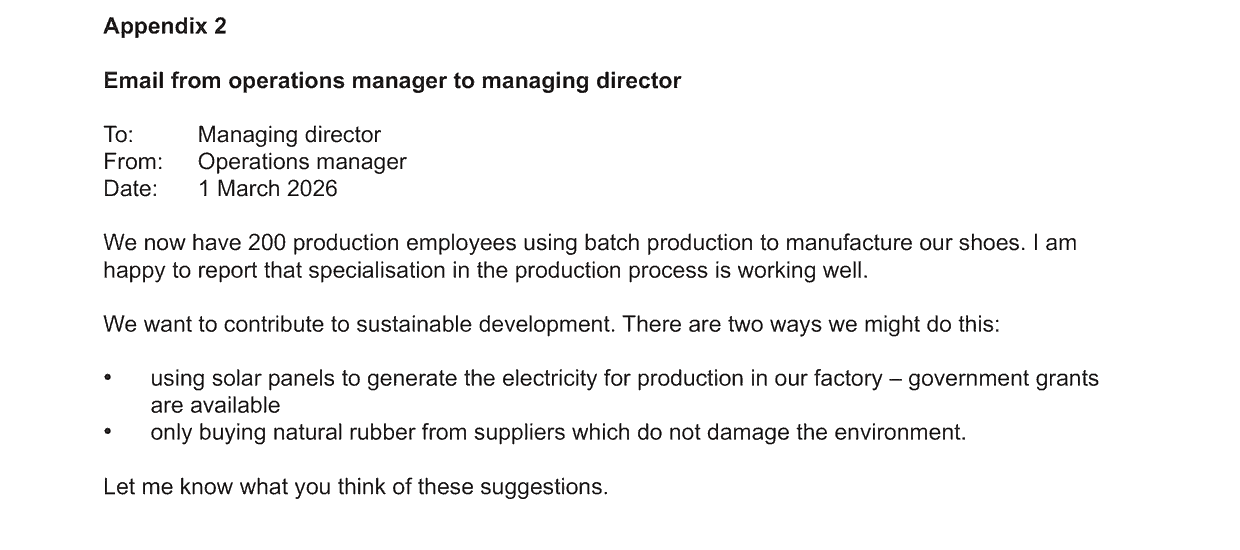
KH is a private limited company. It manufactures shoes for people with large feet. People with large feet often find it difficult to buy shoes to fit them. KH started producing shoes for this niche market 10 years ago. KH has a good brand image and charges a high price for its shoes. The marketing director has produced an advertisement for its current products shown in Appendix 1. She knows it is important that the advertisement meets all the legal controls on marketing. KH’s shoes are made from imported high-quality natural rubber extracted from trees. KH’s suppliers have cleared forests to grow their rubber trees. Pressure groups have been posting their concerns on social media. KH has started to sell its shoes online which has increased its sales. KH’s managing director wants to expand the business and plans to build a second factory. A new operations manager will need to be recruited. Internal or external recruitment could be used for this position. All KH’s managers are encouraged to use delegation. KH’s marketing director is considering whether to produce shoes of all sizes and to start selling to a mass market. If KH starts selling to a mass market many changes will need to be made.

Appendix 1
Appendix 2
Appendix 3
Question 4(b)May/Jun 20260450/2312 marks

Using Appendix 3 and other information, consider KH’s financial position and that of its main competitor. Which business was in a better financial position in 2025? Justify your answer using suitable calculations. KH’s financial position main competitor’s financial position conclusion

Show mark scheme

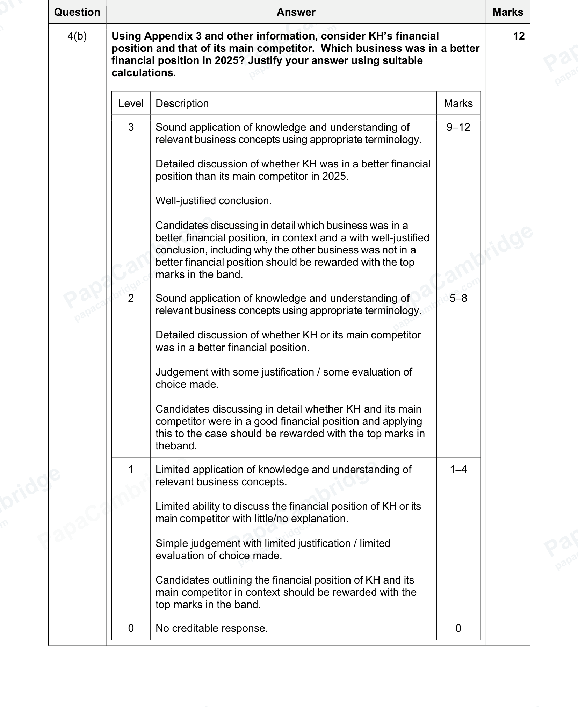
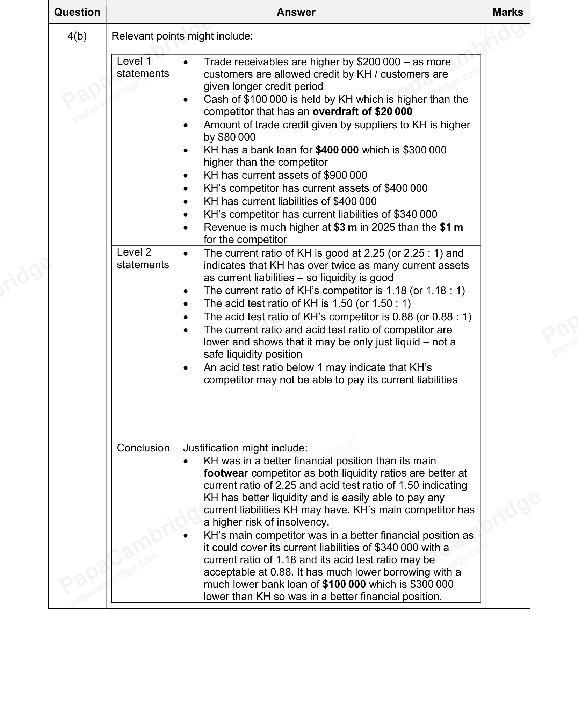
Using Appendix 3 and other information, consider KH’s financial 12 position and that of its main competitor. Which business was in a better financial position in 2025? Justify your answer using suitable calculations. Level Description Marks 3 Sound application of knowledge and understanding of 9–12 relevant business concepts using appropriate terminology. Detailed discussion of whether KH was in a better financial position than its main competitor in 2025. Well-justified conclusion. Candidates discussing in detail which business was in a better financial position, in context and a with well-justified conclusion, including why the other business was not in a better financial position should be rewarded with the top marks in the band. 2 Sound application of knowledge and understanding of 5–8 relevant business concepts using appropriate terminology. Detailed discussion of whether KH or its main competitor was in a better financial position. Judgement with some justification / some evaluation of choice made. Candidates discussing in detail whether KH and its main competitor were in a good financial position and applying this to the case should be rewarded with the top marks in the band. 1 Limited application of knowledge and understanding of 1–4 relevant business concepts. Limited ability to discuss the financial position of KH or its main competitor with little/no explanation. Simple judgement with limited justification / limited evaluation of choice made. Candidates outlining the financial position of KH and its main competitor in context should be rewarded with the top marks in the band. 0 No creditable response. 0 Relevant points might include: Level 1 • Trade receivables are higher by $200 000 – as more statements customers are allowed credit by KH / customers are given longer credit period

  • Cash of $100 000 is held by KH which is higher than the competitor that has an overdraft of $20 000
  • Amount of trade credit given by suppliers to KH is higher by $80 000
  • KH has a bank loan for $400 000 which is $300 000 higher than the competitor
  • KH has current assets of $900 000
  • KH’s competitor has current assets of $400 000
  • KH has current liabilities of $400 000
  • KH’s competitor has current liabilities of $340 000
  • Revenue is much higher at $3 m in 2025 than the $1 m for the competitor Level 2 • The current ratio of KH is good at 2.25 (or 2.25 : 1) and statements indicates that KH has over twice as many current assets as current liabilities – so liquidity is good
  • The current ratio of KH’s competitor is 1.18 (or 1.18 : 1)
  • The acid test ratio of KH is 1.50 (or 1.50 : 1)
  • The acid test ratio of KH’s competitor is 0.88 (or 0.88 : 1)
  • The current ratio and acid test ratio of competitor are lower and shows that it may be only just liquid – not a safe liquidity position
  • An acid test ratio below 1 may indicate that KH’s competitor may not be able to pay its current liabilities Conclusion Justification might include:
  • KH was in a better financial position than its main footwear competitor as both liquidity ratios are better at current ratio of 2.25 and acid test ratio of 1.50 indicating KH has better liquidity and is easily able to pay any current liabilities KH may have. KH’s main competitor has a higher risk of insolvency.
  • KH’s main competitor was in a better financial position as it could cover its current liabilities of $340 000 with a current ratio of 1.18 and its acid test ratio may be acceptable at 0.88. It has much lower borrowing with a much lower bank loan of $100 000 which is $300 000 lower than KH so was in a better financial position.
Mark scheme, 0450/23 May/Jun 2026 question 4(b) (page 1 of 2)
Mark scheme, 0450/23 May/Jun 2026 question 4(b) (page 2 of 2)
Case study: Exceptional Sailing (ES)

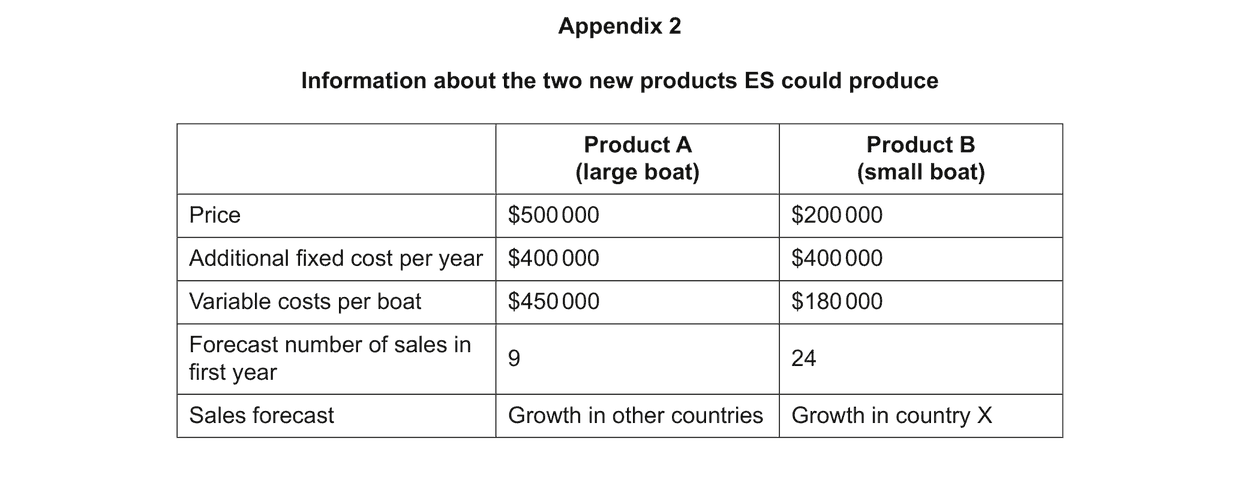
Tim worked at a large boat manufacturer in country X for 20 years. He is highly skilled in building boats. Tim decided to start his own business, called ES, 4 years ago. He currently operates as a sole trader. ES only makes and sells boats in country X. It has become established as a well-known brand with a reputation for high quality. ES has 12 skilled employees including an assistant who helps Tim to run the business. ES has a flat organisational structure with a short chain of command. ES has grown quickly and Tim plans to expand the business further by selling his boats to customers in other countries. He is aware that there are opportunities and threats of globalisation, especially as tariffs and quotas on boats and their component parts have been removed both in country X and in other countries. Tim plans to take out a bank loan to help fund the expansion. His two brothers will also invest in the business. One of his brothers has experience of financial management and the other is skilled in IT. Tim will need to decide whether ES should become a partnership or a private limited company. Tim wants to manufacture a new boat and he will need to choose between Product A and Product B. Information about the two new boats is shown in Appendix 2. ES currently promotes its boats in sailing magazines. Tim is considering using social media to promote his new boat to a wider market. Tim will need to recruit 4 new employees. These new employees will require training and Tim has to decide whether to train them at ES or send them to college two days a week.

Appendix 1
Appendix 2

Appendix 3 — referenced by Q4(a)

Email from Tim to his two brothers To: My two brothers From: Tim Date: 1 October 2025 I am pleased that you have both decided to invest in the business. I know that it will be good to work together and make decisions about the growth of ES. I have included some financial information for 2024.

  • Revenue increased by 50%
  • Gross profit margin was 65%
  • Profit was $100 000
  • Current ratio was 2
  • Acid test ratio was 0.5

---

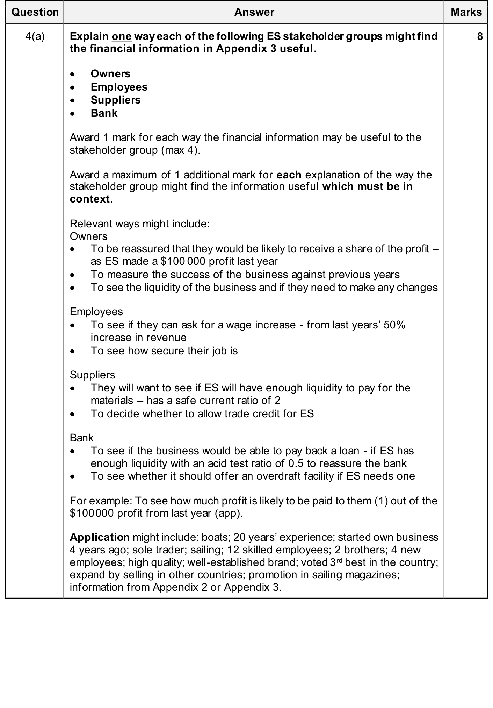
Question 4(a)Oct/Nov 20250450/238 marks

Explain one way each of the following ES stakeholder groups might find the financial information in Appendix 3 useful. Owners: Employees: Suppliers: Bank:

Show mark scheme

Explain one way each of the following ES stakeholder groups might find 8 the financial information in Appendix 3 useful.

  • Owners
  • Employees
  • Suppliers
  • Bank Award 1 mark for each way the financial information may be useful to the stakeholder group (max 4). Award a maximum of 1 additional mark for each explanation of the way the stakeholder group might find the information useful which must be in context. Relevant ways might include: Owners
  • To be reassured that they would be likely to receive a share of the profit – as ES made a $100 000 profit last year
  • To measure the success of the business against previous years
  • To see the liquidity of the business and if they need to make any changes Employees
  • To see if they can ask for a wage increase - from last years’ 50% increase in revenue
  • To see how secure their job is Suppliers
  • They will want to see if ES will have enough liquidity to pay for the materials – has a safe current ratio of 2
  • To decide whether to allow trade credit for ES Bank
  • To see if the business would be able to pay back a loan - if ES has enough liquidity with an acid test ratio of 0.5 to reassure the bank
  • To see whether it should offer an overdraft facility if ES needs one For example: To see how much profit is likely to be paid to them (1) out of the $100 000 profit from last year (app). Application might include: boats; 20 years’ experience; started own business 4 years ago; sole trader; sailing; 12 skilled employees; 2 brothers; 4 new employees; high quality; well-established brand; voted 3rd best in the country; expand by selling in other countries; promotion in sailing magazines; information from Appendix 2 or Appendix 3.
Mark scheme, 0450/23 Oct/Nov 2025 question 4(a)
Case study: Philip Flop (PF)

Philip started PF 10 years ago as a sole trader in country X. PF makes shoes out of natural rubber. Philip used $100 000 of his own money to start up PF. The business has been very successful. Last year Philip changed PF from a sole trader business to a private limited company because he wanted to grow the business. PF employs 20 workers to make the shoes. They are paid a weekly wage based on the number of hours worked. Philip often has to recruit new production workers as the jobs are boring. Other local businesses pay a higher wage for similar work. Philip needs to improve the motivation of PF’s employees and has to decide the best way to do this. Philip wants to build a new factory. This factory will produce a new range of shoes. PF’s products will still be made from natural rubber which is grown in the local area. The bank has agreed to provide a loan to finance the building of the new factory. Philip needs to choose a suitable location for the new factory and is considering the following factors:

  • availability of raw materials
  • transport links
  • government influence. PF operates in a very competitive market. Philip will need to make a decision about how to promote the new range of shoes in a mass market. Philip’s sister is a successful entrepreneur and is considering investing in PF. She is using the extracts from PF’s statements of financial position, shown in Appendix 3, to help her decide.
Appendix 1

Appendix 2 — referenced by Q4(a)

Newspaper article from Main News in country X, 2 April 2025 The government is increasing tax rates on people’s incomes and on business profits. The tax on people’s incomes will increase by 2% and the tax on profits made by businesses will increase by 4%. These increases will be introduced next month. No further tax increases are planned.

Appendix 3
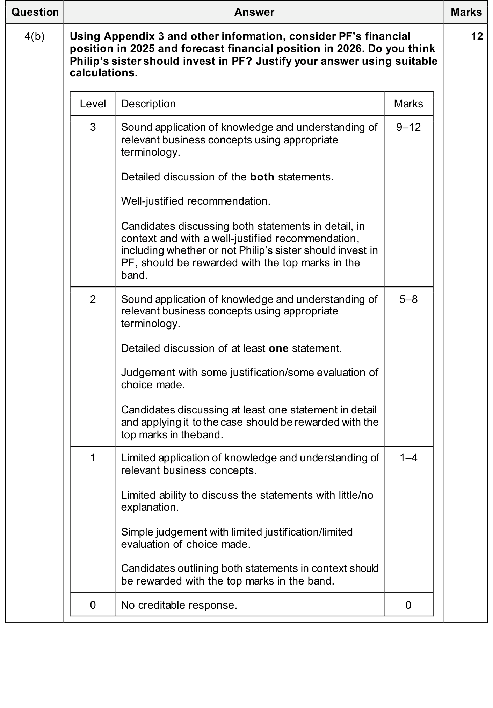
Question 4(b)May/Jun 20250450/2112 marks

Using Appendix 3 and other information, consider PF’s financial position in 2025 and forecast financial position in 2026. Do you think Philip’s sister should invest in PF? Justify your answer using suitable calculations. 2025: 2026 (forecast): Recommendation:

Show mark scheme

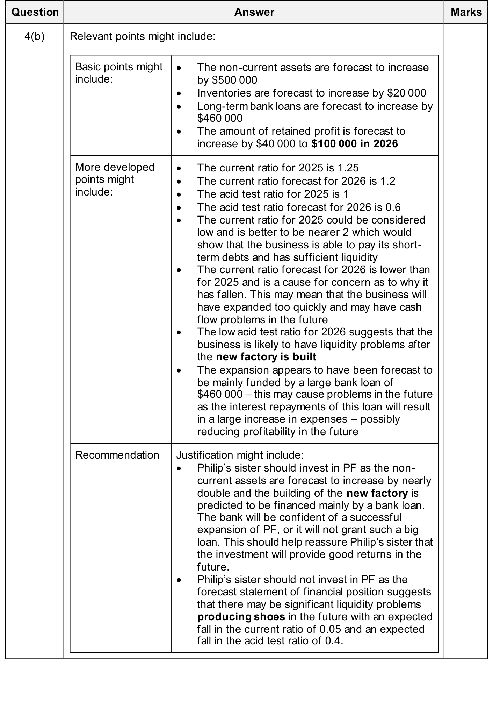
Using Appendix 3 and other information, consider PF’s financial 12 position in 2025 and forecast financial position in 2026. Do you think Philip’s sister should invest in PF? Justify your answer using suitable calculations. Level Description Marks 3 Sound application of knowledge and understanding of 9–12 relevant business concepts using appropriate terminology. Detailed discussion of the both statements. Well-justified recommendation. Candidates discussing both statements in detail, in context and with a well-justified recommendation, including whether or not Philip’s sister should invest in PF, should be rewarded with the top marks in the band. 2 Sound application of knowledge and understanding of 5–8 relevant business concepts using appropriate terminology. Detailed discussion of at least one statement. Judgement with some justification/some evaluation of choice made. Candidates discussing at least one statement in detail and applying it to the case should be rewarded with the top marks in the band. 1 Limited application of knowledge and understanding of 1–4 relevant business concepts. Limited ability to discuss the statements with little/no explanation. Simple judgement with limited justification/limited evaluation of choice made. Candidates outlining both statements in context should be rewarded with the top marks in the band. 0 No creditable response. 0 Relevant points might include: Basic points might • The non-current assets are forecast to increase include: by $500 000

  • Inventories are forecast to increase by $20 000
  • Long-term bank loans are forecast to increase by $460 000
  • The amount of retained profit is forecast to increase by $40 000 to $100 000 in 2026 More developed • The current ratio for 2025 is 1.25 points might • The current ratio forecast for 2026 is 1.2 include: • The acid test ratio for 2025 is 1
  • The acid test ratio forecast for 2026 is 0.6
  • The current ratio for 2025 could be considered low and is better to be nearer 2 which would show that the business is able to pay its short- term debts and has sufficient liquidity
  • The current ratio forecast for 2026 is lower than for 2025 and is a cause for concern as to why it has fallen. This may mean that the business will have expanded too quickly and may have cash flow problems in the future
  • The low acid test ratio for 2026 suggests that the business is likely to have liquidity problems after the new factory is built
  • The expansion appears to have been forecast to be mainly funded by a large bank loan of $460 000 – this may cause problems in the future as the interest repayments of this loan will result in a large increase in expenses – possibly reducing profitability in the future Recommendation Justification might include:
  • Philip’s sister should invest in PF as the non- current assets are forecast to increase by nearly double and the building of the new factory is predicted to be financed mainly by a bank loan. The bank will be confident of a successful expansion of PF, or it will not grant such a big loan. This should help reassure Philip’s sister that the investment will provide good returns in the future.
  • Philip’s sister should not invest in PF as the forecast statement of financial position suggests that there may be significant liquidity problems producing shoes in the future with an expected fall in the current ratio of 0.05 and an expected fall in the acid test ratio of 0.4.
Mark scheme, 0450/21 May/Jun 2025 question 4(b) (page 1 of 2)
Mark scheme, 0450/21 May/Jun 2025 question 4(b) (page 2 of 2)
Case study: Vegan Veg (VV)

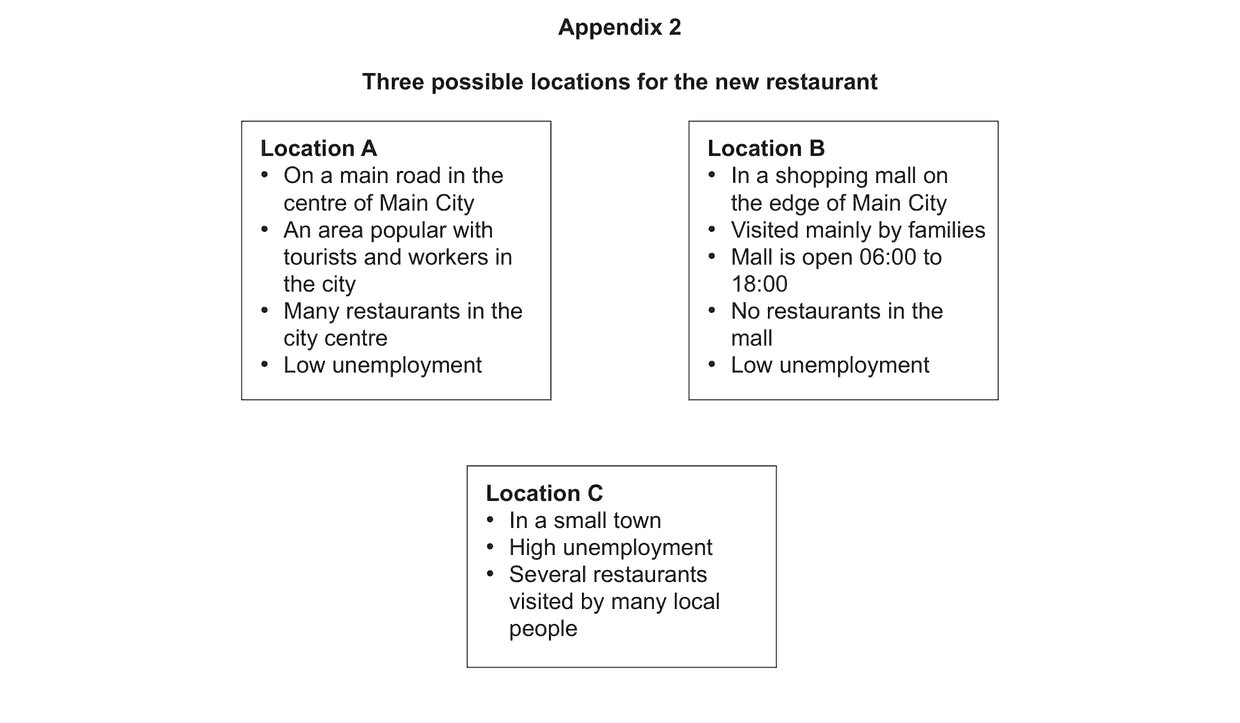
Jemi has always wanted to own a business. She is planning to buy a franchise called VV, a restaurant brand that only serves vegan meals. The meals do not contain any ingredients made from animal products. Market segmentation is important to VV. There has been an increasing trend for people to eat vegan meals. Jemi will need to decide the best location for her restaurant. There are three possible locations outlined in Appendix 2. The restaurant will serve a wide range of vegan meals and Jemi will purchase ingredients, including fruit and vegetables, directly from local suppliers. Jemi will employ a chef to cook the meals. The chef will be expected to work 40 hours a week. Jemi has identified the two best applicants. Their details are shown in Appendix 1. As well as a chef, Jemi plans to employ another 3 people to help in the kitchen and 8 people to serve customers in the restaurant. Jemi knows that keeping these employees motivated will be important. She is considering using job enrichment or giving a discount on meals in the restaurant to keep her employees motivated. Jemi is going to use her own capital of $50 000 to buy the franchise, but she will also need a source of external finance to help set up the business. Jemi knows that the profitability and liquidity ratios for her restaurant will be important for the success of her business.

Appendix 1
Appendix 2

Appendix 3 — referenced by Q4(a)

Newspaper article from Main News, 3 May 2025 A recent government report said that everyone should be eating more fruit and vegetables. It found that this is particularly important to help keep children healthy and to live a long life. Eating less meat is also good for the environment. Five years ago, only 10% of the population ate vegan meals but this percentage has increased to 25%. It is forecast that this trend will continue. Many well-known restaurants are adding vegan meals to their menus. There are also new vegan restaurants being opened. However, it is getting more difficult to find reliable suppliers of fruit and vegetables. Restaurants are now having to buy from suppliers that are further away.

---

Question 3(b)May/Jun 20250450/2312 marks

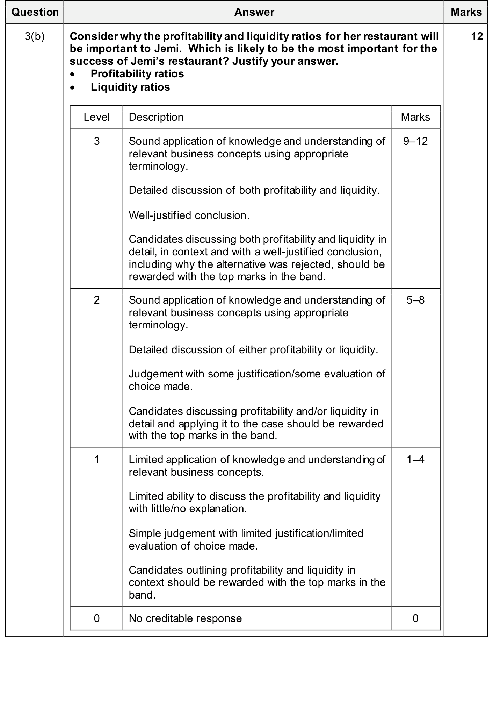
Consider why the profitability and liquidity ratios for her restaurant will be important to Jemi. Which is likely to be the most important for the success of Jemi’s restaurant? Justify your answer. Profitability ratios: Liquidity ratios: Conclusion:

Show mark scheme

Consider why the profitability and liquidity ratios for her restaurant will 12 be important to Jemi. Which is likely to be the most important for the success of Jemi’s restaurant? Justify your answer.

  • Profitability ratios
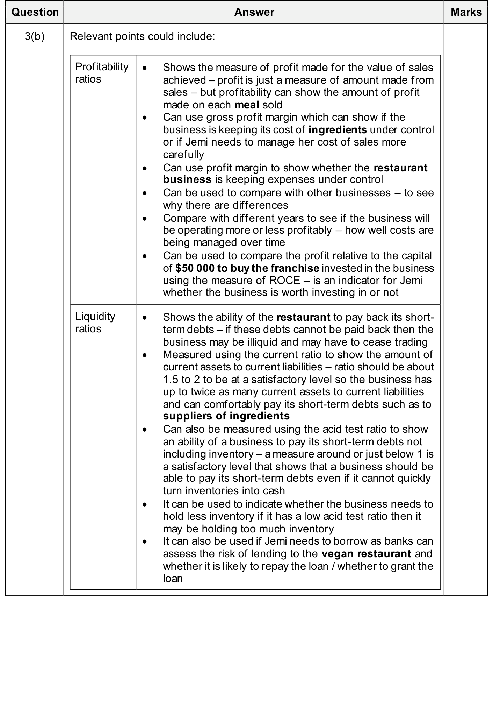
  • Liquidity ratios Level Description Marks 3 Sound application of knowledge and understanding of 9–12 relevant business concepts using appropriate terminology. Detailed discussion of both profitability and liquidity. Well-justified conclusion. Candidates discussing both profitability and liquidity in detail, in context and with a well-justified conclusion, including why the alternative was rejected, should be rewarded with the top marks in the band. 2 Sound application of knowledge and understanding of 5–8 relevant business concepts using appropriate terminology. Detailed discussion of either profitability or liquidity. Judgement with some justification/some evaluation of choice made. Candidates discussing profitability and/or liquidity in detail and applying it to the case should be rewarded with the top marks in the band. 1 Limited application of knowledge and understanding of 1–4 relevant business concepts. Limited ability to discuss the profitability and liquidity with little/no explanation. Simple judgement with limited justification/limited evaluation of choice made. Candidates outlining profitability and liquidity in context should be rewarded with the top marks in the band. 0 No creditable response 0 Relevant points could include: Profitability • Shows the measure of profit made for the value of sales ratios achieved – profit is just a measure of amount made from sales – but profitability can show the amount of profit made on each meal sold
  • Can use gross profit margin which can show if the business is keeping its cost of ingredients under control or if Jemi needs to manage her cost of sales more carefully
  • Can use profit margin to show whether the restaurant business is keeping expenses under control
  • Can be used to compare with other businesses – to see why there are differences
  • Compare with different years to see if the business will be operating more or less profitably – how well costs are being managed over time
  • Can be used to compare the profit relative to the capital of $50 000 to buy the franchise invested in the business using the measure of ROCE – is an indicator for Jemi whether the business is worth investing in or not Liquidity • Shows the ability of the restaurant to pay back its short- ratios term debts – if these debts cannot be paid back then the business may be illiquid and may have to cease trading
  • Measured using the current ratio to show the amount of current assets to current liabilities – ratio should be about 1.5 to 2 to be at a satisfactory level so the business has up to twice as many current assets to current liabilities and can comfortably pay its short-term debts such as to suppliers of ingredients
  • Can also be measured using the acid test ratio to show an ability of a business to pay its short-term debts not including inventory – a measure around or just below 1 is a satisfactory level that shows that a business should be able to pay its short-term debts even if it cannot quickly turn inventories into cash
  • It can be used to indicate whether the business needs to hold less inventory if it has a low acid test ratio then it may be holding too much inventory
  • It can also be used if Jemi needs to borrow as banks can assess the risk of lending to the vegan restaurant and whether it is likely to repay the loan / whether to grant the loan Conclusion Justification might include:
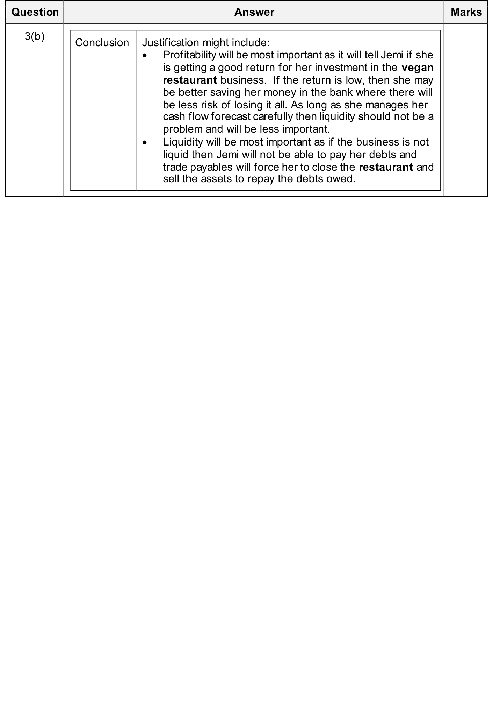
  • Profitability will be most important as it will tell Jemi if she is getting a good return for her investment in the vegan restaurant business. If the return is low, then she may be better saving her money in the bank where there will be less risk of losing it all. As long as she manages her cash flow forecast carefully then liquidity should not be a problem and will be less important.
  • Liquidity will be most important as if the business is not liquid then Jemi will not be able to pay her debts and trade payables will force her to close the restaurant and sell the assets to repay the debts owed.
Mark scheme, 0450/23 May/Jun 2025 question 3(b) (page 1 of 3)
Mark scheme, 0450/23 May/Jun 2025 question 3(b) (page 2 of 3)
Mark scheme, 0450/23 May/Jun 2025 question 3(b) (page 3 of 3)

46 more questions from 2019–2024

🔒 Unlock every Analysis of accounts question from 2019–2024

All 46 come with their mark schemes, answers and case studies, and appear in the practice tool above once you’re signed in. It’s free.

Create a free accountSign in

A few of them

  • 0450/11 · Oct/Nov 2024 · Question 3(a)Define… 🔒
  • 0450/11 · Oct/Nov 2024 · Question 3(b)Calculate JTA’s return on capital… 🔒
  • 0450/12 · Oct/Nov 2024 · Question 3(b)Calculate HRO’s… 🔒
  • 0450/13 · Oct/Nov 2024 · Question 4(b)Identify two external users… 🔒
  • 0450/22 · Oct/Nov 2024 · Question 4(b)Using Appendix 3 and other information, consider… 🔒
  • + 41 more, by year in the table above

Questions and mark schemes are from past Cambridge papers and are reproduced for revision. Topical Vault is an independent revision resource, not affiliated with or endorsed by Cambridge Assessment International Education.

IGCSE Business questions by topic

Each topic opens this practice tool with only that topic’s questions, plus how often it comes up and every question on it in one list. Revision notes for IGCSE Business →

  1. Ch 1Business activity
  2. Ch 2Classification of businesses
  3. Ch 3Enterprise, business growth and size
  4. Ch 4Types of business organisation
  5. Ch 5Business objectives and stakeholder objectives
  6. Ch 6Motivating employees
  7. Ch 7Organisation and management
  8. Ch 8Recruitment, selection and training of employees
  9. Ch 9Internal and external communication
  10. Ch 10Marketing, competition and the customer
  11. Ch 11Market research
  12. Ch 12The marketing mix: product
  13. Ch 13The marketing mix: price
  14. Ch 14The marketing mix: place
  15. Ch 15The marketing mix: promotion
  16. Ch 16Technology and the marketing mix
  17. Ch 17Marketing strategy
  18. Ch 18Production of goods and services
  19. Ch 19Costs, scale of production and break-even analysis
  20. Ch 20Achieving quality production
  21. Ch 21Location decisions
  22. Ch 22Business finance: needs and sources
  23. Ch 23Cash flow forecasting and working capital
  24. Ch 24Income statements
  25. Ch 25Statement of financial position
  26. Ch 26Analysis of accounts
  27. Ch 27Economic issues
  28. Ch 28Environmental and ethical issues
  29. Ch 29Business and the international economy