← Topical Vault

Classification of businesses · IGCSE Business

Cambridge 0450 / 0264, Paper 1 & 2. 1,484 questions, 2019 to 2026.

Topic
Year

Every question begins with its business context — a short case for Paper 1, a full case study (shared across all four questions on that paper) for Paper 2. Mark schemes show the typed marking points alongside a cropped image of the official mark scheme page for exact wording.

About Classification of businesses

Classifying businesses into primary, secondary and tertiary sectors, the public and private sectors, and why the importance of each sector changes as an economy develops.

New to Classification of businesses, or finding these questions hard?

Read the notes first: the key ideas, diagrams and formulas, and the mistakes examiners see most, in about 9 minutes.

Read the Classification of businesses notes →

21 past paper questions on this topic since 2019, across 15 exam sessions.

How often it comes up

YearPaper 1Paper 2TotalChart
2026202
2025404
2024404
2023202
2022202
2021314
2020202
2019011

Every 2025–2026 question on Classification of businesses

The whole topic on one page, with answers and mark schemes. Printing this page prints just this list.

Paper 1 · Short answer and structured (6)

Scenario

BRK is a copper mining business which operates in the primary sector. It is a multinational company (MNC) with mines in 15 countries. As a large business BRK benefits from economies of scale. BRK’s managing director knows the business creates many external costs. He said: ‘I often have to respond to the actions of pressure groups who try to influence BRK’s decisions. However, it is important to recognise that a business can create external benefits.’

Question 4(a)May/Jun 20260450/122 marks

Define ‘primary sector’.

Show mark scheme

Define ‘primary sector’. Award 2 marks for a full definition. Award 1 mark for a partial definition.

  • (Businesses/firms whose business activity) involves the extraction of raw materials [2]
  • Extracts (and uses) the natural resources (of the earth to produce raw materials used by other businesses). [2]
  • The sector that generates raw materials (which the secondary sector then uses to make a product) [2] Partial definition e.g.
  • Produces/collects/gets/removes raw/natural materials (from the earth) [1]
  • Sells natural/raw materials [1]
Mark scheme, 0450/12 May/Jun 2026 question 4(a)
Scenario

LMB provides healthcare services for people aged 70 years and above. It is a large public sector business which is continuing to grow. The human resources manager has started the recruitment process for 500 additional employees. He is also planning on-the-job training for all LMB’s employees. The business uses email as its main method of communication. The human resources manager knows that there are many benefits to a business of having a well-motivated workforce.

Question 2(a)Feb/Mar 20260450/122 marks

Define ‘public sector business’.

Show mark scheme

Define ‘public sector business'. Award 2 marks for a full definition. Award 1 mark for a partial definition.

  • State/government owned (and controlled) business(es) [2] Partial definition, e.g.
  • Run/managed by the government [1]
Mark scheme, 0450/12 Feb/Mar 2026 question 2(a)
Scenario

WMH is a business which operates in the secondary sector. It makes furniture including tables and chairs. WMH’s employees are all members of a trade union. The Managing Director knows the business is likely to remain small. She is considering introducing new technology into WMH’s factory. She also knows it is important for a manufacturing business to choose a suitable location for a factory.

Question 1(b)Oct/Nov 20250450/112 marks

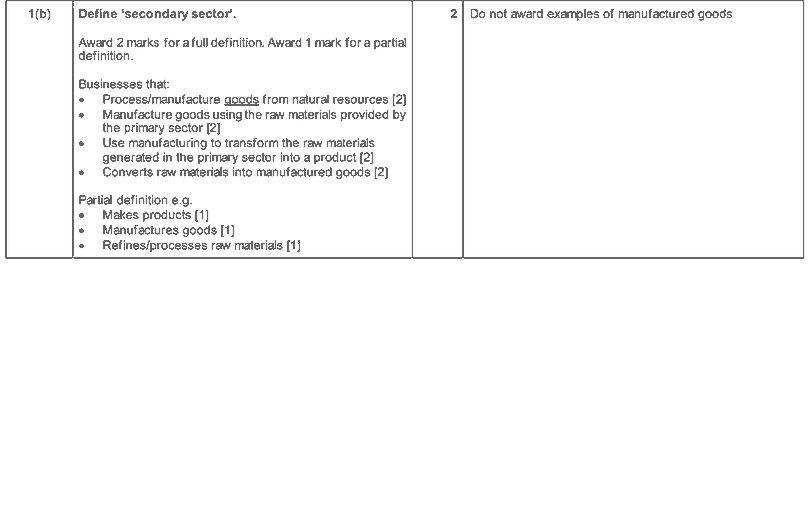
Define ‘secondary sector’.

Show mark scheme

Define ‘secondary sector’. Award 2 marks for a full definition. Award 1 mark for a partial definition. Businesses that:

  • Process/manufacture goods from natural resources [2]
  • Manufacture goods using the raw materials provided by the primary sector [2]
  • Use manufacturing to transform the raw materials generated in the primary sector into a product [2]
  • Converts raw materials into manufactured goods [2] Partial definition e.g.
  • Makes products [1]
  • Manufactures goods [1]
  • Refines/processes raw materials [1]
Mark scheme, 0450/11 Oct/Nov 2025 question 1(b)
Scenario

ZPR is a business in the tertiary sector. It has 1 restaurant which has 20 employees. The Human Resources Manager is preparing a job description as ZPR needs 2 new chefs. He said: ‘I need to advertise the job vacancies externally. ZPR will use a range of financial rewards as it can be difficult to recruit employees.’ The manager knows there are many factors for a business to consider when deciding who to recruit.

Question 4(a)Oct/Nov 20250450/132 marks

Define ‘tertiary sector’.

Show mark scheme

Define ‘tertiary sector’. Award 2 marks for a full definition. Award 1 mark for a partial definition.

  • Industry/industries which provide services to consumers/customers and/or other sectors of the economy [2]
  • Businesses that supply a service to consumers and/or other businesses [2] Partial definition e.g.
  • Provide services [1]
Mark scheme, 0450/13 Oct/Nov 2025 question 4(a)
Scenario

Hal wants to be a successful entrepreneur. He plans to leave his job to start up a bakery. The bakery will operate in the private sector. The business will have many stakeholder groups. Hal has been told it is important for a new business to select an appropriate source of start-up capital. He also knows new businesses are at a greater risk of failure.

Question 3(a)May/Jun 20250450/122 marks

Define ‘private sector’.

Show mark scheme

Define ‘private sector’. Award 2 marks for a full definition. Award 1 mark for a partial definition.

  • (When business activities are) owned by individuals [2]
  • (The part of the economy that is) controlled by individuals and companies for profit [2] Partial definition e.g.
  • Not government/state controlled [1]
  • Run/controlled by individuals [1]
Mark scheme, 0450/12 May/Jun 2025 question 3(a)
Scenario

SEP operates in the tertiary sector. As a social enterprise, SEP has many objectives. It collects old books from libraries and schools and sells them to customers at a low price. SEP provides training for its 10 part-time employees. SEP’s manager wants to know how the introduction of a legal minimum wage might affect a business.

Question 4(a)Feb/Mar 20250450/122 marks

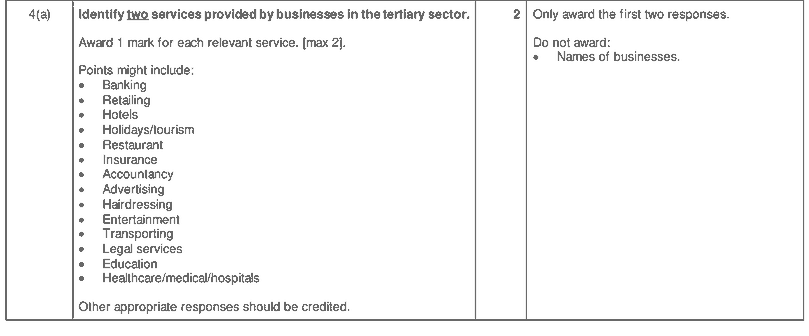
Identify two services provided by businesses in the tertiary sector. Service 1: Service 2:

Show mark scheme

Identify two services provided by businesses in the tertiary sector. Award 1 mark for each relevant service. [max 2]. Points might include:

  • Banking
  • Retailing
  • Hotels
  • Holidays/tourism
  • Restaurant
  • Insurance
  • Accountancy
  • Advertising
  • Hairdressing
  • Entertainment
  • Transporting
  • Legal services
  • Education
  • Healthcare/medical/hospitals Other appropriate responses should be credited.
Mark scheme, 0450/12 Feb/Mar 2025 question 4(a)

15 more questions from 2019–2024

🔒 Unlock every Classification of businesses question from 2019–2024

All 15 come with their mark schemes, answers and case studies, and appear in the practice tool above once you’re signed in. It’s free.

Create a free accountSign in

A few of them

  • 0450/12 · Oct/Nov 2024 · Question 1(a)Identify two features of a private sector… 🔒
  • 0450/13 · Oct/Nov 2024 · Question 3(a)Define… 🔒
  • 0450/12 · May/Jun 2024 · Question 2(a)Define… 🔒
  • 0450/12 · Feb/Mar 2024 · Question 1(b)Define… 🔒
  • 0450/12 · Oct/Nov 2023 · Question 3(a)Define… 🔒
  • + 10 more, by year in the table above

Questions and mark schemes are from past Cambridge papers and are reproduced for revision. Topical Vault is an independent revision resource, not affiliated with or endorsed by Cambridge Assessment International Education.

IGCSE Business questions by topic

Each topic opens this practice tool with only that topic’s questions, plus how often it comes up and every question on it in one list. Revision notes for IGCSE Business →

  1. Ch 1Business activity
  2. Ch 2Classification of businesses
  3. Ch 3Enterprise, business growth and size
  4. Ch 4Types of business organisation
  5. Ch 5Business objectives and stakeholder objectives
  6. Ch 6Motivating employees
  7. Ch 7Organisation and management
  8. Ch 8Recruitment, selection and training of employees
  9. Ch 9Internal and external communication
  10. Ch 10Marketing, competition and the customer
  11. Ch 11Market research
  12. Ch 12The marketing mix: product
  13. Ch 13The marketing mix: price
  14. Ch 14The marketing mix: place
  15. Ch 15The marketing mix: promotion
  16. Ch 16Technology and the marketing mix
  17. Ch 17Marketing strategy
  18. Ch 18Production of goods and services
  19. Ch 19Costs, scale of production and break-even analysis
  20. Ch 20Achieving quality production
  21. Ch 21Location decisions
  22. Ch 22Business finance: needs and sources
  23. Ch 23Cash flow forecasting and working capital
  24. Ch 24Income statements
  25. Ch 25Statement of financial position
  26. Ch 26Analysis of accounts
  27. Ch 27Economic issues
  28. Ch 28Environmental and ethical issues
  29. Ch 29Business and the international economy