Recruitment, selection and training of employees · IGCSE Business
Cambridge 0450 / 0264, Paper 1 & 2. 1,484 questions, 2019 to 2026.
Topic
Year
Every question begins with its business context — a short case for Paper 1, a full
case study (shared across all four questions on that paper) for Paper 2. Mark schemes show the typed
marking points alongside a cropped image of the official mark scheme page for exact wording.
About Recruitment, selection and training of employees
Recruiting, selecting and training employees, reducing the size of the workforce through dismissal or redundancy, and legal controls over employment.
New to Recruitment, selection and training of employees, or finding these questions hard?
Read the notes first: the key ideas, diagrams and formulas, and the mistakes examiners see most, in about 22 minutes.
104 past paper questions on this topic since 2019, across 23 exam sessions.
How often it comes up
Year
Paper 1
Paper 2
Total
Chart
2026
7
4
11
2025
15
3
18
2024
10
4
14
2023
8
4
12
2022
10
4
14
2021
6
4
10
2020
11
5
16
2019
7
2
9
Every 2025–2026 question on Recruitment, selection and training of employees
The whole topic on one page, with answers and mark schemes. Printing this page prints just this list.
Paper 1 · Short answer and structured (22)
Scenario
SDY sells hats and scarves. One of SDY’s objectives is to increase the number of sales. SDY has 240 shops and 3000 employees. All its shop managers use a democratic leadership style. The human resources director is currently recruiting new employees to work in SDY’s shops. External recruitment will be used. All new employees will be given induction training.
Question 3(d)May/Jun 20260450/116 marks
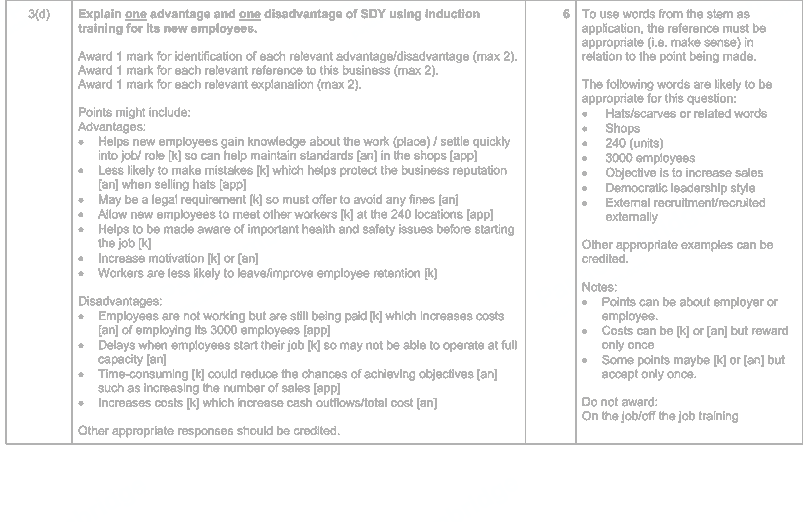
Explain one advantage and one disadvantage of SDY using induction training for its new employees. advantage explanation disadvantage explanation
Show mark scheme
Explain one advantage and one disadvantage of SDY using induction training for its new employees. Award 1 mark for identification of each relevant advantage/disadvantage (max 2). Award 1 mark for each relevant reference to this business (max 2). Award 1 mark for each relevant explanation (max 2). Points might include: Advantages:
Helps new employees gain knowledge about the work (place) / settle quickly into job/ role [k] so can help maintain standards [an] in the shops [app]
Less likely to make mistakes [k] which helps protect the business reputation [an] when selling hats [app]
May be a legal requirement [k] so must offer to avoid any fines [an]
Allow new employees to meet other workers [k] at the 240 locations [app]
Helps to be made aware of important health and safety issues before starting the job [k]
Increase motivation [k] or [an]
Workers are less likely to leave/improve employee retention [k] Disadvantages:
Employees are not working but are still being paid [k] which increases costs [an] of employing its 3000 employees [app]
Delays when employees start their job [k] so may not be able to operate at full capacity [an]
Time-consuming [k] could reduce the chances of achieving objectives [an] such as increasing the number of sales [app]
Increases costs [k] which increase cash outflows/total cost [an] Other appropriate responses should be credited.
Question 3(e)May/Jun 20260450/116 marks
Explain two methods of external recruitment a business could use. Which is likely to be the best method for a business to use? Justify your answer.
Show mark scheme
Explain two methods of external recruitment a business could use. Which is likely to be the best method for a business to use? Justify your answer. Award up to 2 marks for identification of relevant points. Award up to 2 marks for relevant development of points. Award up to 2 marks for justified decision about which is the best method of external recruitment for a business to use. Points might include:
Specialist/trade magazines [k] can target potential employees interested in this industry/type of work [an]
Online/ social media/ website /LinkedIn [k] which can reach large numbers of people / include detailed information/low cost [an] but not everyone has access to the internet [an]
(Recruitment) agencies [k] which saves administration time [an] but recruitment agencies charge a fee for their services [an]
(Government-run) job centres [k] as no cost to the business [an] but only reach those people who are actively looking for a job [an]
Local newspapers [k] which people could ignore [an]
National newspapers [k] but must pay to advertise [an] which increases costs [an]
Notices/poster/flyers (shop windows/ outside the business) [k]
Job fairs [k]
Billboards [k]
Television/cinema [k]
Word of mouth [k] Other appropriate responses should be credited. Justification might include: Recruitment agencies [k] which saves administration time [an]. Another method is online recruitment sites [k] which can reach many people [an]. An online recruitment site is the best method because having access to a wider pool of people can make it easier to find the right person for the job [eval] which may reduce the need to readvertise in the future [eval].
Scenario
APL is a public limited company. It manufactures mobile phones. APL has 20000 employees working in its 5 factories in country X. The business uses many methods to motivate its employees including paying bonuses. Managers are encouraged to use different leadership styles. APL uses external recruitment when recruiting new employees.
Question 1(c)May/Jun 20260450/124 marks
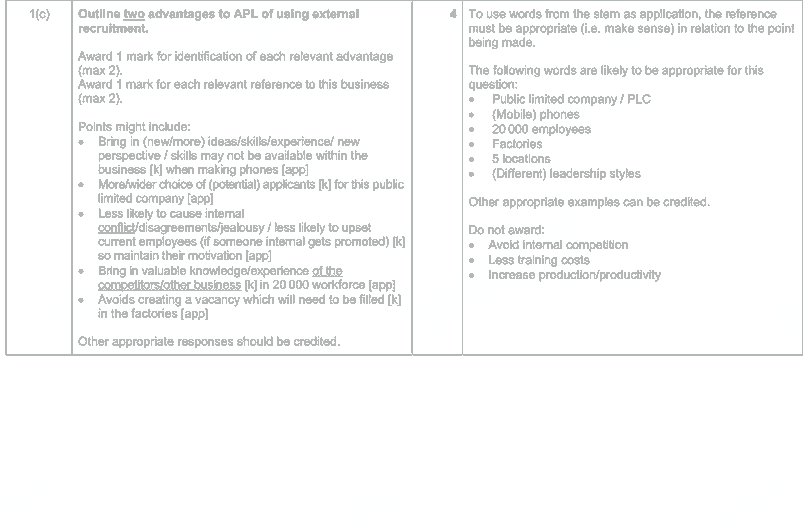
Outline two advantages to APL of using external recruitment. advantage 1 advantage 2
Show mark scheme
Outline two advantages to APL of using external recruitment. Award 1 mark for identification of each relevant advantage (max 2). Award 1 mark for each relevant reference to this business (max 2). Points might include:
Bring in (new/more) ideas/skills/experience/ new perspective / skills may not be available within the business [k] when making phones [app]
More/wider choice of (potential) applicants [k] for this public limited company [app]
Less likely to cause internal conflict/disagreements/jealousy / less likely to upset current employees (if someone internal gets promoted) [k] so maintain their motivation [app]
Bring in valuable knowledge/experience of the competitors/other business [k] in 20 000 workforce [app]
Avoids creating a vacancy which will need to be filled [k] in the factories [app] Other appropriate responses should be credited.
Scenario
CCH builds large boats in its factory. The business has 1800 employees who are all members of a trade union. All CCH’s employees are offered regular on-the-job training. The human resources director uses different financial methods of motivation for CCH’s production employees. She knows there are many legal controls over employment that might affect a business. The directors want to know the advantages to CCH of changes in technology.
Question 2(b)May/Jun 20260450/132 marks
Identify two legal controls over employment that might affect a business. legal control 1 legal control 2
Show mark scheme
Identify two legal controls over employment that might affect a business. Award 1 mark per legal control (max 2). Points might include:
Contract of employment/conditions of employment or examples e.g. holiday entitlement/sick days
Health and safety / working conditions
Legal minimum wage
Legal minimum age / child labour
Working hours/time
Discrimination/equal opportunities
(Unfair) dismissal
Redundancy
Right to work / work visa / work permit / health check / proof of identity
Termination/notice period Other appropriate responses should be credited.
Question 2(e)May/Jun 20260450/136 marks
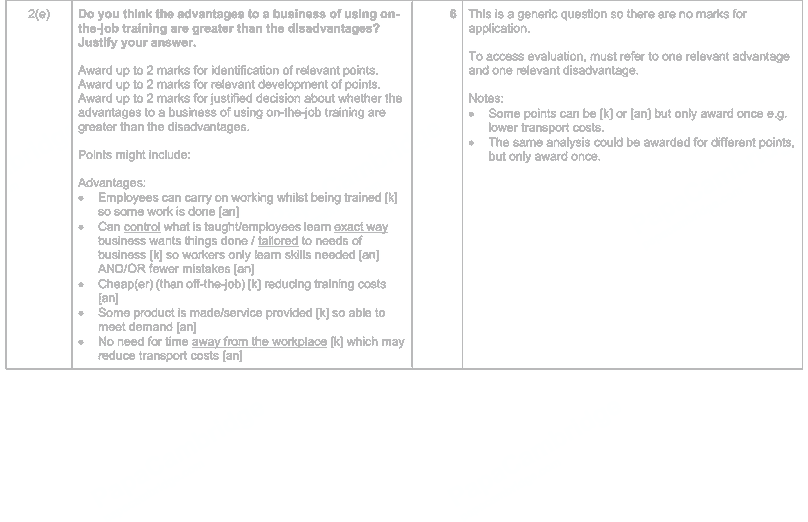
Do you think the advantages to a business of using on-the-job training are greater than the disadvantages? Justify your answer.
Show mark scheme
Do you think the advantages to a business of using on- the-job training are greater than the disadvantages? Justify your answer. Award up to 2 marks for identification of relevant points. Award up to 2 marks for relevant development of points. Award up to 2 marks for justified decision about whether the advantages to a business of using on-the-job training are greater than the disadvantages. Points might include: Advantages:
Employees can carry on working whilst being trained [k] so some work is done [an]
Can control what is taught/employees learn exact way business wants things done / tailored to needs of business [k] so workers only learn skills needed [an] AND/OR fewer mistakes [an]
Cheap(er) (than off-the-job) [k] reducing training costs [an]
Some product is made/service provided [k] so able to meet demand [an]
No need for time away from the workplace [k] which may reduce transport costs [an] Disadvantages:
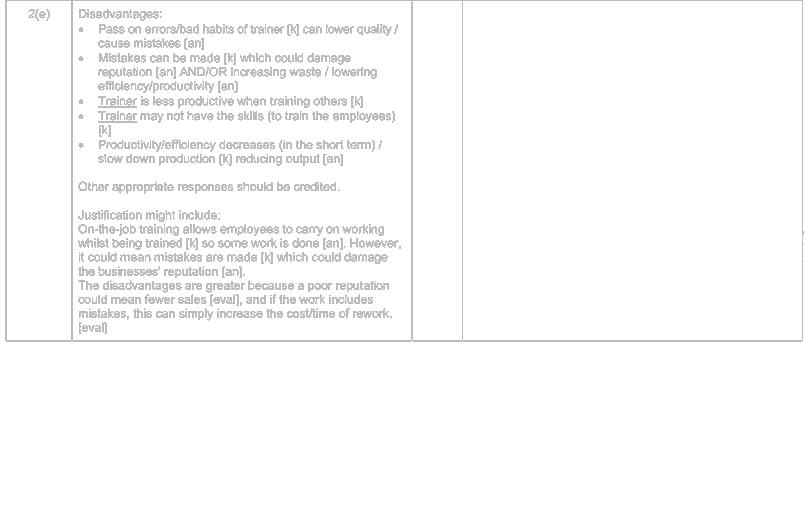
Pass on errors/bad habits of trainer [k] can lower quality / cause mistakes [an]
Mistakes can be made [k] which could damage reputation [an] AND/OR increasing waste / lowering efficiency/productivity [an]
Trainer is less productive when training others [k]
Trainer may not have the skills (to train the employees) [k]
Productivity/efficiency decreases (in the short term) / slow down production [k] reducing output [an] Other appropriate responses should be credited. Justification might include: On-the-job training allows employees to carry on working whilst being trained [k] so some work is done [an]. However, it could mean mistakes are made [k] which could damage the businesses’ reputation [an]. The disadvantages are greater because a poor reputation could mean fewer sales [eval], and if the work includes mistakes, this can simply increase the cost/time of rework. [eval]
Scenario
LMB provides healthcare services for people aged 70 years and above. It is a large public sector business which is continuing to grow. The human resources manager has started the recruitment process for 500 additional employees. He is also planning on-the-job training for all LMB’s employees. The business uses email as its main method of communication. The human resources manager knows that there are many benefits to a business of having a well-motivated workforce.
Question 2(c)Feb/Mar 20260450/124 marks
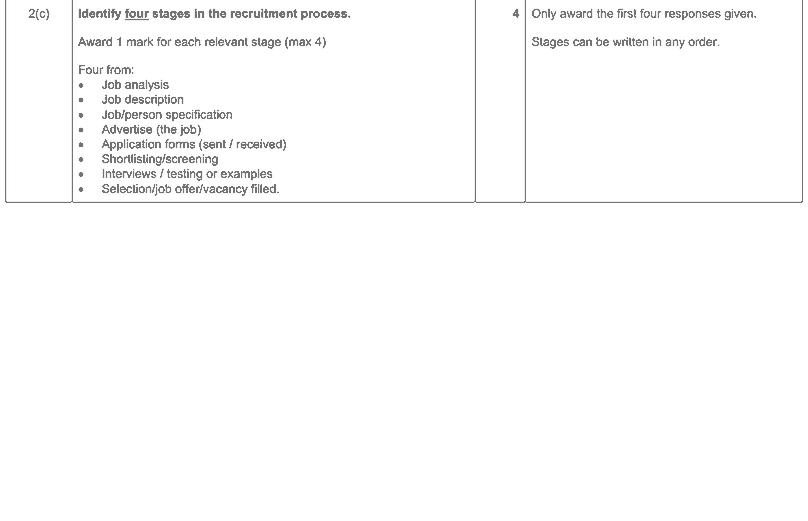
Identify four stages in the recruitment process. 1 2 3 4
Show mark scheme
Identify four stages in the recruitment process. Award 1 mark for each relevant stage (max 4) Four from:
Job analysis
Job description
Job/person specification
Advertise (the job)
Application forms (sent / received)
Shortlisting/screening
Interviews / testing or examples
Selection/job offer/vacancy filled.
Question 2(d)Feb/Mar 20260450/126 marks
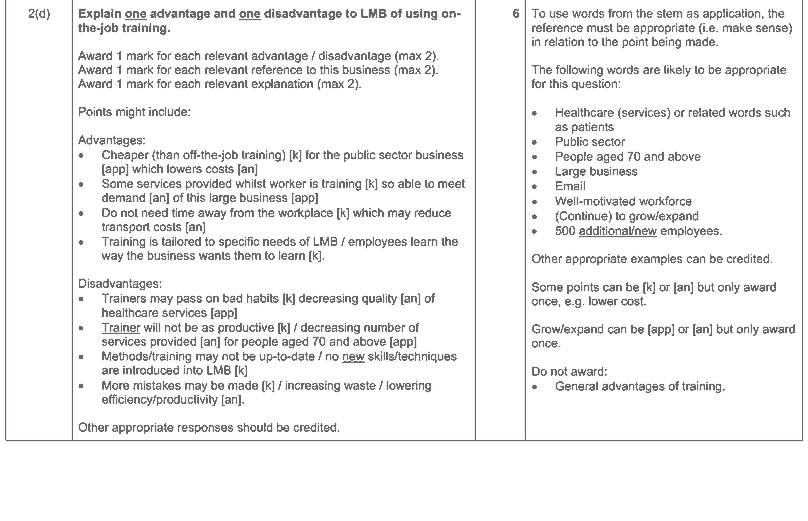
Explain one advantage and one disadvantage to LMB of using on-the-job training. advantage explanation disadvantage explanation
Show mark scheme
Explain one advantage and one disadvantage to LMB of using on- the-job training. Award 1 mark for each relevant advantage / disadvantage (max 2). Award 1 mark for each relevant reference to this business (max 2). Award 1 mark for each relevant explanation (max 2). Points might include: Advantages:
Cheaper (than off-the-job training) [k] for the public sector business [app] which lowers costs [an]
Some services provided whilst worker is training [k] so able to meet demand [an] of this large business [app]
Do not need time away from the workplace [k] which may reduce transport costs [an]
Training is tailored to specific needs of LMB / employees learn the way the business wants them to learn [k]. Disadvantages:
Trainers may pass on bad habits [k] decreasing quality [an] of healthcare services [app]
Trainer will not be as productive [k] / decreasing number of services provided [an] for people aged 70 and above [app]
Methods/training may not be up-to-date / no new skills/techniques are introduced into LMB [k]
More mistakes may be made [k] / increasing waste / lowering efficiency/productivity [an]. Other appropriate responses should be credited.
Scenario
SBL is a fast food restaurant which sells 900 chicken burgers each week. It has 14 employees. The owner, Vicki, provides her employees with training but does not currently use delegation. She is preparing a break-even chart to help calculate SBL’s margin of safety. A partially completed break-even chart is shown in Fig. 3.1. Vicki wants to know how an economic recession might affect her business. Break-even chart for SBL Fig. 3.1
Question 3(e)Oct/Nov 20250450/116 marks
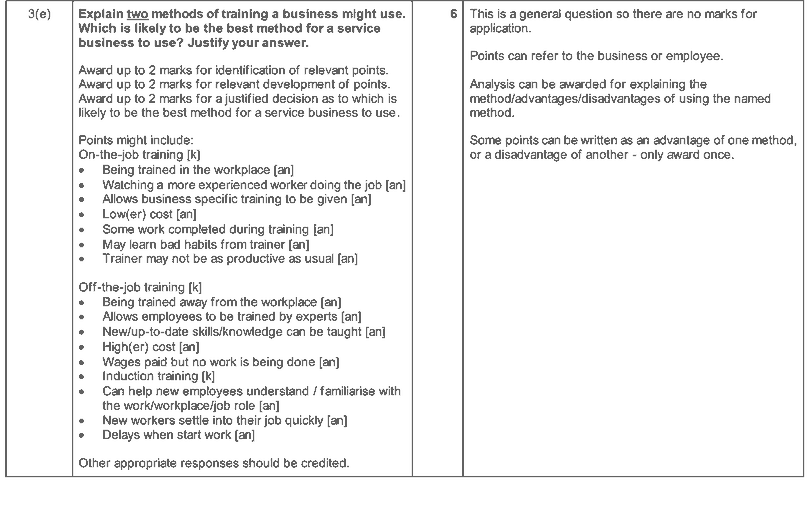
Explain two methods of training a business might use. Which is likely to be the best method for a service business to use? Justify your answer.
Show mark scheme
Explain two methods of training a business might use. Which is likely to be the best method for a service business to use? Justify your answer. Award up to 2 marks for identification of relevant points. Award up to 2 marks for relevant development of points. Award up to 2 marks for a justified decision as to which is likely to be the best method for a service business to use. Points might include: On-the-job training [k]
Being trained in the workplace [an]
Watching a more experienced worker doing the job [an]
Allows business specific training to be given [an]
Low(er) cost [an]
Some work completed during training [an]
May learn bad habits from trainer [an]
Trainer may not be as productive as usual [an] Off-the-job training [k]
Being trained away from the workplace [an]
Allows employees to be trained by experts [an]
New/up-to-date skills/knowledge can be taught [an]
High(er) cost [an]
Wages paid but no work is being done [an]
Induction training [k]
Can help new employees understand / familiarise with the work/workplace/job role [an]
New workers settle into their job quickly [an]
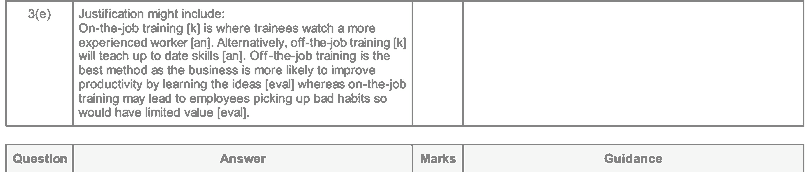
Delays when start work [an] Other appropriate responses should be credited. Justification might include: On-the-job training [k] is where trainees watch a more experienced worker [an]. Alternatively, off-the-job training [k] will teach up to date skills [an]. Off-the-job training is the best method as the business is more likely to improve productivity by learning the ideas [eval] whereas on-the-job training may lead to employees picking up bad habits so would have limited value [eval]. Answer
Scenario
BEI is a multinational company. It manufactures aeroplanes. Quality assurance is important. BEI has 5000 employees. BEI’s directors have announced plans to reduce the size of its workforce (downsize). The Human Resources Director is considering which employees to make redundant. Information about employee A can be found in Table 1.1. Table 1.1 Information about employee A
Worked at BEI for 1 year
Worked at another manufacturing business for 12 years
Able to use most of the machines at BEI
Often late for work
Popular with other employees
Left school with 2 IGCSEs
Question 1(b)Oct/Nov 20250450/122 marks
Identify two reasons why a business might reduce the size of its workforce. Reason 1: Reason 2:
Show mark scheme
Identify two reasons why a business might reduce the size of its workforce. Award one mark per reason (max 2). Points might include:
Fall/decrease in demand/sales/revenue / recession
Introduction of automation/machinery/technology / becoming capital intensive
Financial problems / (need) to reduce costs
Closure of factory/shop/office
Merger/takeover
Relocation / move its operations (to another part of country/world) Other appropriate responses should be credited.
Question 1(c)Oct/Nov 20250450/124 marks
Outline, with reference to BEI, the difference between redundancy and dismissal.
Show mark scheme
Outline, with reference to BEI, the difference between redundancy and dismissal. Award 1 mark for showing understanding of redundancy (max 1). Award 1 mark for showing understanding of dismissal (max 1). Award 1 mark for each relevant reference to this business (max 2). Points might include: Redundancy:
The job is no longer needed/exists [k] as business is downsizing [app]
The worker has done nothing wrong [k] when making aeroplanes [app]
Being asked to leave because the skills/experience of the employee are no longer needed [k] Dismissal:
Employee is incompetent/cannot do the job / not meeting targets [k] at the multinational company [app]
Being asked to leave because of poor behaviour/conduct of employees [k] which may affect quality assurance [app]
Termination of employment by the employer / when employee is told/made to leave job against will of employee [k] Other appropriate responses should be credited.
Question 1(d)Oct/Nov 20250450/126 marks
Explain one advantage and one disadvantage of BEI making employee A redundant. Advantage: Explanation: Disadvantage: Explanation:
Show mark scheme
Explain one advantage and one disadvantage of BEI making employee A redundant. Award 1 mark for identification of each relevant advantage/disadvantage (max 2). Award 1 mark for each relevant reference to this business (max 2). Award 1 mark for each relevant explanation (max 2). Points might include: Advantages:
May have to pay out less in compensation/redundancy payment [k] as only been there for 1 year [app] which could help lower cash outflows / use funds for other areas of the business [an]
Could improve productivity/efficiency [k] because they are often late for work [app] so orders are met on time [an] Disadvantages:
May lose a lot of experience [k] as worked at another business for 12 years [app] which could lead to more mistakes / less output [an]
May lose skills [k] as employee A can use most of the machinery [app] which may lead to production delays [an]
May lower motivation of other employees [k] as employee A is popular with them [app] which could increase labour turnover [an]
May have to train someone else [k] which can increase costs [an]
Lower output [k] Other appropriate responses should be credited.
Scenario
ZPR is a business in the tertiary sector. It has 1 restaurant which has 20 employees. The Human Resources Manager is preparing a job description as ZPR needs 2 new chefs. He said: ‘I need to advertise the job vacancies externally. ZPR will use a range of financial rewards as it can be difficult to recruit employees.’ The manager knows there are many factors for a business to consider when deciding who to recruit.
Question 4(b)Oct/Nov 20250450/132 marks
Define ‘job description’.
Show mark scheme
Define ‘job description’. Award 2 marks for a full definition. Award 1 mark for a partial definition.
Outlines the responsibilities and duties to be carried out by someone to do a (specific) job [2]
A list of the key points about a job, job title, key duties, responsibilities and accountabilities [2]
A description of the tasks, roles, and responsibilities of a particular position [2] Partial definition e.g.
States what the job involves [1]
Question 4(d)Oct/Nov 20250450/136 marks
Explain two ways ZPR could use to advertise its job vacancies externally. Way 1: Explanation: Way 2: Explanation:
Show mark scheme
Explain two ways ZPR could use to advertise its job vacancies externally. Award 1 mark for identification of each relevant way (max 2). Award 1 mark for each relevant reference to this business (max 2). Award 1 mark for each relevant explanation (max 2). Points might include:
National newspapers [k] especially as it is difficult to recruit employees [app] so could attract people from a wider area/whole country [an]
Recruitment agencies [k] as need 2 chefs [app] and the agency will do all the work for the business (saving time) [an]
Specialist magazines [k] such as one aimed at restaurants [app] as potential employees are more likely to see it [an]
Company website [k] of this tertiary sector business [app] as there is likely to be no fee/free [an]
Online recruitment sites [k] which can reach a large number of people [an]
(Government run) job centres [k]
Visiting universities/colleges [k]
Local newspapers [k] Other appropriate responses should be credited.
Question 4(e)Oct/Nov 20250450/136 marks
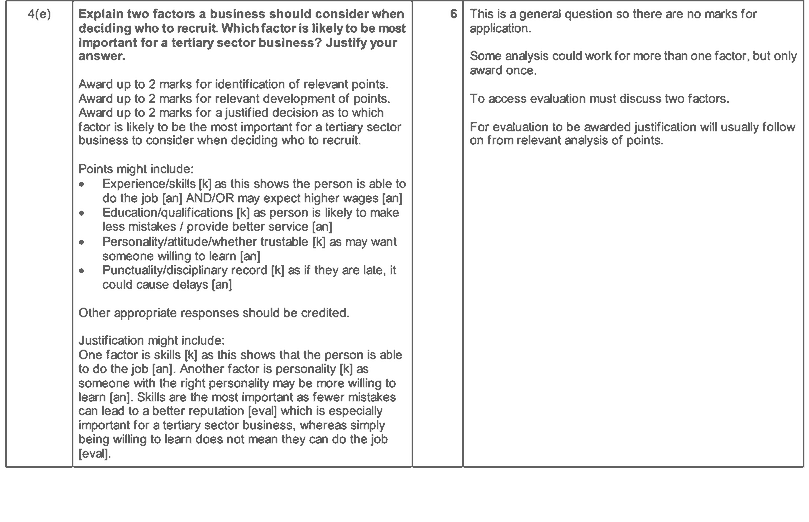
Explain two factors a business should consider when deciding who to recruit. Which factor is likely to be the most important for a tertiary sector business? Justify your answer.
Show mark scheme
Explain two factors a business should consider when deciding who to recruit. Which factor is likely to be most important for a tertiary sector business? Justify your answer. Award up to 2 marks for identification of relevant points. Award up to 2 marks for relevant development of points. Award up to 2 marks for a justified decision as to which factor is likely to be the most important for a tertiary sector business to consider when deciding who to recruit. Points might include:
Experience/skills [k] as this shows the person is able to do the job [an] AND/OR may expect higher wages [an]
Education/qualifications [k] as person is likely to make less mistakes / provide better service [an]
Personality/attitude/whether trustable [k] as may want someone willing to learn [an]
Punctuality/disciplinary record [k] as if they are late, it could cause delays [an] Other appropriate responses should be credited. Justification might include: One factor is skills [k] as this shows that the person is able to do the job [an]. Another factor is personality [k] as someone with the right personality may be more willing to learn [an]. Skills are the most important as fewer mistakes can lead to a better reputation [eval] which is especially important for a tertiary sector business, whereas simply being willing to learn does not mean they can do the job [eval].
Scenario
LFK is a coal-mining business. It has 135 employees who are all provided with training. After the dismissal of one of LFK’s employees there is a job vacancy for a new supervisor. External recruitment will be used. The Managing Director is preparing a cash flow forecast for LFK. An extract is shown in Table 3.1. Table 3.1 Extract from LFK’s cash flow forecast July - September 2025 $000 July August September Cash inflow 600 400 730 Cash outflow 720 X 590 Net cash flow (120) (100) 140 Opening balance 40 (80) (180) Closing balance (80) (180) Y
Question 3(a)May/Jun 20250450/112 marks
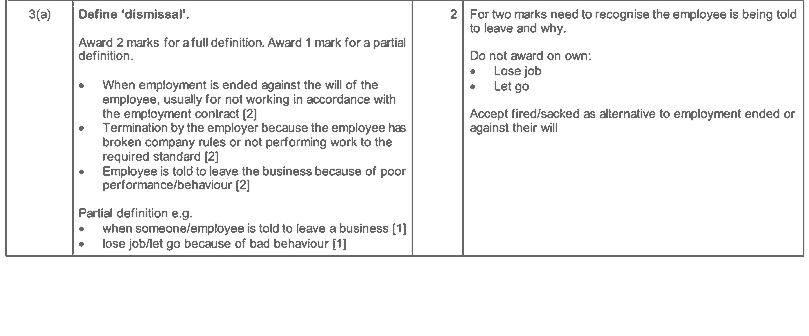
Define ‘dismissal’.
Show mark scheme
Define ‘dismissal’. Award 2 marks for a full definition. Award 1 mark for a partial definition.
When employment is ended against the will of the employee, usually for not working in accordance with the employment contract [2]
Termination by the employer because the employee has broken company rules or not performing work to the required standard [2]
Employee is told to leave the business because of poor performance/behaviour [2] Partial definition e.g.
when someone/employee is told to leave a business [1]
lose job/let go because of bad behaviour [1]
Question 3(d)May/Jun 20250450/116 marks
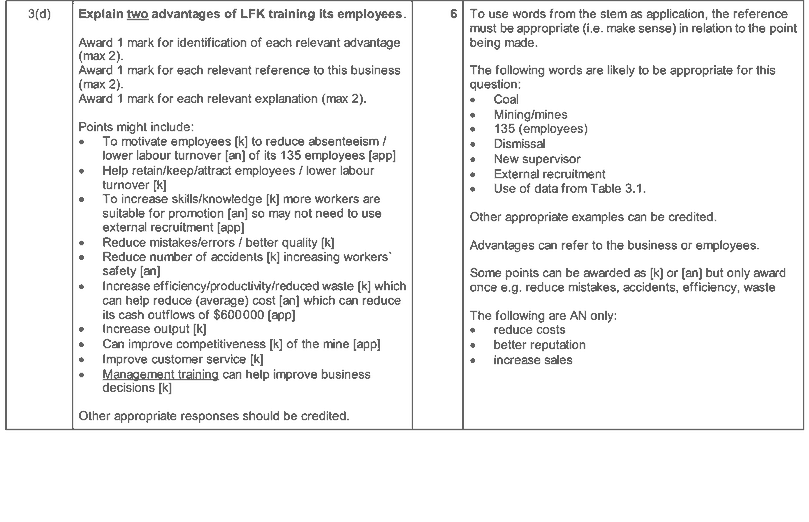
Explain two advantages of LFK training its employees. Advantage 1: Explanation: Advantage 2: Explanation:
Show mark scheme
Explain two advantages of LFK training its employees. Award 1 mark for identification of each relevant advantage (max 2). Award 1 mark for each relevant reference to this business (max 2). Award 1 mark for each relevant explanation (max 2). Points might include:
To motivate employees [k] to reduce absenteeism / lower labour turnover [an] of its 135 employees [app]
Help retain/keep/attract employees / lower labour turnover [k]
To increase skills/knowledge [k] more workers are suitable for promotion [an] so may not need to use external recruitment [app]
Reduce mistakes/errors / better quality [k]
Reduce number of accidents [k] increasing workers` safety [an]
Increase efficiency/productivity/reduced waste [k] which can help reduce (average) cost [an] which can reduce its cash outflows of $600 000 [app]
Increase output [k]
Can improve competitiveness [k] of the mine [app]
Improve customer service [k]
Management training can help improve business decisions [k] Other appropriate responses should be credited.
Question 3(e)May/Jun 20250450/116 marks
Do you think the advantages of external recruitment for a business are greater than the disadvantages? Justify your answer.
Show mark scheme
Do you think the advantages of external recruitment for a business are greater than the disadvantages? Justify your answer. Award up to 2 marks for identification of relevant points. Award up to 2 marks for relevant development of points. Award up to 2 marks for a justified decision as to whether the advantages of external recruitment for a business are greater than the disadvantages. Points might include: Advantages:
Brings new skills/ideas [k] improving productivity / efficiency [an]
Wider choice of applicants [k] increases possibility of finding the best person for the job [an]
Can bring valuable knowledge/experience of competition [k] so might gain a competitive advantage [an]
Avoids creating a vacancy which will need to be filled [k]
Avoids risk of upsetting employees when someone internal is promoted [k] which could demotivate/cause others to leave [an] Disadvantages:
No knowledge of how business works / current operations [k] so may need (induction) training [an]
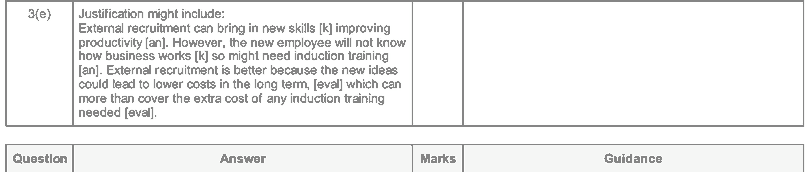
More time spent / takes longer to fill vacancy [k] which could be used for other purposes [an] Other appropriate responses should be credited. Justification might include: External recruitment can bring in new skills [k] improving productivity [an]. However, the new employee will not know how business works [k] so might need induction training [an]. External recruitment is better because the new ideas could lead to lower costs in the long term, [eval] which can more than cover the extra cost of any induction training needed [eval]. Answer
Scenario
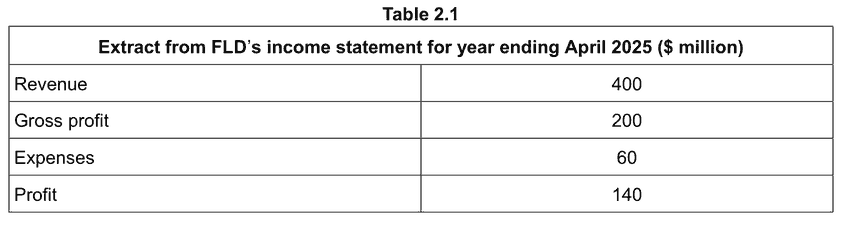
FLD is a furniture retailer. It has 460 shops and 20000 employees. Internal recruitment is used when recruiting new shop managers. The Managing Director wants to know whether job rotation is the best method of motivation for a large business to use. The Finance Director is reviewing FLD’s income statement. An extract is shown in Table 2.1. She is concerned that FLD’s gross profit is decreasing. Table 2.1 Extract from FLD’s income statement for year ending April 2025 ($ million) Revenue 400 Gross profit 200 Expenses 60 Profit 140
Question 2(d)May/Jun 20250450/126 marks
Explain two advantages to FLD of using internal recruitment when recruiting new managers. Advantage 1: Explanation: Advantage 2: Explanation:
Show mark scheme
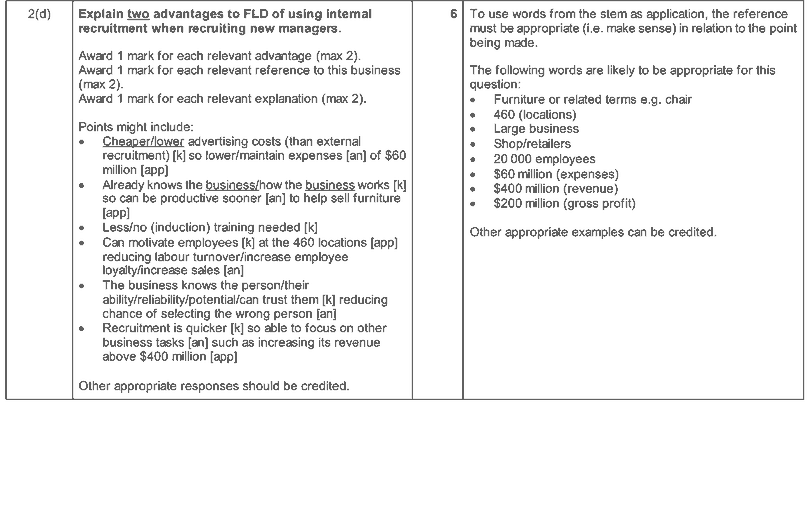
Explain two advantages to FLD of using internal recruitment when recruiting new managers. Award 1 mark for each relevant advantage (max 2). Award 1 mark for each relevant reference to this business (max 2). Award 1 mark for each relevant explanation (max 2). Points might include:
Cheaper/lower advertising costs (than external recruitment) [k] so lower/maintain expenses [an] of $60 million [app]
Already knows the business/how the business works [k] so can be productive sooner [an] to help sell furniture [app]
Less/no (induction) training needed [k]
Can motivate employees [k] at the 460 locations [app] reducing labour turnover/increase employee loyalty/increase sales [an]
The business knows the person/their ability/reliability/potential/can trust them [k] reducing chance of selecting the wrong person [an]
Recruitment is quicker [k] so able to focus on other business tasks [an] such as increasing its revenue above $400 million [app] Other appropriate responses should be credited.
Scenario
HYT is a travel business which sells holidays. One of its objectives is growth. Last year HYT completed a takeover of one of its competitors. External sources of finance were used to fund this growth. HYT now has 460 shops and 4000 employees. The Human Resources Director knows there are benefits and limitations for a business of having full-time employees. HYT’s managers use ideas from Herzberg’s motivational theory to keep employees motivated. Good internal communication is important for HYT.
Question 4(e)May/Jun 20250450/136 marks
Do you think the benefits to a business of having full-time employees are greater than the limitations? Justify your answer.
Show mark scheme
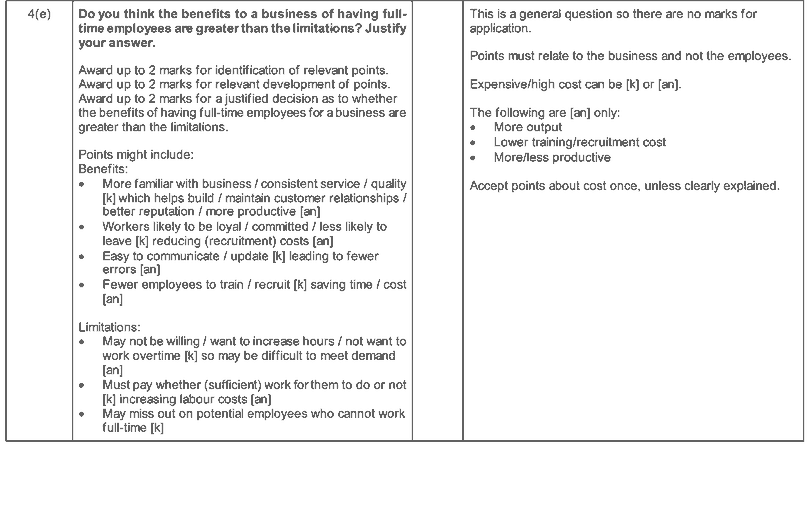
Do you think the benefits to a business of having full- time employees are greater than the limitations? Justify your answer. Award up to 2 marks for identification of relevant points. Award up to 2 marks for relevant development of points. Award up to 2 marks for a justified decision as to whether the benefits of having full-time employees for a business are greater than the limitations. Points might include: Benefits:
More familiar with business / consistent service / quality [k] which helps build / maintain customer relationships / better reputation / more productive [an]
Workers likely to be loyal / committed / less likely to leave [k] reducing (recruitment) costs [an]
Easy to communicate / update [k] leading to fewer errors [an]
Fewer employees to train / recruit [k] saving time / cost [an] Limitations:
May not be willing / want to increase hours / not want to work overtime [k] so may be difficult to meet demand [an]
Must pay whether (sufficient) work for them to do or not [k] increasing labour costs [an]
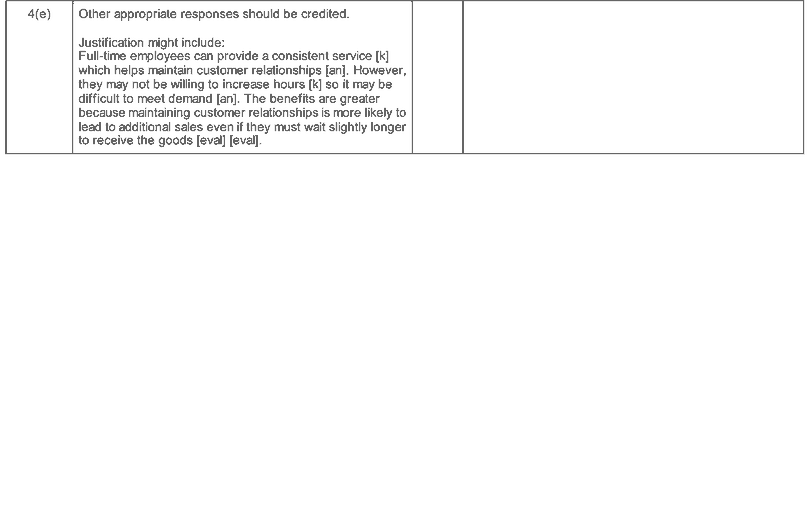
May miss out on potential employees who cannot work full-time [k] Other appropriate responses should be credited. Justification might include: Full-time employees can provide a consistent service [k] which helps maintain customer relationships [an]. However, they may not be willing to increase hours [k] so it may be difficult to meet demand [an]. The benefits are greater because maintaining customer relationships is more likely to lead to additional sales even if they must wait slightly longer to receive the goods [eval] [eval].
Scenario
SEP operates in the tertiary sector. As a social enterprise, SEP has many objectives. It collects old books from libraries and schools and sells them to customers at a low price. SEP provides training for its 10 part-time employees. SEP’s manager wants to know how the introduction of a legal minimum wage might affect a business.
Question 4(c)Feb/Mar 20250450/124 marks
Outline two benefits to SEP of having part-time employees. Benefit 1: Benefit 2:
Show mark scheme
Outline two benefits to SEP of having part-time employees. Award 1 mark for each relevant benefit [max 2]. Award 1 mark for each relevant explanation in context [max 2]. Points might include:
Cheaper than full-time / reduce labour costs / no need to pay when not working [k] which may help have low prices [app]
More flexible hours of work [k] when selling books [app]
Can ask/more likely to work at busier times [k] for the social enterprise [app]
Can/more likely to extend working hours [k] for the tertiary sector business [app]
Provides a range of skills/experience [k] among the 10 employees [app]
Helps attract well-qualified employees who need flexible hours [k]
Can help keep experienced staff [k] Other appropriate responses should be credited.
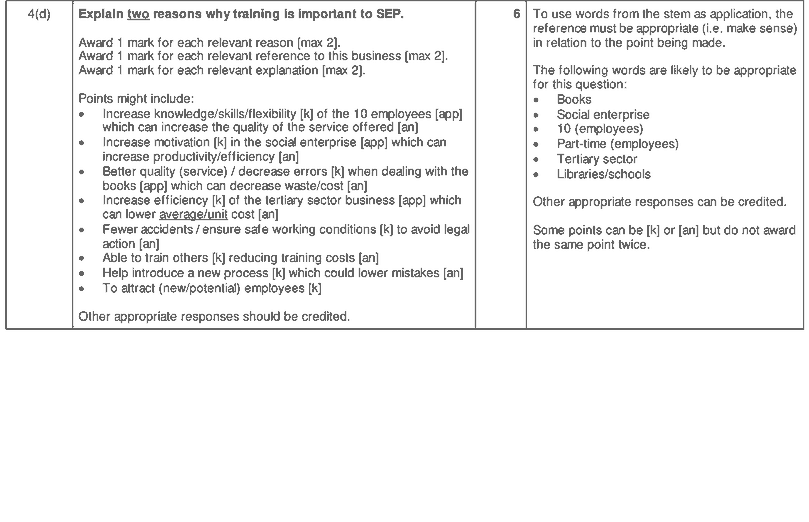
Question 4(d)Feb/Mar 20250450/126 marks
Explain two reasons why training is important to SEP. Reason 1: Explanation: Reason 2: Explanation:
Show mark scheme
Explain two reasons why training is important to SEP. Award 1 mark for each relevant reason [max 2]. Award 1 mark for each relevant reference to this business [max 2]. Award 1 mark for each relevant explanation [max 2]. Points might include:
Increase knowledge/skills/flexibility [k] of the 10 employees [app] which can increase the quality of the service offered [an]
Increase motivation [k] in the social enterprise [app] which can increase productivity/efficiency [an]
Better quality (service) / decrease errors [k] when dealing with the books [app] which can decrease waste/cost [an]
Increase efficiency [k] of the tertiary sector business [app] which can lower average/unit cost [an]
Fewer accidents / ensure safe working conditions [k] to avoid legal action [an]
Able to train others [k] reducing training costs [an]
Help introduce a new process [k] which could lower mistakes [an]
To attract (new/potential) employees [k] Other appropriate responses should be credited.
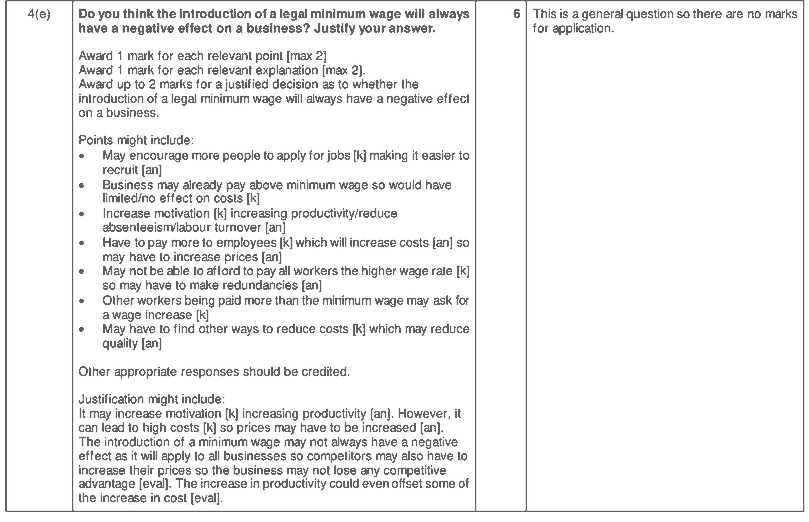
Question 4(e)Feb/Mar 20250450/126 marks
Do you think the introduction of a legal minimum wage will always have a negative effect on a business? Justify your answer.
Show mark scheme
Do you think the introduction of a legal minimum wage will always have a negative effect on a business? Justify your answer. Award 1 mark for each relevant point [max 2] Award 1 mark for each relevant explanation [max 2]. Award up to 2 marks for a justified decision as to whether the introduction of a legal minimum wage will always have a negative effect on a business. Points might include:
May encourage more people to apply for jobs [k] making it easier to recruit [an]
Business may already pay above minimum wage so would have limited/no effect on costs [k]
Have to pay more to employees [k] which will increase costs [an] so may have to increase prices [an]
May not be able to afford to pay all workers the higher wage rate [k] so may have to make redundancies [an]
Other workers being paid more than the minimum wage may ask for a wage increase [k]
May have to find other ways to reduce costs [k] which may reduce quality [an] Other appropriate responses should be credited. Justification might include: It may increase motivation [k] increasing productivity [an]. However, it can lead to high costs [k] so prices may have to be increased [an]. The introduction of a minimum wage may not always have a negative effect as it will apply to all businesses so competitors may also have to increase their prices so the business may not lose any competitive advantage [eval]. The increase in productivity could even offset some of the increase in cost [eval].
Paper 2 · Case study (7)
Case study: Youth Clothes (YC)
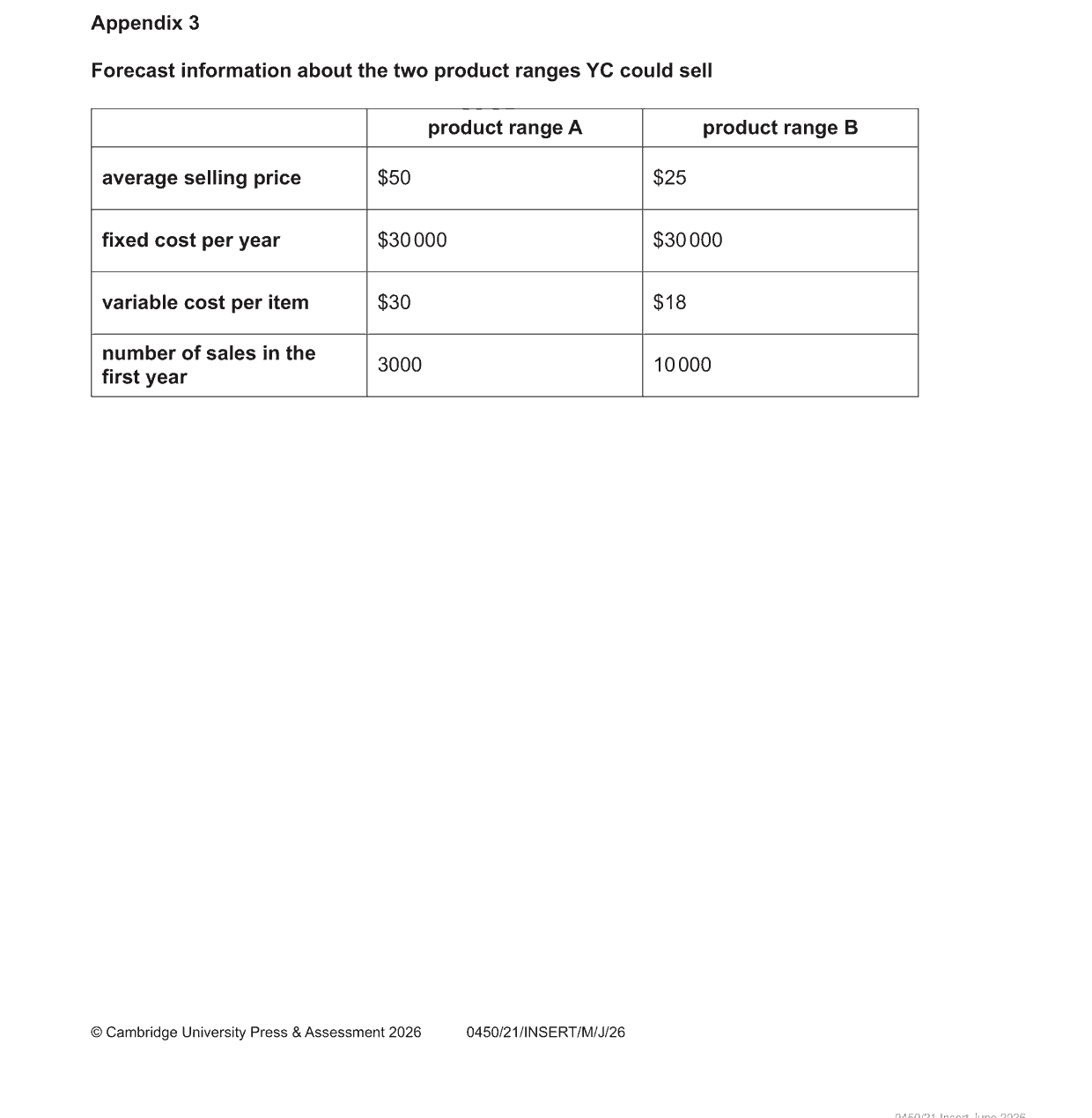
Ashanti has just completed a degree in business studies at university. She plans to start up her own clothes shop called YC in Main City in country X. Ashanti will be a sole trader and thinks she has the right characteristics to be a successful entrepreneur. Her target market is customers between 16 and 30 years of age. Ashanti has written a business plan to help her when she starts YC. She has $20 000 in savings which she could invest in the business. Ashanti needs to decide whether to use owners’ savings, a bank loan or leasing to purchase the equipment for her shop. Ashanti will employ an assistant manager and 3 more people to help her in the shop. She knows that legal controls over employment may benefit her employees. Ashanti wants to make sure her employees will be motivated, and she needs to decide the best way to do this. Ashanti needs to decide on the product range to sell in her shop. Appendix 3 contains financial information about the two product ranges she is considering selling. Ashanti will only sell one of these product ranges when she first opens her shop and must decide which one to choose.
Question 4(a)May/Jun 20260450/218 marks
Explain four legal controls over employment that may benefit Ashanti’s employees. legal control 1 legal control 2 legal control 3 legal control 4
Show mark scheme
Explain four legal controls over employment that may benefit Ashanti’s 8 employees. One mark for a benefit of each legal control (max 4). Award a maximum of one additional mark for each explanation of the benefit of the legal control in the context of YC employees. Answers might include:
Protected against unfair dismissal – shop workers will have security of employment
Will be provided with an employment contract – so that 3/4 employees will know what they will be paid / hours worked / holiday entitlement
Protects against discrimination – so the sole trader owner will treat her employees equally
Health and safety laws – protect against injury from dangerous shop equipment
Should be paid at least the legal minimum wage – so the workers in the clothes shop have a reasonable level of pay
Restriction on maximum hours that can be worked – so the assistant manager is not overworked
Redundancy/retrenchment payments made – so that if the new start-up no longer needs so many employees they will receive a payment Notes:
Only award discrimination once i.e. age, race and gender are not separate points.
Do not award trade union membership, free health care or job description.
The following are too vague; paid fairly, clean environment/good working conditions. For example: The employees will be provided with an employment contract (1) so that the 3 employees will know what hours they will be expected to work (app). Application could include: clothes; clothes shop/YC’s shop; sole trader; $20 000; shop equipment; 3/4 employees; entering boom phase of business cycle; assistant manager.
Case study: KE (Kitchen Equipment)
KE is a public limited company in country X. It has 10 000 employees. KE manufactures cooking equipment such as cooking pots, which it sells at low prices. KE produces 20 million cooking pots per year in its factory, and sells its products in country X. The market for cooking pots is very competitive. KE uses simple packaging to help keep costs low. KE is planning to build a second factory. The existing factory is working at maximum output and is unable to meet growing demand. The second factory will allow KE to increase sales from $90 million to $180 million per year. KE needs to choose between two possible locations for the second factory. Information about the two locations is shown in Appendix 1. KE does not currently use lean production. The operations director plans to introduce lean production in both the existing factory and the second factory. Training for all employees is important for KE. KE is planning to produce a new cooking pot when it opens the second factory. The marketing director will use primary market research to help decide whether to produce product A or product B. Information about the two new cooking pots in shown in Appendix 3. KE wants to choose the cooking pot with the highest potential revenue and profit.
Question 4(a)May/Jun 20260450/228 marks
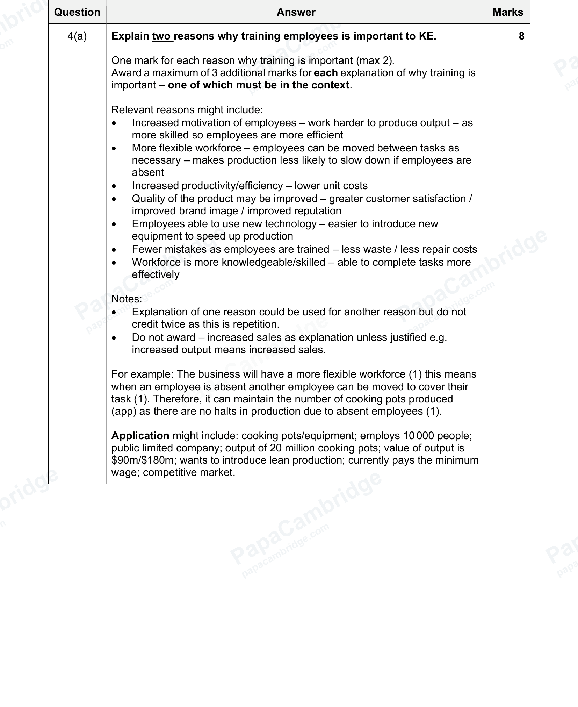
Explain two reasons why training employees is important to KE. reason 1 explanation reason 2 explanation
Show mark scheme
Explain two reasons why training employees is important to KE. 8 One mark for each reason why training is important (max 2). Award a maximum of 3 additional marks for each explanation of why training is important – one of which must be in the context. Relevant reasons might include:
Increased motivation of employees – work harder to produce output – as more skilled so employees are more efficient
More flexible workforce – employees can be moved between tasks as necessary – makes production less likely to slow down if employees are absent
Increased productivity/efficiency – lower unit costs
Quality of the product may be improved – greater customer satisfaction / improved brand image / improved reputation
Employees able to use new technology – easier to introduce new equipment to speed up production
Fewer mistakes as employees are trained – less waste / less repair costs
Workforce is more knowledgeable/skilled – able to complete tasks more effectively Notes:
Explanation of one reason could be used for another reason but do not credit twice as this is repetition.
Do not award – increased sales as explanation unless justified e.g. increased output means increased sales. For example: The business will have a more flexible workforce (1) this means when an employee is absent another employee can be moved to cover their task (1). Therefore, it can maintain the number of cooking pots produced (app) as there are no halts in production due to absent employees (1). Application might include: cooking pots/equipment; employs 10 000 people; public limited company; output of 20 million cooking pots; value of output is $90m/$180m; wants to introduce lean production; currently pays the minimum wage; competitive market.
Case study: Kitty’s Homeshoes (KH)
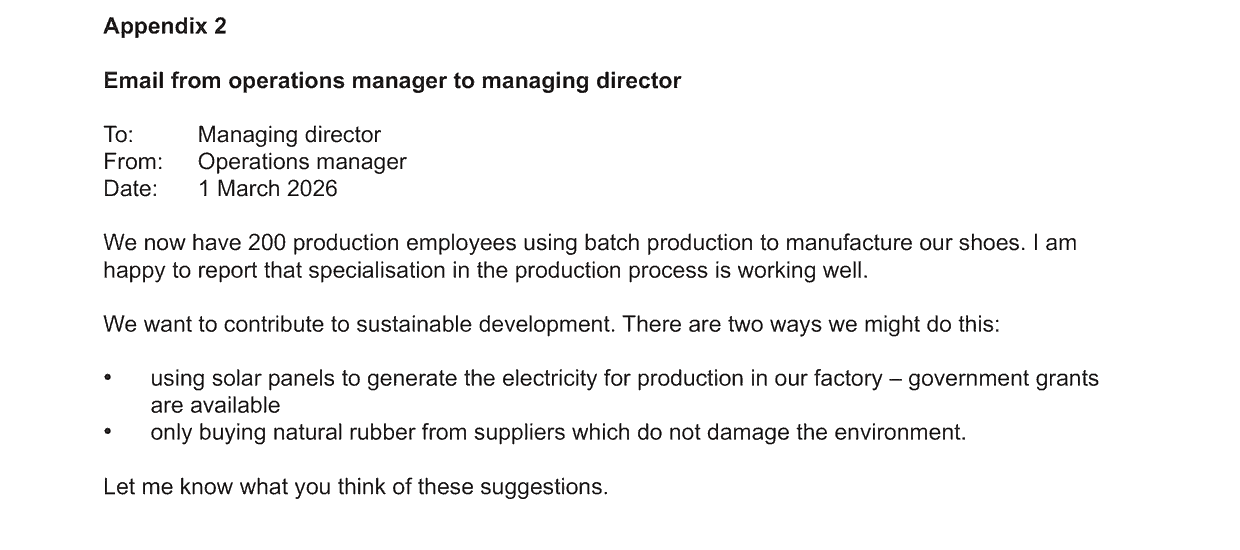
KH is a private limited company. It manufactures shoes for people with large feet. People with large feet often find it difficult to buy shoes to fit them. KH started producing shoes for this niche market 10 years ago. KH has a good brand image and charges a high price for its shoes. The marketing director has produced an advertisement for its current products shown in Appendix 1. She knows it is important that the advertisement meets all the legal controls on marketing. KH’s shoes are made from imported high-quality natural rubber extracted from trees. KH’s suppliers have cleared forests to grow their rubber trees. Pressure groups have been posting their concerns on social media. KH has started to sell its shoes online which has increased its sales. KH’s managing director wants to expand the business and plans to build a second factory. A new operations manager will need to be recruited. Internal or external recruitment could be used for this position. All KH’s managers are encouraged to use delegation. KH’s marketing director is considering whether to produce shoes of all sizes and to start selling to a mass market. If KH starts selling to a mass market many changes will need to be made.
Question 1(b)May/Jun 20260450/2312 marks
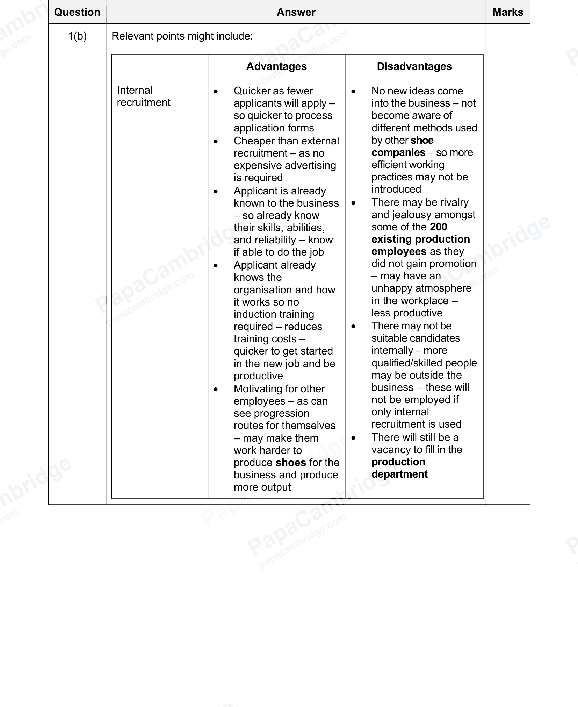
Consider the advantages and disadvantages for KH of using internal or external recruitment when recruiting a new operations manager. Should KH use internal or external recruitment? Justify your answer. internal recruitment external recruitment recommendation
Show mark scheme
Consider the advantages and disadvantages for KH of using internal or 12 external recruitment when recruiting a new operations manager. Should KH use internal or external recruitment? Justify your answer. Level Description Marks 3 Sound application of knowledge and understanding of 9–12 relevant business concepts using appropriate terminology. Detailed discussion of both types of recruitment. Well-justified recommendation. Candidates discussing both types of recruitment, in context and with a well-justified recommendation, including why the alternative type of recruitment was rejected, should be rewarded with the top marks in the band. 2 Sound application of knowledge and understanding of 5–8 relevant business concepts using appropriate terminology. Detailed discussion of at least one type of recruitment. Judgement with some justification / some evaluation of choice made. Candidates discussing both types of recruitment in detail and applying them to the case should be rewarded with the top marks in the band. 1 Limited application of knowledge and understanding of 1–4 relevant business concepts. Limited ability to discuss the types of recruitment with little/no explanation. Simple judgement with limited justification / limited evaluation of choice made. Candidates outlining both types of recruitment in context should be rewarded with the top marks in the band. 0 No creditable response. 0 Notes:
Do not award mirror arguments (an advantage of internal recruitment may be a disadvantage of external recruitment, but this should only be credited once). Relevant points might include: Advantages Disadvantages Internal • Quicker as fewer • No new ideas come recruitment applicants will apply – into the business – not so quicker to process become aware of application forms different methods used
Cheaper than external by other shoe recruitment – as no companies – so more expensive advertising efficient working is required practices may not be
Applicant is already introduced known to the business • There may be rivalry – so already know and jealousy amongst their skills, abilities, some of the 200 and reliability – know existing production if able to do the job employees as they
Applicant already did not gain promotion knows the – may have an organisation and how unhappy atmosphere it works so no in the workplace – induction training less productive required – reduces • There may not be training costs – suitable candidates quicker to get started internally – more in the new job and be qualified/skilled people productive may be outside the
Motivating for other business – these will employees – as can not be employed if see progression only internal routes for themselves recruitment is used – may make them • There will still be a work harder to vacancy to fill in the produce shoes for the production business and produce department more output Advantages Disadvantages External • There will be new • Recruitment may take recruitment ideas in the business longer – as – which may make the advertisements are business more needed which may competitive with other take time to be read shoe manufacturers and responded to
There may be no applicants / rivalry between the interviewing new manager and applicants for the job existing employees – of Operations there will not be Manager jealousy amongst the • The person is not 200 production known to the business employees who did – risk of employing not get the promotion someone who does
The quality of the not have the skills and candidates may be expertise required to high/more understand the experienced/more production of shoes skilled • May have to pay a
Wider choice of higher salary than for applicants to choose an internal recruit from • New recruit may be
There will be no new less effective for a time vacancy to replace the after first being internal applicant employed – as they will take time to understand the structure of KH
It may be demotivating for existing employees as not able to be promoted Recommendation Justification might include:
KH should use internal recruitment as it already has 200 employees working in the first shoe factory and it will be motivating for them to get the chance to be promoted. This should increase efficiency and lead to a greater output for KH. An external applicant may be less familiar with the type of shoes KH produces and therefore is likely to be less effective.
KH should use external recruitment so new ideas can be introduced and make the specialisation process more effective leading to lower costs.
Case study: Coffee, Tea and Desserts (CTD)
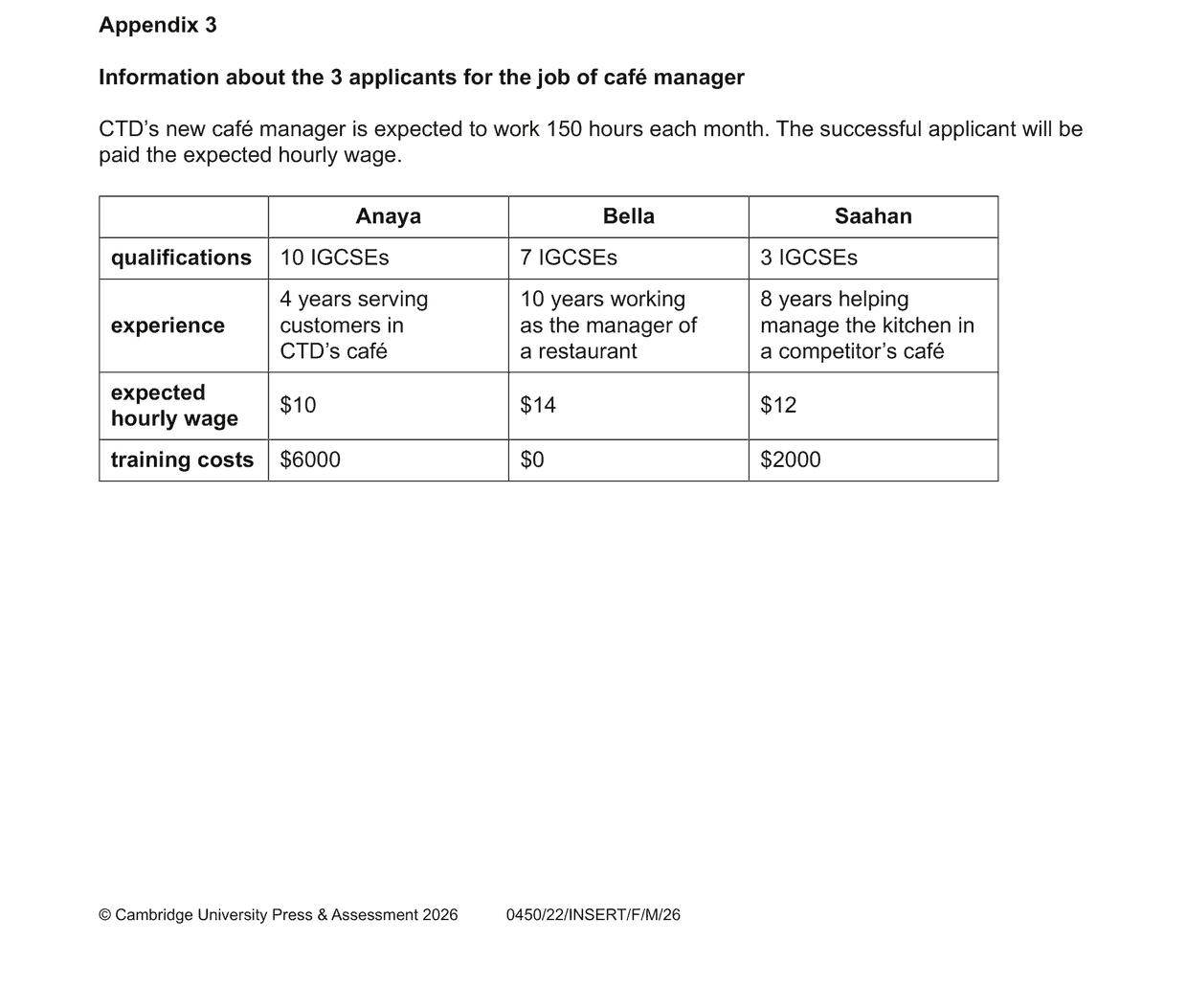
Nadia started CTD 4 years ago in the centre of Main City. CTD is a successful café that sells coffee, tea and desserts. Nadia operates as a sole trader. When she opened her café she wanted the business to remain small. Nadia has 3 employees serving customers in the café. CTD has a reputation for selling high-quality desserts. Nadia has 8 employees making the desserts in the café kitchen. Each worker carries out a task and then passes the part-finished product on to the next employee until the dessert is finished. Nadia knows that CTD’s good reputation could be lost if the high quality of her desserts is not maintained. Nadia is considering the best way to continue to produce high-quality desserts in her kitchen. Nadia uses cost-plus pricing for all the food and drinks CTD sells. She knows promotion is important for CTD as she wants to encourage new customers and create brand loyalty amongst her existing customers. Most of CTD’s customers are people working or shopping in the city centre who walk past the café. Nadia is now planning to expand and open a second café in Main City. Nadia is considering whether to set up a new café or to take over a competitor’s café. Nadia is recruiting a café manager for the second café whichever option she chooses. She has three applicants to choose between. Information about these applicants is shown in Appendix 3.
Appendix 2 — not directly referenced by any question in this paper
Email from Nadia’s accountant to Nadia To: Nadia From: Nadia’s accountant Date: 1 February 2026 Hi Nadia I have reviewed CTD’s accounts and assessed the short-term and long-term financial needs of the business. I have noticed that at certain times of the year the café has a cash flow problem. You need to carefully plan when to buy ingredients for the café. Have you thought about asking for trade credit from your suppliers? I know you plan to expand the business by opening a second café in Main City. Please be aware that the government will increase interest rates from 2% to 6% in the next two months.
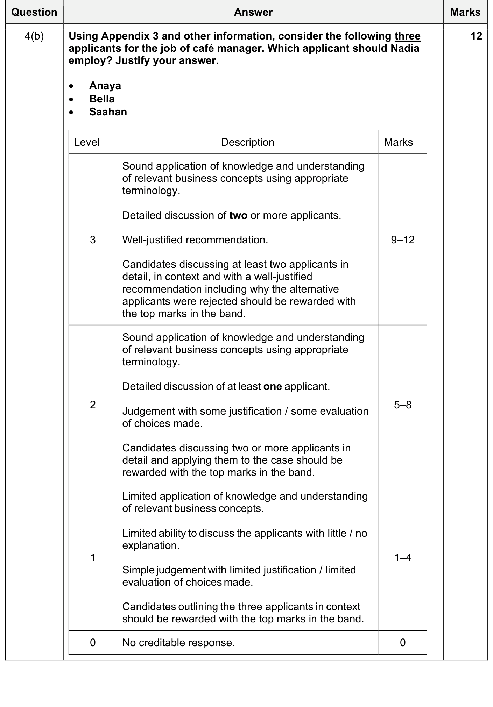
Question 4(b)Feb/Mar 20260450/2212 marks
Using Appendix 3 and other information, consider the following three applicants for the job of café manager. Which applicant should Nadia employ? Justify your answer. Anaya Bella Saahan recommendation
Show mark scheme
Using Appendix 3 and other information, consider the following three 12 applicants for the job of café manager. Which applicant should Nadia employ? Justify your answer.
Anaya
Bella
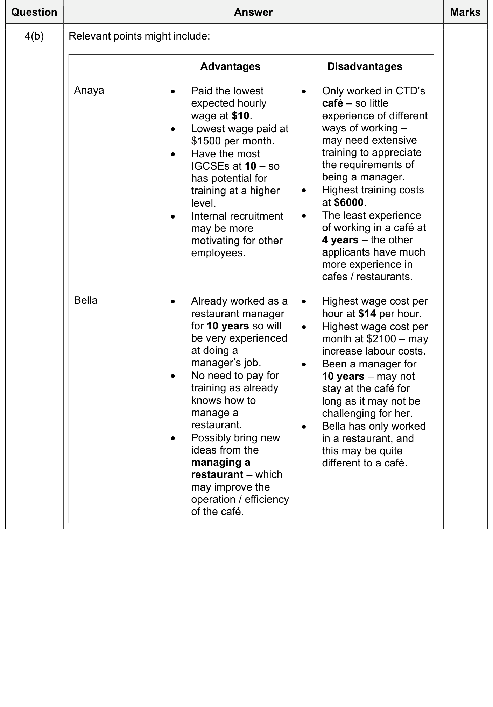
Saahan Level Description Marks Sound application of knowledge and understanding of relevant business concepts using appropriate terminology. Detailed discussion of two or more applicants. 3 Well-justified recommendation. 9–12 Candidates discussing at least two applicants in detail, in context and with a well-justified recommendation including why the alternative applicants were rejected should be rewarded with the top marks in the band. Sound application of knowledge and understanding of relevant business concepts using appropriate terminology. Detailed discussion of at least one applicant. 2 5–8 Judgement with some justification / some evaluation of choices made. Candidates discussing two or more applicants in detail and applying them to the case should be rewarded with the top marks in the band. Limited application of knowledge and understanding of relevant business concepts. Limited ability to discuss the applicants with little / no explanation. 1 1–4 Simple judgement with limited justification / limited evaluation of choices made. Candidates outlining the three applicants in context should be rewarded with the top marks in the band. 0 No creditable response. 0 Relevant points might include: Advantages Disadvantages Anaya • Paid the lowest • Only worked in CTD’s expected hourly café – so little wage at $10. experience of different
Lowest wage paid at ways of working – $1500 per month. may need extensive
Have the most training to appreciate IGCSEs at 10 – so the requirements of has potential for being a manager. training at a higher • Highest training costs level. at $6000.
Internal recruitment • The least experience may be more of working in a café at motivating for other 4 years – the other employees. applicants have much more experience in cafes / restaurants. Bella • Already worked as a • Highest wage cost per restaurant manager hour at $14 per hour. for 10 years so will • Highest wage cost per be very experienced month at $2100 – may at doing a increase labour costs. manager’s job. • Been a manager for
No need to pay for 10 years – may not training as already stay at the café for knows how to long as it may not be manage a challenging for her. restaurant. • Bella has only worked
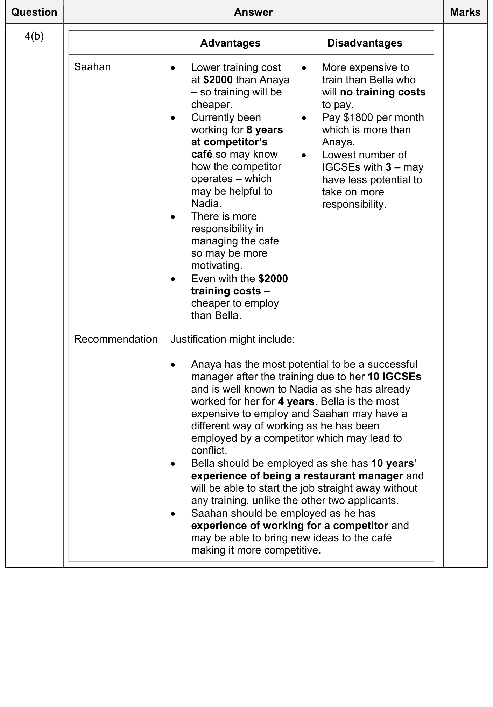
Possibly bring new in a restaurant, and ideas from the this may be quite managing a different to a café. restaurant – which may improve the operation / efficiency of the café. Advantages Disadvantages Saahan • Lower training cost • More expensive to at $2000 than Anaya train than Bella who – so training will be will no training costs cheaper. to pay.
Currently been • Pay $1800 per month working for 8 years which is more than at competitor’s Anaya. café so may know • Lowest number of how the competitor IGCSEs with 3 – may operates – which have less potential to may be helpful to take on more Nadia. responsibility.
There is more responsibility in managing the cafe so may be more motivating.
Even with the $2000 training costs – cheaper to employ than Bella. Recommendation Justification might include:
Anaya has the most potential to be a successful manager after the training due to her 10 IGCSEs and is well known to Nadia as she has already worked for her for 4 years. Bella is the most expensive to employ and Saahan may have a different way of working as he has been employed by a competitor which may lead to conflict.
Bella should be employed as she has 10 years’ experience of being a restaurant manager and will be able to start the job straight away without any training, unlike the other two applicants.
Saahan should be employed as he has experience of working for a competitor and may be able to bring new ideas to the café making it more competitive.
Case study: Luxury Bathrooms (LB)
LB is a large private limited company. The business was started 20 years ago in country X. LB manufactures luxury bathroom products including baths, showers and basins, which it sells to specialist retail shops. The Managing Director knows that working capital is important. LB has recently introduced new machinery into its factory. The business has continued to grow each year and has benefited from economies of scale including financial, purchasing and managerial. The market for luxury bathrooms is very competitive in country X. LB plans to produce a new range of bathroom products. It is using primary market research to decide which products to manufacture. LB also needs to choose which channel of distribution to use. It could sell the new range of bathroom products to the same specialist retail shops as its existing products, or sell directly to customers through its website. LB currently uses its website to provide information and does not sell its products through it. LB wants to enter the luxury bathroom market in country Y. It plans to build a factory in country Y in 2026. LB will probably use a bank loan to finance the building of the factory. LB needs to communicate the expansion plans to all of its employees. Choosing the most suitable method of communication will be important.
Appendix 3 — referenced by Q4(b)
Newspaper article from City News in country Y, September 2025 The economy in country Y is growing and consumer incomes are rising. This is causing an increase in demand for luxury items for the home which is forecast to continue. There are many local businesses manufacturing bathroom products. The government is aware that multinational companies are considering locating factories in country Y. There are both benefits and drawbacks to country Y of allowing businesses from other countries to build their factories here.
---
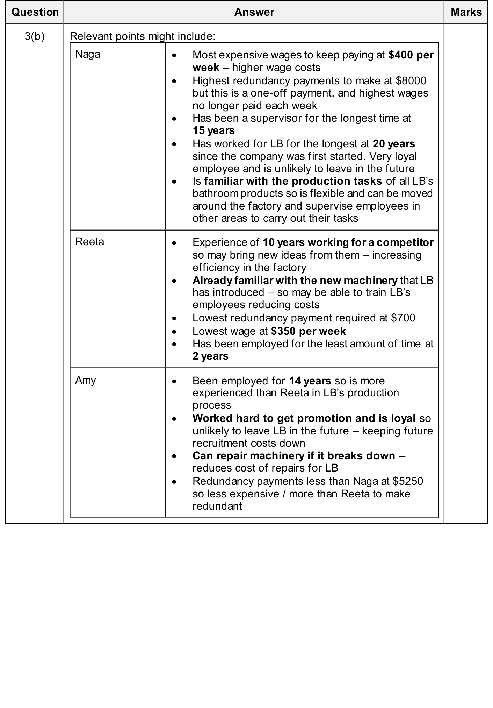
Question 3(b)Oct/Nov 20250450/2112 marks
Using Appendix 2 and other information, consider the three employees that LB could make redundant. Which employee should LB choose? Justify your answer.
Naga
Reeta
Amy Naga: Reeta: Amy: Recommendation:
Show mark scheme
Using Appendix 2 and other information, consider the three employees 12 that LB could make redundant. Which employee should LB choose? Justify your answer.
Naga
Reeta
Amy Level Description Marks 3 Sound application of knowledge and understanding of 9–12 relevant business concepts using appropriate terminology. Detailed discussion of two or more employees. Well-justified recommendation. Candidates discussing all three employees, in context and with a well-justified recommendation, including why the alternative employees were rejected, should be rewarded with the top marks in the band. 2 Sound application of knowledge and understanding of 5–8 relevant business concepts using appropriate terminology. Detailed discussion of at least one employee. Judgement with some justification / some evaluation of choice made. Candidates discussing in detail two or more employees and applying these to the case should be rewarded with the top marks in the band. 1 Limited application of knowledge and understanding of 1–4 relevant business concepts. Limited ability to discuss the employees with little/no explanation. Simple judgement with limited justification / limited evaluation of choice made. Candidates outlining all three employees in context should be rewarded with the top marks in the band. 0 No creditable response. 0 Relevant points might include: Naga • Most expensive wages to keep paying at $400 per week – higher wage costs
Highest redundancy payments to make at $8000 but this is a one-off payment, and highest wages no longer paid each week
Has been a supervisor for the longest time at 15 years
Has worked for LB for the longest at 20 years since the company was first started. Very loyal employee and is unlikely to leave in the future
Is familiar with the production tasks of all LB’s bathroom products so is flexible and can be moved around the factory and supervise employees in other areas to carry out their tasks Reeta • Experience of 10 years working for a competitor so may bring new ideas from them – increasing efficiency in the factory
Already familiar with the new machinery that LB has introduced – so may be able to train LB’s employees reducing costs
Lowest redundancy payment required at $700
Lowest wage at $350 per week
Has been employed for the least amount of time at 2 years Amy • Been employed for 14 years so is more experienced than Reeta in LB’s production process
Worked hard to get promotion and is loyal so unlikely to leave LB in the future – keeping future recruitment costs down
Can repair machinery if it breaks down – reduces cost of repairs for LB
Redundancy payments less than Naga at $5250 so less expensive / more than Reeta to make redundant Recommendation Justification might include:
Naga should be made redundant as she has the highest wages and therefore will save the greatest amount of wage costs. Reeta has the lowest wages per week so is cheaper to employ and Amy is very loyal and hardworking so is unlikely to leave in the future.
Reeta should be made redundant as she has worked the shortest time for LB, at 2 years, and therefore less experienced.
Amy should be made redundant as she has not worked for LB as long as Naga and has only been a supervisor for 5 years which is less time than Naga so has less experience.
Case study: Exceptional Sailing (ES)
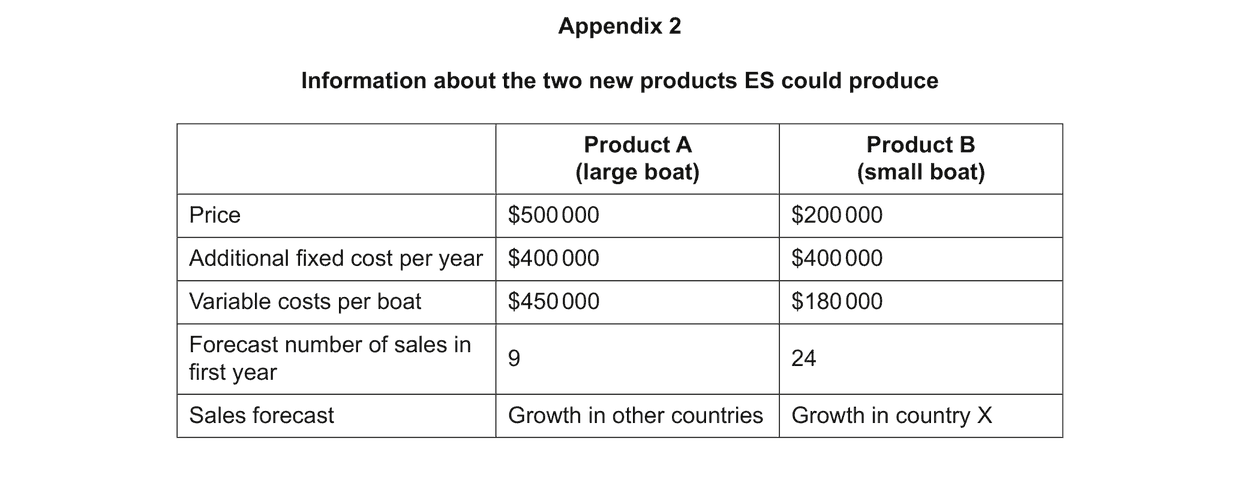
Tim worked at a large boat manufacturer in country X for 20 years. He is highly skilled in building boats. Tim decided to start his own business, called ES, 4 years ago. He currently operates as a sole trader. ES only makes and sells boats in country X. It has become established as a well-known brand with a reputation for high quality. ES has 12 skilled employees including an assistant who helps Tim to run the business. ES has a flat organisational structure with a short chain of command. ES has grown quickly and Tim plans to expand the business further by selling his boats to customers in other countries. He is aware that there are opportunities and threats of globalisation, especially as tariffs and quotas on boats and their component parts have been removed both in country X and in other countries. Tim plans to take out a bank loan to help fund the expansion. His two brothers will also invest in the business. One of his brothers has experience of financial management and the other is skilled in IT. Tim will need to decide whether ES should become a partnership or a private limited company. Tim wants to manufacture a new boat and he will need to choose between Product A and Product B. Information about the two new boats is shown in Appendix 2. ES currently promotes its boats in sailing magazines. Tim is considering using social media to promote his new boat to a wider market. Tim will need to recruit 4 new employees. These new employees will require training and Tim has to decide whether to train them at ES or send them to college two days a week.
Appendix 3 — referenced by Q4(a)
Email from Tim to his two brothers To: My two brothers From: Tim Date: 1 October 2025 I am pleased that you have both decided to invest in the business. I know that it will be good to work together and make decisions about the growth of ES. I have included some financial information for 2024.
Revenue increased by 50%
Gross profit margin was 65%
Profit was $100 000
Current ratio was 2
Acid test ratio was 0.5
---
Question 3(b)Oct/Nov 20250450/2312 marks
Consider the advantages and disadvantages of ES using on-the-job or off-the-job training for its new employees. Which method should Tim use? Justify your answer. On-the-job training: Off-the-job training: Recommendation:
Show mark scheme
Consider the advantages and disadvantages of ES using on-the-job or 12 off-the-job training for its new employees. Which method should Tim use? Justify your answer.
On-the-job training
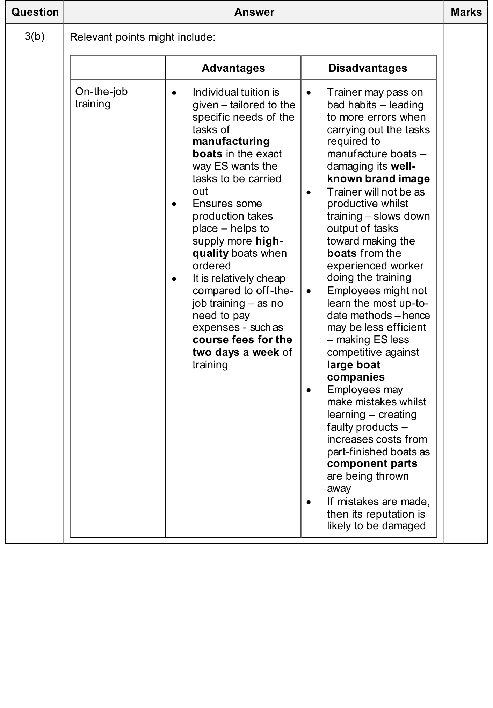
Off-the-job training Level Description Marks 3 Sound application of knowledge and understanding of 9–12 relevant business concepts using appropriate terminology. Detailed discussion of both training methods. Well-justified recommendation. Candidates discussing both training methods in detail, in context and a with well-justified recommendation, including why the alternative training method was rejected, should be rewarded with the top marks in the band. 2 Sound application of knowledge and understanding of 5–8 relevant business concepts using appropriate terminology. Detailed discussion of at least one training method. Judgement with some justification / some evaluation of choices made. Candidates discussing one or more training method in detail and applying it to the case should be rewarded with the top marks in the band. 1 Limited application of knowledge and understanding of 1–4 relevant business concepts. Limited ability to discuss the training methods with little/no explanation. Simple judgement with limited justification / limited evaluation of choices made. Candidates outlining both training methods in context should be rewarded with the top marks in the band. 0 No creditable response. 0 Relevant points might include: Advantages Disadvantages On-the-job • Individual tuition is • Trainer may pass on training given – tailored to the bad habits – leading specific needs of the to more errors when tasks of carrying out the tasks manufacturing required to boats in the exact manufacture boats – way ES wants the damaging its well- tasks to be carried known brand image out • Trainer will not be as
Ensures some productive whilst production takes training – slows down place – helps to output of tasks supply more high- toward making the quality boats when boats from the ordered experienced worker
It is relatively cheap doing the training compared to off-the- • Employees might not job training – as no learn the most up-to- need to pay date methods – hence expenses - such as may be less efficient course fees for the – making ES less two days a week of competitive against training large boat companies
Employees may make mistakes whilst learning – creating faulty products – increases costs from part-finished boats as component parts are being thrown away
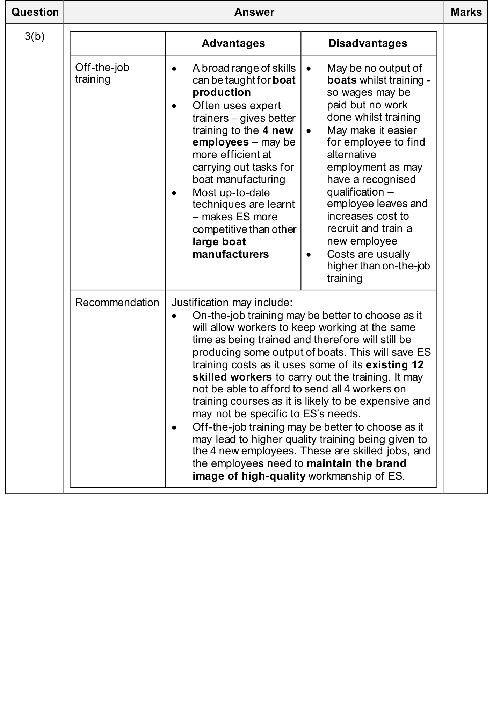
If mistakes are made, then its reputation is likely to be damaged Advantages Disadvantages Off-the-job • A broad range of skills • May be no output of training can be taught for boat boats whilst training - production so wages may be
Often uses expert paid but no work trainers – gives better done whilst training training to the 4 new • May make it easier employees – may be for employee to find more efficient at alternative carrying out tasks for employment as may boat manufacturing have a recognised
Most up-to-date qualification – techniques are learnt employee leaves and – makes ES more increases cost to competitive than other recruit and train a large boat new employee manufacturers • Costs are usually higher than on-the-job training Recommendation Justification may include:
On-the-job training may be better to choose as it will allow workers to keep working at the same time as being trained and therefore will still be producing some output of boats. This will save ES training costs as it uses some of its existing 12 skilled workers to carry out the training. It may not be able to afford to send all 4 workers on training courses as it is likely to be expensive and may not be specific to ES’s needs.
Off-the-job training may be better to choose as it may lead to higher quality training being given to the 4 new employees. These are skilled jobs, and the employees need to maintain the brand image of high-quality workmanship of ES.
Case study: Vegan Veg (VV)
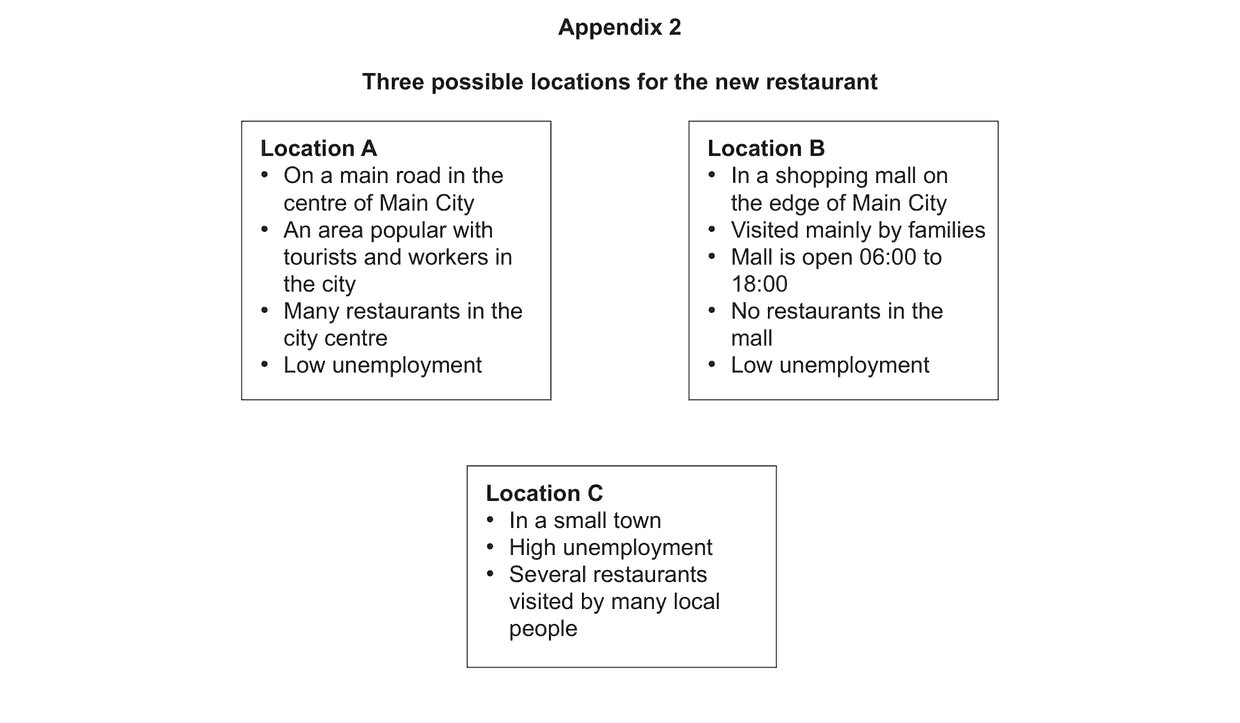
Jemi has always wanted to own a business. She is planning to buy a franchise called VV, a restaurant brand that only serves vegan meals. The meals do not contain any ingredients made from animal products. Market segmentation is important to VV. There has been an increasing trend for people to eat vegan meals. Jemi will need to decide the best location for her restaurant. There are three possible locations outlined in Appendix 2. The restaurant will serve a wide range of vegan meals and Jemi will purchase ingredients, including fruit and vegetables, directly from local suppliers. Jemi will employ a chef to cook the meals. The chef will be expected to work 40 hours a week. Jemi has identified the two best applicants. Their details are shown in Appendix 1. As well as a chef, Jemi plans to employ another 3 people to help in the kitchen and 8 people to serve customers in the restaurant. Jemi knows that keeping these employees motivated will be important. She is considering using job enrichment or giving a discount on meals in the restaurant to keep her employees motivated. Jemi is going to use her own capital of $50 000 to buy the franchise, but she will also need a source of external finance to help set up the business. Jemi knows that the profitability and liquidity ratios for her restaurant will be important for the success of her business.
Appendix 3 — referenced by Q4(a)
Newspaper article from Main News, 3 May 2025 A recent government report said that everyone should be eating more fruit and vegetables. It found that this is particularly important to help keep children healthy and to live a long life. Eating less meat is also good for the environment. Five years ago, only 10% of the population ate vegan meals but this percentage has increased to 25%. It is forecast that this trend will continue. Many well-known restaurants are adding vegan meals to their menus. There are also new vegan restaurants being opened. However, it is getting more difficult to find reliable suppliers of fruit and vegetables. Restaurants are now having to buy from suppliers that are further away.
---
Question 1(b)May/Jun 20250450/2312 marks
Using Appendix 1 and other information, consider the following two applicants for the position of chef at Jemi’s new restaurant. Which applicant should Jemi employ? Justify your answer.
Tianna
Vea Tianna: Vea: Recommendation:
Show mark scheme
Using Appendix 1 and other information, consider the following two 12 applicants for the position of chef at Jemi’s new restaurant. Which applicant should Jemi employ? Justify your answer.
Tianna
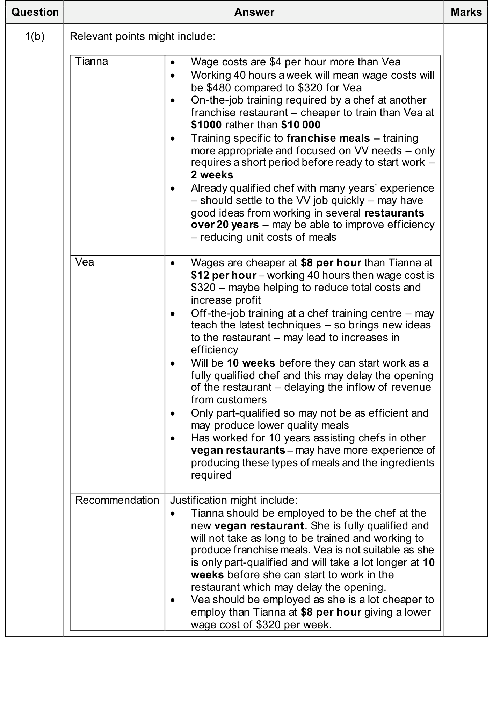
Vea Level Description Marks 3 Sound application of knowledge and understanding of 9–12 relevant business concepts using appropriate terminology. Detailed discussion of both applicants. Well-justified recommendation. Candidates discussing both applicants in detail, in context and with a well-justified recommendation, including why the alternative applicant was rejected, should be rewarded with the top marks in the band. 2 Sound application of knowledge and understanding of 5–8 relevant business concepts using appropriate terminology. Detailed discussion of at least one applicant. Judgement with some justification/some evaluation of choice made. Candidates discussing at least one applicant in detail and applying it to the case should be rewarded with the top marks in the band. 1 Limited application of knowledge and understanding of 1–4 relevant business concepts. Limited ability to discuss the applicants with little/no explanation. Simple judgement with limited justification/limited evaluation of choice made. Candidates outlining both applicants in context should be rewarded with the top marks in the band. 0 No creditable response. 0 Relevant points might include: Tianna • Wage costs are $4 per hour more than Vea
Working 40 hours a week will mean wage costs will be $480 compared to $320 for Vea
On-the-job training required by a chef at another franchise restaurant – cheaper to train than Vea at $1000 rather than $10 000
Training specific to franchise meals – training more appropriate and focused on VV needs – only requires a short period before ready to start work – 2 weeks
Already qualified chef with many years’ experience – should settle to the VV job quickly – may have good ideas from working in several restaurants over 20 years – may be able to improve efficiency – reducing unit costs of meals Vea • Wages are cheaper at $8 per hour than Tianna at $12 per hour – working 40 hours then wage cost is $320 – maybe helping to reduce total costs and increase profit
Off-the-job training at a chef training centre – may teach the latest techniques – so brings new ideas to the restaurant – may lead to increases in efficiency
Will be 10 weeks before they can start work as a fully qualified chef and this may delay the opening of the restaurant – delaying the inflow of revenue from customers
Only part-qualified so may not be as efficient and may produce lower quality meals
Has worked for 10 years assisting chefs in other vegan restaurants – may have more experience of producing these types of meals and the ingredients required Recommendation Justification might include:
Tianna should be employed to be the chef at the new vegan restaurant. She is fully qualified and will not take as long to be trained and working to produce franchise meals. Vea is not suitable as she is only part-qualified and will take a lot longer at 10 weeks before she can start to work in the restaurant which may delay the opening.
Vea should be employed as she is a lot cheaper to employ than Tianna at $8 per hour giving a lower wage cost of $320 per week.
75 more questions from 2019–2024
🔒 Unlock every Recruitment, selection and training of employees question from 2019–2024
All 75 come with their mark schemes, answers and case studies, and appear in the practice tool above once you’re signed in. It’s free.
0450/12 · Oct/Nov 2024 · Question 4(b)Identify one benefit and one limitation of… 🔒
0450/12 · Oct/Nov 2024 · Question 4(c)Outline one reason why each of the… 🔒
0450/13 · Oct/Nov 2024 · Question 4(d)Explain two possible reasons why providing training… 🔒
0450/13 · Oct/Nov 2024 · Question 4(e)Do you think the advantages for a… 🔒
0450/23 · Oct/Nov 2024 · Question 2(b)Consider the benefits to SA of having… 🔒
+ 70 more, by year in the table above
Questions and mark schemes are from past Cambridge papers and are reproduced for revision. Topical Vault is an independent revision resource, not affiliated with or endorsed by Cambridge Assessment International Education.
IGCSE Business questions by topic
Each topic opens this practice tool with only that topic’s questions, plus how often it comes up and every question on it in one list. Revision notes for IGCSE Business →
Pick a paper, sub-topics and years to draw from (leave any blank for "all"), choose
how many questions you want, and we'll open a new worksheet page with a random set for you to review
and download.