Cambridge 9609, Paper 3 & 4. 330 questions, 2020 to 2026.
Topic
Year
Case studies and questions retyped from the original Cambridge material; Paper 3 mark
schemes are cropped from the official mark scheme PDFs, Paper 4 mark schemes are retyped as text.
A few 2020–2022 Paper 3 case studies were recovered by OCR from a damaged source file —
those are marked where it applies.
About Investment appraisal
Questions on investment appraisal: payback, accounting rate of return (ARR) and net present value (NPV), and the qualitative factors in investment decisions.
New to Investment appraisal, or finding these questions hard?
Read the notes first: the key ideas, diagrams and formulas, and the mistakes examiners see most, in about 13 minutes.
21 past paper questions on this topic since 2020, across 12 exam sessions.
How often it comes up
Year
Paper 3
Total
Chart
2026
3
3
2025
3
3
2024
4
4
2023
4
4
2022
1
1
2021
4
4
2020
2
2
Every 2025–2026 question on Investment appraisal
The whole topic on one page, with answers and mark schemes. Printing this page prints just this list.
Paper 3 · Business decision-making (case study) (6)
Case study: Carrum Cars (CC)
CC is a private limited company, based in country W, that sells cars. Gross domestic product (GDP) in country W has increased significantly in the last five years.
CC was set up in 2022 and for two years it traded online and from a small showroom in the centre of city A.
CC does not manufacture cars. The business buys cars directly from manufacturers and then sells these from its showroom and on its website.
Showroom relocation
In March 2024, CC purchased a large plot of land on a busy road in country W. It built a large showroom so that customers can view the cars and take them for a test drive. This investment was financed by a bank loan. In August 2024, CC relocated to the new showroom.
The new showroom building also has offices for the directors and managers and an area for internet sales. Figure 1.1 shows some data about the showroom relocation.
CC’s new showroom:
opened in August 2024
capacity to store 70 cars in inventory at any one time
employee and customer parking for an additional 30 cars
two other competitor car showrooms within 5 km
closest populated areas: city A – 9 km away, population 500 000 city B – 21 km away, population 200 000.
Figure 1.1 Data about CC’s showroom relocation
Organisational structure
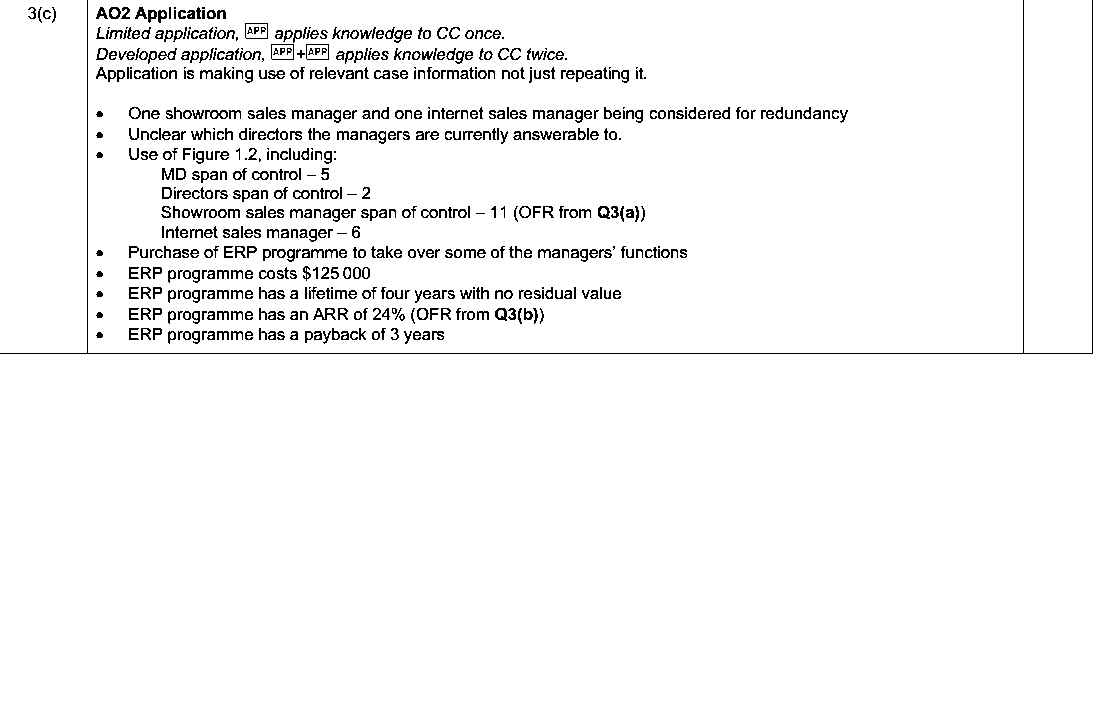
At a recent meeting of the board of directors, the efficiency of CC was discussed. Figure 1.2 shows the current organisational structure for CC in 2026. The number in brackets in each box shows the number of employees in that role.
Figure 1.2 CC’s organisational chart
CC’s finance director, Emele, thinks that the business has too many levels of hierarchy. She has proposed that CC delayers the company by making the showroom sales manager and the internet sales manager redundant. She has proposed that CC should invest in an Enterprise Resource Planning (ERP) programme which would take over most of the managerial functions currently carried out by the two managers.
The showroom sales employees are paid using commission based on achieving sales targets. The cleaners are paid country W’s minimum wage, and the other employees are paid a salary. The mechanics are paid a relatively high salary due to a skills shortage in country W. ERP investment appraisal
Emele has carried out an investment appraisal for the proposed ERP programme (see Table 1.1). There is no residual value for this investment at the end of its four-year life.
Table 1.1 Net cashflow for the proposed ERP software
Inventory control
The operations director, Tofua, is more concerned about the inventory held by CC. ‘When we were located at the old showroom, we held very little inventory’ said Tofua, ‘and it worked well for us. However, since opening the new showroom, we have been holding more and more inventory, and it is causing significant opportunity costs.’ Table 1.2 shows inventory and cost data for CC.
Table 1.2 Inventory and cost data for CC
The managing director, Olivia, thinks that reducing the inventory level in the showroom would be an inappropriate decision. She knows that many customers expect to be able to see and test drive a car before they agree to purchase it. Without inventory of the different car models CC sells, she worries that demand will decrease, especially with the current high inflation rate in country W.
Tofua has prepared a summary report of CC’s current inventory (see Table 1.3).
Table 1.3 CC’s current inventory
Sales forecasting
At a recent board meeting, Jing, the marketing director, presented the quarterly sales forecast. An extract from the quarter 3 (July to September) 2026 forecast is shown in Figure 1.3.
July and August – low sales due to customers prioritising vacations.
September – manufacturers launch new car models – high sales expected.
market trends – 35% increase in demand for electric vehicles.
Figure 1.3 Extract from Q3, 2026 CC sales forecast
Olivia, the managing director, is concerned that Jing’s forecast does not include more qualitative sales forecasting.
Question 3May/Jun 20269609/3216 marks
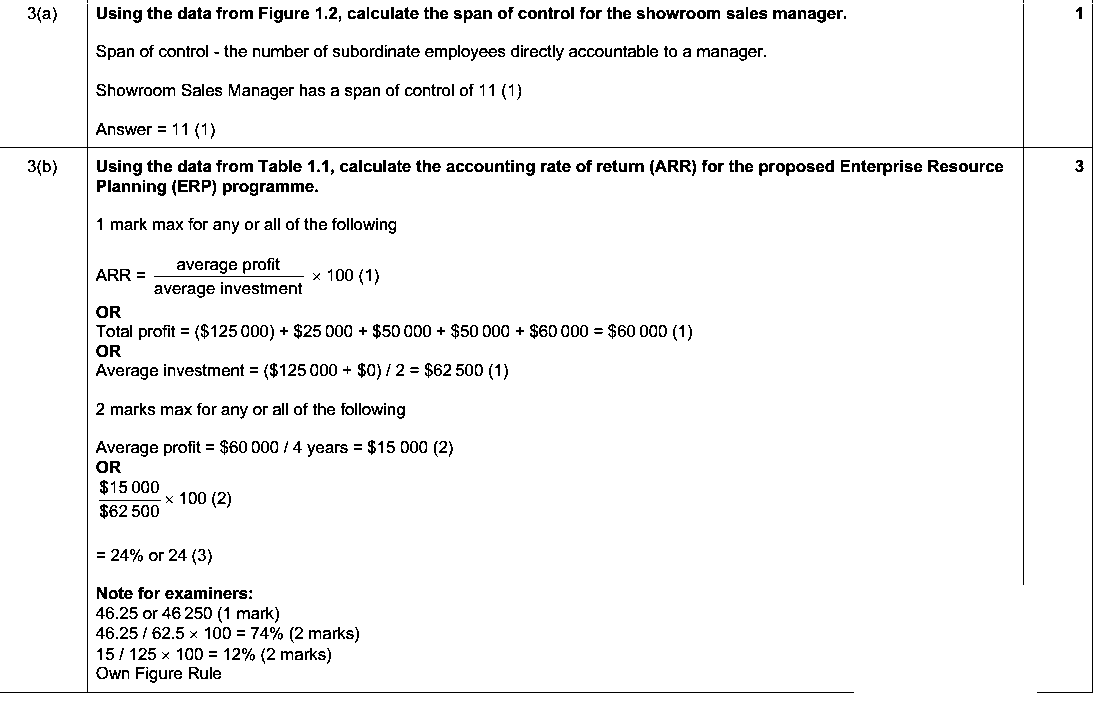
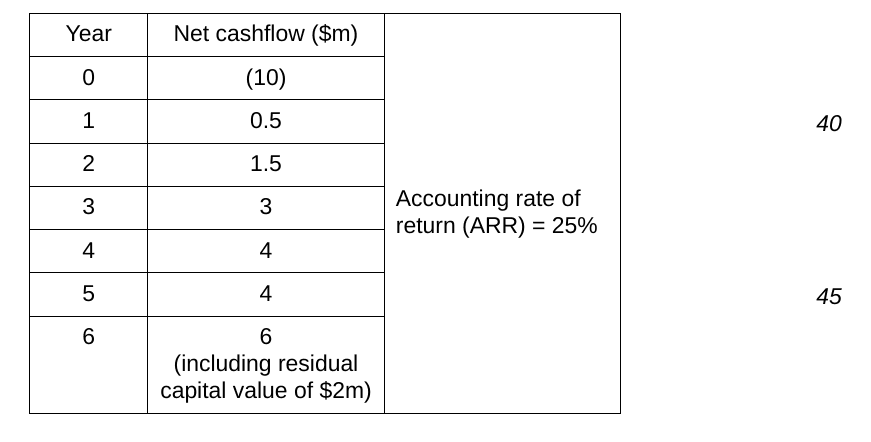
(a) Using the data from Figure 1.2, calculate the span of control for the showroom sales manager. Span of control - the number of subordinate employees directly accountable to a manager. Showroom Sales Manager has a span of control of 11 (1). [1 marks]
(b) Using the data from Table 1.1, calculate the accounting rate of return (ARR) for the proposed Enterprise Resource Planning (ERP) programme. [3 marks]
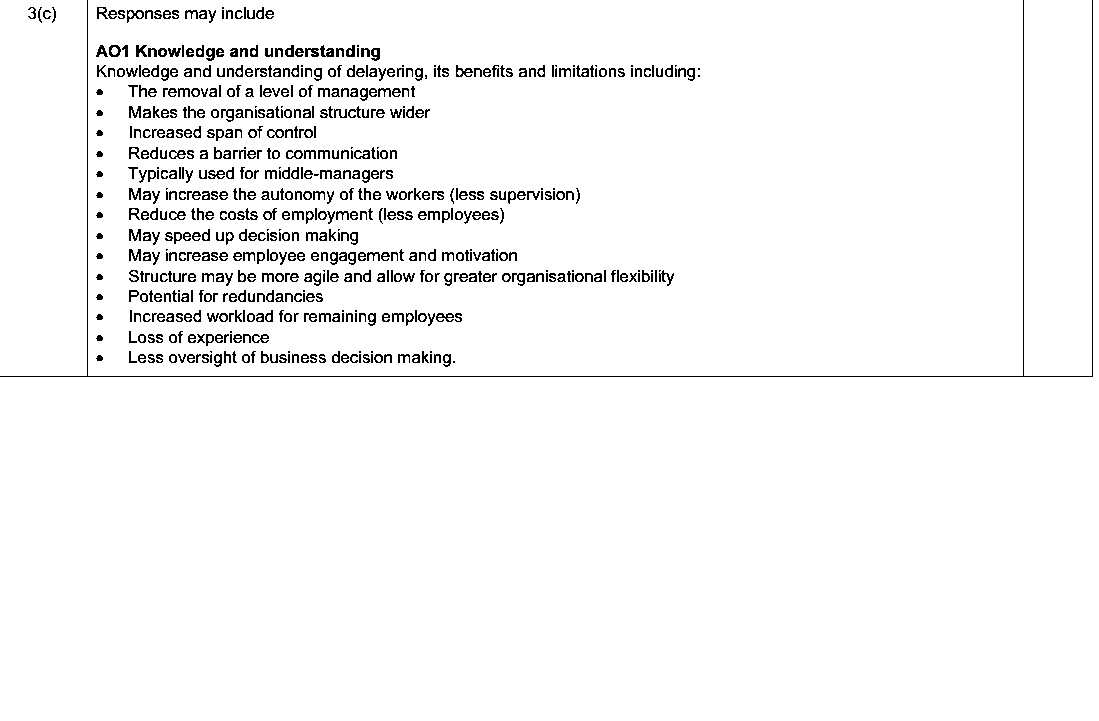
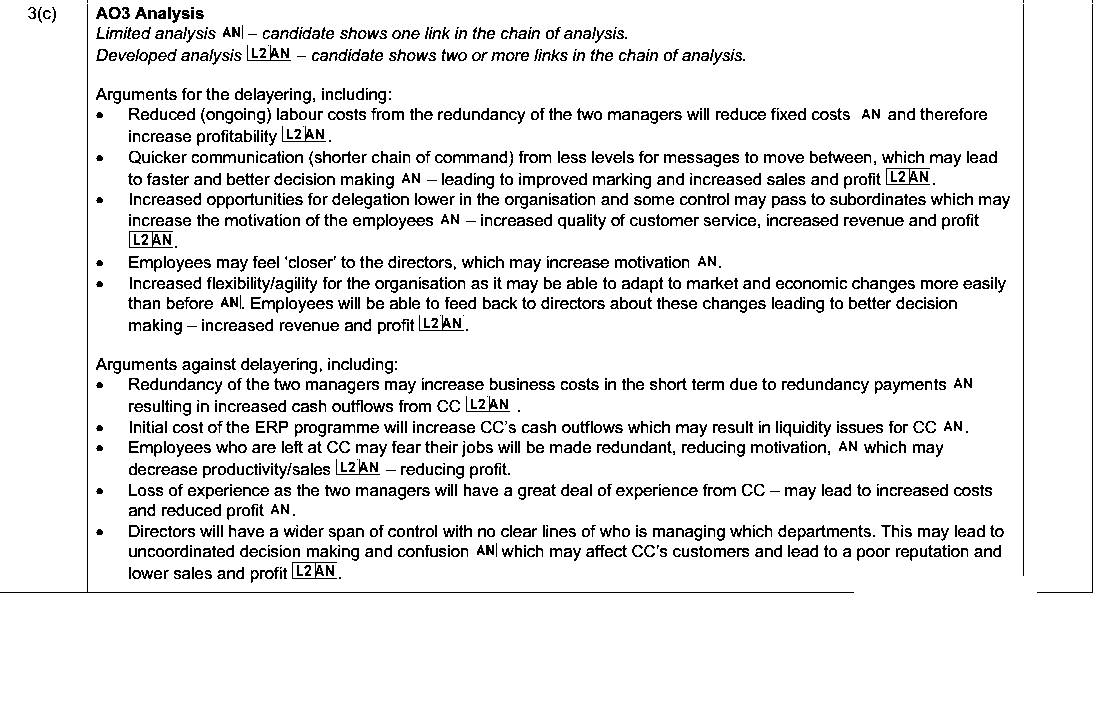
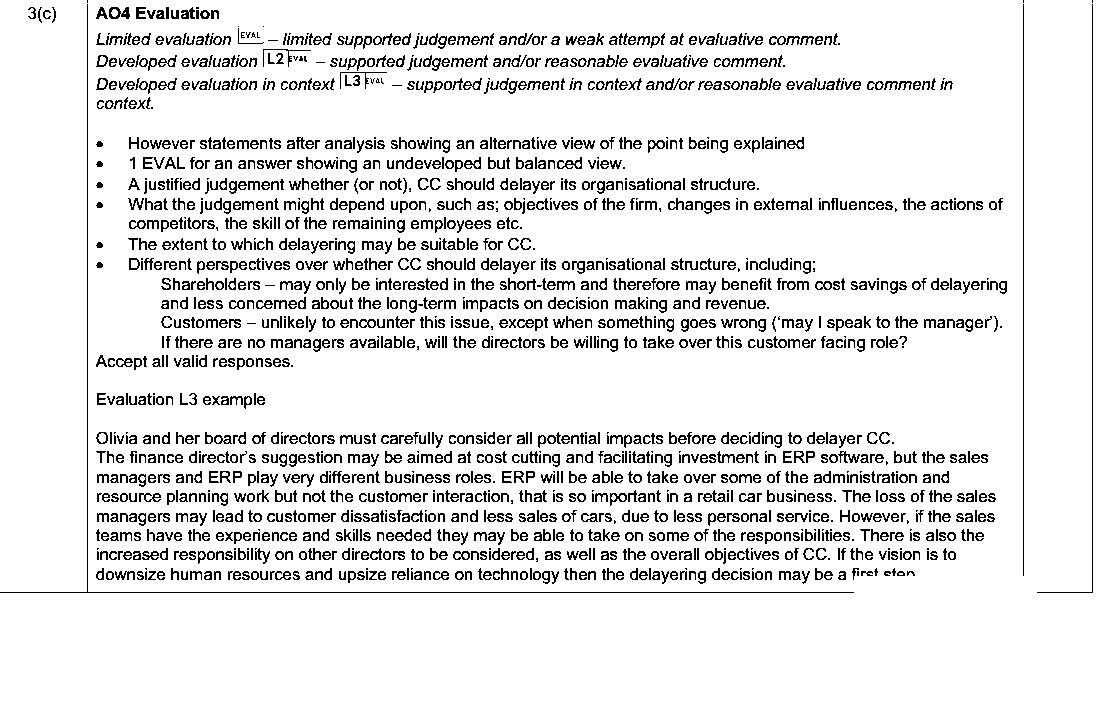
(c) Evaluate whether the directors should delayer CC’s organisational structure. [12 marks]
Show mark scheme
Case study: Reeta Roy (RR)
RR is a manufacturer and retailer of luxury beauty products. Reeta Roy started RR in 2016 after managing several small enterprises with limited success.
Using her creativity, Reeta produced the first batch of soap in her kitchen. Reeta used fresh ingredients from her home region of country X. Customer feedback was positive and Reeta decided to form a private limited company. RR rented a local factory to start production. The location of the factory was important as Reeta’s business plan was to work with local farmers who could supply fresh ingredients. RR decided not to use machines and instead recruited skilled workers to hand-make its products.
Reeta believes the culture of RR is essential in creating a luxury product. Reeta expects employees to share her pride in RR’s products whether they work in manufacturing or have face-to-face contact with the final consumer.
RR’s first retail store opened in 2017 selling only RR products. By 2026, RR had opened 22 retail stores in country X, with more planned.
Reeta’s leadership
Though employees admire Reeta’s determination, energy and charisma, RR has a high labour turnover of graduate level managers due to limited promotion opportunities and training. Reeta believes that leaders are born with the traits and abilities to lead.
Supply issues
The success of RR’s brand is built on using local ingredients. Sourcing quality ingredients to meet demand is a constant problem. RR occasionally has to accept a variation in the standard of ingredients. Some of RR’s products made using these ingredients have to be rejected after quality control. The operations manager has suggested that RR should introduce lean production.
Country X’s economic performance
Since 2016, there has been rapid economic growth in country X, see Table 1.1.
Table 1.1 Country X economic data
International expansion
RR plans to expand internationally. Reeta wants RR to expand by opening retail units in other countries. However, the marketing team believes that RR should start selling its products using information technology (IT), for example, by using RR’s website and social media. Reeta believes that selling online will have a negative impact on RR’s luxury brand. Reeta thinks that the consumer’s positive interaction with the retail staff is important.
Table 1.2 shows some information about the sales of luxury beauty products in country X.
Table 1.2 Sales of luxury beauty products in country X ($m)
A survey of RR’s consumers found that 60% said visiting an RR store was a key factor in their purchase decisions and that 45% would consider buying RR products online.
The marketing team has produced an investment appraisal for its IT proposal, see Table 1.3.
Table 1.3 Investment appraisal for the marketing team’s IT proposal
FSA
FSA is a multinational company and the market leader in beauty products. FSA is aiming to add to its portfolio of luxury brands. RR’s growing reputation has come to the attention of FSA’s Chief Executive, Gabriel Laurent. Gabriel met with Reeta to discuss purchasing 20% of RR’s share capital. Gabriel was impressed by Reeta’s vision for RR and her leadership values. Reeta has placed a high financial value on RR’s shares which is far greater than shown by RR’s latest published accounts. FSA’s Chief Financial Officer (CFO) is concerned by RR’s lack of detailed accounting data including financial ratios. However, Gabriel is convinced that buying 20% of RR’s shares at the value proposed by Reeta is a unique investment opportunity for FSA.
Question 4May/Jun 20269609/3316 marks
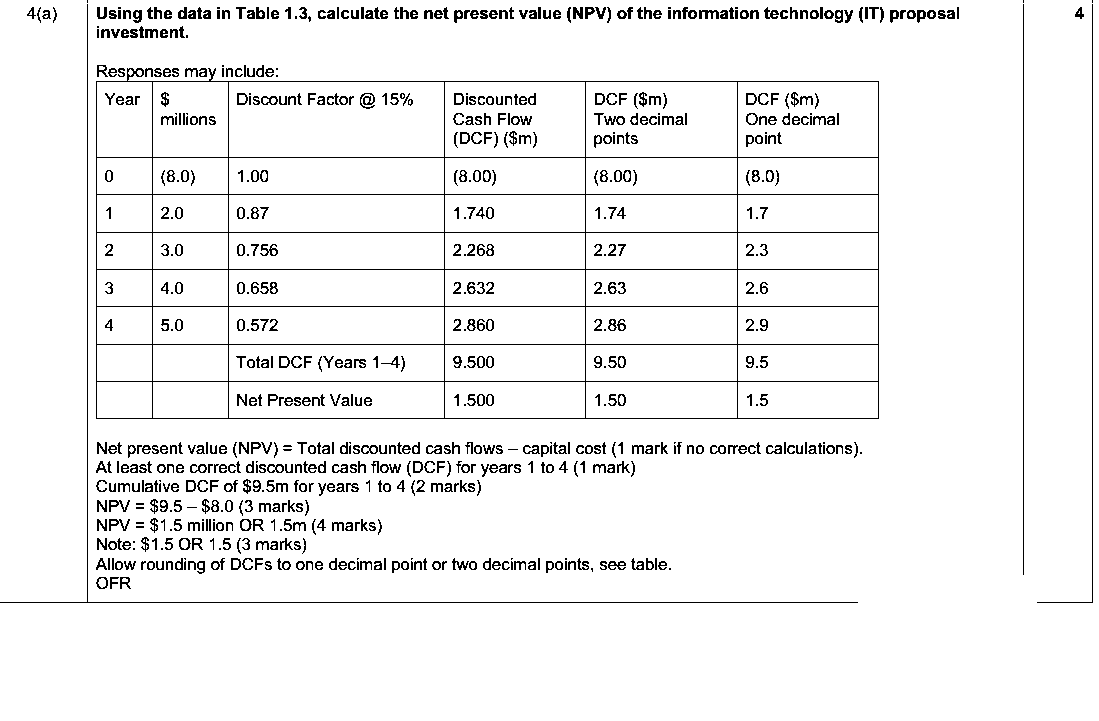
(a) Using the data in Table 1.3, calculate the net present value (NPV) of the information technology (IT) proposal investment. [4 marks]
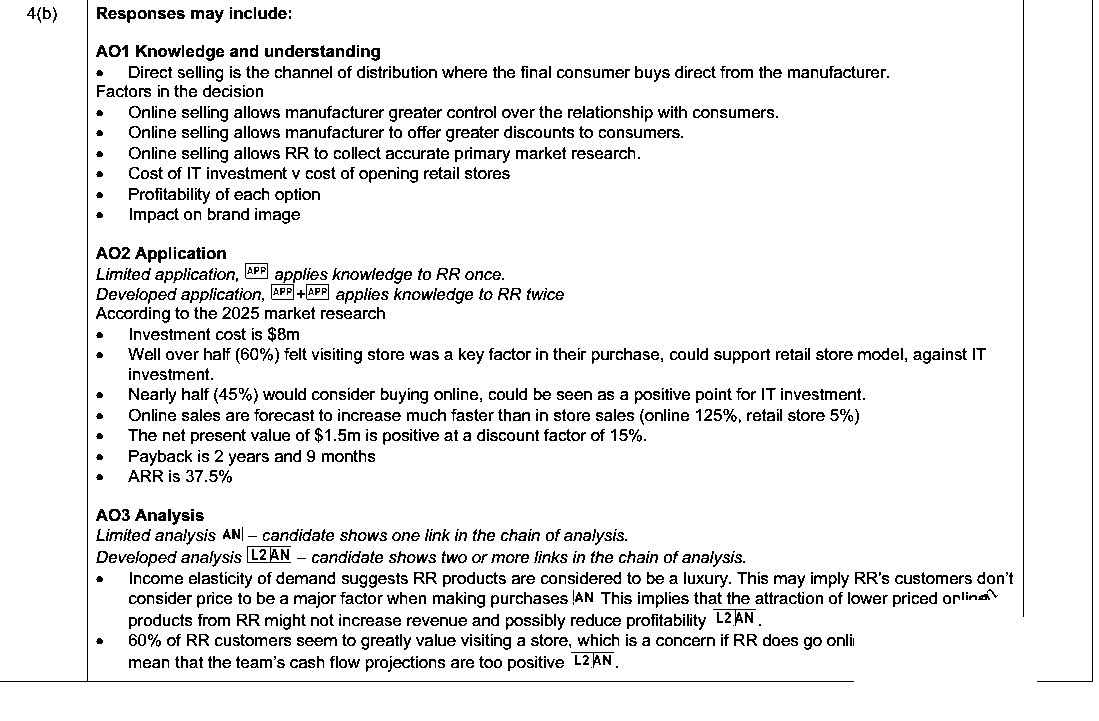
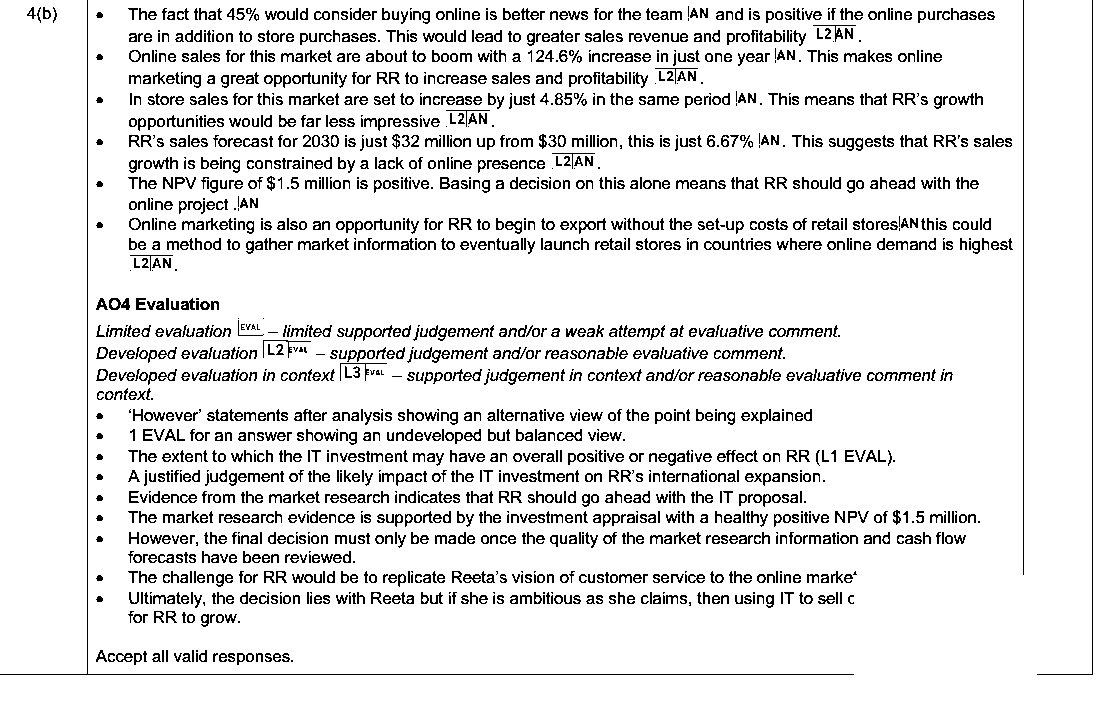
(b) Evaluate whether RR should invest in the information technology (IT) proposal to support its international expansion. [12 marks]
Show mark scheme
Case study: Pavni’s Pottery (PP)
In 2021, Pavni was made redundant from her job as a production supervisor for a large pottery business. She then decided to open PP as a private limited company in country W.
PP produces and sells handmade gift items made of clay and processed in a kiln. A kiln is a high-temperature oven which turns clay into pottery. PP started with a small range of products including cups, bowls and plates but has since increased its product range to include tea light holders, fridge magnets and small plant pots. The new range of tea light holders has been PP’s most successful product to date.
Pavni has carried out some research into the gift market in country W and has identified forecasts for continued growth. Forecasts indicate that the gift market could grow to $540 million by 2029. The pottery gift segment of this market is 3% and this segment is very competitive.
Marketing
Pavni sells 75% of her products through three retail outlets business to business (B2B). These retailers place orders with PP quarterly and PP has a 2-month lead time from receiving the order to goods being ready for delivery.
PP has a website for consumers to order direct. Products are delivered to consumers within one week. PP has started to gain brand recognition from repeat consumers. Pavni would like the business to consumer sales (B2C) to grow.
Pavni has employed a university graduate, Fiza, on a full-time contract. Fiza has a marketing degree and is going to manage PP’s social media accounts. The marketing role will involve two tasks:
making regular posts on all the main social media platforms
developing artificial intelligence (AI) for use in customer service.
Financial data
Pavni is anticipating B2C sales will increase to more than 50% of PP’s output once its social media marketing is established. She is uncertain of the impact this will have on PP’s financial efficiency.
Table 1.1 shows PP’s historical financial efficiency data. Table 1.2 shows data relating to PP’s financial efficiency for 2025.
Table 1.1 PP’s historical financial efficiency data
Table 1.2 Data relating to PP’s financial efficiency for 2025
Human Resources and Business Growth
PP employs two potters. Both are experienced in pottery design and manufacture. They are encouraged to research and develop their own ideas. Pavni allows both employees paid time to research and develop their own ideas. She then evaluates their designs and decides whether to produce the suggested new products.
Pavni encourages intrapreneurship by having a flat organisational structure and using delegation. Pavni believes this business approach will help PP’s growth.
Consumers are increasingly ordering from social media platforms. For PP to respond to market development, the business is developing its social media marketing.
PP’s supplier
Country W only has one supplier of clay. PP uses this supplier. The supplier offers 30 days payment terms with a 5% discount if PP pays within 20 days. The supplier imports clay from China and so it has limited control over the quality or cost.
Investment appraisal
PP will need to increase production capacity to meet the forecast demand from online orders. In order to grow the business, Pavni has decided to invest in a new, larger kiln. The new kiln will allow more items to be manufactured at the same time and will decrease the number of faulty products.
Pavni is considering two options for the new kiln. Table 1.3 shows the investment appraisal information.
Table 1.3 Investment appraisal information for the two different kiln options
Question 4Feb/Mar 20269609/3216 marks
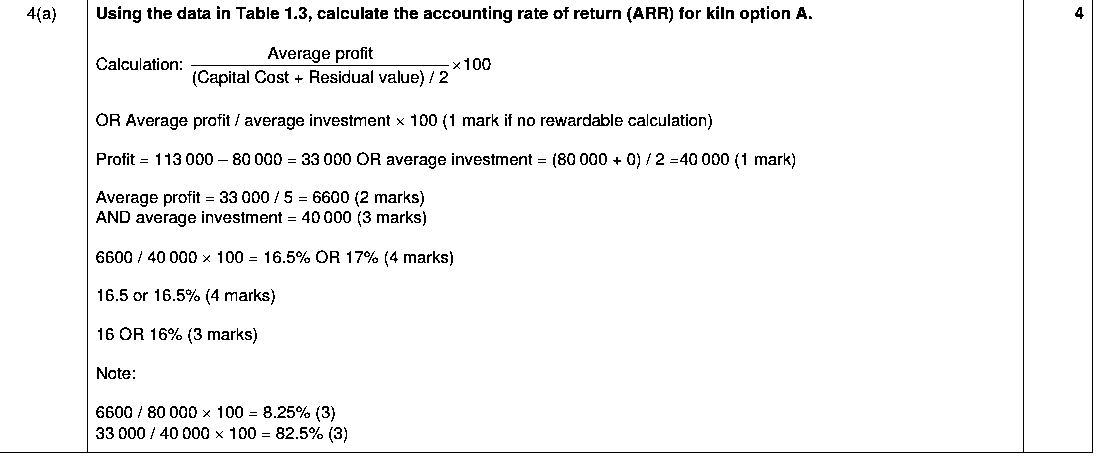
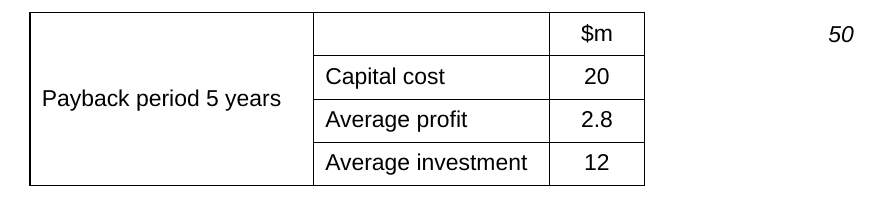
(a) Using the data in Table 1.3, calculate the accounting rate of return (ARR) for kiln option A. Average profit Calculation: × 100 (Capital Cost + Residual value) / OR Average profit / average investment × 100 ( if no rewardable calculation). [4 marks]
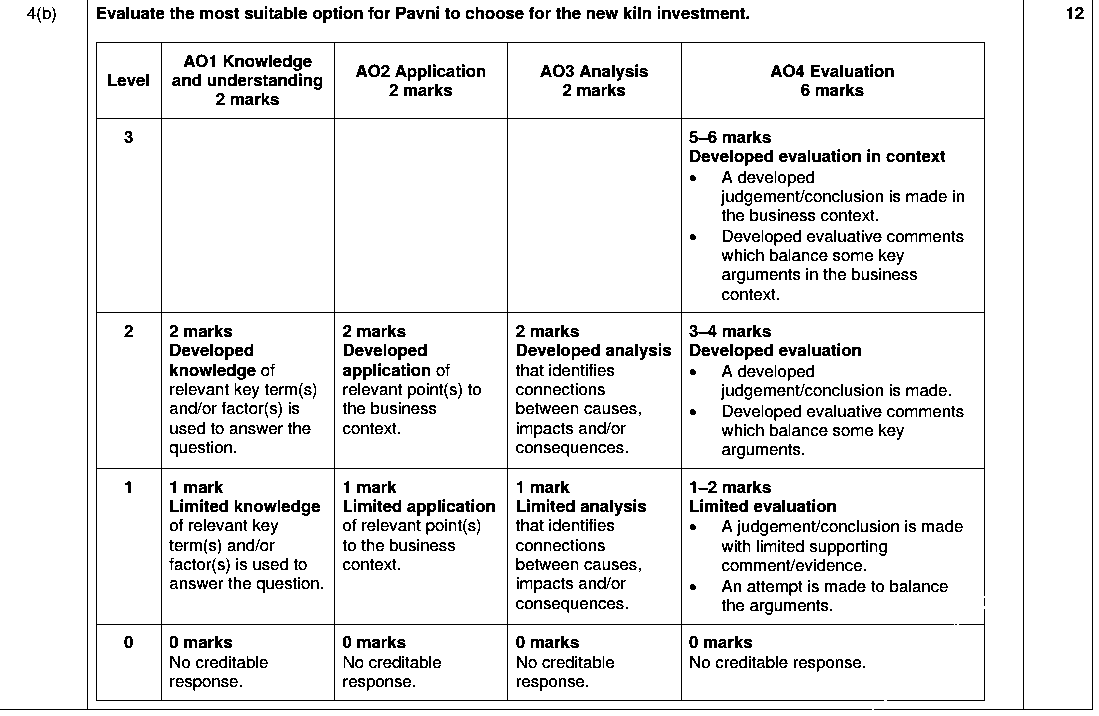
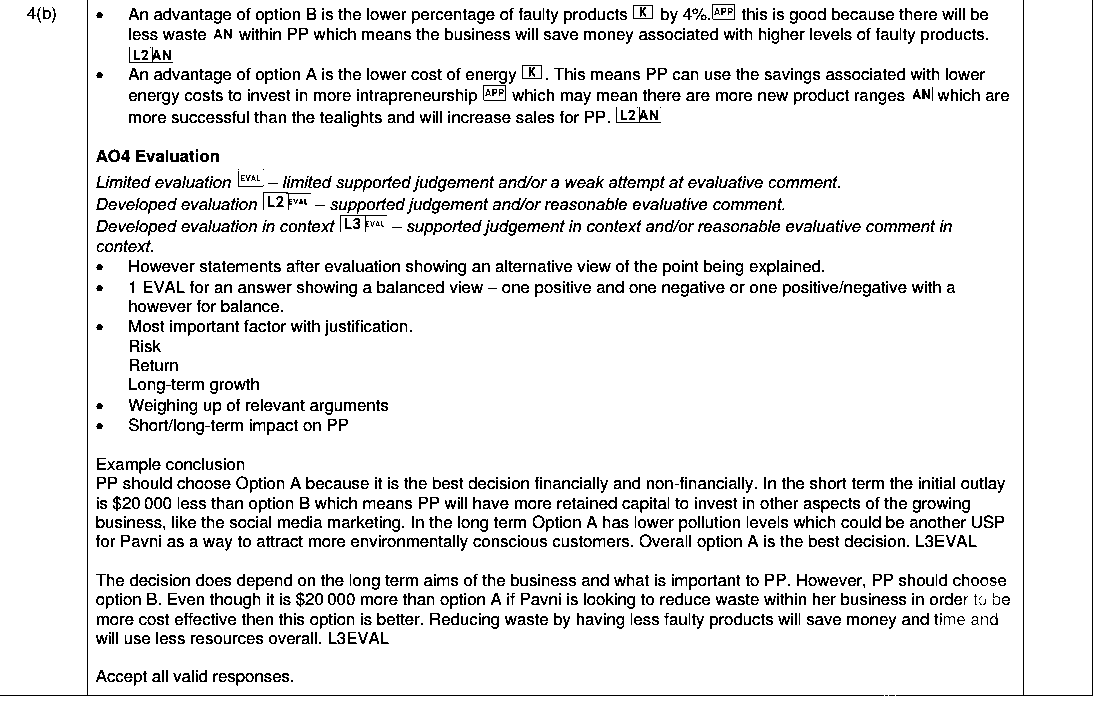
(b) Evaluate the most suitable option for Pavni to choose for the new kiln investment. [12 marks]
Show mark scheme
Case study: Pedro’s Perfect Pies (PPP)
Pedro left school without any formal qualifications. Pedro was given the opportunity to work in a pie factory. This was owned by an entrepreneur who wanted to help unqualified young people.
Pedro spent six years working at the factory. He was quickly promoted because he was conscientious and showed initiative. When the business owner retired, she offered Pedro the chance to buy the business. Pedro raised capital from his savings, friends and family and bought the business. PPP became a private limited company, with Pedro as Managing Director. PPP is based in country A.
PPP manufactures a wide range of pies in its factory. The pies are sold to retailers in country A and other countries in the region.
Growth
PPP has grown steadily over the last few years. Its revenue and profits have increased by an average of 8% per year. Production capacity has been increased to keep up with demand. Growth has been financed by retained earnings and bank loans. Recent accounting data is shown in Table 1.1.
Table 1.1: Accounting data
External influences
Real incomes in country A and other countries in the region have been falling due to high inflation and low economic growth. Trade between country A and other countries in the region has become more difficult, due to country A leaving an international trade agreement. Consumers are changing their eating habits, and many people are eating less meat.
Marketing
When Pedro bought the business, he identified an opportunity to develop a premium product. Pedro asked the marketing team to carry out market research. The results of this established that there was a market for high quality, higher priced pies. Pedro discussed this new product development with all of his marketing team because he valued their opinions.
Once the premium pies were launched, PPP branded its products as either classic or premium pies. Most pies PPP produces still contain meat. However, a newly developed premium no‑meat vegan pie has started to sell very well. PPP is also planning to launch a new classic pie with a cheese filling especially for the export market.
Elasticity
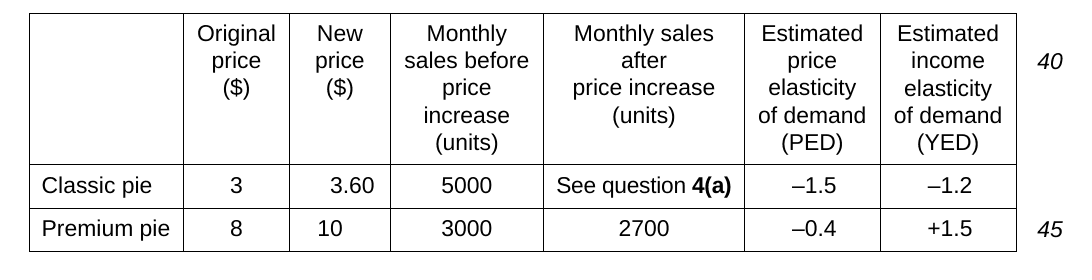
Due to higher production costs PPP has increased its prices. Pedro has analysed some elasticity data for one type of classic pie and one type of premium pie, see Table 1.2.
Table 1.2: Elasticity data
Human resources
Pedro has always been a self‑confident innovator, both in terms of new product ideas and the way that PPP is organised and led. He is known for his social skills and is respected and trusted by his employees.
Pedro is also keen to help young unemployed people, in the same way as he was helped. PPP offers training apprenticeships in all areas of the factory. Trainees attend local colleges one day each week and are supervised by the department managers.
Pedro thinks employees are PPP’s greatest asset. As well as training apprentices, he offers competitive wages and all employees have opportunities for career development and promotion within PPP. Pedro is also socially aware as he rewards employees for good ideas from weekly kaizen group discussions. Many employees have been with the company for more than five years.
Process innovation
PPP’s current production process is labour intensive and pies are produced using batch production. All employees accept responsibility for product quality and are trained in quality assurance methods.
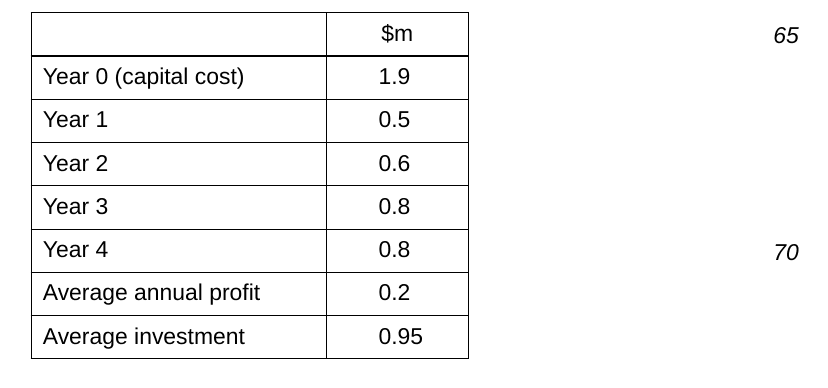
Pedro is considering investing in a new computer‑controlled pie‑making machine, see Table 1.3. This would increase production capacity in the factory. Factory employees would still need to complete the production process by adding the PPP pastry logo to the pies.
Table 1.3: Forecast net cash flow data for the proposed new machine
Pedro is undecided about increasing the use of machinery, especially as PPP will have to borrow the finance to purchase it.
Question 3Oct/Nov 20259609/3116 marks
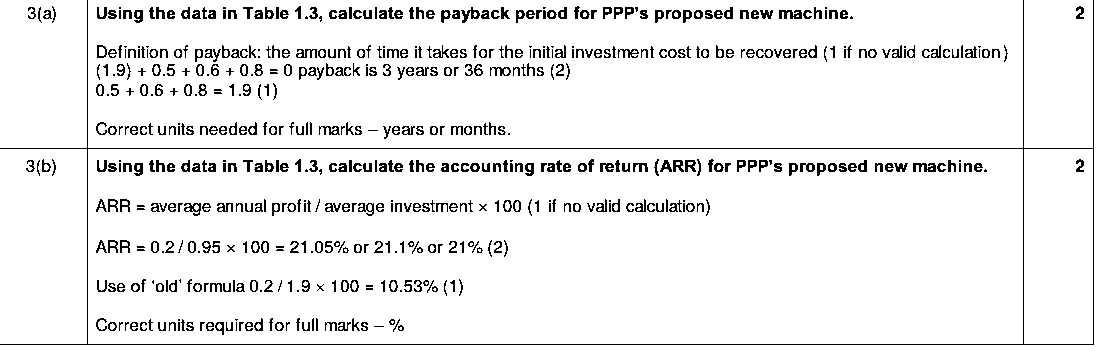
(a) Using the data in Table 1.3, calculate the payback period for PPP’s proposed new machine. Definition of payback: the amount of time it takes for the initial investment cost to be recovered (1 if no valid calculation ) (1.9) + 0.5 + 0.6 + 0.8. [2 marks]
(b) Using the data in Table 1.3, calculate the accounting rate of return (ARR) for PPP’s proposed new machine. ARR = average annual profit / average investment × 100 (1 if no valid calculation). [2 marks]
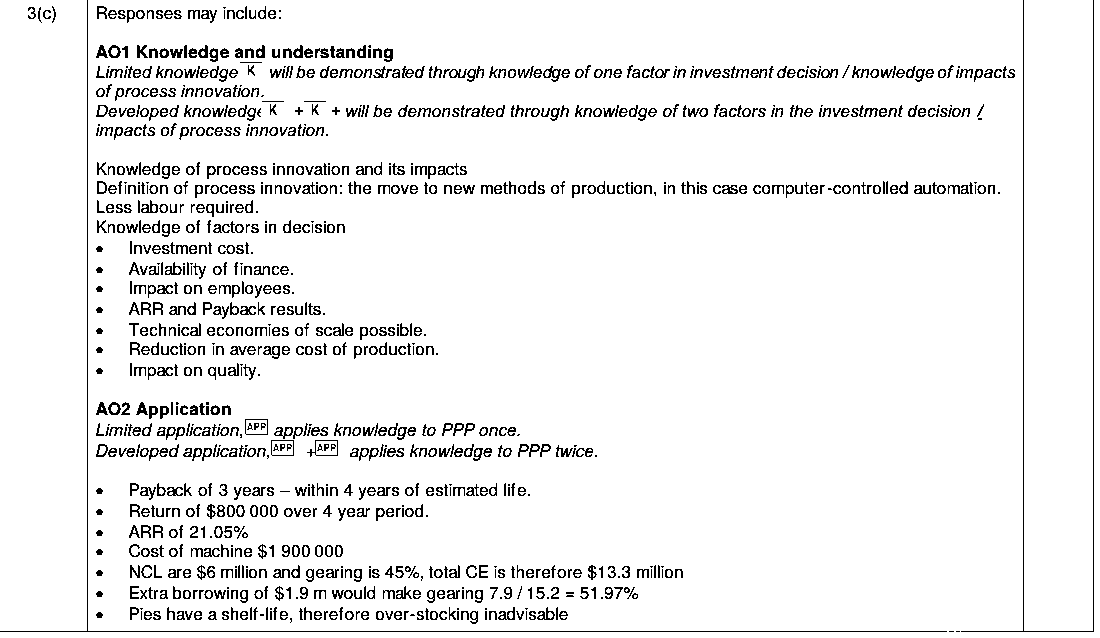
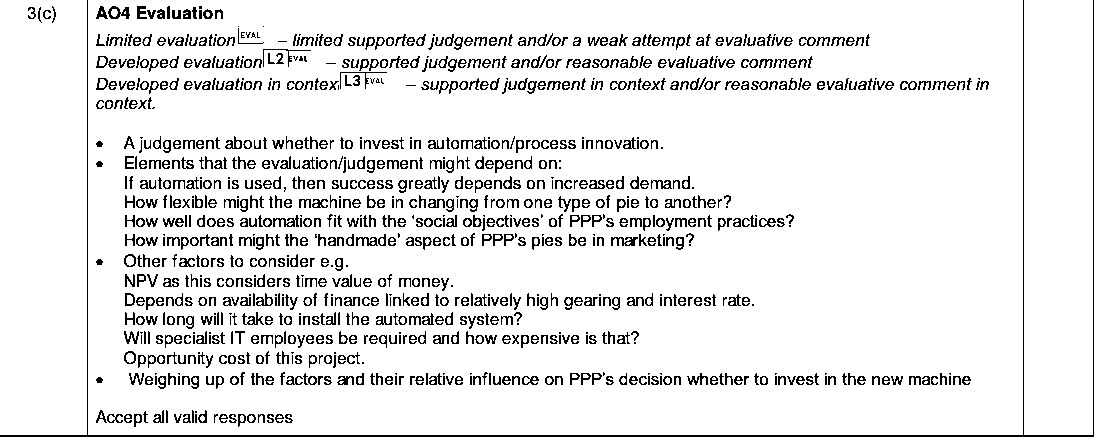
(c) Evaluate whether PPP should invest in the new machine. [12 marks]
Show mark scheme
Case study: Komate Tropical Juice (KTJ)
KTJ is a private limited company based in country B in Africa. It was set up in 2014 by Ada Hadebe who is the majority shareholder and Managing Director. KTJ specialises in producing tropical fruit juices. KTJ’s mission statement is ‘to bring the tropical taste of Africa to the world through ethical relationships with farmers by focusing on sustainability throughout the supply chain’.
Sourcing fruit
KTJ’s range of tropical fruit juices includes baobab, papaya and pineapple. Juices are produced from seasonal fruits without added sugar or colourings. Most fruits are sourced from local farm cooperatives in country B. The farms are chosen for their sustainable farming methods which KTJ has to regularly audit. Some fruits, not grown in country B, are imported from other countries in Africa.
Employees
KTJ has a flat organisational structure. Ada encourages a ‘soft’ approach to human resource management (HRM) and believes in the benefits of delegation. Ada is proud that KTJ has won awards in country B for its substantial investment in employee training and development.
Plastic packaging
Recently, one of KTJ’s operations managers commissioned research into KTJ’s use of plastic bottles for its fruit juices. After six months of research the final report recommended that KTJ should in future only use plastic bottles made entirely from recycled materials. Ada is considering whether to implement this change.
Expansion
KTJ has an excellent reputation for the quality of its tropical fruit juices which are marketed as premium products. Export demand has increased significantly during the past two years, especially from other African countries. KTJ’s factory in country B is nearing full capacity. Ada thinks that KTJ should expand by processing tropical fruit in a location outside of country B. Ada authorised Gudaf, a junior market analyst, to prepare a report identifying the two best locations for the additional new factory. Gudaf visited multiple locations and prepared an investment appraisal. Gudaf will present the report to the Board of Directors next week recommending a location in either country C or country D.
Extracts from Gudaf’s report are in Table 1.1, Table 1.2 and Table 1.3.
Table 1.1: Information about country C and country D
Table 1.2: Investment data for country C location
Table 1.3: Investment data for country D location
Seasonal sales
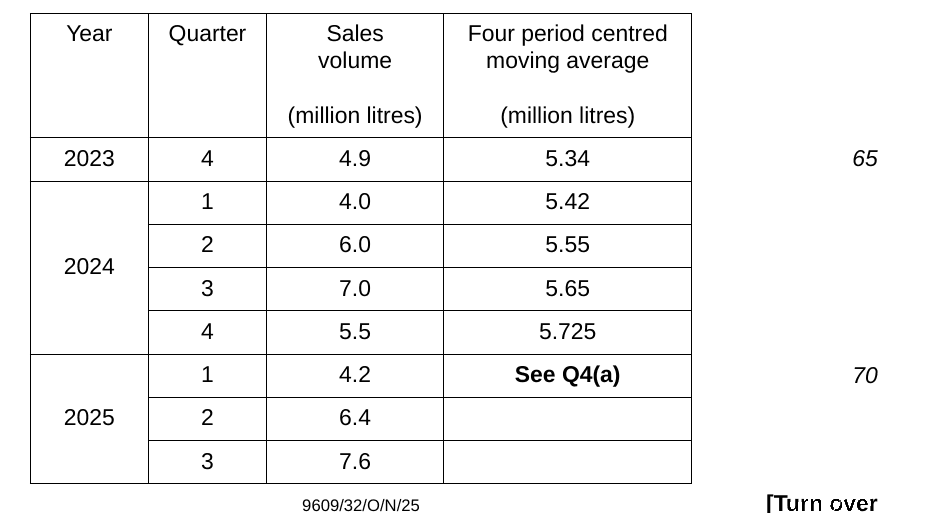
Since 2018, KTJ has exported tropical fruit juices to the US. The US is one of the world’s most competitive markets for food and drink products. Sales are increasing and have met targets. Ada believes that KTJ can increase its market share significantly. Ada instructed the US marketing manager to carry out a market analysis and then develop a new marketing plan. The marketing manager is using time series analysis to help make business decisions. Table 1.4 is an extract of KTJ sales data in the US.
Table 1.4: KTJ tropical juice sales in the US by volume
Fluctuations in the exchange rate
Ada monitors the external environment carefully to identify changes that will impact KTJ. There have been fluctuations in the exchange rate of country B’s currency in recent years. At the last 75 Board Meeting Ada commented ‘financial markets have been unsettled by the recent change of government in country B. This has led to an average 20% depreciation in the value of country B’s currency. This presents both an opportunity for, and a threat to, KTJ.’
Question 3Oct/Nov 20259609/3216 marks
(a) Using the data in Table 1.2, calculate the payback of the country C location. [2 marks]
(b) Using the data in Table 1.3, calculate the accounting rate of return (ARR) of the country D location. [2 marks]
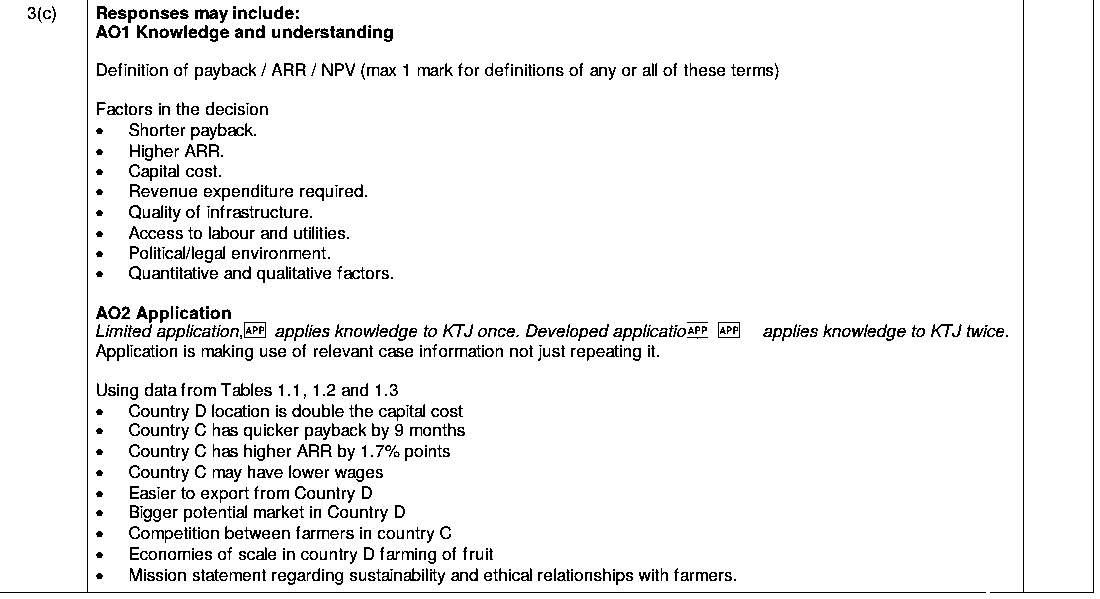
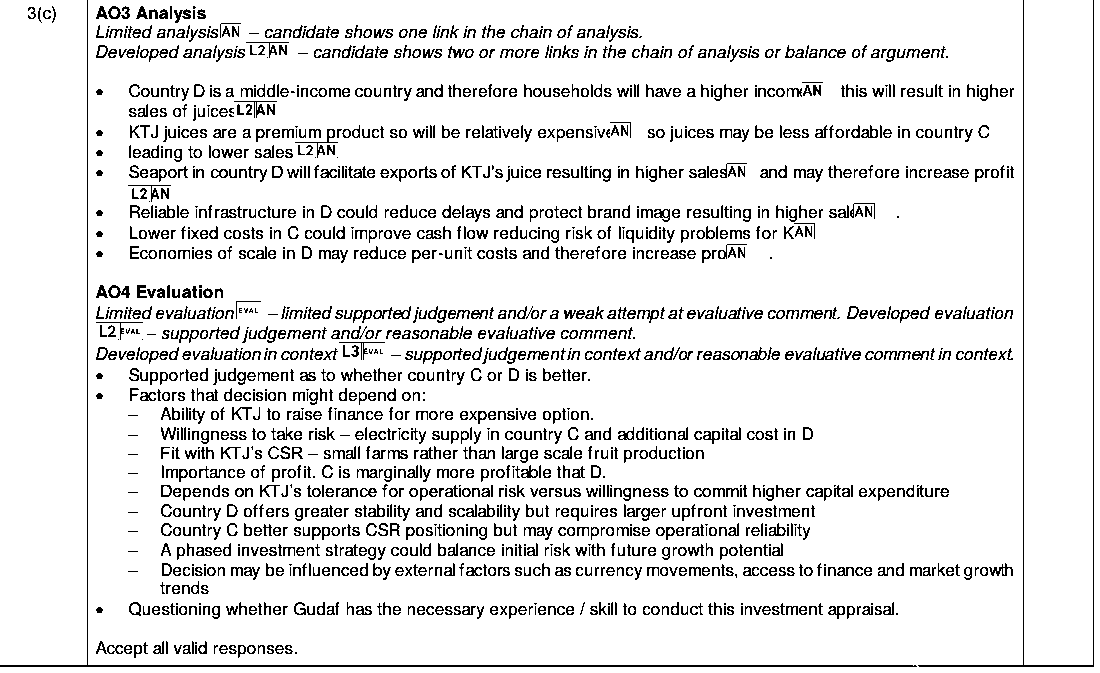
(c) Evaluate which location KTJ should choose for its new factory. [12 marks]
Show mark scheme
Case study: Lithium Battery Metals (LBM)
Lithium is an essential raw material used in batteries for electric vehicles, smart phones and other products. LBM has developed techniques to detect lithium using mapping technology. LBM sells its survey results to other mining companies. LBM’s annual revenue is less than $1 million and it is losing $2–3 million per year. LBM is planning to start its own lithium mining operations in country G, where it is based.
LBM has researched and developed two effective ways of mining lithium. The first is hot water mining and the second is hard rock mining. LBM became a public limited company one year ago. LBM has substantial finance obtained from grants, shareholders and crowdfunding available for investment. LBM’s revenue is forecast to rise rapidly once mining begins.
Sales forecasting
Annual global demand for lithium is rising considerably and forecasts show world supply will not meet demand after 2030. As LBM establishes its own mining operations it will need to forecast sales. There are likely to be variations in demand for electric vehicles and smart phones over time. It is difficult to vary the output from lithium mines at very short notice. Holding inventory of this raw material involves high costs. Alternatives to lithium are being developed.
Concerns of government
LBM is the only business in country G planning to mine lithium. The government is very concerned that:
demand from industry for lithium in country G will not be met in the long‑term
LBM is currently unprofitable
LBM may be a target for a hostile takeover from a multinational business.
The government is therefore considering nationalising LBM.
Hot water lithium mining
Despite local opposition, LBM plans to open its first mine in four months’ time. Hot water from three kilometres underground will be pumped up to a factory where lithium and possibly other rare raw materials will be extracted from the water. After the extraction process the hot water can then be used for heating local housing. The Operations Director, Astor, estimates the project has a 15‑year life span. However, future cash flows beyond six years become increasingly uncertain.
Table 1.1 shows the data used by LBM in the decision to go ahead with the hot water mine. The data excludes costs and revenues from extracting other raw materials that may be found in the water. LBM has enough finance for the hot water mine if there are no adverse variances to the budget.
Table 1.1: Investment appraisal for hot water lithium mining
Human resource management (HRM) and the hot water mine
LBM uses a ‘soft’ HRM approach for its current 35 graduate employees. They are given delegated powers and decide their own work patterns individually or in self‑selected teams. Many of these graduates are involved in using the mapping technology to find new mines and developing mining techniques.
LBM has started recruiting 150 people to be employed at the hot water mine site. Ten new employees will be technology specialists who will closely supervise the work. The other new employees will be trained to operate machinery. The directors plan to use a ‘hard’ HRM approach for these machine operators.
Hard rock lithium mining
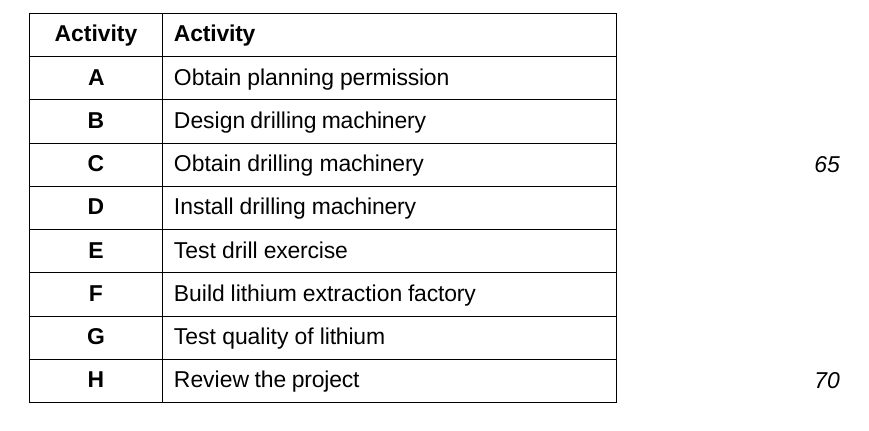
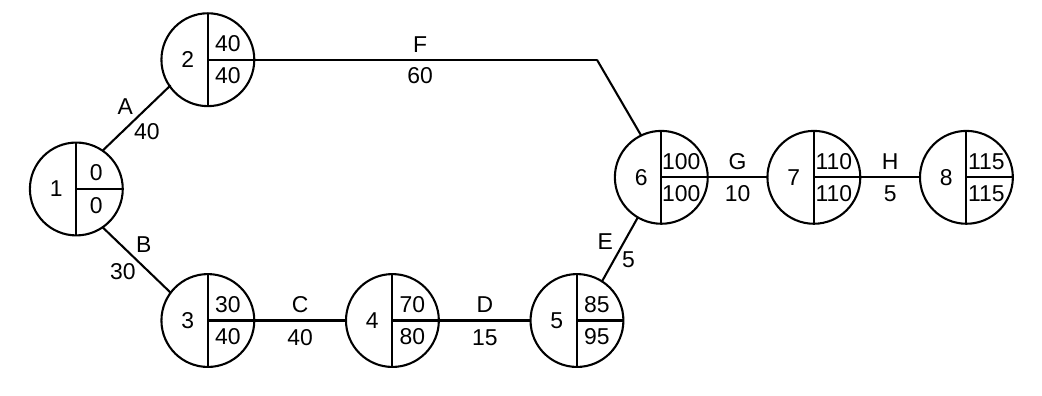
LBM is also planning to open a hard rock lithium mine in two years’ time. Lithium is found inside hard rock layers underground. LBM plans to drill into these, bringing rock to the surface to be treated to extract lithium. Astor has identified a suitable area 500 metres underground. Table 1.2 and Figure 1.1 show the results of some of his operations planning. The data was obtained from mining industry sources, suppliers of drilling equipment and the LBM Research and Development (R & D) team.
Table 1.2: Hard rock lithium mining project activities used in Critical Path Analysis (CPA)
Figure 1.1: Network for hard rock lithium mining project (durations in weeks)
Question 3Oct/Nov 20259609/3316 marks
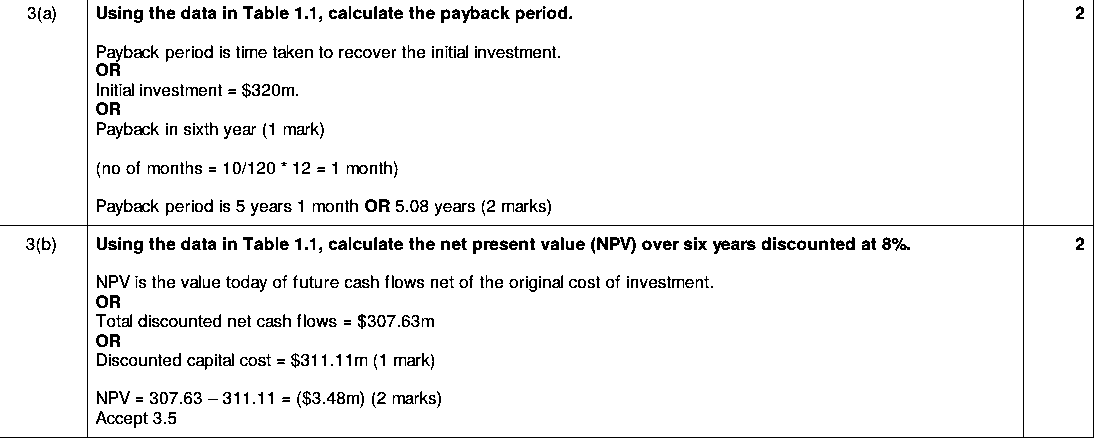
(a) Using the data in Table 1.1, calculate the payback period. Payback period is time taken to recover the initial investment. OR Initial investment = $320m. OR Payback in sixth year () (no. [2 marks]
(b) Using the data in Table 1.1, calculate the net present value (NPV) over six years discounted at 8%. NPV is the value today of future cash flows net of the original cost of investment. OR Total discounted net cash flows = $307.63m OR Discounted capital cost = $311.11m (). [2 marks]
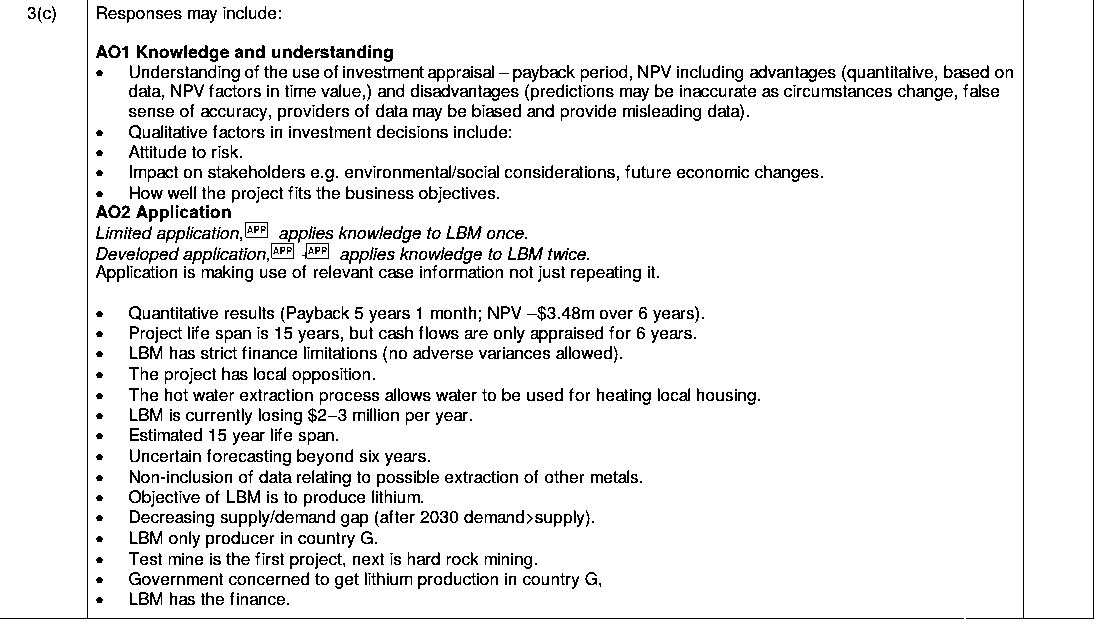
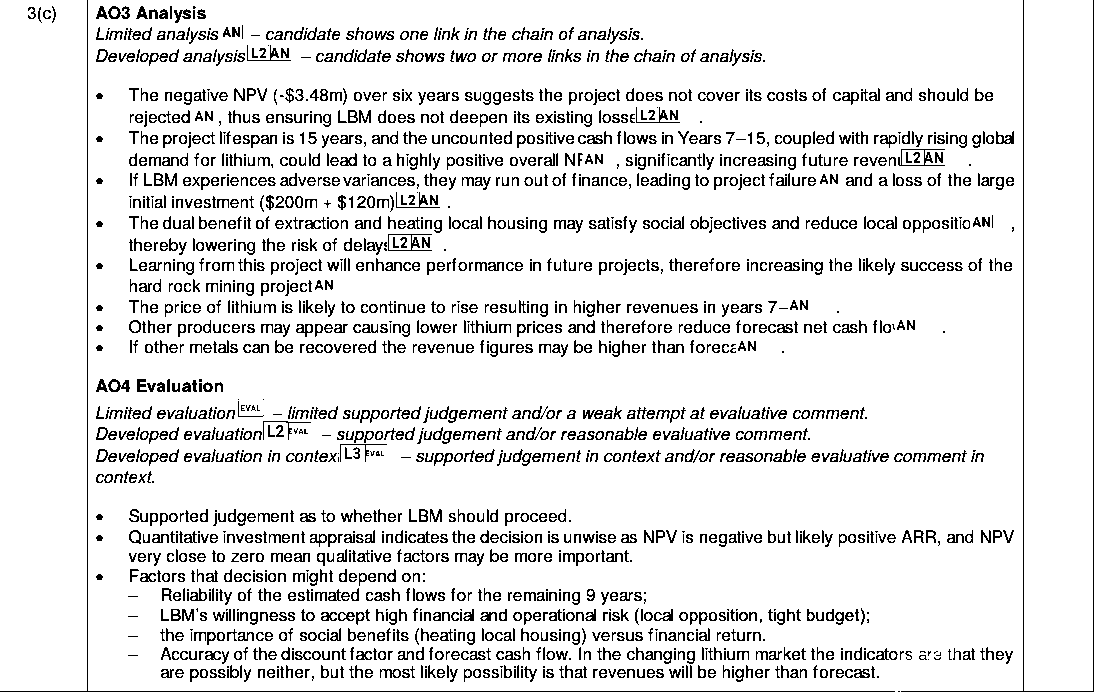
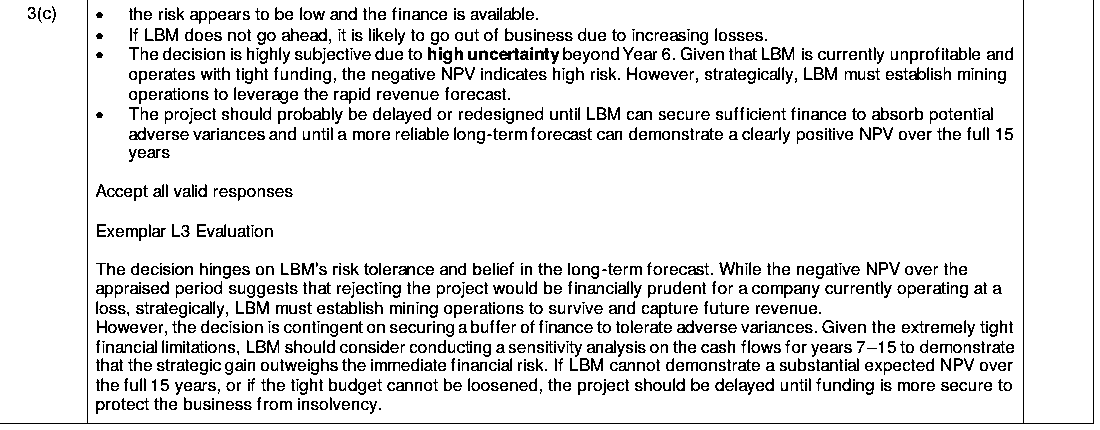
(c) Evaluate LBM’s decision to go ahead with the hot water test mine. Leve. [12 marks]
Show mark scheme
15 more questions from 2020–2024
🔒 Unlock every Investment appraisal question from 2020–2024
All 15 come with their mark schemes, answers and case studies, and appear in the practice tool above once you’re signed in. It’s free.
9609/31 · May/Jun 2024 · Question 3Calculate the accounting rate of return (ARR)… 🔒
9609/32 · May/Jun 2024 · Question 42.… 🔒
9609/33 · May/Jun 2024 · Question 31.… 🔒
9609/32 · Oct/Nov 2023 · Question 41.… 🔒
+ 10 more, by year in the table above
Questions and mark schemes are from past Cambridge papers and are reproduced for revision. Topical Vault is an independent revision resource, not affiliated with or endorsed by Cambridge Assessment International Education.
A Level Business questions by topic
Each topic opens this practice tool with only that topic’s questions, plus how often it comes up and every question on it in one list. Revision notes for A Level Business →
Pick a paper, sub-topics and years to draw from (leave any blank for "all"), choose
how many questions you want, and we'll open a new worksheet page with a random set for you to review
and download.