Question 5Oct/Nov 20259609/3312 marks
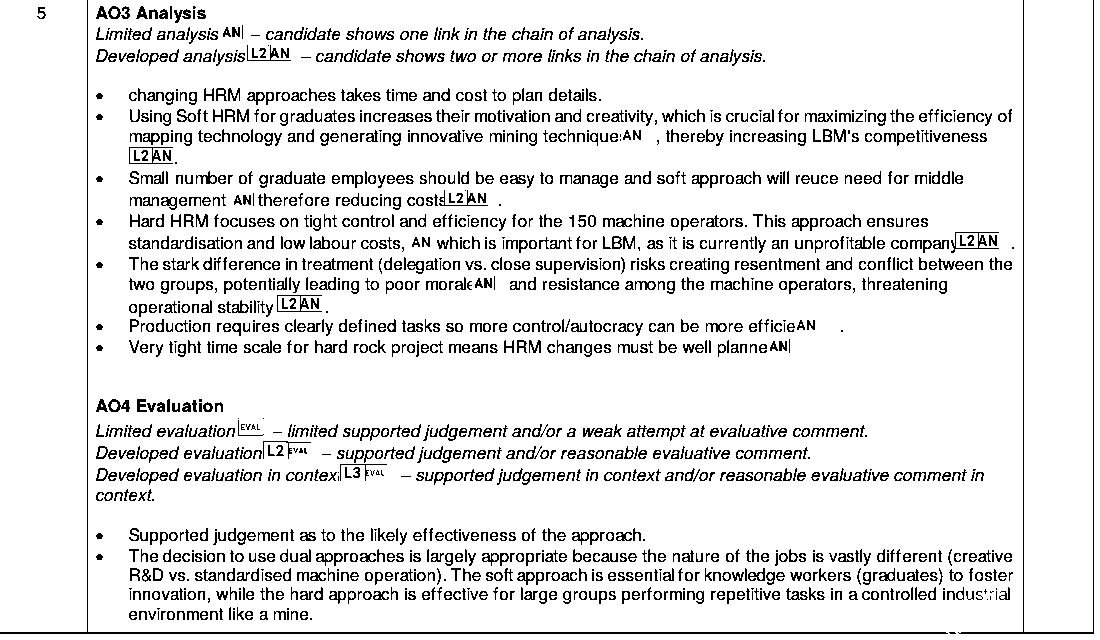
Evaluate LBMs decision to use two different approaches to HRM. [12 marks]
Show mark scheme



Cambridge 9609, Paper 3 & 4. 330 questions, 2020 to 2026.
Case studies and questions retyped from the original Cambridge material; Paper 3 mark schemes are cropped from the official mark scheme PDFs, Paper 4 mark schemes are retyped as text. A few 2020–2022 Paper 3 case studies were recovered by OCR from a damaged source file — those are marked where it applies.
Questions on human resource management strategy: hard and soft HRM, flexible and zero-hours contracts, measuring and improving employee performance, management by objectives, and the use of IT and AI in HRM.
New to Human resource management strategy, or finding these questions hard?
Read the notes first: the key ideas, diagrams and formulas, and the mistakes examiners see most, in about 13 minutes.
21 past paper questions on this topic since 2020, across 11 exam sessions.
| Year | Paper 3 | Paper 4 | Total | Chart |
|---|---|---|---|---|
| 2026 | 0 | 1 | 1 | |
| 2025 | 5 | 1 | 6 | |
| 2024 | 5 | 3 | 8 | |
| 2023 | 2 | 0 | 2 | |
| 2022 | 1 | 0 | 1 | |
| 2021 | 1 | 0 | 1 | |
| 2020 | 2 | 0 | 2 |
The whole topic on one page, with answers and mark schemes. Printing this page prints just this list.
Lithium is an essential raw material used in batteries for electric vehicles, smart phones and other products. LBM has developed techniques to detect lithium using mapping technology. LBM sells its survey results to other mining companies. LBM’s annual revenue is less than $1 million and it is losing $2–3 million per year. LBM is planning to start its own lithium mining operations in country G, where it is based.
LBM has researched and developed two effective ways of mining lithium. The first is hot water mining and the second is hard rock mining. LBM became a public limited company one year ago. LBM has substantial finance obtained from grants, shareholders and crowdfunding available for investment. LBM’s revenue is forecast to rise rapidly once mining begins.
Annual global demand for lithium is rising considerably and forecasts show world supply will not meet demand after 2030. As LBM establishes its own mining operations it will need to forecast sales. There are likely to be variations in demand for electric vehicles and smart phones over time. It is difficult to vary the output from lithium mines at very short notice. Holding inventory of this raw material involves high costs. Alternatives to lithium are being developed.
LBM is the only business in country G planning to mine lithium. The government is very concerned that:
The government is therefore considering nationalising LBM.
Despite local opposition, LBM plans to open its first mine in four months’ time. Hot water from three kilometres underground will be pumped up to a factory where lithium and possibly other rare raw materials will be extracted from the water. After the extraction process the hot water can then be used for heating local housing. The Operations Director, Astor, estimates the project has a 15‑year life span. However, future cash flows beyond six years become increasingly uncertain.
Table 1.1 shows the data used by LBM in the decision to go ahead with the hot water mine. The data excludes costs and revenues from extracting other raw materials that may be found in the water. LBM has enough finance for the hot water mine if there are no adverse variances to the budget.
LBM uses a ‘soft’ HRM approach for its current 35 graduate employees. They are given delegated powers and decide their own work patterns individually or in self‑selected teams. Many of these graduates are involved in using the mapping technology to find new mines and developing mining techniques.
LBM has started recruiting 150 people to be employed at the hot water mine site. Ten new employees will be technology specialists who will closely supervise the work. The other new employees will be trained to operate machinery. The directors plan to use a ‘hard’ HRM approach for these machine operators.
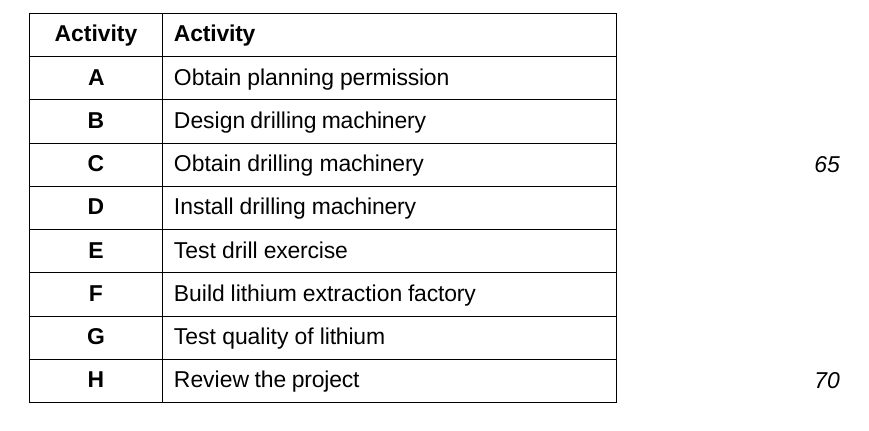
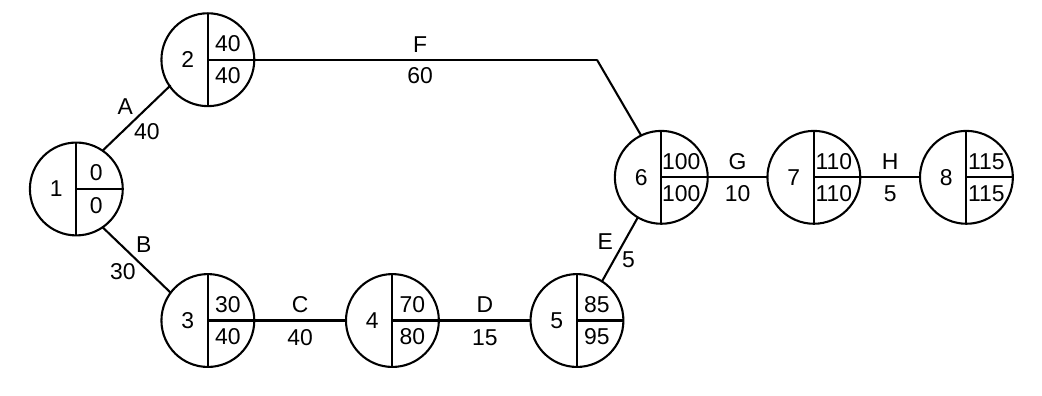
LBM is also planning to open a hard rock lithium mine in two years’ time. Lithium is found inside hard rock layers underground. LBM plans to drill into these, bringing rock to the surface to be treated to extract lithium. Astor has identified a suitable area 500 metres underground. Table 1.2 and Figure 1.1 show the results of some of his operations planning. The data was obtained from mining industry sources, suppliers of drilling equipment and the LBM Research and Development (R & D) team.
Table 1.2: Hard rock lithium mining project activities used in Critical Path Analysis (CPA)

Evaluate LBMs decision to use two different approaches to HRM. [12 marks]
WS is a public limited company. WS manufactures leather shoes for adults. It sells to major shoe retailers and to small independent shoe shops. WS products are targeted at three constantly changing markets: fashion, leisure and work. Its sales employees are reporting that small independent shoe shops have experienced an increasing demand for non-leather and recyclable shoes. There is a growing consumer awareness that resources used in production need to be sustainable. Jon, the Marketing Director, is very keen for WS to carry out an environmental audit.
Enterprise resource planning (ERP) WS uses different IT systems for managing production, marketing and human resources. Keri, the Operations Director, thinks that the processes needed to produce and market shoes could be more integrated. Greater integration could help to improve the efficiency of WS. Keri has begun to research ERP as a means of achieving this integration. She knows that ERP is very expensive and takes time to implement but she is convinced that it could offer WS substantial efficiency benefits.
WS uses batch production to produce different styles of shoes. The production employees at WS are:
Milo, the Human Resources Director, and Keri are concerned that the performance of production employees is declining. Table 1.1 gives data about production and production employees.
WS sells its shoes into three markets: fashion, leisure and work. Each market has its own characteristics. WS shoes are medium to high price in each market. Research shows that consumers consider WS shoes are good quality for the prices charged.
Jon is preparing a marketing plan with the objective of increasing annual sales by 5% without entering any new markets. Table 1.2 shows time series analysis sales data Jon is using. Jon considers that time series analysis will help him make decisions to achieve WS’s marketing objective. Table 1.3 gives additional information about the markets WS sells to.
In recent years, the directors of WS have made long-term investment a priority rather than short-term increases in dividends.
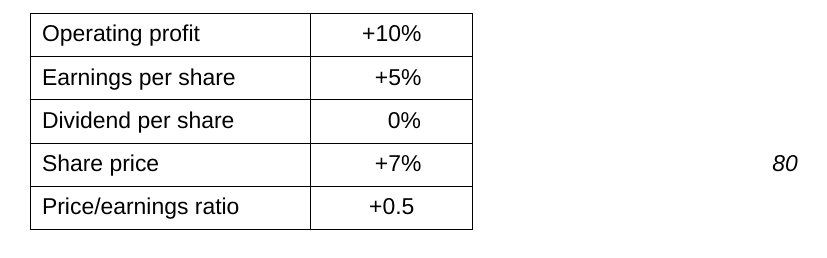
The main shareholders in WS take an active interest in the business. At the next company Annual General Meeting (AGM) these shareholders intend to ask the directors to explain their method to increase investor returns. These shareholders will be looking for an effective method to achieve an increase in their return. Table 1.4 shows changes in key investment indicators and ratios.
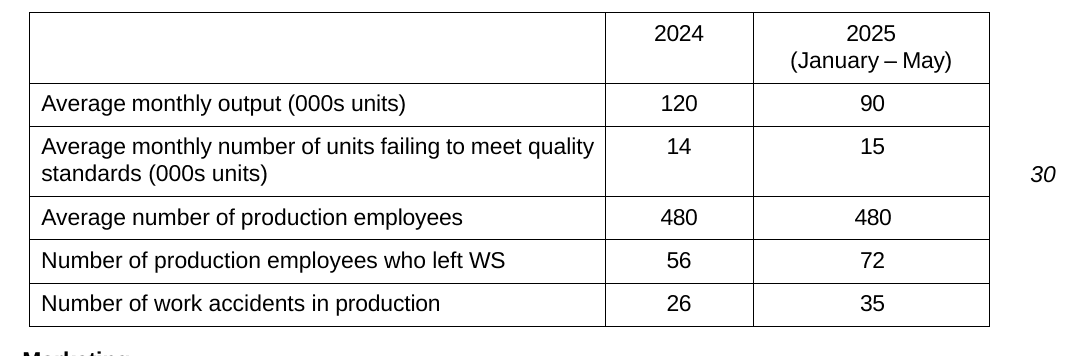
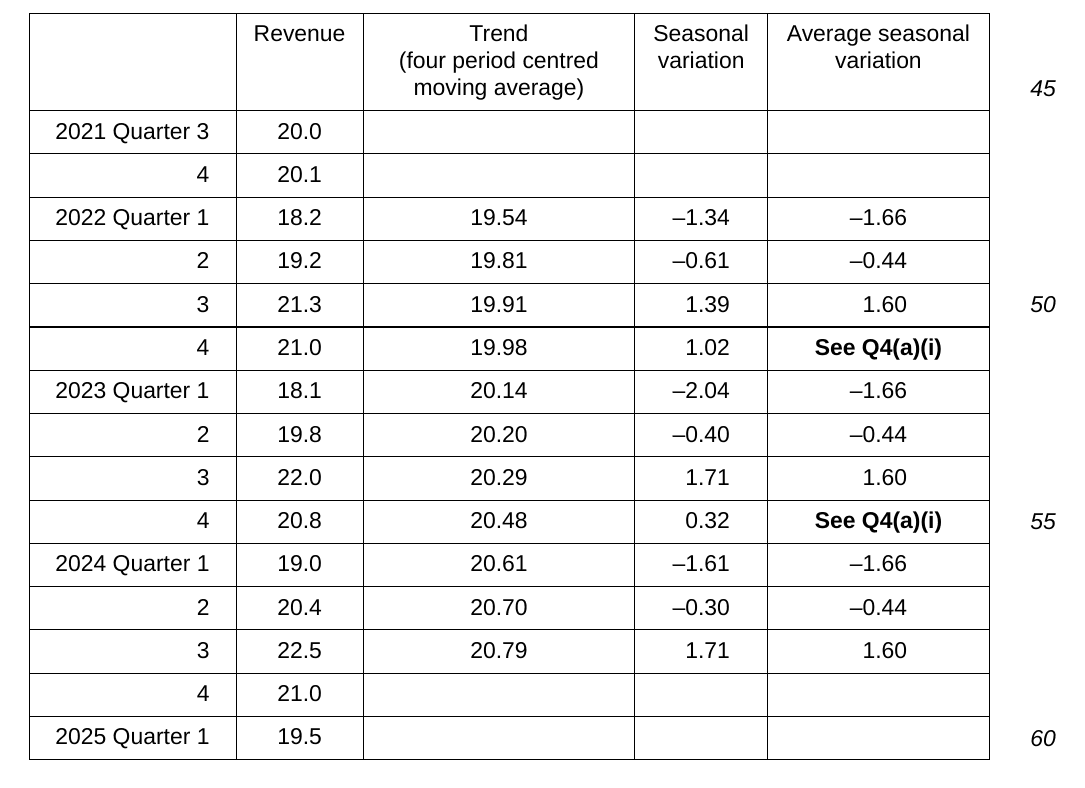

(a) Using the data in Table 1.1, calculate the average monthly labour productivity for January to May 2025. Average monthly labour productivity = Total output / Number of employees OR 90 000 / 480 (1) 187.5 (2) OR 188 (2). [2 marks]
(b) Using the data in Table 1.1, calculate the percentage of output that failed to meet quality standards for January to May 2025. Percentage failing to meet quality standards / output × 100 OR 15 000 / 90 000 × 100 (1) 16.67% OR 16.7% OR 17% (2). [2 marks]
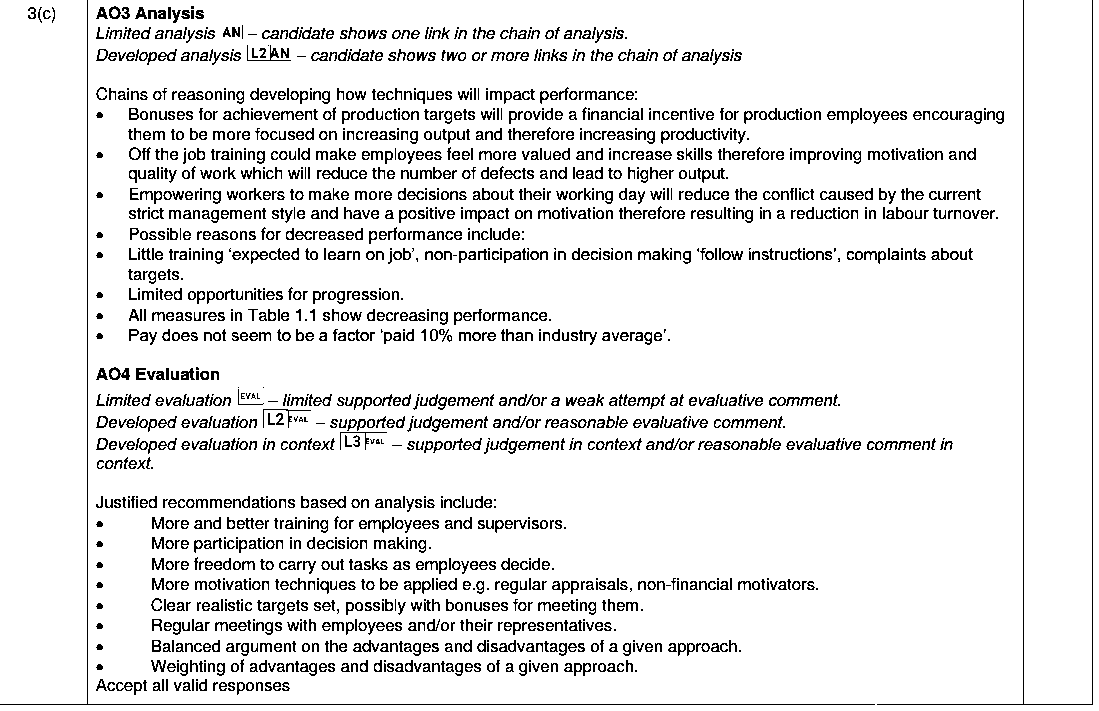
(c) Evaluate the best approach for WS to improve the performance of its production employees. [12 marks]


PAIR was set up in 2012 by Kaarina Laine, a graduate in Applied Artificial Intelligence. PAIR is a private limited company in country F. Kaarina, the Managing Director, owns 70% of the shares. Four other directors own the remaining shares.
PAIR’s mission statement is ‘to transform business use of robots’. PAIR designs and manufactures robots which use artificial intelligence (AI) to support business operations. PAIR’s most successful robot, the KB1, is an autonomous cleaning robot. In 2024 the KB1 had the leading market share in country F. It is also a successful export for PAIR. The global market for autonomous cleaning robots is competitive with many brands available.
The first version of the KB1 was launched in 2013. PAIR’s sales strategy focused on leasing to businesses to provide a cost-effective solution to cleaning the workplace. Initially sales growth was slow, led by the sales team contacting prospective customers to arrange product demonstrations and trials.
However, global economic growth after the pandemic led to labour shortages which affected the recruitment of cleaning employees. Consequently, many schools, offices and hotels approached PAIR to lease the latest version of the KB1. Revenue grew rapidly from 2021 but PAIR was unable to fully meet demand due to production constraints.
PAIR invests 7% of revenue in Research & Development (R&D) compared to the industry average of 5%. In 2023, the eighth version of the KB1 was launched providing a more innovative, powerful and quieter cleaner. This version has a longer battery life and can clean different floor types. It uses video technology to learn as it cleans.
In 2024, PAIR began development of a new AI delivery robot, Delbot, which will target the hotel market. It will deliver food, towels and other items to hotel rooms. Kaarina confirmed, in a press release, that the Delbot will be available to customers from early 2026. She commented that the whole process from concept to product launch will only take 18 months.
PAIR has a flat organisational structure and is divided into functional departments. The R&D department uses a matrix structure creating one-off teams for specific projects. In 2024 PAIR employed a total of 120 employees.
Quality defects At the end of 2023 PAIR’s Operations Director reported increasing quality problems:
In June 2024 PAIR began the process of replacing quality control with quality assurance. This included:
Table 1.1 provides production and employee data for the KB1 factory. In 2024 PAIR had a labour productivity target of 2200 KB1s per employee.
Kaarina is concerned whether the decision to introduce quality assurance has been beneficial for PAIR.
Increase dividends?
Kaarina plans to expand the product portfolio and enter new international markets. PAIR’s growth has been financed from retained profit and long-term borrowing. Kaarina is now considering whether to change PAIR to a public limited company. Table 1.2 shows selected financial data and ratios for PAIR.
The other four shareholders are dissatisfied with PAIR’s dividend payments and are pressuring Kaarina to increase dividends for 2025.
In February 2025 a battery in one of the latest KB1 robots overheated causing a fire at the school where it was operating. The Operations Director investigated and found that there was a fault in the battery supplied to PAIR. Following the investigation PAIR issued a press release in April identifying the battery supplier as being responsible for the fire. The Marketing Director is concerned about PAIR’s lack of contingency planning. She has finally persuaded Kaarina to call an emergency board meeting to consider the benefits of contingency planning.
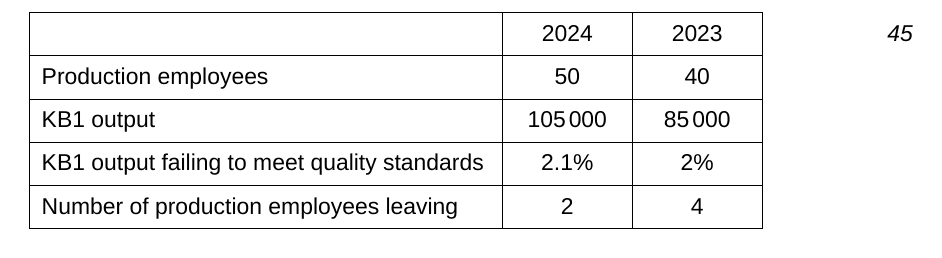

(a) Using the data in Table 1.1, calculate the labour productivity for 2024. Labour productivity = annual output / employees OR output per worker in a given time period OR output per worker hour ( if no rewardable calculation). [2 marks]
(b) Using the data in Table 1.1, calculate the labour turnover of production employees in 2024. Labour turnover = Number of employees leaving the business / Average number of employees × 100 ( if no rewardable calculation) 2 / 50 × 100 (1). [2 marks]
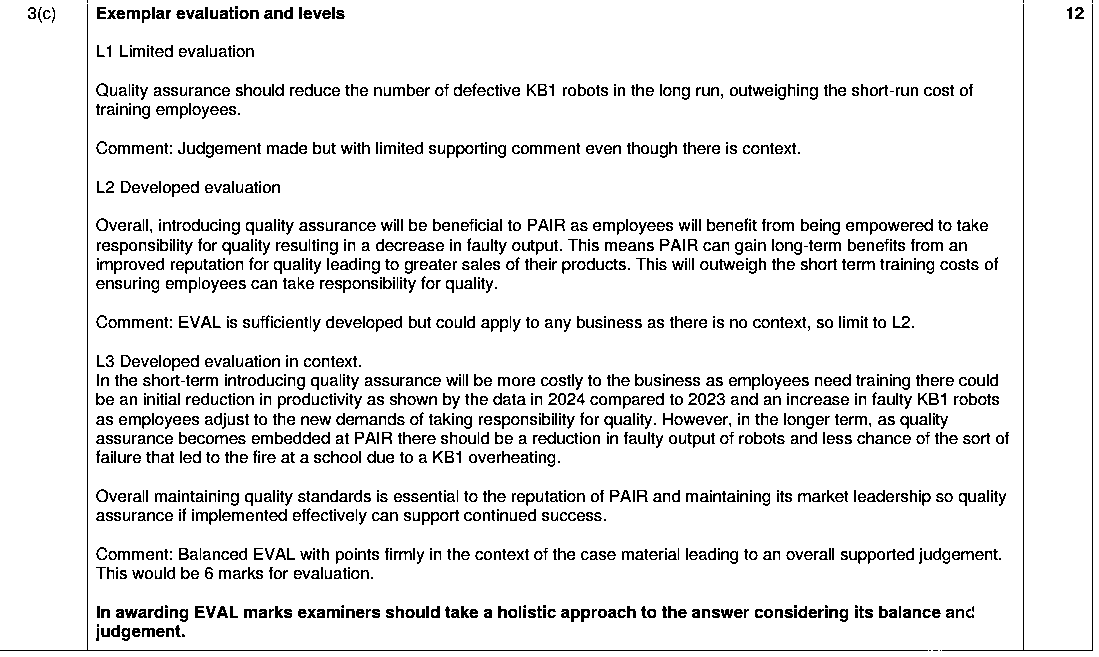
(c) Evaluate whether the decision to introduce quality assurance is likely to be beneficial for PAIR. [12 marks]




WCP was started in 2015 in Australia by Aldin. He wanted to use his enterprise skills for the benefit of society. Aldin persuaded several of his friends and family to invest and WCP was set up as a private limited company. WCP manufactures toilet paper using sustainable resources. Aldin wants WCP to be a profitable company, selling its toilet paper in high income countries. Aldin also has important social objectives for WCP. WCP donates fifty percent of all profits after tax to its own charity that works in low-income countries to provide better toilets and improve sanitation.
Inflation has been rising and economic growth is slow in all the main countries where WCP sells its products. Governments in these countries have increased interest rates.
There is increasing environmental awareness and higher income earners continue to buy ethically sourced and produced products.
All WCP sales of its toilet paper are currently made through its website. The toilet paper is sent directly to customers from distribution centres in the US, Europe and Australia.
Customers have to order toilet paper in large quantities. WCP has a loyal customer base of ethically-minded customers who are prepared to pay premium prices for its toilet paper.
WCP’s toilet paper is presented in distinctive packaging. The packaging is brightly coloured and recyclable, displaying the WCP company logo and its slogan ‘We Care’. Effective customer relationship marketing ensures that customers are reminded to reorder toilet paper and are also kept up-to-date with the WCP charity’s projects worldwide.
Aldin wants to start selling WCP toilet paper in supermarkets in Europe. WCP need to decide on an appropriate integrated marketing plan to sell its toilet paper through supermarkets.
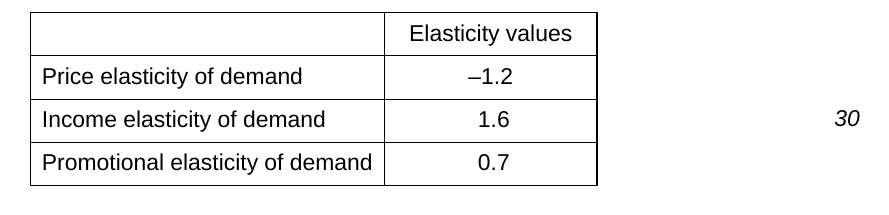
Using sales figures from the last two years, Aldin has estimated the elasticity data for online sales of the WCP toilet paper product. These estimates are shown in Table 1.1.
Aldin is always considering ways to expand WCP. WCP has the opportunity to take over GC, a successful company based in the US that manufactures eco-friendly paper products. Aldin thinks that this takeover would be an effective way for WCP to increase its scale of operations. Aldin is trying to raise the finance for the $8 million required to take over GC. He is considering raising this through long-term bank loans. However, WCP’s Finance Director has suggested that they
might convert WCP to a public limited company and raise the finance required through a share flotation. Table 1.2 shows extracts from WCP’s financial statements.
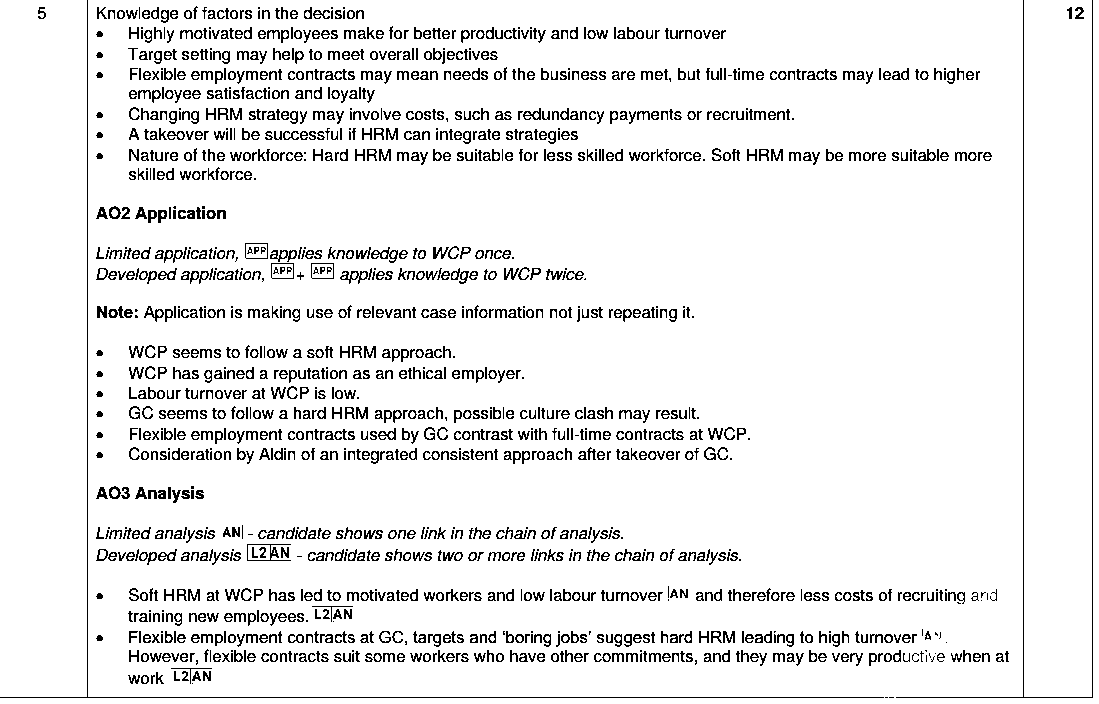
Aldin supports creativity in WCP employees and rewards innovative ideas. All WCP employees have full-time permanent contracts and are paid above average salaries. Employee requests for flexi-time are granted whenever possible, as Aldin believes that work-life balance is important. Employees are offered relevant training to help develop their careers with promotion opportunities. Labour turnover is low and WCP has gained a reputation as an ethical employer.
The human resources management (HRM) approach at GC is quite different to WCP. The aim of GC’s approach is to minimise unit labour costs. Production line employees are paid the national minimum hourly wage and most have part-time or zero hours contracts. Team leaders on each production line are set daily targets and monitor employees’ work to ensure these are achieved. Labour turnover is high and employees complain about boring jobs and low pay.
If the takeover goes ahead, Aldin will consider whether to change the HRM approach at GC to be the same as the current HRM approach at WCP.

Evaluate the most important factor Aldin should consider before changing the HRM approach at GC if the takeover goes ahead. [12 marks]



IPA is a private limited company in country N, a low-income country in Africa. Adesola Kalu set up IPA in 2019. It has a mission to provide technology access to millions of people through recommerce – the selling of previously owned or used products. IPA buys used smartphones, refurbishes them in its factory and then resells them. This provides consumers and businesses cheaper access to technologically advanced smartphones.
The market for refurbished smartphones in country N is growing rapidly. Most refurbished smartphones are sold during major festival periods. It is a competitive market in which no business has more than a 1% market share. In 2024 12 million refurbished smartphones were sold in country N and this is expected to rise to 14.2 million in 2025. IPA sold 104 000 refurbished smartphones in 2024, an increase of 24 000 from 2023. The average consumer of new smartphones upgrades to the latest model every 15 months. This short upgrade cycle has contributed to the growth of the refurbished market.
The refurbished smartphone market is characterised by inconsistent pricing, stolen devices and untrusted offline retailers. IPA sells refurbished smartphones online through its website and offline through local retailers.
IPA aims to provide convenience, cost-effectiveness and quality assurance to its customers. IPA targets both start-up businesses and households. Promotion has focused on advertising on digital platforms. Prices are competitive. Generous credit terms are given when selling to business start-ups.
Adesola has set an objective to increase sales volume by 60% by the end of 2026. Research by the Marketing Director found that:
The Marketing Director has proposed changes to the current marketing mix including:
IPA has 55 employees of whom 40 are production employees who check and refurbish smartphones. The remaining employees include production supervisors, administrators, sales staff and technicians. Adesola is the Managing Director and there are also directors of finance, marketing, human resources and operations. Production employees are skilled and employed on full-time contracts. IPA invests in training of production employees and pay is competitive. However, at the last board meeting the Finance Director proposed that contracts for most production employees should be changed to zero hours contracts. The Human Resources (HR) Director is now considering the implications of this.
Each smartphone is refurbished and quality-tested, with a 25-point quality check, by IPA’s skilled employees. IPA sells the refurbished smartphones with a 6-month guarantee.
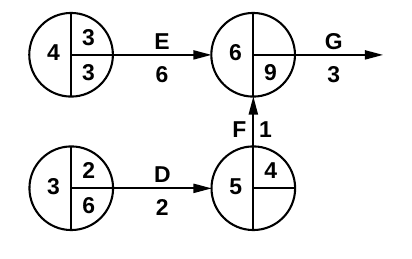
As sales increase, IPA has to recruit and train new production employees. With low unemployment in country N, this is not easy. IPA’s factory is close to full capacity. Consequently, Adesola plans to upgrade machinery and extend the factory to meet expected future demand. Using network analysis, the Operations Director estimates the factory expansion and machinery upgrade will take a minimum of 24 weeks. Activities include:
A partial network diagram is shown in Fig. 1.1 (all activities linked to nodes 5 & 6 are shown).
IPA is profitable but margins are low on each refurbished smartphone. IPA pays sellers of smartphones immediately when the smartphone is received at its factory. The Finance Director is worried about IPA’s liquidity and gearing, particularly as Adesola has committed IPA to rapid expansion plans. Selected financial data and ratios are shown in Table 1.1.
In 2024, economic growth in country N slowed and unemployment began to rise. In response 70 the government is implementing a policy to upgrade infrastructure in country N. This includes providing tax incentives for internet service providers to improve mobile phone connectivity in rural areas.
Further policy measures include a cut in the standard rate of income tax by two percentage points from April 2025. The central bank has also cut interest rates. 75

Analyse one advantage and one disadvantage to IPA of changing employment contracts from full -time to zero hours for most production employees. [8 marks]


A motel is a hotel targeted at motorists. GM owns a chain of motels across Europe. The original GM motel was built in 1958, and the owners have used external growth to take over smaller motel chains.
In 2018 GM purchased Travel Pal (TP), a chain of 20 motels. GM now owns 104 motels across Europe.
GM’s revenue and profit have not yet returned to the levels reached before 2020. The HR Director believes that poor employee performance is to blame. He believes that GM needs a strategy to improve employee performance to increase revenue and profit.
Emergency evacuation plan for employees and guests of GM motels.
Call points are located on each floor.
Do not attempt to fight the fire.
Call the emergency services.
Each GM motel will have a fire practice once a year.
key included in product not included in product
GM has invested $10m in replacing some employees with devices.
GM has made over 200 employees redundant.
‘Guests at GM can check themselves in as easily as using the checkout at the supermarket’, said GM’s managing director. ‘We are making sure that GM will remain competitive in the European markets for years to come’.

Advise GM’s board of directors on an appropriate strategy for improving employee performance. [20 marks]
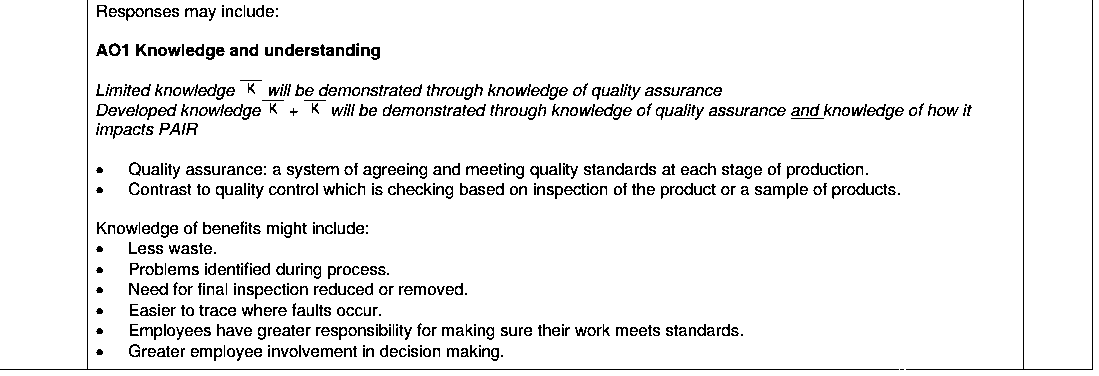
Knowledge (max 1 mark) can be awarded for any relevant business knowledge about business strategy, employee performance and improving employee performance, including:
Hard and soft HRM Flexible working contracts Management by objectives (MBO)
Motivation is the desire to do something Motivation is the desire to do something, for example a person can be motivated to 1 K for identification and 1 work harder by financial incentives. DEV for a point of explanation Motivation is the desire to do something, for example a person can be motivated to 1 K for identification and 2 work harder by financial incentives. A worker can also be motivated by non-financial DEVs for two points of explanation incentives, like belonging.
No other AO2, AO3 OR AO4 marks can be awarded without AO1.
Application (max 2 marks) can be awarded for applying knowledge, analysis or evaluation of strategies to improve employee performance.
Candidates MUST apply this to GM Allow any use of the data that is linked to another AO. Context that is used, but not linked to another AO is REP.
Analysis must be business facing, however given that the question is about employee performance, accept that increased motivation/productivity/efficiency of workers as a result of the policy chosen as the and then develop to with how this policy fully impacts the business.
Analysis is likely to be based on the policies GM could use to improve performance ( and and ), including:
Non-financial methods may prove cheaper, but do individual motel managers have the skills to effectively motivate their staff using non-financial methods.
Motivation derived from the implementation of employee participation in an Operational Strategies – TQM, Quality circles, Kaizen
Hard HRM – may increase efficiency, but also demotivate employees.
Soft HRM – may motivate employees, but could decrease efficiency.
Flexible working contracts – some employees (such as cleaners) may be able to have some flexibility in their work hours, but the majority of motel employees are unlikely to be able to have significantly levels of flexibility.
Management by objectives (MBO) – may need a SMART objective (current objective is not SMART). Might be a suitable method for managers, but less likely to be useful for other employees.
Role of IT and AI in HRM – Use of the internet and AI to recruit, including application filters and the use of AI to design HR resources, such as job descriptions. Likely to require a significant investment in the short term, but could reduce costs in the long term.
Candidates need to identify a policy and provide developed analysis to get to L2, this then needs to be counterbalanced to get to L3. If a candidate does this twice, they will gain 8 marks.
Evaluation will largely depend on the points raised in the analysis.
Evaluation ( and and ) including:
Candidates MUST answer the question –.what strategies will help improve performance at GM. The development and support of this judgement will help them to move through L2 and L3.
To award L3 the answer must be in context and draw upon the previous analysis.
No credit (limited supporting evidence) with context) supporting evidence) GM should GM should start GM should start using a soft HRM GM should start using a soft HRM approach start using a using a soft HRM approach as this will have a bigger as this will have a bigger impact on staff soft HRM approach as this impact on staff morale. If staff are morale. If staff are treated well they will be approach. will have a bigger treated well they will be more more motivated and productive helping GM impact on staff motivated and productive helping increase productivity and bring down costs. morale. GM increase productivity and bring This is important as they recover from their down costs. earlier losses in 2022.
Accept all valid responses.
RR is a restaurant based in country W. The business was set up in 1980 by sole trader, Riki. RR developed a positive reputation for tasty food, reasonable prices and outstanding customer service leading to loyal customers. RR made a profit every year.
At the end of 2020 Riki retired and sold RR to Chelsea, an entrepreneur. Chelsea had just completed a business management degree and wanted to grow the business steadily over the first five years of ownership. Chelsea also aimed to increase profitability by at least 30% by the end of 2025. Chelsea believed that this could be achieved by a human resource (HR) strategy to increase efficiency by reducing labour cost, the highest cost of the business.
2021 Sole trader Chelsea takes control of RR on 1st January 2021. RR has a total of 20 employees. All employees have permanent contracts with fixed hours. Many of the employees have worked for RR for over 30 years. Chelsea introduces an HR strategy to increase efficiency by reducing labour cost (see Appendix 1). Five employees, two chefs and three customer service employees, are made redundant. Problems with the customer booking system due to employee errors. This led to disciplinary action.
2022 Labour turnover starts to increase (see Appendix 2). Customer satisfaction starts to fall (see Appendix 3). Annual revenue is 50% lower than 2021. 2023 Chelsea reports a loss of $52 500. Chelsea struggles to raise finance to improve the liquidity of RR.
2024 Chelsea accepts Mario as an equal partner into the business. Mario is a successful chef with many ideas to improve the business performance. Chelsea retains responsibility for the operations and HR functions. Mario takes on responsibility for the marketing and finance functions. Mario assesses RR’s financial performance over time (see Appendix 4). 2025 Mario considers a recent market research report (see Appendix 5).
Mario wants to improve the performance of RR against its competitors. Mario needs advice on the most appropriate approach he could use to develop a new business strategy to achieve this.
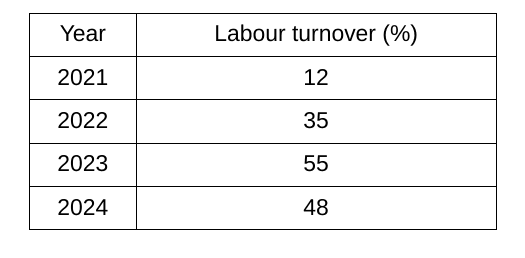
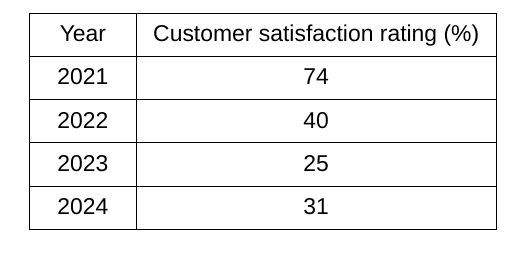
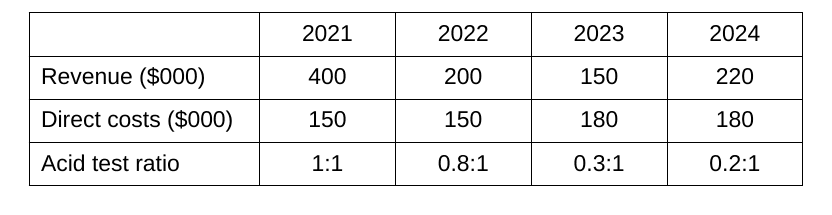
Evaluate the impact of Chelsea’s HR strategy on RR’s performance between 2021 and 2024. [20 marks]
Knowledge (max 3 marks) can be awarded for any relevant business knowledge about HR Strategy:
Indicated by as 1 mark (max 2 s), Application must support an assessment objective to be in context.
Application can be awarded for use of RR’s context, including any elements of RR’s human resource strategy between 2021 and 2024:
Analysis of the impact of the HR strategy on a business ( and and ) including:
Limited analysis – candidate shows one link in the chain of analysis (max 3).
Developed analysis of individual strategic element – candidate shows two or more links in the chain of analysis.
Developed analysis of overall strategy – candidate shows a counter answer to the chain of analysis (2-sided answer).
Still relatively high level of labour turnover in 2024.
Evaluation will largely depend on the points raised in the analysis.
Accept all valid responses.
🔒 Unlock every Human resource management strategy question from 2020–2024
All 14 come with their mark schemes, answers and case studies, and appear in the practice tool above once you’re signed in. It’s free.
Questions and mark schemes are from past Cambridge papers and are reproduced for revision. Topical Vault is an independent revision resource, not affiliated with or endorsed by Cambridge Assessment International Education.
Each topic opens this practice tool with only that topic’s questions, plus how often it comes up and every question on it in one list. Revision notes for A Level Business → Full A Level Business past papers →