← Topical Vault

Finance and accounting strategy · A Level Business

Cambridge 9609, Paper 3 & 4. 330 questions, 2020 to 2026.

Topic
Year

Case studies and questions retyped from the original Cambridge material; Paper 3 mark schemes are cropped from the official mark scheme PDFs, Paper 4 mark schemes are retyped as text. A few 2020–2022 Paper 3 case studies were recovered by OCR from a damaged source file — those are marked where it applies.

About Finance and accounting strategy

Questions on finance and accounting strategy: using accounting data and ratio analysis in strategic decisions, and how useful published accounts are to managers and investors.

New to Finance and accounting strategy, or finding these questions hard?

Read the notes first: the key ideas, diagrams and formulas, and the mistakes examiners see most, in about 12 minutes.

Read the Finance and accounting strategy notes →

15 past paper questions on this topic since 2023, across 8 exam sessions.

How often it comes up

YearPaper 3Paper 4TotalChart
2026325
2024246
2023404

Every 2025–2026 question on Finance and accounting strategy

The whole topic on one page, with answers and mark schemes. Printing this page prints just this list.

Paper 3 · Business decision-making (case study) (3)

Case study: Sugar-Less Scoops (SLS)

SLS was set up in country A in 2024 by Cali and Faiza as a private limited company. Cali and Faiza own 52% of the shares and two venture capitalists own 48% of the shares. Cali and Faiza identified a market for an alternative to high-sugar ice cream demanded by health-conscious consumers.

SLS manufactures zero-sugar ice creams. Its unique selling point (USP) is the distinctive flavours of its zero-sugar ice creams. SLS’s ice cream retails for a higher price than its competitors. SLS has a mission statement of ‘bringing quality to the zero-sugar ice cream market’.

Initial market research

Cali and Faiza invested a significant proportion of their start-up finance in market research. The research showed:

  • sales within the global zero-sugar ice cream market are forecast to increase by 15% per year until 2030.
  • 48% of people asked said they would consider switching to a zero-sugar ice cream brand.
  • 65% of people asked wanted a wide selection of flavours and carton sizes.

SLS decided to manufacture 10 flavours of zero-sugar ice cream in individual and share size cartons using packaging that is 100% recyclable. SLS is proud to only use the best natural ingredients. SLS started selling its products in a selection of premium supermarkets in country A.

The market and marketing

The zero-sugar ice cream market is supported by the government of country A who are concerned about health problems within the country. The government has identified diets high in sugar as one of the leading causes of these health problems. This has increased the demand for zero-sugar ice cream.

There are high levels of competition in the zero-sugar ice cream market within country A, with many new businesses offering similar products. There are currently five large businesses which control 60% of this market. The remaining 40% of the market is made up of many small businesses. SLS has developed a strong brand through social media marketing and free trials at some supermarkets. SLS has a 5% market share in country A.

The average monthly income in country A has increased from $500 to $510. This has resulted in the market for zero-sugar ice cream in country A increasing by 4%. However, SLS’s sales to retailers have increased by 8%. There have been no other changes.

Cali wants to increase profitability by increasing the price of each individual carton from $3.50 to $4.00. Faiza’s research has shown that this will result in a reduction of 20% in the quantity demanded.

Plans for expansion

Market research carried out by Cali and Faiza on country Z has identified the country as an excellent manufacturing base as well as a potential new market. Country Z is located a long distance away from country A. There is limited recognition of the SLS brand in country Z. To expand into country Z, SLS will need long-term borrowing of $3 million to open a factory and a regional office. Table 1.1 contains further financial information for SLS.

Table 1.1 Financial information 30th April 2026

There are empty factory units available to rent or buy in country Z. Country Z is investing in infrastructure for high speed WIFI and an improvement to the road system.

There are differences between country A and country Z, see Table 1.2. There are also social and demographic differences between consumers in the two countries. Cali and Faiza think that passing power to a regional office in country Z would be the most effective way of SLS responding to these differences. The new regional office would have responsibility for production, distribution and marketing of SLS’s ice cream in country Z.

Table 1.2 Comparison of country A and country Z

Case material: Sugar-Less Scoops (SLS)
Question 4May/Jun 20269609/3116 marks

(a) Using data in Table 1.1, calculate the new gearing ratio if SLS borrows $3 million to open a factory and a regional office in country Z. [4 marks]

(b) Evaluate the likely impact on the shareholders of SLS of the decision to increase long-term borrowing by $3 million. [12 marks]

Show mark scheme
Mark scheme, 9609/31 May/Jun 2026 question 4 (page 1 of 5)
Mark scheme, 9609/31 May/Jun 2026 question 4 (page 2 of 5)
Mark scheme, 9609/31 May/Jun 2026 question 4 (page 3 of 5)
Mark scheme, 9609/31 May/Jun 2026 question 4 (page 4 of 5)
Mark scheme, 9609/31 May/Jun 2026 question 4 (page 5 of 5)
Case study: Reeta Roy (RR)

RR is a manufacturer and retailer of luxury beauty products. Reeta Roy started RR in 2016 after managing several small enterprises with limited success.

Using her creativity, Reeta produced the first batch of soap in her kitchen. Reeta used fresh ingredients from her home region of country X. Customer feedback was positive and Reeta decided to form a private limited company. RR rented a local factory to start production. The location of the factory was important as Reeta’s business plan was to work with local farmers who could supply fresh ingredients. RR decided not to use machines and instead recruited skilled workers to hand-make its products.

Reeta believes the culture of RR is essential in creating a luxury product. Reeta expects employees to share her pride in RR’s products whether they work in manufacturing or have face-to-face contact with the final consumer.

RR’s first retail store opened in 2017 selling only RR products. By 2026, RR had opened 22 retail stores in country X, with more planned.

Reeta’s leadership

Though employees admire Reeta’s determination, energy and charisma, RR has a high labour turnover of graduate level managers due to limited promotion opportunities and training. Reeta believes that leaders are born with the traits and abilities to lead.

Supply issues

The success of RR’s brand is built on using local ingredients. Sourcing quality ingredients to meet demand is a constant problem. RR occasionally has to accept a variation in the standard of ingredients. Some of RR’s products made using these ingredients have to be rejected after quality control. The operations manager has suggested that RR should introduce lean production.

Country X’s economic performance

Since 2016, there has been rapid economic growth in country X, see Table 1.1.

Table 1.1 Country X economic data

International expansion

RR plans to expand internationally. Reeta wants RR to expand by opening retail units in other countries. However, the marketing team believes that RR should start selling its products using information technology (IT), for example, by using RR’s website and social media. Reeta believes that selling online will have a negative impact on RR’s luxury brand. Reeta thinks that the consumer’s positive interaction with the retail staff is important.

Table 1.2 shows some information about the sales of luxury beauty products in country X.

Table 1.2 Sales of luxury beauty products in country X ($m)

A survey of RR’s consumers found that 60% said visiting an RR store was a key factor in their purchase decisions and that 45% would consider buying RR products online.

The marketing team has produced an investment appraisal for its IT proposal, see Table 1.3.

Table 1.3 Investment appraisal for the marketing team’s IT proposal

FSA

FSA is a multinational company and the market leader in beauty products. FSA is aiming to add to its portfolio of luxury brands. RR’s growing reputation has come to the attention of FSA’s Chief Executive, Gabriel Laurent. Gabriel met with Reeta to discuss purchasing 20% of RR’s share capital. Gabriel was impressed by Reeta’s vision for RR and her leadership values. Reeta has placed a high financial value on RR’s shares which is far greater than shown by RR’s latest published accounts. FSA’s Chief Financial Officer (CFO) is concerned by RR’s lack of detailed accounting data including financial ratios. However, Gabriel is convinced that buying 20% of RR’s shares at the value proposed by Reeta is a unique investment opportunity for FSA.

Case material: Reeta Roy (RR)
Question 5May/Jun 20269609/3312 marks

Evaluate the usefulness of accounting data to FSA in the decision to purchase shares in RR. [12 marks]

Show mark scheme
Mark scheme, 9609/33 May/Jun 2026 question 5 (page 1 of 3)
Mark scheme, 9609/33 May/Jun 2026 question 5 (page 2 of 3)
Mark scheme, 9609/33 May/Jun 2026 question 5 (page 3 of 3)
Case study: Pavni’s Pottery (PP)

In 2021, Pavni was made redundant from her job as a production supervisor for a large pottery business. She then decided to open PP as a private limited company in country W.

PP produces and sells handmade gift items made of clay and processed in a kiln. A kiln is a high-temperature oven which turns clay into pottery. PP started with a small range of products including cups, bowls and plates but has since increased its product range to include tea light holders, fridge magnets and small plant pots. The new range of tea light holders has been PP’s most successful product to date.

Pavni has carried out some research into the gift market in country W and has identified forecasts for continued growth. Forecasts indicate that the gift market could grow to $540 million by 2029. The pottery gift segment of this market is 3% and this segment is very competitive.

Marketing

Pavni sells 75% of her products through three retail outlets business to business (B2B). These retailers place orders with PP quarterly and PP has a 2-month lead time from receiving the order to goods being ready for delivery.

PP has a website for consumers to order direct. Products are delivered to consumers within one week. PP has started to gain brand recognition from repeat consumers. Pavni would like the business to consumer sales (B2C) to grow.

Pavni has employed a university graduate, Fiza, on a full-time contract. Fiza has a marketing degree and is going to manage PP’s social media accounts. The marketing role will involve two tasks:

  • making regular posts on all the main social media platforms
  • developing artificial intelligence (AI) for use in customer service.

Financial data

Pavni is anticipating B2C sales will increase to more than 50% of PP’s output once its social media marketing is established. She is uncertain of the impact this will have on PP’s financial efficiency.

Table 1.1 shows PP’s historical financial efficiency data. Table 1.2 shows data relating to PP’s financial efficiency for 2025.

Table 1.1 PP’s historical financial efficiency data

Table 1.2 Data relating to PP’s financial efficiency for 2025

Human Resources and Business Growth

PP employs two potters. Both are experienced in pottery design and manufacture. They are encouraged to research and develop their own ideas. Pavni allows both employees paid time to research and develop their own ideas. She then evaluates their designs and decides whether to produce the suggested new products.

Pavni encourages intrapreneurship by having a flat organisational structure and using delegation. Pavni believes this business approach will help PP’s growth.

Consumers are increasingly ordering from social media platforms. For PP to respond to market development, the business is developing its social media marketing.

PP’s supplier

Country W only has one supplier of clay. PP uses this supplier. The supplier offers 30 days payment terms with a 5% discount if PP pays within 20 days. The supplier imports clay from China and so it has limited control over the quality or cost.

Investment appraisal

PP will need to increase production capacity to meet the forecast demand from online orders. In order to grow the business, Pavni has decided to invest in a new, larger kiln. The new kiln will allow more items to be manufactured at the same time and will decrease the number of faulty products.

Pavni is considering two options for the new kiln. Table 1.3 shows the investment appraisal information.

Table 1.3 Investment appraisal information for the two different kiln options

Case material: Pavni’s Pottery (PP)
Question 3Feb/Mar 20269609/3216 marks

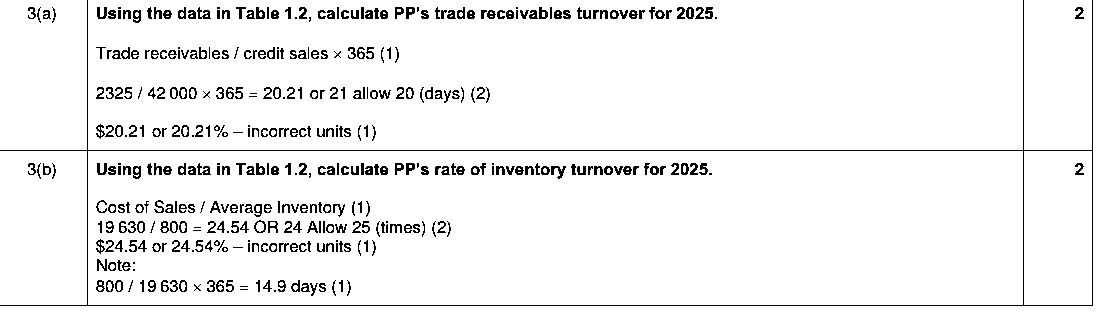
(a) Using the data in Table 1.2, calculate PP’s trade receivables turnover for 2025. Trade receivables / credit sales × 365 (1) 2325 / 42 000 × 365. [2 marks]

(b) Using the data in Table 1.2, calculate PP’s rate of inventory turnover for 2025. Cost of Sales / Average Inventory (1) 19 630 / 800. [2 marks]

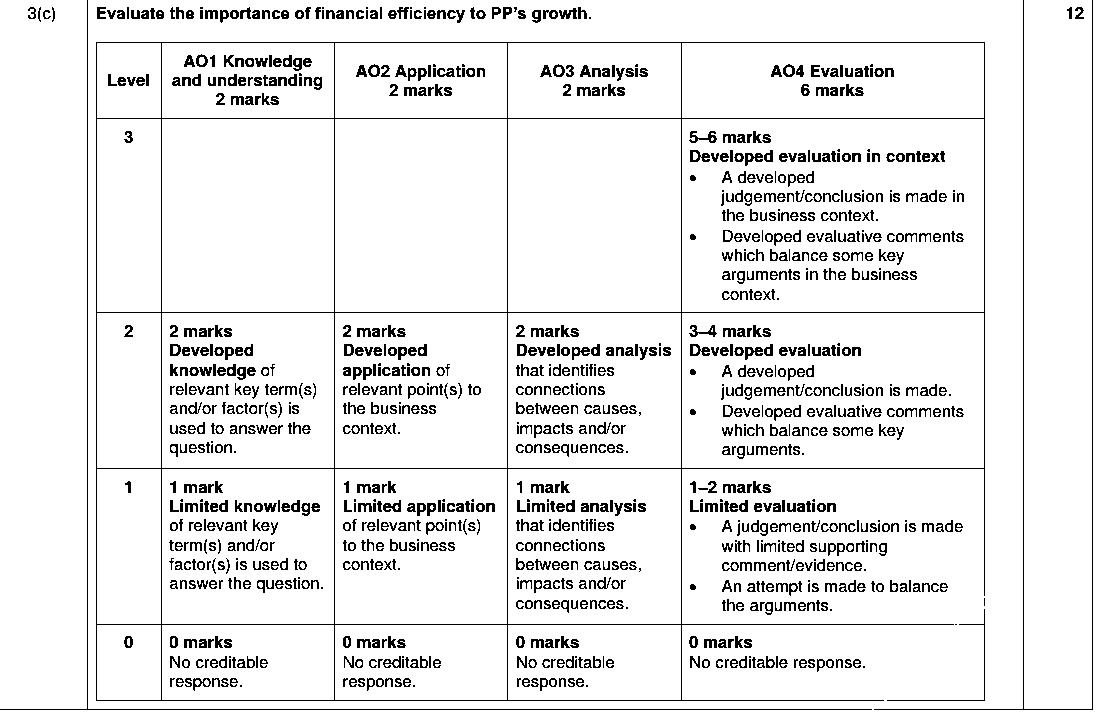
(c) Evaluate the importance of financial efficiency to PP’s growth. [12 marks]

Show mark scheme
Mark scheme, 9609/32 Feb/Mar 2026 question 3 (page 1 of 5)
Mark scheme, 9609/32 Feb/Mar 2026 question 3 (page 2 of 5)
Mark scheme, 9609/32 Feb/Mar 2026 question 3 (page 3 of 5)
Mark scheme, 9609/32 Feb/Mar 2026 question 3 (page 4 of 5)
Mark scheme, 9609/32 Feb/Mar 2026 question 3 (page 5 of 5)

Paper 4 · Business strategy (case study) (2)

Case study: Edmund’s Hollow Farm (EH)

EH is a farm that grows a range of vegetables which are sold to local retailers (B2B). Ursula bought EH in 2014 using all of her savings. At that time she was a sole trader.

Ursula struggled to make enough revenue from just growing and selling vegetables.

Timeline of EH

2015Ursula takes out a bank loan (see Appendix 1) to build a farm shop to sell her vegetables direct to consumers (B2C).2016The farm shop increases EH’s revenue (see Appendix 2). Ursula decides to stock a wider range of goods to sell in the farm shop.2017Ursula is pleased with the performance of the farm shop and decides to expand it. She uses investment appraisal to decide whether to expand the current farm shop or move to larger premises. She uses payback to evaluate these options and decides to move to larger premises.2018Ursula believes that opening a café on the farm will increase her revenue even further. To fund this, Ursula decides that EH should become a private limited company. EH becomes a private limited company and sells shares to raise capital for the café (see Appendix 3).2019Ursula wants to expand EH even further. However, the other directors are concerned about Ursula’s rapid expansion of EH. The board of directors review the financial statements published this year (see Appendix 4) as they have not received any dividend. 2020– A global pandemic forces the farm shop and café to close temporarily. 20222023EH re-opens the farm shop and café but trade is now low, and they are operating at a loss.2024EH’s board of directors are concerned for the long-term survival of EH. They think the whole business is at risk because of its rapid expansion. The board of directors decide to review EH’s financial ratios (see Appendix 5). The board of directors votes to remove Ursula as managing director.2025EH’s board of directors make the decision to close the farm shop and café permanently. The farm continues to trade by selling a range of vegetables. Developing a new business strategy EH’s board of directors want the farm to survive but are unsure how to achieve this. A SWOT analysis approach has been suggested as a starting point to developing a new business strategy. - w.

Appendix 1: Details of the loan for the farm shop in 2015

  • $65 000 loan amount
  • 15% interest per annum
  • To be repaid over 7 years
  • Gearing of EH after the loan is 35%

Appendix 2: Financial data for EH in 2016

Appendix 3: Details of EH incorporation in 2018

  • There are five shareholders, including Ursula.
  • Ursula is the managing director, and she owns 45% of the shares.
  • Share capital raised $55 000. All of this is spent to open the café.

Appendix 4: Extracts of financial statements for EH 2019

includes bank overdraft of $9000

Appendix 5: Ratios for EH in 2024

  • Current ratio = 0.8 : 1
  • Acid test = 0.4 : 1
  • Return on capital employed = 2%
  • Gearing = 65%
  • Dividend cover = 0.5 times
Case material: Edmund’s Hollow Farm (EH)
Question 1May/Jun 20269609/4320 marks

Evaluate EH’s finance and accounting strategy between 2015 and 2025. [20 marks]

Show mark scheme

AO1 Knowledge and understanding

Knowledge (max 1 mark) can be awarded for knowledge about accounting and finance strategy, can be awarded for understanding of the accounting and finance strategy up to two marks including:

  • Definition of accounting and finance strategy
  • Definition of sources of finance such as loan
  • Costs, including break-even analysis
  • Costing
  • Budgets and variances
  • Financial statements

Statement of Profit or Loss (Income Statement): This tells managers if their current strategy is working in terms of generating sales, controlling costs, and achieving profits.

Definitions of revenue, cost of sales, gross profit, expenses, profit from operations (operating profit), taxation, profit for the year, dividends, retained earnings.

Statement of Financial Position (Balance Sheet): This shows the financial structure of the business – what assets it owns and how those assets are funded through liabilities and equity.

Definitions of non-current assets, current assets, current liabilities, net current assets, net assets, non-current liabilities, working capital, reserves and equity.

Cash flow Statement – showing the cash inflows and outflows for the business over a period of time.

  • Analysis of published accounts Liquidity ratios; current ratio, acid test ratio.

Profitability ratios; ROCE, gross profit margin, profit margin.

Gearing ratio.

Investment ratio; dividend yield, dividend cover, PE ratio.

  • Investment appraisal; payback, ARR, NPV.
  • Understanding of long-term borrowing – example, debts, liability
  • Understanding of what dividends are – reward for investment to shareholders Profitability ratios help assess the performance of a business based on its ability Some basic knowledge about Profitability ratios help assess the performance of a business based on its ability 1 K for identification and 1 DEV revenue and the capital invested in the business..

Profitability ratios help assess the performance of a business based on its ability 1 K for identification and 2 DEVs revenue and the capital invested in the business. ROCE formula is operating profit/capital employed ×100..

Note: Candidates can gain full marks for AO1 from one term that is explained ( + + ) or from two terms partially explained ( + and + ).

No other AO2, AO3 OR AO4 marks can be awarded without AO1.

AO2 Application

Application (max 2 marks) can be awarded for applying knowledge of accounting and finance strategy, to EH between 2015 and 2025:

Award one for each application of knowledge to EH between 2015 and 2025.

  • Takes out a loan for the farm shop $65 000 loan amount 15% interest per annum To be repaid over 7 years Gearing of EH after the loan is 35%
  • Issues shares to raise capital $55 000 raised All used for café expansion She owns 45% of shares
  • Financial statements in Appendix 4
  • Ratios in Appendix 5 Current ratio = 0.8:1 Acid test = 0.4:1 ROCE = 2% Gearing = 65% Dividend cover = 0.5 times
  • Any data from Appendix 1–4

AO3 Analysis

Analysis is likely to be based on EH’s loan, expansion of the shop/sources of finance, profit and loss data (Appendices 1–4).

Analysis of the effectiveness of EH’s financial strategy ( and and ) including:

  • Loan has interest payments which means the cost of borrowing increases leading to lower profits. However, the loan helped in funding the café which generated revenue for the farm increasing their profitability.
  • The gearing ratio increased which mean they will have difficulty paying their debt decreasing their cash flow.
  • 2019 has a loss made in the accounts – how does this impact on the overall financial position of the firm? Is this because some elements of the expansion are not profitable?
  • Revenue has increased in 2017 which meant that the business has more chances for growth. But the pandemic forced their sales to drop closing their shop and café.
  • Global pandemic closes the shop/café which results in a loss of income – putting more pressure on the revenue from the farm business for those 2 years.
  • Financial position between 2022–24 is poor. Ratios are poor. Gearing has soared – possibly to get through the pandemic. All of this puts pressure on the finances of the farm which must be supporting the rest of the business. Lack of dividends is going to cause concern with shareholders which may discourage shareholders from investing in EH.

AO4 Evaluation

Evaluation ( and and ) including:

Candidates MUST answer the question – Evaluate EH’s finance and accounting strategy between 2015 and 2025. how effective was EH’s finance strategy between 2015 and 2025.

The development and support of this judgement will help them to move through L2 and L3. To award L3 the answer must be in context and draw upon the previous analysis.

Evaluation will largely depend on the points raised in the analysis.

  • A judgement over the effectiveness of the financial strategy between 2015 and 2025
  • EH/Ursula have relied very much on external finance – loans and share issues which have put the business in a poor state financially by 2025.
  • Profits are low given the nature of the business, but should that mean they use external finance as much as they have?
  • A lot of the expansion seems to have been underfunded or managed ineffectually which comes from Ursula’s management and maybe the four other investors may want a different approach which could change the direction of the business.
  • There has been a global pandemic which is unpredictable and perhaps the business and the expansion would have been successful if this hadn’t have happened.
  • There was no way of knowing how the business would bounce back and this is out of EH’s control – unfortunately the customers did not return as expected – again not necessarily EH’s fault.
  • Accounting and Finance strategy has been successful given survival over the last 7 years/162 years
  • This depends upon external factors such as increasing interest rates and its effect on the accounting and finance position of EH – Evaluative comments needs to answer the question in terms of success/effectiveness of strategy.

Accept all valid responses.

No credit

L1 including: (limited L2 including: (developed L3 (developed supporting supporting evidence) supporting evidence) evidence with context) EH’s accounting and EH’s accounting and EH’s accounting and finance EH’s accounting and finance finance strategy was finance strategy was strategy was successful as strategy was successful as there successful successful as there were there were short term increases were short term increases in short term increases in in profits. Using the loan profits. Using the loan allowed profits allowed the business to open the business to open the stores the stores and increase and increase customers and customers and revenue. revenue from 159 500 in 2018 to 161 000 in 2019.

The effectiveness of The effectiveness of the The effectiveness of the The effectiveness of the the accounting and accounting and finance accounting and finance strategy accounting and finance strategy finance strategy strategy depends on depends on business depends on business objectives. depends on other business objectives. If the objectives. If the business If the business focusses on the factors business depends on the focuses on the wrong wrong objectives this will lead to wrong objectives this will objectives If the business an ineffective strategy. For lead to an ineffective depends on the wrong example, if EH focussed on strategy. objectives this will lead to an growth and opening stores very ineffective strategy. For fast this might lead to failure. The example, if EH focussed on directors are concerned at the growth and opening stores very rapid expansion which lead to the fast this might lead to failure. closure of the café and shop permanently showing how the objectives led to an ineffective strategy.

Case study: Potato Farm (PF)

Farouk has been a farmer for his whole working life. He owns PF, the biggest potato farm in country B.

PF supplies the majority of supermarkets and food manufacturers in country B.

In 2018, PF’s crops were destroyed by disease that spread throughout the potato crops of country B. This led to PF requiring finance to survive. Farouk converted PF into a private limited company in 2019 with the majority of shares owned by a private equity firm. Farouk still retains 40% of the shares and he is the chief executive officer (CEO). PF’s mission statement is:

‘PF is committed to fulfilling our customers’ needs by supplying the tastiest potato products tailored to the country B market.’

Timeline of PF

2020Farouk chairs his first annual general meeting (AGM). He presents ratio analysis based on the most recent financial statements (see Appendix 1). Farouk hires a management consultant to analyse PF’s market and growth options (see Appendix 2).2021The management consultant completes her analysis and presents two growth options to the board of directors (see Appendix 3).2022Farouk uses scenario planning to choose between the two options for growth. Option 2 is chosen.2023Farouk outlines his strategic implementation plan to the AGM (see Appendix 4).2024PF finalises the takeover of ZF. Both business divisions start to trade as PF.2025PF’s revenue increases by 15% and its profit increases by 7%.

Developing a strategy for growth

Farouk is pleased with how PF has steadily increased its revenue and profit since taking over ZF. He thinks it is time for PF to continue growing.

Farouk is unsure of the best strategy for growth. He believes that PF’s financial statements will be important to develop an effective new strategy for growth.

Appendix 1: PF’s ratio analysis in 2020

Appendix 2: Analysis of PF and its market in 2020

Strategic approaches used to analyse the potato market in country B and PF’s position in that market.

  • SWOT analysis
  • PEST analysis
  • Force field analysis.

Appendix 3: Growth options presented in 2021

Option 1

To use internal (organic) growth. Purchase low-cost land in country B and neighbouring countries. Use this land to grow more potatoes and target an international market with PF’s current products.

Option 2

To use forward vertical integration and takeover Zingy Fries (ZF), a manufacturer of potato products in country B. This will increase PF’s revenue and should allow for increased economies of scale.

Appendix 4: Extract from strategic implementation plan for the takeover of ZF in 2023

Case material: Potato Farm (PF)
Question 2Feb/Mar 20269609/4220 marks

Advise Farouk on the usefulness of financial statements when developing a new strategy for PF’s growth. [20 marks]

Show mark scheme

Responses may include:

AO1 Knowledge and understanding

No other AO2, AO3 or AO4 marks can be awarded without AO1 Knowledge (max 1 mark) can be awarded for knowledge of the use of financial statements can be awarded for further understanding of use of financial statements up to two marks including:

  • Statement of profit or loss: to evaluate the profitability of a business over a period of time (usually one year) shows the income and expenses for a business statutory requirement for companies actual profit data can be compared with the budgeted profit levels used to calculate tax owed to government available to all stakeholders of a business Bankers and creditors need the information to help decide whether to lend money to the business.

Potential investors will use the profit performance of the business to help decide to whether to buy shares in it or not.

  • Statement of financial position to evaluate the worth of a business overview of what a business owns and owes on one particular date statutory requirement for companies can be used by stakeholders to value a business available to all stakeholders of a business To find ways to increase shareholder equity through share capital and/or retained earnings
  • Allow knowledge of cashflow statements to be included.

They show negative closing cash flows. This means that plans can be made to source additional finance, such as a bank overdraft or the injection of more capital from the owner. essential to all business plans. A business start-up has better chance of gaining finance if investors and bankers have access to a cash flow

NOTE: A maximum of 1 mark – K – can be given for knowledge of ratios only.

Financial statements such as profit and loss statement is useful as it shows the Some basic knowledge about Financial statements such as profit and loss statement is useful as it shows the 1 K for identification and 1 DEV for a revenue, cost of sales and expenses of the year. This means we can point of explanation evaluate the profitability of the business.

Financial statements such as profit and loss statement is useful as it shows the 1 K for identification and 2 DEVs for revenue, cost of sales and expenses of the year. This means we can two points of explanation evaluate the profitability of the business. A business can use this statement to calculate profitability ratios such as gross profit margin which is gross profit/revenue x100..

Note: Candidates can gain full marks for AO1 from one term that is explained ( + + ) or from two terms partially explained ( + and + ).

AO2 Application

Application (max 2 marks) can be awarded for applying knowledge, analysis or evaluation of usefulness of financial statements.

Allow any use of the data that is linked to another AO. Context that is used, but not linked to another AO is REP.

  • PF is biggest potato farm in country B
  • PF supplies the majority of supermarkets and shops in country B
  • PF converted into a private limited company in 2019
  • Farouk retained 40% of the shares
  • Mission statement:

Fulfilling customer needs Tastiest potato products Tailored to country B market

  • First AGM in 2020.
  • Appendix 1 PF ratio analysis:

85% GPM – seems high, but impossible to know without some industry or time comparisons.

4% operating profit margin – seems low, but again difficult to analyse without comparisons. Suggests high expenses, since GPM is 85%.

ROCE of 18% – likely to please investors Gearing of 80% – highly geared, may struggle to find future borrowings and to repay long term debts/interest.

Current ratio of 1:1 – reasonable level to be able to repay current liabilities with current assets.

Acid test of 0.3:1 – shows that PF may be holding too much inventory. Also issues over inventory storage and spoilage.

  • Management consultant strategically analyses PF’s market SWOT analysis PEST analysis Force Field analysis Scenario planning (found in the timeline)
  • Management consultant presents findings to BoD (Appendix 3):

Option 1

  • Internal (organic) growth
  • Purchase low-cost land in country B and neighbouring countries
  • Increase potato growth
  • Target international market with PF’s current products Option 2
  • Forward vertical integration to takeover ZF
  • ZF manufactures potato products
  • Increase PF’s revenue
  • Increased economies of scale
  • PF chooses option 2 in 2022
  • Farouk’s strategic implementation plan (Appendix 4):

Objectives and KPIs set by Farouk (MD) by January 2024 Roles and responsibilities assigned by Farouk by February 2024 Workforce planning after takeover to be done by HR Director by February 2024 New marketing strategy done by Marketing Director by June 2024 Operations Director assigned to implement lean production by June 2024 Finance Director responsible for integrating ZF and PF accounting and finance systems by December 2024

  • PF finalises purchase of ZF in 2024
  • Combined PF and ZF trade under the PF brand in 2024
  • Revenue increases by 15% in 2025
  • Profit increases by 7% in 2025.

AO3 Analysis ( and and )

Analysis will depend on the element(s) chosen by the candidate, including:

  • Statement of profit or loss: to evaluate the profitability of a business – ‘bottom line’ and used by most/all businesses, so can be compared.

However, may need comparison to be useful, or use of ratio analysis, so that comparison can be made with competitors, similar businesses etc. over a period of time (usually one year) – most statements of financial position include previous years for comparison – shows trends in revenue/profit etc. – allows stakeholders to make decisions about PF. Likely to be important for growth as PF may require more finance.

Shows the income and expenses for a business – useful to stakeholders, gaining finance etc. statutory requirement for companies – avoids being fined and making the Directors responsible. can be used to calculate tax owed to government – tax evasion is illegal and failure to accurately report profit or loss is illegal. available to all stakeholders of a business – including PF’s competitors and can be used to judge the financial ‘health’ of PF.

  • Statement of financial position to evaluate the worth of a business (what it owes and what it owns) – important if finance is needed to grow – can tell investors/borrowers the gearing and value of PF. at one specific date (as at) – can be manipulated, depending on when the statement is completed – window dressing – in a primary market the timing of this may be very important. overview of what a business owns and owes on one particular date statutory requirement for companies – avoids being fined and making the Directors responsible. can be used by stakeholders to value a business and to judge the risk of investment or even of being their customer.

Supermarkets may want to know this data to decide whether to use PF and whether it can trust the business. available to all stakeholders of a business – including PF’s competitors and can be used to judge the financial ‘health’ of PF.

  • Analysis of ratios Gearing ratio is high which informs us that PF cannot borrow any more loans and needs to find other ways to finance the business such as share capital?

Operating profit is a lot lower than gross profit margin suggesting that expenses are high and therefore retained profit is low therefore reducing chances of finance for growth.

Candidates need to provide developed analysis to get to L2, this then needs to be counterbalanced to get to L3. If a candidate does this twice, they will gain 8 marks.

The counterbalanced points can be two separate points as long as candidate shows a two-sided response that is developed

AO4 Evaluation

Evaluation ( and and ) including:

  • A judgement over the usefulness of the financial statements when developing a new strategy for PF’s growth
  • A judgement over the most useful financial statements when developing a new strategy for PF’s financial growth
  • A judgement over the different uses financial statements may be used for by PF and their stakeholders
  • What the judgement(s) may depend upon; the reactions of competitors, the external environment (social, legal, economic, environmental, political, technological), the reactions of stakeholders, the reactions of customers to PF’s growth, the nature of ZF’s potato products
  • Weighing up of the likely usefulness of different financial statements to PF in the future.

Accept all valid responses.

10 more questions from 2023–2024

🔒 Unlock every Finance and accounting strategy question from 2023–2024

All 10 come with their mark schemes, answers and case studies, and appear in the practice tool above once you’re signed in. It’s free.

Create a free accountSign in

A few of them

  • 9609/33 · Oct/Nov 2024 · Question 41.… 🔒
  • 9609/41 · Oct/Nov 2024 · Question 2Advise DF on the likely impact of… 🔒
  • 9609/42 · Oct/Nov 2024 · Question 2Advise Idir on what accounting data he… 🔒
  • 9609/43 · Oct/Nov 2024 · Question 1Evaluate the impact of FB’s finance and… 🔒
  • 9609/41 · May/Jun 2024 · Question 1Evaluate LC’s business performance between 2014 and… 🔒
  • + 5 more, by year in the table above

Questions and mark schemes are from past Cambridge papers and are reproduced for revision. Topical Vault is an independent revision resource, not affiliated with or endorsed by Cambridge Assessment International Education.

A Level Business questions by topic

Each topic opens this practice tool with only that topic’s questions, plus how often it comes up and every question on it in one list. Revision notes for A Level Business →

  1. Unit 1Business and its environment
  2. Ch 6External influences on business activity
  3. Ch 7External economic influences on business activity
  4. Ch 8Business strategy
  5. Ch 9Corporate planning and implementation
  6. Unit 2Human resource management
  7. Ch 10Human resource management (AS Level content, before syllabus change)
  8. Ch 13Organisational structure
  9. Ch 14Business communication
  10. Ch 15Leadership
  11. Ch 16Human resource management strategy
  12. Unit 3Marketing
  13. Ch 21Marketing analysis
  14. Ch 22Marketing strategy
  15. Unit 4Operations management
  16. Ch 25Capacity utilisation and outsourcing (AS Level content, before syllabus change)
  17. Ch 26Location and scale
  18. Ch 27Quality management
  19. Ch 28Operations strategy
  20. Unit 5Finance and accounting
  21. Ch 31Costs (AS Level content, before syllabus change)
  22. Ch 33Financial statements
  23. Ch 34Analysis of published accounts
  24. Ch 35Investment appraisal
  25. Ch 36Finance and accounting strategy