← Topical Vault

Limited companies: Further considerations · AS Level Accounting

Cambridge 9706, Paper 1 & 2. 1,558 questions, 2020 to 2026.

Topic
Year

Pages reproduced from the original Cambridge question papers and mark schemes. Tables, ruled accounts and answer templates are cropped images, not retyped — shown on a white card so they stay readable in dark mode. Paper 2 questions with parts in more than one topic are filed whole under every topic they touch; parts outside the chosen topics are dimmed. Click any image to enlarge it. Mark schemes are hidden until you choose to reveal them.

About Limited companies: Further considerations

Further limited company topics: issues of shares, bonus and rights issues, and the statement of changes in equity.

New to Limited companies: Further considerations, or finding these questions hard?

Read the notes first: the key ideas, diagrams and formulas, and the mistakes examiners see most, in about 30 minutes.

Read the Limited companies: Further considerations notes →

33 past paper questions on this topic since 2020, across 13 exam sessions.

How often it comes up

YearPaper 1Paper 2TotalChart
2026415
2025617
2024112
2023415
2022628
2021123
2020213

Every 2025–2026 question on Limited companies: Further considerations

The whole topic on one page, with answers and mark schemes. Printing this page prints just this list.

Paper 1 · Multiple choice (10)

Question 19May/Jun 20269706/111 mark

At the beginning of a financial year, a limited company had an issued share capital of $900000, consisting of ordinary shares of $0.50 each. During the year, the company made a bonus issue of three ordinary shares for every two ordinary shares held. What was the total number of ordinary shares at the year-end?

9706/11 May/Jun 2026 question 19
Show answer

DCorrect answer

Question 19May/Jun 20269706/131 mark

At the beginning of a financial year, a limited company had an issued share capital of $900000, consisting of ordinary shares of $0.50 each. During the year, the company made a bonus issue of three ordinary shares for every two ordinary shares held. What was the total number of ordinary shares at the year-end?

9706/13 May/Jun 2026 question 19
Show answer

DCorrect answer

Question 2Feb/Mar 20269706/121 mark

Which sources of finance are only available to limited companies?

9706/12 Feb/Mar 2026 question 2
Show answer

CCorrect answer

Question 19Feb/Mar 20269706/121 mark

What could be used to fund a bonus issue of shares?

9706/12 Feb/Mar 2026 question 19
Show answer

ACorrect answer

Question 1Oct/Nov 20259706/121 mark

A company needs to raise finance to build a factory. Which action is suitable to protect the existing shareholders’ interest? A bonus issue of shares B fully subscribed rights issue of shares C issue of debentures D general issue of ordinary shares

Show answer

BCorrect answer

Question 19Oct/Nov 20259706/131 mark

A company provides the following information.

9706/13 Oct/Nov 2025 question 19 (image 1 of 2)

The following transactions then take place. 1 The company makes a rights issue of one new ordinary share for every two held, at $1.30. The issue is fully subscribed. 2 A bonus issue of two ordinary shares for every three held is then made. What is the maximum possible balance of the retained earnings after these transactions?

9706/13 Oct/Nov 2025 question 19 (image 2 of 2)
Show answer

CCorrect answer

Question 20May/Jun 20259706/111 mark

A company provides the following information about its equity.

9706/11 May/Jun 2025 question 20 (image 1 of 2)

The directors propose to issue bonus shares on the basis of one $1 share for every three already held. Following this, the directors intend to make a rights issue on the basis of one new $1 share for every four shares held, at a premium of $0.20 per share. What will be the total equity of the company after the share issues?

9706/11 May/Jun 2025 question 20 (image 2 of 2)
Show answer

BCorrect answer

Question 20May/Jun 20259706/131 mark

A company provides the following information about its equity.

9706/13 May/Jun 2025 question 20 (image 1 of 2)

The directors propose to issue bonus shares on the basis of one $1 share for every three already held. Following this, the directors intend to make a rights issue on the basis of one new $1 share for every four shares held, at a premium of $0.20 per share. What will be the total equity of the company after the share issues?

9706/13 May/Jun 2025 question 20 (image 2 of 2)
Show answer

BCorrect answer

Question 17Feb/Mar 20259706/121 mark

A company uses a revenue reserve to make a bonus issue of ordinary shares. Which accounts should be debited and credited to record this?

9706/12 Feb/Mar 2025 question 17
Show answer

ACorrect answer

Question 18Feb/Mar 20259706/121 mark

A company had an issued share capital of 400 000 ordinary shares of $1 each. It then made a bonus issue of one ordinary share for every five ordinary shares held. This was later followed by a rights issue of one ordinary share for every three ordinary shares held. What was the balance on the share capital account after these transactions?

9706/12 Feb/Mar 2025 question 18
Show answer

DCorrect answer

Paper 2 · Structured questions (2)

Question 3Feb/Mar 20269706/2215 marks

The statement of financial position of N plc at 1 January 2025 included the following:

9706/22 Feb/Mar 2026 question 3 context (image 1 of 2)

During the year ended 31 December 2025, the following took place:

9706/22 Feb/Mar 2026 question 3 context (image 2 of 2)

The profit for the year ended 31 December 2025 was $92 500.

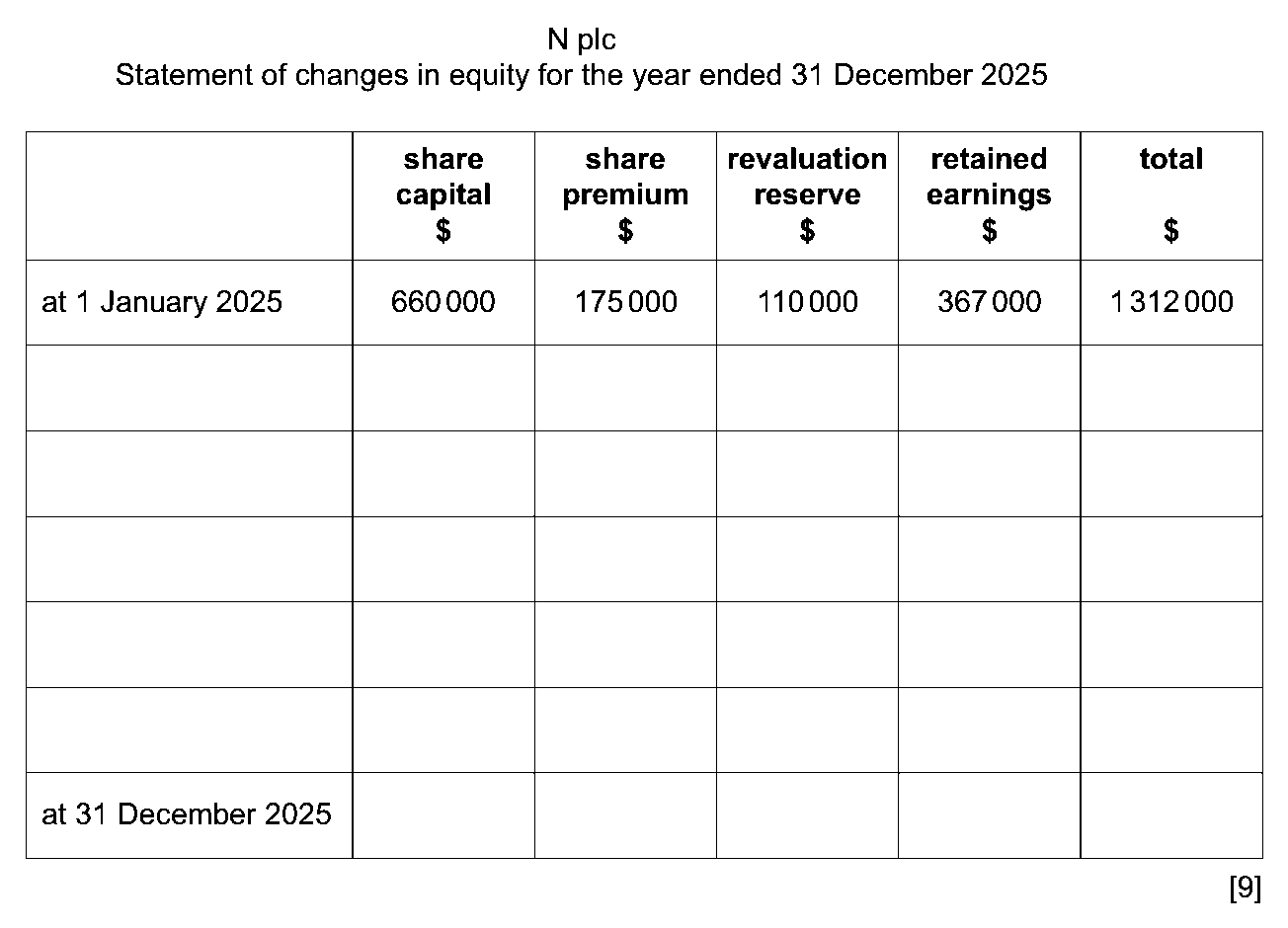
(a) Prepare the statement of changes in equity for the year ended 31 December 2025. [9 marks]

9706/22 Feb/Mar 2026 question 3(a)

(b) Explain two advantages to a company of making a rights issue of shares rather than a new issue of shares. [4 marks]

(c) Explain one reason for creating a general reserve. [2 marks]

The directors are considering creating a general reserve.

Show mark scheme

(a)

Mark scheme, 9706/22 Feb/Mar 2026 question 3(a) (image 1 of 2)
Mark scheme, 9706/22 Feb/Mar 2026 question 3(a) (image 2 of 2)

W1 Bonus issue: 3/5  660 000 = $396 000 W2 Number of shares 1 056 000  4 = 4 224 000  $0.2 = $84 480 W3 Rights issue 4 224 000/3 = 1 408 000 shares Increase in share capital $352 000 Increase in share premium: 1 408 000  $0.10 = $140 800

(b)

A rights issue is less time consuming than making a general issue of shares (1) because there are less rules and regulations/already know the shareholders (1)

  • A rights issue is less costly (1) no need for a prospectus/promotion costs (1)
  • The control of the company is unaffected by a rights issue (1) as shares are purchased by existing shareholders/not new shareholders (in proportion to their existing shareholding) (1)
  • More likely to be successful than a general issue (1) as shares are offered at a favourable price (1) Max 4 Accept other valid responses.

(c)

  • To ensure finance is retained in the business for some future needs/in case of emergency (1) ensures they have necessary funds to respond/liquid enough (1)
  • Divided policy flexibility (1) allows dividend payout in less profitable years (1) Max 2 Accept other valid responses.
Question 3Feb/Mar 20259706/2215 marks

The following balances had been extracted from the books of W Limited on 1 January 2024.

9706/22 Feb/Mar 2025 question 3 context (image 1 of 2)

During the year ended 31 December 2024, the following occurred:

9706/22 Feb/Mar 2025 question 3 context (image 2 of 2)

The profit for the year ended 31 December 2024 was $148 000.

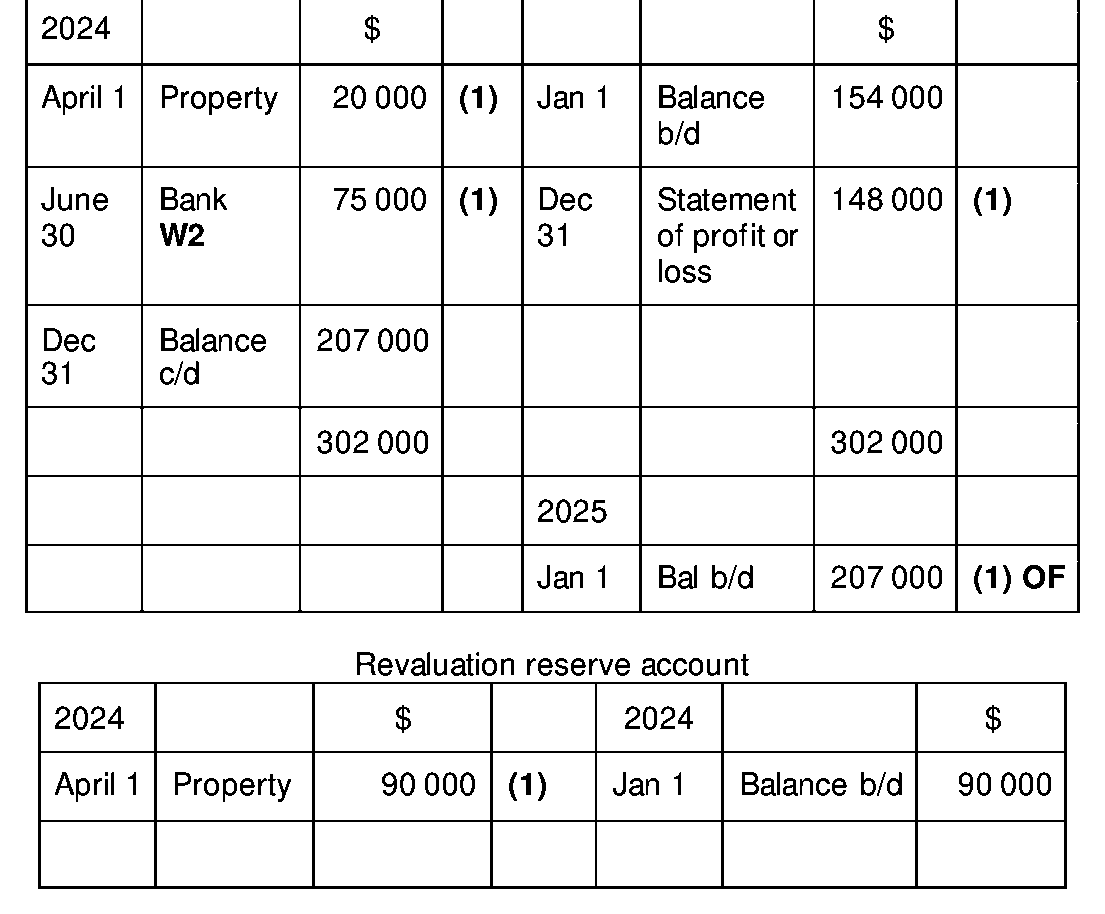
(a) Prepare the following ledger accounts for the year ended 31 December 2024. [9 marks]

9706/22 Feb/Mar 2025 question 3(a) (image 1 of 2)
9706/22 Feb/Mar 2025 question 3(a) (image 2 of 2)

Workings:

(b) State two features of capital reserves. [2 marks]

(c) State two differences between a rights issue of shares and an issue of debentures. [4 marks]

Show mark scheme

(a)

Mark scheme, 9706/22 Feb/Mar 2025 question 3(a) (image 1 of 2)
Mark scheme, 9706/22 Feb/Mar 2025 question 3(a) (image 2 of 2)

W1 Rights issue Share capital: 1 500 000  2/3  $0.50 = $500 000 (1) Share premium: 1 500 000  2/3  $0.20 = $200 000 (1) W2 Interim dividend = $75 000 Interim dividend: 750 000  2 shares  $0.05 = $75 000 (1)

(b)

Cannot be used to finance dividend payments (1) Arise from non-trading activities of a company (1) Can be used for bonus issue of shares (1) Max 2 Accept other valid responses

(c)

Debenture interest will have to be paid annually affecting/reducing cashflows and profits (1) whereas dividends on shares are discretionary (1). Rights issue of shares is a permanent source of finance (1) whereas debentures have to be repaid at a future date OR long term loan (1). Shareholders have voting rights (1) debenture holders do not have voting rights (1). Debentures may require collateral (1) no collateral needed for rights issue (1). Max 4 Accept other valid responses

21 more questions from 2020–2024

🔒 Unlock every Limited companies: Further considerations question from 2020–2024

All 21 come with their mark schemes, answers and case studies, and appear in the practice tool above once you’re signed in. It’s free.

Create a free accountSign in

A few of them

  • 9706/12 · Oct/Nov 2024 · Question 19The statement of financial position of a… 🔒
  • 9706/23 · May/Jun 2024 · Question 3Usman began selling goods on credit on… 🔒
  • 9706/12 · Oct/Nov 2023 · Question 20A limited company has the following in… 🔒
  • 9706/23 · Oct/Nov 2023 · Question 3The directors of J Limited provided the… 🔒
  • 9706/11 · May/Jun 2023 · Question 19Gordon sells goods on credit… 🔒
  • + 16 more, by year in the table above

Questions and mark schemes are from past Cambridge papers and are reproduced for revision. Topical Vault is an independent revision resource, not affiliated with or endorsed by Cambridge Assessment International Education.

AS Level Accounting questions by topic

Each topic opens this practice tool with only that topic’s questions, plus how often it comes up and every question on it in one list. Revision notes for AS Level Accounting →

  1. Ch 2Double-entry bookkeeping: Credit transactions
  2. Ch 3Books of prime entry
  3. Ch 5The classification of accounts and division of the ledger
  4. Ch 6The trial balance
  5. Ch 7Statement of profit or loss
  6. Ch 8Statements of financial position for sole traders
  7. Ch 9Accounting concepts
  8. Ch 10Accruals and prepayments (the matching concept)
  9. Ch 11Accounting for the depreciation of non-current assets
  10. Ch 12Irrecoverable debts
  11. Ch 13Bank reconciliation statements
  12. Ch 14Control accounts
  13. Ch 15The correction of errors
  14. Ch 16Incomplete records
  15. Ch 17Incomplete records: Further considerations
  16. Ch 18Partnership accounts
  17. Ch 19Partnership changes
  18. Ch 21An introduction to limited company accounts
  19. Ch 22Limited companies: Further considerations
  20. Ch 27Computerised accounting systems
  21. Ch 30Accounting information for stakeholders
  22. Ch 32Costing of materials and labour
  23. Ch 33Absorption costing
  24. Ch 34Unit, job and batch costing
  25. Ch 35Marginal costing
  26. Ch 37Budgeting and budgetary control