Question 23May/Jun 20269706/111 mark
What is a direct cost?
Show answer
ACorrect answer
Cambridge 9706, Paper 1 & 2. 1,558 questions, 2020 to 2026.
Pages reproduced from the original Cambridge question papers and mark schemes. Tables, ruled accounts and answer templates are cropped images, not retyped — shown on a white card so they stay readable in dark mode. Paper 2 questions with parts in more than one topic are filed whole under every topic they touch; parts outside the chosen topics are dimmed. Click any image to enlarge it. Mark schemes are hidden until you choose to reveal them.
Costing materials and labour: inventory valuation methods (FIFO and AVCO) and methods of remunerating labour.
New to Costing of materials and labour, or finding these questions hard?
Read the notes first: the key ideas, diagrams and formulas, and the mistakes examiners see most, in about 28 minutes.
56 past paper questions on this topic since 2020, across 12 exam sessions.
| Year | Paper 1 | Paper 2 | Total | Chart |
|---|---|---|---|---|
| 2026 | 5 | 1 | 6 | |
| 2025 | 5 | 4 | 9 | |
| 2024 | 7 | 3 | 10 | |
| 2023 | 11 | 1 | 12 | |
| 2022 | 8 | 0 | 8 | |
| 2021 | 5 | 0 | 5 | |
| 2020 | 6 | 0 | 6 |
The whole topic on one page, with answers and mark schemes. Printing this page prints just this list.
What is a direct cost?
ACorrect answer
A trading company provided the following details about its inventory for January.
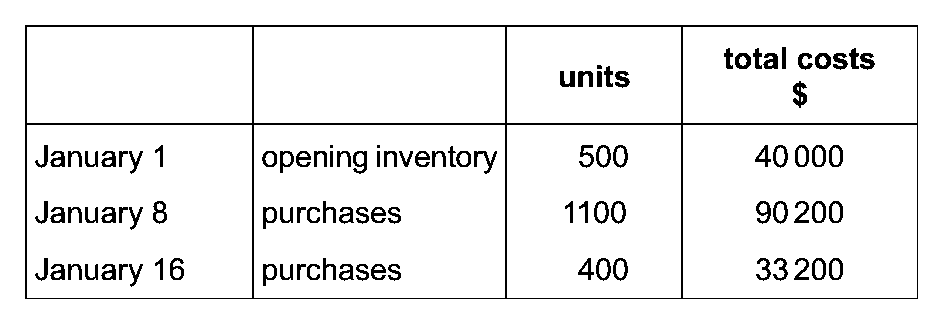
During January, 1500 units were sold at $120 each. What is the gross profit for January, using the first in first out (FIFO) method of inventory valuation?

CCorrect answer
Workers are paid at a basic rate of $25 per hour, working 8 hours a day for a 40-hour week. To finish an urgent job, eight workers were needed to work 10 hours every day, Monday to Sunday, for two weeks. They were paid a premium of 40% over the basic rate on the extra time worked each week. What were the total wages paid for this job?

CCorrect answer
What is a direct cost?
ACorrect answer
A trading company provided the following details about its inventory for January.
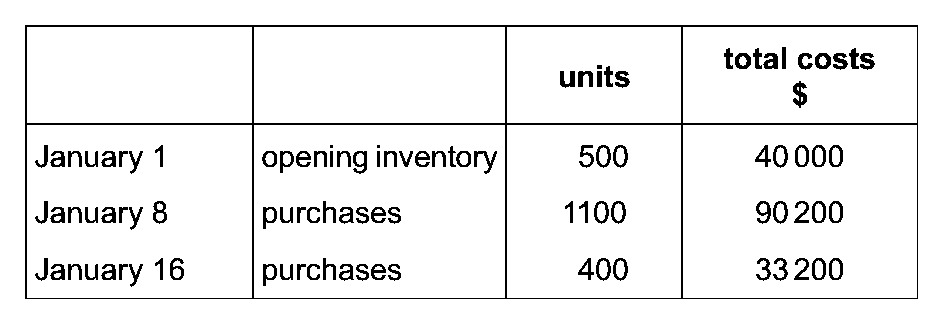
During January, 1500 units were sold at $120 each. What is the gross profit for January, using the first in first out (FIFO) method of inventory valuation?

CCorrect answer
An employee works a 40-hour week at an hourly rate of $8. She receives a bonus of 30% of the hourly rate for time saved producing each unit. The target production time is 30 minutes per unit. Last week she worked 40 hours and produced 90 units. What were her total earnings for the week?

BCorrect answer
A new manufacturing business has just completed its first year of operation. The following details relate to its inventory of direct materials.
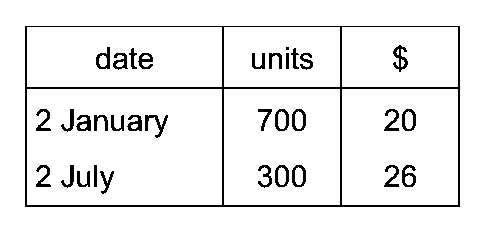
The following items were taken from inventory for production.
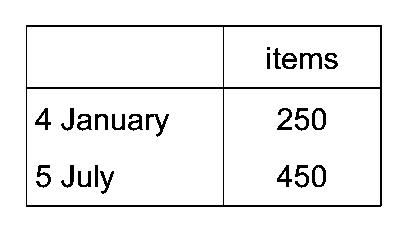
What would be the value of inventory at the end of the year using the AVCO (periodic) method?

ACorrect answer
A restaurant owner paid the following:
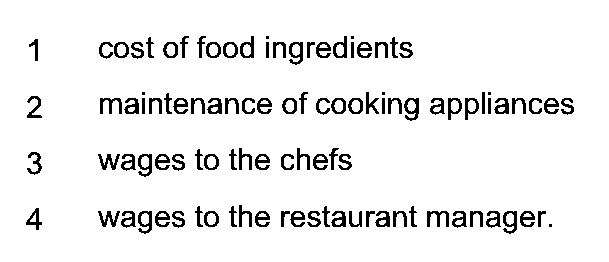
Which costs are indirect costs?
CCorrect answer
On 1 March, a business had an inventory of 3 items which had cost $8 each. The business uses the FIFO method of valuing inventory. During March the following transactions occurred.
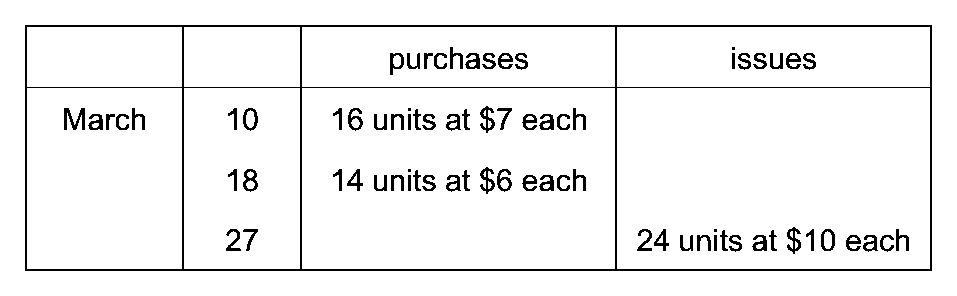
What was the value of inventory at the end of March?

CCorrect answer
A factory produces 1100 units per day. Daily machinery set-up costs are $2000. Direct material cost per unit is $3. Machine operators are paid $400 per day. Each can produce a maximum of 200 units per day. What is the average cost per unit?
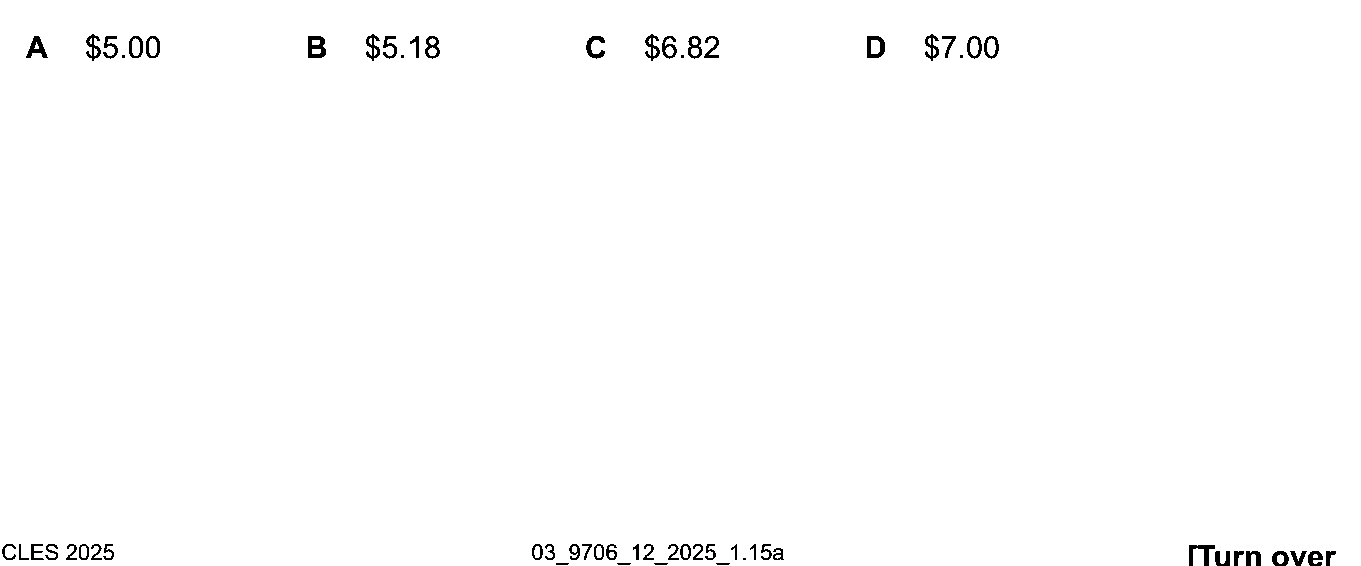
DCorrect answer
Y Limited is a manufacturing company which makes a range of food products. The company uses absorption costing. The factory has two production departments: baking and packaging. There are also two service departments: stores and canteen. Some budgeted overheads have already been allocated to departments as follows:
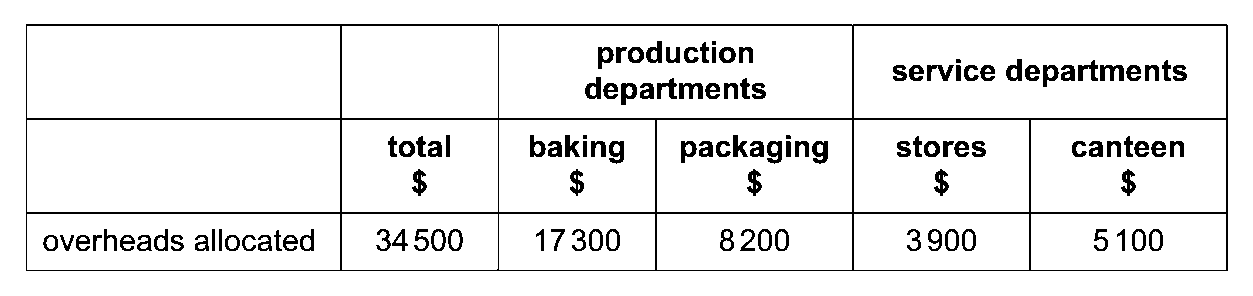
The following budgeted overheads for July 2026 are to be apportioned between the departments.
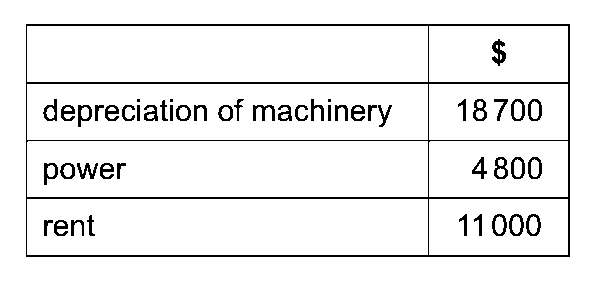
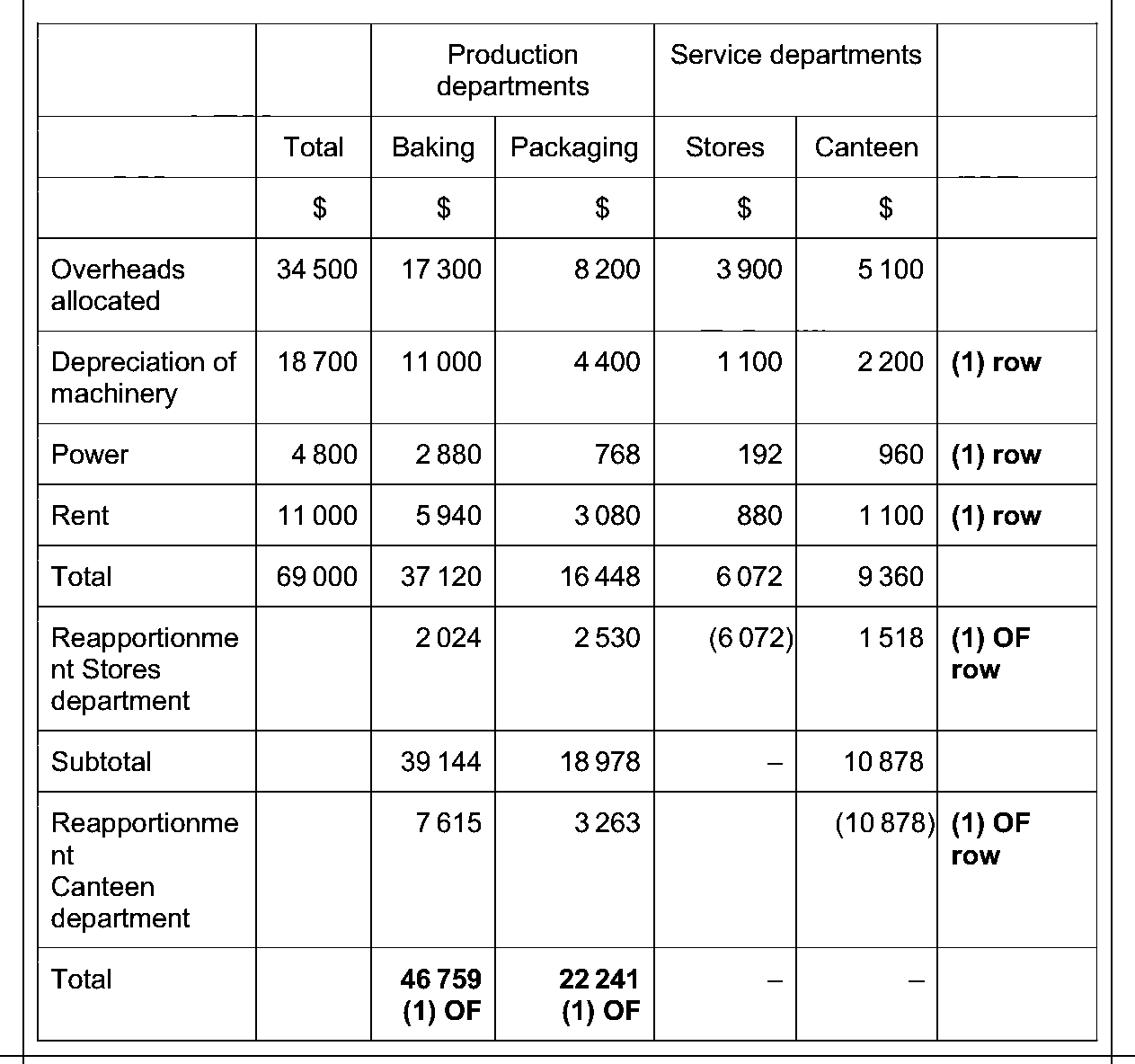
(a) Complete the table to show the apportionment of overheads and the reapportionment of service department overheads. [7 marks]
The following additional information is available:
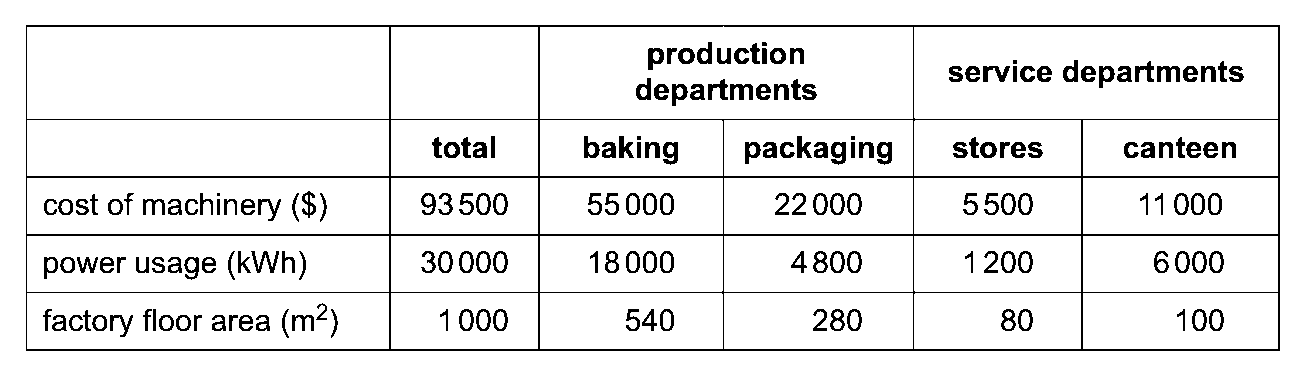
Reapportionment of the service department overheads is to be based on the following budgeted information for July 2026.
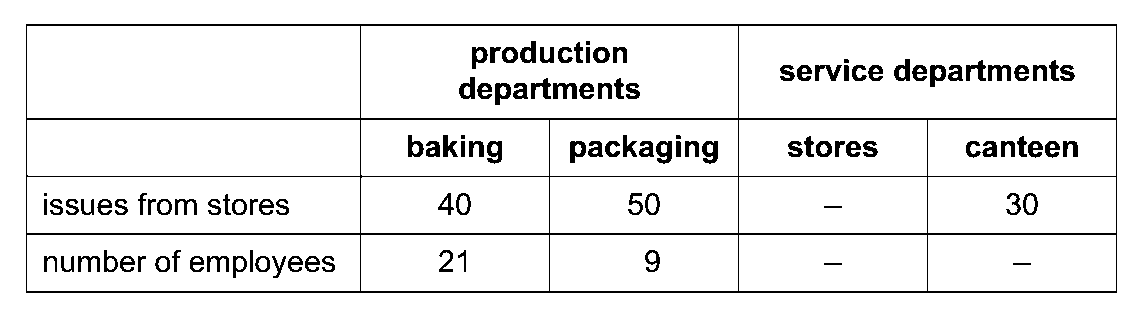

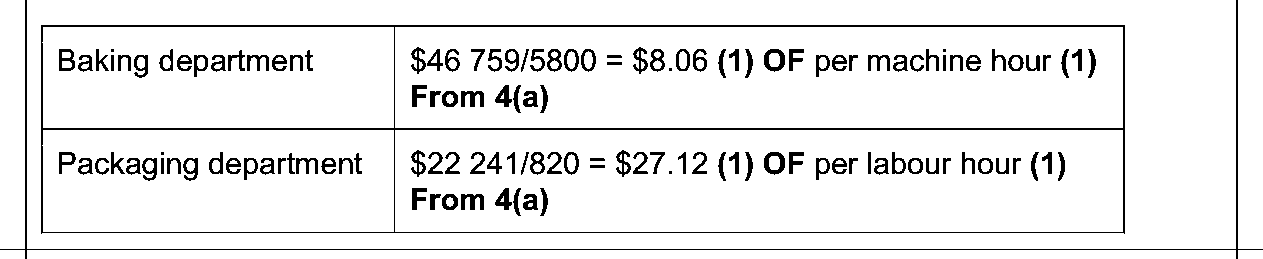
(b) Calculate, to two decimal places, the overhead absorption rates for each of the two production departments. baking department packaging department [4 marks]
The following budgeted information is available for the production departments for July 2026.
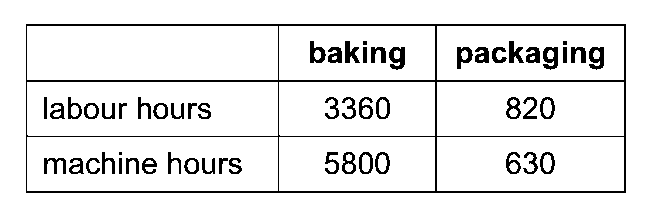
(c) State two reasons why overheads could be over‑absorbed in the packaging department. [2 marks]
In a recent month, overheads were over‑absorbed in the packaging department.
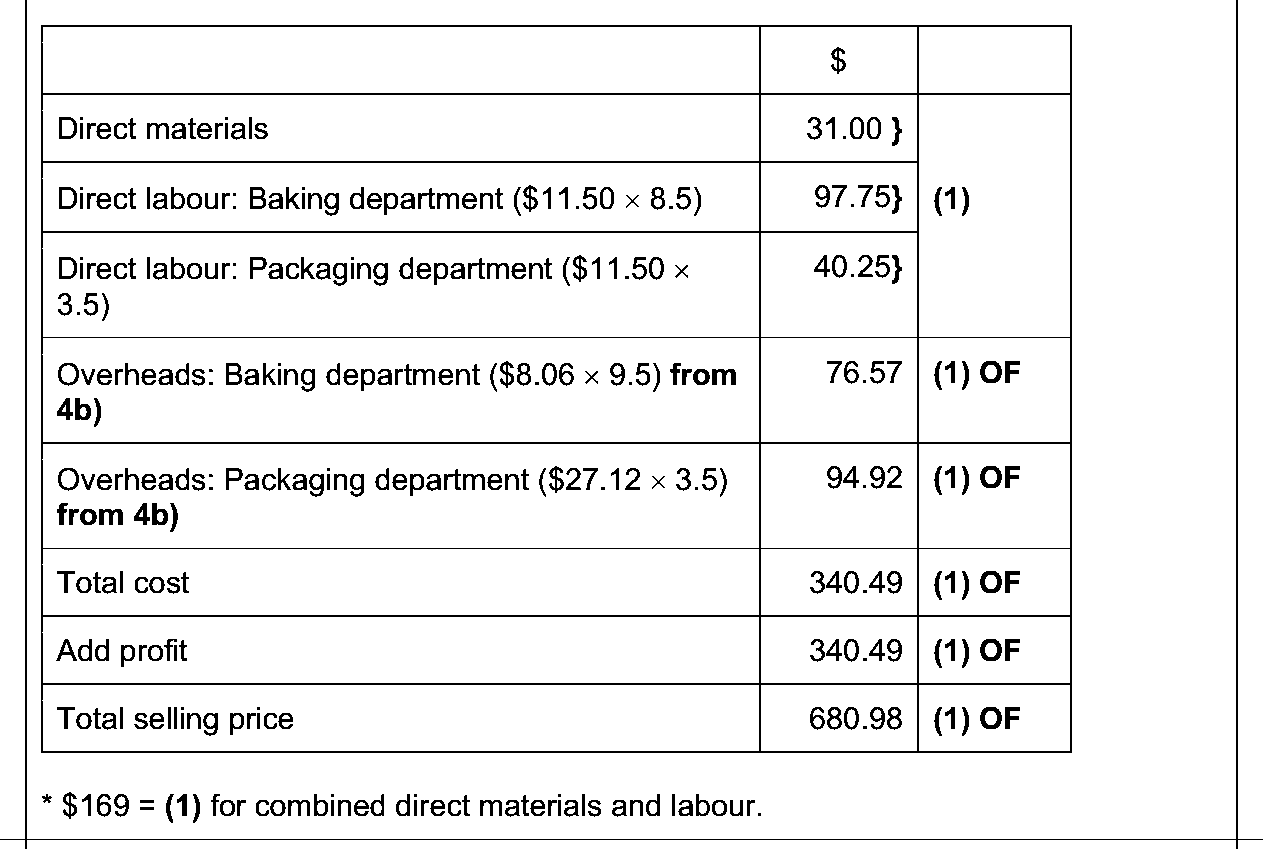
(d) Calculate the selling price of the order. [6 marks]
Y Limited has received an order for products to be produced in July 2026. The order will require the following:
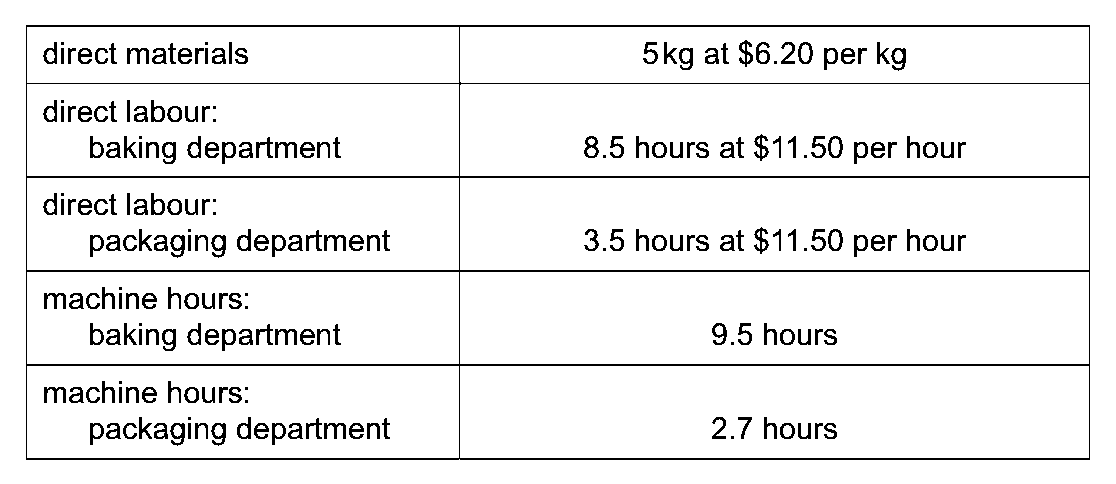
The company’s policy is to achieve a gross profit margin of 50%.
(e) Advise the directors whether or not this order should be accepted. Justify your answer by considering the advantages and disadvantages of accepting the order. Calculations are not required. [5 marks]
Currently, the factory is operating at full capacity. However, the directors are concerned that some regular customers have indicated they may reduce demand in future months, which could reduce output to 96%. The directors have been approached by a new customer who is prepared to place an order which will require 8% of one month’s total output. However, the customer expects to be offered a special price, reducing the gross profit margin to 40%.
(f) State two features of the AVCO method of inventory valuation. [2 marks]
The stores department uses the weighted average cost (AVCO) method to value inventory. Inventory is managed using the just in time (JIT) system.
(g) Explain one advantage and one disadvantage of the JIT system of inventory management. advantage ................................................................................................................................. disadvantage ............................................................................................................................ [4 marks]
(a)
(b)
(c)
department. If actual overheads are less than budgeted overheads (1) If actual production is greater than budgeted production (1)
(d)
(f)
Avoids inequality of identical items being charged to different jobs at different prices (1) Smooths out changes in cost (1) Recognises that identical items purchased at different times and prices have identical values (1) A new average value is calculated every time a new purchase of inventory is made (1) May not represent any price actually paid for inventory (1) Max 2 Accept other valid responses
(g)
management. Advantages (Max 2 marks) Reduces the need to hold large quantities of inventory (1) resulting in reduced storage costs (1) Less cash is tied up in inventory (1) this could then mean cash can be used for other opportunities (1) Less inventory stolen/damaged (1) which lowers wastage costs/improves profit margins (1) Inventory is always available when required (1) preventing holdups in production (1) can react fast to changes in consumer tastes (1) which helps increase revenue (1) Disadvantages (Max 2 marks) Requires a reliable supply chain (1) to avoid stockouts/delays in production (1) Requires proper operations management (1) to identify which components are required and at what time (1) Unexpected orders cannot be met (1) as materials aren’t in storage/lose out on sales/ revenue (1) Delivery/admin costs may be higher (1) due to increased amount of orders placed (1) Miss out on economies of scale/bulk buying/discounts (1) which will lead to higher average costs (1) Accept other valid responses
V Limited is a manufacturing company which uses absorption costing at one of its factories.
(a) Explain two differences between marginal costing and absorption costing. [4 marks]
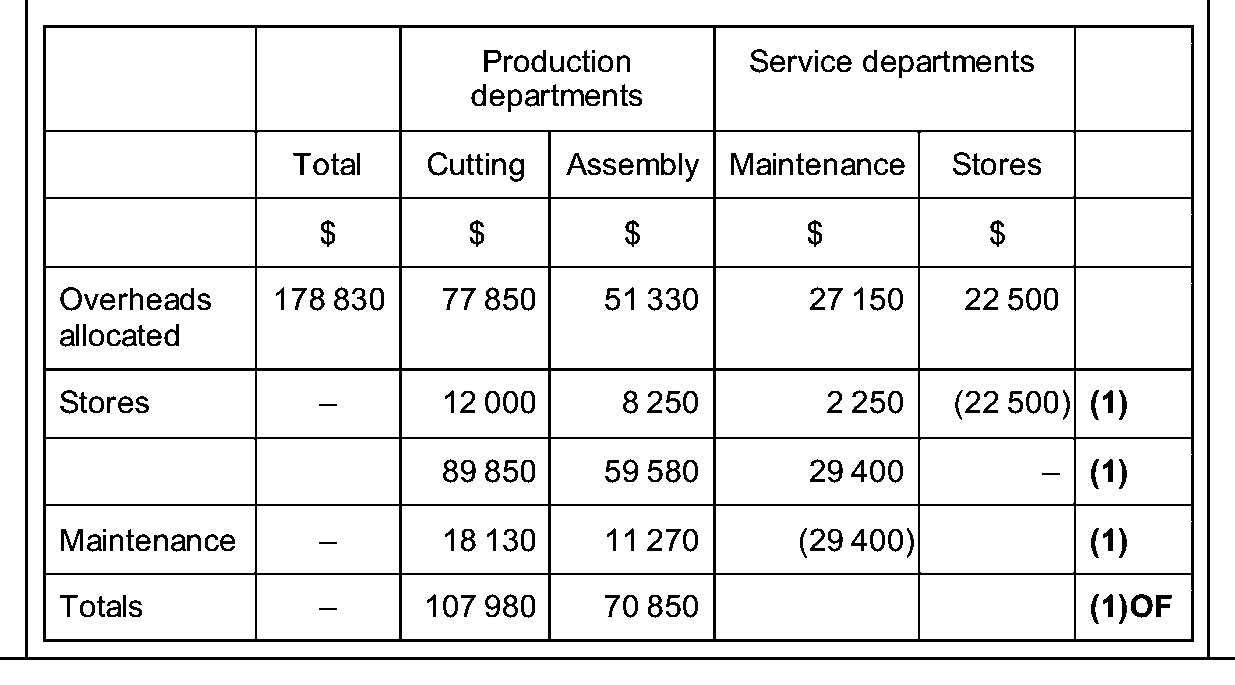
(b) Complete the table to show the reapportionment of service department overheads. [4 marks]
At one of its factories, V Limited has two production departments: cutting and assembly. There are also two service departments: maintenance and stores. All budgeted overheads for the year ended 30 September 2025 have been allocated to departments as follows:
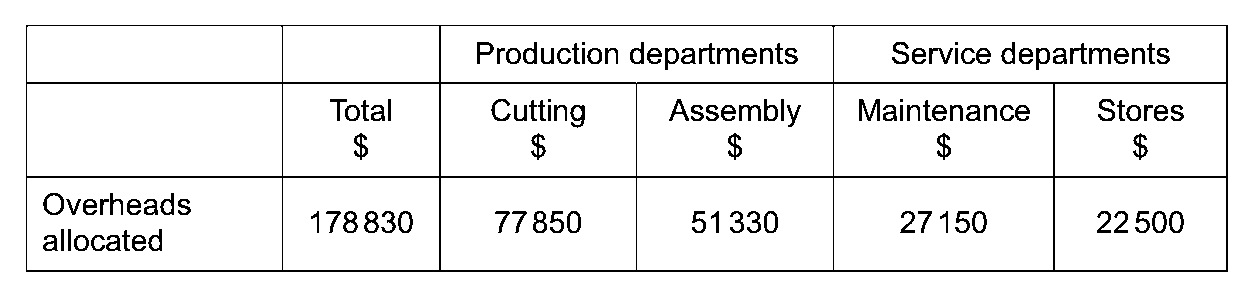
allocated The following additional budgeted information is available about the departments.
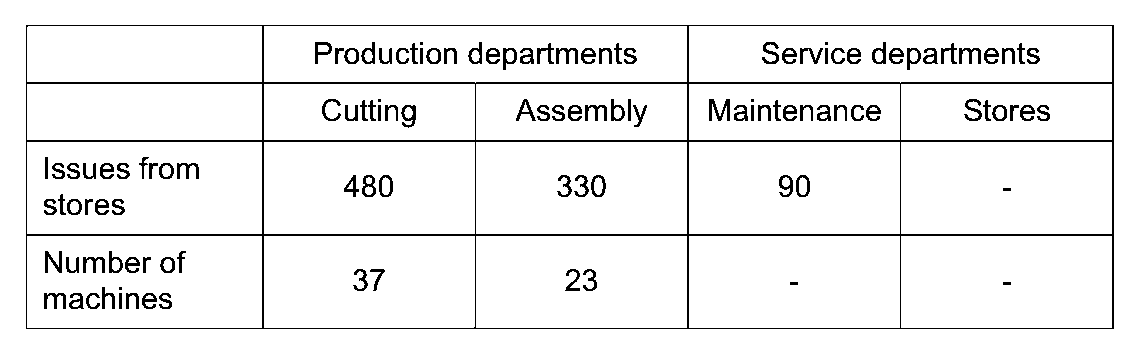

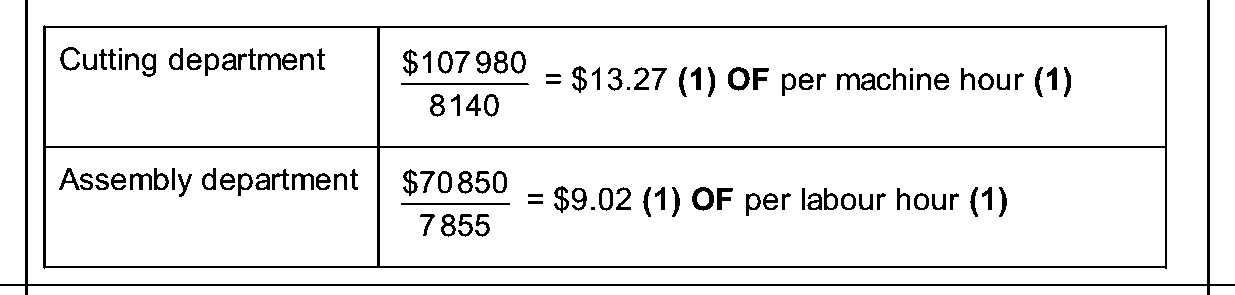
(c) Calculate, to two decimal places, the overhead absorption rates for each department for the year ended 30 September 2025. Cutting department Assembly department [4 marks]
The following forecast information is available for the two production departments for the year ended 30 September 2025.

(d) Calculate the over‑absorption or under‑absorption of overheads for the assembly department for the year ended 30 September 2025. [3 marks]
For the year ended 30 September 2025, actual results for the assembly department were as follows:
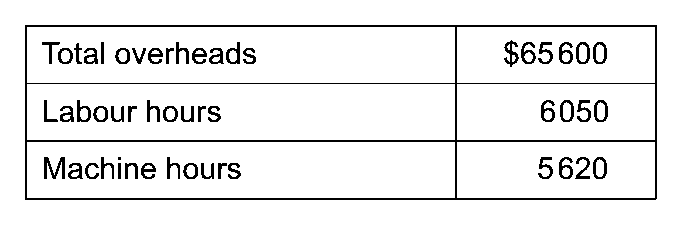
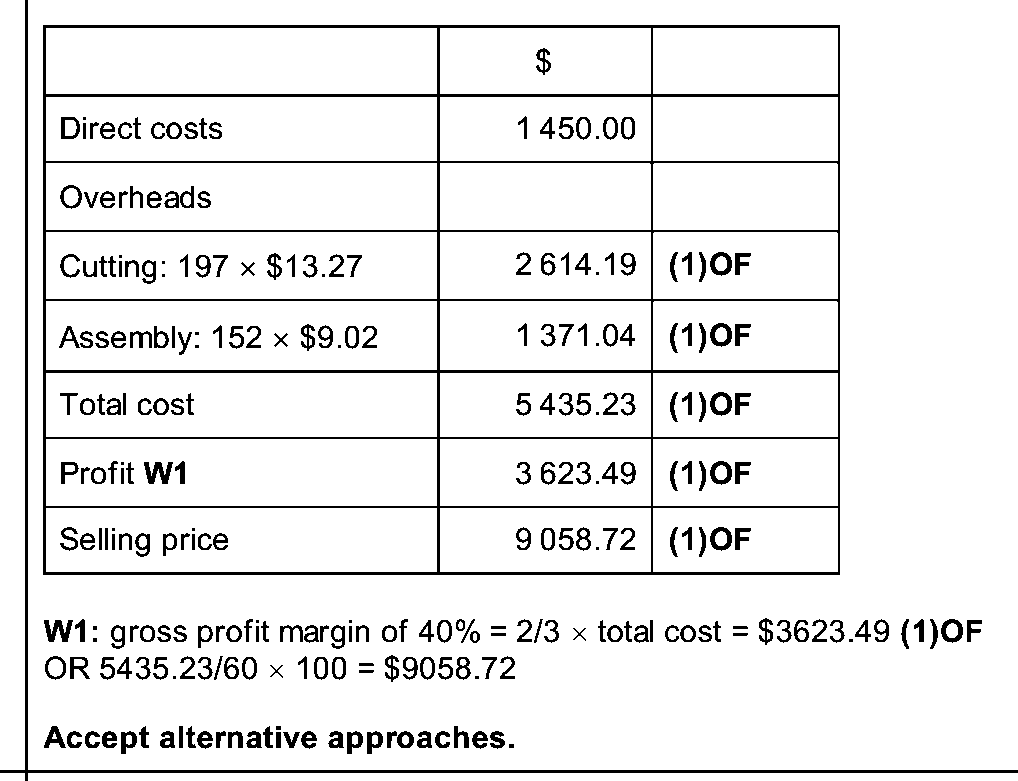
(e) Calculate the selling price of the order. [5 marks]
An order was received from a customer in August 2025. The following information is available.
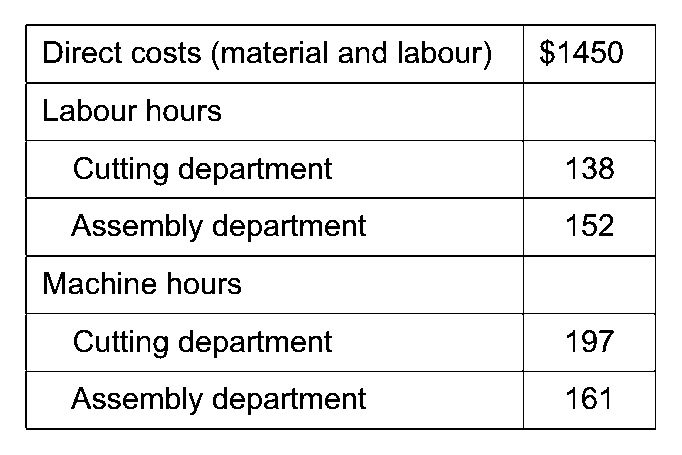
Products are sold with a gross profit margin of 40%.
(f) Calculate the profit or loss which would be made on the order from the overseas customer. [1 marks]
V Limited uses marginal costing at another factory where a single type of product is made. The following budgeted information is available.
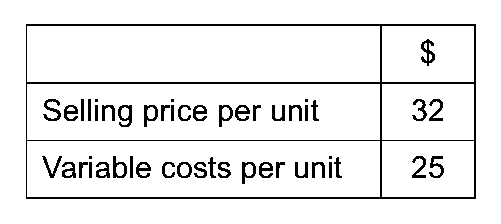
Fixed costs per month are $48 000. Currently, the monthly production and sales are 7200 units which is 60% of normal capacity. However, demand for the product has been falling in recent months. The directors have received an enquiry from an overseas customer who is located in a new market area. 1 The customer would make an order for 1500 units. 2 The customer would pay a reduced price of $29 per unit. 3 V Limited would incur delivery charges of $375 on the order.
(g) Advise the directors whether or not they should accept the order from the overseas customer. Justify your answer by discussing both the advantages and disadvantages of accepting the order. [7 marks]
(h) Explain the key principle of the just in time (JIT) method of inventory control. [2 marks]
(a)
Marginal costing treats only variable costs as product cost (1) whereas absorption costing treats both variable and fixed costs as product costs (1) Marginal costing classifies costs by behaviour, as to whether or not they change with the level of output (1) whereas absorption costing classifies costs by nature, whether they are directly or indirectly related to the production process (1) Marginal costing is useful for short term decisions (such as make or buy) (1) whereas absorption costing is useful for long term decisions (such as setting prices) (1) Marginal costing is for internal reporting (1) but absorption is for external reporting/financial statements as it follows IAS (1) Accept other valid responses.
(b)
(c)
(e)
(f)
overseas customer. Profit from order: 1500 4 = $6000 – $375 = $5625 (1)
(h)
Supplies should be received exactly when they are needed (1) and do not need to be stored by the business beforehand. (1) Accept other valid responses
Ameerah’s business uses absorption costing.
(a)(i) Define the following terms: cost centre [1 marks]
(a)(ii) Define the following terms: fixed cost [1 marks]
(a)(iii) Define the following terms: indirect labour. [1 marks]
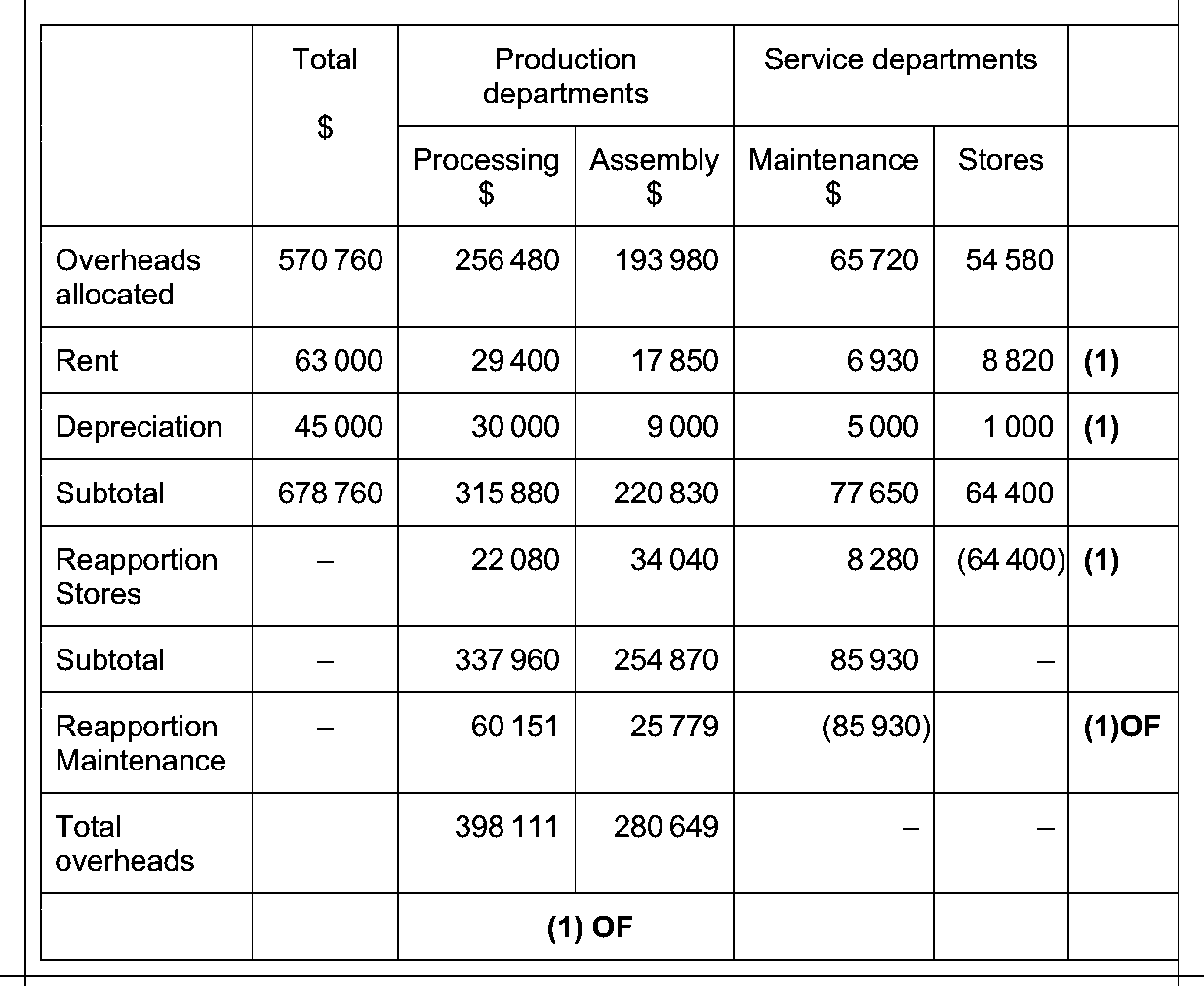
(b) Complete the table to show the total overheads for each department and the reapportionment of service department overheads. [5 marks]
The business operates two production departments: Processing and Assembly, and it operates two service departments: Maintenance and Stores. The following budgeted information is available.
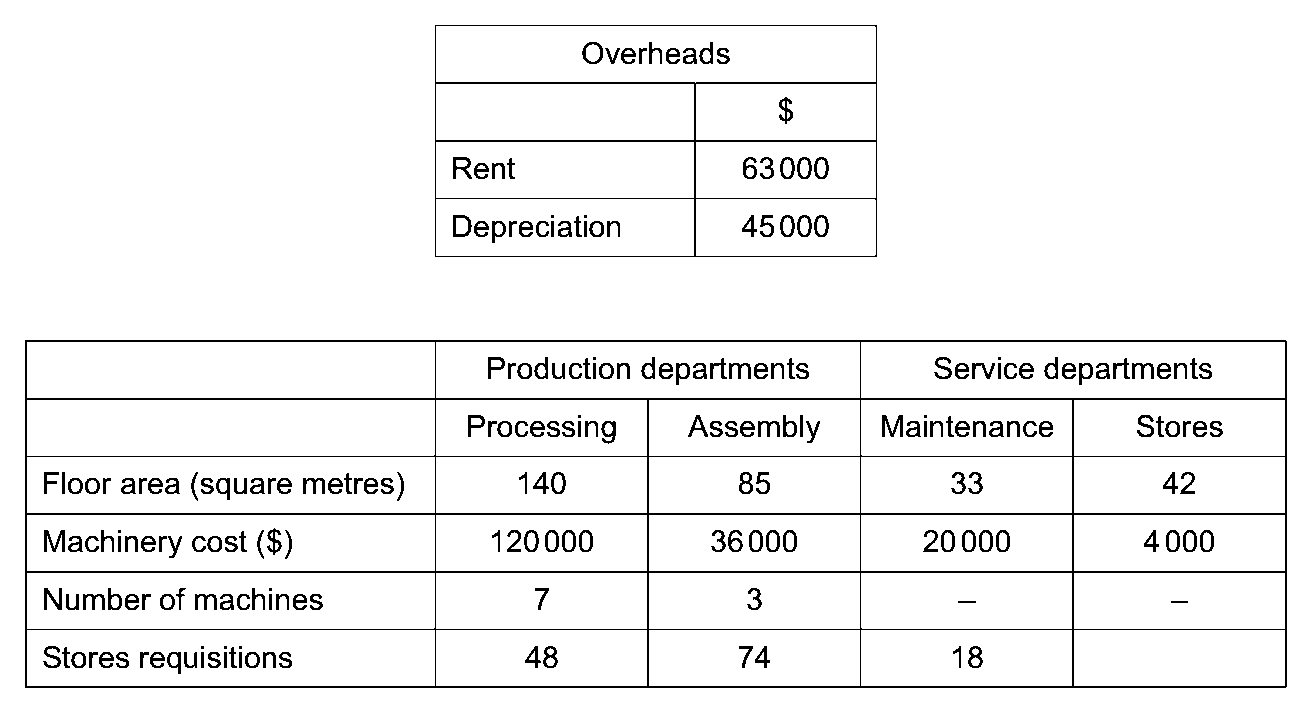
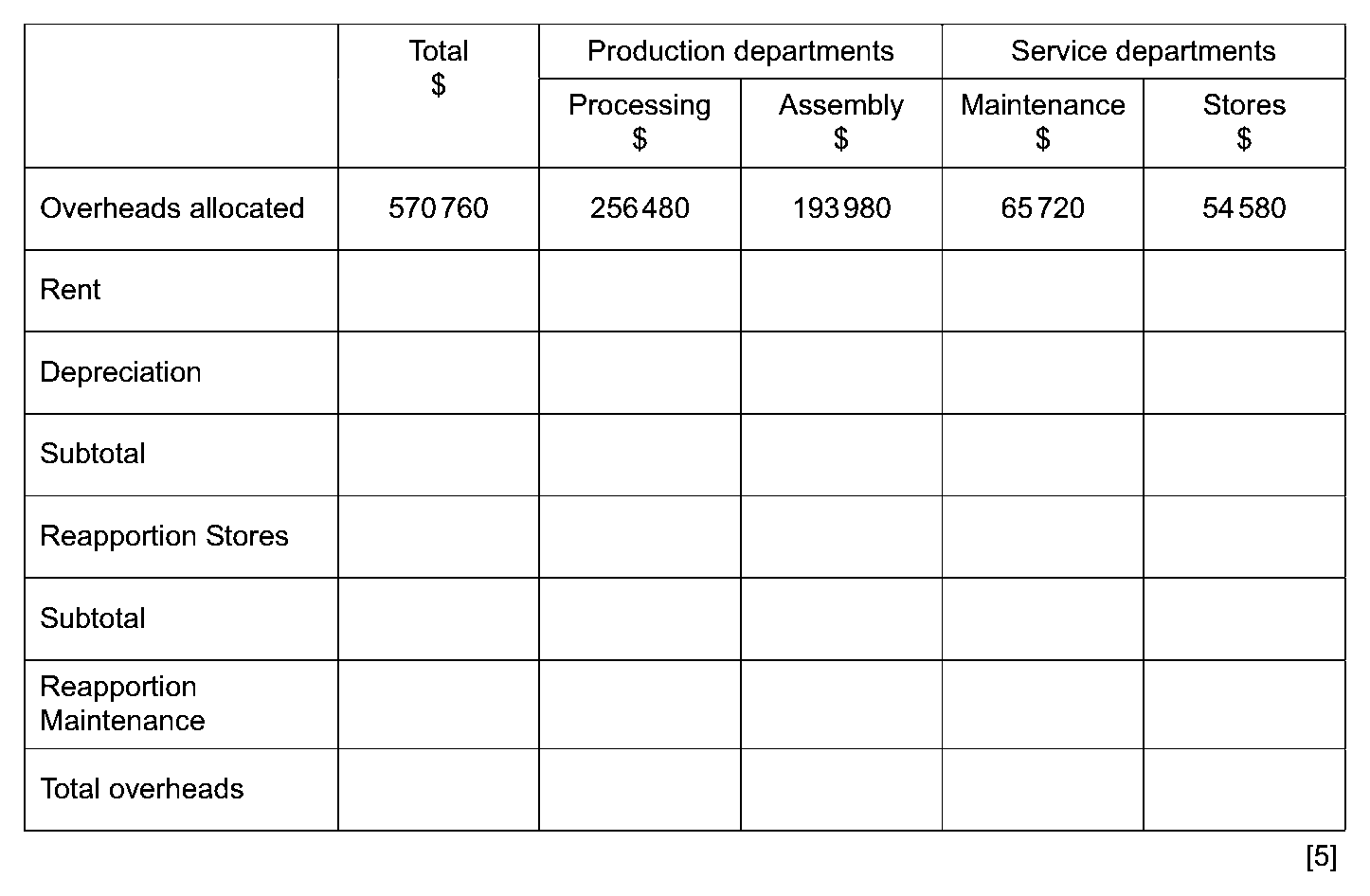
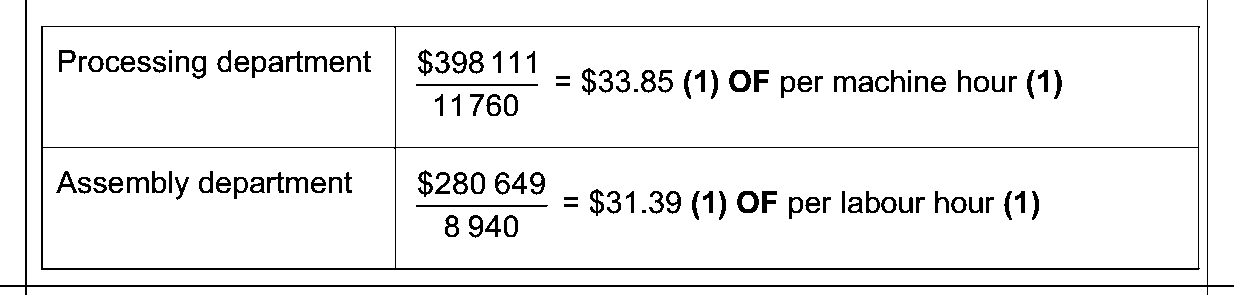
(c) Calculate, to two decimal places, an overhead absorption rate for each production department, using a suitable basis. Processing department Assembly department [4 marks]
Budgeted hours for each production department were as follows:
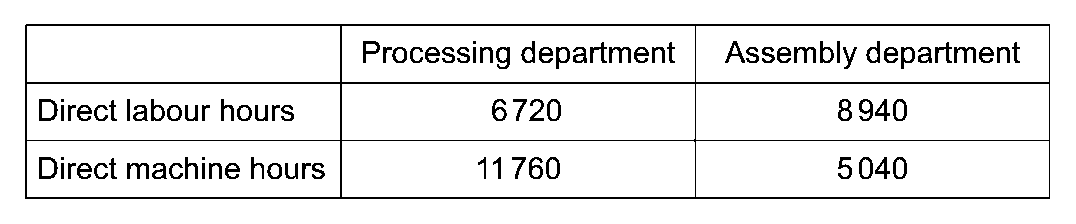
(d) State two reasons why overheads may be under-absorbed. [2 marks]
(e) Calculate the amount saved per unit by paying experienced labour at a higher rate. [3 marks]
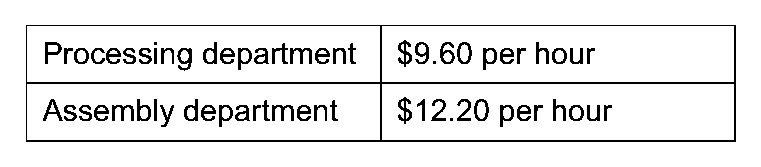
The following information is available about pay rates for direct labour in the Processing department.
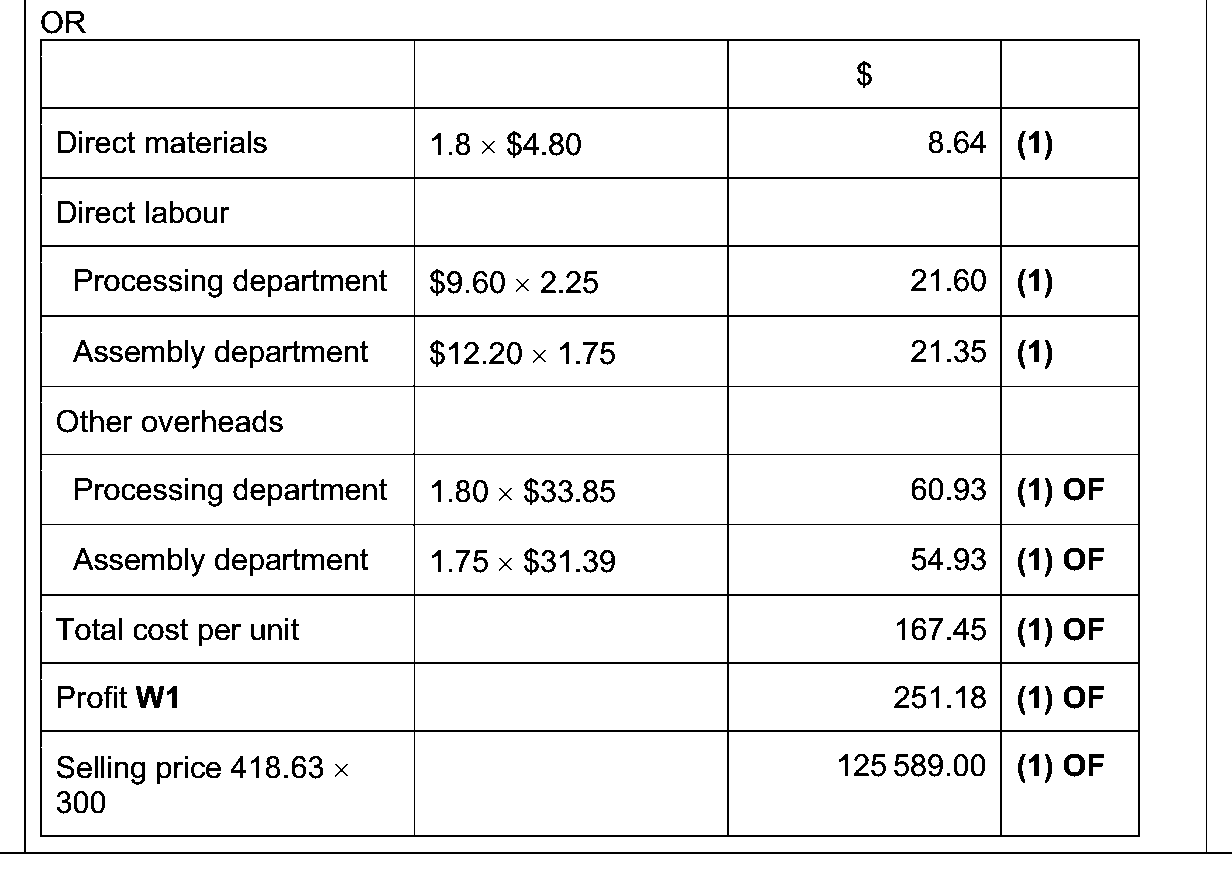
(f) Prepare a statement to show the total selling price for the customer’s order. [8 marks]
A customer has made an order for 300 units of a product. Each unit will require the following:
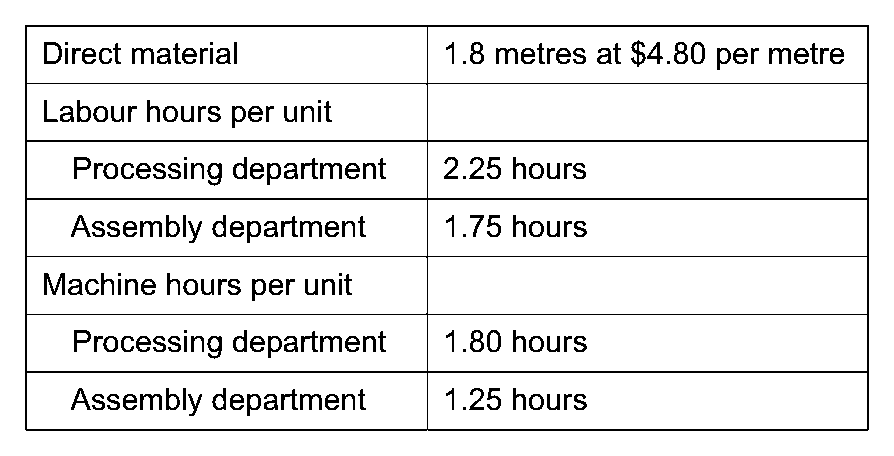
Direct labour rate will be as follows:
Selling prices are set to achieve a profit margin of 60%.
(g) Advise Ameerah whether or not she should use marginal costing rather than absorption costing. Justify your advice. [5 marks]
Ameerah is concerned that she may be losing customers due to high selling prices. She has been considering using marginal costing rather than absorption costing in order to enable more competitive pricing.
(a)(i)
cost centre a department/service location/activity to which costs can be attributed (1)
(a)(ii)
fixed cost A cost that remains unchanged within a certain level of activity / output (1)
(a)(iii)
indirect labour costs of employees whose work cannot be directly identified with the finished product (1)
(b)

(c)

(d)
Under absorption of overheads occurs when either actual expenditure is more than budgeted expenditure (1) and/or production is less than planned (1).
(e)
rate. Lower rate: $9.60 per hour / 24 units = $0.40 per unit (1) Higher rate: $10.50 per hour/30 units = $0.35 per unit (1) The amount saved is $0.05 per unit (1) OF
(f)

W1 Profit = 1.5 cost $50 235.75 OR
(g)
For the change (max 2) Marginal costing will enable prices to be set more flexibly (1) enabling the business to be more competitive Will be useful for other short-term decision making situations (such as limiting factor decisions as well as special order pricing) (1) Avoids some problems associated with absorption costing (such as arbitrary apportionment of overheads) (1) Against the change (max 2) Risk that fixed costs may not be covered (1) May be difficulties in establishing the marginal cost where some costs have both fixed and variable elements (1) Ignores the fact that in the long run all costs are variable (1) Max 4 Accept other valid responses Decision supported with a comment (1)
Ameerah’s business uses absorption costing.
(a)(i) Define the following terms: cost centre [1 marks]
(a)(ii) Define the following terms: fixed cost [1 marks]
(a)(iii) Define the following terms: indirect labour. [1 marks]
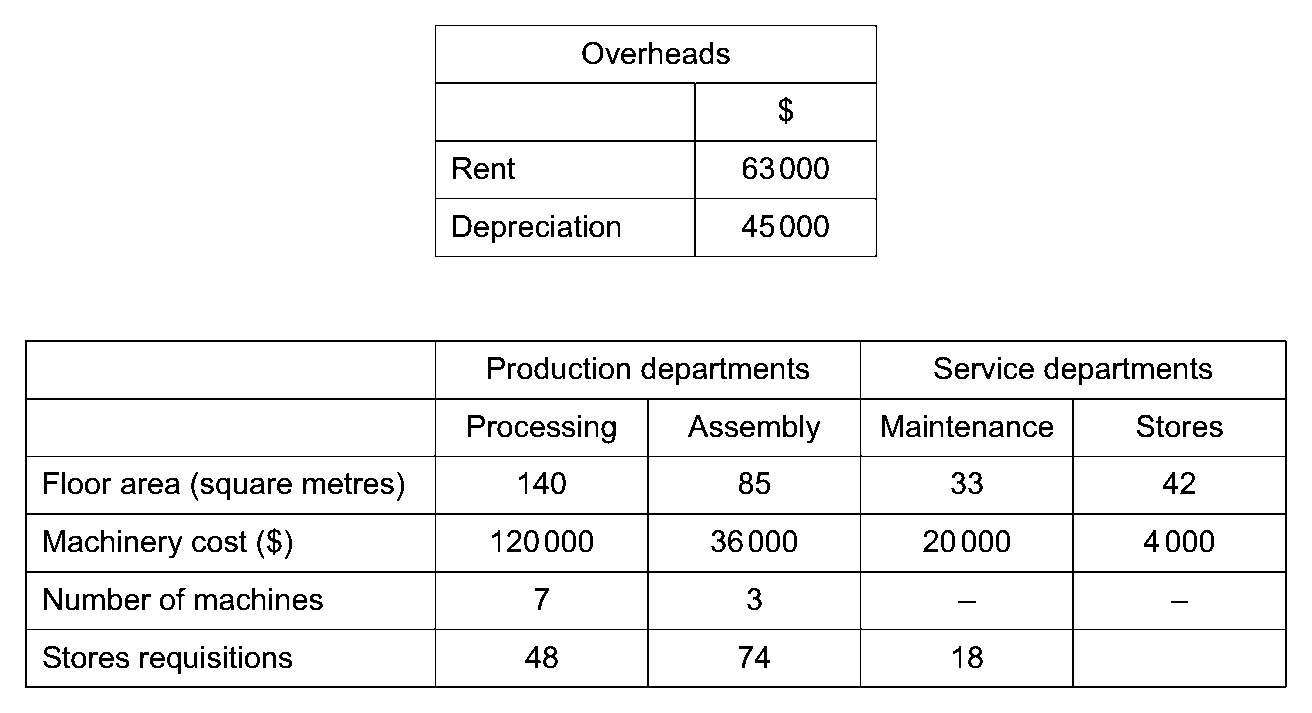
(b) Complete the table to show the total overheads for each department and the reapportionment of service department overheads. [5 marks]
The business operates two production departments: Processing and Assembly, and it operates two service departments: Maintenance and Stores. The following budgeted information is available.

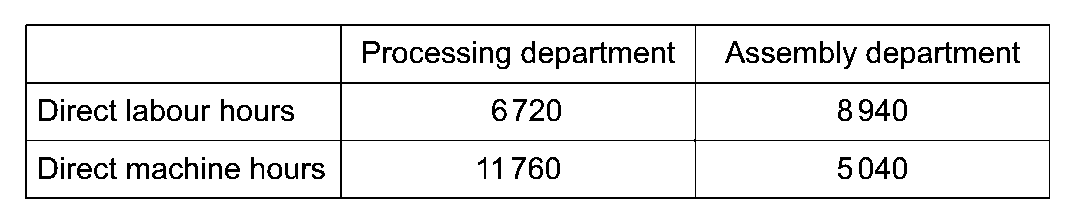
(c) Calculate, to two decimal places, an overhead absorption rate for each production department, using a suitable basis. Processing department Assembly department [4 marks]
Budgeted hours for each production department were as follows:
(d) State two reasons why overheads may be under-absorbed. [2 marks]
(e) Calculate the amount saved per unit by paying experienced labour at a higher rate. [3 marks]
The following information is available about pay rates for direct labour in the Processing department.
(f) Prepare a statement to show the total selling price for the customer’s order. [8 marks]
A customer has made an order for 300 units of a product. Each unit will require the following:
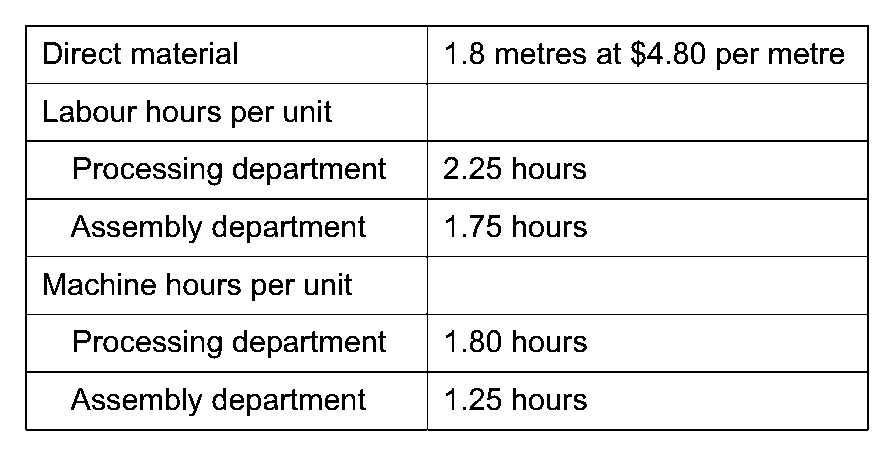
Direct labour rate will be as follows:
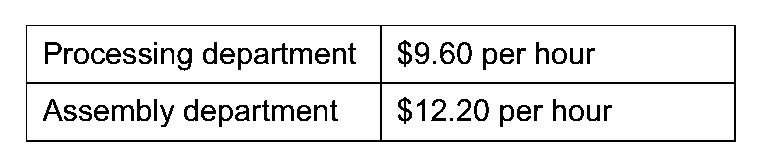
Selling prices are set to achieve a profit margin of 60%.
(g) Advise Ameerah whether or not she should use marginal costing rather than absorption costing. Justify your advice. [5 marks]
Ameerah is concerned that she may be losing customers due to high selling prices. She has been considering using marginal costing rather than absorption costing in order to enable more competitive pricing.
(a)(i)
cost centre a department/service location/activity to which costs can be attributed (1)
(a)(ii)
fixed cost A cost that remains unchanged within a certain level of activity / output (1)
(a)(iii)
indirect labour costs of employees whose work cannot be directly identified with the finished product (1)
(b)
(c)
(d)
Under absorption of overheads occurs when either actual expenditure is more than budgeted expenditure (1) and/or production is less than planned (1).
(e)
rate. Lower rate: $9.60 per hour / 24 units = $0.40 per unit (1) Higher rate: $10.50 per hour/30 units = $0.35 per unit (1) The amount saved is $0.05 per unit (1) OF
(f)
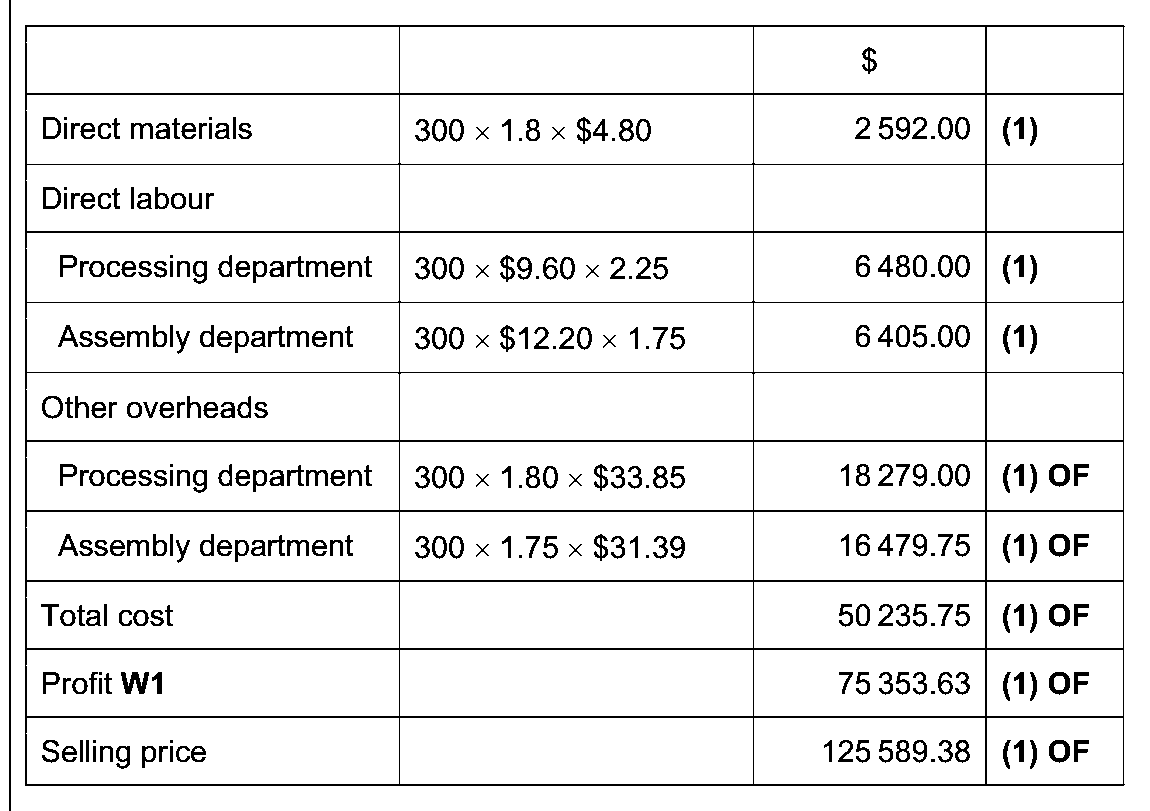
W1 Profit = 1.5 cost $50 235.75 OR
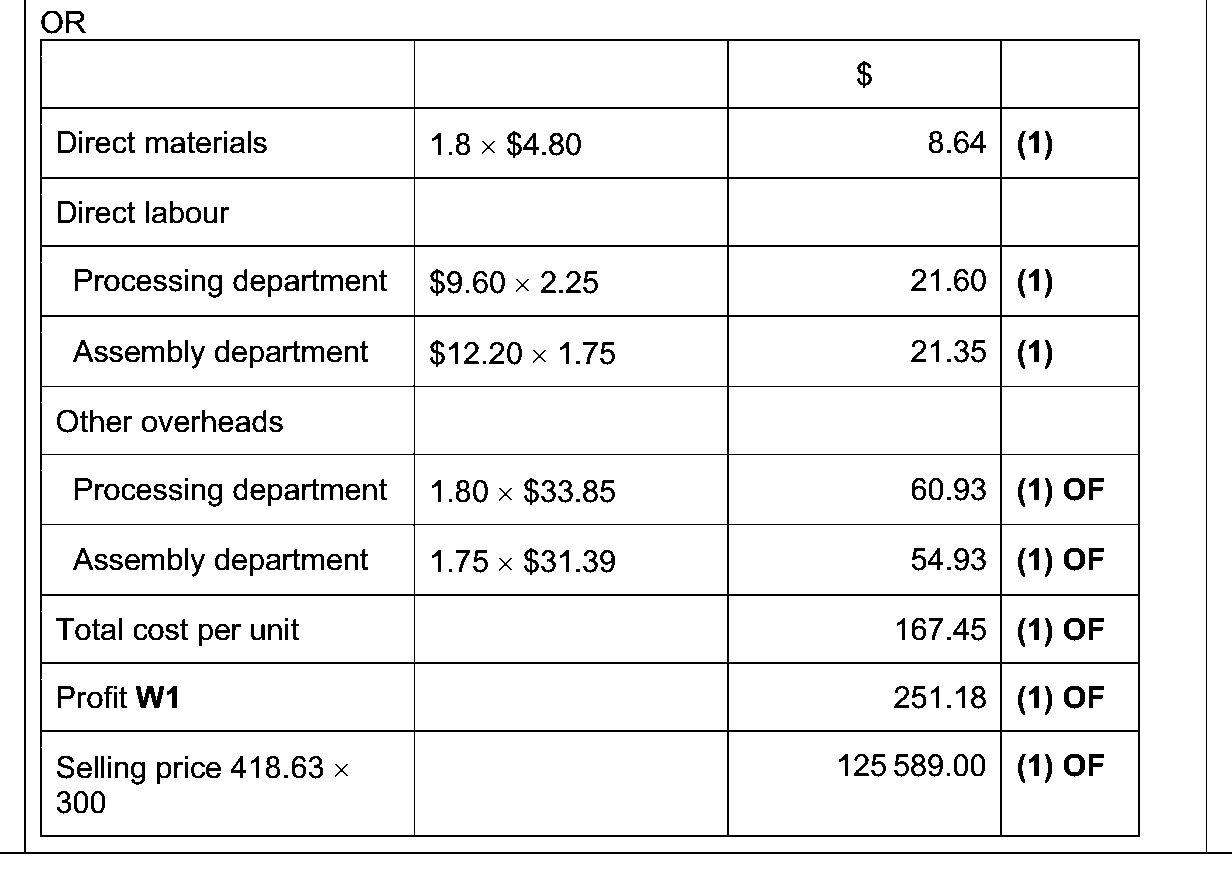
(g)
For the change (max 2) Marginal costing will enable prices to be set more flexibly (1) enabling the business to be more competitive Will be useful for other short-term decision making situations (such as limiting factor decisions as well as special order pricing) (1) Avoids some problems associated with absorption costing (such as arbitrary apportionment of overheads) (1) Against the change (max 2) Risk that fixed costs may not be covered (1) May be difficulties in establishing the marginal cost where some costs have both fixed and variable elements (1) Ignores the fact that in the long run all costs are variable (1) Max 4 Accept other valid responses Decision supported with a comment (1)
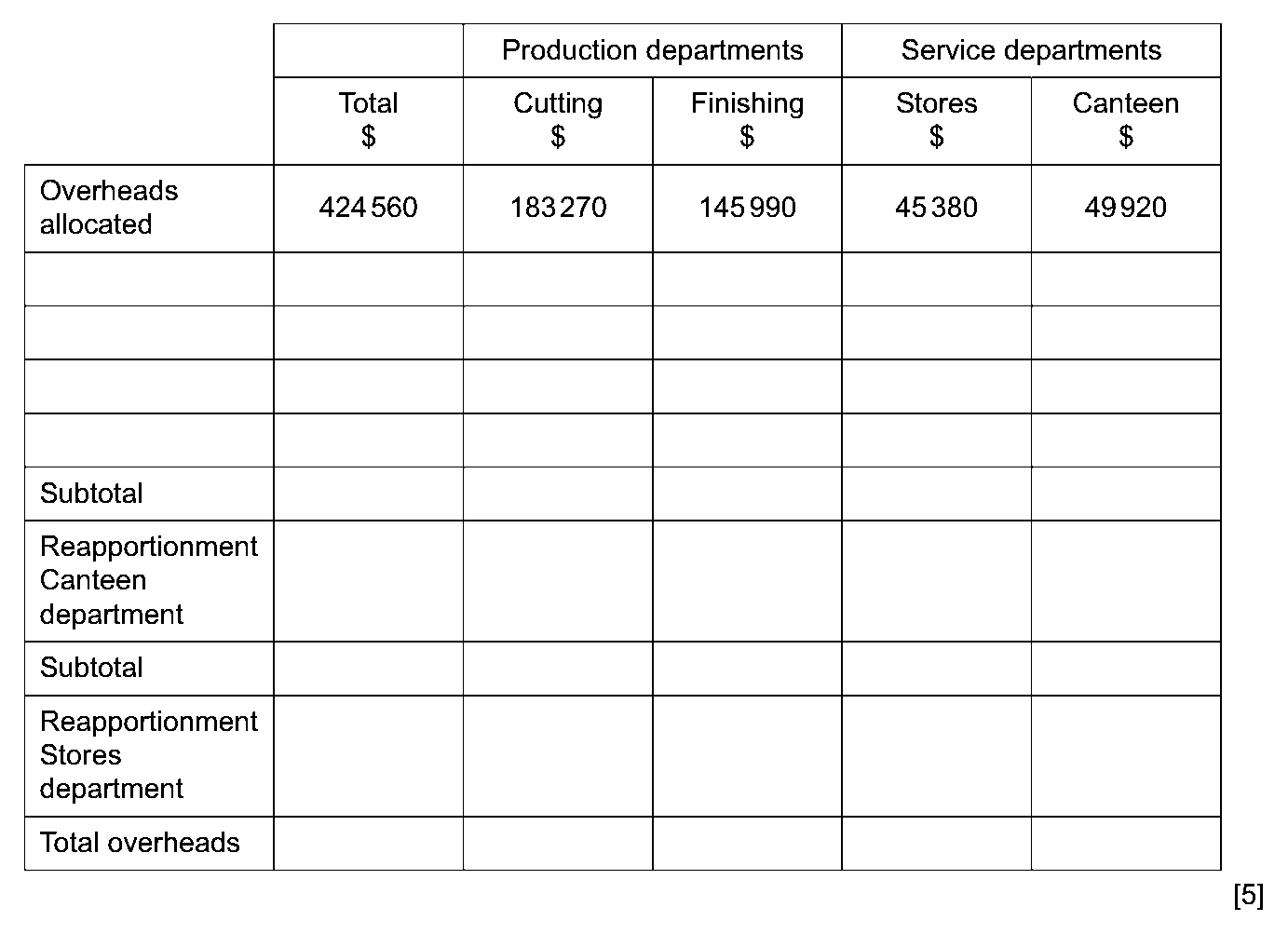
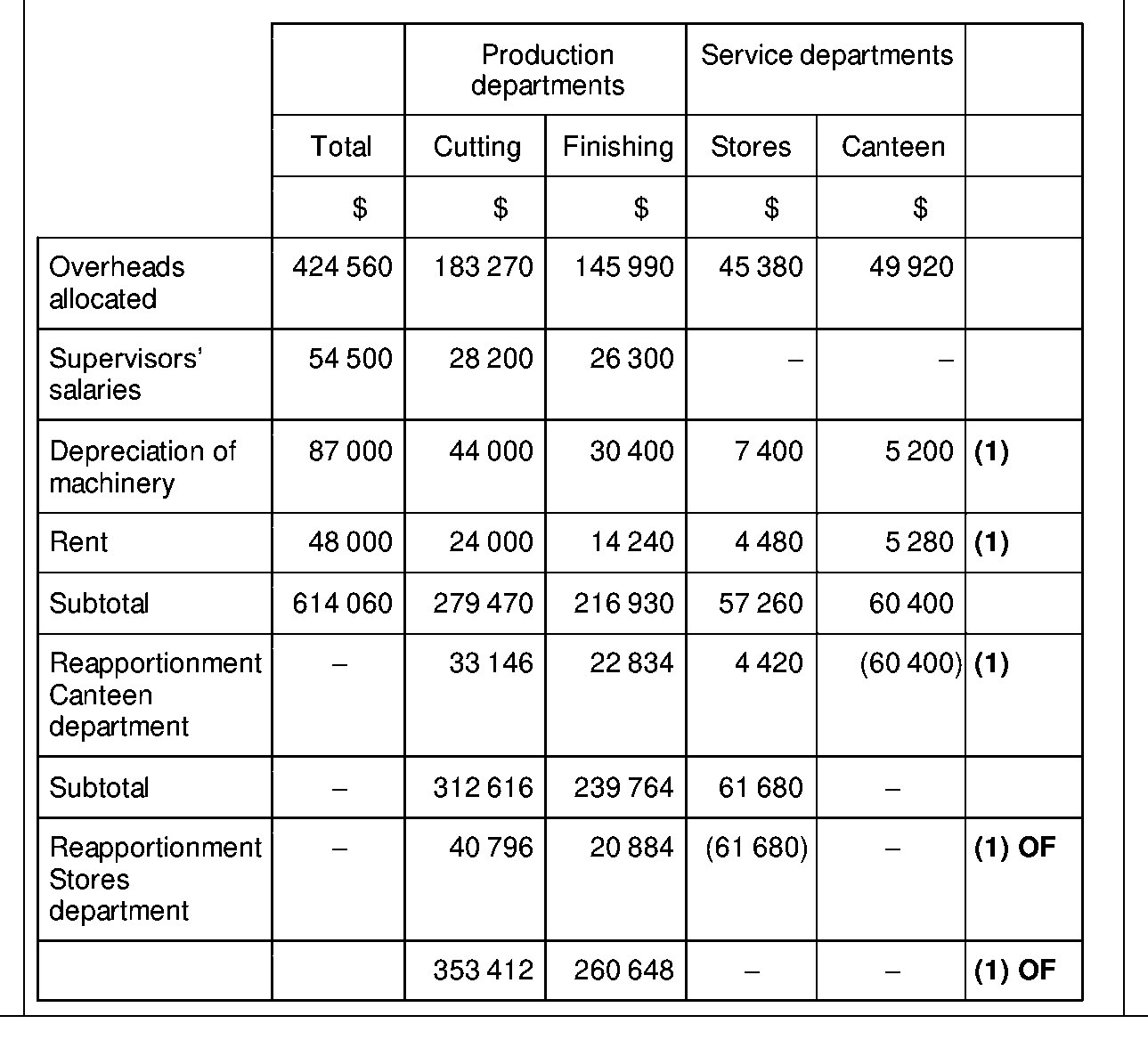
D Limited is a manufacturing company which uses absorption costing. The factory has two production departments, Cutting and Finishing. It also has two service departments, Stores and Canteen. Some budgeted overheads have been allocated to departments as follows:
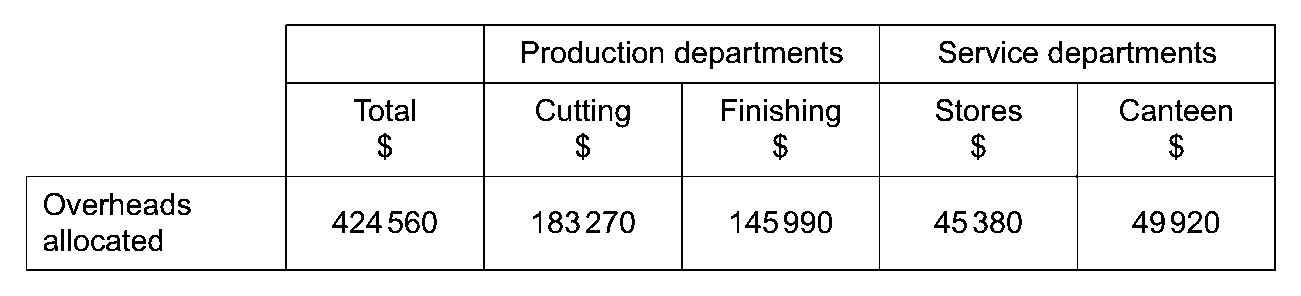
allocated The following budgeted overheads have yet to be allocated or apportioned.
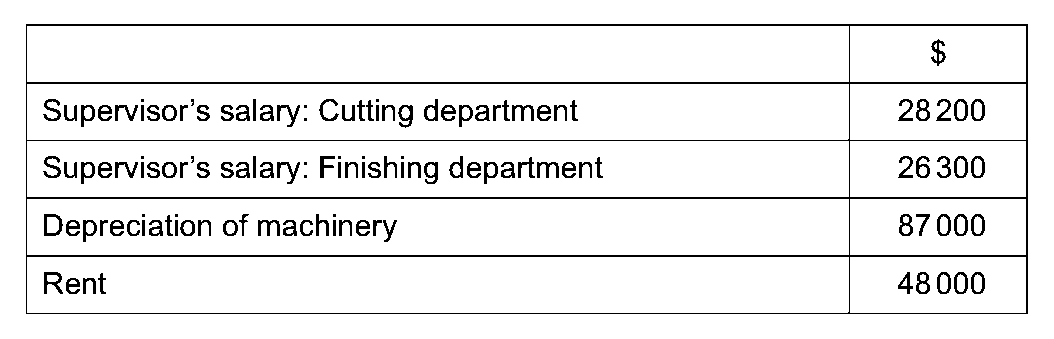
Apportionment is based on the following information.
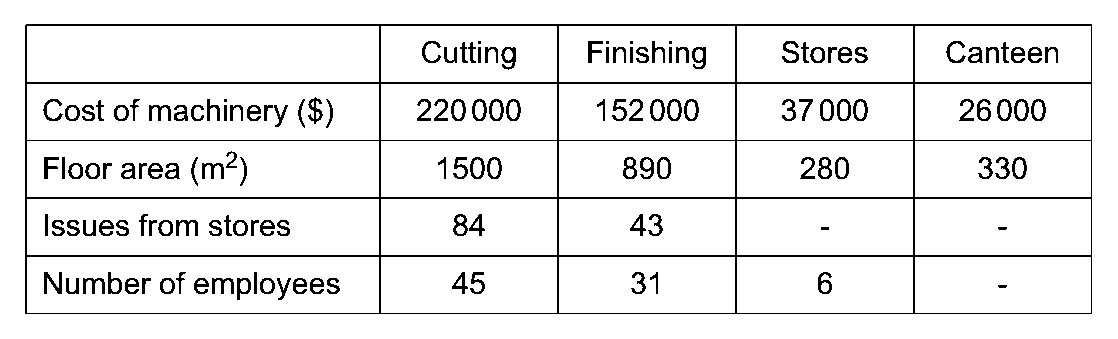
(a) Complete the following table to show the apportionment of overheads and the reapportionment of service department overheads. [5 marks]
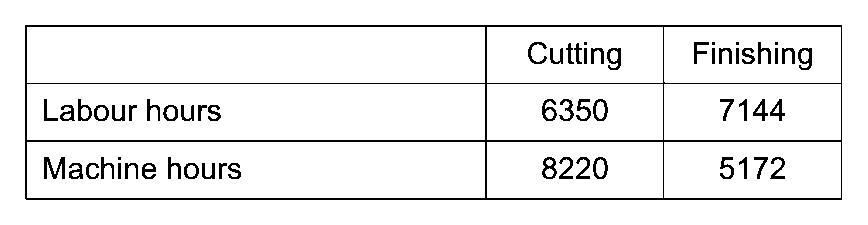
(b) Calculate, to two decimal places, an overhead absorption rate for each production department, using a suitable basis. Cutting department Finishing department [4 marks]
Budgeted hours for each production department were as follows:
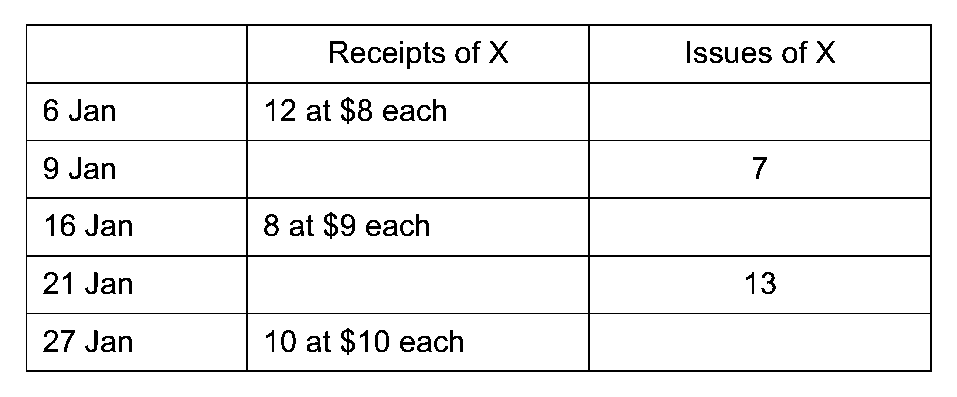
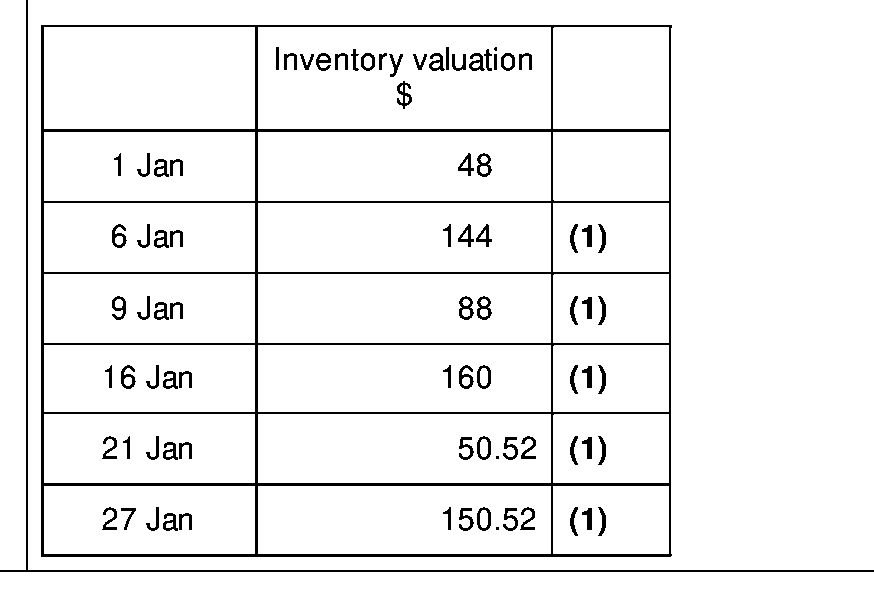
(c) Complete the following table to show the value of the closing inventory of component X, using AVCO. [5 marks]
The Stores department issues component X to the Finishing department. The weighted average cost (AVCO) method of inventory control is used by the Stores department. The following details about this component are available for January 2025. On 1 January 2025, the Stores department held six component X in inventory which had cost $8 each.
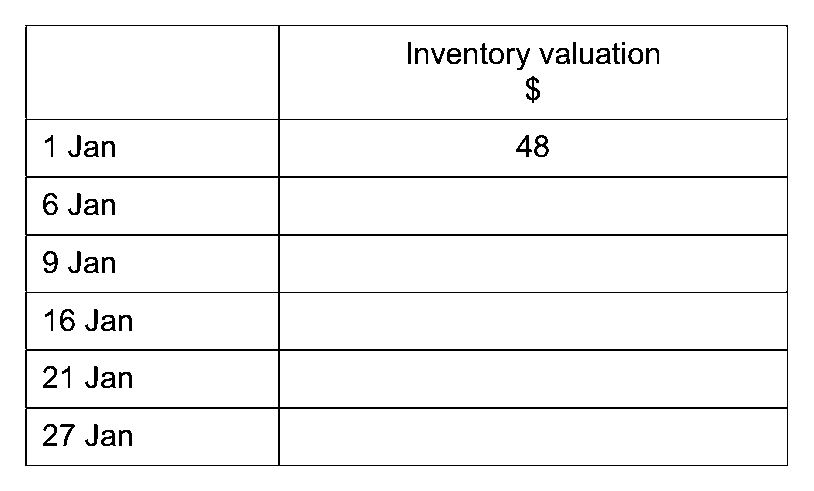
Workings:
(d)(i) Calculate the profit to be made in August 2025 for each option. Option A [6 marks]
D Limited uses marginal costing at another factory where two products, Bee and Cee, are made. The following forecast information is available for August 2025.
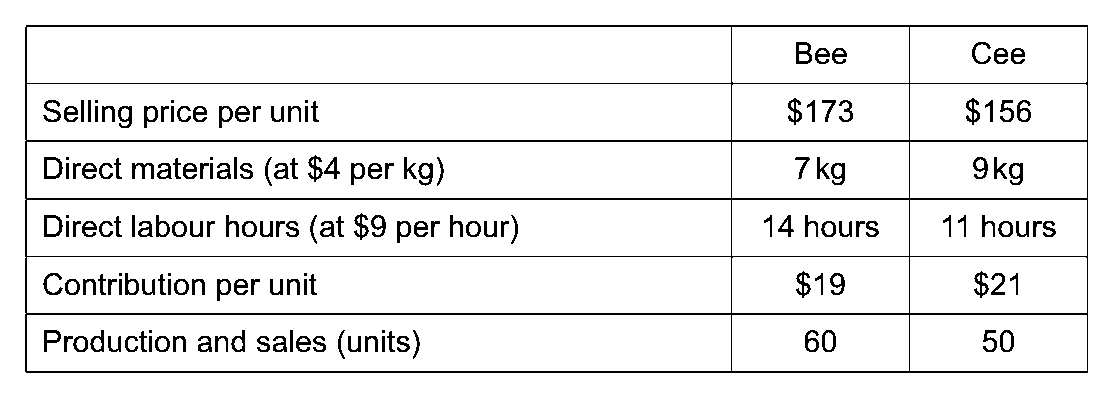
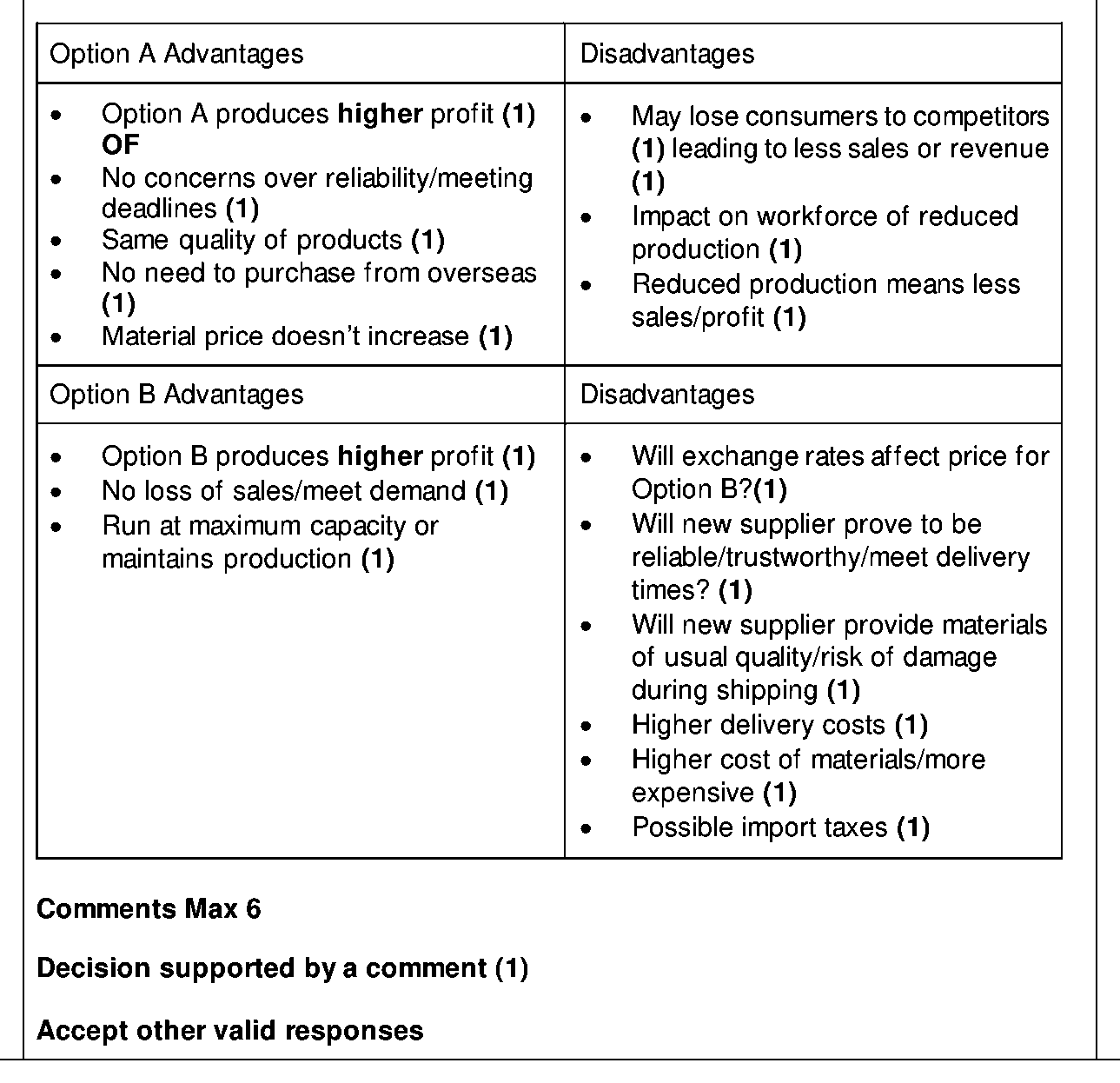
Fixed costs are $1100 per month. The supplier of direct materials has notified the directors that delivery problems will mean that in August 2025 only 70% of the forecast requirement for direct materials will be available. The directors are considering two options for August 2025. Option A: Organise production in order to produce the maximum profit with the available materials. Option B: Purchase additional materials from a new overseas supplier to make up the shortfall. The supplier charges $5 per kg.
(d)(ii) Calculate the profit to be made in August 2025 for each option. Option B [3 marks]
D Limited uses marginal costing at another factory where two products, Bee and Cee, are made. The following forecast information is available for August 2025.
Fixed costs are $1100 per month. The supplier of direct materials has notified the directors that delivery problems will mean that in August 2025 only 70% of the forecast requirement for direct materials will be available. The directors are considering two options for August 2025. Option A: Organise production in order to produce the maximum profit with the available materials. Option B: Purchase additional materials from a new overseas supplier to make up the shortfall. The supplier charges $5 per kg.
(e) Advise the directors which option they should choose. Justify your answer. [7 marks]
(a)
(c)
(d)(i)

(d)(ii)
Option B Remaining units of Cee (50-21) = 29 units (1) New contribution Cee: $21 – $9 = $12 (1) Profit: as for option A $481 + (29 $12) = $829 (1)
(e)
🔒 Unlock every Costing of materials and labour question from 2020–2024
All 41 come with their mark schemes, answers and case studies, and appear in the practice tool above once you’re signed in. It’s free.
Questions and mark schemes are from past Cambridge papers and are reproduced for revision. Topical Vault is an independent revision resource, not affiliated with or endorsed by Cambridge Assessment International Education.
Each topic opens this practice tool with only that topic’s questions, plus how often it comes up and every question on it in one list. Revision notes for AS Level Accounting →