Question 2(a)May/June 20269609/132 marks
Define the term ‘capital expenditure’.
Show mark scheme

Cambridge 9609, Paper 1 & 2. 1,080 questions, 2020 to 2026.
Case studies and questions reproduced from the original Cambridge material; mark schemes are cropped from the official mark scheme PDFs. Papers from 2020–2022 were set on the previous syllabus and can touch content that is A Level today — those topics are marked “A Level content” above.
Why businesses need finance, working capital, capital and revenue expenditure, and internal and external sources of finance.
New to Business finance, or finding these questions hard?
Read the notes first: the key ideas, diagrams and formulas, and the mistakes examiners see most, in about 14 minutes.
77 past paper questions on this topic since 2020, across 18 exam sessions.
| Year | Paper 1 | Paper 2 | Total | Chart |
|---|---|---|---|---|
| 2026 | 5 | 2 | 7 | |
| 2025 | 7 | 4 | 11 | |
| 2024 | 6 | 7 | 13 | |
| 2023 | 6 | 5 | 11 | |
| 2022 | 4 | 7 | 11 | |
| 2021 | 9 | 6 | 15 | |
| 2020 | 5 | 4 | 9 |
The whole topic on one page, with answers and mark schemes. Printing this page prints just this list.
Define the term ‘capital expenditure’.
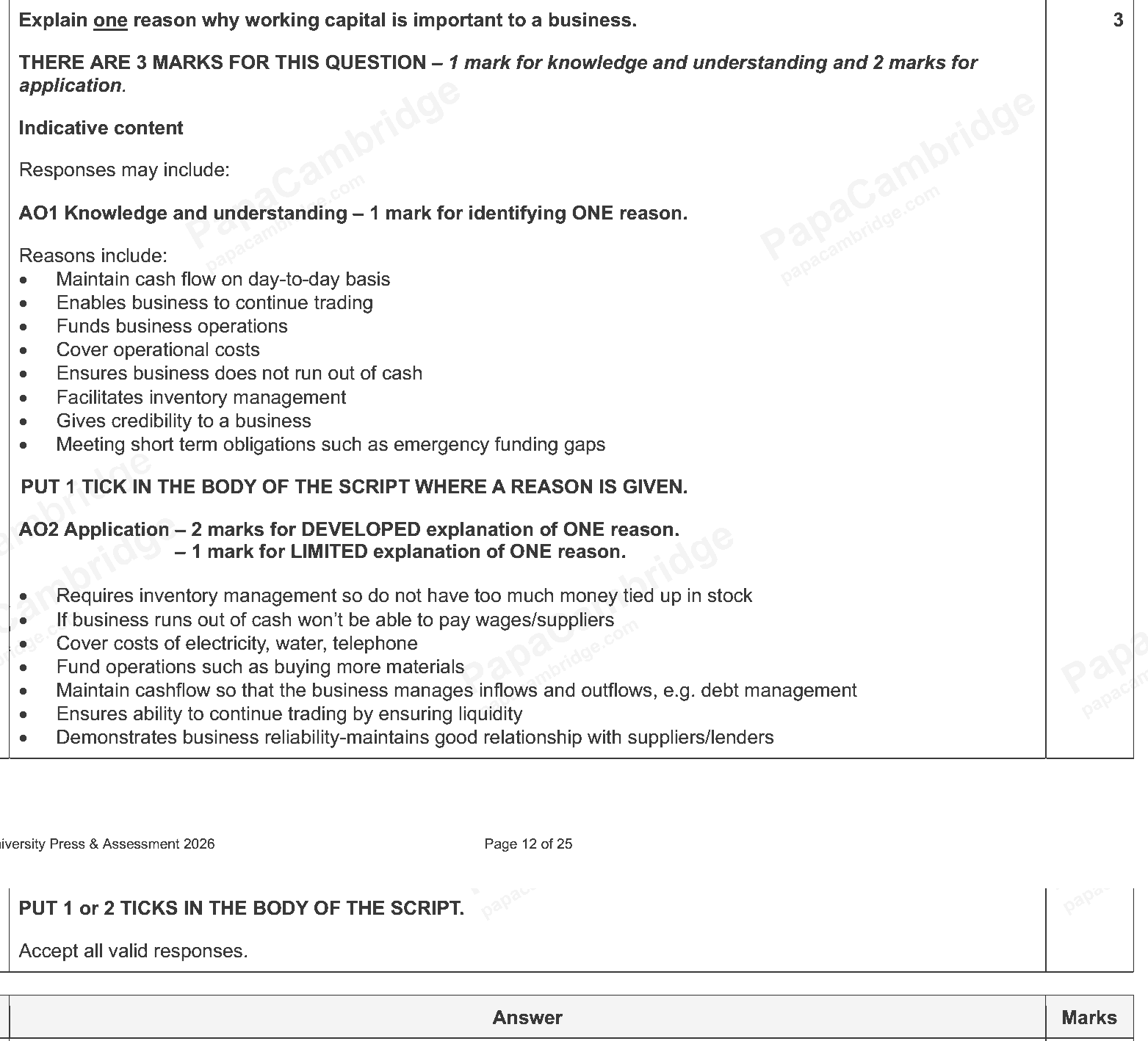
Explain one reason why working capital is important to a business.
Analyse two factors which may influence a business’s choice of sources of finance.

Analyse two reasons why a lack of finance may lead to business failure.

Evaluate whether using internal sources of finance is the most appropriate way to fund the growth of a pharmaceutical business.

Define the term liquidation.

Explain one external source of finance for a business.

Analyse two benefits to a business of using an internal source of finance for business growth.

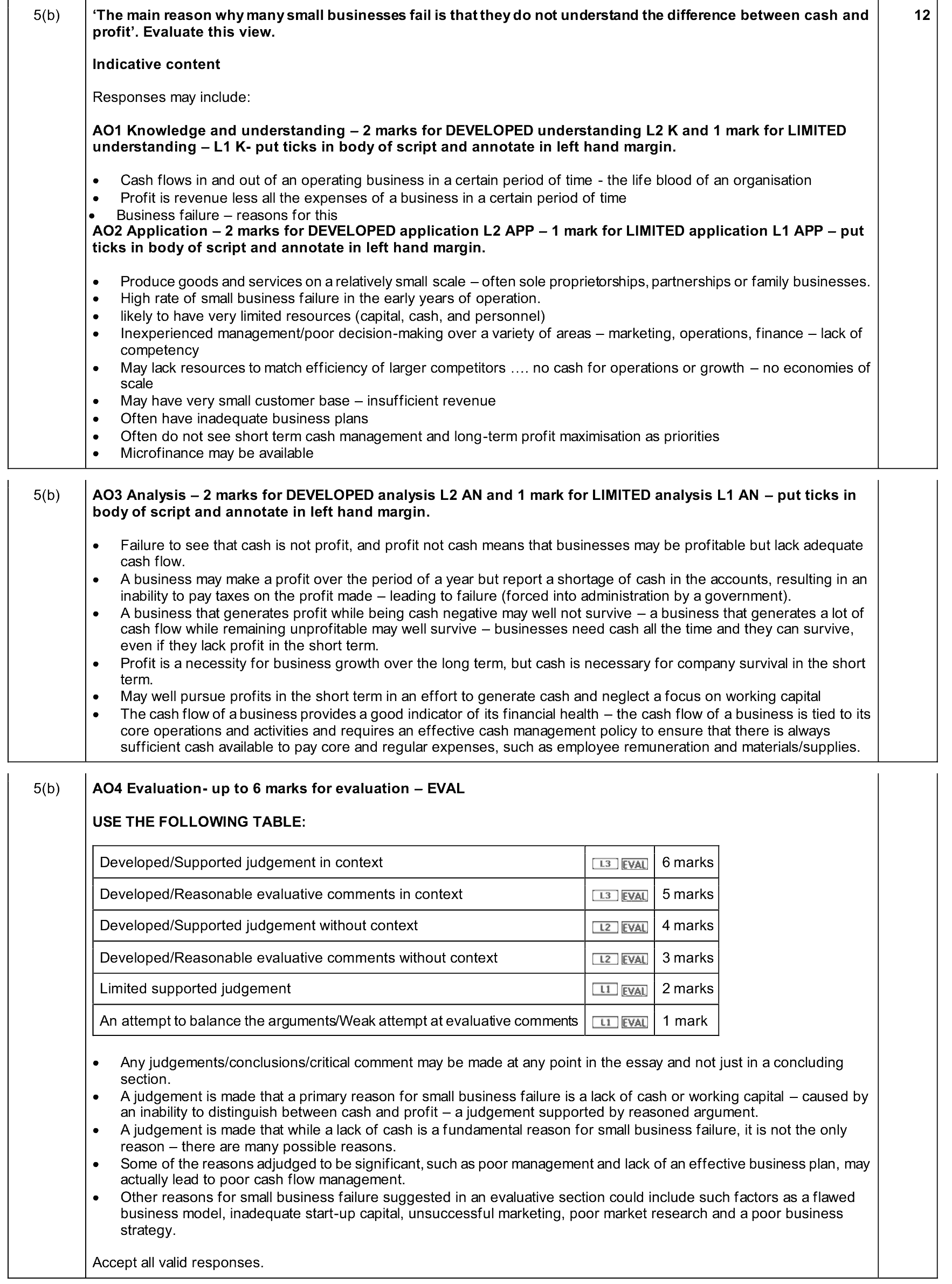
‘The main reason why many small businesses fail is that they do not understand the difference between cash and profit.’ Evaluate this view.
‘A large bank loan is the most appropriate source of finance for the expansion of a furniture retailer.’ Evaluate this view.

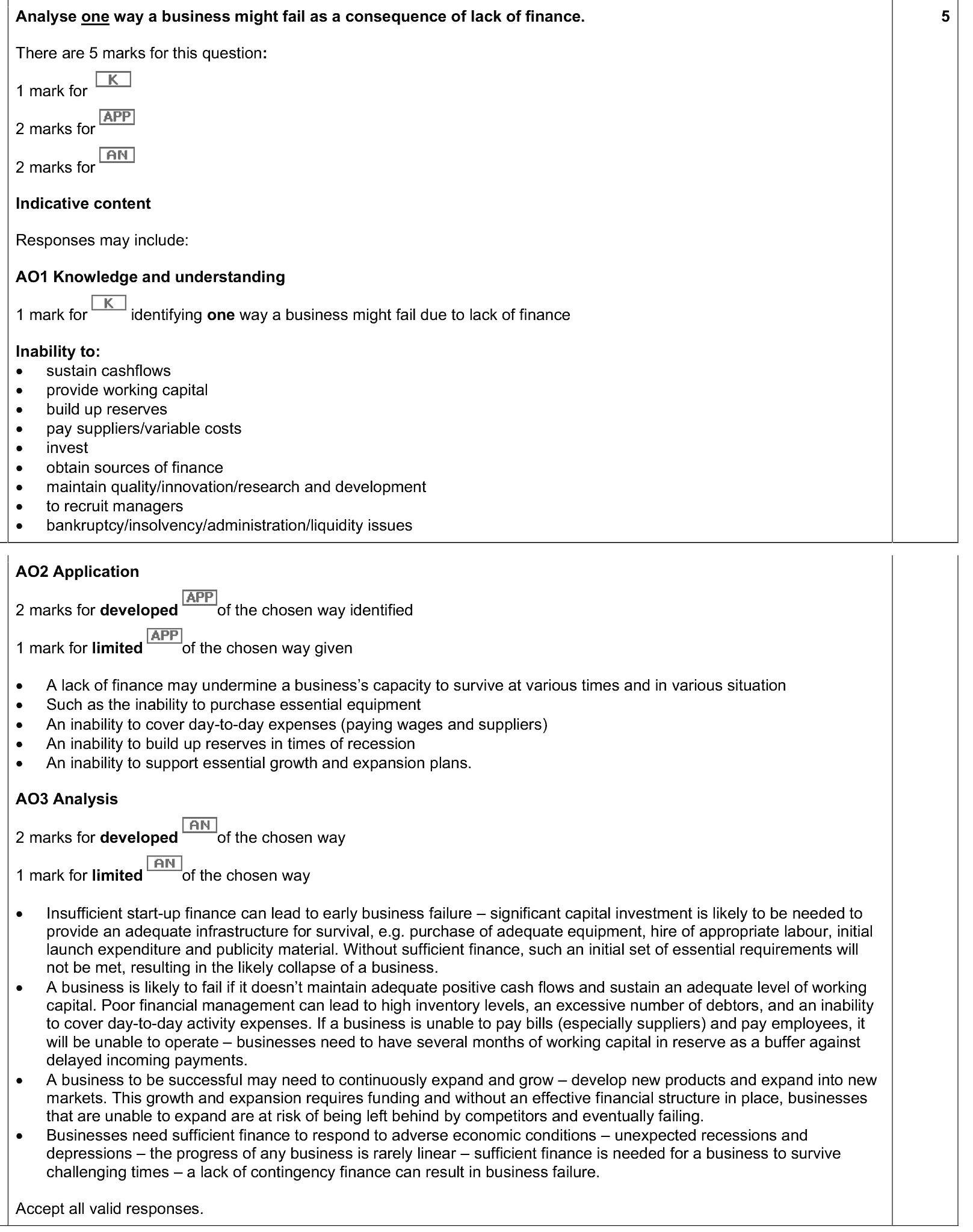
Analyse one way a business might fail as a consequence of lack of finance.
Analyse two advantages to a business of using sale and leaseback of non-current assets as a source of finance.

Zorba had always had a passion for flower arranging. When he was made redundant from his job as an engineer last year, he decided to use all of his savings to set up a flower shop called ZF. Although Zorba did not require any additional finance, he decided to write a business plan before setting up ZF. Table 2.1 shows an extract from his business plan, showing the 5 planned expenditure for ZF.

Zorba opened ZF at the start of January 2026. However, Zorba encountered a number of problems with Supply Chain Management during the first three months of ZF’s trading. 15 These included:
Refer to Table 2.1. Calculate Zorba’s capital expenditure when he set up ZF.
Refers to: images/cases/s26_22_p3_Table_2_1_Planned_expenditure_for_ZF.png

JT is owned by Jo as a sole trader business that provides school bus services to local public sector schools in city K. JT’s main customer is the local government. Established in 2015, JT is building a brand reputation as a safe and reliable transportation method for school children in city K. JT offers a range of services: 5

JT has 50 buses and 100 employees. Jo encourages employee participation at all levels of the business operation. Jo would like to implement customer relationship marketing (CRM) at JT, to improve 20 its relationship with the local government. To set up a CRM system will require $3m investment in computer systems, software and staff training. Jo believes that CRM could help JT become the leader in a very competitive school transport market.
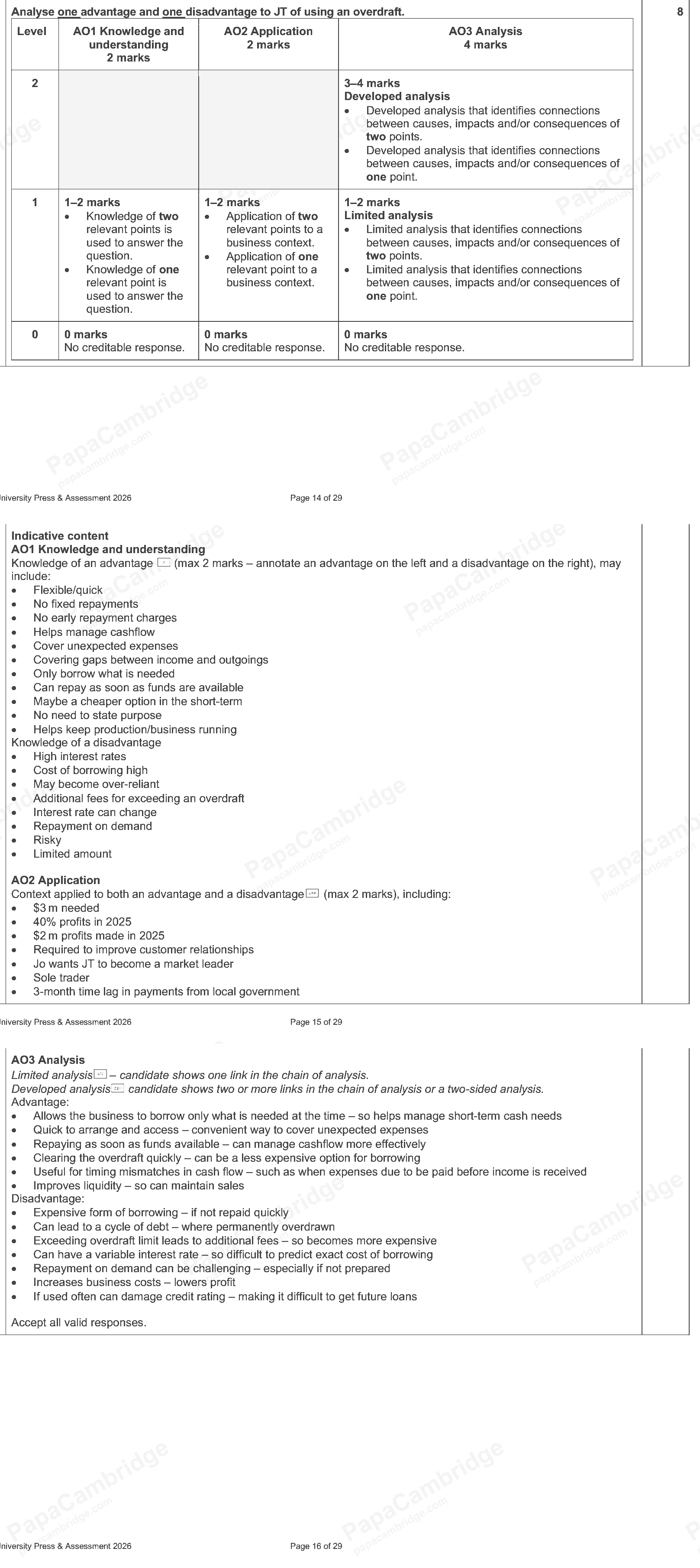
Analyse one advantage and one disadvantage to JT of using an overdraft.
SF is a private limited company that develops and maintains large-scale solar farms in
country X. SF operates as a capital intensive business.
Bob is an entrepreneur and the majority shareholder of SF. He invested into SF’s first solar
farm. SF took out high-interest bank loans to cover initial cash flow problems and provide
working capital. SF used internal (organic) growth over the next 10 years. 5
SF rents fields from farmers. Its main capital expenditure is solar panels, which are installed
on the rented fields. The solar panels generate electricity, which SF sells to energy providers.
Solar panel technology is constantly improving.
SF operates five solar farms in country X. A team of seven engineers maintain all of SF’s
solar farms. 10
Table 1.1 shows SF’s budgeted and actual data for 2024.

Bob has identified that SF can increase its revenue by using batteries to store electricity
generated by the solar panels. This electricity can then be sold at peak times for premium
prices. This will require significant investment into battery technology. 20
Bob wants to retain control of SF but is concerned about the investment required for further
growth. In 2024 the cost of renting new farmland and purchasing solar panels increased
significantly.
ZB is a multinational battery manufacturer that is keen to start a joint venture with SF. If the
joint venture goes ahead, ZB will insist that SF uses ZB batteries in all future solar farms. 25
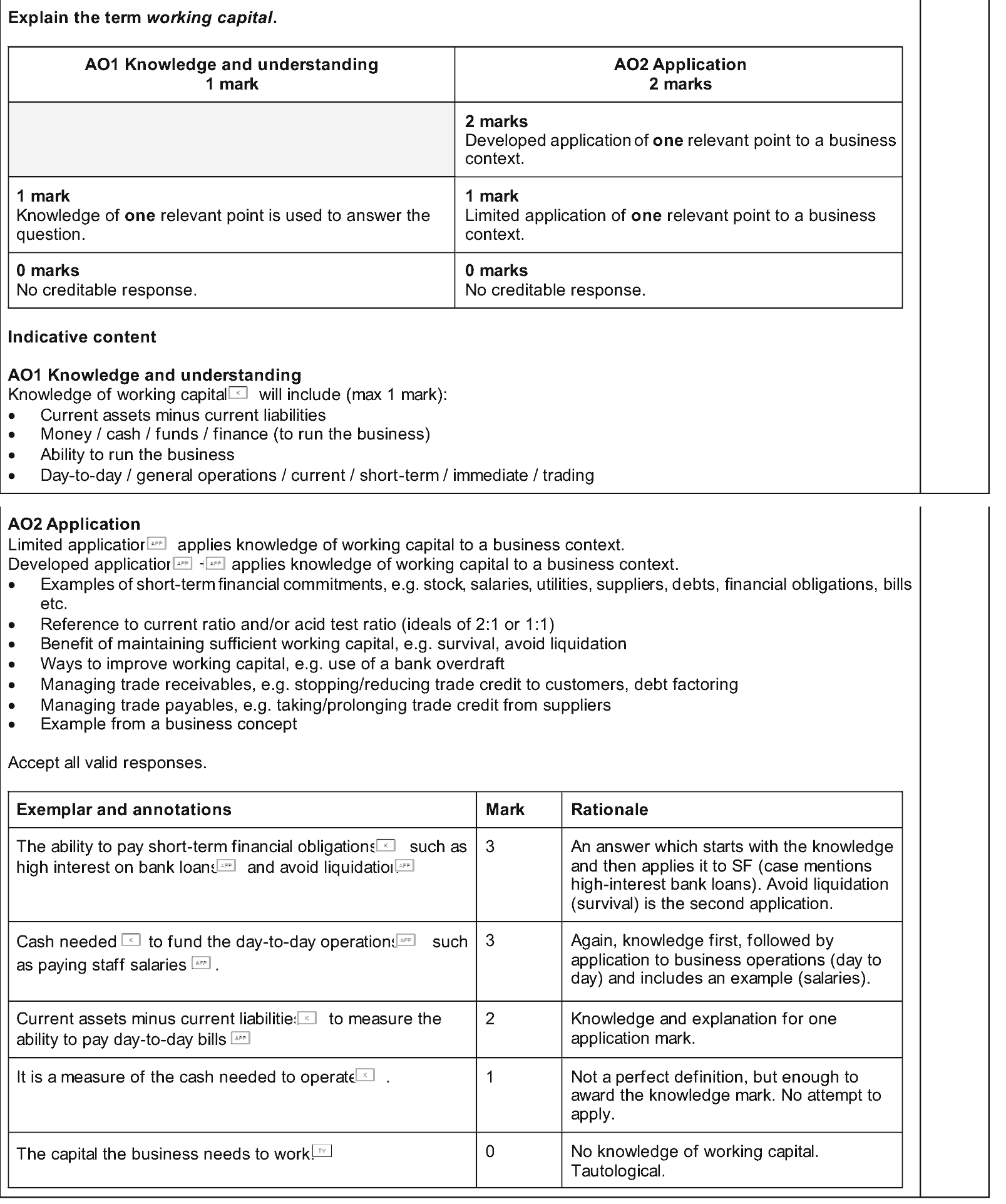
Explain the term working capital.
PH owns student rental accommodation in all the major cities in country Y. PH used demographic segmentation in its market research. This research identified that university students would pay a premium for high specification rental accommodation. PH has specialist teams focused on sales, maintenance, customer service and finance. There is little opportunity for internal promotion. PH pays low salaries, however, it offers 5 profit sharing to motivate its 150 employees. This has been effective as PH has had low labour turnover. In the last two years, profit levels have fallen by 75%. In 2024, 45 employees left PH. Complaints about maintenance and customer service have increased due to the lack of experienced employees in PH. 10 The Finance Director is reviewing PH’s existing sources of finance, shown in Fig 2.1. Bank loans 8% Owner’s Mortgage investment 42% 28% Overdrafts 22%

Frank, the Operations Director, wants to improve the sustainability of PH’s operations. He plans to:
Analyse one advantage and one disadvantage to PH of using an overdraft as a source of finance.

Kaia left university with a degree in textile design. Using her entrepreneurial qualities, Kaia set up PB as a sole trader. Her current objective is to break even. Kaia uses job production to make blankets which are personalised with a picture. Each customer logs into the PB website and chooses the size of blanket. The customer then uploads a picture that they want printed onto the blanket. 5 Many of Kaia’s customers buy the blankets as gifts for special occasions. Kaia has employed a social media influencer to promote her blankets. The influencer will be paid a salary of $250 a week and a 5% commission on revenue that comes directly from the influencer. Fig 2.1 shows the revenue that came directly from the social media influencer in February. 10 Revenue ($) Week 1 Week 2 Week 3 Week 4

Kaia would like to relocate PB to larger premises. She is applying for external sources of finance, and she has written a five-year business plan to support her applications.
Identify one external source of finance.

FF is a partnership in country Q that grows a range of fruits and vegetables, such as apples,
carrots and potatoes. FF also provides an advisory service to other farmers. The partnership
was established in 2018 by three friends, Amrit, Harry and Sally, who provided the working
capital. Their aim was to produce healthy and tasty food for themselves and others.
FF grows crops using natural methods and practices. The produce is free from chemicals 5
and pesticides. It only uses renewable energy sources, such as solar panels and wind
turbines. It harvests the crops by hand or using simple machines that minimise damage or
waste, but this is labour intensive.
FF sells its products directly to consumers through its own farm shop and online delivery
service. It also sells to local restaurants. Table 2.1 shows information on FF’s revenue and 10
costs in 2024.

FF has gained a loyal customer base who appreciate the quality, flavour and nutrition of its products. However, FF also faces some challenges and risks in the competitive and uncertain food market. FF has limited capacity in producing crops. Weather conditions affect its yield and quality. It also must deal with pests, diseases and natural disasters that could 20 damage or destroy its crops. Another challenge that FF faces is the high level of demand for its products in the market. The partnership must meet the expectations and requirements of its customers who want fresh, varied and consistent products throughout the year.
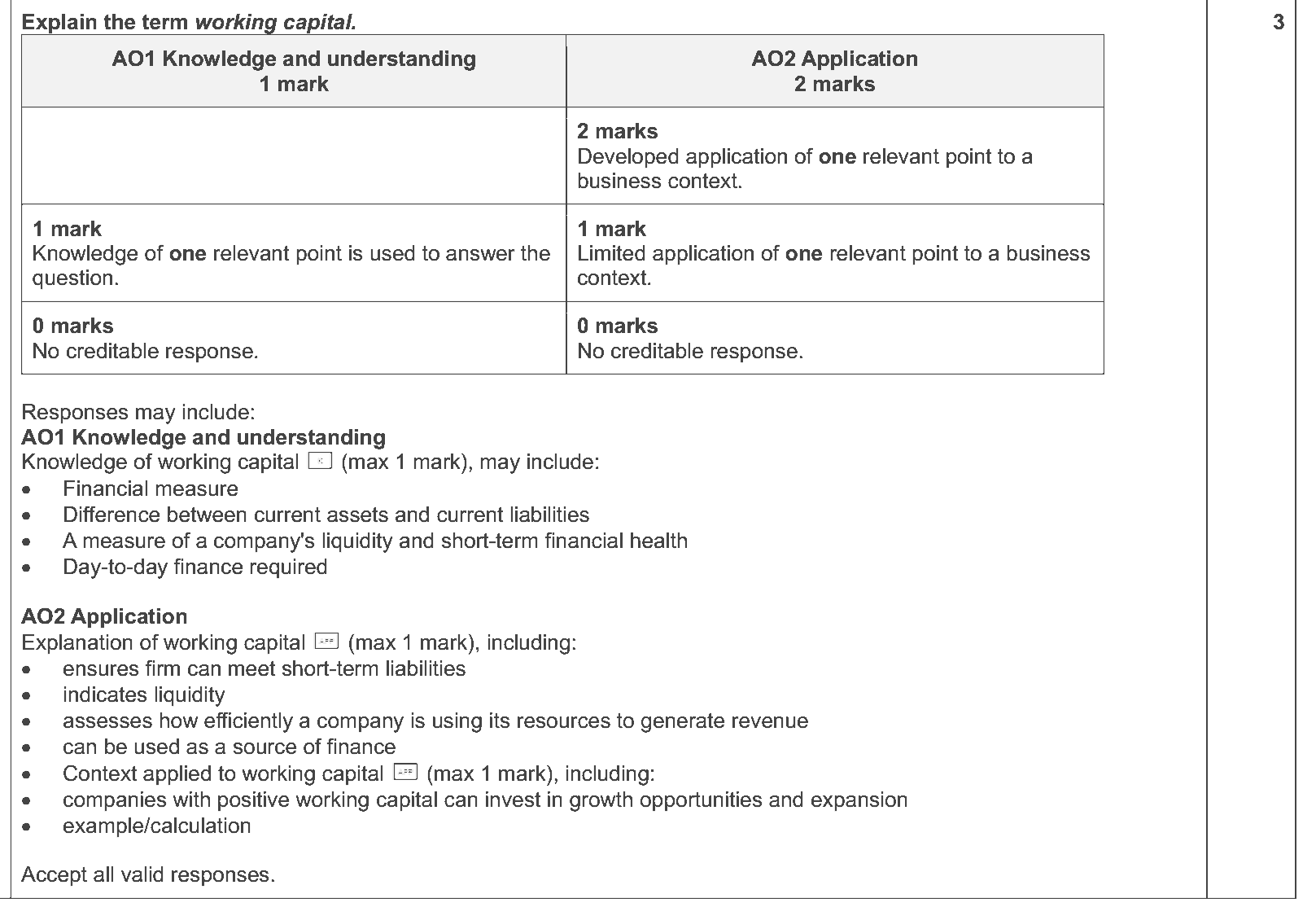
Explain the term working capital.
🔒 Unlock every Business finance question from 2020–2024
All 59 come with their mark schemes, answers and case studies, and appear in the practice tool above once you’re signed in. It’s free.
Questions and mark schemes are from past Cambridge papers and are reproduced for revision. Topical Vault is an independent revision resource, not affiliated with or endorsed by Cambridge Assessment International Education.
Each topic opens this practice tool with only that topic’s questions, plus how often it comes up and every question on it in one list. Revision notes for AS Level Business → Full AS Level Business past papers →